
Matter is the smart-home standard that everyone has quietly been waiting for since roughly 2017, and the standard that everyone — including the companies that made it — keeps explaining badly. If you've read five articles about Matter and still aren't sure whether it replaces Wi-Fi, or Thread, or...
Matter is the smart-home standard that everyone has quietly been waiting for since roughly 2017, and the standard that everyone — including the companies that made it — keeps explaining badly. If you've read five articles about Matter and still aren't sure whether it replaces Wi-Fi, or Thread, or HomeKit, or Alexa, or Zigbee, or any of those — the confusion is not your fault. The industry has been shipping features faster than it can describe them, and "Matter works everywhere" has done more damage to comprehension than good.
This article isn't a hands-on review. It's an editorial primer on what Matter actually is in 2026, what it actually changes in a real home, what it still doesn't fix, and how to evaluate a "Matter" product in the store. We'll use the SwitchBot Hub Mini (Matter) as the worked example throughout, because it's one of the cleanest ways to see what a Matter "bridge" does in practice — and reference a few other products already covered on Celmin along the way. By the end you'll have a durable mental model that survives the next six marketing cycles.
The 60-second version
| Question | Honest answer |
|---|---|
| What is Matter? | A networking + device standard that lets smart-home products from different brands talk to each other through your hubs (Apple, Google, Amazon, Samsung) without separate apps. |
| Does it replace Wi-Fi? | No. Matter runs on top of Wi-Fi (for mains-powered devices) and Thread (for battery-powered devices). |
| Does it replace HomeKit, Alexa, Google? | No. They still exist. Matter makes them cooperate, not compete. |
| Does it replace Zigbee? | Sort of. Existing Zigbee devices usually need a bridge (like SwitchBot Hub Mini) to become Matter-visible; new devices increasingly ship Thread/Matter natively. |
| Will my old gadgets work with Matter? | Only if (a) the manufacturer added Matter via firmware, or (b) you run them through a bridge that translates Zigbee/Bluetooth/proprietary into Matter. |
| Is it ready in 2026? | Mostly yes. Stable for lights, plugs, locks, thermostats, sensors. Still maturing for cameras, video doorbells, robot vacuums. |
Pro tip: The honest benefit of Matter isn't "everything works." It's one fewer app per brand. A home with Matter fully set up opens Apple Home (or Google Home) and controls devices from six brands from one screen. That's a small real win, not a revolution.
What Matter actually is — a structural definition
Matter is an application-layer protocol agreed on in 2022 by the Connectivity Standards Alliance (formerly the Zigbee Alliance), with Apple, Google, Amazon, and Samsung as founding members. That's four sentences of technical language, so let's translate each piece.
Application-layer protocol means Matter defines what devices say to each other — "turn on," "I am a lightbulb," "my temperature is 21°C" — regardless of how the bits travel. It's the vocabulary, not the road.
The CSA standard matters because before Matter, every major player had their own "vocabulary" (HomeKit's ADK, Google's Weave, Amazon's own mesh dialect). Devices had to learn three or four dialects, and manufacturers had to pay three or four certification fees. Matter unified the dialect. That's the actual useful thing.
Runs over Wi-Fi, Thread, and Ethernet. Matter doesn't define radio waves. It uses whichever radios your device has:
- Wi-Fi for always-powered devices (light bulbs in a socket, plugs, thermostats, TVs).
- Thread — a low-power mesh radio built specifically for battery devices (door sensors, locks, leak detectors, window contacts). Thread is the physical-layer hero of Matter; it's what makes a Matter door sensor last 3 years on a coin-cell battery when a Wi-Fi sensor would last 3 weeks.
- Ethernet for wired devices (hubs, switches).
Bluetooth LE is used during initial setup (the scan-the-QR-code step) and then stops mattering.
None of this is Matter "replacing" your Wi-Fi. Your Wi-Fi keeps doing its job. Matter just defines what the smart bulb on your Wi-Fi says to your Google Home speaker on the same Wi-Fi.
The three roles in a Matter home
Once you understand the three roles, the rest of the Matter story makes sense.
1. Matter devices. The end things — bulbs, plugs, locks, sensors, thermostats. Each one advertises itself as a specific Matter "device type" ("Matter smart bulb," "Matter door lock," "Matter plug"). A product earns the Matter logo by implementing its device type's standard correctly.
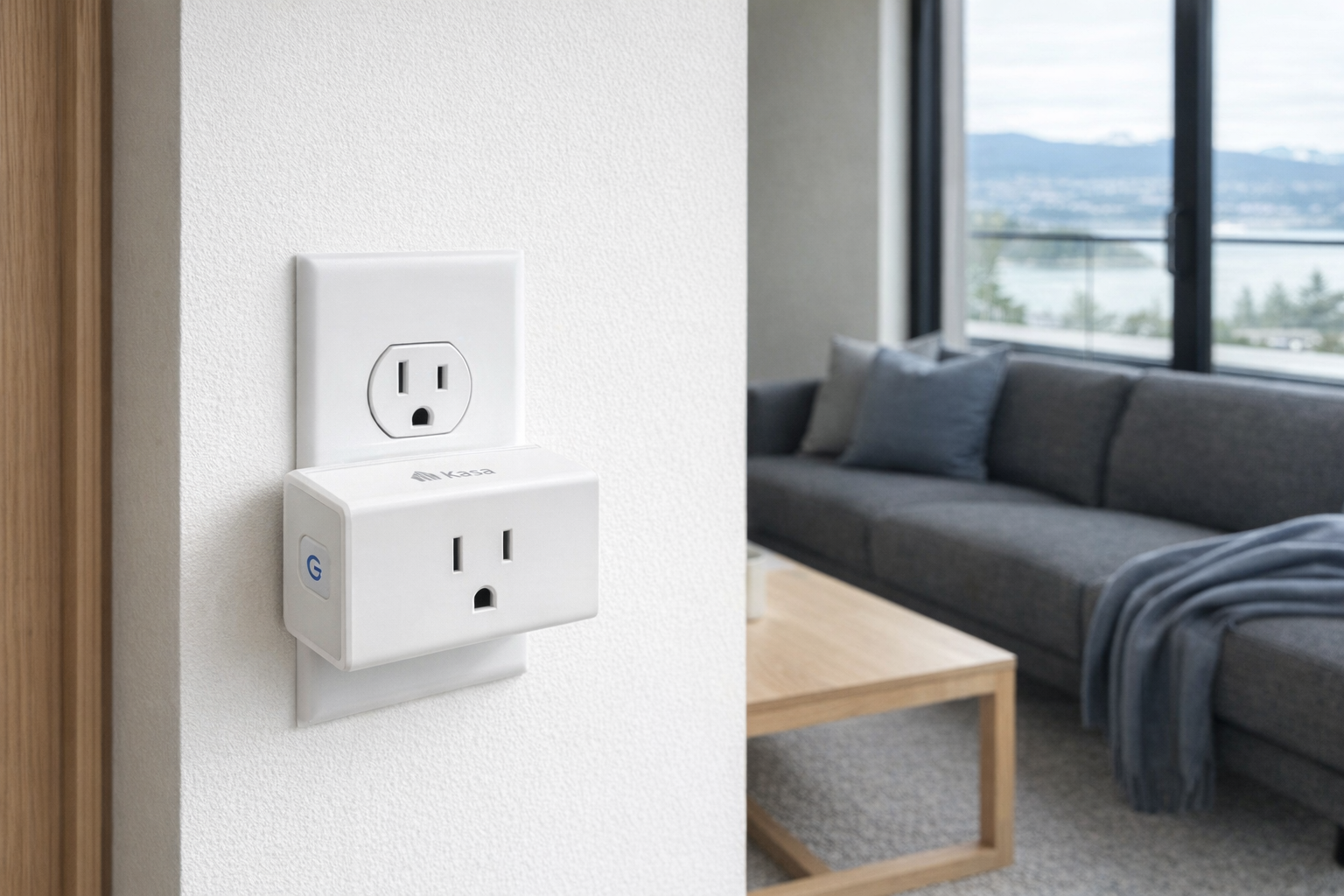
2. Matter controllers. Hubs and apps that talk to Matter devices. In a typical home these are Apple Home, Google Home, Amazon Alexa, or Samsung SmartThings — and in 2026, all of them. One device can be "commissioned" to multiple controllers at the same time. Your Kasa Matter plug can respond to Alexa and Apple Home simultaneously without conflict.
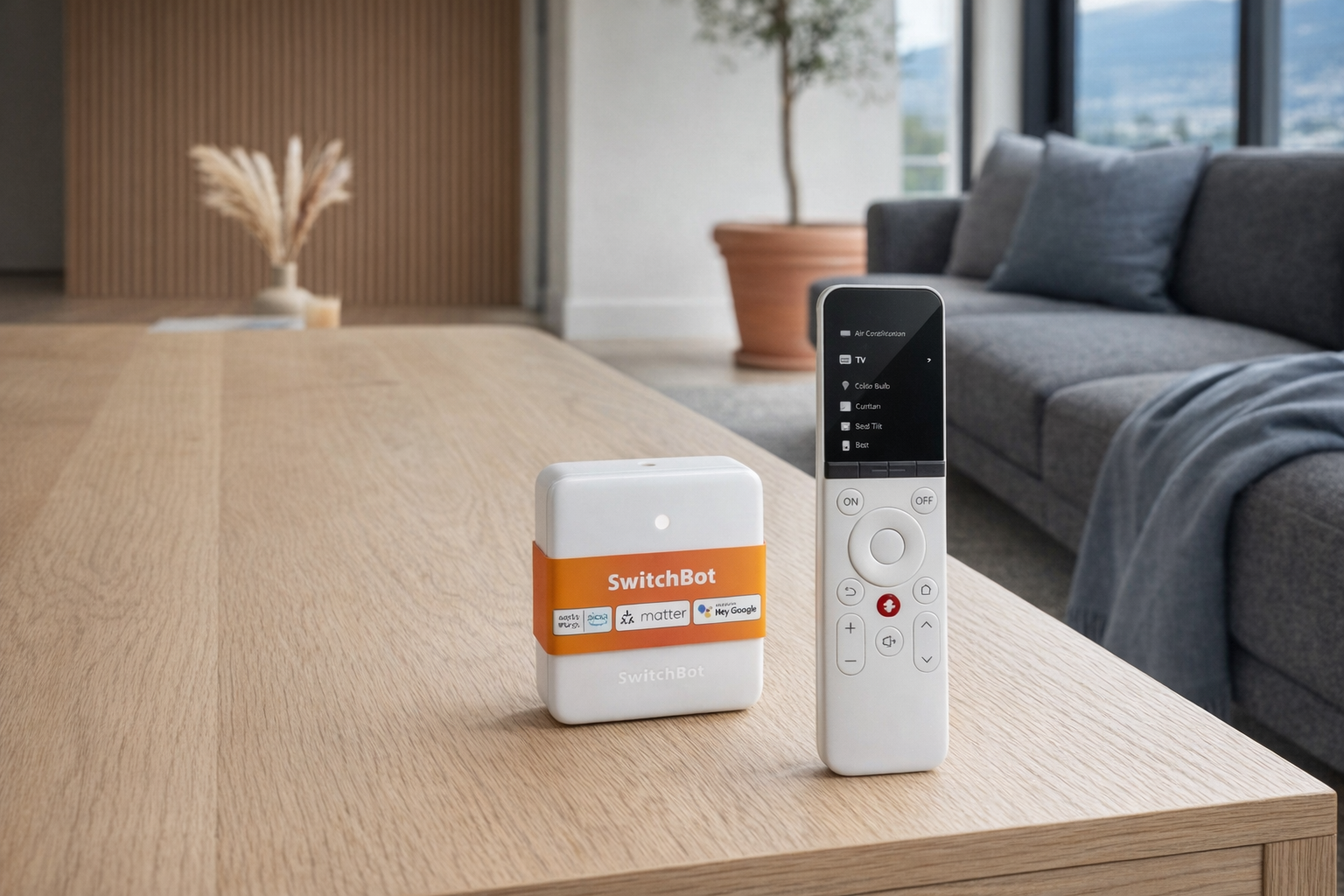
3. Matter bridges. Pieces of hardware that translate non-Matter devices (usually older Zigbee or proprietary protocols) into Matter. The SwitchBot Hub Mini (Matter) is a bridge: it speaks Bluetooth LE to SwitchBot's own devices (the Blind Tilt, the Lock Ultra, the original Bot button-presser) and re-presents them as Matter devices to whatever controller you use. You see SwitchBot products in Apple Home as if they were native Matter, even though they aren't.
The worked example: SwitchBot Hub Mini (Matter)
At about $125 CAD, the SwitchBot Hub Mini (Matter) is the product to study if you want to see what a Matter bridge actually does. It's a small puck (~65mm across, ~20mm tall) that sits on a shelf, runs on USB-C power, connects to your Wi-Fi, and exposes up to 20 SwitchBot devices as Matter-compatible endpoints in whichever hub you run.
What it bridges, and how. SwitchBot's own product line uses Bluetooth LE between the hub and each device. That's a short-range protocol, which is why SwitchBot recommends one Hub Mini per floor or per ~40m² area. The Hub Mini listens to your voice-command or scheduled trigger from Apple Home / Google Home / Alexa, translates it into SwitchBot BLE commands, and sends them to the Blind Tilt on your window or the Lock Ultra on your door.
What it does not bridge. Only SwitchBot-branded devices. Hub Mini is not a universal Zigbee/Z-Wave hub (the SwitchBot Hub 2 has more radios, as does SmartThings). If you have a Philips Hue light, don't buy this to bridge it — buy the actual Hue bridge. If you have a mix of Zigbee and Matter devices, the right hub is probably Amazon Echo Hub, Google Nest Hub Max, or SmartThings Station.
Why it matters for Canadian renters specifically. Because SwitchBot's most useful renter-friendly products — the Blind Tilt and the Lock Ultra — are Bluetooth-only by default. Without the hub, you'd control them only when your phone is in BLE range, and they'd only show up in the SwitchBot app. With the Hub Mini, they become first-class citizens of Apple Home or Google Home, schedulable like any other bulb. That bridging is the whole reason to own this product.
The 3.1/5 rating on the source listing is worth addressing directly. Early reviews reflect real bugs from the first six months of SwitchBot's Matter rollout — commissioning failures, devices dropping off, slow state sync. Most of those have been resolved through firmware updates through 2025 and into 2026, and current reviews trend much more positive. That said, this is still a newer Matter bridge than the incumbents (Apple's own Matter support, Google's Nest Hub Max), so expect occasional re-commissioning if you restart the hub.
What Matter genuinely fixes
In plain terms, four real improvements, one per layer of the stack.
- One app for daily control. You open Apple Home, and the list includes SwitchBot devices, Nanoleaf panels, Aqara sensors, a Govee backlight, a Kasa Matter outdoor plug, and an Ecobee thermostat. Previously, that list lived in six apps. Now it's one.
- Cross-brand automation. "When the Aqara door sensor opens, turn on the Govee TV backlight" — a scene that used to require IFTTT, webhooks, or a dedicated hub — now runs natively in Apple Home or Google Home because both devices speak Matter.
- Multi-admin control. One lock, multiple controllers at the same time. The same Matter deadbolt can be controlled from Apple Home (for the family), SmartThings (for the Samsung user in the household), and Alexa (for the kids' voice commands). Previously, devices could only be "owned" by one ecosystem.
- Local control — mostly. Matter encourages local control (controller talks directly to device on your LAN) rather than cloud routing (controller → internet → manufacturer cloud → back to device). This is faster, more private, and keeps working when the internet is down. Not every device implements local control fully, and the marketing is louder than the reality — but the infrastructure is there.
What Matter still doesn't fix
Being honest about this matters more than the marketing admits.
- Cameras and video doorbells. The Matter 1.4 spec added camera support, but as of 2026 real-world camera interoperability is still rough. A Ring doorbell doesn't show its live view in Apple Home yet. An Arlo camera still needs its own app. If you expected "buy any Matter camera, watch it in Apple Home," you'll be disappointed for another year or two. For now, cameras are still an ecosystem decision (Ring = Alexa, Logitech Circle View = HomeKit, Nest = Google) more than a Matter decision.
- Robot vacuums. Same story. A Matter vacuum spec exists. Few robot vacuums fully ship it. Roborock, Dreame, iRobot have added partial support but their full feature sets (maps, no-go zones, room-by-room cleaning) still live in their proprietary apps. Do not buy a robot vacuum expecting full-feature Matter control this year.
- Matter doesn't make devices cheaper. A Matter-certified bulb is not meaningfully cheaper than a non-Matter equivalent. Matter is about interoperability, not price. Don't wait for a "Matter price drop" that isn't coming.
- Matter doesn't replace the manufacturer app. The SwitchBot app still exists, and firmware updates, device-specific calibration, and advanced features usually live there. Matter gives you universal basic control across ecosystems — not feature parity. Plan on running 2–3 manufacturer apps for setup and updates, and using Apple/Google/Alexa for daily control.
- Older non-Matter devices still need their old hubs. Your 2019 Philips Hue bridge isn't suddenly obsolete; it bridges Hue bulbs into Matter. Your older Aqara hub still handles Aqara-branded sensors. Matter doesn't magically Matter-ify old products — bridges exist for a reason.
Real products already on Celmin that are Matter-ready
These are products from our catalog that ship Matter support today, and how each fits into a Matter home.
- SwitchBot Hub Mini (Matter) — the bridge for SwitchBot-branded devices.
- Kasa Matter Smart Outdoor Plug — native Matter, works with Apple Home / Google Home / Alexa / SmartThings straight out of the box. One of the cleanest first-Matter-purchase examples under $30.
- Ecobee Smart Thermostat Enhanced — native Matter (added via firmware in 2024), also supports HomeKit, Alexa, Google, SmartThings.
- Echo Dot 5th Gen — acts as a Matter controller and a Thread border router. Dropping one in the house gives you voice control over your Matter devices.
- HomePod Mini — Apple's Matter controller and Thread border router. If you're HomeKit-first, this is the cheapest way to add Matter + Thread capability to the house.
You'll notice an absence on this list: the Google Nest Smart Thermostat covered elsewhere in the Celmin catalog doesn't currently support Matter. Google's flagship products have been slower to adopt Matter than their own marketing admits. If Matter support matters to you, the Ecobee is the honest pick between the two — see the full Nest vs Ecobee comparison for more.
How to read a "Matter" product listing in the store
In 2026, almost every smart-home product listing mentions Matter somewhere. Four of those mentions mean genuinely different things. Train yourself to see the difference.
- "Matter over Wi-Fi" — the device is a Matter-certified Wi-Fi device. Works out of the box with any Matter controller. Usually the simplest case. Example: the Kasa Matter Outdoor Plug.
- "Matter over Thread" — battery-powered device using Thread as the radio. Requires at least one Thread border router in the house (a HomePod Mini, an Echo Dot with Thread, a Nest Hub Max, or a dedicated Thread router) or it can't actually reach Matter. Read this carefully before you buy.
- "Matter-ready" or "Matter-enabled (coming soon)" — the device will get Matter through a firmware update, but doesn't have it yet. Translation: "not Matter today." Don't pay a premium for this until the update lands.
- "Works with Matter via bridge" — the device itself isn't Matter. A separate hub from the same brand bridges it. That's what the SwitchBot Hub Mini does for SwitchBot devices. Completely legitimate, but you need to budget the hub in your purchase.
The three questions worth asking before buying Matter today
- Do you already have a Matter controller in the house? A HomePod Mini, Echo Dot with Thread, Nest Hub Max, or SmartThings Station. If no, buy one first — a Matter device without a controller is just a regular smart device.
- Is your house Thread-capable? If you're buying Matter-over-Thread products (sensors, locks, battery switches), at least one of your controllers must be a Thread border router. HomePod Mini, Echo Dot (4th gen and later with Thread chip), and Nest Hub Max all are. Check yours before buying a Thread device.
- Are you future-proofing, or are you solving a real problem? If you have one brand of devices and are happy in one ecosystem, Matter isn't urgent. If you have three or more brands or a mixed-household (iPhone user + Alexa user in the same home), Matter genuinely simplifies life. Otherwise, it's a nice-to-have.
Got Questions About Matter? Let's Clear Things Up.
Is this a hands-on review?
No. This is an editorial primer on Matter as a standard, using the SwitchBot Hub Mini and a few other Celmin-catalog products as real examples. It's designed to give you a durable mental model, not to replace testing each device in your own home.
Does Matter replace Alexa, Google Home, or Apple Home?
No. Those are still the apps and voice assistants. Matter is the standard that lets devices talk to all three at once. You'll still say "Alexa, turn off the living room light." Matter just means the light can be a Kasa, a Hue, or a Nanoleaf, and Alexa treats them all the same.
Does Matter replace Wi-Fi?
No. Matter devices run on top of your existing Wi-Fi (for mains-powered gear) or Thread (for battery gear). If your home Wi-Fi is weak, Matter doesn't fix that. If anything, a strong Wi-Fi 6 router with coverage in every room is more important in a Matter home than it used to be, because more devices depend on it.
Do I need a new hub to use Matter?
Sometimes. You need at least one Matter controller in the house. If you already own an Apple HomePod Mini, Echo Dot (4th gen or later), Nest Hub (2nd gen), SmartThings Station, or Apple TV 4K (2021+), you already have one — Matter support was added via firmware. If you don't, the cheapest entry is the Echo Dot 5th Gen at ~$47 CAD.
Is Thread better than Zigbee?
Functionally similar — both are low-power mesh radios built for battery devices. Thread is newer, IP-based, and integrates directly with Matter, so newer products prefer it. Zigbee still works fine and is widely deployed (Hue, Aqara, IKEA Tradfri), but it needs a bridge to participate in Matter. For new purchases in 2026, bias toward Thread + Matter products.
What does Matter cost?
Matter itself costs nothing. The savings vary: some Matter products are modestly cheaper than pre-Matter equivalents (hubs are simpler), but most are the same price. What Matter saves you is the second and third hub you used to need. A household that would have bought a Philips Hue hub + Aqara hub + SmartThings hub + their chosen voice platform can now often get away with one of those hubs + a Matter-capable speaker. That's maybe $80–$150 saved over five years.
Should I delay smart-home purchases until Matter matures further?
For most categories, no. Bulbs, plugs, thermostats, and locks are Matter-stable today. The categories worth waiting on are cameras and robot vacuums, where Matter support is real but functionally incomplete. For those two, buy within the ecosystem you actually use (Ring if Alexa-first, Logitech if HomeKit-first) and revisit Matter in 2027.
Where should I go next if I want to actually build a Matter-centric home?
Start here: The Renter's Smart Home: No Drilling, No Landlord Drama walks through an 8-product Matter-compatible kit under $300, and Nest vs Ecobee in Canada covers the thermostat decision with Matter readiness in mind. For the bridge itself, the SwitchBot Hub Mini setup guide walks through commissioning the hub into Apple Home or Google Home.
If you're sorting out what's real and what's marketing in the smart-home industry — especially in Canada — Celmin covers the full catalog without the hype. More explainers, comparisons, and buyer guides at https://celmin.ca.
Discussion
Sign up or sign in to join the conversation.