
If you're buying a smart thermostat in Canada in 2026, two products are doing 90% of the selling and almost all of the installing: the Google Nest Smart Thermostat and the Ecobee Smart Thermostat Enhanced. Everything else — Honeywell T-series, Amazon's own Alexa thermostat, the Mysa for b...
If you're buying a smart thermostat in Canada in 2026, two products are doing 90% of the selling and almost all of the installing: the Google Nest Smart Thermostat and the Ecobee Smart Thermostat Enhanced. Everything else — Honeywell T-series, Amazon's own Alexa thermostat, the Mysa for baseboard heat — is either a special case, a rebrand, or a rounding error in this market. The real decision, for most Canadian homes, is one of these two.
This article isn't a hands-on review. Nothing here is based on installing both units in the same house and timing them. Instead, it's an editorial comparison of what each thermostat actually does differently in 2026, what changes when you live in a Canadian winter, which utility rebates apply, and who each one genuinely fits. By the end you should know which one to buy — or whether you should skip both and keep your existing dumb thermostat — in about fifteen minutes.
At a glance
| Google Nest Smart Thermostat | Ecobee Smart Thermostat Enhanced | |
|---|---|---|
| Price (CAD) | ~$83 | ~$236 |
| Rating signal | 4/5 on the source listing | 4.4/5 on the source listing |
| Made by | Google (Honeywell Home tech) | ecobee (Canadian — Toronto HQ) |
| Remote room sensors | Not supported on this model | Supported (sold separately) |
| Ecosystem | Works with Alexa, Google Home | Works with Alexa, Google, HomeKit, Matter |
| Schedule learning | Preset modes (home/away/sleep) | Adaptive scheduling & Eco+ algorithms |
| Install | Guided DIY via Alexa app | Guided DIY via Ecobee app (C-wire or included PEK) |
| Best for | Budget-first owners on Google or Alexa stacks | HomeKit households, multi-zone homes, anyone wanting Matter today |
| Skip if | You want HomeKit, remote sensors, or deep scheduling | You're on a strict budget and don't need the extras |
Pro tip: The thermostat is the cheap part of this decision. The expensive part is the C-wire situation in your furnace closet. Confirm that before you buy either one — it's the thing most people learn about two hours into install, not before.
What each one actually is
The Google Nest Smart Thermostat at roughly $83 CAD is Google's budget-tier smart thermostat — not to be confused with the older Nest Learning Thermostat (the $250 puck with the dial). This is the simpler, Alexa-compatible unit built with Honeywell Home technology, ENERGY STAR certified, and marketed around ~$50/year in claimed energy savings (Google's number, not a tested one). It supports home / away / sleep presets, guided DIY installation via the Alexa app, and basic scheduling. It's not the premium learning thermostat — it's the Nest that most Canadians are actually buying because it's under $100.
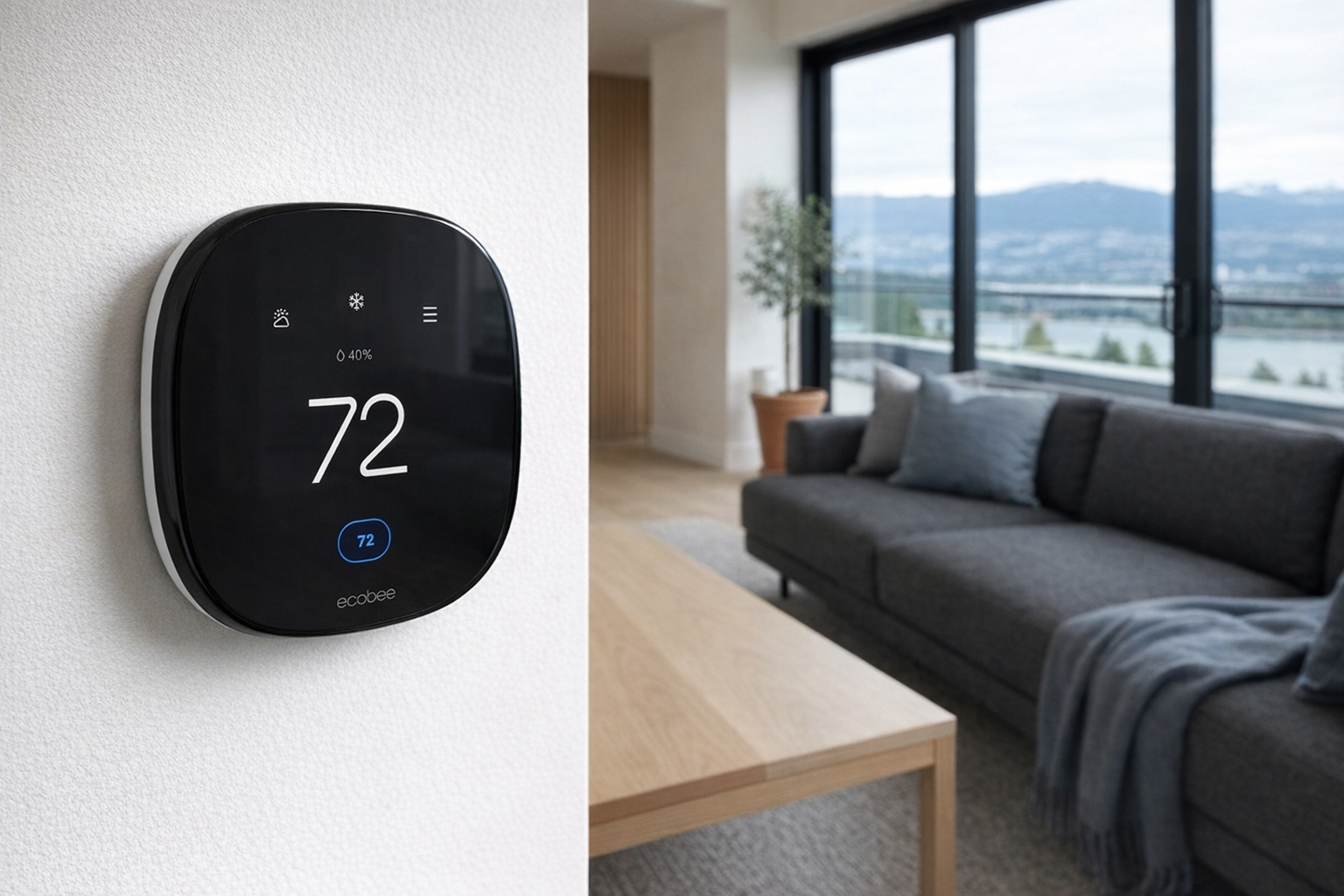
The Ecobee Smart Thermostat Enhanced at roughly $236 CAD is Ecobee's 2024–2026 flagship replacement for the Enhanced line. It's designed and built by Ecobee — a Toronto-headquartered Canadian company — and works with Alexa, Google, Apple HomeKit, SmartThings, and Matter out of the box. It supports remote room sensors (sold separately) so the thermostat reads temperature where people actually are, not just at the hallway where the thermostat sits. The Eco+ algorithm learns your HVAC's heat-up and cool-down curves and pre-runs the system based on weather, occupancy, and time-of-use electricity pricing.
The fundamental difference: Nest is a good thermostat. Ecobee is a good thermostat and a smarter-home hub.
The eight battlegrounds
1. Ecosystem compatibility — the one that eliminates half the buyers
This is the decision that preempts all the others. If you use Apple HomeKit, buy the Ecobee. Nest (the cheap one) doesn't support HomeKit at all. Google is never going to add HomeKit support to a Google product competing with Google Home. If your phone is an iPhone and you're already running Home app automations for locks, lights, or shades, the Ecobee is the only sensible answer.
If you're on Google Home or Alexa exclusively, either works — but the Ecobee also works on those, plus HomeKit, plus Matter, plus SmartThings. So "what ecosystem am I in today" is the wrong question. The right question is: "what ecosystem might I add in three years?" If the answer is "anything," Ecobee is the safer choice. If the answer is "definitely only Alexa or Google," Nest is cheaper and fine.
2. Remote room sensors — the thing that makes multi-floor houses work
The single biggest real-world comfort upgrade in smart thermostats isn't AI, it's remote room sensors: small battery-powered pucks placed in bedrooms, offices, and nurseries that feed temperature and motion back to the thermostat. Ecobee supports them as an add-on and uses them to average the temperature across occupied rooms, not just the one the thermostat is nailed to. The Nest Smart Thermostat does not support this.
This matters more than it sounds in Canadian two-storey houses. The classic complaint — "the upstairs is always 4°C warmer than the main floor" — is solved by sensors, not by AI. If you have a multi-floor home, a baby's room that stays cold, or a home office over a garage, you need the Ecobee. Spend the $236.
3. Schedule learning — AI marketing vs actual algorithms
Both thermostats do some form of "learning," but they're learning different things.
Nest Smart Thermostat uses preset modes (home, away, sleep) and lets you schedule temperature changes manually. The learning is relatively light — it's not the old Learning Thermostat's full adaptive schedule. Claim-to-reality ratio here: mostly fine, not magical.
Ecobee's Eco+ is a genuinely more sophisticated algorithm. It learns your HVAC system's ramp time (how long it takes to raise the house by 1°C), integrates local weather forecasts, and pre-runs the system to hit target temperatures at your preferred times — rather than starting at the target and playing catch-up. It also uses time-of-use electricity pricing in Ontario, Quebec, and British Columbia to pre-heat or pre-cool during off-peak rates. That's real software engineering, and it's where the $150 price gap starts earning its keep if you have a TOU plan.
4. Install and the C-wire reality
Both manufacturers claim DIY install in 20–30 minutes, and both are telling the truth — if you have a C-wire (common wire) running to your existing thermostat. The C-wire provides continuous 24V power to the smart thermostat; without it, smart features can't run reliably.
- Nest Smart Thermostat recommends a C-wire but works on most 24V HVAC systems. If you don't have a C-wire and your system is simple enough, it may work with reduced functionality, but Google officially recommends getting one installed.
- Ecobee ships with a Power Extender Kit (PEK) that lets you work around a missing C-wire by installing a small board inside the furnace — adds 15 minutes to the install if you're comfortable with low-voltage wiring, a call to an HVAC tech if you're not.
The practical advice: before you buy either, open your current thermostat, photograph the wires, and check for a "C" terminal with a wire in it. If yes, either thermostat installs easily. If no, the Ecobee has a cleaner out-of-the-box fix. The Nest will probably work but with more fiddling.
5. Canadian utility rebates — where the price gap narrows
This is the most under-discussed factor in the Nest vs Ecobee comparison. Canadian provincial utility rebates for ENERGY STAR smart thermostats often cover $75–$125 of the purchase price — and availability is province-specific, not uniform.
As of the most recent program updates, rebates have been offered through Enbridge (Ontario), SaveONenergy, Energir (Quebec), BC Hydro's Power Smart, Efficiency Manitoba, and Efficiency Nova Scotia. Both Nest and Ecobee are typically eligible — verify current rebate eligibility with your specific utility before buying, because the qualifying models rotate.
Worth noting: the Ecobee Enhanced, after a $100 rebate, effectively lands around $136 — narrowing the gap with the un-rebated Nest to roughly $50. Once you're there, the Ecobee's extra features almost certainly justify the remaining spread. Always check rebate status before comparing list prices.
6. Energy savings — read the claims carefully
Google's listing for the Nest Smart Thermostat advertises "average savings of about $50/year." Ecobee historically cites ~23% on heating and cooling. Both numbers are drawn from manufacturer testing, not independent measurement, and your results depend mostly on your house's insulation and your current schedule habits, not on which thermostat you bought.
The honest version: a smart thermostat will save you money if your current habit is "leave it at 21°C all day whether anyone's home or not." If you already set it back manually when you leave or sleep, the energy savings from upgrading are marginal — the value is in convenience, not the electricity bill.
7. App UX and long-term software support
Nest is operated through Google Home, which has had a choppy few years — app rewrites, feature removal, some lingering bugs after the Nest app was sunset. It works, but it doesn't feel as polished as the Ecobee app.
Ecobee runs its own app, which has been iterated on continuously for a decade. It's denser and slightly more technical-looking than Google Home, but it exposes the Eco+ settings, sensor-by-sensor temperature data, and HVAC runtime statistics that Nest doesn't surface. For people who want to actually see what their thermostat is doing, Ecobee is the better piece of software. For people who want "set it and forget it," either works.
A longer-term concern: Google has a documented track record of deprecating products (Nest Secure, Dropcam, Works with Nest API, Nest Learning Thermostat in Europe in late 2025). Ecobee, as a focused independent Canadian company now owned by Generac, has a narrower product line and less history of killing products. If "will this still be supported in five years" matters to you, Ecobee is the lower-risk bet.
8. Five-year total cost, not list price
The comparison most people skip. Over five years, a $236 Ecobee with one added room sensor ($50) lands around $286 all-in. A $83 Nest with no sensor support lands at $83. The $200 delta is real — but you're comparing a single-sensor thermostat to a multi-sensor, multi-ecosystem one. If you never cared about remote sensors, multi-room comfort, or HomeKit, that $200 stays in your pocket and the Nest was always the right answer.
The three questions that actually decide this
Everything above reduces to three questions. Answer them honestly and the decision is basically made.
- Do you use Apple HomeKit or plan to? Yes → Ecobee, done. No → continue.
- Does your house have hot/cold spots between floors or rooms? Yes → Ecobee (you need the remote sensors). No → continue.
- Is a $150 price difference meaningful to your budget right now? Yes → Nest. No → Ecobee — the extra Matter/Eco+/longevity headroom is worth it even if you don't use it on day one.
The verdict, by household
| If this sounds like you... | ...buy this |
|---|---|
| Single-level condo or small apartment, Google/Alexa only, tight budget | Nest Smart Thermostat (~$83) |
| iPhone household, HomeKit user | Ecobee Smart Thermostat Enhanced (~$236) |
| Two-storey house with temperature imbalance between floors | Ecobee + 1–2 room sensors |
| Renter who might move in 12 months | Nest — cheaper to leave behind or resell |
| You want to be Matter-ready today | Ecobee — Matter is built in, not retrofitted |
| Time-of-use electricity customer (Ontario, Quebec, BC) | Ecobee — Eco+ uses TOU pricing actively |
| You already hate thermostat apps and just want a schedule | Honestly — keep your current one. Smart thermostats only shine if you use them. |
Got Questions About Nest vs Ecobee in Canada? Let's Clear Things Up.
Is this a hands-on review?
No. This is an editorial comparison based on the current spec sheets, ecosystem documentation, and publicly available behaviour of both thermostats. It's designed to help you decide which one fits your house, not to replace side-by-side testing.
Is the Nest Smart Thermostat the same as the old Nest Learning Thermostat?
No — and this is one of the most common buying mistakes. The Nest Learning Thermostat (the round puck with the dial, ~$300 CAD historically) has full adaptive learning. The Nest Smart Thermostat ($83 here) is the simpler, budget model built with Honeywell tech. If you're cross-shopping the dial puck, you're comparing it to a higher-tier Ecobee (the Premium, which we haven't covered here), not the Enhanced.
Which one works in Canadian winter — specifically Quebec / Manitoba / Prairie cold?
Both work at extreme cold. The thermostat itself doesn't care about outdoor temperature — it controls the 24V signal to your furnace like any other thermostat would. What matters in cold-climate Canadian homes is (a) whether you have a two-stage or multi-stage furnace (both thermostats support common residential configurations), and (b) whether you have heat pumps with a gas backup (common in new-build Ontario and BC). For complex heat-pump + gas configurations, the Ecobee has broader native support; Nest can handle many of them but may need an installer's help.
Do these support electric baseboard heaters?
No — neither. Nest and Ecobee both operate on 24V low-voltage HVAC signaling, which is incompatible with line-voltage baseboard heaters common in older Quebec, BC, and Atlantic Canadian homes. For baseboard heat, the honest recommendation is a Mysa thermostat (designed in St. John's, Canada, specifically for this problem). Don't buy either of these products for baseboard heating.
What does it cost in Canada to get one installed?
DIY install is free if you have a C-wire. A certified HVAC tech to install a C-wire runs $120–$250 CAD in most cities depending on furnace accessibility. An installer to put the thermostat in on top of that is usually another $80–$120. Most homeowners do the thermostat install themselves in 30 minutes; the C-wire is the only piece worth paying for.
Can I move my Ecobee with me when I move?
Yes — both are easy to un-install and take to a new home, which is why the Ecobee (despite being more expensive) is often actually the better long-term renter purchase if you're in Canada for 3+ years but plan to move. Take the original thermostat faceplate back out of the closet, re-install it, and take the smart one with you.
Where should I buy to verify the latest details and rebates?
Canadian listings for both products change frequently and rebates are province-specific. Verify current pricing and rebate eligibility directly: Nest Smart Thermostat · Ecobee Smart Thermostat Enhanced. Also check your local utility's rebate page — Enbridge, SaveOnEnergy, Energir, BC Hydro, Efficiency Manitoba, and Efficiency Nova Scotia all have thermostat programs that shift model eligibility quarterly.
Which one would Celmin pick?
For the average Canadian two-bedroom household with a reasonable budget: Ecobee Smart Thermostat Enhanced — after rebates, the price gap narrows to roughly $50, and the HomeKit + Matter + multi-sensor headroom is worth it even if you don't use everything on day one. The Nest Smart Thermostat is the right answer only for single-zone, budget-first, Google- or Alexa-exclusive buyers who are certain they'll never want HomeKit or room sensors. That's a narrower market than the $83 price tag makes it look.
If you're building a smarter home in Canada and want honest head-to-head comparisons without the affiliate-card blur — plus the ones worth skipping — Celmin covers the full catalog without the marketing theater. More comparisons, reviews, and buyer guides at https://celmin.ca.
Discussion
Sign up or sign in to join the conversation.