
Vacuum sealing gets explained far too neatly. Retail listings make it sound like a small countertop machine can "lock in freshness" for ages, eliminate food waste, improve flavour, organize your freezer, and somehow turn meal prep into a personality. The problem is that vacuum sealing is useful f...
Vacuum sealing gets explained far too neatly. Retail listings make it sound like a small countertop machine can "lock in freshness" for ages, eliminate food waste, improve flavour, organize your freezer, and somehow turn meal prep into a personality. The problem is that vacuum sealing is useful for reasons that are more boring — and more important — than the marketing. It removes air, which slows oxidation and reduces freezer burn. That matters. But it does not sterilize food, does not make unsafe food safe, and does not give you permission to ignore refrigeration rules.
This article is not a hands-on review. It's an editorial primer on what vacuum sealing actually does, what it doesn't do, which foods it helps most, which foods you should think twice about sealing, and how to read the claims on vacuum sealer listings without getting talked into nonsense. We'll use the Mesliese Vacuum Sealer Machine 90Kpa 6-in-1 as the worked example, because it shows the mainstream bag-sealer format most people are actually buying, and we'll compare it with a compact upright model, a Mason-jar sealer, and a sous vide cooker where vacuum sealing genuinely matters.
The 60-second version
| Question | Honest answer |
|---|---|
| What does vacuum sealing actually do? | It removes much of the air around food, which slows oxidation and reduces freezer burn. |
| Does vacuum sealing make food last forever? | No. It extends storage life, especially in the freezer, but food still ages and can still become unsafe. |
| Is vacuum sealing the same as canning? | Absolutely not. Vacuum sealing is not a substitute for pressure canning or proper heat processing. |
| Can I vacuum seal wet foods? | Sometimes, but moisture at the seal is a common failure point. Some machines handle it better than others. |
| Is Mason-jar vacuum sealing the same as bag sealing? | No. Jar sealing is mainly useful for dry goods and short-term storage logic; bag sealing is the freezer workhorse. |
| Does vacuum sealing stop bacterial growth? | It slows spoilage linked to oxygen, but it does not stop anaerobic risks. That's why sloppy food-safety advice around vacuum sealing is dangerous. |
| Is a vacuum sealer worth buying? | Usually yes if you freeze meat, buy in bulk, portion meals, or cook sous vide. No if it will live in a cabinet and come out twice a year. |
Pro tip: The most honest reason to buy a vacuum sealer is not "freshness." It's freezer discipline. If it helps you portion food properly, label it, and avoid throwing out frosted-over mystery meat three months later, it's doing its job.
What vacuum sealing actually is — a structural definition
Vacuum sealing is a storage method that removes air from around food and closes that food inside a low-oxygen package. In plain English: less oxygen around the food means slower oxidation, less dehydration in the freezer, and less chance that the surface turns dry, grey, stale, or unpleasant.
That matters because two common storage problems are oxygen exposure and moisture loss. Oxygen contributes to rancidity, colour changes, and flavour deterioration. Moisture loss in the freezer leads to freezer burn — the leathery, dried-out patches people often blame on the freezer itself when the real issue is poor packaging. A vacuum bag reduces both.
What it does not do is "kill bacteria" in some broad miracle sense. Vacuum sealing changes the environment around the food; it does not cook it, sterilize it, or reset the clock. Aerobic spoilage organisms need oxygen, so reducing oxygen helps with some forms of deterioration. But anaerobic organisms do not need oxygen the same way, which is why vacuum sealing has to be paired with the boring rules people want to skip: keep cold food cold, freeze promptly, thaw safely, and do not treat sealed food like a science exemption.
That distinction is where most bad advice starts. Vacuum sealing is best understood as better packaging, not preservation magic. Better packaging is valuable. Magic is not on offer.
The two storage problems vacuum sealing actually solves
1. Oxidation and flavour loss
A lot of food quality loss is simply chemistry. Fats go rancid. Cut produce discolours. Coffee, nuts, spices, and grains lose aroma. Meat in the freezer gradually tastes old even before it becomes clearly inedible. Reducing air exposure slows that process.
This is why vacuum sealing is especially useful for foods with a lot of surface area or fat. Ground meat, fish portions, shredded cheese for freezing, bulk bacon, nuts, and pre-portioned marinated proteins all benefit. It is also why the "up to 5x longer" type of claim on some listings should be read cautiously: the real outcome depends on the food, the temperature, and whether the seal was actually good. But the direction of improvement is real.
2. Freezer burn and dehydration
Freezer burn is not spoilage in the same sense as rotten food, but it absolutely ruins quality. Moisture migrates out of the food, ice crystals form, and texture suffers. A badly wrapped steak can be edible and still be depressing. Vacuum sealing is one of the few genuinely effective household fixes for that problem.
The realistic timeline people should know is this: conventionally wrapped meat in a home freezer often starts losing quality in roughly 2 to 3 months, while well-vacuum-sealed meat can hold quality far longer — often up to 2 years depending on the cut, freezer stability, and packaging quality. That's not a promise that every bagged item will be wonderful after two years. It's a reminder that packaging quality is not a small detail. It's the whole point.
The safety part people keep explaining badly
The easiest way to misunderstand vacuum sealing is to hear "less oxygen" and assume "less bacterial growth" in a total sense. That is not how this works.
Aerobic spoilage slows; anaerobic risk does not disappear
Many forms of visible spoilage are helped by oxygen. Remove oxygen and some of those problems slow down. Good. But some pathogens are comfortable in low-oxygen environments. That is why vacuum sealing is not a loophole around refrigeration, freezing, or proper canning methods.
This is especially important when people start talking about garlic-in-oil, herb oils, or low-acid foods stored carelessly. Those are exactly the kinds of situations where sloppy "vacuum-seal it and it'll keep" advice becomes more than annoying. It becomes unsafe. If a food requires pressure canning for shelf stability, vacuum sealing is not a substitute.
Cold storage still matters
A vacuum bag on the counter is still a bag on the counter. If food needed refrigeration before sealing, it still needs refrigeration after sealing. If it needed freezing for long-term storage, it still does. Vacuum sealing improves the package, not the room temperature.
Sealing can hide the visual signs you normally rely on
Another small but real issue: sealed food often looks tidier and more "official" than loosely stored food. That can create false confidence. A clear date label matters more with vacuum sealing, not less. If you cannot remember when you sealed it, the machine did not save you from bad habits.
Bag sealing vs Mason-jar sealing — different tools, different jobs
This is where buyers often get sidetracked, because "vacuum sealer" now covers two fairly different categories.
Bag sealing: best for freezer foods, proteins, meal prep, and sous vide
A standard countertop vacuum sealer pulls air from a plastic bag and heat-seals the open edge shut. This is the format most people should think of first. It is the best fit for raw meat, fish, portioned leftovers meant for freezing, bulk produce headed to the freezer, and batch-cooking.
It is also the format that matters for sous vide. If you want food submerged in a temperature-controlled water bath, a dependable bag seal matters. That's one reason bag sealers remain more broadly useful than the smaller jar gadgets.
Mason-jar sealing: best for dry goods and pantry organization
A Mason-jar vacuum sealer removes air from a jar with a compatible lid. That can be useful for dry goods like coffee beans, nuts, flour-adjacent ingredients, dehydrated goods, or pantry items you want to protect from humidity and repeated opening. It can also help with short-term fridge storage in some cases.
But Mason-jar vacuum sealing is often oversold. It is not the main answer for wet leftovers, soups, large proteins, or freezer efficiency. Jars take space, can be heavy, and are simply not as practical as bags for bulk freezing. The honest framing is that jar sealers are specialists, not replacements for a standard bag machine.
The worked example: Mesliese Vacuum Sealer Machine 90Kpa 6-in-1
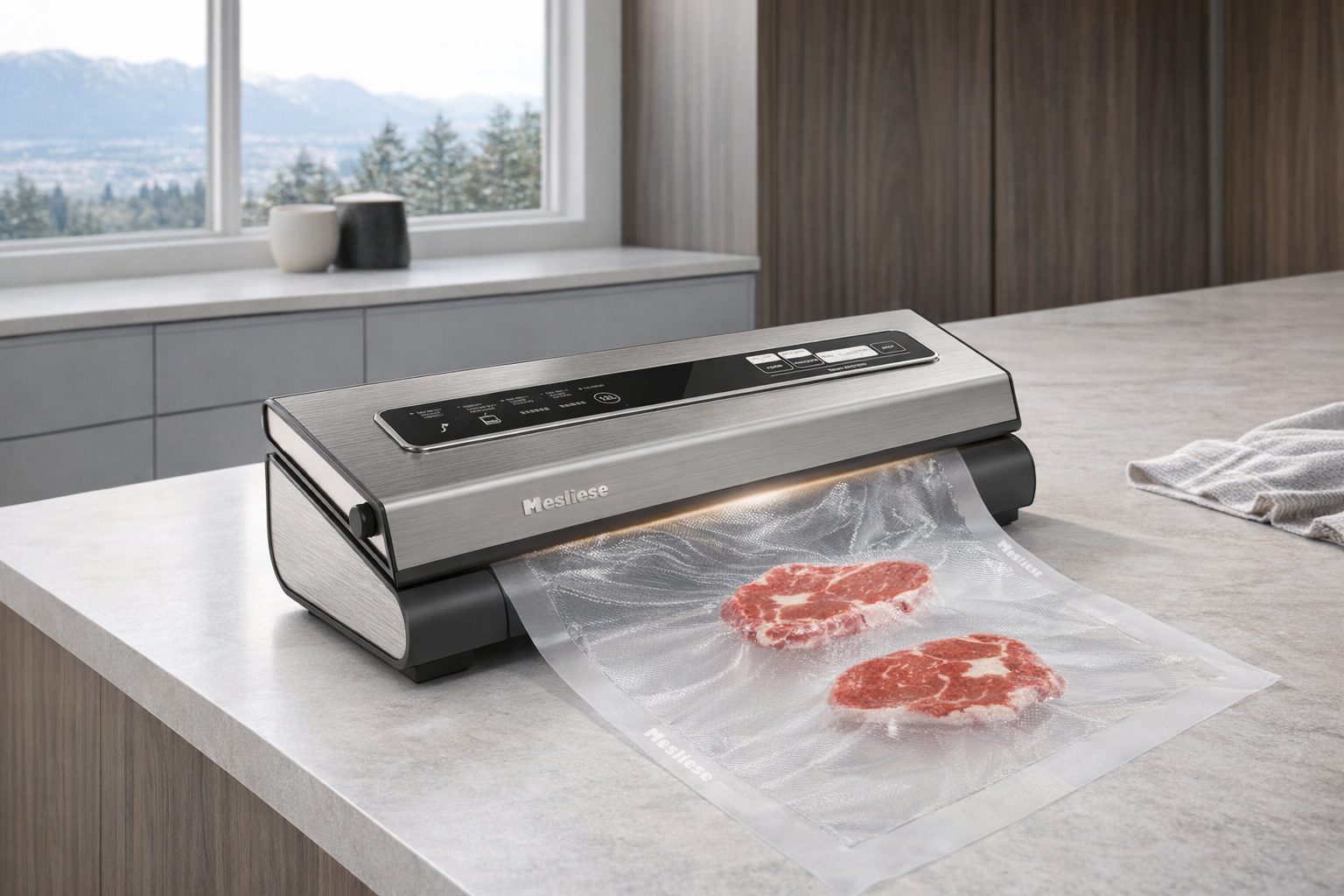
The Mesliese Vacuum Sealer Machine 90Kpa 6-in-1 is a useful anchor product because it looks like what most people actually mean when they say "vacuum sealer": a horizontal countertop machine with enough modes to handle common kitchen tasks without pretending to be a commercial chamber system.
According to the listing, it offers 90Kpa suction, a 120W motor, and 6-in-1 functions: Dry, Moist, Normal, Soft, Seal, and Vac&Seal. It also has a 12mm widened heating strip, a built-in cutter, built-in bag storage, an included air suction hose, 2 bag rolls, and 5 pre-cut bags. At about $91 CAD, that's an aggressive price for a feature set that at least on paper addresses the real failure points of home vacuum sealing: weak suction, bad seals, and awkward workflow.
Why these details matter in concept terms:
- Dry and Moist modes are not fluff if implemented properly. Moisture is one of the main reasons seals fail. A machine that acknowledges wet foods are harder to package is already being more honest than listings that act as though soup and steak behave the same.
- Normal and Soft modes matter because fragile foods can be crushed if the suction is too aggressive. Bread, berries, or delicate items are where "maximum vacuum" is not automatically better.
- A 12mm heating strip is the kind of spec that sounds boring and is actually useful. Seal integrity matters more than flashy control panels. If a machine makes durable, consistent seals, that matters more than whether it has six labels or eight.
- The built-in cutter and bag storage are not glamorous, but they reduce friction. If portioning food is annoying, people stop doing it.
The Mesliese also illustrates what vacuum sealing does not solve. A powerful motor cannot compensate for a dirty bag edge, trapped liquid, bad labeling habits, or food that should not have been stored that way to begin with. Machines get blamed for a lot of user error, but the opposite is also true: good-looking features can distract from poor storage judgment.
Editorially, this is the kind of product that makes sense for households that freeze meat regularly, portion meals, buy warehouse packs, or want to try sous vide without overspending. It also looks more practical than premium-branded machines that charge far more for design polish. The part to stay skeptical about is not the feature list; it's the idea that modes and suction numbers guarantee outcomes. They don't. Technique still matters.
- Full explainer: Mesliese Vacuum Sealer Machine 90Kpa 6-in-1 on Celmin · Directory: product page
The core product types that make vacuum sealing make sense
InstaSeal — compact sealer for smaller kitchens
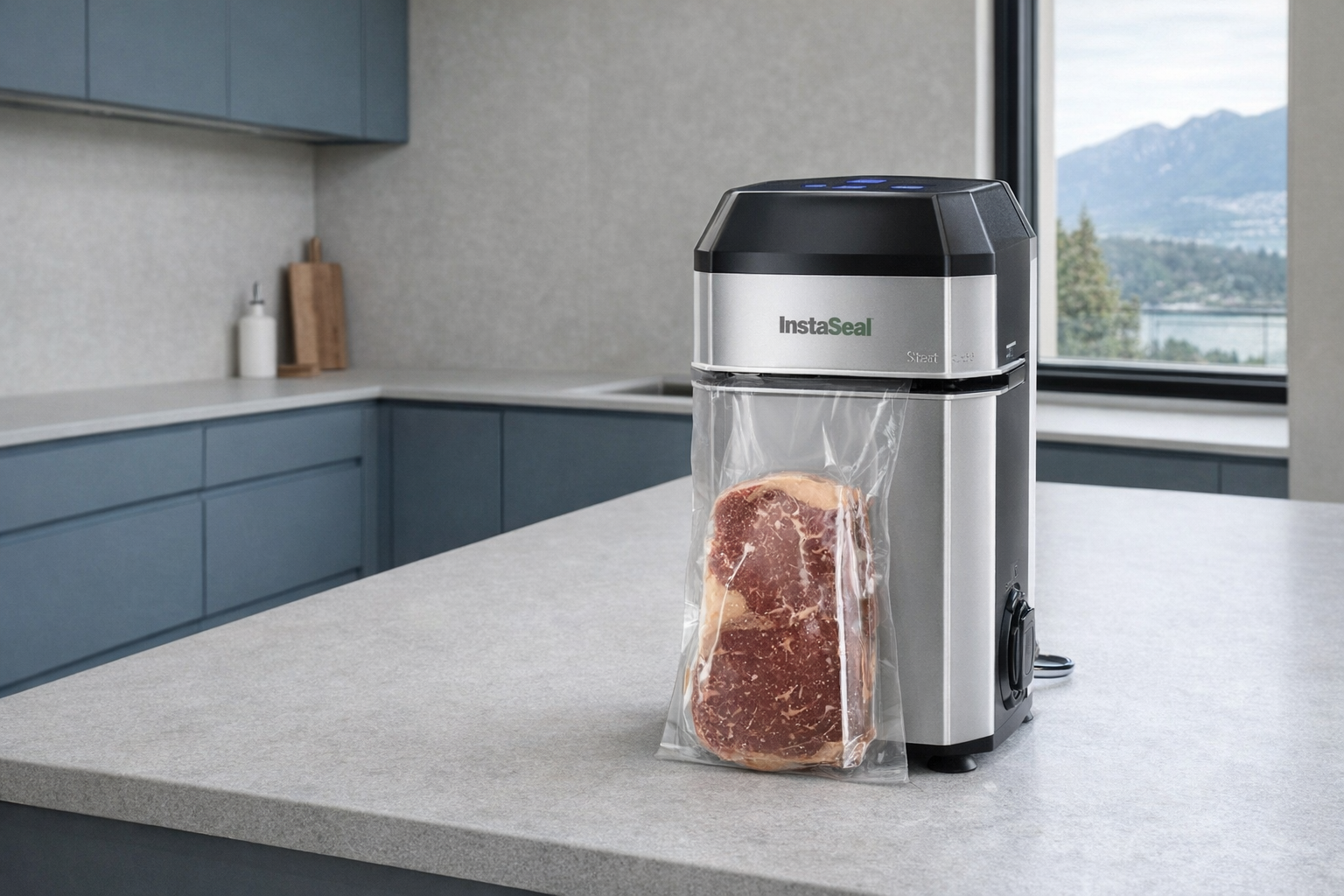
The InstaSeal Vacuum Sealer with 12 Bags takes a different angle: compactness. Its upright 5 x 5 x 9 inch design is the point. For apartment kitchens, crowded counters, or households that hate hauling out bulky gadgets, that's a more practical pitch than raw power. It also includes 12 pre-cut bags, automatic sensor operation, a no-leak design for liquids and marinades, and an airtight double seal.
That "no-leak" claim deserves a calm reality check. Liquids are still one of the hardest things for edge-style vacuum sealers to manage cleanly. Even if a machine is better designed for marinades and soups, wet sealing remains fussier than dry sealing. The fair judgment here is that the InstaSeal's format looks convenient, but anyone buying it mainly for soups should lower expectations and think more in terms of chilled sauces, marinated proteins, or partially frozen wet foods rather than carefree ladling and sealing.
At roughly $153 CAD, it is also not cheap for a compact model. So the question is not whether it is good value in the abstract; it's whether footprint matters enough in your kitchen to justify paying more than the Mesliese. For some people the answer is yes. For others, a small body with premium pricing is exactly the kind of compromise that sounds smarter on a listing than it feels in a real cabinet.
- Full explainer: InstaSeal Vacuum Sealer with 12 Bags on Celmin · Directory: product page
UNERVER M12 — jar sealing for dry goods, not a bag-sealer replacement
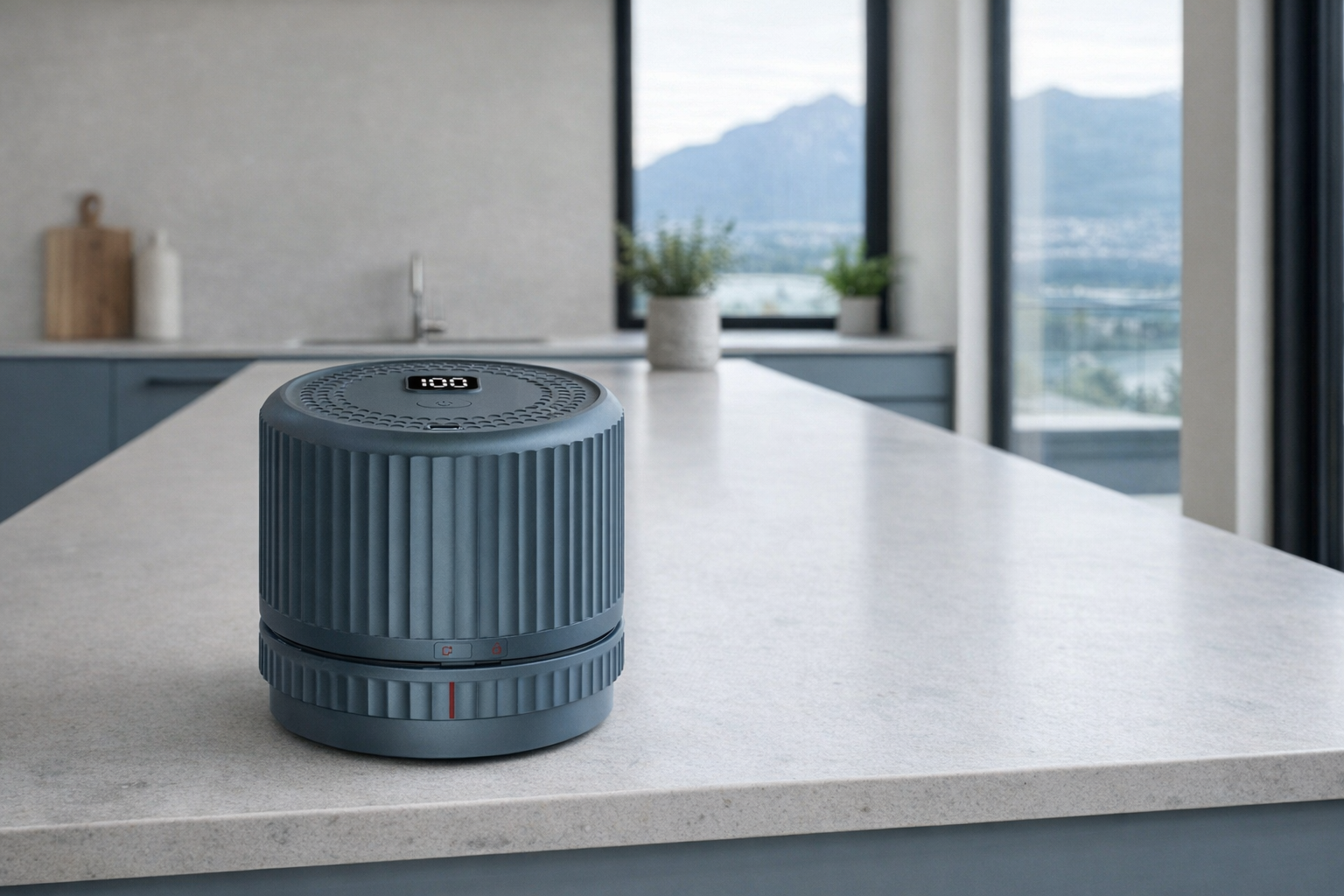
The UNERVER M12 Smart Electric Mason Jar Vacuum Sealer is the worked example for the other category people confuse with mainstream vacuum sealing. It is a cordless jar sealer with auto-stop operation, a large LED screen that displays negative pressure value, USB-C charging, and a battery reportedly good for about 350 jars per charge. It includes 5 wide and 5 regular mouth canning lids plus a cap opener, and it sells for around $39 CAD.
That price makes it easy to understand the appeal. For dry goods, this is a neat, relatively low-cost storage tool. Coffee beans, loose snacks, nuts, dehydrated fruit, baking ingredients, and pantry items that suffer from humidity are the sensible use cases. It's also less intimidating than a full countertop sealer.
But this is exactly the kind of product that gets oversold by implication. A jar sealer is not your answer for freezing portions of chicken thighs, packing salmon fillets, or storing batch-cooked chili efficiently. It is not a replacement for a bag sealer. It is a pantry gadget with some fridge utility. That's narrower than the marketing usually suggests, but still perfectly legitimate.
The practical opinion here is simple: if you already use Mason jars constantly, a tool like this could fit your habits. If you don't, buying a jar sealer to avoid buying a real vacuum sealer is usually a detour.
- Full explainer: UNERVER M12 Smart Electric Mason Jar Vacuum Sealer on Celmin · Directory: product page
KitchenBoss — where vacuum sealing meets sous vide for a real reason
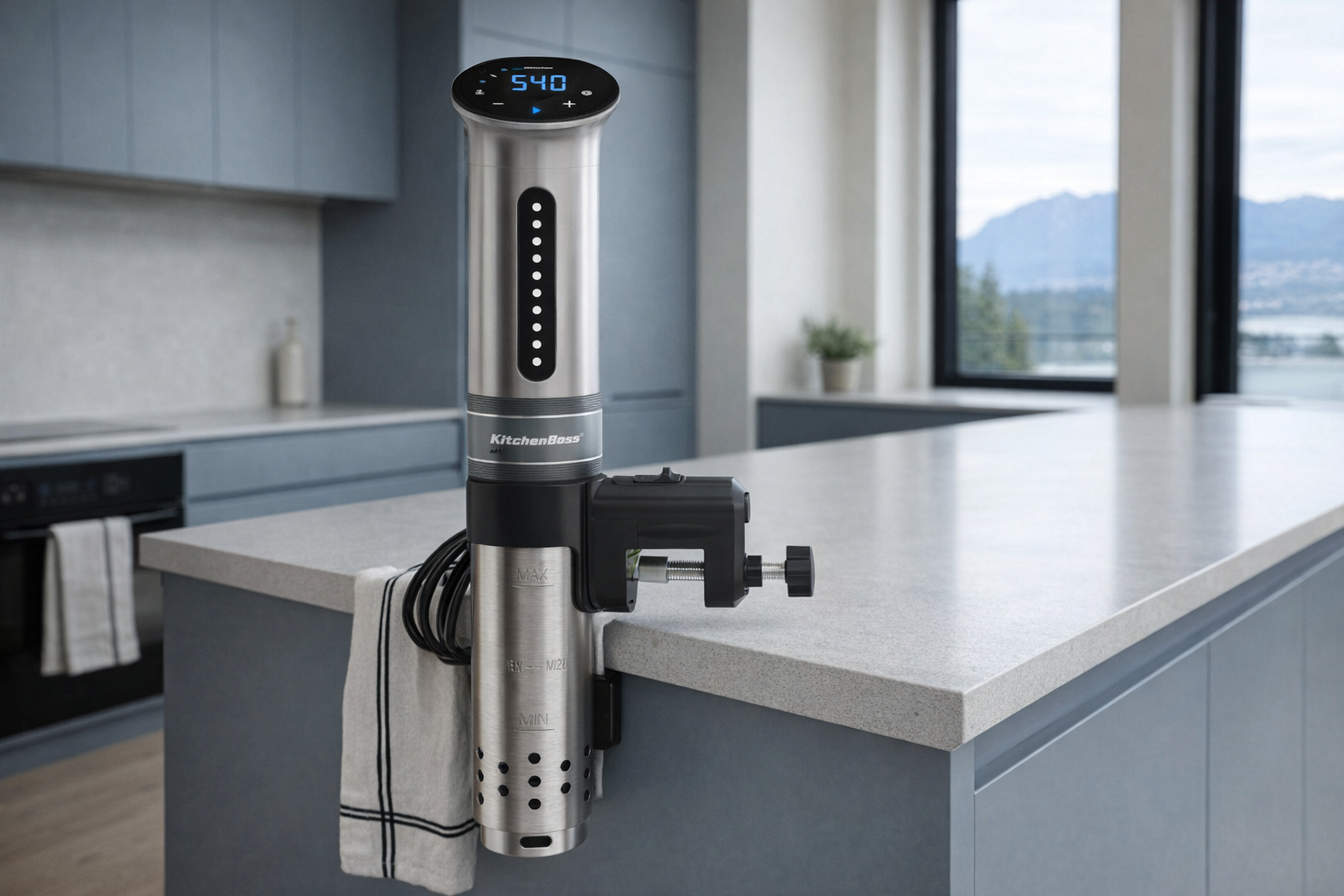
The KitchenBoss WiFi Sous Vide Cooker 1100W is not a vacuum sealer, but it belongs in this discussion because sous vide is one of the few places vacuum-sealed bags have a clear, non-hyped cooking role. According to the listing, it offers 1100W of power, temperature control from 40–90°C, WiFi app control, a brushless DC motor running at 2900r/m, and 16L/min water flow in a full SUS304 stainless steel body.
What this illustrates is that vacuum sealing is sometimes about cooking logistics, not only storage. A properly sealed bag keeps food in even contact with the water bath and reduces the floating, leaking, or dilution issues that come with badly packed food. If someone is buying a sealer mainly because they want to cook sous vide, that's actually a cleaner justification than a vague promise about freshness.
The opinionated part: WiFi on a sous vide cooker is less important than retailers think. Precise temperature control and build quality matter more than phone theatrics. But if you're already cooking this way, a decent bag sealer moves from "nice to have" to "actually useful." That is a more grounded pairing than buying both appliances because internet meal-prep culture said you should.
- Full explainer: KitchenBoss WiFi Sous Vide Cooker 1100W on Celmin · Directory: product page
What vacuum sealing genuinely fixes
- It reduces freezer burn dramatically.
This is the biggest real win. Better air removal and a proper seal keep frozen food from drying out and tasting old long before you planned to use it. - It makes bulk buying more rational.
If you buy family packs of meat or warehouse-size portions, vacuum sealing lets you split them into meal-sized units immediately instead of leaving them in flimsy store wrap. - It improves portion control and labeling habits.
Sealing tends to push people toward packaging food intentionally. That's not glamorous, but it prevents waste more effectively than "freshness technology" slogans do. - It helps with sous vide cooking.
For proteins and prepared meals going into a water bath, a sealed bag is a practical cooking tool, not just a storage method. - It can make pantry storage cleaner when used with jars.
For dry goods, a jar sealer can reduce repeated air exposure and humidity creep. That's useful, even if it's a smaller niche than full-bag sealing.
What vacuum sealing still doesn't fix
- It does not make unsafe food safe.
This is the most important limitation. Vacuum sealing does not replace refrigeration, freezing, or proper canning methods, and it does not remove anaerobic food-safety concerns. - It does not guarantee a perfect seal.
Moisture at the bag edge, wrinkles, overfilled bags, or trapped food particles can all cause failure. People often blame the machine when the real issue is technique. - It does not stop quality loss forever.
Even when meat can hold quality much longer — from the usual 2–3 months toward up to 2 years in good freezer conditions — flavour and texture still decline eventually. - It does not suit every food equally well.
Delicate foods crush, some moist foods are messy to seal, and some items are simply better wrapped or stored another way. - It does not make bag reuse automatically smart.
Reusing bags sounds thrifty, but hygiene matters. Raw meat bags are not where frugality should become improvisation.
Real products already on Celmin that are vacuum-sealing-ready or adjacent
- Mesliese Vacuum Sealer Machine 90Kpa 6-in-1 on Celmin — the most straightforward mainstream bag-sealer example in this group.
- InstaSeal Vacuum Sealer with 12 Bags on Celmin — compact upright design for kitchens where footprint is a real constraint.
- UNERVER M12 Smart Electric Mason Jar Vacuum Sealer on Celmin — useful for dry goods, but narrower than a standard sealer.
- KitchenBoss WiFi Sous Vide Cooker 1100W on Celmin — not a sealer, but a realistic reason many people end up wanting one.
How to read a "vacuum sealer" product listing
A lot of vacuum sealer listings are technically true and still misleading. Here are the claims worth decoding.
1. "Powerful suction" or a Kpa number
A number like 90Kpa sounds authoritative, and it is more useful than vague hype, but suction alone is not the whole story. A strong pull matters less if the seal is inconsistent or if wet foods regularly contaminate the seal line.
2. "Moist mode" or "liquid-friendly"
This usually means the machine is designed to better manage wet foods, not that it has solved the liquid problem permanently. If you plan to seal soups or sauces, assume some prep is still required — often chilling or partially freezing first.
3. "Double seal" or widened heating strip
This is one of the more meaningful claims. Seal quality is the whole game. A 12mm heating strip or double-seal design is more relevant than flashy controls because failed seals erase every other advantage.
4. "Jar sealer" language
If the product seals Mason jars, treat it as a different class of tool. Good for dry goods, limited for freezer meal prep. Don't let a pantry accessory masquerade as a universal preservation system.
5. "Preserves food 5x longer"
This kind of claim can be directionally true and still too broad to be useful. Five times longer than what, under what temperature, with what food, and with what package quality? Use it as a sign that vacuum sealing helps, not as a storage promise.
The three questions worth asking before buying vacuum sealing today
- Are you mostly freezing proteins and cooked meals, or storing dry pantry goods?
If it's freezer food, buy a proper bag sealer. If it's mainly coffee, nuts, and dry goods, a Mason-jar sealer may be enough. - Will the machine live on the counter or disappear into a cabinet?
A compact model like the InstaSeal makes more sense if space is tight. A fuller-featured model like the Mesliese makes more sense if you'll actually use it regularly. - Are you buying the machine, or the habit?
The machine only helps if you portion, label, date, and rotate food. If that system sounds annoying, be honest now. A vacuum sealer does not create kitchen discipline by itself.
Got Questions About Vacuum Sealing? Let's Clear Things Up.
Is this a hands-on review?
No. This is an editorial primer on vacuum sealing as a food-storage method, using the listed products as real examples of different tool types. It's meant to give you a durable framework for buying and using the category sensibly.
Does vacuum sealing replace freezing or refrigeration?
No. It improves packaging, which helps preserve quality, but cold storage rules still apply. If something needed the fridge before sealing, it still needs the fridge after sealing.
Is vacuum sealing the same as canning?
No, and this is where bad internet advice becomes risky. Vacuum sealing is not pressure canning, not water-bath canning, and not a substitute for approved shelf-stable preservation methods for low-acid foods.
Which foods should you think twice about sealing?
Anything that creates a false sense of safety deserves caution. Garlic-in-oil is a classic example where low-oxygen storage is not something to improvise with. Soft cheeses, very wet mushrooms under some storage conditions, and improperly chilled moist foods also deserve more thought than "just vacuum seal it." When in doubt, freeze promptly or store conventionally rather than trying to outsmart food safety.
Why do sealed bags still get freezer burn sometimes?
Usually because the seal wasn't clean, the bag had trapped moisture near the seal line, the food had sharp edges that compromised the bag, or air remained in the package. Freezer burn after vacuum sealing is not proof the method is fake; it's usually proof that technique and packaging details matter.
Can you reuse vacuum sealer bags?
Sometimes, but use judgment. Bags that held dry foods may be more reasonable candidates than bags that held raw meat or fish. Hygiene matters more than thrift here. Reuse is not automatically smart if it creates cleaning and contamination risks.
What does vacuum sealing cost?
On the products here, there is a broad spread. A jar-focused tool like the UNERVER M12 sits around $39 CAD. A mainstream countertop machine like the Mesliese is around $91 CAD. A compact upright unit like the InstaSeal is around $153 CAD. The real cost question is not just the machine — it's also bags, storage space, and whether you'll use it enough to reduce waste.
Where should I go next if I want a specific product breakdown?
Start with the direct explainers: the Mesliese Vacuum Sealer Machine 90Kpa 6-in-1 on Celmin if you want the mainstream all-purpose option, the InstaSeal Vacuum Sealer with 12 Bags on Celmin if compact size matters most, the UNERVER M12 Smart Electric Mason Jar Vacuum Sealer on Celmin if you're really shopping for dry-goods storage, and the KitchenBoss WiFi Sous Vide Cooker 1100W on Celmin if your real interest is the cooking side.
If you're building a smarter home in Canada and want honest comparisons of gadgets worth considering — plus the ones worth skipping — Celmin covers the full catalog without the marketing theater. More comparisons, reviews, and buyer guides at https://celmin.ca.
Discussion
Sign up or sign in to join the conversation.