
Canadian bedrooms swing between two uncomfortable truths. In January, the furnace runs until indoor humidity drops into the twenties — static at the light switch, sinuses that feel sandpapered, wood furniture cracking along the grain. In July, the same room holds heat like a held breath: windows ...
Canadian bedrooms swing between two uncomfortable truths. In January, the furnace runs until indoor humidity drops into the twenties — static at the light switch, sinuses that feel sandpapered, wood furniture cracking along the grain. In July, the same room holds heat like a held breath: windows open to humid air, or windows closed to traffic noise, and sleep becomes a negotiation with the thermostat.
The mistake most people make is treating those problems as one problem. They buy a humidifier for a hot August night because the air feels "wrong." They point a box fan at dry winter skin and wonder why nothing improves. A fan and a humidifier both change how a bedroom feels, but they change different physical variables. Confuse the two and you spend money on the wrong tool — or worse, run both badly and wake up clammy, dried out, or both.
This field guide teaches the mechanics first: what air movement actually does to your body, what relative humidity controls, and how Canadian seasons map to each. Then we walk through two machines we have lived with in real bedrooms — the DREO Smart Omni Oscillating Fan for circulation and evaporative cooling, and the DREO Smart Humidifier 4L Top Fill for moisture management. If you already know whether you need to move air or add water, skip ahead to our companion essay, Move the Air or Add Moisture? The DREO Fan and Humidifier Question. If you want the physics before the product map, keep reading.
Air movement vs moisture: two different levers
Comfort in a bedroom depends on temperature, humidity, and airflow — three variables that interact but do not substitute for one another.
A fan moves air. It does not lower room temperature in any meaningful sense. What it does is accelerate evaporative cooling on your skin: sweat and moisture on your body evaporate faster when air passes over you, which is why a breeze feels cool even when the thermometer has not moved. Fans also mix stratified air — hot air trapped near the ceiling, cold pockets by the floor — and can reduce the stuffy feeling of a sealed condo. Some people use fan noise as sleep white noise. None of that requires changing the water content of the air.
A humidifier adds moisture. It raises relative humidity (RH) — the percentage of water vapour the air is holding relative to what it could hold at that temperature. In winter, cold outdoor air heated indoors becomes desert-dry; a humidifier puts water back into the room air as fine mist. In summer, central air conditioning can strip humidity even when it is muggy outside. A humidifier does not cool the room. In fact, adding moisture can make a hot room feel heavier if you are already above comfortable RH. The target band for most Canadian bedrooms is 40–50% RH — enough to protect mucous membranes and wood, not so much that condensation breeds mould.
A fan cools people, not rooms. A humidifier fixes dry air, not heat. Buying the wrong one is like bringing a snow shovel to sand a driveway — the tool works; the diagnosis does not.
Understanding that split is the whole game. Everything below maps symptoms to the correct lever.
When you need a fan
Reach for circulation when heat or stagnation is the complaint — not dryness.
Heat waves and warm nights. Upper-floor apartments, west-facing bedrooms, and homes without central AC push sleeping temperatures past comfort. A fan across the bed provides evaporative cooling without window-unit hydro costs — not AC in a heat dome, but enough for shoulder-season sleep.
Stuffy, sealed spaces. Weather-stripped bedrooms smell stale without being dry. Moving air breaks stagnant pockets when RH readings are normal.
White noise and hot-sleeper truces. A DC fan on low delivers airflow and masking sound. Directional breeze on one side of the bed settles partner temperature wars without HVAC rewiring.
Fans fail when the problem is dry air — cracked lips, nosebleeds, static shocks, guitars going sharp. More airflow in a dry room can actually increase evaporative moisture loss from your skin. That is not the fan's fault; it is the wrong prescription.
When you need a humidifier
Reach for moisture when dryness is the complaint — not heat.
Winter furnace dryness. November through March, indoor RH without intervention often sits in the 20–35% range — below the 30–50% comfort band Health Canada and HVAC guidance cite. Nosebleeds, sore throats, and static follow.
AC-dried summer bedrooms. Central or window AC strips moisture from delivered air. A closed bedroom can feel dry despite muggy weather elsewhere.
Wood, instruments, and nurseries. Guitars and solid furniture need stable RH; nurseries benefit from quiet top-fill units with auto targeting — follow clinician advice for medical conditions.
Humidifiers fail when the problem is heat. Adding mist to an already-warm, already-humid August bedroom pushes RH past 60% and makes sleep worse. They also fail when maintenance is skipped — ultrasonic units need weekly cleaning and decent water, or biofilm and white dust become the new problem.
Summer sleep sidebar: If your issue is feeling hot under covers rather than dry air, a passive cooling layer can help before you add another appliance. The Elegear Arc-Chill cooling blanket uses cool-touch fibres to wick heat from skin — it does not replace a fan or AC, but pairs well with low-speed airflow on warm nights when humidity is already fine.
At a glance: DREO fan vs DREO humidifier
| DREO Smart Omni Fan | DREO Smart Humidifier 4L | |
|---|---|---|
| Primary job | Air movement, evaporative cooling, circulation | Raise and maintain relative humidity |
| Best season | Late spring through summer; any warm night | Late fall through winter; AC-dried summer rooms |
| Noise (low setting) | ~20 dB — whisper / white-noise territory | ~28 dB — bedroom-friendly mist |
| Smart features | Wi-Fi app, Alexa/Google, 8-hour timer, schedules | Wi-Fi app, Alexa/Google, auto humidity target |
| Standout hardware | 120° + 120° omni oscillation, DC motor, 9 speeds | 4L top-fill tank, modular cleaning, ~36 hr low runtime |
| Maintenance | Dust blades occasionally; no consumables | Weekly cleaning; filtered/distilled water; cartridge consumables |
| Price (CAD) | ~$140–150 | ~$60–70 |
| Best room | Medium bedroom, nursery, home office | Bedroom, nursery, closed home office |
| Deep dive | Living with the DREO fan | Living with the DREO humidifier |
Neither row picks a winner — they solve different equations. Many Canadian households eventually own both; the question is which one you need first for the season you are in.
DREO Smart Omni Fan: whole-room airflow for warm bedrooms
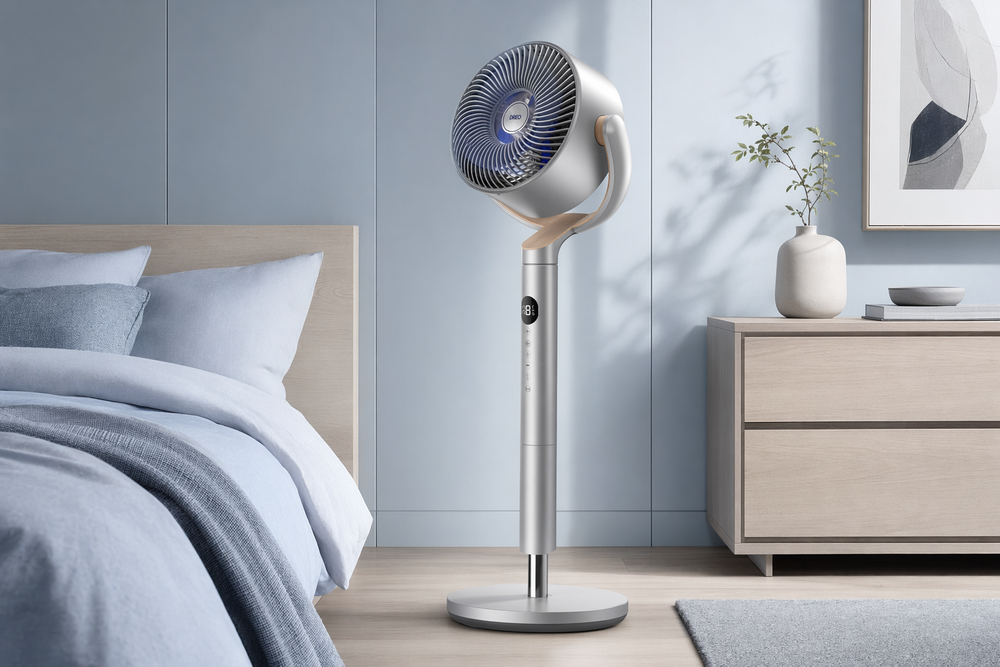
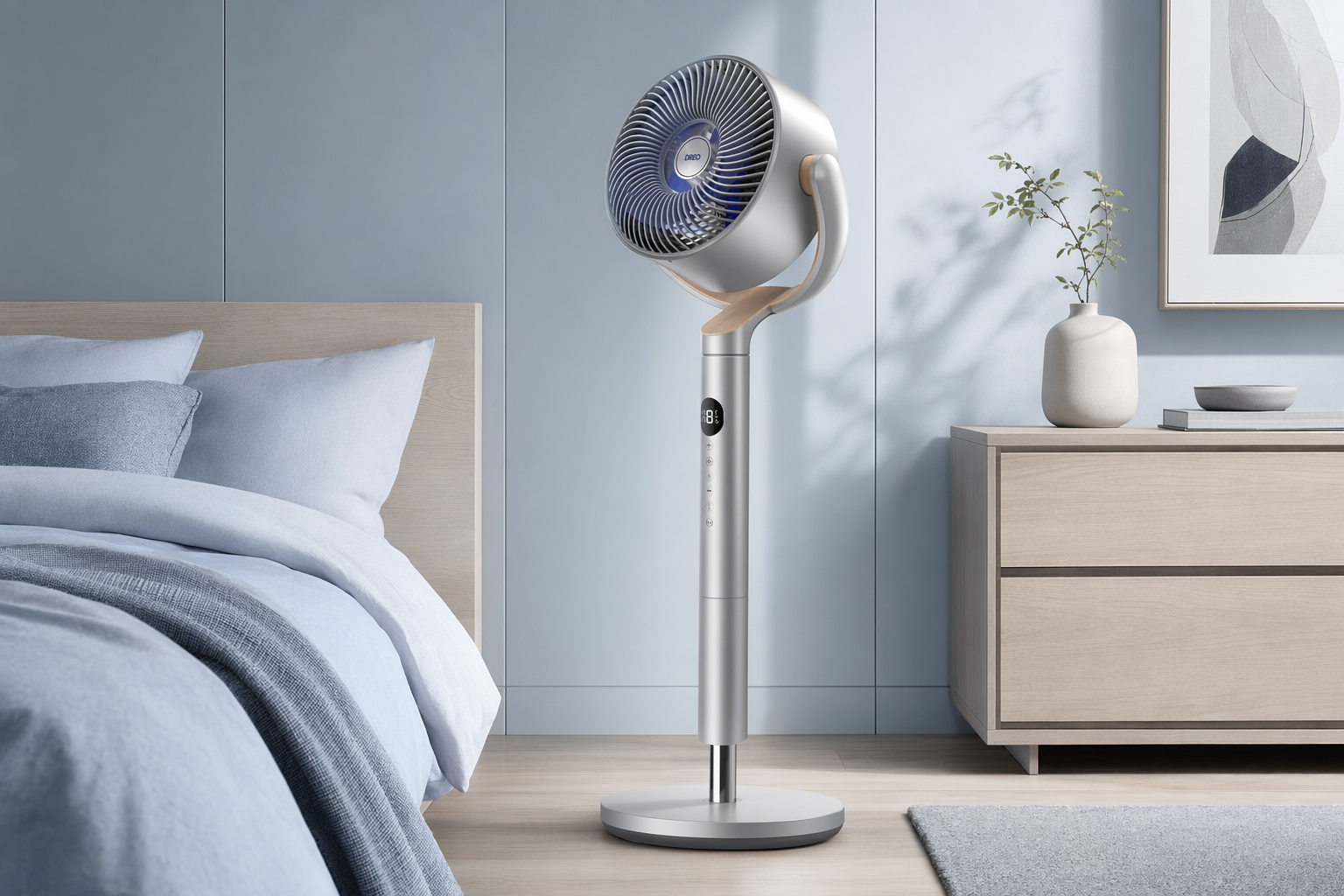
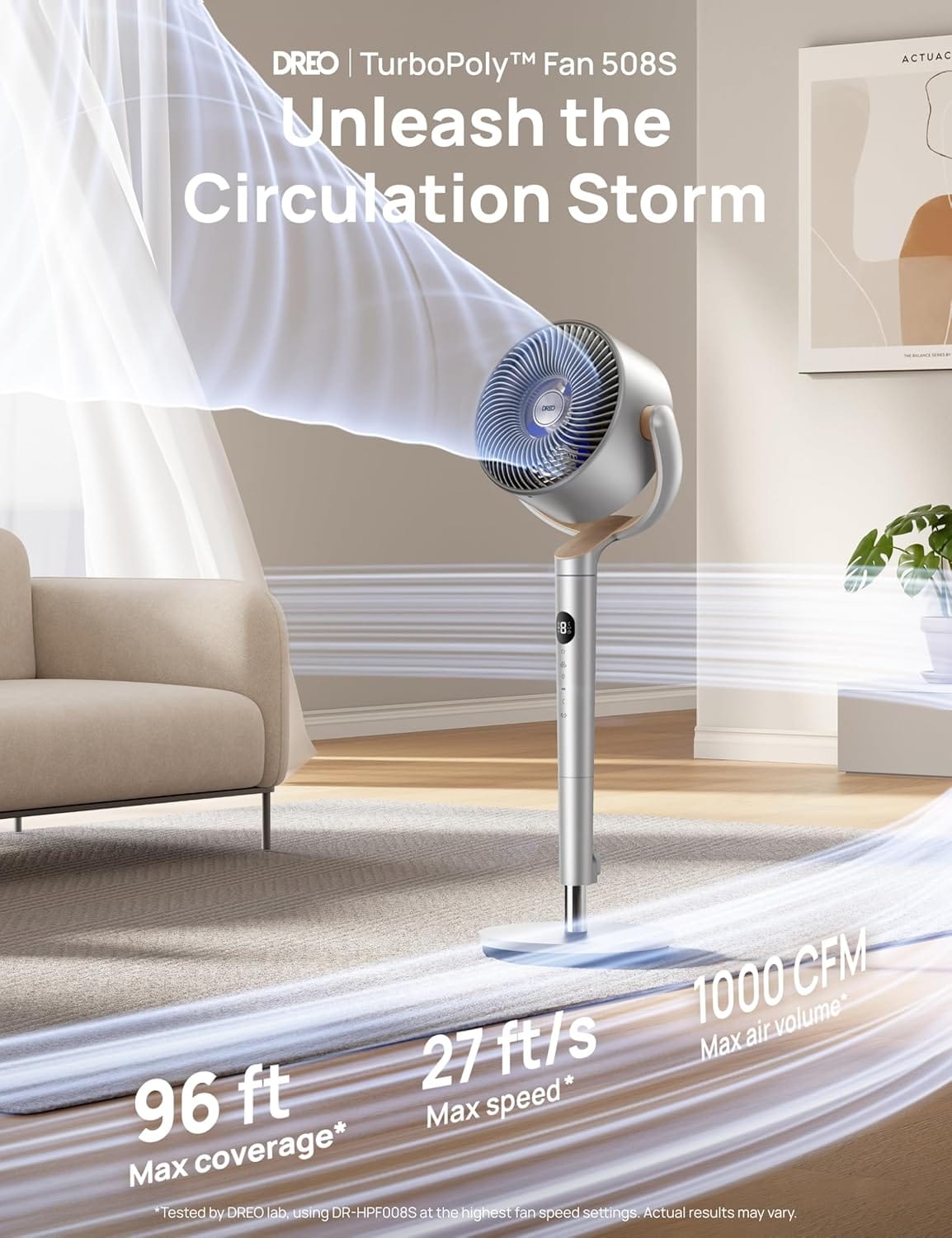
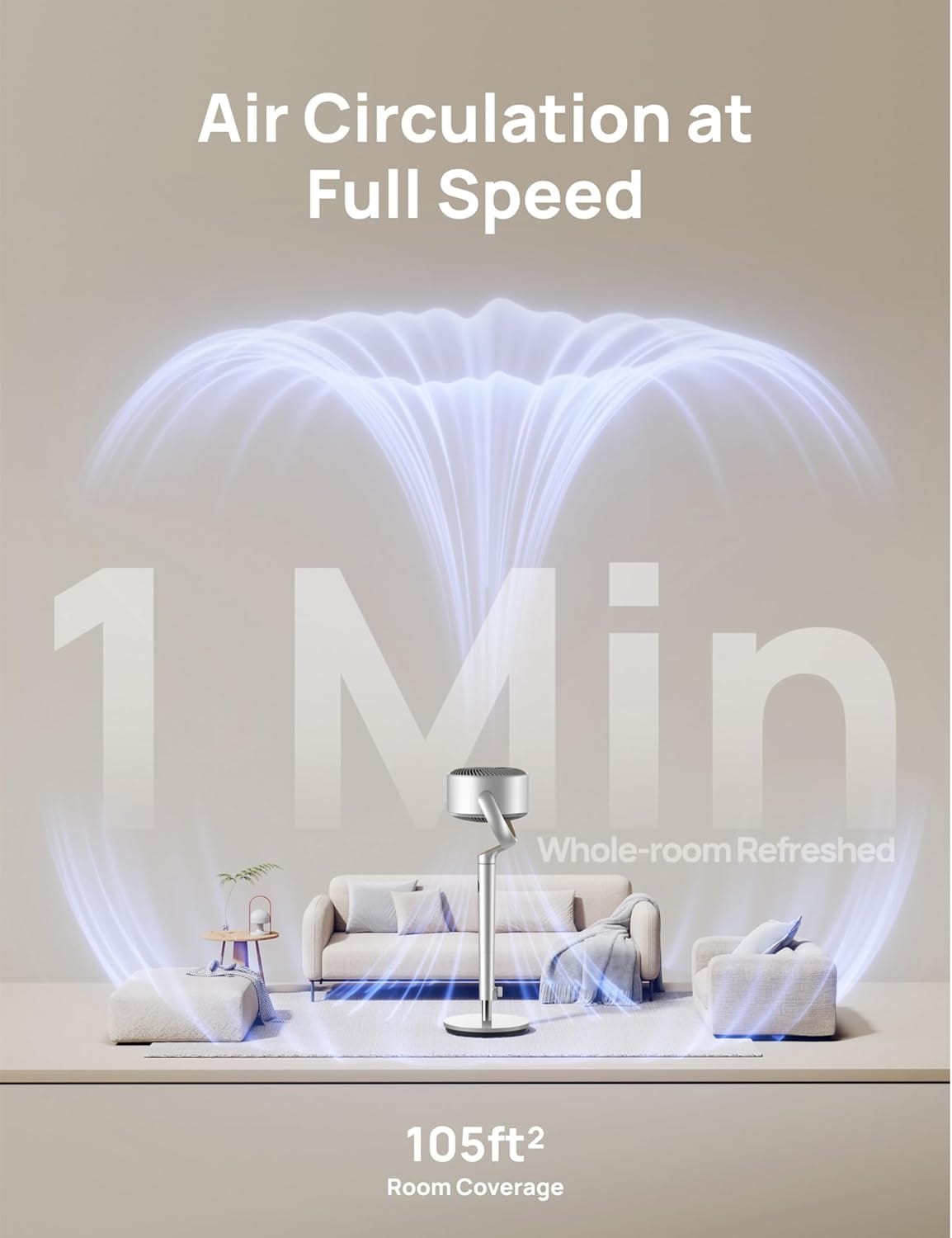
The DREO Smart Omni Oscillating Fan attacks the geometry problem most pedestal fans ignore. Standard units sweep left to right while blowing at a fixed vertical angle — one cold stripe across the floor, hot air still pooling above the bed. DREO's omni design oscillates 120 degrees horizontally and 120 degrees vertically, nodding while it pans so airflow distributes through the room volume instead of a single plane.
The motor is DC, not AC — more efficient and quieter at low speed. That is how DREO can credibly claim ~20 dB at the bottom of its nine-speed range. Decibels are logarithmic; speeds 8–9 are audibly louder and appropriate for afternoon heat, not silent sleep. Most bedroom owners live between speeds 2 and 5 overnight.
Smart features matter when you are already in bed: app schedules to ramp down after midnight, Alexa or Google voice commands, an 8-hour timer cap, and an RGB ring at the base that you should disable on night one if you sleep in darkness. Local remote and onboard controls still work when Wi-Fi misbehaves — important during the 2.4 GHz pairing dance every smart-home device in Canada eventually demands.
Position the fan so oscillation sweeps the bed without blasting one face all night. Adjustable height (37–42 inches) aims airflow over the mattress. One unit covers a typical 150–250 ft² bedroom; open lofts need more than a single pedestal.
Who it fits: hot sleepers, nurseries, July home offices, Alexa/Google households wanting schedules. Who should look elsewhere: occasional desk-breeze buyers, large open floors, anyone fine with a $40 box fan.
For noise curves, RGB opinions, and Wi-Fi troubleshooting, read our DREO fan honest buyer guide.

DREO Smart Humidifier 4L: moisture without the flip-and-spill ritual
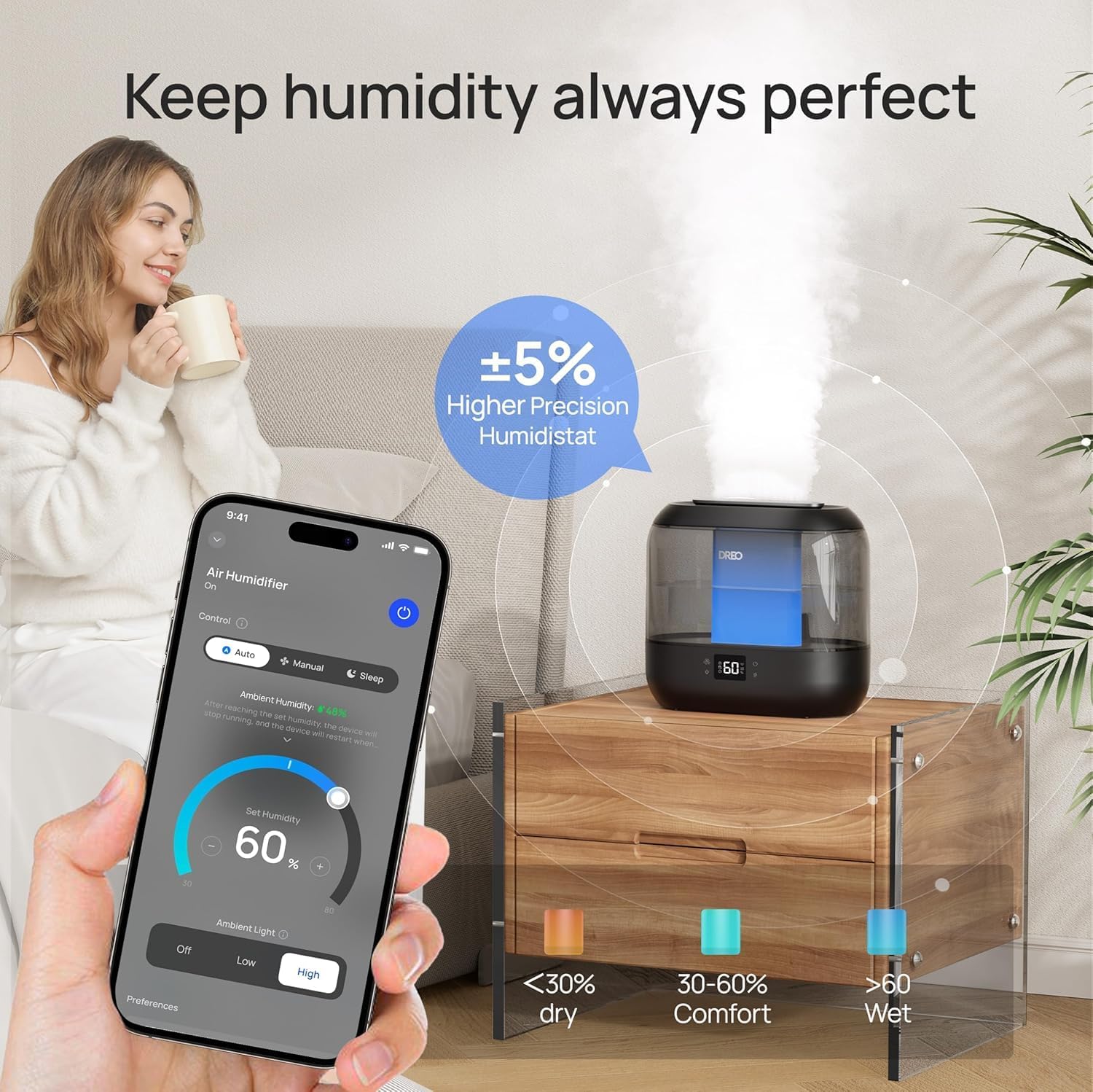
The DREO Smart Humidifier 4L Top Fill targets the friction that makes people abandon humidifiers by February. Bottom-fill tanks require removal, inversion over the sink, and careful reseating — every refill is a spill risk. Top fill lets you pour from a pitcher while the unit sits on a dresser. For a nursery refill at 1 a.m., that difference is not cosmetic.
The 4L tank delivers up to ~36 hours on low mist — overnight and workday coverage from one fill. On higher output, plan for 12–16 hours, still enough for a closed bedroom night. An onboard humidity sensor closes the loop: set 45% in the app, let auto mode mist and pause, instead of guessing with a manual dial until the floor glistens.

Cool mist ultrasonic humidification vibrates water into fine droplets — no heating element, lower energy use, safer around kids than warm-mist units. The trade-offs are real: hard Canadian tap water leaves white mineral dust on furniture; distilled or filtered water is strongly recommended in Toronto, Calgary, and other mineral-heavy municipalities. Weekly cleaning with the included brush prevents biofilm; skipped maintenance is how humidifiers become mould machines.
Noise at sleep settings lands around 28 dB in owner reports — a soft hiss, not appliance rumble. Disable the night light in the app if you sleep in total darkness. Optional aroma pads exist; run plain water first until baseline comfort is established.
Sizing honesty: a 4L unit is a room tool, not a whole-home solution. Closed bedrooms up to roughly 200–300 ft² see the best results. Open doors dilute effectiveness; oversized open lofts may never hit the target RH no matter how hard the unit mists.
Who it fits: winter-dry bedrooms and nurseries; AC-dried summer sleeping rooms; buyers replacing hated bottom-fill units; anyone wanting Alexa humidity control on a ~$60–70 CAD budget.
Who should look elsewhere: large open floor plans needing whole-zone humidity; medical requirements for warm mist; buyers unwilling to clean weekly or buy decent water.
The DREO humidifier honest buyer guide covers leakage troubleshooting, replacement cartridge listings, and hard-water city notes we will not repeat here.
Running both: legitimate — with guardrails
Shoulder season — April in Vancouver, October in Ottawa — can deliver warm days and dry nights in the same week. Owning both a fan and a humidifier is not extravagant; it is Canadian climate literacy.
Run both when: shoulder season mixes dry nights with warm afternoons, or a nursery needs stable RH plus low airflow for sound.
Avoid: aiming high-speed fan directly at mist output; humidifying past 55% RH in summer; sealing windows while blasting mist onto cold walls.
Rule: humidifier hits RH target first; fan adds sleep comfort second.
How to size for your bedroom
Start with square footage and ceiling height, then match the tool.
Fans: Medium bedrooms (120–250 ft²) with normal 8-foot ceilings are the sweet spot for a pedestal omni fan. Smaller rooms work fine on low speed — you may not need full oscillation. Above 300 ft² or open mezzanine layouts, treat one fan as partial relief, not whole-zone cooling.
Humidifiers: Output is measured in mist volume and tank runtime, not square footage alone. A 4L ultrasonic unit realistically maintains 40–50% RH in a closed 150–250 ft² bedroom. Larger spaces, high ceilings, or constantly open doors need a bigger tank or tempered expectations. Buy a cheap hygrometer — $10–15 CAD — and trust the number over how the air "feels."
If symptoms and measurements disagree, believe the hygrometer. Dry air below 35% RH wants moisture. Warm air above 24°C with normal humidity wants movement — or AC, or a cooling blanket — not mist.
Who should skip both
Some bedroom problems are outside this category.
Central HVAC already humidifies/dehumidifies — Whole-house systems with proper humidifier pads or integrated dehumidification may make a portable unit redundant. Check your furnace settings before duplicating.
The room needs AC, not airflow — Sustained heat above comfort thresholds needs refrigerant cooling, not faster evaporation of sweat.
Mould and standing water — If you smell mustiness or see growth, fix the moisture source before adding a humidifier.
Renters forbidden from window units — A fan helps but does not replace building-level ventilation problems. Landlord issues need landlord solutions.
Frequently asked questions
Can a humidifier grow mould?
Yes — if you neglect cleaning. Ultrasonic humidifiers need weekly scrubbing of accessible surfaces, dry storage when not in use, and water that does not load minerals into every crevice. Top-fill designs like the DREO 4L make maintenance easier; they do not make it optional. Replace cartridges on schedule and reseat gaskets firmly after cleaning to avoid base leaks.
Is a fan as good as air conditioning?
No. A fan improves thermal comfort via evaporation; AC removes heat from the air. On moderate warm nights, a quiet DC fan may be enough. During heat warnings, treat the fan as supplement — and know that fans cool people, not pets left alone in closed rooms without AC.
What humidity should I target in a Canadian bedroom?
40–50% RH is the common comfort band cited by Health Canada and HVAC references. Below 30%, dryness symptoms dominate. Above 55–60% in winter risks condensation on cold windows; in summer, it feels oppressive. Use auto mode with a target around 45% and adjust by feel.
Fan or humidifier first?
Follow the season and the symptom. Dry nose, static, cracking wood → humidifier first. Hot, stuffy, need white noise → fan first. If you want the decision framed as lifestyles rather than specs, read Move the Air or Add Moisture?.
The bottom line
Bedroom climate in Canada is a seasonal puzzle, not a single-product purchase. Fans move air and cool skin through evaporation; humidifiers restore moisture when furnaces and AC strip it away. The DREO Omni fan earns its place with quiet DC airflow, dual-axis oscillation, and smart scheduling for warm nights. The DREO 4L humidifier earns its place with top-fill convenience, long runtime, and closed-loop humidity targeting for dry winters.
Name the variable that hurts — heat, stagnation, or dryness. Measure RH if you are unsure. Pick the lever that matches. Then read the deep dives for ownership quirks, and the philosophy essay if you are still staring at both Amazon tabs.
Discussion
Sign up or sign in to join the conversation.