
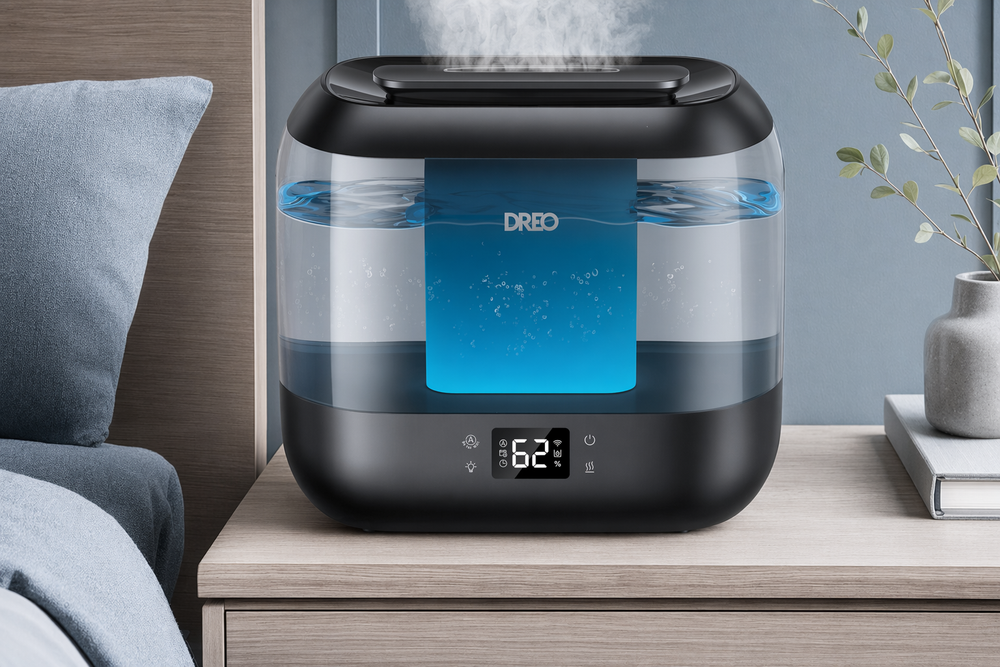
Canadian winters are dry in a way that announces itself — static shocks at the light switch, sinuses that feel sandpapered by February, wood furniture cracking along the grain. Summer air conditioning dries rooms too, just more quietly. A humidifier fixes the symptom. Most humidifiers add a new s...
Canadian winters are dry in a way that announces itself — static shocks at the light switch, sinuses that feel sandpapered by February, wood furniture cracking along the grain. Summer air conditioning dries rooms too, just more quietly. A humidifier fixes the symptom. Most humidifiers add a new symptom: lifting a heavy tank, turning it upside down over the sink, and trailing water across the counter.
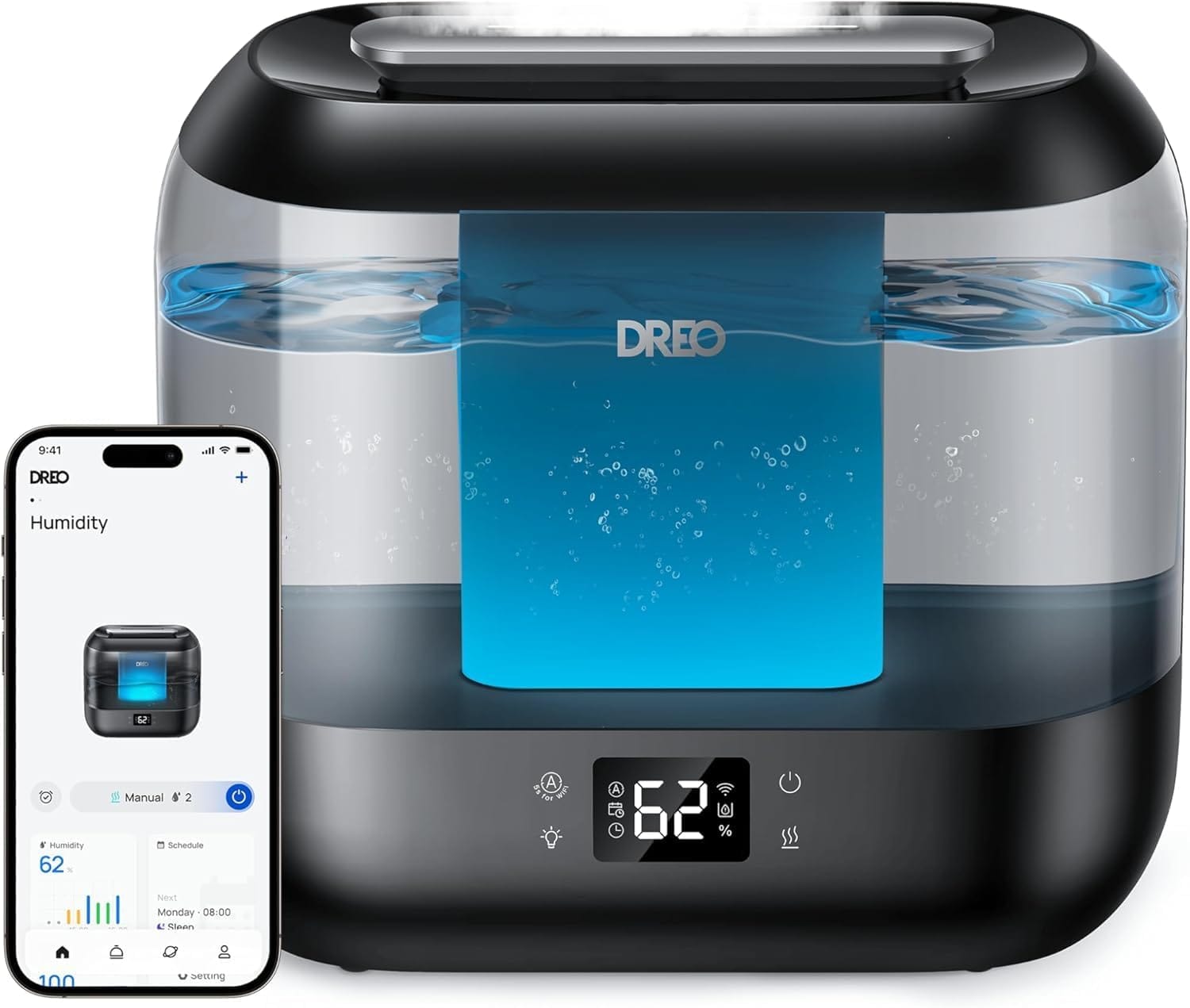
The DREO Smart Humidifier 4L Top Fill targets the annoying part. You pour water in from the top without removing the tank. You clean modular parts without a engineering degree. You set a target humidity in an app — or ask Alexa — and let it adjust instead of blasting mist until the floor is damp. For bedrooms, nurseries, and home offices across Canada, that convenience stack is the pitch.

The snapshot
| DREO Smart Humidifier 4L | |
|---|---|
| What it is | Cool mist humidifier with 4L top-fill tank and smart humidity control |
| Runtime | Up to ~36 hours on low; ~12–16 hours on higher settings |
| Noise | ~28 dB acoustic design — bedroom-friendly |
| Mist | Ultra-fine cool mist; optional aroma pad for essential oils |
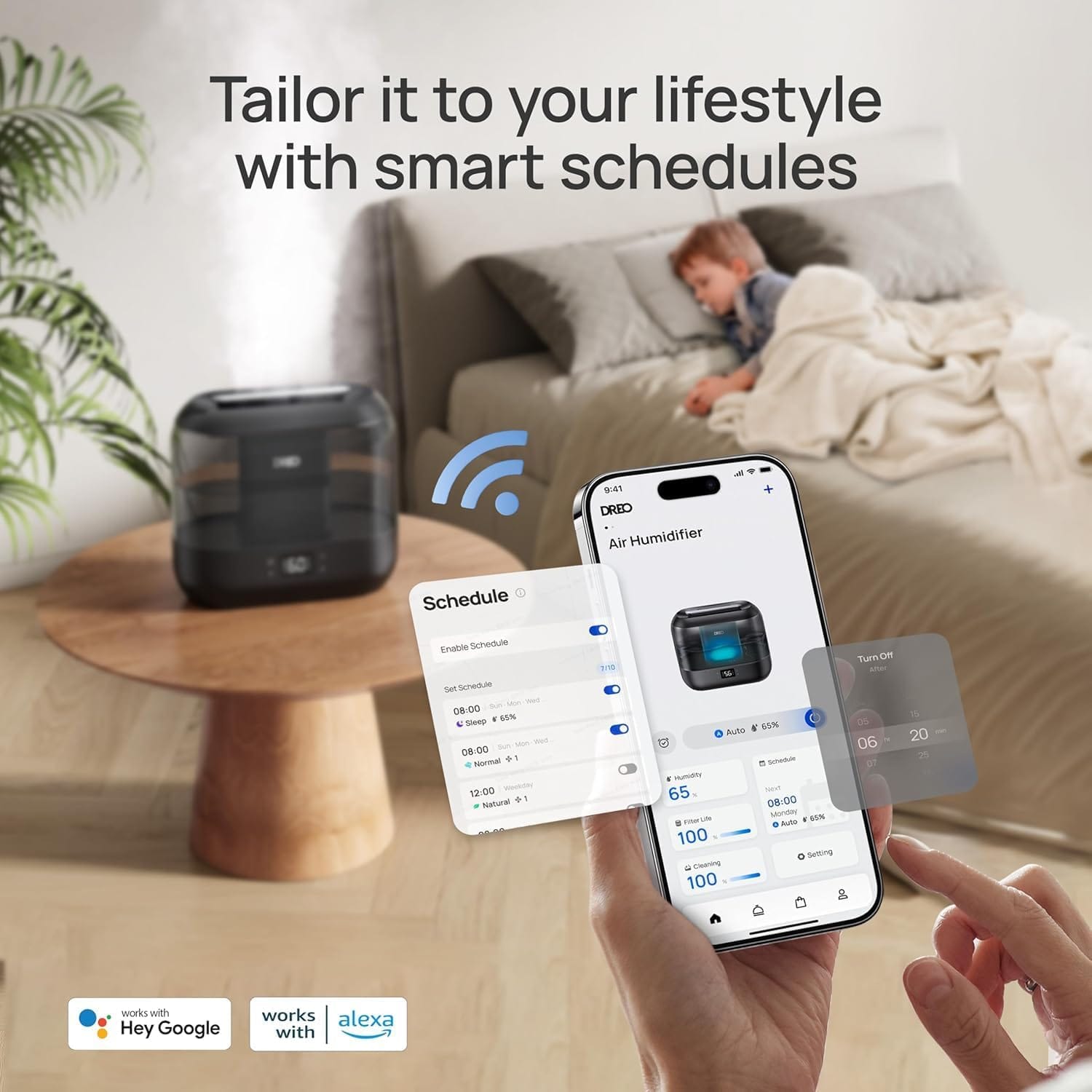
| Smart control | Wi-Fi app, Alexa/Google, auto humidity targeting, night light (disable-able) |
| Maintenance | Modular design, included brush; filter/cartridge consumables |
| Real price (CAD) | ~$60–70 on Amazon.ca (list often ~$80; frequent discounts) |
What buyers on Amazon are saying
The DREO 4L smart humidifier holds 4.4 stars on Amazon.ca with over ten thousand ratings — enough data to trust the shape of feedback. Amazon’s review summary aligns with long-form owner reports.
Quiet operation is among the most-cited positives. Nursery and bedroom buyers describe it as super quiet or silent at low and medium mist — white-noise territory at most, not appliance rumble. Several note sleeping better after the first night with humidity restored.
Ease of use and top-fill design earn repeated praise. Reviewers like filling without removing the tank, simple setup, and cleaning access compared to older bottom-fill units they replaced. “Best humidifier I’ve had” appears often in quality mentions.
App and smart features get mixed-but-mostly-positive notes. Fans of the DREO app like remote humidity readouts, schedules, and turning off the night light from bed. Detractors mention needing the app for some functions or occasional Wi-Fi quirks — usually resolved by re-pairing.
The friction clusters in three areas:
- Leakage complaints — A significant minority report water pooling at the base, often linked to filter caps or gaskets not seated fully after cleaning. Fixable when caught early; frustrating when it damages floors.
- White dust with tap water — Hard Canadian tap water leaves mineral residue on furniture near the mist path. Distilled or filtered water reduces this — a recurring tip in reviews, not optional advice in hard-water cities.
- Humidity control accuracy — Mixed opinions on whether auto mode hits the target in larger rooms or extremely dry climates. Works well in typical bedrooms; struggles when undersized for open spaces.
Overall: owners who wanted a quiet bedroom humidifier with easy fills tend to stay satisfied; owners who skip maintenance or use hard tap water tend to post lower stars.
What it's actually trying to do
Comfortable indoor humidity in Canada often sits between 40% and 50% relative humidity. Below that, mucous membranes dry out and wood shrinks. Far above it, mould risk rises. A good humidifier adds moisture steadily without soaking surfaces.
Cool mist ultrasonic humidifiers vibrate water into fine droplets — no heating element, lower energy use, safer around kids than warm mist. The trade-off is mineral carry-over if water is hard, and the need for regular cleaning to prevent biofilm.
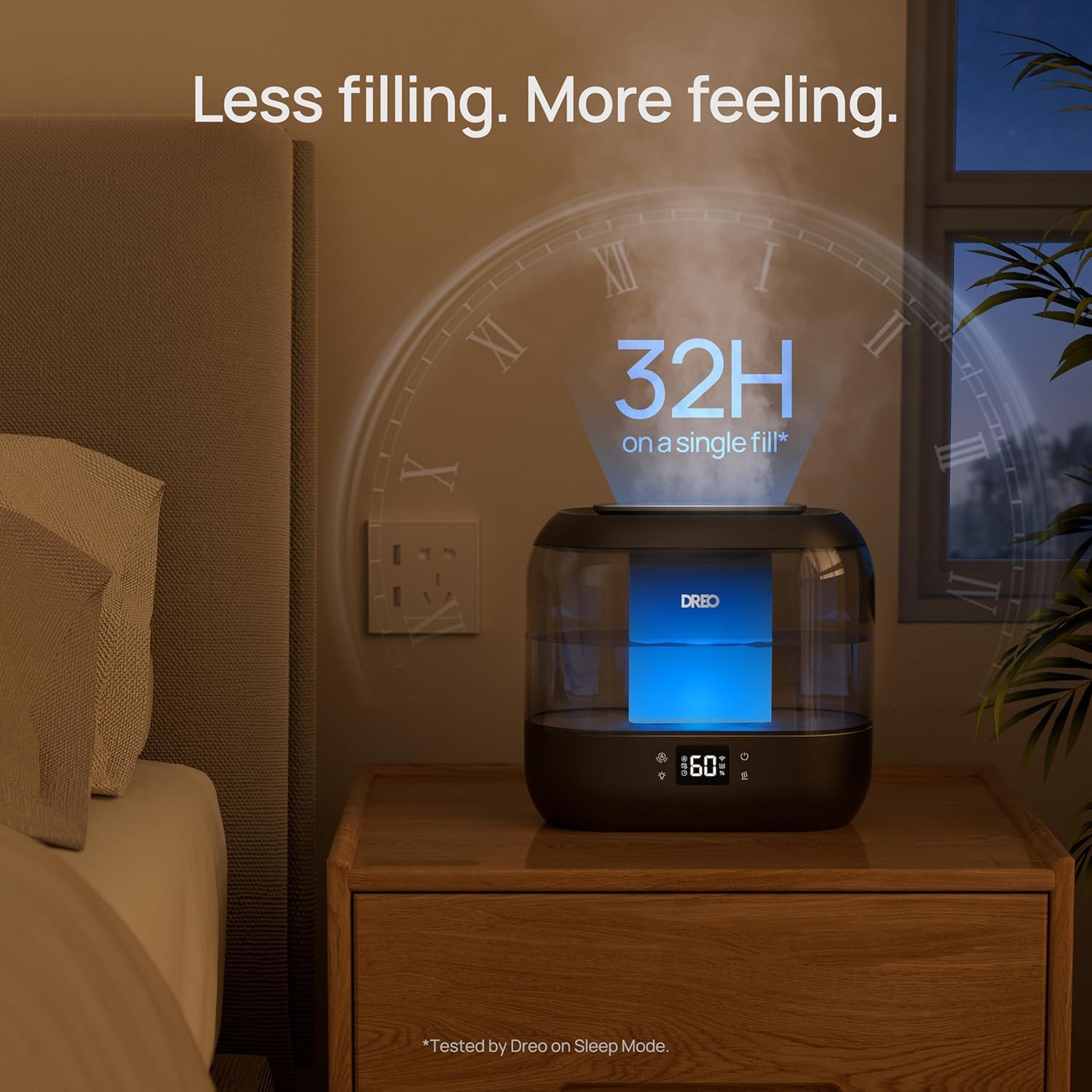
DREO’s 4L tank targets overnight runtime — refill once per day in moderate use. Top-fill removes the heaviest UX friction in the category. Smart humidity targeting closes the loop: measure, mist, stop — instead of guessing with a dial.

Top fill — why it sounds minor but is not
Bottom-fill tanks require removal, inversion, and alignment on reseat — every refill is a two-handed spill risk. Top fill lets you pour from a pitcher while the unit sits on a dresser. For parents refilling a nursery unit at midnight, that difference is not cosmetic.
Modular internals simplify scrubbing. Humidifiers that hide seams grow mould; accessible parts encourage weekly maintenance. The included brush is a hint: use it.
Water choice and the white dust problem
Ultrasonic mist carries dissolved minerals onto surfaces. In Toronto, Calgary, or anywhere with hard water, white dust on dark furniture is a known outcome with tap fill.
Amazon.ca reviewers who switched to distilled or RO water report the problem disappearing. Filter cartridges help but add ongoing cost. Budget water as part of ownership — not just electricity.
Smart humidity — useful when calibrated
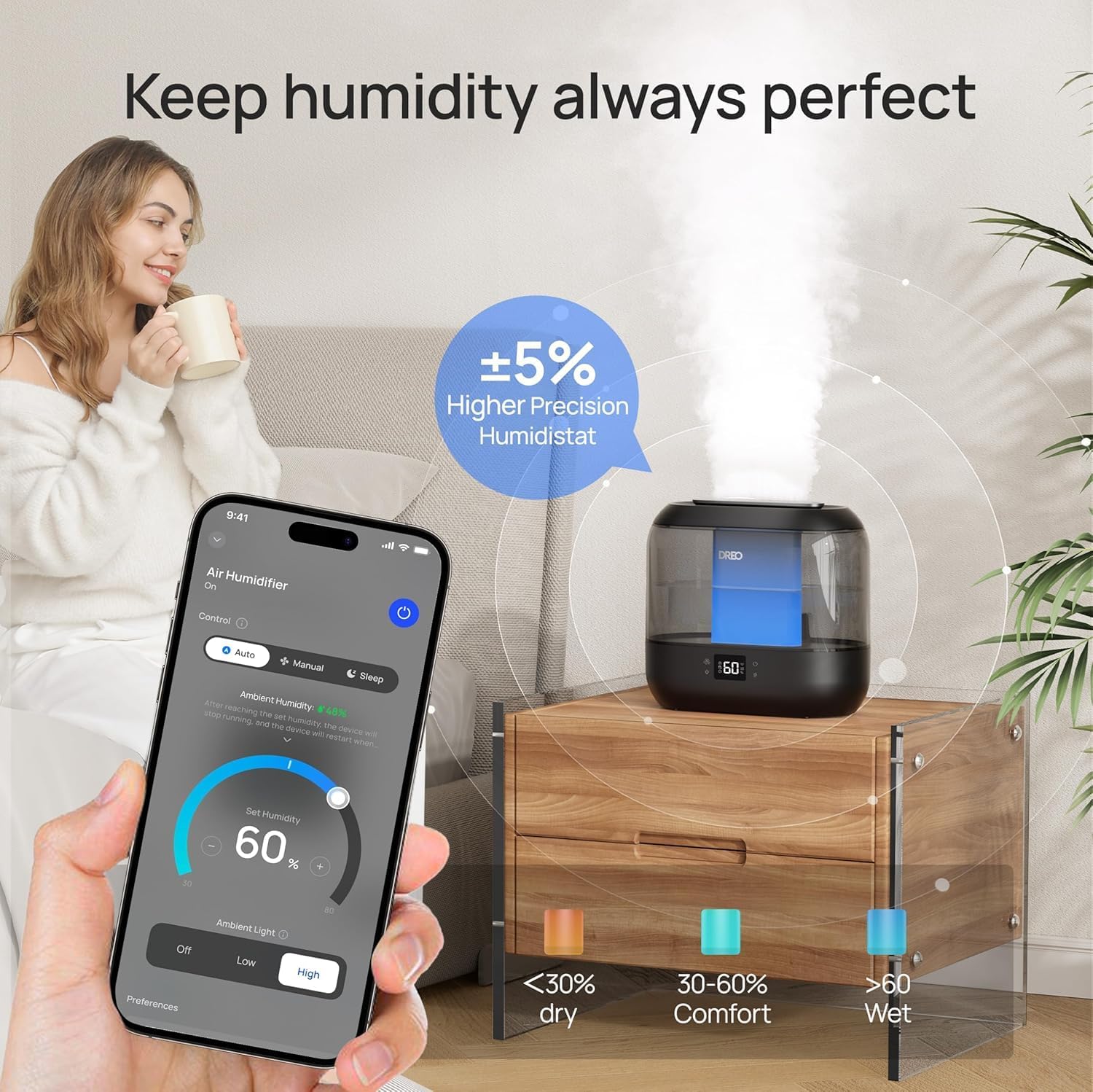
Setting 45% in the app and walking away beats manual mist blasting. The onboard sensor is room-local — humidity ten feet away may differ, which is normal. Auto mode works best in enclosed bedrooms; open doors dilute effectiveness.
Night light can be disabled — do this immediately if you sleep in darkness. Aroma pad use is optional; run plain water first until baseline comfort is established.
Winter bedrooms versus summer AC dryness
Canadian ownership often spans both extremes. February in Edmonton or Winnipeg can drop indoor humidity into the twenties without intervention — cracked lips, shocked pets, guitars going sharp. July in a Toronto condo with central AC can feel equally dry despite outdoor humidity. The same 4L unit addresses both: overnight mist in a closed bedroom restores comfort without steaming the whole home. Whole-house humidifiers exist for furnace integration; this unit is the room-scale answer when one sleeping space matters most or when renters cannot touch HVAC infrastructure.
What it gets genuinely right
- Genuinely quiet at sleep settings — the 28 dB claim holds up in owner reports.
- Top-fill convenience — fewer spills, faster refills, happier nightly routines.
- Long runtime on low — overnight and workday coverage from one fill.
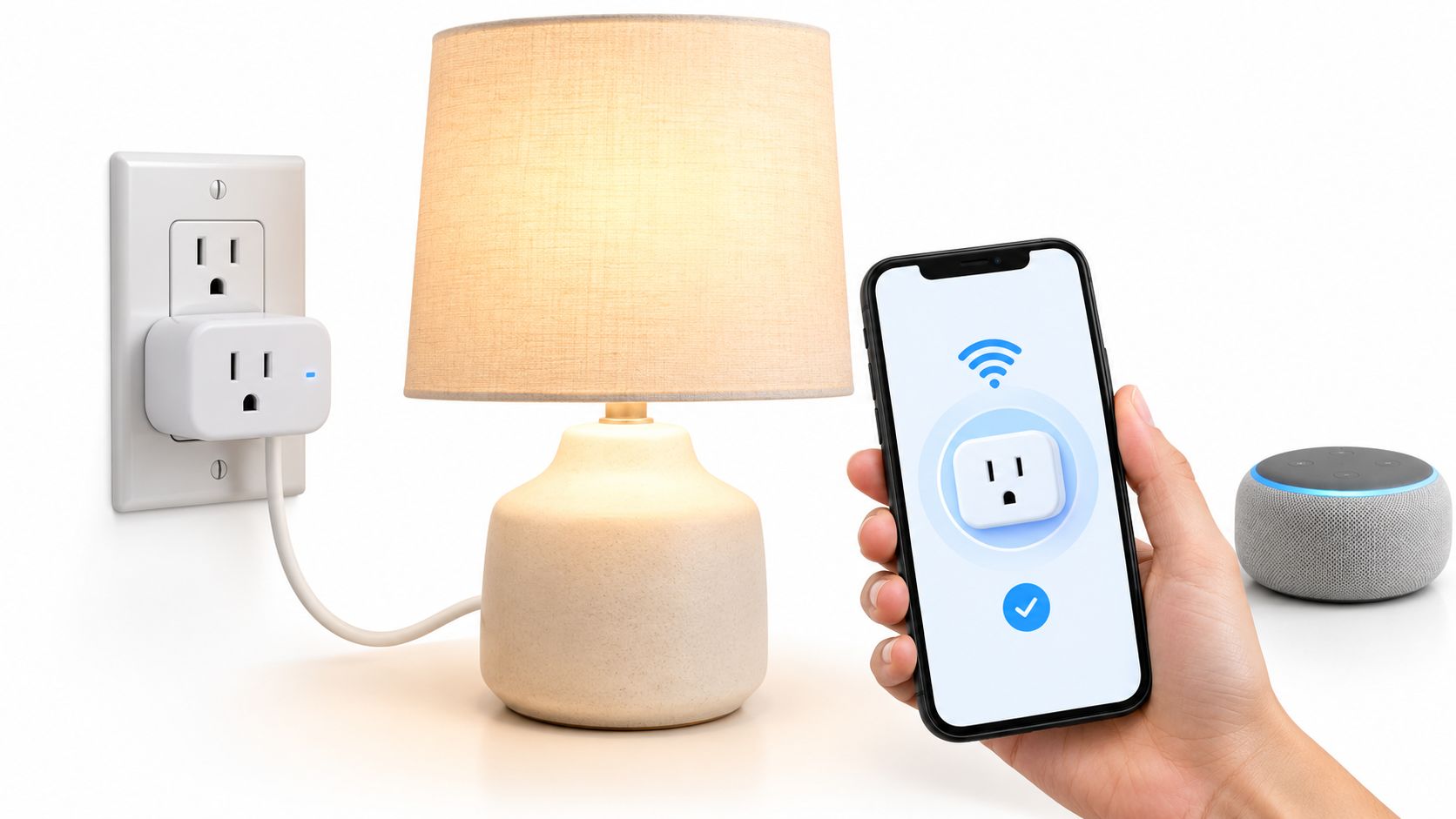
- Smart integration — Alexa, Google, and app control for hands-off adjustment.
- Compact footprint — dresser or nightstand friendly compared to whole-home units.
- Fine mist — even dispersion without soaking the floor when maintained properly.
Who should buy it — and who really shouldn't
This is your humidifier if you're:
- Fighting dry winter air in a bedroom, nursery, or home office
- Replacing an old bottom-fill unit you hate refilling
- Wanting auto humidity with app or voice control
- Willing to use filtered or distilled water and clean weekly
Walk away if you're:
- Humidifying a large open floor plan — a 4L unit may be undersized
- Needing warm mist for medical reasons — this is cool mist only
- Unwilling to maintain filters and gaskets — leakage risk rises without care
- Expecting zero ongoing cost — cartridges and water choices matter
The decision, in three honest questions
- Is my main problem dry air in one room while sleeping? If yes, capacity and quietness fit. Whole-home dryness needs a different scale of solution.
- Will I refill with decent water and clean it regularly? If yes, white dust and mould stay manageable. If no, frustration follows.
- Do I want smart humidity or is a manual dial enough? Smart features justify the price when you use them; ignore them and a simpler humidifier may cost less.
A few questions worth answering
How often do I refill the 4L tank?
On low mist in a bedroom, many owners go 24–36 hours. On high, plan for 12–16 hours — still overnight-capable.
Why is there water under the base?
Usually an improperly seated filter cap or gasket after cleaning. Reseat components dry, refill, and watch the first cycle. Persistent leaks warrant contacting DREO support — replacements appear in reviews.
Can I use tap water?
You can; hard water produces white dust. Distilled or filtered water is strongly recommended in mineral-heavy Canadian municipalities.
Does it work with Alexa and Google?
Yes — for power, mist level, and humidity targets once paired on 2.4 GHz Wi-Fi.
What does it cost in Canada?
Budget roughly $60–70 CAD on Amazon.ca; list near $79.99 with regular discounts to ~$69.99. Verify current pricing before buying.
Looking for buyer guides that tell you the trade-offs, not just the highlights? More honest, Canadian-focused gadget coverage lives at celmin.ca.
Sign up or sign in to join the conversation.