
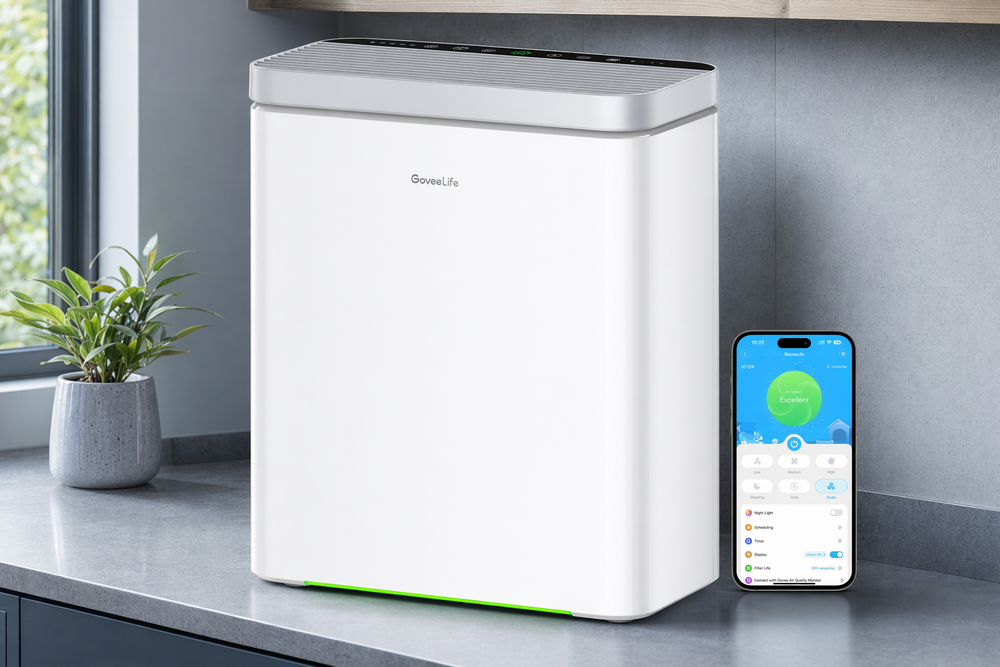

Canadian homes spend most of the year fighting the same invisible problem: air that never really gets refreshed. Winter means sealed windows, furnace dust, and wood-stove particulate drifting through the neighbourhood. Spring brings pollen you cannot see until your sinuses register it. Summer wil...
Canadian homes spend most of the year fighting the same invisible problem: air that never really gets refreshed. Winter means sealed windows, furnace dust, and wood-stove particulate drifting through the neighbourhood. Spring brings pollen you cannot see until your sinuses register it. Summer wildfire season turns the horizon hazy and sends you scrambling for anything that might scrub the bedroom before sleep. You are not imagining the throat tickle or the dust that returns two days after you wiped the shelf — the air inside is genuinely carrying more than you want to breathe.
The trap most people fall into is buying a purifier the way they buy a space heater: match the square footage on the box to the room label in their head and call it done. That approach fails quietly. A unit rated for 1,000 ft² in a lab does not guarantee clean air in your split-level in Calgary when bedroom doors stay closed and the furnace keeps mixing stale air between floors. Coverage numbers are ceilings, not promises — and two machines that look similar on a spec sheet can serve completely different jobs in real Canadian homes.
This field guide teaches the mechanics first — what PM2.5 actually measures, how CADR translates into usable airflow, and why air changes per hour matter more than marketing copy. Then we map two purifiers we have lived with and tested against those numbers: the GoveeLife Smart Air Purifier (sensor-led automation for medium-to-large rooms) and the TEBILD Air Purifier (big-zone airflow and washable economics). If you already know which philosophy fits your home — watch the air versus move more air cheaply — skip ahead to our companion essay, Smart Monitor vs Big Room: Two Ways to Purify Canadian Air. If you want the math first, keep reading.
What "clean air" actually means
Air purifiers do not manufacture fresh air. They pull room air through a filter, trap particulates and some gases, and exhaust cleaner air on the other side. Effectiveness depends on three ideas working together.
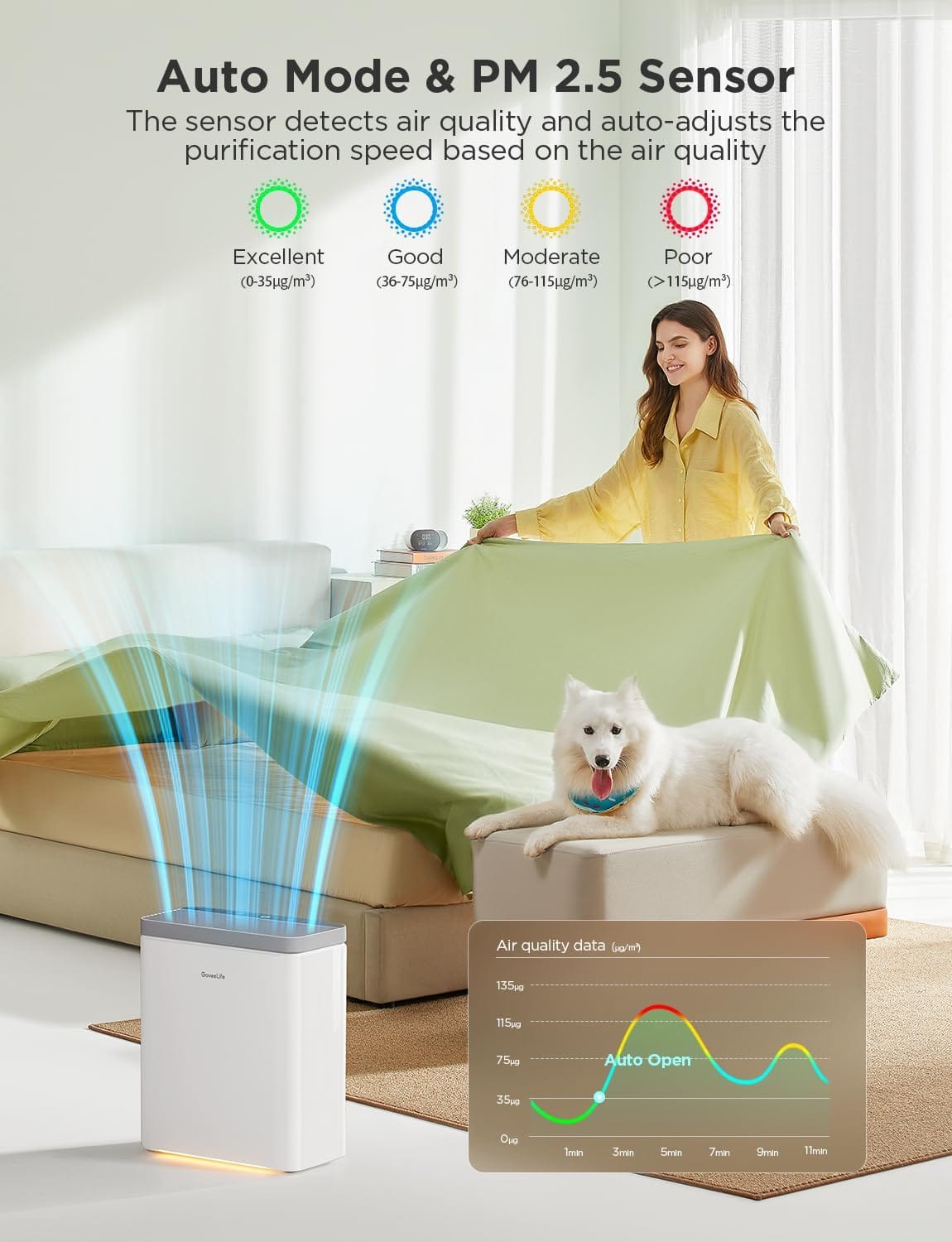
PM2.5 refers to fine particulate matter — particles 2.5 micrometres or smaller. That size range matters because these particles stay suspended long enough to travel from your kitchen into your bedroom, penetrate deep into lungs, and trigger allergy and asthma responses. Wood smoke, vehicle exhaust, cooking oil aerosols, and much pollen debris land in this category. A purifier with a PM2.5 sensor is measuring the problem you actually feel on bad air days, not abstract "air quality."
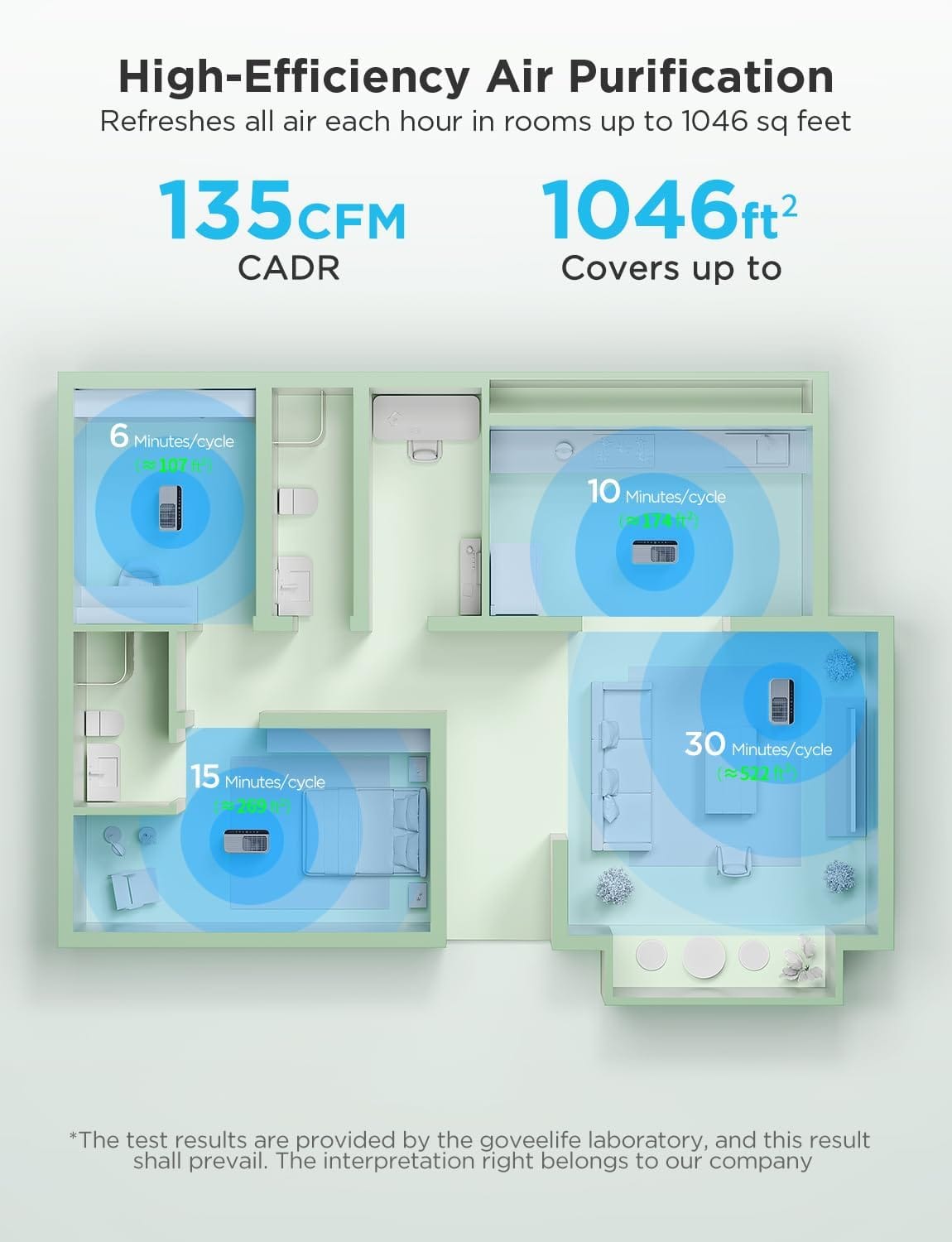
CADR — Clean Air Delivery Rate — is the industry standard for how much filtered air a unit pushes per minute. It is reported separately for smoke, dust, and pollen, though smoke CADR is the number most often quoted because it represents the smallest, hardest-to-capture particles. CADR is measured in cubic feet per minute (CFM) in North America. A higher CADR means the unit can process more room volume per hour — but only for the air that actually passes through the machine.
ACH — air changes per hour — is the number that ties CADR to your room. If a 400 ft² room with 8-foot ceilings holds roughly 3,200 cubic feet of air, and your purifier delivers 135 CFM CADR at maximum speed, you get about 2.5 air changes per hour in that single zone with ideal mixing. Marketing coverage figures usually assume one ACH at max CADR in a sealed space. That is why a "1,046 ft²" rating describes a theoretical ceiling, not a whole-house guarantee.
The practical takeaway: a purifier improves the air in the zone where it runs. Closed doors, open floor plans, stairwells, and HVAC circulation all change how quickly clean air reaches the room where you sleep. Physics always wins over the number printed on the box.
Filter types and the hidden cost of ownership
Most consumer purifiers in this price range use a three-stage stack:
Washable pre-filter — catches hair, pet fur, and large dust before it clogs the expensive core. Rinsing or vacuuming every two to four weeks is free maintenance that extends HEPA life. Both machines in this guide include one.
HEPA filter — the main capture stage. True HEPA (or H13/H14 marketing variants) claims 99.97% efficiency on particles down to 0.3 microns. That is the standard for pollen, fine dust, and smoke particulate. HEPA does not remove gases on its own.
Activated carbon — adsorbs odours and some volatile organic compounds: cooking smells, litter-box ammonia, mild smoke scent. Carbon saturates over time; when odours return despite a fresh-looking HEPA, the carbon stage is often spent.
Replacement cartridges are the real long-term price. A $130 purifier that needs $36 filters twice a year costs more over three years than a $110 unit with $30 replacements. Budget for consumables when you compare options — not just the Amazon checkout total today.
At a glance: GoveeLife vs TEBILD
| GoveeLife H7124 | TEBILD ZX001 | |
|---|---|---|
| Philosophy | Sensor-driven auto mode + app | Big-room airflow + simple controls |
| Claimed coverage | Up to 1,046 ft² (~97 m²) | Up to 2,500 ft² |
| CADR (approx.) | ~135 CFM | Higher airflow on turbo; exact CADR varies by listing |
| PM2.5 sensor | Yes — drives auto mode + app graphs | Yes — colour ring + auto fan |
| Smart features | Govee app, Alexa, schedules, RGB | Remote control; no Wi-Fi required |
| Noise | ~24 dB sleep; turbo audible | Sleep mode quiet; high speed noticeable |
| Filter cost (CAD) | ~$36–40 every 6–8 months | ~$30–35 every 6–8 months |
| Unit price (CAD) | ~$130–150 | ~$100–110 |
| Best room | Bedroom, nursery, open kitchen-living | Finished basement, large main floor, home office |
| Deep dive | Living with GoveeLife | Living with TEBILD |
Neither row declares a winner. They solve different problems. The table tells you where to aim each machine — not which brand to cheer for.
GoveeLife Smart Air Purifier: the sensor-led bedroom companion
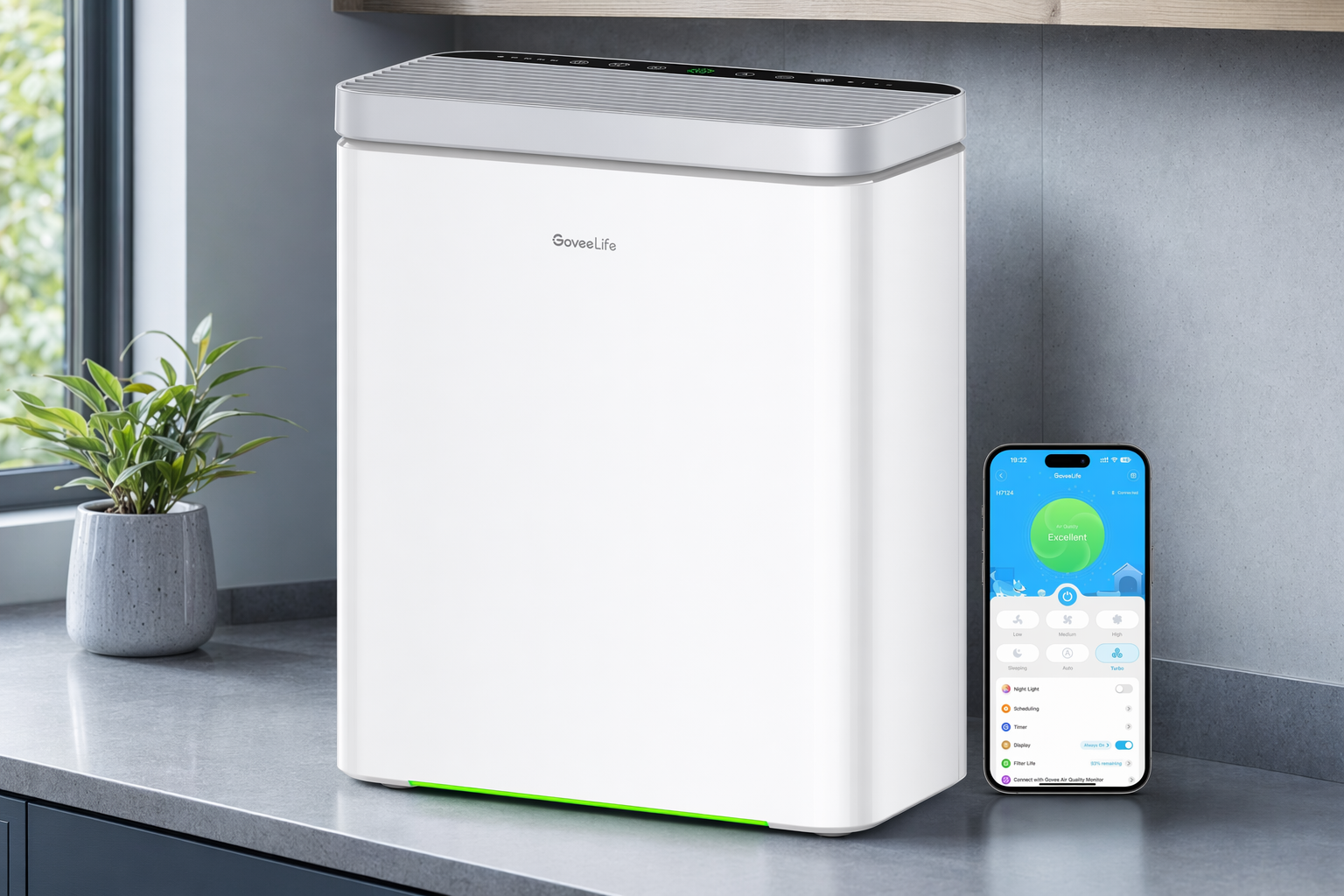
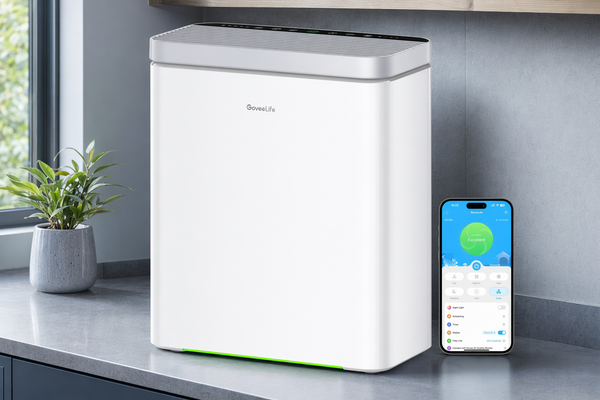
The GoveeLife Smart Air Purifier is built around a closed loop: measure PM2.5, adjust fan speed, report back to your phone. At roughly $130–150 CAD with H13 HEPA filtration and a claimed 1,046 ft² coverage ceiling, it punches above its price tier on features — especially if you want set-and-forget automation in a room where you actually sleep.
The unit's personality is the PM2.5 sensor on the front. In auto mode, the fan ramps when particulate levels spike — after frying bacon, when the dog shakes out, during a mild smoke event — and eases off when the air stabilizes. That behaviour saves noise and power compared to running high all day. The Govee app adds historical graphs, filter-life percentage, schedules that dim the RGB ring at night, and Alexa voice control if you already live in that ecosystem.
Placement matters more than the coverage headline. With ~135 CFM CADR, the GoveeLife has believable headroom in a 400 ft² living room with normal ceilings — roughly two-plus air changes per hour at max speed in that zone alone. Park it in a hallway expecting the upstairs to follow, and you will wonder why the machine "does not work." Put it in the bedroom with the door closed during allergy season, and particulate levels drop in ways the app can show you.
Sleep mode is genuinely bedroom-friendly — a soft hum rather than a appliance roar — provided you schedule the lights off. Turbo mode is a different story: loud, effective, and correct for wildfire afternoons when windows stay shut.
The honest friction points are predictable. Wi-Fi setup requires 2.4 GHz; the unit does not join 5 GHz networks. Replacement filters run ~$36–40 CAD every six to eight months — search "GoveeLife H7124 replacement filter" on Amazon.ca for the official cartridge. Advanced automations in the Govee ecosystem sometimes expect a separate air-quality monitor even though the purifier already has a sensor — a quirk power users notice, casual users rarely do.
Who it fits: pet owners and mild allergy households targeting one large room or open kitchen-living zone; renters who want measurable feedback without premium-brand pricing; anyone already running Govee lights or sensors who values a single app.
Who should look elsewhere: whole-house purification fantasies on one unit; people who refuse apps and Wi-Fi setup; buyers who need the lowest filter cost over five years.
For the full ownership picture — filter math, auto-mode quirks, wildfire-week tactics — read our GoveeLife honest buyer guide.

TEBILD Air Purifier: big-zone airflow without the app tax
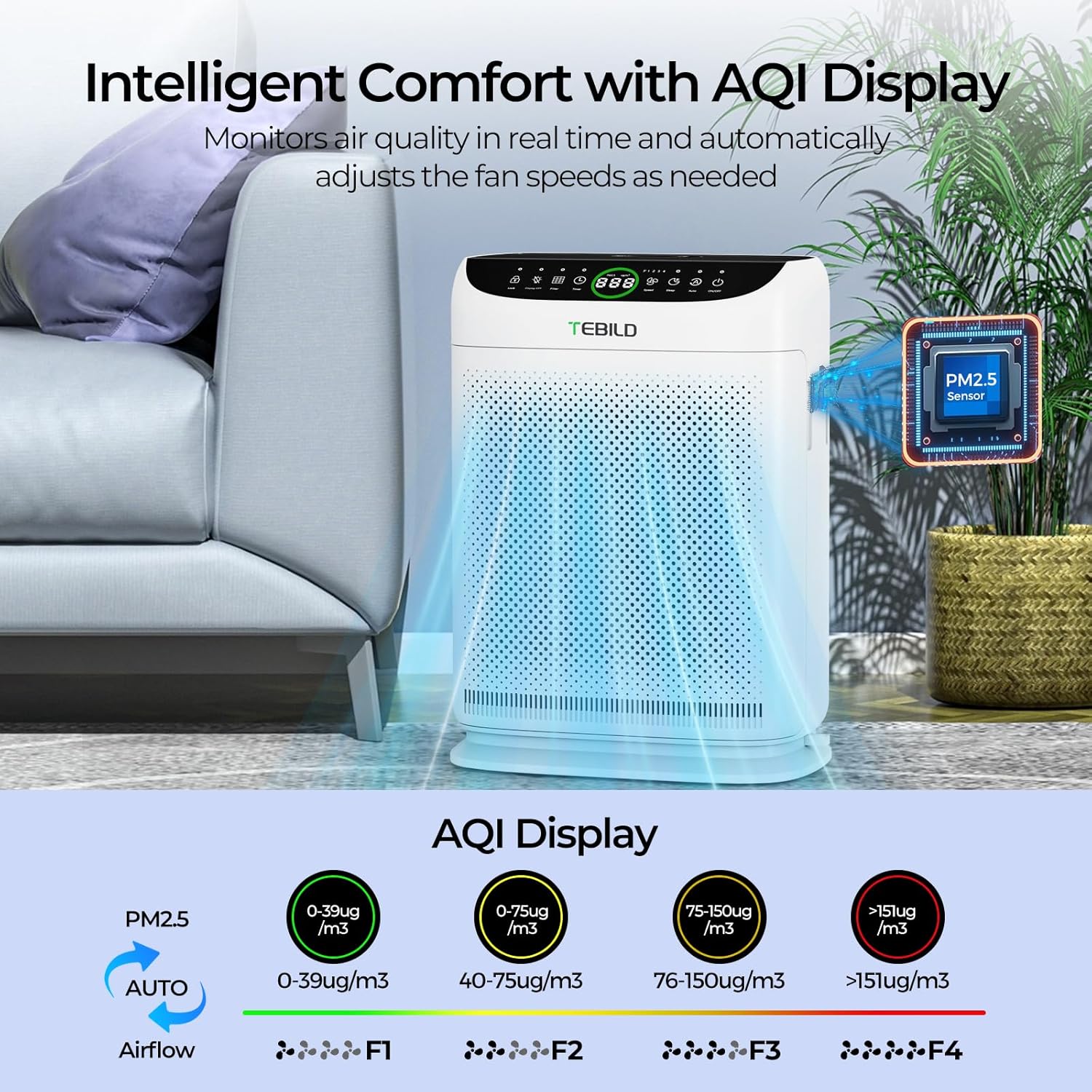
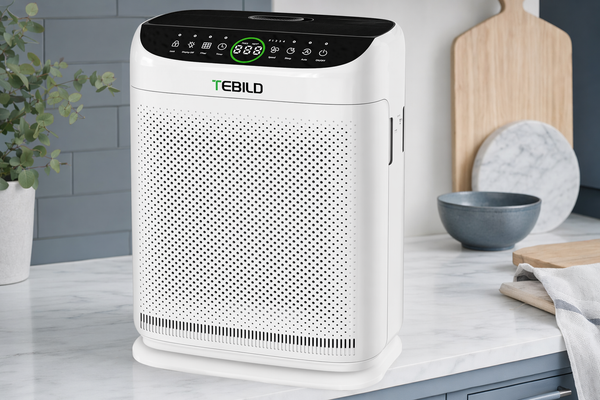
The TEBILD Air Purifier takes a different bet: move more air through a dual-sided intake, show you PM2.5 on a colour ring, and skip the Wi-Fi pairing dance entirely. The headline number — 2,500 ft² claimed coverage — is designed to stop scrollers mid-swipe. The honest use case is a large single zone: finished basement, open main floor, big home office, daycare playroom.
At ~$100–110 CAD, TEBILD undercuts established brands while still shipping HEPA filtration, activated carbon, a washable pre-filter, auto mode, sleep mode, a 12-hour timer, and a remote control (stored inside the unit on arrival — check the cavity before assuming it is missing). No app means no 2.4 GHz troubleshooting. Touch panel plus remote is the entire interface.
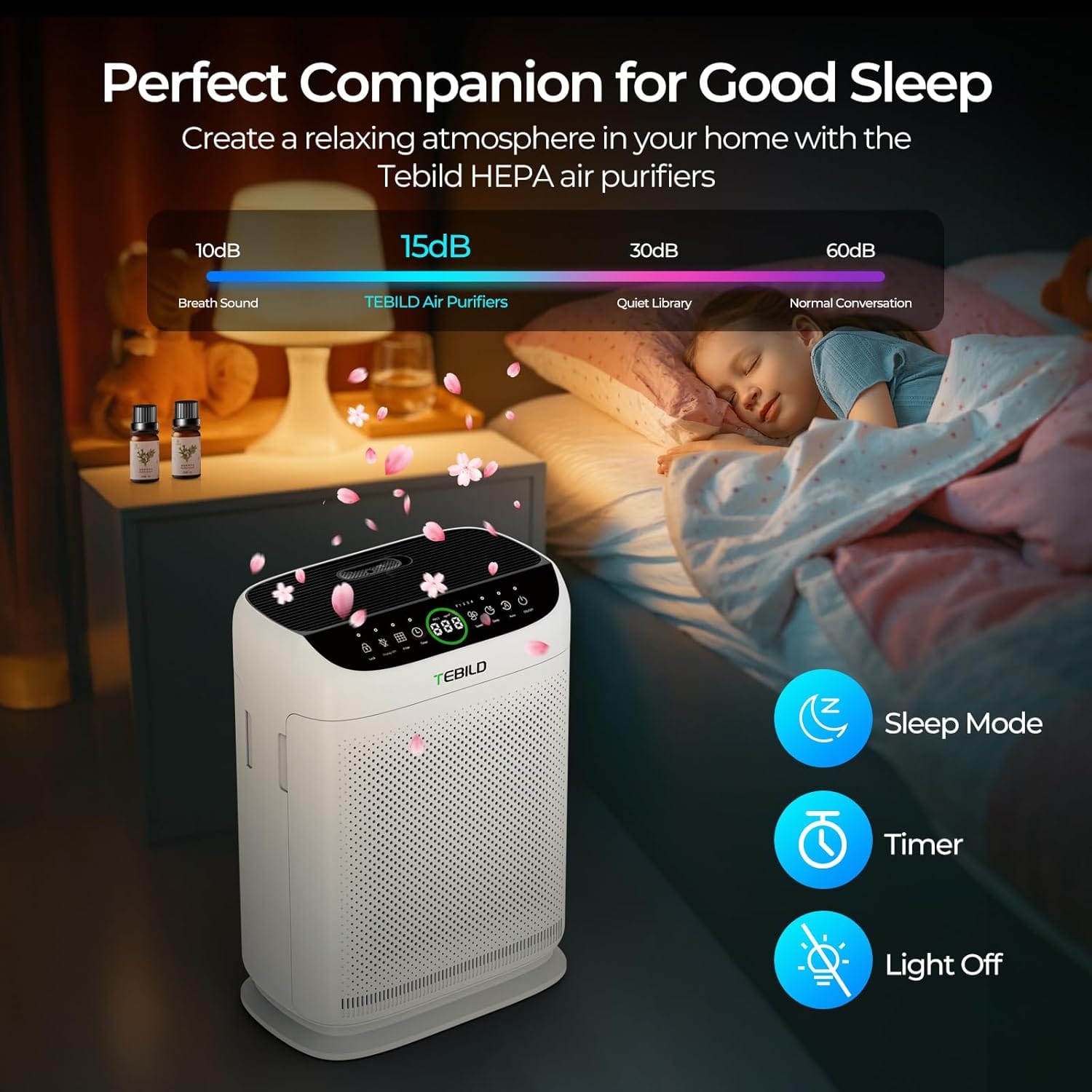
The engineering emphasis is airflow architecture. Dual intakes pull from both faces of the tower; high fan speeds move a visible volume of air when auto mode detects elevated PM2.5. Cooking sends particulate readings spiking — the unit responds loudly, which is correct behaviour, not a defect. Wildfire weeks follow the same pattern: close windows, run turbo in the zone where you spend time, accept that upstairs bedrooms with closed doors lag behind the main floor.
Translate the 2,500 ft² claim the same way you would any coverage figure: one ACH at maximum CADR in ideal conditions. A truly open 2,000 ft² main floor will see gradual improvement away from the unit; a 600 ft² basement suite will cycle aggressively. Buyers who size for 600–1,000 ft² of real breathing space report the best satisfaction — not because the machine underperforms, but because expectations match physics.
Filter economics favour long ownership. Replacement cartridges around ~$30–35 CAD every six to eight months beat many premium brands on consumable cost. Wash the pre-filter regularly; vacuum HEPA housing when you change seasons.
Who it fits: basement finishing projects; pet households with litter-box odour in a large open area; buyers who want buttons and a remote, not another app; budget-conscious shoppers who still refuse to skip true HEPA and a real sensor.
Who should look elsewhere: multi-storey whole-home expectations on one box; brand-loyal buyers uncomfortable with a lesser-known manufacturer; anyone who needs Alexa routines and historical PM2.5 graphs on their phone.
The TEBILD honest buyer guide covers placement math, aromatherapy tray opinions, and warranty details we will not repeat here.
How to size one purifier for your room
Start with volume, not floor area alone. Multiply square footage by ceiling height to get cubic feet. Divide your target CADR by that volume to estimate air changes per hour at max speed. For allergy sufferers, aim for two or more ACH in the room where you sleep — which often means choosing a unit with headroom above the marketing minimum, or accepting that you will run higher fan speeds more often.
A rough rule from allergists and HVAC technicians: take your room's square footage and divide by two when shopping if you have pollen, pet, or dust sensitivity. A 300 ft² bedroom wants a machine marketed toward at least 600 ft² of coverage at one ACH — then run auto mode and close the door at night.
Open floor plans need placement, not hope. Position the purifier where air mixes naturally — central to the zone you inhabit, not tucked in a dead corner behind a couch. Stairwells and HVAC returns steal mixing efficiency; a second unit on another floor beats one heroic tower every time.
If you are still torn between sensor automation and big-room economics after the math, our philosophy essay Smart Monitor vs Big Room walks through scenarios — bedroom allergy, open basement, wildfire week — without turning into a spec-sheet shootout.
Who should skip both
Some problems consumer purifiers were never designed to fix.
Whole-house HVAC mindset — If you want every room normalized simultaneously, you need duct-mounted filtration or multiple portable units — not one Amazon box in the living room.
Tiny closets and powder rooms — Under 100 ft² spaces do not need a tower purifier; ventilation or a smaller desktop unit suffices.
Silent obsession on a filter budget of zero — Both machines need cartridge replacements. A clogged HEPA is an expensive fan.
Radon, mould remediation, and medical-grade needs — Consumer HEPA helps with particulate and odour; it does not replace professional mitigation or specialist equipment for severe respiratory conditions. Consult a clinician for clinical air requirements.
Ionizer-only "purifiers" — If a listing does not specify true HEPA and CADR, assume marketing smoke.
Frequently asked questions
Can one purifier clean my whole home?
One unit cleans the zone where it runs first. Closed doors slow mixing between floors and rooms. Treat portable purifiers as room or zone tools — bedroom, nursery, open main floor — not central HVAC replacements. Multi-storey homes benefit from multiple units or adjusted expectations.
Do these help during Canadian wildfire smoke?
Yes, for particulate reduction and smoke odour in a closed room — not as respirator-level protection. Close windows, run turbo during peak smoke, and understand that outdoor air quality events stress filters faster. Replace cartridges sooner after heavy smoke weeks.
How often should I replace filters?
Plan every six to eight months for typical use with both machines. Wash pre-filters every two to four weeks. Pet-heavy homes, constant turbo, and wildfire season shorten HEPA life. Use each unit's filter indicator — app percentage on GoveeLife, time-and-use judgment on TEBILD — and inspect visually when seasons change.
GoveeLife or TEBILD — which should I buy?
Choose GoveeLife if you want app graphs, Alexa, and sensor-led set-and-forget in a bedroom or medium open zone near ~$130–150 CAD. Choose TEBILD if you need aggressive airflow in a large single space, prefer remote-and-buttons simplicity, and want lower filter costs near ~$100–110 CAD. For the decision framed as lifestyles rather than specs, read Smart Monitor vs Big Room.
The bottom line
Buying an air purifier in Canada is less about finding the "best" brand and more about matching CADR, sensor behaviour, and filter economics to the room where you actually breathe. The GoveeLife earns its place with PM2.5-driven automation and smart-home integration at a price that leaves budget for replacement cartridges. The TEBILD earns its place with big-zone airflow, washable pre-filter habits, and operation that never asks you to debug Wi-Fi.
Learn the numbers. Size for your real zone. Budget for filters. Then pick the philosophy that fits — or read both deep dives and let your floor plan decide.
Discussion
Sign up or sign in to join the conversation.