
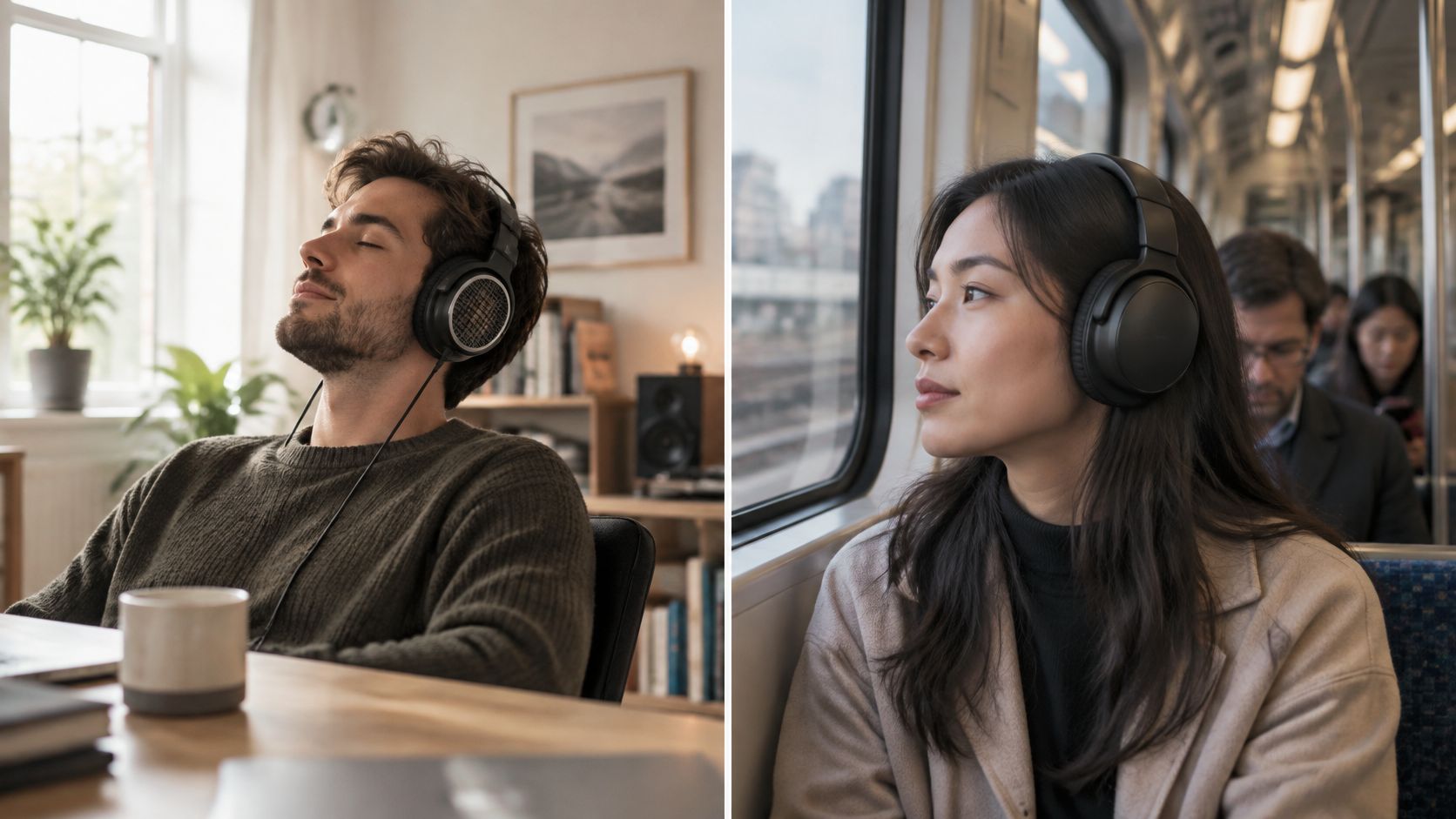
You're on the condo sofa with an album playing, your partner's asleep in the next room, and tomorrow's train ride promises another loud neighbour. The headphones that make that album feel spacious at home may be the wrong pair for both your partner and your commute. With open back vs closed back headphones, the useful starting point isn't which design sounds more impressive. It's who else will hear your music, and what you need to hear around you.
Table of Contents
- Open Back and Closed Back at a Glance
- How Ear Cup Design Sets Isolation and Leakage
- Soundstage, Tone and Room Feel
- Hearing Safety Depends on Volume, Not the Label
- Matching the Design to Canadian Homes and Commutes
- Fit, Comfort and Winter Wear
- Choose Your Headphone Design Before You Buy
Open Back and Closed Back at a Glance
Open-back and closed-back headphones compared at a glance
| Criterion | Open-back | Closed-back |
|---|---|---|
| Passive isolation from outside noise | Low | High with a good seal |
| Sound leakage to nearby people | High, by design | Low with a good seal |
| Soundstage and spaciousness | Usually wider | Usually narrower, more intimate |
| Awareness of surroundings | Good, but playback can mask sounds | Reduced |
| Microphone bleed on calls | Higher risk | Lower risk |
| Best setting | Quiet room, private desk | Condo, office, transit, shared space |
Choose closed-back for shared or noisy spaces, and open-back for a quiet, private room. That's the most useful default, not a guarantee that every model will perform equally well.
Open-back headphones have vented or porous outer cups that let outside sound in and playback out. Closed-back headphones use enclosed cups and ear pads to create an acoustic seal, increasing isolation and privacy when they fit properly.
Choose for the room you actually use
A shared sofa is a demanding place for open-back listening. Someone beside you may hear the rhythm, vocals or dialogue even when you're comfortable with the volume. A closed pair is the more considerate starting point, particularly when the room is otherwise quiet.
A private desk changes the calculation. If nobody nearby needs silence and household noise is modest, you can enjoy an open design without asking it to do something it wasn't built for.
Neither label describes a quality tier. Open and closed describe construction, not how accurately a headphone reproduces music. A well-tuned closed pair can be a better purchase than a poorly tuned open pair, especially if the latter forces you to listen through background conversation.
Also separate your priorities. Wanting privacy isn't the same as wanting to shut out your surroundings. You might need to keep call audio away from a partner while still noticing the doorbell. That requires a deliberate listening arrangement, rather than buying whichever pair blocks the most sound.
Buying rule: Choose the enclosure for your environment, then choose the exact model for its sound and fit.
Start with these questions:
- Shared listening space: Will anyone else hear or share the room while I listen?
- Environmental awareness: Do I need to hear people, alerts or activity around me?
Those answers will usually narrow the choice more effectively than a promise of bigger bass or a wider soundstage.
How Ear Cup Design Sets Isolation and Leakage
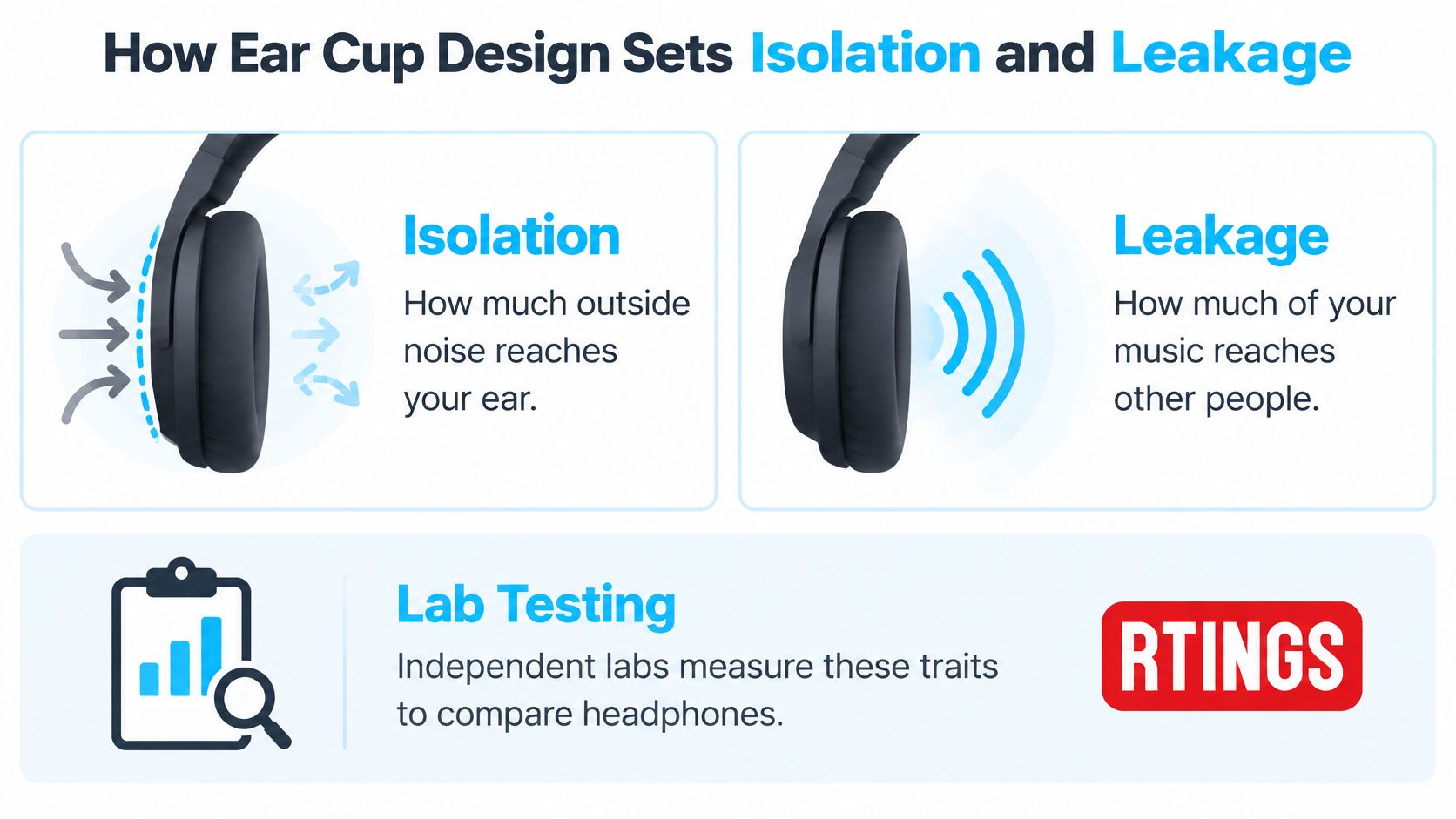
Isolation is how much outside noise the headphones keep from reaching your ears. Leakage is how much of your playback reaches other people. They're related, but they aren't interchangeable measurements.
A headphone can reduce some incoming sound without keeping every detail of your music private. Likewise, an isolation graph doesn't tell you exactly what a nearby microphone will capture.
The distinction is easiest to understand visually.
What laboratory results tell you
RTINGS' isolation testing describes leakage measurements using a sine sweep, a microphone positioned 0.5 ft from a dummy head, five reseated measurements per ear, and results normalized to 1 ft across 100 Hz to 20 kHz. Its representative isolation results include the following attenuation ranges within the speech-presence band.
Measured attenuation in the speech band
| Headphone | Design | Attenuation in speech range | Band |
|---|---|---|---|
| Sony MDR-7506 | Closed-back | 27.5 to 30.3 dB | 3.07 to 3.87 kHz |
| AKG K712 Pro | Open-back | 1.6 to 6.9 dB | 3.07 to 3.87 kHz |
These are incoming-noise attenuation results, not measurements of how much music escapes. Higher attenuation means less external sound reaches the listener at the tested frequencies.
The speech-presence region matters because it contributes to how clearly you perceive voices and consonants. But conversation spans a broader range, so these results don't establish that one model will eliminate speech. They also can't tell you whether someone beside you can identify the podcast you're playing. For that, examine leakage results or perform a listening check.
Fit is part of the acoustic design
A closed cup needs a continuous pad contact around your ear. Glasses arms, hair caught underneath the cushion and flattened pads can interrupt that contact. A strong laboratory result is therefore a starting point, not a promise about the fit on your head.
When comparing closed-back headphones, check both the measured isolation and the pad construction. Look for cushions that surround your ears without resting awkwardly on them, and enough adjustment to keep the cups level.
- For conversation nearby: Inspect isolation across the speech frequencies, not just an overall score.
- For playback privacy: Look for a separate leakage measurement and test your usual content.
- For noisy travel: Check low-frequency isolation as well, since strong speech-band attenuation doesn't establish how well a pair handles rumble.
Active noise cancelling isn't a leakage fix. It can reduce incoming noise, but it doesn't close a vented cup or repair a gap beneath an ear pad.
Soundstage, Tone and Room Feel
Open-back headphones don't automatically sound better. Their spacious presentation can be appealing, but spaciousness and accuracy aren't the same thing. A headphone can place instruments convincingly while still making vocals too sharp or bass too light for your preferences.
The cup construction is visible, but the tuning isn't.
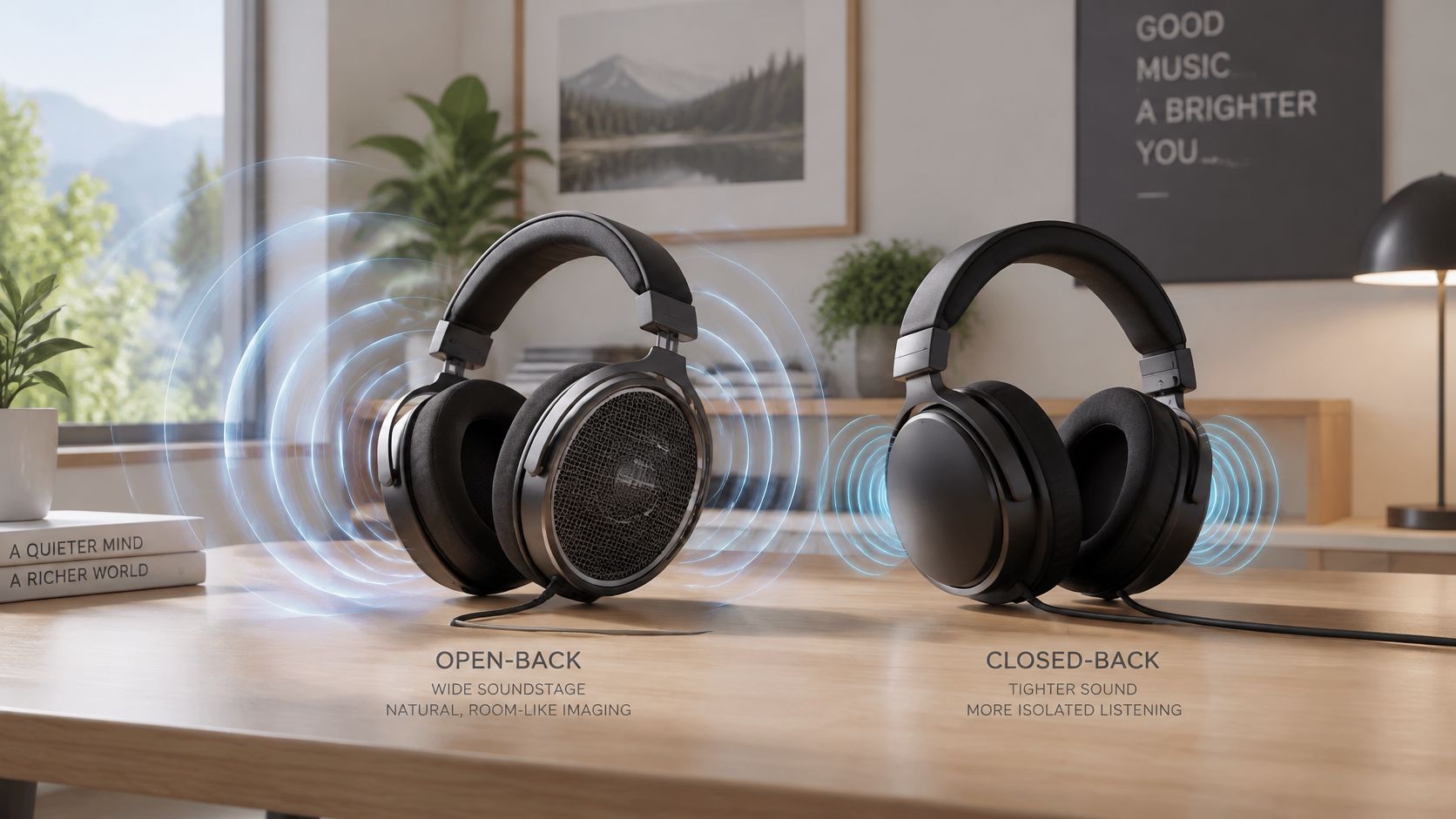
Soundstage describes the perceived space around recorded sounds. Open designs often provide a less enclosed presentation because their vented construction changes the acoustic conditions around the driver. That doesn't turn headphones into room speakers, and it doesn't guarantee precise placement.
Closed models often sound more intimate. Some also have a bass-forward tuning that listeners enjoy, but a sealed enclosure doesn't guarantee stronger, deeper or better-controlled bass. Treat those as model-specific characteristics.
Compare models rather than reputations
The practical setting advice in Best Buy Canada's quiet-study headphone guide reinforces the trade-off: an open design belongs in a quiet environment where its lack of isolation won't undermine listening. Household ventilation, conversations and heating noise don't disappear because a headphone has an audiophile reputation.
Models such as the AKG K712 Pro and Audeze MM-100 need their own frequency-response, distortion and fit assessments. Their shared open-back construction doesn't establish a universal tonal advantage. Driver implementation, pad geometry and tuning remain important.
For a useful audition:
- Use familiar recordings: Include natural speech, a dense arrangement and a track with sustained low bass.
- Match perceived loudness: Adjust each pair separately so the louder one doesn't win by sounding more forceful.
- Check specific weaknesses: Listen for sharp consonants, recessed vocals, indistinct bass and instruments that become difficult to separate.
- Inspect the exact model's graphs: Don't substitute measurements from a related version or another headphone in the same series.
The broader construction differences are also useful to hear discussed.
At a quiet desk, spatial presentation can materially affect enjoyment and monitoring decisions. On a bus, intelligibility and noise control usually deserve more attention than subtle spatial differences. Podcasts don't need an expansive stage to remain clear.
Connection type is another separate decision. Our wired versus wireless sound-quality guide helps distinguish that choice from enclosure design, so you don't mistake a cable or wireless feature for evidence of better tuning.
Hearing Safety Depends on Volume, Not the Label
Isolation isn't hearing protection, and a sealed cup doesn't make loud playback safe. Open-back headphones are not automatically safer either. The relevant questions are how much sound reaches your ears and how long you listen.
Health Canada's hearing-loss guidance provides the exposure reference points below, and its student headphone study found that 3.2% exceeded the common occupational reference of 85 dBA over 8 hours at their maximum usual volume, while 77.6% remained below the 75 dBA-for-8-hours level.
Canadian exposure reference points for headphone listening
| Sound level | Duration | Health Canada reference |
|---|---|---|
| 75 dBA | 8 hours per day | No known permanent-hearing-loss risk |
| 85 dBA or higher | 8 hours per day | Can pose a significant risk of hearing loss |
| 100 dBA | About 15 minutes | Potentially hazardous level |
These are exposure reference points, not targets to use up. Your ears also encounter sound outside headphone sessions, and the volume slider on a player isn't a calibrated measure of sound at your eardrum.
How your environment changes your habits
The student study measured headphone output with realistic rubber ears and microphones positioned where the eardrums would be. That matters because a listener's impression of their volume setting isn't the same as a measured exposure.
On transit, competing noise can tempt you to raise playback until every quiet passage is audible. Effective closed-back isolation may reduce that temptation. But you can still select an unsafe level inside a well-isolated cup.
Open designs create a different trap: they can sound comfortable in a quiet room, then encourage higher settings when someone starts a conversation nearby or a fan comes on. Don't use extra volume as a substitute for a suitable listening environment.
Comfortable ear pads and an airy presentation don't establish that your listening level is safe.
Build a repeatable listening routine
- Start low in a quiet place: Set a comfortable baseline before entering a noisy environment, rather than adjusting against the noise immediately.
- Use exposure tools where supported: Check your device's headphone-level monitoring and volume-limit controls. Treat estimates cautiously when the device doesn't know the connected headphone's output.
- Shorten louder sessions: Take listening breaks and reduce level rather than assuming a different enclosure removes the risk.
- Check before commuting: A saved setting from yesterday's quiet recording may be unnecessarily loud for today's content.
An ordinary music headset also isn't a substitute for designated hearing protectors where workplace protective equipment is required. Buy protection for hazardous noise as a separate safety decision, not as an extra feature you assume your music headphones provide.
Matching the Design to Canadian Homes and Commutes
Say your condo's desk sits near the bedroom door. During the day, your partner works beside you; at night, they're trying to sleep while you finish a film. The useful test isn't whether your headphones sound open and natural. It's whether the dialogue remains audible where your partner sits or sleeps.
Leakage is a household problem before it's a sound problem.
The Canadian Centre for Occupational Health and Safety's telework guidance recommends addressing noise through room isolation or headphones and choosing a workspace away from living-area distractions. In a compact home, that means considering the room arrangement alongside the headphones.
Different listening locations create different compromises.
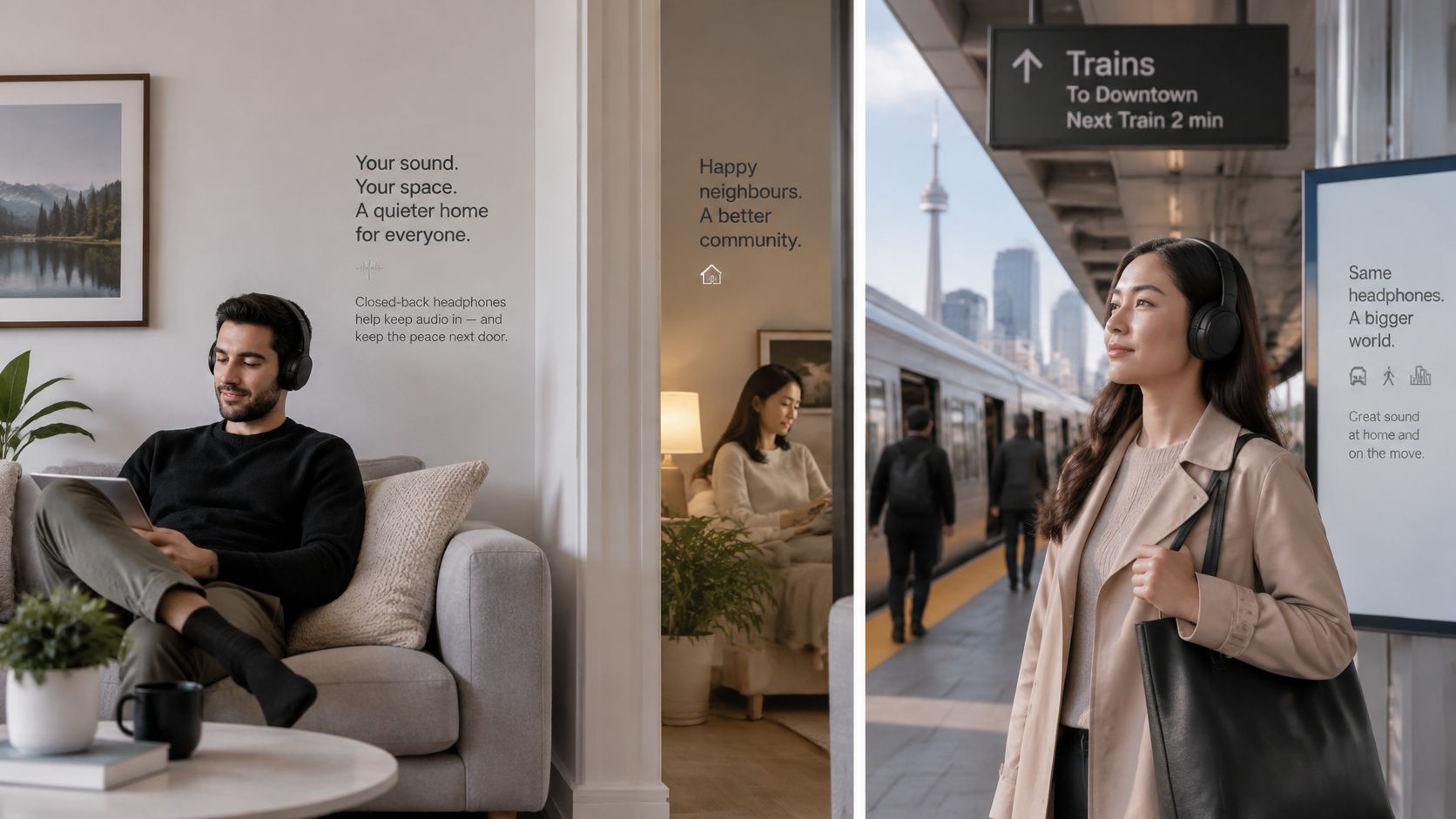
A practical household walkthrough
In a shared bedroom, start with closed-back and test with speech-heavy content. Don't assume headphone leakage travels through walls like a loudspeaker, but don't assume a bedroom door makes nearby playback inaudible either.
At a home-office desk, record a sample call using your normal microphone position. Play incoming speech through the headphones while leaving your own microphone open, then listen to the recording. Software echo control may help, but it shouldn't be your only defence against audible playback.
Around children or household alerts, arrange an explicit way to stay reachable. Neither open cups nor a transparency mode guarantees you'll notice an alarm while music is playing. Pause playback for important conversations rather than relying on partial audibility.
On transit, closed-back is the practical starting point, but passive isolation alone may leave substantial rumble. In a library, prioritise low leakage even when the room itself is quiet. On a café patio, wind, conversation and nearby tables make an open design difficult to justify.
Test where other people will be
Use your usual listening level and ask someone to check audibility at the same desk, an adjacent sofa and a neighbouring room. Include spoken dialogue as well as music, since recognisable words can be more distracting than indistinct sound.
Repeat the microphone test with the application you use for calls. A voice-recorder test and a video-call application may process incoming audio differently.
If over-ear cups are awkward to carry or don't suit your commute, compare in-ear headphones as another form factor. Judge their fit, isolation and awareness trade-offs separately rather than assuming smaller means more suitable.
Fit, Comfort and Winter Wear
A wool toque can undermine an otherwise good closed-back fit. Fabric beneath the pad can hold part of the cushion away from your head, changing both isolation and bass. Moving the headband over the hat won't solve that if thick material still sits under the ear cups.
Winter fit needs to be checked with the clothing you wear, not just with bare ears in a shop.
Winter fit problems, causes and fixes
| Winter situation | Effect on fit | Fix |
|---|---|---|
| Wool toque beneath the cups | Fabric can lift the pads and interrupt the seal | Try thinner fabric around the ears or position compatible cups directly against the skin |
| Thick glasses arms under the pad | A gap can reduce isolation and alter bass | Try more compliant, manufacturer-compatible pads and check for pressure points |
| Vented open-back cups in a cold room | Ears may feel less insulated | Warm the room or add a neck warmer without obstructing the cups |
| Worn or cracked cushions in dry air | Uneven cushions can weaken contact and comfort | Replace damaged pads with the intended compatible parts |
Check pressure as well as seal
Clamp force needs balance. Too little can leave the cups unstable; too much can press glasses into your temples or create jaw discomfort. Added weight can also become irritating during a long desk session, even when the first impression is comfortable.
Pad material affects warmth and feel, but swapping materials isn't acoustically neutral. A thicker or more breathable aftermarket pad can change the distance between your ears and the drivers, the seal and the resulting tone. Don't treat pad swapping as a guaranteed comfort upgrade.
Open-back ventilation may feel pleasant in a warm office and less welcome in a chilly room. That's a comfort preference, not a reason to cover the vents with fabric or modify the enclosure.
Use a gentle seal check
Put on a closed pair normally, move hair away from the cushions and play familiar bass-rich music at a modest level. Press the cups inward gently without covering any ports or controls.
- A clear bass increase: The original fit may have had a leak. Reposition the cups and repeat with your glasses and winter clothing.
- Little change: The existing seal may already be good. This result alone doesn't identify an open design or prove a fitting problem.
- Pain or excessive pressure: Stop pressing. A seal that only works with uncomfortable force isn't a workable fit.
Before committing, confirm that you can order replacement pads in Canada. Buy the headphones only if their ongoing fit is maintainable, rather than assuming cushions will remain comfortable indefinitely.
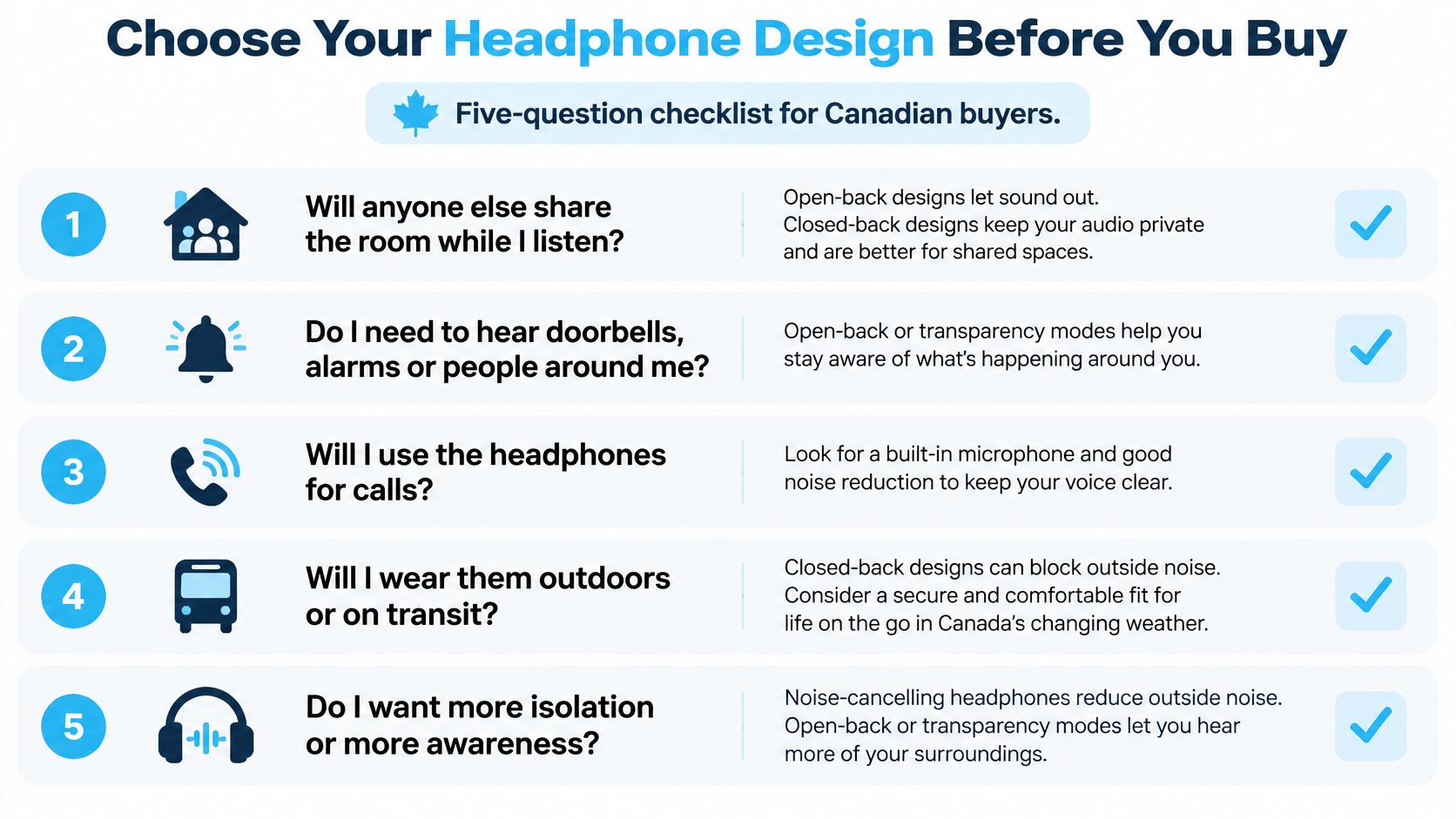
Choose Your Headphone Design Before You Buy
Answer these questions before comparing product listings:
- Shared room: Will anyone else share the room while I listen?
- Awareness: Do I need to hear doorbells, alarms or people around me?
- Calls: Will I use the headphones near an active microphone?
- Winter travel: Will I wear them outdoors or on transit with a toque and glasses?
- Listening habits: Do I turn up the volume for long sessions or to overcome noise?
Use the checklist to separate privacy needs from awareness needs.
Turn your answers into a purchase
Shared rooms, calls and transit point towards closed-back. A strong need for environmental awareness doesn't automatically point the same way. It calls for a plan to remain reachable, or an open design when leakage is acceptable.
A quiet private room with no nearby microphone gives open-back headphones their best opportunity. Mixed use usually favours closed-back because you can adjust tuning more readily than you can remove a model's inherent leakage.
Before paying, check the exact model's isolation and frequency-response measurements. Confirm CAD pricing, Canadian availability, the return policy and compatible replacement pads. During the return window, try your normal calls, clothing and listening locations rather than judging only a favourite track.
Affiliate disclosure: Celmin's product links to Amazon.ca are paid links, and we may earn a commission from them. Weigh recommendations against your room, fit and listening needs.
Our Headphone Finder asks a few questions and gives personalized headphone recommendations. Visit Celmin to narrow your options around the privacy, awareness and everyday fit you need, then check the shortlist against your home and commute.
Sign up or sign in to join the conversation.