
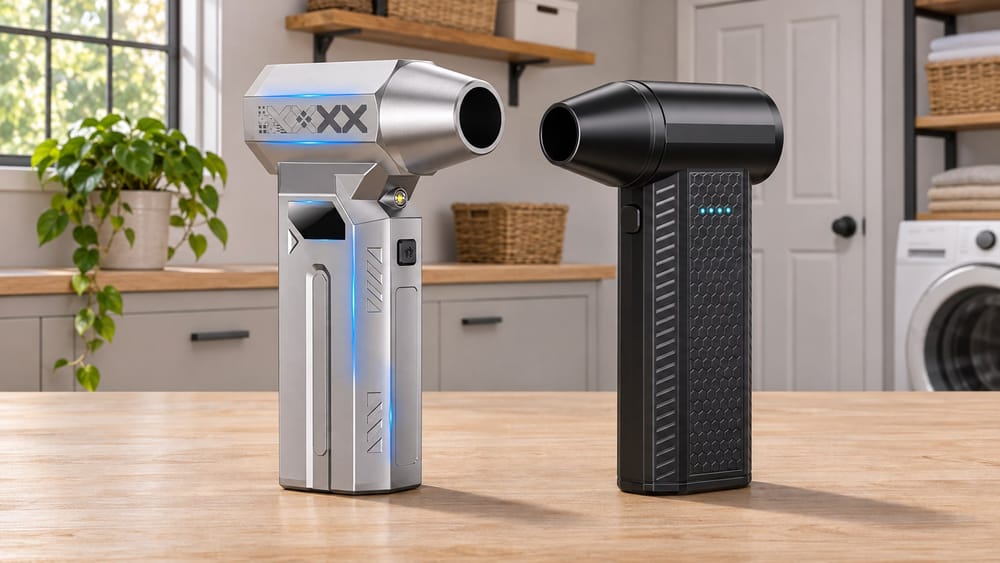
Compare fourq F4 and MiaEpic air dusters by nozzle assortment, display and light controls, charging needs and approved cleaning tasks.
Both the fourq F4 and MiaEpic offer four speed settings. The F4 has the larger advertised nozzle assortment; MiaEpic adds a display and light. Choose around the attachments and controls you will actually use, rather than treating the largest motor-speed headline as the deciding feature.
The useful choice starts with the object you need to clean. An air duster blows dust elsewhere; neither tool collects it, and neither is automatically suitable for delicate electronics.
| Advertised detail | fourq F4 | MiaEpic |
|---|---|---|
| Speed settings | Four | Four |
| Attachments | Five nozzles, three brushes | Four nozzles; confirm other included accessories |
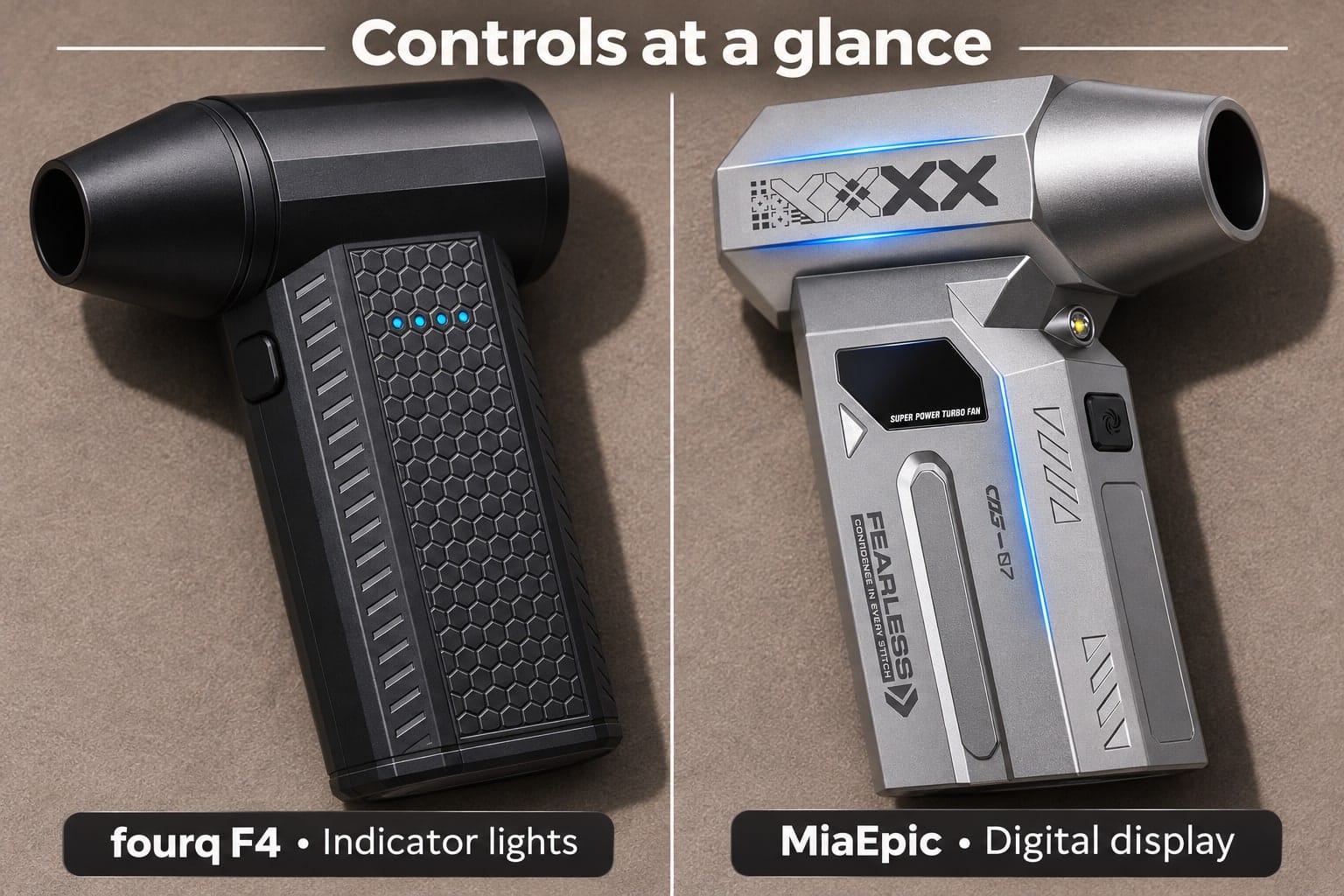
| Controls and visibility | Confirm the supplied controls | Display and LED light advertised |
fourq F4 air duster
 Shop at Amazon.ca
MiaEpic air duster
Shop at Amazon.caIdentify the job before choosing the controls
Both products are relevant only after you have confirmed that directed airflow is appropriate for the object. Start there. A narrow recess in a permitted household item and a sensitive electronic component should not be treated as the same task simply because both collect dust.
Then decide what makes the job awkward. If it is access, nozzle shape may be the deciding feature. If it is checking the selected setting or seeing a poorly lit area, controls and visibility may matter more. That gives the F4's accessory assortment and MiaEpic's display-and-light arrangement different reasons to be considered.
Neither product collects the debris it dislodges. Plan where the dust will go and how you will remove it afterwards. A blower can be inconvenient when the surrounding area must stay clean or when moving dust into the air is itself a problem.
What to compare in the attachment kits
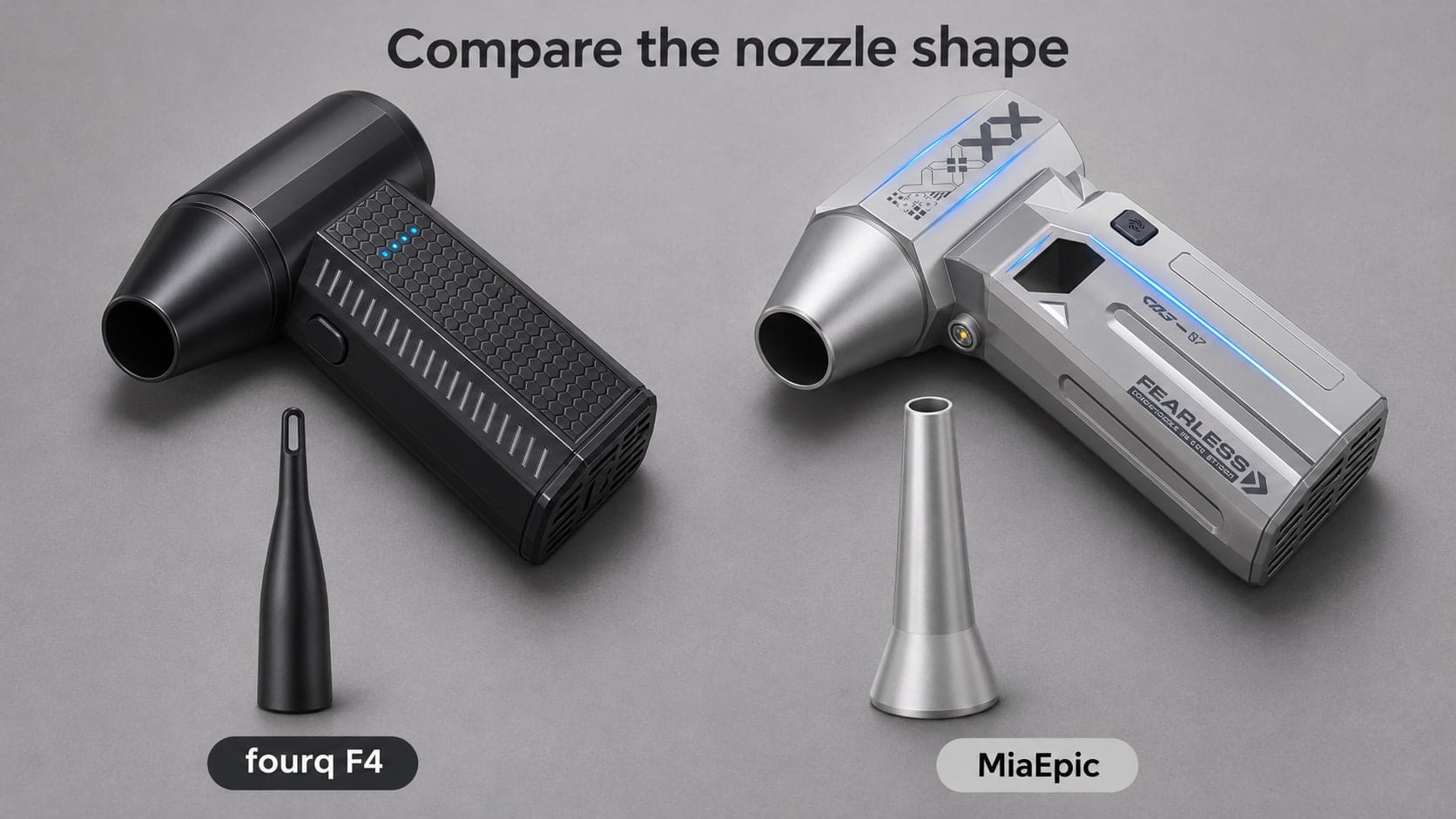
The F4 advertises five nozzles and three brushes, while MiaEpic advertises four nozzles. Look for distinct shapes that suit your approved jobs instead of assuming the larger inventory automatically offers more value. Several similar pieces may overlap in purpose.
Check attachment security and the permitted way to remove each piece. A fitting that looks familiar is not proof that accessories can be shared between the two products. Buy around the supplied kit or explicitly supported replacements rather than an assumed common connector.
Brushes require their own suitability check. Contact can damage a surface even where gentle airflow is allowed. Bristle material, stiffness and the equipment maker's instructions matter more than an accessory being included with a duster.
If one particular nozzle is the reason for buying, confirm that it is included in the exact offer and ask about replacements. A useful kit can become less useful when its most relevant small attachment is lost and cannot be obtained separately.
Why the bigger numbers do not settle it
Rotor speed is not airflow at the cleaning surface. Nozzle shape, distance and the selected setting affect the job, while excess force can be undesirable on delicate items. Neither motor-speed headline establishes the better choice for your equipment.
The F4 advertises roughly 20–30 minutes of runtime. For MiaEpic, confirm working time at the setting and with the nozzle you intend to use. A maximum runtime without those conditions is a poor basis for planning a long cleanup.
Treat motor speed, battery capacity and accessory count as separate specifications. Choose the approved cleaning method first, then the tool and setting that fit it.
A display is useful when it answers a real question
MiaEpic's display may help with checking a setting or battery indication, but establish what information it actually shows. Do not assume a percentage is an exact prediction of minutes remaining, or that a display means the tool measures airflow at the surface.
Likewise, a light can make an area easier to see without making the cleaning method appropriate there. If visibility is the only issue, compare the light's intended role with the task instead of treating it as a performance advantage over the F4.
With either unit, the stop control and speed adjustment should be easy to use while maintaining a sensible grip. Learn the controls before approaching a delicate object. A tool that needs awkward hand changes to stop may be less convenient for your routine even if its specification looks stronger.
Runtime comparisons need matching conditions
The F4's advertised 20–30 minutes is a range with limited test context. MiaEpic's useful working time also needs confirmation for the intended setting. Neither figure should be interpreted as an assured high-output session without those conditions.
Decide whether your normal work consists of short bursts or a longer continuous task. Include any specified cooling breaks and duty-cycle limits. Battery charge remaining and permission to continue operating are separate questions.
Check charging time, required input and included accessories. A USB-C shape alone does not tell you how quickly either unit charges. If the tool will live in a cupboard and come out occasionally, establish a routine that leaves it ready without ignoring its battery-care instructions.
Do not assume that a larger battery claim or motor-speed number makes one tool a better long-session choice. Without comparable conditions, the sensible comparison is the documented working time and operating limits of the exact unit you would buy.
The area around the object matters too
Clear away lightweight items that could move and keep the airflow away from people and pets. For permitted tasks, arrange the object and surrounding area so dislodged material has somewhere manageable to go. Blowing debris deeper into another recess can create a harder cleanup.
Choose a suitable location and follow any protection requirements in the tool and object instructions. Do not use either product for hazardous dust or materials outside its intended use. A general household-cleaning description does not establish specialist dust-handling capability.
Keep the intake unobstructed while holding the unit. The hand position that looks comfortable in a photo may not be appropriate if it covers an opening. Recheck grip and nozzle security when changing attachments rather than treating the tool as one fixed configuration.
Which extras would you actually use?
The F4 has more advertised nozzles and brushes. Look at their shapes and match them to approved cleaning tasks. Two attachments that do much the same thing add less value than one that reaches the area you need.
MiaEpic’s display may make a selected setting or battery indication easier to check; confirm what it shows in the manual. The light could help you see a dark recess, but it does not establish that blowing air into that recess is safe.
For either tool, check the required charging power source and the cable included with the selected bundle. Leave time to recharge between jobs instead of assuming that the USB-C connector alone sets the charging speed.
When neither is the right choice
If the equipment manufacturer prohibits a blower, that settles the question for that equipment. An extra nozzle, lower setting or display does not override the restriction. Use the approved maintenance method instead of trying to make one of these purchases fit every cleaning need.
If the material is stuck residue rather than loose dust, more airflow may add little. Similarly, if containing debris is essential, an outward-blowing tool lacks the collection function needed. These are category limitations shared by both products, not shortcomings that the other model necessarily fixes.
Which is better for occasional approved dusting?
Choose the kit with the attachment and control arrangement you actually need, once its instructions and charging requirements are clear. F4's larger advertised assortment is useful only if the extra pieces serve a purpose in your routine.
Is MiaEpic's light enough reason to pay more?
Only if it meaningfully improves visibility for a permitted recurring task and the rest of the product is well specified. Confirm the feature and control behaviour in the exact model's instructions. It does not establish stronger or safer airflow.
Can either be used on any computer keyboard or fan?
Do not assume that. Check the specific equipment's care directions, including restrictions on blowers and brushes. The computer-cleaning language around an air duster is not an approval from the maker of your device.
What breaks a close tie?
Clear instructions, appropriate attachment shapes, understandable controls, return terms and support. Those are more useful buying criteria than an rpm claim without a comparable measurement of airflow and task results.
Follow the object’s care instructions
Some equipment makers prohibit blowers for cleaning. Dell’s maintenance guidance, for example, advises against them. Check the instructions for your own equipment before directing air at vents, fans or components.
The same applies to brushes: an included brush is not proof of suitability for a sensitive surface. Do not improvise an internal cleaning procedure because the product photograph shows a computer nearby.
For permitted jobs, keep the intake clear, secure small loose objects and plan how to collect the displaced dust. Follow any duty-cycle or cooling limits in the blower’s manual.
The F4 is the more interesting offer if its attachment shapes solve your tasks. MiaEpic is the more interesting offer if the display and light make those tasks easier. Buy either only after confirming the cleaning method is appropriate; an unverified rpm advantage is a weak reason to choose.
fourq F4 air duster
Shop at Amazon.caMiaEpic air duster
Shop at Amazon.caImages are AI-generated illustrations based on product references.
Sign up or sign in to join the conversation.