
The "AI desk pet" is one of the strangest product categories to crystallize in the last two years. It's not quite a toy, not quite a smart assistant, not quite a robot — but pulls just enough from all three that a single label keeps failing to fit. A $415 EMO that wants to sing you a good morning...
The "AI desk pet" is one of the strangest product categories to crystallize in the last two years. It's not quite a toy, not quite a smart assistant, not quite a robot — but pulls just enough from all three that a single label keeps failing to fit. A $415 EMO that wants to sing you a good morning. A $83 pendant called Eiliko that's supposed to chat with you from around your neck. A $955 Norby used mostly in car dealerships. A $275 Razer holographic cylinder running on Grok. They're all filed in the same corner of the store, and they are not the same product.
This article isn't a hands-on review of any of them. It's an editorial look at what this category actually is in 2026 — how the AI inside works, what you're really buying when you pay for a "companion," which products here are genuinely different from each other, and who the whole category is honestly for. If you've been curious about why everyone's suddenly selling miniature robots with faces, this is the skeptical-but-fair framing you don't get from the marketing page.
Quick snapshot
| Product | Price (CAD) | Form factor | AI engine | Best for |
|---|---|---|---|---|
| Eiliko by Energize Lab | ~$83 | Wearable pendant | Cloud chatbot | Gift-seekers, curious teens |
| Tikpal AI Voice Partner | ~$179 | Pocket voice device | Cloud LLM | Productivity-first users (Notion, Xmind) |
| LOONA Deskmate | ~$275 | iPhone-docked robot | ChatGPT + iPhone | iPhone-centric workers |
| Razer Project AVA | ~$275 | Glass holographic cylinder | xAI Grok | Gamers, esports coaching fans |
| EMO AIBI Pocket Pet | ~$415 | Wearable robot companion | ChatGPT, on-device | Long-term pet-replacement seekers |
| Norby Robot | ~$955 | Floor-standing commercial robot | Custom voice AI | Retail / hospitality businesses (not home use) |
Pro tip: Don't evaluate a desk pet the way you'd evaluate a Nest or a Vitamix. Evaluate it the way you'd evaluate a houseplant, a pet, or a Tamagotchi — something you're choosing to share your attention with, not something you're optimizing around.
What counts as an "AI desk pet" in 2026
The category is young enough that the line keeps moving. For this guide, an AI desk pet is a physical object (not a phone app, not a pure speaker) that runs some kind of conversational AI and presents a personality to the user — through a face, voice, animation, or embodied movement. That definition still sweeps a lot of different products into the same bucket, so it helps to split them into three honest sub-categories.
1. Companion-first. The whole point is to be there. It doesn't really do work, doesn't replace your assistant, doesn't automate anything. It greets you, reacts to you, has a personality, asks how you are. EMO AIBI and Eiliko sit here. This is the hardest type to justify rationally and the easiest type to genuinely love.
2. Productivity-first. A voice assistant with a body. It has a personality layer on top, but the reason to buy it is that it takes notes, talks to Notion, manages your calendar, or coaches your gameplay. Tikpal and LOONA Deskmate sit here. Razer AVA is a hybrid because it both has a personality and claims PC screen-analysis features.
3. Commercial. Not really a desk pet at all — a retail-scale AI greeter used in car dealerships, hospitality, and event booths. Norby is the only one in this lineup, and it's in this article mostly to keep you from accidentally ordering a $955 business appliance for your kitchen counter.
That split matters because nearly every disappointment reviewers report about "AI desk pets" comes from buying one category expecting another. If you bought EMO to take your meeting notes, you'll be unhappy. If you bought Tikpal hoping it would emotionally greet you every morning, you'll also be unhappy. The category's most honest framing is: what job am I hiring this thing to do?
The six products, separated by what they actually are
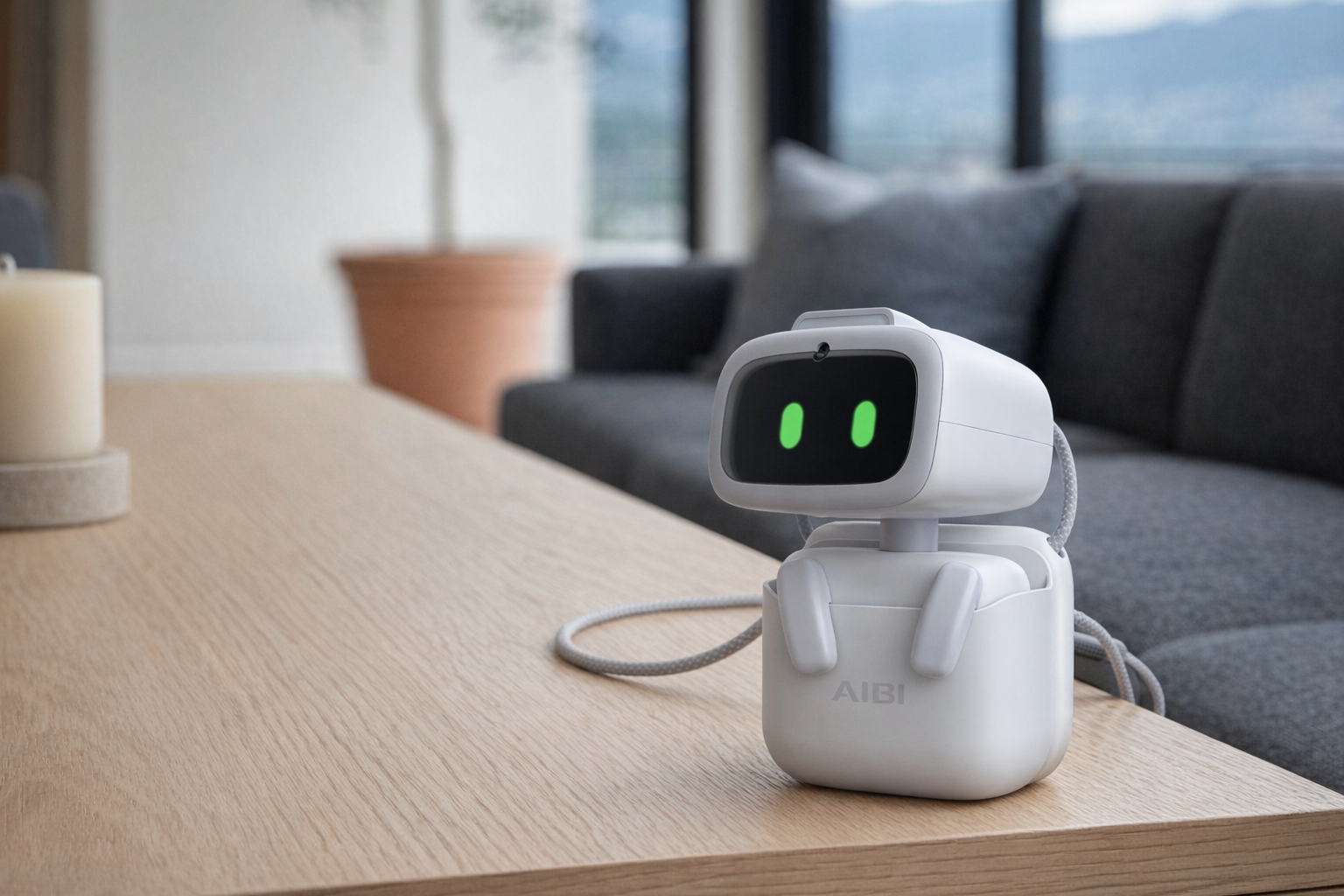
EMO AIBI Pocket Pet — the flagship of the companion-first camp
At roughly $415 CAD, EMO AIBI is the most refined product in this lineup for the "I just want a small pet-shaped thing on my desk" use case. It's built by Living.AI, uses ChatGPT for voice interaction, has face recognition, takes photos, sings, dances, shows weather animations, and — crucially — includes offline voice commands so the personality doesn't fully die if your Wi-Fi does. The charging dock acts as a stand, the form factor is small enough to travel with, and the animation library is clearly the work of a team that took "cute" seriously as a product requirement.
What makes EMO honest in a category full of noise is that it's not pretending to be productive. Nothing about it is pitched as "finally, an AI that takes your notes." It's a personality-first product, and the price reflects the emotional engineering behind it — dozens of custom animations, a music engine, a moderately convincing dance routine. The comparable sibling product is Eilik (the original desk robot from Energize Lab, which Eiliko is the smaller pendant version of) — Eilik is more playful and cheaper, but EMO feels more thought-through.
📺 Watch: EMO in a real desk setting
- Best for: People who want an actual companion object on their desk and treat the purchase like buying a houseplant, not a tool.
- Full explainer: EMO AIBI Pocket Pet on Celmin · Directory: product page
Eiliko by Energize Lab — the entry-level novelty
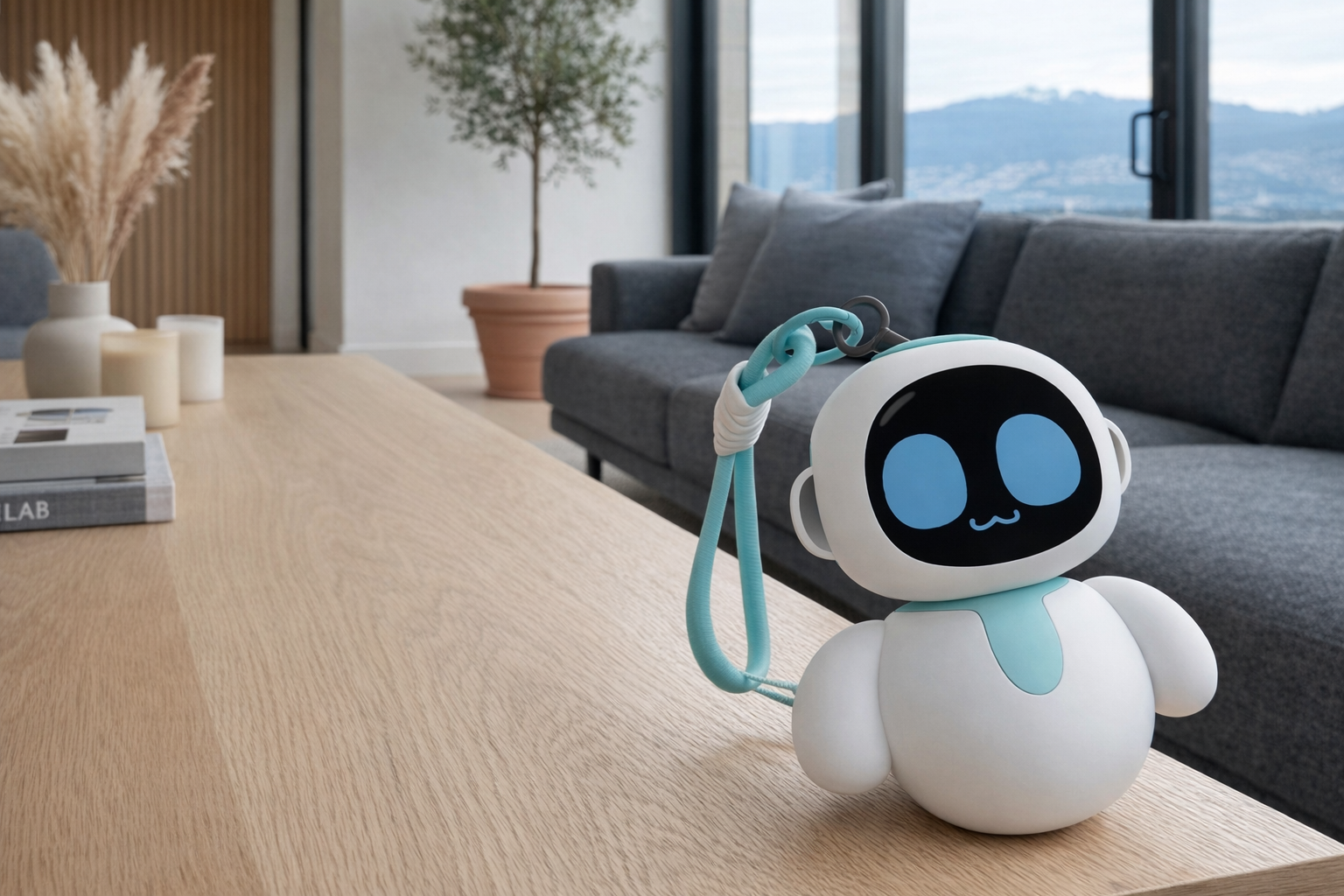
Eiliko is the $83 CAD wearable AI charm pendant from Energize Lab — the same company behind the Eilik desk robot. It's a tiny animated-face pendant with an AI chatbot and expressive emotional animations, marketed explicitly as an electronic gift for couples and friends. At a third the price of LOONA and a fifth the price of EMO, it's the easiest entry point into the category.
What Eiliko is not is a serious AI companion. The chatbot is cloud-dependent, battery life on wearable-sized devices is always the constraint, and the form factor is less "pet on your desk" and more "animated keychain you occasionally look at." That's fine. The product is honest about what it is: a fun gift at a reasonable price that puts a friendly face in someone's pocket. Don't cross-shop it against EMO — different jobs, different budgets, different expectations.
- Best for: Gift-buyers, teenagers curious about the category, anyone who wants a low-commitment way to try the novelty without risking $400.
- Full explainer: Eiliko on Celmin · Directory: product page
LOONA Deskmate — the iPhone-docked workmate
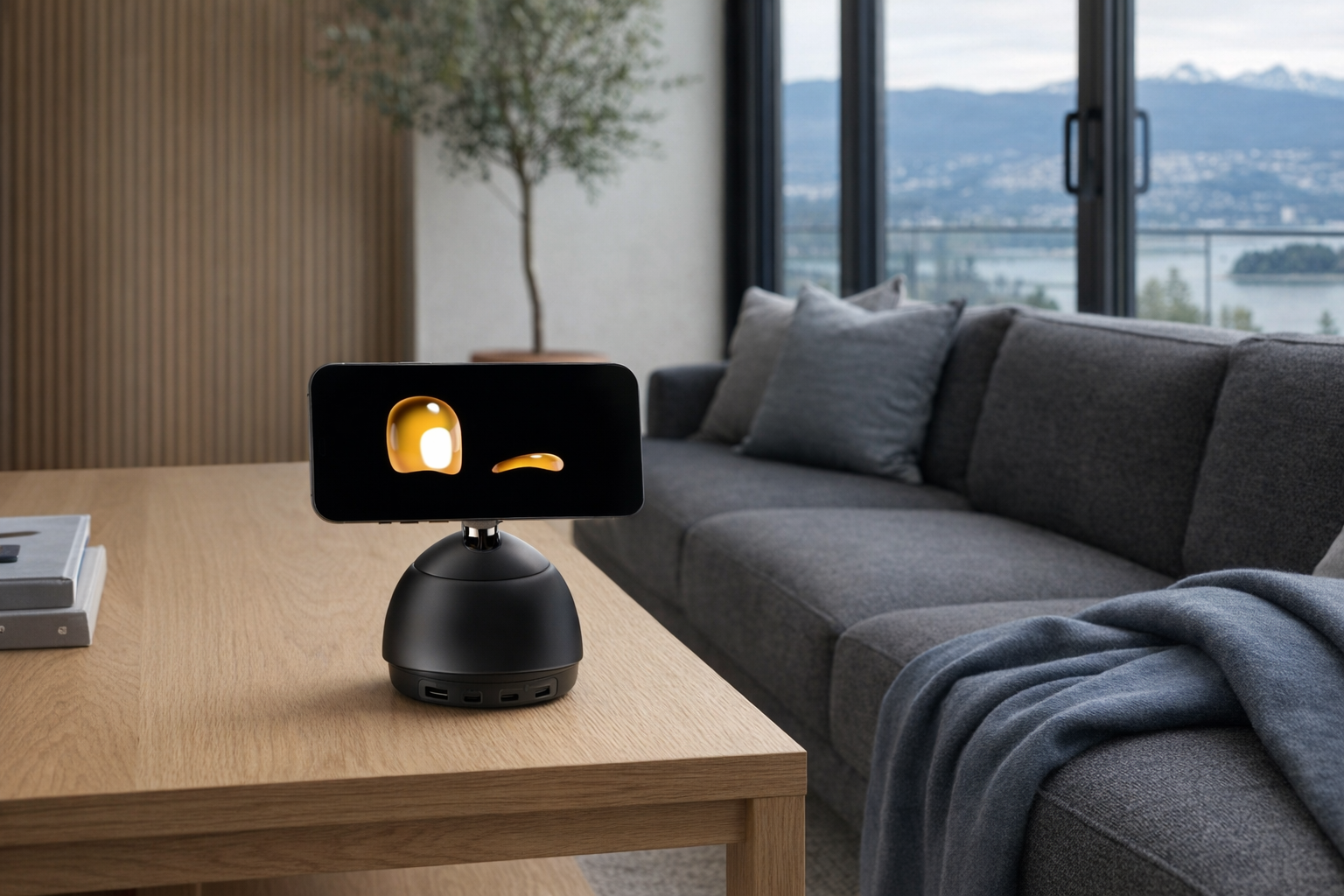
LOONA Deskmate at about $275 CAD takes a fundamentally different approach: it uses your iPhone as its brain, docking via MagSafe and running real-time, context-aware AI collaboration through the phone. The robot is the body, the phone is the processor. This matters because it sidesteps the hardest problem in the category — running capable AI on cheap onboard chips — by just renting your existing hardware.
The result is a product that reads more like a desktop ChatGPT client with a friendly face than a traditional desk pet. It's pitched at screen-task support, workflow automation, and voice-driven productivity. The trade-off is obvious: no iPhone, no LOONA. If you're on Android, you're shopping in the wrong aisle. If you live in the iPhone + MagSafe ecosystem and already use ChatGPT daily, LOONA is genuinely different from everything else in this list.
- Best for: iPhone-heavy knowledge workers who want an embodied ChatGPT on the desk, not a separate gadget running its own mediocre AI.
- Full explainer: LOONA Deskmate on Celmin · Directory: product page
Tikpal AI Voice Partner — the quiet productivity pick
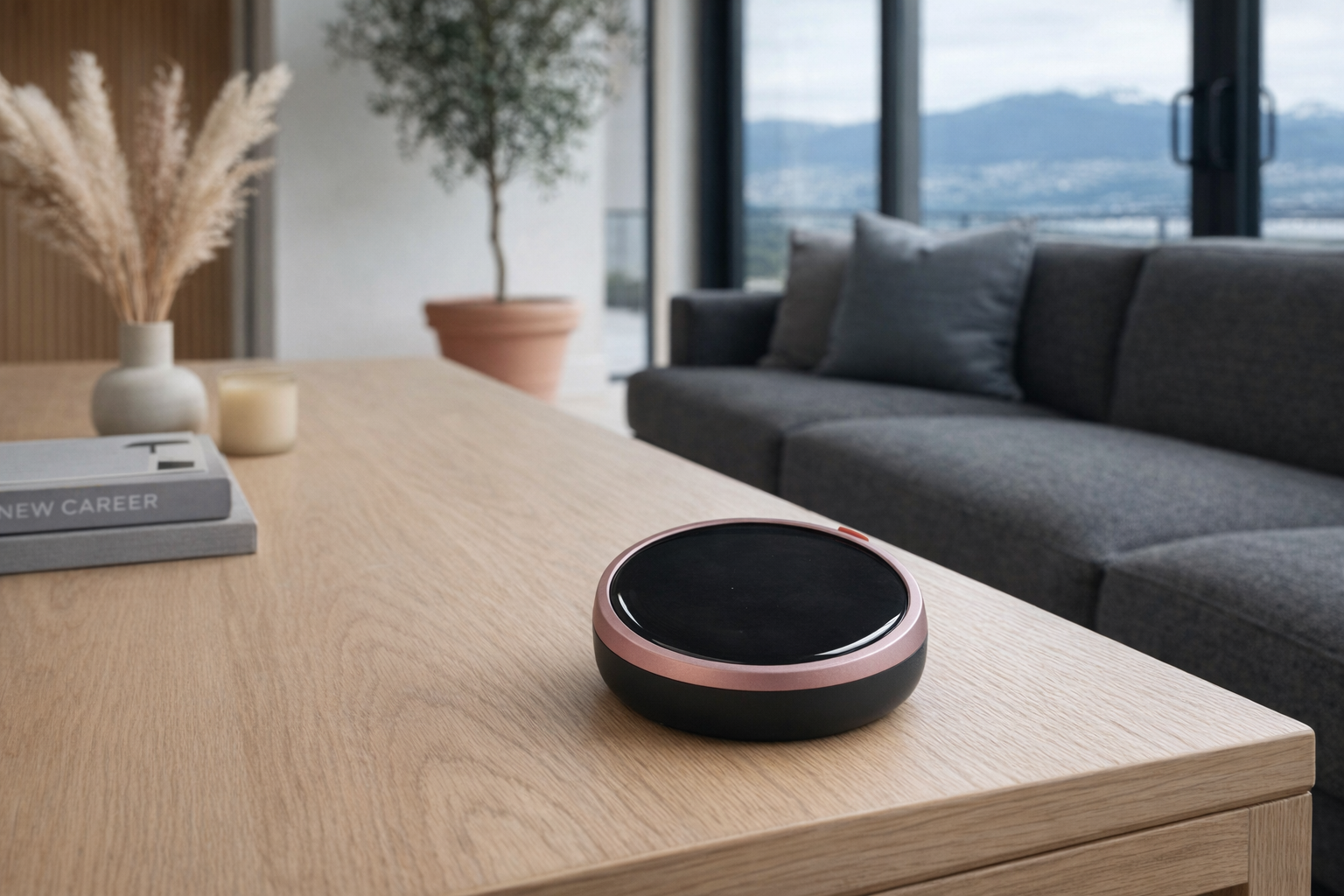
Tikpal at $179 CAD is the sleeper of this category and the product least likely to be pitched as a "pet." It's a compact voice-first AI device with a four-microphone array, AI noise reduction, an AMOLED display, and — the reason to care — native sync with Notion, Xmind, Google Calendar, Mail, and Cloud storage. It's IPX7 waterproof, which suggests the Tikpal team expected people to take it to kitchens, gyms, and outdoors, not just sit it on an office desk.
The personality layer on Tikpal is minimal. That's the point. If you want something that quietly captures thoughts into your actual note-taking apps without you opening a laptop, this is the device. It has more in common with a Rabbit R1 or Humane Pin than with EMO or Eiliko. If the idea of talking to a pet face doesn't appeal but talking to a small, tough voice device does, Tikpal is the one to look at.
- Best for: Notion/Xmind power users, writers who capture ideas mid-walk, people who want the productivity side of AI companions without the cute shell.
- Full explainer: Tikpal AI Voice Partner on Celmin · Directory: product page
Razer Project AVA — the hologram experiment
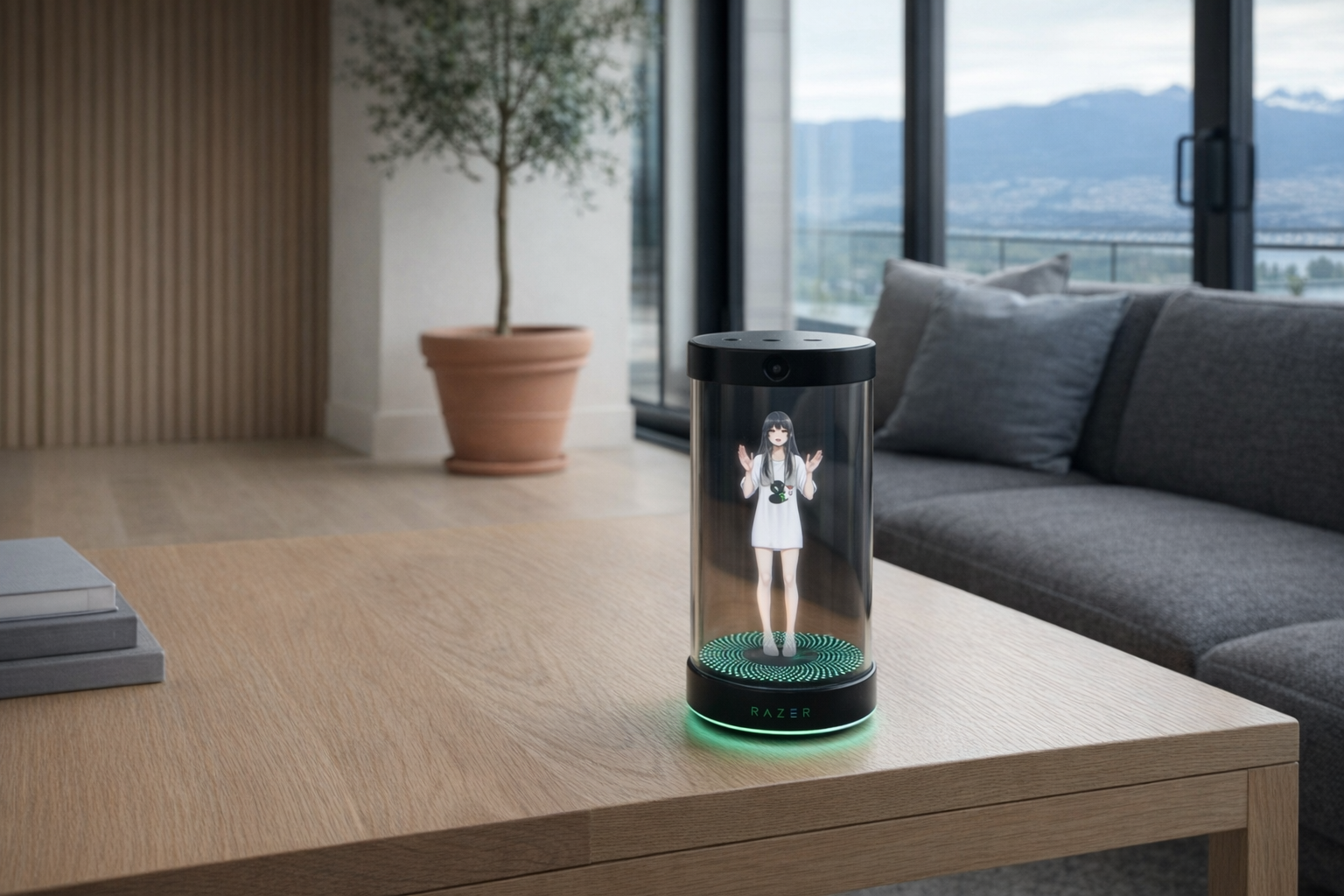
At $275 CAD, Razer's Project AVA is the most visually ambitious product in this lineup — a 5.5-inch animated hologram inside a glass cylinder, powered by xAI's Grok engine, with an HD camera, dual microphones, and a headline feature called PC Vision that analyzes what's on your screen in real time. On paper, it's the most futuristic item on the list. In reality, it's also the most likely to disappoint if you expected it to be all of EMO + all of LOONA + all of Tikpal in one device.
Razer is a gaming company, and AVA is shaped by gaming priorities: esports coaching, screen analysis, a more anime-styled avatar. If that's your life, the value proposition is legitimate — there's nothing quite like it. If you were hoping for a general-purpose assistant or a quiet companion, AVA is louder and more performative than either use case wants. It's also running on Grok, which has its own opinions about tone and refusal patterns that you may or may not love. This is the category's most divisive product.
- Best for: PC gamers, esports-adjacent users, people who specifically want a hologram on the desk and don't mind Razer ecosystem lock-in.
- Full explainer: Razer Project AVA on Celmin · Directory: product page
Norby Robot — not actually a desk pet, a retail employee
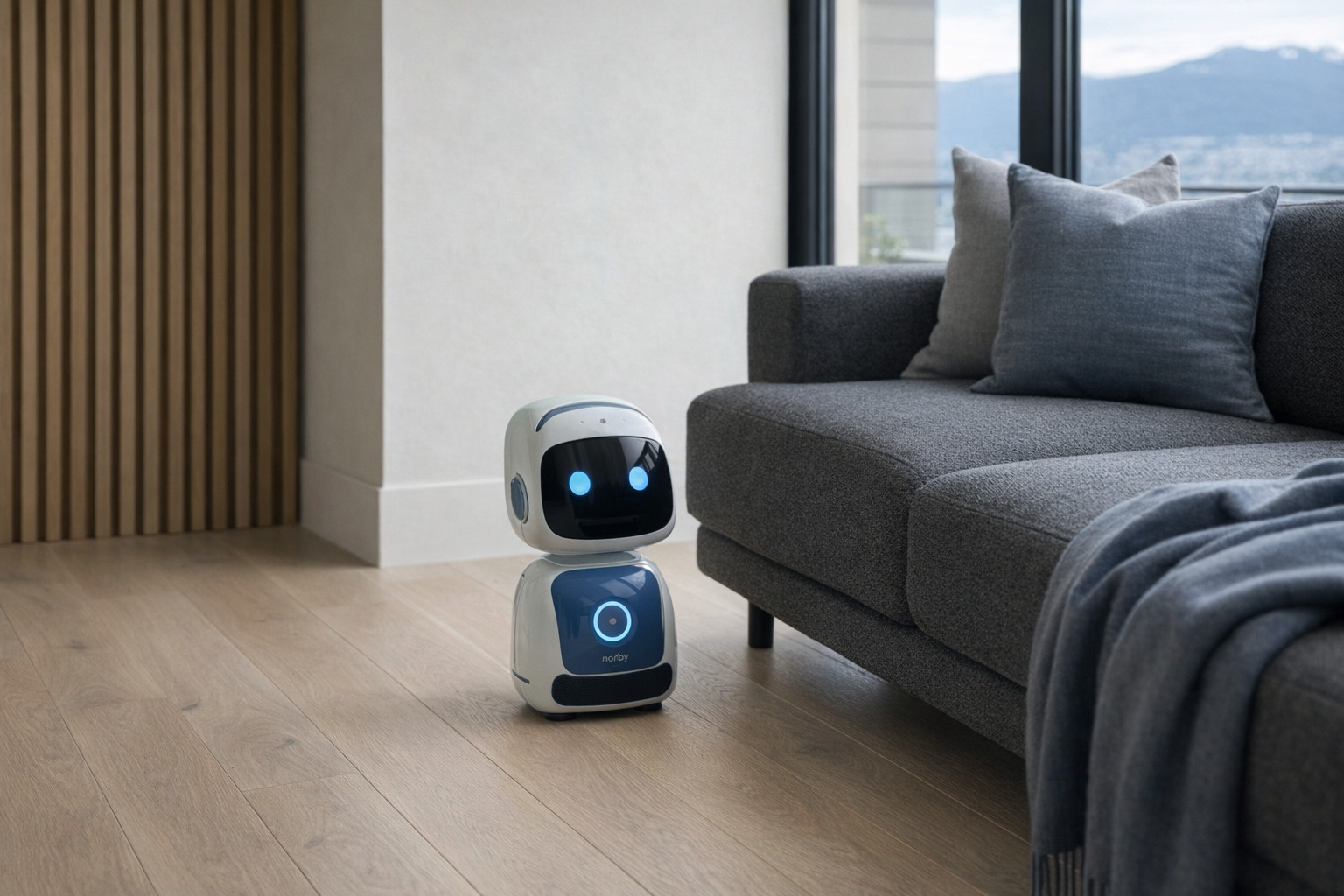
Norby at $955 CAD is a retail, automotive, hospitality, and real estate AI robot. It greets customers, answers product questions, captures sales leads, supports 30+ languages, and is designed to run 24/7 in commercial settings. It is in this guide only because it keeps showing up in AI-companion roundups online, which is misleading. It is not a desk pet. It is a business tool.
If you run a showroom, lobby, or event booth, Norby is an interesting product — cheaper than most comparable commercial greeters, with a reasonable AI layer. If you're looking for a companion for your home office, close the tab. The $955 is targeted at commercial ROI (lead capture, multilingual support), not personal attachment. Buying one for your desk is like buying a Square Register to handle Venmo transfers with friends.
- Best for: Small business owners in retail / hospitality / car dealerships who need an AI front-of-house. Not home users.
- Full explainer: Norby Robot on Celmin · Directory: product page
How the AI inside these products actually works
The single most confusing thing about this category is that "AI" means six different things across these six products, and the marketing doesn't try very hard to clarify.
Cloud vs. on-device. EMO advertises offline voice commands, which means a small set of baked-in intents works without Wi-Fi, but the richer ChatGPT-driven conversation is cloud-dependent. LOONA and Razer AVA are almost fully cloud, routed through your phone or internet connection. Eiliko and Tikpal are cloud-first. If your internet dies, most of these products turn into expensive paperweights with a face. Ask yourself how stable your home Wi-Fi is before investing here.
Subscription posture. This is the quiet structural risk of the entire category. An AI desk pet whose brain lives in the cloud is also a desk pet whose brain can be billed for later. EMO, LOONA, and Razer AVA all tie back to cloud models that the manufacturer pays for — and increasingly, "premium conversation" and "advanced features" live behind optional subscriptions. When buying, look hard for whether core conversation requires an ongoing fee, or only add-on features do. Treat a $415 desk pet that also wants $9/month forever very differently from one that works for years on the one-time purchase.
Privacy. Most of these products have a microphone, some have a camera, some have face recognition. The data flow is: you speak → device uploads audio → cloud LLM transcribes and responds → device plays response. Unless you've read the privacy policy, you should assume voice data is transiting through the manufacturer's servers, possibly retained for model improvement, and possibly shared with the underlying LLM provider (OpenAI, xAI, etc.). This isn't necessarily dangerous, but if you're the kind of person who disables Alexa's voice history, you'll want to do the same research here. Razer AVA with its PC Vision screen-reading raises the stakes materially — that's literal screen contents going somewhere.
Personality engines. What makes an "AI pet" feel like a pet rather than a speaker is the animation and emotion system layered on top of the raw LLM. EMO has clearly had the most engineering invested here — dozens of expressive states, custom animations for weather, songs, emotional reactions. That's why it costs $415, not because the ChatGPT in it is fundamentally better than the ChatGPT in a $20 API call.
The three questions worth asking before you buy one
If you strip away the marketing and the novelty, almost every desk-pet decision comes down to three questions. The answers point you at exactly one product in this lineup.
- What job am I hiring this thing to do? A companion (EMO, Eiliko), a productivity device (Tikpal, LOONA), a gaming sidekick (Razer AVA), or a commercial greeter (Norby)? The category's biggest disappointments are people who bought the wrong sub-category. Figure this out first.
- What happens to the product if the company stops supporting it, or if I lose Wi-Fi for a weekend? A hardware-first companion like EMO has offline fallbacks and will still greet you in a blackout. A fully cloud-routed one like LOONA or AVA is effectively dead without its stack. Buy accordingly.
- Am I comfortable with this device's camera, mic, and cloud data trail? If the answer is "I haven't thought about it," the answer is no. Look up the privacy policy, check whether conversations are retained, decide whether that's acceptable for the room you'll put it in. For bedrooms and kitchens, be pickier.
Where each one genuinely fits
| If this sounds like you... | ...buy this |
|---|---|
| Curious-gift-giver budget, want to try the category | Eiliko (~$83) |
| Notion / Xmind power user, writer, voice-first capture | Tikpal AI Voice Partner (~$179) |
| Heavy iPhone user, want embodied ChatGPT on your desk | LOONA Deskmate (~$275) |
| PC gamer, esports-adjacent, want the hologram | Razer Project AVA (~$275) |
| Want an actual pet-like companion, treat as houseplant-adjacent | EMO AIBI Pocket Pet (~$415) |
| Running a car dealership, real estate office, or hotel lobby | Norby Robot (~$955) |
| Just want a tiny smart speaker | Skip category — Echo Dot or HomePod Mini |
The honest recommendation for most home buyers is: Eiliko if you want to taste the category cheaply, EMO if you want the real companion experience and have the budget. Everything else in the lineup either serves a narrower audience (Razer AVA, LOONA) or isn't aimed at you at all (Norby).
Got Questions About AI Desk Pets? Let's Clear Things Up.
Is this a hands-on review?
No. This is an editorial explainer comparing the category using six products already in our catalog. It's designed to help you understand the shape of the market and decide which sub-category fits your needs — not to replace testing each product yourself.
Can AI desk pets really replace a pet, or a person?
No, and buying one on that premise is a recipe for returning it. What they can do is add small moments of levity to a desk — a good-morning greeting, a silly animation after a long Zoom call, a voice in a quiet home office. If that sounds meaningful, the category works for you. If it sounds sad, it won't.
Do any of them work without Wi-Fi?
Only partially. EMO advertises offline voice commands for a baked-in set of intents — weather animations, simple responses, dances — so it's the most resilient here. LOONA, Tikpal, Razer AVA, and Eiliko are effectively useless offline because their conversation layer lives in the cloud. Norby, as a commercial product, depends on its backend. If your internet is flaky, bias toward EMO.
Will these need a monthly subscription?
Some do. Any product where the conversation is routed through a cloud LLM has ongoing hosting costs, and companies eventually need to recoup them. Read the pricing page carefully before buying. In particular, check whether the advertised AI features work forever with the purchase, or whether they're a "free for the first year" arrangement that flips to paid later. This is where the category's long-term economics get dicey.
Are there privacy concerns with these devices?
Yes — proportional to how much sensing they do. Eiliko and Tikpal mostly capture voice. EMO adds a camera and face recognition. Razer AVA adds real-time screen analysis (PC Vision), which is materially more sensitive — that's literal screen contents going somewhere. Treat these devices with the same scrutiny you'd give an Alexa, a Ring camera, or any always-listening hardware. For a broader framing, see our upcoming Matter, in Plain English primer, which includes a section on local-first smart home hardware.
Which AI desk pet lasts the longest?
This is unknowable at the moment — the category is young. But the products most likely to still be useful in 3 years are the ones that (a) have offline fallbacks, (b) don't depend on a specific subscription to function, and (c) are made by companies with an established product line, not a single-SKU startup. By those filters, EMO AIBI is the safest bet, and Tikpal is the next safest because its productivity integrations (Notion, Calendar) would still be useful even if the conversational AI layer was replaced.
Where should I buy these to verify the latest details?
Links: EMO · Eiliko · LOONA Deskmate · Razer Project AVA · Tikpal · Norby. Some of these are direct-from-manufacturer preorders; shipping, Canadian import duty, and warranty service vary substantially between them.
If you're trying to make sense of the weirder corners of the smart-home and AI-companion world in Canada — and want honest framing on which products are worth it versus which are hype — Celmin covers the full catalog without the marketing theater. More explainers, comparisons, and buyer guides at https://celmin.ca.

Discussion
Sign up or sign in to join the conversation.