
LED strip lights are one of those categories that look simple right up until you try to buy them. On one side, you have endless $14 to $18 generic kits promising 16 million colours, music sync, app control, timers, and "easy installation" in 100ft or 130ft lengths. On the other, you have branded ...
LED strip lights are one of those categories that look simple right up until you try to buy them. On one side, you have endless $14 to $18 generic kits promising 16 million colours, music sync, app control, timers, and "easy installation" in 100ft or 130ft lengths. On the other, you have branded products like Govee's TV kits that cost several times more and seem to be solving a completely different problem. Online listings blur all of this together, so people end up cross-shopping a TV backlight against a ceiling strip, or buying a 130ft bargain roll and wondering why one end looks dimmer than the other.
This article isn't a hands-on review. It's an editorial look at what LED strip lights actually are in 2026 — what matters in a real room, which specs are meaningful, why adhesive claims deserve skepticism, what happens on long runs, and which products in this small lineup are genuinely different from each other. If you're trying to light a bedroom, a ceiling perimeter, a kitchen accent line, or a TV wall without getting fooled by the packaging, this is the plain-English version.
Quick snapshot
| Product | Price (CAD) | Form factor | AI engine / Core mechanism | Best for |
|---|---|---|---|---|
| DAYBETTER LED Strip Lights 130ft | ~$18 | 2-roll RGB room strip kit | App + 24-key IR remote, 24V strip system | Cheap full-room perimeter lighting |
| KSIPZE 100ft LED Strip Lights RGB Music Sync | ~$14 | Long RGB room strip kit | App + IR remote, built-in mic music sync | Lowest-cost accent lighting for bedrooms/kitchens |
| Govee TV Backlight 3 Lite | ~$74 | TV backlight kit | TV-focused reactive backlighting ecosystem | People lighting a TV, not a room |
Pro tip: Evaluate LED strips the way you'd evaluate paint, trim, or under-cabinet lighting — as part of the room itself. Don't buy them like a gadget first. The practical questions are density, mounting, power, and whether the app will annoy you after week one.
What counts as an "LED strip light" in 2026
For this guide, an LED strip light is a flexible lighting strip meant to be mounted onto a surface — wall edge, ceiling line, cabinet underside, desk back, TV rear panel — and controlled through a basic remote, app, or both. That sounds broad because it is broad. The problem is that shoppers often treat all strip lights as interchangeable when they really fall into three different camps with different expectations, different compromises, and different prices.
1. Long-run room lighting. This is the big-box, low-cost category most people mean when they say "LED strip lights." DAYBETTER LED Strip Lights 130ft and KSIPZE 100ft LED Strip Lights RGB Music Sync fit here. The point is coverage: a bedroom perimeter, a dorm, a basement rec room, maybe the top edge of walls or the underside of furniture. These kits are priced aggressively because they're not trying to deliver precision colour accuracy or premium build. They're trying to give you a lot of RGB light for very little money. That's a fair trade if you understand it.
2. Accent-first decorative strips. This overlaps with long-run lighting, but the job is narrower: a kitchen toe-kick, shelves, bed frame, gaming desk, or a small ceiling feature. KSIPZE can land here just as easily as in the first category, because 100ft is often more than people actually need. In this use case, LED density matters more than total advertised length. A sparse 30 LEDs/m strip can look dotted and cheap when directly visible; 60 LEDs/m is the normal baseline; 120 LEDs/m is where strips start looking genuinely smoother and more premium. Most bargain mega-length kits compete on footage, not density. That's not a scam, but it is the reason some installs look better than others.
3. TV backlight systems. Govee TV Backlight 3 Lite belongs here, and this is the category people most often misunderstand. A TV backlight kit is not just "a shorter strip." It's a different product type aimed at bias lighting behind a television, often tied to video-reactive effects and a more developed app ecosystem. That's a more honest design than pretending one generic 100ft bedroom strip can also be a premium home-theatre accessory. If your goal is to improve how a TV setup looks, buy a TV product. If your goal is to trace a room perimeter, buy room strips. Those are different shopping trips.
That split matters because the biggest source of buyer disappointment is simple category mismatch. Someone buys a cheap 100ft RGB kit expecting refined TV ambilight behaviour, or buys a TV backlight expecting it to light a whole condo living room. Neither product failed. The wrong product was hired for the wrong job.
The 3 products, separated by what they actually are
DAYBETTER LED Strip Lights 130ft — the cheap large-room default
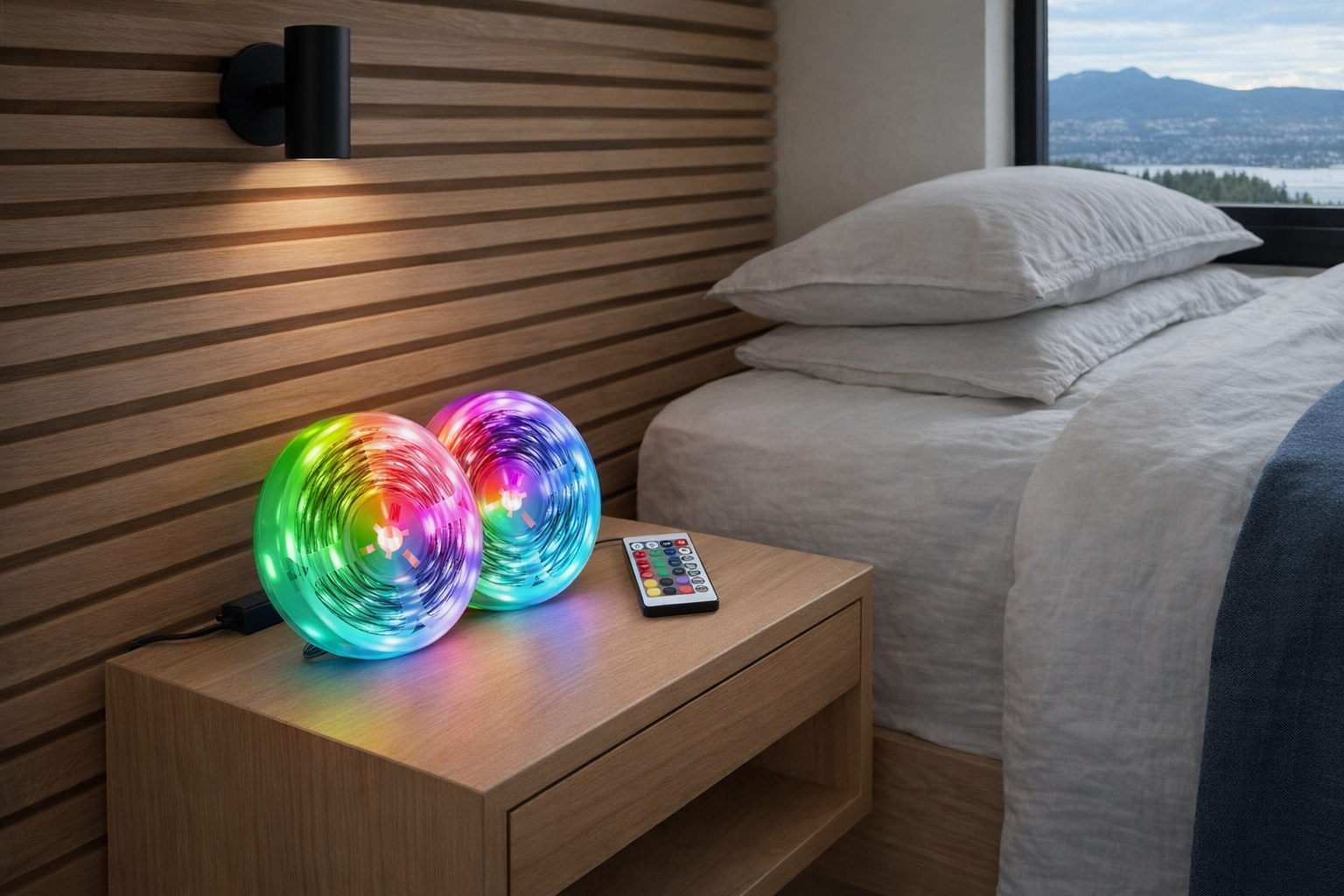
At roughly $18 CAD, DAYBETTER LED Strip Lights 130ft is the category in its most recognizable form: 2 rolls of 65ft, RGB colour changing, app control, a 24-key IR remote, music sync, timer functions, colour memory, and a 24V power supply. In other words, it's not pretending to be architectural lighting. It's selling reach. If you want to run a strip around a bedroom ceiling, along a dorm wall, behind furniture, or across a party space without spending serious money, this is the kind of kit most people actually buy.
The honest read is that DAYBETTER's strongest feature is also its biggest trap: 130ft sounds like pure upside until you remember what long runs do to LED strips. Once you're going past roughly 10m, voltage drop becomes part of the conversation, and that's before you get into how sparse many budget strips can look. The supplied 24V setup is a better starting point for long lengths than cheaper low-voltage setups would be, but physics still wins. A realistic expectation is broad ambient colour around a room, not perfectly even premium lighting from end to end. That's fine at $18. It's just not magic. The included app and remote setup is practical, if not especially elegant, and that's exactly the tone this product should strike.
📺 Watch: DAYBETTER in a real room-style setup
- Best for: People who want the cheapest plausible way to outline a whole room and understand that "a lot of RGB for little money" is the point.
- Full explainer: DAYBETTER LED Strip Lights 130ft on Celmin · Directory: product page
KSIPZE 100ft LED Strip Lights RGB Music Sync — the bargain pick with the usual compromises
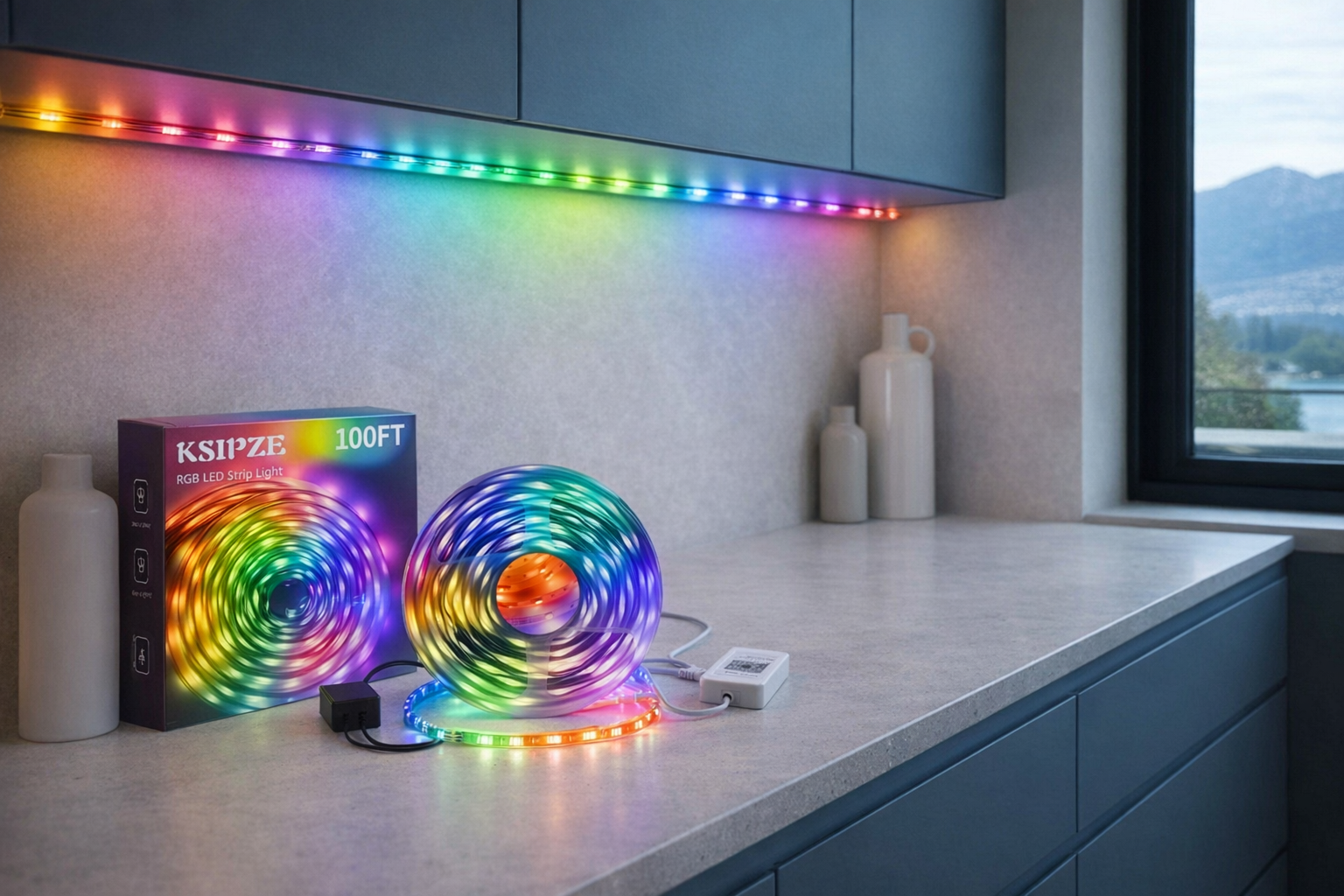
At about $14 CAD, KSIPZE 100ft LED Strip Lights RGB Music Sync is even more aggressively priced than DAYBETTER and follows the same broad formula: RGB strip lighting, app plus IR remote, 16 million colours, timer settings, and music sync. The listing also calls out a built-in microphone for reacting to sound, which is a useful distinction from kits that rely only on a phone app for music effects. If the job is "make a bedroom, kitchen, or gaming corner glow on a tiny budget," KSIPZE is speaking directly to that buyer.
What makes KSIPZE less interesting than its price suggests is that the category's real weaknesses don't disappear just because the listing says "easy peel-and-stick installation in minutes." They usually get worse. The adhesive on bargain strips is rarely the part to trust most, especially on painted walls, textured surfaces, or rentals where paint damage matters. Most strip adhesive will eventually test your luck, and often your drywall. If you're mounting anything you care about keeping up, 3M VHB or another better mounting solution is the practical answer, not faith in the stock backing. KSIPZE is attractive because it's cheap, not because it's refined. That's an honest reason to buy it, but keep the expectations in the right zip code.
📺 Watch: KSIPZE overview
- Best for: Lowest-budget bedroom or kitchen accent setups where cost matters more than polish or app quality.
- Full explainer: KSIPZE 100ft LED Strip Lights RGB Music Sync on Celmin · Directory: product page
Govee TV Backlight 3 Lite — a different category wearing the same label
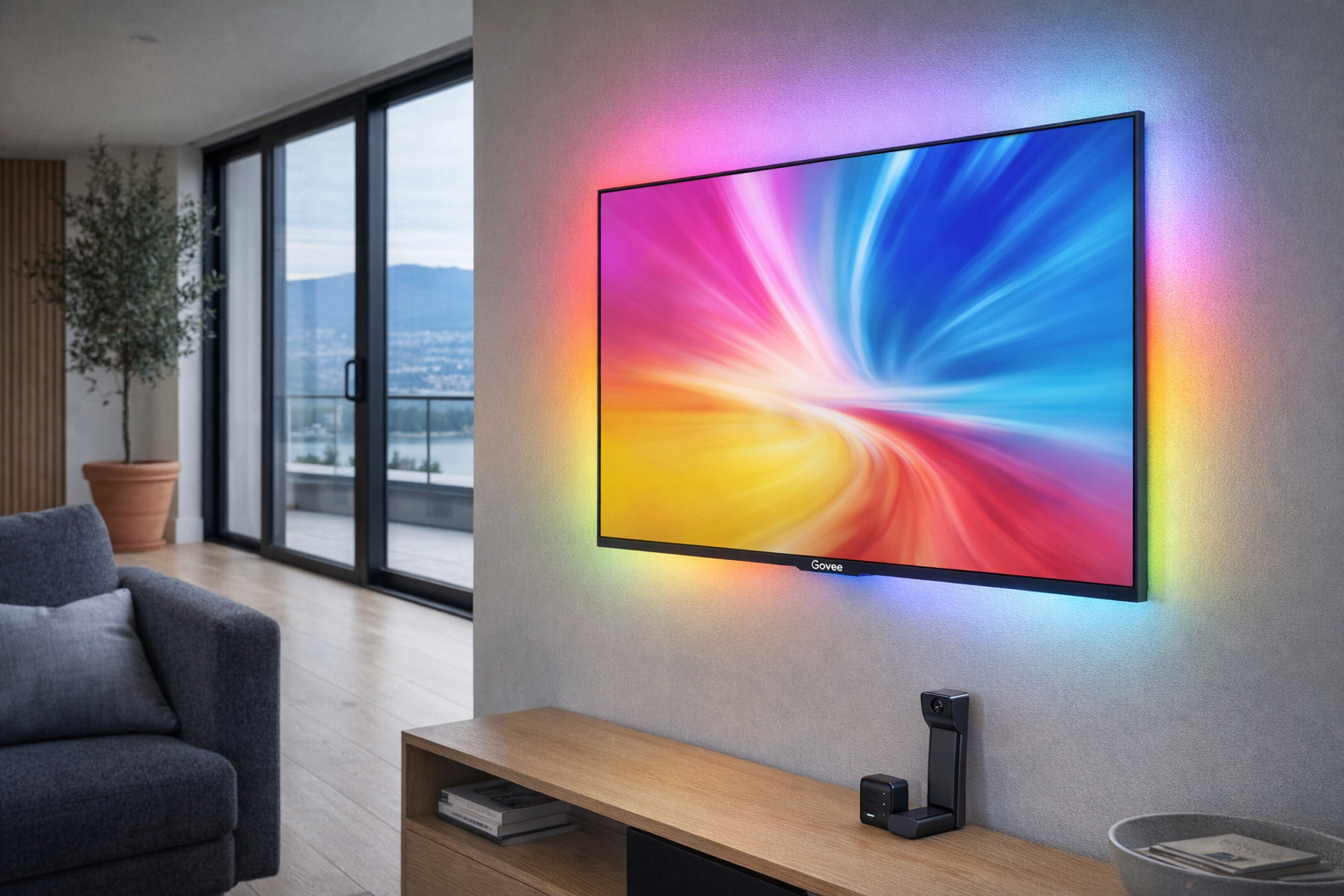
At roughly $74 CAD, Govee TV Backlight 3 Lite costs dramatically more than the room-strip kits in this article, and that's your first clue that it should not be compared to them by length alone. This is a TV backlight product in Govee's entertainment category, not a generic perimeter-lighting roll. The point is to live behind a television and make the TV setup look better, not to stretch 100ft around a bedroom ceiling and call it a day.
The more important distinction is ecosystem. DAYBETTER and KSIPZE both live in the familiar bargain-strip world of "our own app plus a little IR remote." Govee, by contrast, sits inside Govee Home, which is generally the richer app environment in this space. That's often what you're paying for as much as the hardware itself: better scene management, a more coherent platform, and a product designed for a specific placement. If you're shopping for TV bias lighting, Govee is the serious option in this lineup. If you're shopping for cheap room glow, it is plainly the wrong tool and an expensive mistake. That sounds obvious, but it's where a lot of people still get lost.
- Best for: TV owners who want a proper backlight product and would rather buy the right category than force a generic strip to do theatre-duty.
- Full explainer: Govee TV Backlight 3 Lite on Celmin · Directory: product page
How the strip-light technology actually works
The marketing around LED strips is repetitive enough that it hides the only details that really matter. "16 million colours," "music sync," "app control," and "timer" are table stakes now. The structural differences are elsewhere.
1. LED density: the spec most listings avoid emphasizing.
If you only remember one thing from this guide, make it this: LEDs per metre matter more than most mood-lighting buzzwords. Around 30 LEDs/m is sparse. It can be fine for indirect glow where the strip itself is hidden, but when the strip is exposed or reflected, it often looks dotted and cheap. 60 LEDs/m is the normal baseline for decent-looking strips. 120 LEDs/m is where lighting starts to look smoother, more continuous, and more premium. The catch is that mega-length bargain kits often steer the conversation toward total footage instead. That's understandable: "130ft" sells better than "low-density RGB tape." But in a real room, density is what affects whether the result feels like lighting or decoration-store leftovers.
2. Voltage drop is real on long runs.
Long strip kits are not infinitely scalable. Once you start getting into runs longer than about 10m, voltage drop becomes a practical issue, meaning the far end of the strip can appear dimmer or less colour-accurate than the beginning. DAYBETTER's 24V supply helps compared with weaker setups, but it does not erase the limitation. This is why two 65ft rolls are more meaningful than one uninterrupted fantasy ribbon that somehow behaves perfectly forever. If you're planning a large room, think in segments, not just total advertised length. The cheap-strip category is very good at selling big numbers and very bad at teaching people why long electrical paths have consequences.
3. The adhesive is often the least trustworthy part of the kit.
"Peel-and-stick" sounds painless because it helps convert browsers into buyers. In real homes, though, adhesive is where bargain LED strips most often become annoying. Painted walls, slightly dusty trim, textured ceilings, and dry winter interiors are not friendly environments for mediocre adhesive. Worse, when strip backing does hold too well, it can pull paint on removal. That's the ugly little secret of this category: the included mounting solution is often either too weak or too aggressive, and sometimes both depending on surface prep and paint quality. If you're mounting strips on painted walls and care about them staying up, 3M VHB is usually the more grown-up answer. That's not glamorous, but it is more useful than another colour preset.
4. App ecosystems matter more than the remote after the first week.
DAYBETTER and KSIPZE use their own app ecosystems and include IR remotes because that's what this category expects. Those remotes are convenient, especially in bedrooms or rental setups, but they're also a sign of a simpler product tier. Govee's advantage is not that it invented coloured LEDs. It's that Govee Home is generally the richer software environment, which matters if you actually use scenes, schedules, grouped products, and more deliberate automation instead of just turning the lights purple and forgetting about them. A bad app doesn't ruin a cheap strip, but it does set the ceiling on how pleasant the product is to live with.
5. Music sync is usually a fun extra, not a buying reason.
Both DAYBETTER and KSIPZE promote music syncing, and KSIPZE specifically notes a built-in microphone. That's fine for parties, bedrooms, or teen setups, but it's not a mark of product quality on its own. Music-reactive lighting has been easy to implement for years. Treat it like a bonus feature, not proof that one kit is technologically superior. In most households, the lights will spend far more time on a static colour or timer than pulsing to a speaker.
The three questions worth asking before you buy
- Am I lighting a room, an accent, or a TV?
This is the first cut. If the goal is a whole room perimeter, DAYBETTER and KSIPZE are the relevant products here. If the goal is behind-the-TV bias lighting, Govee TV Backlight 3 Lite is the one that actually belongs in the conversation. Don't cross-shop by headline alone. - Will the strip be visible, and if so, what LED density am I really getting?
Hidden behind furniture is forgiving. Exposed along a wall or reflected in glossy surfaces is not. If you're sensitive to seeing individual light dots, 30 LEDs/m will often disappoint, 60 LEDs/m is safer, and 120 LEDs/m is where things start looking properly smooth. Check the current spec page when density isn't clearly stated. - What surface am I sticking this to, and am I prepared to solve mounting properly?
If it's painted drywall, textured paint, or an area with temperature swings, don't assume the included adhesive will behave. A strip that falls after a month is not a smart bargain. A strip that peels paint is worse. Budget for better mounting tape if the install matters.
Where each one genuinely fits
| If this sounds like you... | ...buy this |
|---|---|
| Want the cheapest plausible full-room RGB outline with lots of length | DAYBETTER LED Strip Lights 130ft (~$18) |
| Want to spend even less and just need simple bedroom/kitchen glow | KSIPZE 100ft LED Strip Lights RGB Music Sync (~$14) |
| Want lighting specifically for the back of a TV | Govee TV Backlight 3 Lite (~$74) |
| Care most about app quality and ecosystem coherence | Govee TV Backlight 3 Lite |
| Care most about dollars-per-foot | KSIPZE or DAYBETTER |
| Want smooth premium-looking visible strip lighting | Probably skip this exact lineup and prioritize higher-density strips instead |
Got Questions About LED Strip Lights? Let's Clear Things Up.
Is this a hands-on review?
No. This is an editorial explainer comparing the category through three products already in our catalog. The goal is to help you understand what matters in LED strip lighting — length, density, adhesive, power, and app quality — not to substitute for direct testing.
Are 100ft and 130ft strip kits actually good for a whole room?
Sometimes, with the right expectations. They can absolutely provide broad RGB ambient lighting around a bedroom, rec room, or ceiling line. What they usually do not provide is perfectly even, premium-looking illumination across every centimetre. Long cheap strips are about coverage and vibe, not precision. That's a fair bargain when the price is $14 to $18 CAD.
Why do some LED strips look dotted and others look smoother?
Usually density. Around 30 LEDs/m tends to look sparse. 60 LEDs/m is the standard point where strips look more respectable. 120 LEDs/m is where the light starts to feel more continuous, especially in visible installations. If the strip will be hidden behind a lip or molding, lower density is easier to forgive.
Will the adhesive damage painted walls?
It can, yes. That's one of the least glamorous but most important truths in this category. Many stock strip adhesives either fail early or grip paint too aggressively when removed. If you're installing on painted walls and want a better chance of both staying power and cleaner mounting, 3M VHB is the more sensible route than trusting whatever came on the roll.
Why does one end of a long strip sometimes look dimmer?
That's usually voltage drop. Once runs extend beyond about 10m, the electrical loss over distance can affect brightness and colour consistency, especially on budget kits. A 24V system like the DAYBETTER listing helps, but it doesn't suspend the laws of physics. For larger rooms, think about segmenting runs instead of assuming one long strip will look identical from end to end.
Is Govee TV Backlight 3 Lite better than generic room strips?
For a TV, yes. For a room perimeter, not necessarily — because it's a different category. Govee's main strength here is that it's a TV backlight product tied to the stronger Govee Home ecosystem. That's useful if your screen is the centrepiece. It is not automatically the better buy for bedrooms, ceilings, or long decorative runs.
What's the Canadian angle here?
Mostly pricing, availability, and installation context. These products often look inexpensive in CAD, but returns, import variations, and listing changes can still matter if you're ordering through marketplaces. Also, cold dry winters are not exactly adhesive-friendly in some homes, especially on painted surfaces that already have marginal prep. That doesn't make strip lights a bad buy. It just makes proper mounting more important than the product photos suggest.
Which one is the Celmin pick?
For cheap full-room lighting, DAYBETTER LED Strip Lights 130ft is the most honest anchor product in this lineup because it gives you a lot of length for very little money and doesn't pretend to be luxury lighting. For ultra-budget buyers, KSIPZE is the cheaper cousin with the expected trade-offs. For TV setups, pick Govee TV Backlight 3 Lite because a TV backlight should be judged as a TV product, not as "less strip for more money."
Where should I buy these to verify the latest details?
Links: DAYBETTER · KSIPZE · Govee TV Backlight 3 Lite. Check the current listing for pricing, included accessories, and any app or compatibility notes before ordering.
If you're building a smarter home in Canada and want honest comparisons of gadgets worth considering — plus the ones worth skipping — Celmin covers the full catalog without the marketing theater. More comparisons, reviews, and buyer guides at https://celmin.ca.

Discussion
Sign up or sign in to join the conversation.