
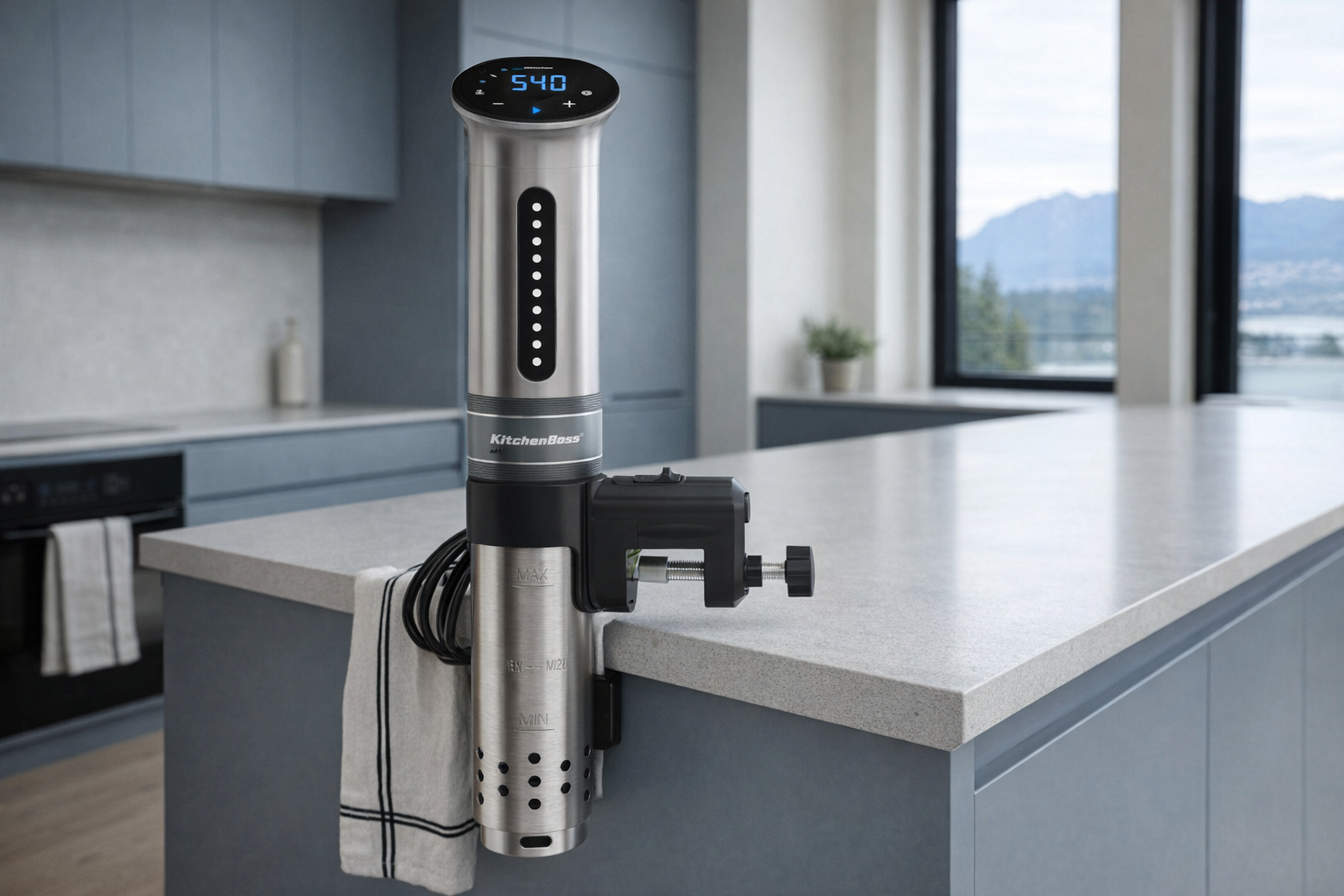
The KitchenBoss WiFi Sous Vide Cooker 1100W sits in a part of the kitchen gadget market that looks deceptively simple from the outside. To a lot of shoppers, all sous vide sticks appear to be roughly the same thing: a clamp, a heating element, a little screen, and a promise of perfectly cooke...
The KitchenBoss WiFi Sous Vide Cooker 1100W sits in a part of the kitchen gadget market that looks deceptively simple from the outside. To a lot of shoppers, all sous vide sticks appear to be roughly the same thing: a clamp, a heating element, a little screen, and a promise of perfectly cooked steak. But the gap between a basic $30-ish no-name immersion circulator and a more fully featured model can be real — not always dramatic, not always worth paying for, but real. With this KitchenBoss model, the differences seem to centre on power, water circulation, quieter operation, stainless steel build quality, and WiFi app control.
This is not a hands-on review. Nothing here is based on personally cooking with the unit. The goal is simpler and more useful: explain what the KitchenBoss WiFi Sous Vide Cooker 1100W actually is, what its listed features suggest in practical use, and whether those features meaningfully separate it from the cheaper end of the sous vide market. If you're deciding between “good enough” and “worth paying a bit more for,” this is the calmer version of that conversation.
📺 Watch: KitchenBoss WiFi Sous Vide Cooker 1100W in context
Quick snapshot
| Question | What the KitchenBoss WiFi Sous Vide Cooker 1100W actually is |
|---|---|
| Category | Kitchen & Dining |
| Made by | KitchenBoss |
| Typical price | ~$130 CAD (listing at the time of writing — verify current pricing) |
| Rating signal | 4.3/5 on the source listing |
| Best for | Home cooks who want more stable sous vide performance, quieter operation, and app-based monitoring |
| Skip if | You only cook sous vide once in a while, want the cheapest possible circulator, or dislike app-connected kitchen gear |
Pro tip: If you buy a sous vide stick at this tier, pair it with a real container and lid solution, not just a random stock pot. Better insulation and less evaporation will often matter more than one extra app feature.
What the KitchenBoss WiFi Sous Vide Cooker 1100W actually is
In plain English, this is an immersion circulator: a clip-on heating and water-circulating device that turns an ordinary pot or container into a temperature-controlled water bath. You seal food in a bag, set a target temperature, and let the machine keep the water there for a long period. The appeal of sous vide is consistency. Chicken breast can stay juicy instead of going stringy. Steak can hit edge-to-edge medium rare instead of grey on the outside and pink only in the centre. Eggs, fish, pork chops, and even some desserts all benefit from the same basic idea: low temperature, high control.
WiFi sous vide cooker with 1100W power, smart app control via KitchenBoss app, precise temperature control from 40-90°C, ultra-silent design with stainless steel construction. Features brushless DC motor with 2900r/m speed and 16L/min water flow.
That description tells you where KitchenBoss is trying to justify the higher price. The headlining points are 1100W of heating power, 40–90°C temperature control, 16L/min water circulation, and a brushless DC motor intended to keep things quieter and presumably longer-lived than the rougher, cheaper alternatives. Compared with a better-known competitor like the Anova Precision Cooker WiFi, the KitchenBoss appears to be aiming at the same general buyer: someone who wants app control and solid performance, but doesn't necessarily want to pay flagship-brand pricing. That is a more interesting position than the disposable-budget end of the category.
Key features at a glance
- WiFi app control for remote monitoring and temperature/timer settings
- 1100W heating power for faster heat-up than lower-wattage budget sticks
- Precise temperature control from 40–90°C
- Brushless DC motor rated at 2900r/m
- 16L/min water flow for stronger circulation
- Ultra-silent design according to the listing
- Full SUS304 stainless steel construction
How the KitchenBoss WiFi Sous Vide Cooker 1100W actually works
Like other immersion circulators, the KitchenBoss clamps to the side of a pot or purpose-built container and heats the water while continuously moving it around. That circulation part matters. A sous vide machine is not just a heater — it is a heater plus a pump. Without proper circulation, you can get hot and cool zones in the bath, which defeats the whole point of precision cooking. The listed 16L/min flow rate suggests KitchenBoss is emphasizing even water movement, which is exactly the right thing to emphasize in this category.
The 1100W figure matters too, but not in the way marketing often frames it. More wattage does not make the food “better” on its own. What it generally does is help the bath reach target temperature faster and recover more effectively when you add cold food. That is especially useful if you're cooking multiple steaks, a larger pork shoulder portion, or using a bigger water bath instead of a small saucepan. A weaker unit can still cook the same food eventually, but it may take longer to get stable.
The app side is the modern add-on. In practical terms, WiFi control usually means three things:
- You can start or adjust a cook from your phone within the limits of the machine and app.
- You can monitor temperature and remaining time remotely, which is genuinely convenient if you're elsewhere in the house.
- You may get presets or guided recipes, which are often more useful for beginners than for experienced cooks.
That's the basic trade-off with connected sous vide devices. The core job — holding water at, say, 54°C for steak or 65°C for eggs — is not new and does not require WiFi. But remote visibility is helpful when you're juggling kids, work calls, or just don't want to keep walking back to the kitchen. As long as you see the app as a convenience layer rather than the reason to buy the machine, that is a sensible setup.
The final differentiator here is the build and motor design. The listing calls out full SUS304 stainless steel construction and a brushless DC motor. Those are not glamorous features, but they are the sort that can matter over time. Stainless steel is easier to take seriously in a hot-water kitchen appliance than thin, glossy plastic, and a brushless motor is at least a credible sign that KitchenBoss is trying to pitch this above the bargain-bin tier. That's a more honest design story than simply claiming “restaurant quality” and leaving it there.
A realistic "day in the life" with KitchenBoss WiFi Sous Vide Cooker 1100W
Based on the listed features and how this category works, here's what a normal use case might look like.
- Morning. You season a couple of chicken breasts or vacuum-sealed meal-prep portions, fill a container with water, clip on the KitchenBoss, and set a target temperature in the app. The 1100W heater gets the bath moving toward temperature while you get on with the rest of the day.
- Midday. From another room, you check the app to confirm the bath is holding steady. This is where WiFi monitoring is genuinely handy: not because sous vide needs babysitting every five minutes, but because it removes that small background uncertainty.
- Afternoon. You add chilled food, and the stronger heating and 16L/min circulation help the water recover and stay even throughout the container. That should matter more in a larger tub than it would in a tiny pot.
- Evening. The cook finishes, you remove the bags, and a quick sear in a pan gives the final texture. Throughout the process, the “ultra-silent” claim would ideally mean the machine fades into the background instead of adding a constant cheap-fan hum to the kitchen.
None of that is a test report. It is simply what the listed feature set implies when translated into ordinary kitchen use.
Who the KitchenBoss WiFi Sous Vide Cooker 1100W is actually for (and who it isn't)
Great fits
- Weeknight home cooks who want repeatable chicken, salmon, or pork without hovering over the stove.
- Meal-prep households cooking multiple portions at once, where stronger circulation and a bit more power make practical sense.
- People upgrading from a budget circulator that feels noisy, flimsy, or slow to recover temperature.
- Curious cooks who actually like app control, especially if they already use connected kitchen gear and don't mind one more app.
Poor fits
- Shoppers who only make steak twice a year and mainly want to try sous vide as cheaply as possible.
- Minimalists who hate account setup and app ecosystems for basic appliances.
- Apartment cooks with very limited storage, because sous vide usually means storing the stick, bags, and ideally a dedicated container.
- Anyone expecting it to replace finishing techniques, since sous vide still usually needs a pan, torch, or grill for browning.
Practical trade-offs
App dependence and connectivity
The biggest question with this KitchenBoss is not whether WiFi is nice to have — it is — but whether you will actually use it enough to justify paying more. Sous vide is a slow process by design. That means remote monitoring can be useful, but it is not as transformative as remote control on, say, a robot vacuum or security camera. Evaluate the app as a small quality-of-life upgrade, not a core cooking breakthrough.
It is also fair to be mildly skeptical of any kitchen app's long-term polish. Check the current app store ratings, update history, and whether the basic controls on the device itself are sufficient. A sous vide cooker should still be worth owning if the app becomes annoying.
Noise and kitchen comfort
KitchenBoss makes a point of calling this model ultra-silent and highlighting the brushless DC motor plus spiral design. That is a meaningful claim in this category because cheaper immersion circulators can sound a bit harsh — part aquarium pump, part small fan, especially in a quiet condo kitchen.
Silence is not just a luxury. Sous vide cooks often run for 1 hour, 2 hours, or much longer, depending on the food. A machine that is merely competent but audibly irritating gets old fast. If this unit is truly quieter than the bargain-tier alternatives, that alone could be one of its most practical advantages.
Build quality, cleaning, and longevity
A SUS304 stainless steel body is the kind of feature that sounds boring until you compare it with low-cost plastic-heavy alternatives after a year of use. In a device that sits over hot water, gets splashed with fat and seasoning, and may be pulled in and out of storage often, material quality matters more than branding language.
That said, stainless steel does not mean maintenance-free. Mineral buildup, food splashes, and general kitchen grime still happen. Check how easily the lower sleeve comes apart for cleaning, and treat any sous vide stick like a precision appliance rather than a pot you can forget in a cupboard forever. Better build usually means better odds, not immunity from wear.
Where the KitchenBoss WiFi Sous Vide Cooker 1100W fits in a modern kitchen
This is not a standalone magic wand. It makes the most sense as part of a small, deliberate setup.
A practical pairing looks something like this:
- A polycarbonate sous vide container or a deep stock pot for the water bath
- A lid with a cutout to reduce evaporation during long cooks
- A vacuum sealer or quality freezer bags using the water-displacement method
- A cast-iron skillet, stainless pan, or grill for finishing
- A kitchen thermometer if you like double-checking results
If your kitchen already leans a bit tech-forward, the KitchenBoss also fits naturally beside products like the Anova Precision Vacuum Sealer, a Meater wireless meat thermometer, or a smart plug setup for nearby prep gear. But it is important to keep expectations sane: the smart part here is convenience, not automation theatre. This is still a water-bath tool first.
For Canadian households specifically, sous vide also makes more sense than some trendy outdoor gadgets for a large chunk of the year. In the middle of winter, when grilling outside is less appealing, a sous vide-and-sear workflow indoors can be a very rational way to get consistent results.
The buying decision, in plain terms
Before buying the KitchenBoss WiFi Sous Vide Cooker 1100W, ask three simple questions:
- Do you actually cook enough sous vide food to benefit from a better stick? If this will be used weekly for chicken, fish, eggs, or meal prep, the jump from a no-name bargain model can make sense. If it is mainly for the occasional steak experiment, the cheaper option may be fine.
- Will you value quiet operation and stronger circulation in real life? Features like a brushless motor, 16L/min flow, and 1100W heating are not glamorous, but they are the sort of upgrades you notice over repeated use.
- Are you happy to pay extra for WiFi as a convenience, not a necessity? If yes, this looks like a reasonable mid-tier buy. If no, a simpler non-WiFi circulator may get you 80% of the result for much less.
If your answers are mostly yes, this looks like a sensible upgrade-tier sous vide cooker rather than a flashy one.
Got Questions About the KitchenBoss WiFi Sous Vide Cooker 1100W? Let's Clear Things Up.
Is this a hands-on review?
No. This is an informational explainer based on the product listing and the broader sous vide category. The goal is to translate the listed features into practical expectations, not to present first-hand testing.
What does the 1100W rating actually mean?
It mainly points to heating power, which affects how quickly the water bath reaches temperature and how well it recovers after adding cold food. It does not automatically mean better-tasting food, but it can make the cooking process feel less sluggish than with a weaker circulator.
Does WiFi matter on a sous vide cooker?
For some people, yes — but mostly as a convenience. Being able to check temperature and remaining time from your phone is useful, especially in a busy home. It is not essential to the cooking method itself, so shoppers who dislike app-connected appliances may be better off with a simpler unit.
Is stainless steel construction actually a big deal here?
It can be. The listed SUS304 stainless steel build suggests a more durable, easier-to-clean body than the cheapest plastic-heavy models. That does not guarantee long life, but it is a more credible material choice for a hot-water appliance.
Is this a good alternative to an Anova cooker?
Potentially, yes, if you want WiFi control and a more premium spec sheet than the ultra-budget options without automatically paying for the biggest brand name. The real comparison point is whether KitchenBoss's app support and long-term reliability feel trustworthy enough for the price difference.
Where can you verify the current listing or buy it?
The most direct place to verify the current price, feature list, and availability is the Amazon listing: KitchenBoss WiFi Sous Vide Cooker 1100W on Amazon Canada. As always with marketplace products, check the latest listing details rather than assuming older screenshots or summaries are still current.
What does it cost in Canada?
At the time of writing, the listed price is ~$130 CAD. Pricing on kitchen gadgets can move around with coupons, seasonal sales, and marketplace changes, so it is worth checking the current listing before buying.
Where is the Celmin Directory listing for this product?
For a catalog-style view of the same product — structured specs, pros and cons, similar picks, and FAQ — see KitchenBoss WiFi Sous Vide Cooker 1100W on Celmin Directory.
If you're building a smarter home in Canada and want honest explainers on gadgets worth considering — plus the ones worth skipping — Celmin covers the full catalog without the marketing theater. More reviews, comparisons, and buyer guides at https://celmin.ca.
Discussion
Sign up or sign in to join the conversation.