
The InstaSeal Vacuum Sealer with 12 Bags sits in a practical corner of the kitchen gadget world: the small vacuum sealer meant for people who want less food waste, tidier freezer storage, and better results when batch-cooking or marinating. This is not a flashy appliance category. It is mostl...
The InstaSeal Vacuum Sealer with 12 Bags sits in a practical corner of the kitchen gadget world: the small vacuum sealer meant for people who want less food waste, tidier freezer storage, and better results when batch-cooking or marinating. This is not a flashy appliance category. It is mostly about preserving meat, vegetables, leftovers, and pantry staples longer than a zip bag would, while taking up less room than the wide, horizontal sealers that tend to live permanently on a counter.
This article is not a hands-on review. Nothing here is based on personally testing the machine. Instead, the goal is to explain what the InstaSeal Vacuum Sealer with 12 Bags actually is, what the listed features suggest about real-world use, and who it genuinely makes sense for. If you are deciding between a compact sealer like this and a larger FoodSaver-style machine, this is the calmer breakdown.
📺 Watch: InstaSeal Vacuum Sealer with 12 Bags in context
Quick snapshot
| Question | What the InstaSeal Vacuum Sealer with 12 Bags actually is |
|---|---|
| Category | Kitchen & Dining |
| Made by | Instaseal |
| Typical price | ~$153 CAD (listing at the time of writing — verify current pricing) |
| Rating signal | 4.2/5 on the source listing |
| Best for | Small kitchens, freezer meal prep, bulk shoppers, people who want to seal liquids more confidently |
| Skip if | You need high-volume sealing, lots of manual controls, or the cheapest possible way to freeze food |
Pro tip: Buy this for its shape and simplicity, not for the fantasy that vacuum sealing turns every household into a sous-vide lab. For most people, the real value is less freezer burn and more organized leftovers.
What the InstaSeal Vacuum Sealer with 12 Bags actually is
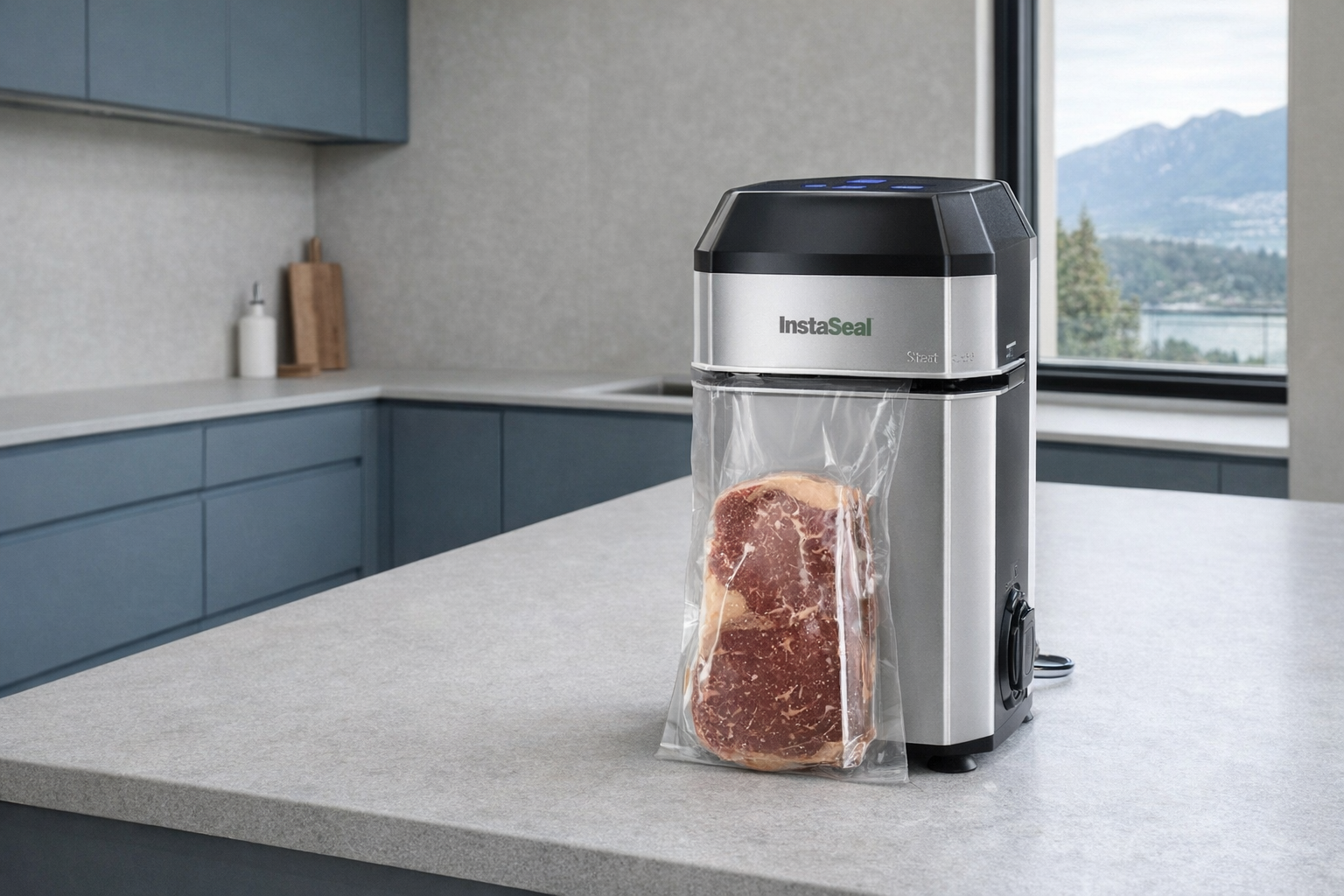
In plain English, the InstaSeal Vacuum Sealer with 12 Bags is a compact countertop appliance that removes air from a bag and heat-seals it shut. The point is to slow down spoilage, reduce freezer burn, and make food storage neater. What makes this one stand out on paper is not raw power or industrial capacity, but its upright 5 x 5 x 9 inch design, its claim of handling liquids and marinades without leaking, and an automatic sensor system meant to stop the cycle when sealing is done.
Compact upright vacuum sealer with space-saving design (5x5x9 inches). Features no-leak design for sealing marinades and soups, airtight double seal, automatic sensor technology, and includes 12 pre-cut bags. Preserves food up to 5x longer.
That combination puts it closer to a convenience-focused home appliance than a heavy-duty prep tool. Compared with a more traditional horizontal model like the FoodSaver V4400 2-in-1 Vacuum Sealer, the InstaSeal appears to trade bag-roll flexibility and larger-batch workflow for a much smaller footprint and a simpler setup. For many kitchens, that is a more honest design than a bulky sealer that gets used twice a month and then shoved into a cabinet.
Key features at a glance
- Compact upright design with a stated footprint of 5 x 5 x 9 inches
- No-leak design intended for sealing liquids, soups, and marinades
- Airtight double seal for a stronger closure than a single-seal approach
- Automatic smart sensor that stops when sealing is complete
- Includes 12 pre-cut bags so you can start using it right away
- Claimed food preservation up to 5x longer, according to the listing
How the InstaSeal Vacuum Sealer with 12 Bags actually works
A vacuum sealer is conceptually simple: place the open edge of a bag into the machine, let it pull out air, then let a heated sealing strip fuse the plastic closed. What matters in practice is how well it manages that sequence without leaving air pockets, crooked seams, or liquid creeping into the sealing channel.
The InstaSeal Vacuum Sealer with 12 Bags appears to simplify this process with an automatic sensor-based cycle. In other words, rather than asking you to manually guess when enough air has been pulled out, the machine is listed as detecting when sealing is complete and then stopping on its own. That usually makes compact sealers friendlier for first-time users, especially if the alternative is fiddling with separate vacuum and seal buttons and learning by trial and error.
Its most notable claimed advantage is the no-leak design for liquids and marinades. That deserves a little skepticism, not because it is impossible, but because liquids are exactly where many home sealers struggle. Thin juices, soup, and wet marinades can get sucked toward the seal area and compromise the bag closure. If the InstaSeal handles wet foods better than average, that makes it genuinely more useful for real kitchens, where chicken in marinade and leftover soup are more common than perfectly dry blocks of cheese.
The double-seal approach is also worth noting. With food storage, a failed seal is not a minor inconvenience; it is the entire job failing quietly in the freezer. A double seal adds redundancy, which can help when a bag gets jostled, stacked, or stored for longer periods. Evaluate that as insurance, not magic.
A likely workflow looks like this:
- Fill one of the included pre-cut bags with the food you want to store.
- Position the open end in the machine's sealing area.
- Let the automatic sensor cycle run, removing air and finishing the seal.
- Store the sealed bag in the fridge, freezer, or pantry depending on the food.
That sounds basic because it is. The difference between a useful vacuum sealer and a frustrating one is usually not whether it can vacuum at all. It is whether it is quick enough, compact enough, and reliable enough that you actually keep using it.
A realistic "day in the life" with InstaSeal Vacuum Sealer with 12 Bags
Because this is an informational piece, here is what a typical use pattern might look like based on the listing and the category itself, not a tested account.
- Morning. You portion a family pack of chicken bought on sale, add marinade to a couple of bags, and use the sealer's no-leak design to close them without the usual mess at the top seam. This is one of the clearest cases for a machine like this.
- Midday. After making a big soup or stew, you cool a portion and package leftovers for the freezer. The compact upright shape matters here because a 5 x 5 x 9 inch appliance is easier to keep on a corner of the counter instead of hauling out a larger machine from deep storage.
- Afternoon. You seal nuts, shredded cheese, or coffee beans to keep air and moisture out. These are the less glamorous jobs that often make a vacuum sealer worth owning over time.
- Evening. You prep a couple of meals ahead for the week, use up some of the 12 included pre-cut bags, and put the unit away without giving up half a drawer. That storage convenience is a bigger deal than product pages usually admit.
Who the InstaSeal Vacuum Sealer with 12 Bags is actually for (and who it isn't)
Great fits
- Apartment dwellers with limited counter and cabinet space who cannot justify a full-width sealer.
- Bulk shoppers buying meat, fish, or produce from Costco and splitting it into smaller freezer-ready portions.
- Meal-prep households that batch-cook soups, stews, sauces, or marinated proteins and want neater storage.
- People frustrated by freezer burn on expensive proteins, especially if they buy in larger packs during sales.
- Beginner home cooks who want an automatic process rather than a machine with a pile of modes and accessories.
Poor fits
- Hunters, fishers, or very high-volume batch preppers sealing dozens of bags in one session; a larger, faster machine may suit them better.
- Shoppers looking for the cheapest storage solution; for them, freezer bags and good labeling may be enough.
- People expecting full commercial flexibility, like custom bag rolls, accessory ports, and lots of seal options, unless the current spec page confirms those features.
- Anyone short on patience for consumables, because vacuum sealers are only useful if you keep compatible bags on hand.
- Households that mostly store dry pantry items in jars anyway, where the return on a dedicated sealer may be modest.
Practical trade-offs
Counter space and storage
This is arguably the strongest case for the InstaSeal. The listed 5 x 5 x 9 inch body is small by vacuum-sealer standards, and that changes the ownership experience a lot. A compact machine can live on the counter, on a pantry shelf, or in a shallow cabinet without becoming a nuisance. If an appliance is easy to reach, it gets used. If it feels like luggage, it does not.
The flip side is that compact appliances sometimes sacrifice throughput. Smaller footprint often means smaller internal components and potentially less flexibility with bag sizes or repeated back-to-back sealing. Check the current listing if you plan to do big batch sessions.
Wet-food performance
The mention of sealing marinades and soups is the most product-specific promise here, and it is the one worth taking seriously but not blindly. Wet sealing is genuinely useful. It is also where many machines reveal their limitations.
If the no-leak design works as intended, this appliance becomes more practical than many entry-level sealers, because real households are not vacuum-sealing only dry crackers and blocks of cheddar. But even with a wet-friendly design, common-sense prep still matters: avoid overfilling bags, keep the top edge as clean as possible, and cool hot liquids before sealing. The machine may help, but it does not repeal kitchen physics.
Ongoing bag costs
The inclusion of 12 pre-cut bags is helpful, but it is a starter pack, not a long-term supply. Like coffee machines that look cheap until pods enter the picture, vacuum sealers make the most financial sense when the food savings outweigh the ongoing cost of bags.
That does not make bag costs a dealbreaker. It just means you should evaluate the full system, not only the ~$153 CAD sticker price. If you seal food regularly and prevent waste, the math can work. If the machine sits idle after the included bags run out, it becomes an expensive drawer resident.
Where the InstaSeal Vacuum Sealer with 12 Bags fits in a modern kitchen
This is not a centrepiece appliance. It works best as part of a slightly more organized food-storage routine.
A realistic setup looks something like this:
- A chest freezer or upright freezer for bulk proteins and batch-cooked meals
- A digital kitchen scale for portioning meat or leftovers evenly
- Glass food containers for short-term fridge storage
- The InstaSeal Vacuum Sealer with 12 Bags for longer-term freezer storage, marinated items, and foods that are prone to freezer burn
If you are into sous-vide cooking, a vacuum sealer can also support that workflow, though that should not be the only reason to buy one. In most homes, the real pairing is more mundane: bulk grocery runs, Sunday prep, and not throwing out half a family pack of pork chops three weeks later.
It also fits well in small kitchens where appliances need to justify their footprint. That is the strongest argument here versus a larger FoodSaver-style unit. If you have abundant space and seal constantly, the bigger machine may be better. If you want something that behaves more like a small storage tool than a mini production line, the InstaSeal makes more sense.
The buying decision, in plain terms
Three questions usually make the decision clearer:
- Will you actually vacuum-seal food more than once in a while? If you regularly freeze meat, leftovers, soups, or meal-prep portions, the answer may be yes. If not, basic freezer bags may be enough.
- Is compact size more important to you than heavy-duty capacity? The 5 x 5 x 9 inch design is the main appeal here. If that is what solves your kitchen problem, it matters more than extra bells and whistles.
- Do you specifically want help with wet foods and marinades? If yes, this model is more interesting than generic bargain sealers. If dry storage is your only use case, you may not need to pay for that promise.
Three yeses make it a sensible buy. If you are already hesitating on two of them, a simpler storage routine or a larger, more established vacuum-sealer platform may be the better move.
Got Questions About the InstaSeal Vacuum Sealer with 12 Bags? Let's Clear Things Up.
Is this a hands-on review?
No. This is an informational explainer based on the product listing, stated features, and how vacuum sealers in this category typically work. It is meant to help you decide whether this model deserves a closer look, not to stand in for long-term testing.
Can it really seal liquids and marinades?
According to the listing, yes, it has a no-leak design for sealing liquids and marinades. That is a meaningful claim because wet foods are where many home sealers struggle. Still, treat it as a practical advantage rather than a guarantee against every messy bag or overfilled soup portion.
How big is the InstaSeal Vacuum Sealer with 12 Bags?
The listed size is 5 x 5 x 9 inches, which is quite compact for this appliance type. That suggests it is designed for kitchens where counter space and cabinet space are limited. If footprint is the reason you have avoided vacuum sealers before, this is the spec to pay attention to.
Does it come with bags, or do you need to buy them right away?
It includes 12 pre-cut bags in the box, which is enough to get started immediately. That is useful for first-time buyers because you can test your routine without placing a second order on day one. For regular use, though, assume ongoing bag purchases are part of ownership.
Is the automatic sensor useful, or just marketing language?
It could be genuinely useful if it works as described. Automatic stop logic can make a sealer easier for beginners by reducing guesswork and helping avoid under- or over-running the cycle. That said, automation is only helpful if it is reliable, so it is worth checking current buyer feedback on the retailer page.
Where can you verify the current listing or buy it?
The simplest place to verify the current product details, price, and availability is the retailer listing here: Amazon product page. That is also where you can confirm whether the included accessories, bag details, and feature wording have changed since this article was written.
What does it cost in Canada?
At the time of writing, the listing price is roughly ~$153 CAD. As with many imported kitchen gadgets, pricing can move around with promotions, exchange rates, and stock levels, so it is worth double-checking the current listing before buying.
Where is the Celmin Directory listing for this product?
For a catalog-style view of the same product — structured specs, pros and cons, similar picks, and FAQ — see InstaSeal Vacuum Sealer with 12 Bags on Celmin Directory.
If you're building a smarter home in Canada and want honest explainers on gadgets worth considering — plus the ones worth skipping — Celmin covers the full catalog without the marketing theater. More reviews, comparisons, and buyer guides at https://celmin.ca.
Discussion
Sign up or sign in to join the conversation.