
PFAS has become one of those terms people vaguely know is bad, but not always in a way that's useful at the store. Most shoppers still think in old categories: non-stick versus stainless, easy-clean versus annoying-clean, cheap pan versus expensive pan. The problem is that "non-stick" has never b...
PFAS has become one of those terms people vaguely know is bad, but not always in a way that's useful at the store. Most shoppers still think in old categories: non-stick versus stainless, easy-clean versus annoying-clean, cheap pan versus expensive pan. The problem is that "non-stick" has never been a meaningful enough label on its own, and in 2026 it's even less useful. A genuinely PFAS-conscious kitchen isn't just about swapping one frying pan. It's about learning which materials deserve trust, which marketing phrases deserve suspicion, and which products are making a specific claim versus just implying one.
This isn't a hands-on review. It's an editorial guide to building a more PFAS-aware kitchen in Canada using five products already covered on Celmin — not because every one of them is sold as "PFAS-free," but because together they show the three honest paths brands take: explicit PFAS-free coatings, material choices that reduce the question entirely, and products where the listing simply doesn't tell you enough. That's the real skill here: not memorizing brands, but learning how to read a product page without getting played by it. One important local note: Health Canada has proposed PFAS-related regulation, but proposed is not the same thing as in force. For now, consumers still have to do more of the filtering themselves.
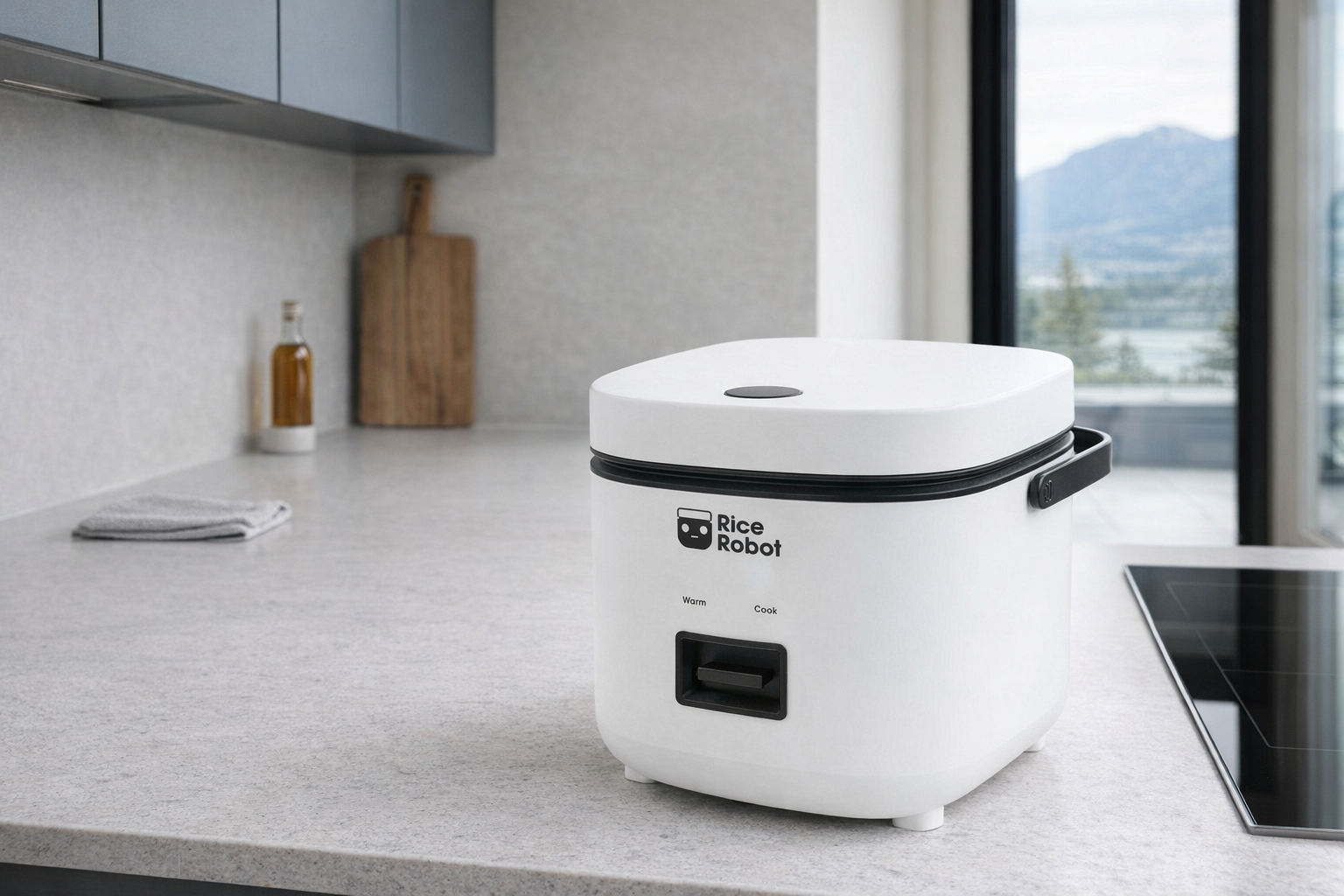
The 5-product PFAS-aware kitchen kit
| Product | Price (CAD) | Tier/Category | PFAS claim clarity |
|---|---|---|---|
| Rice Robot | ~$50 | Tier 1 — explicit PFAS-free claim | High |
| Our Place Wonder Oven | ~$179 | Tier 1 — explicit non-PFAS positioning | Medium-high |
| Vitamix A3500 | ~$230 | Tier 2 — material-first appliance | Medium |
| Greater Goods Scale | ~$59 | Tier 2 — low-contact material-first tool | Medium |
| Bartesian | ~$99 | Tier 3 — unclear listing, verify before buying | Low |
Pro tip: The highest-leverage decision is not "buy only products with giant PFAS-free badges." It's prioritizing food-contact surfaces you heat. A glass-topped scale matters less than a coated rice cooker bowl. A blender container matters more than its touchscreen. If budget is limited, replace heated coated surfaces first, then work outward.
The three buckets of PFAS-aware kitchen buying
A lot of PFAS advice online is too absolute to be useful. Not every kitchen product carries the same exposure question, and not every listing gives you the same level of confidence. The more honest framework is three buckets.
Tier 1 — Explicit claim, high relevance. These are products where the listing makes a direct material or PFAS-related promise, and that promise matters because the product either heats food or uses a coated food-contact surface. This is where a PFAS-focused buyer should spend the most attention. The Rice Robot belongs here because its listing explicitly says PFAS-free ceramic non-stick surface. The Our Place Wonder Oven belongs here because its brand positioning and materials story are part of why shoppers consider it in the first place, even if you should still verify the current spec page before assuming every accessory is covered the same way.
Tier 2 — Material-first, lower drama. These products aren't really sold on PFAS avoidance, but their core materials reduce the issue. Think stainless steel, glass, Tritan, or designs where the main food-contact parts simply don't rely on a fluorinated non-stick coating in the first place. That's a more honest category than a lot of branded wellness language. Vitamix and Greater Goods fit here.
Tier 3 — Unclear, verify before purchase. This is the category shoppers need to get more comfortable saying no to. If a product page is vague, or leans heavily on lifestyle photos while saying little about food-contact materials, you don't fill in the blanks with optimism. You treat the unknown as unknown. Bartesian lands here, not because it's necessarily problematic, but because the supplied listing doesn't give enough material detail for a PFAS-conscious buyer to relax.
That framework matters because the goal is not paranoia. The goal is triage. Replace the things that heat food in coated vessels. Prefer stainless steel and glass where practical. And stop rewarding listings that treat material disclosure like a trade secret.
Tier 1 — Explicit PFAS-focused choices
Rice Robot — the small appliance that makes a clear promise
The Rice Robot Personal Rice Cooker PFAS-free is the anchor product here for a simple reason: it says the thing most listings dance around. According to the listing, it has a PFAS-free ceramic non-stick surface, a 1.2 liter / 1.2 quart capacity, dishwasher-safe components, and an automatic stop when rice is ready. At roughly $50 CAD, that's unusually direct positioning for a category full of vague "healthy ceramic" language. A cheap appliance making a specific materials claim is not proof of perfection, but it is better than making shoppers infer what the coating might be.
For people trying to audit a real kitchen, this is exactly the kind of product worth considering first. Rice cookers are easy to overlook because they seem benign, but they combine heat, moisture, and a coated inner surface that touches food repeatedly. That's precisely the kind of purchase where "PFAS-free" has practical meaning. The compact size also makes sense for apartments, dorms, or anyone who cooks grains for one or two people rather than feeding a family of five. The included stainless steel steamer tray, color-coded measuring cups, serving spoon, and 60-recipe book round it out into a decent value package instead of a bare-minimum gadget.
The honest caveat: "ceramic non-stick" is not a magic phrase either. It tells you more than generic non-stick does, but it does not mean immortal. Ceramic-style coatings can still wear over time, and buyers should think of this as a practical PFAS-avoidance appliance, not a lifetime heirloom. Still, for ~$50 and a 4.2/5 source-listing rating, this is a more transparent buy than most bargain coated cookers.
- Best for: small households replacing older mystery-coating rice cookers on a budget
- Full explainer: Rice Robot Personal Rice Cooker PFAS-free on Celmin · Directory: product page
Our Place Wonder Oven — attractive, useful, and still worth verifying carefully
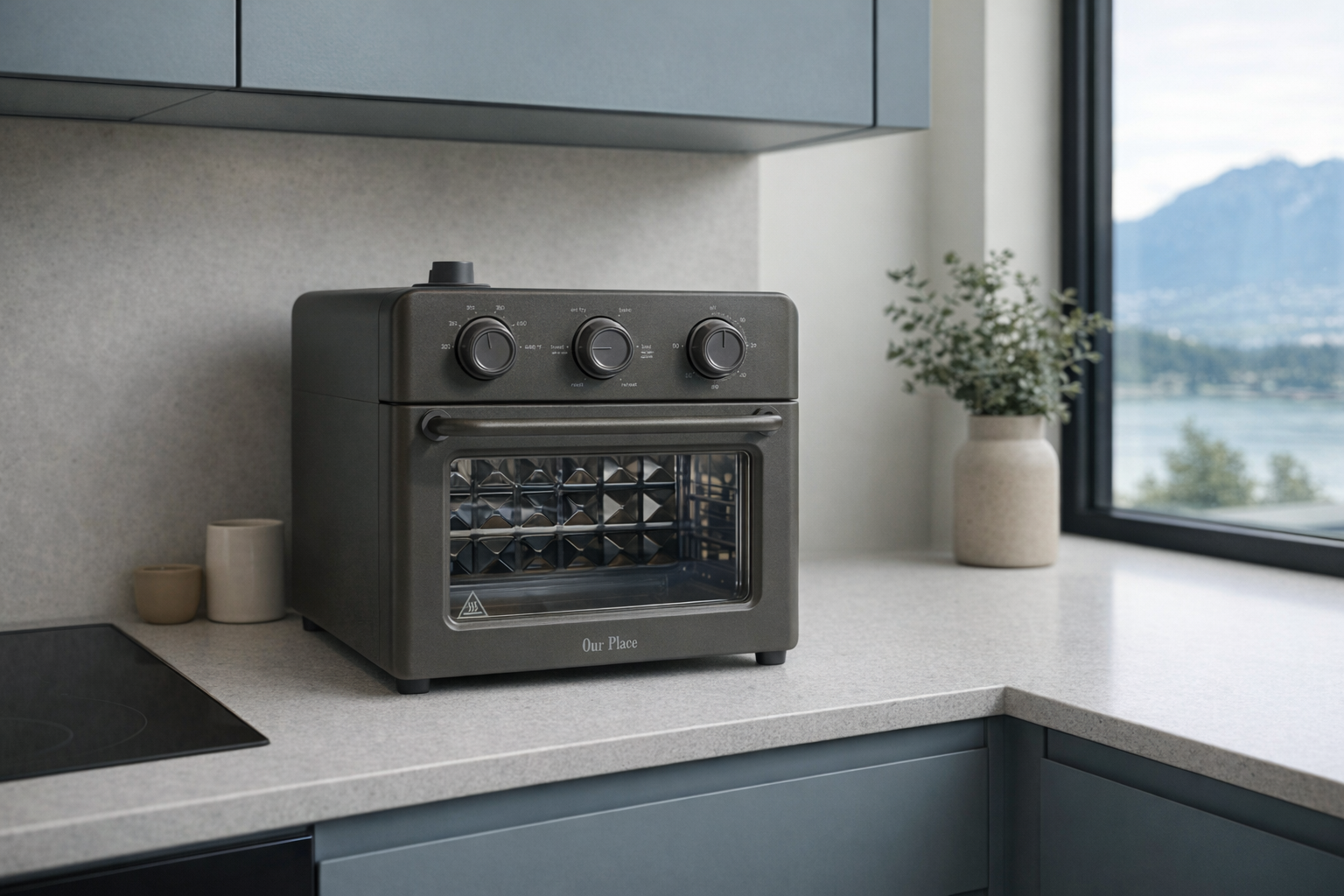
The Our Place Wonder Oven 6-in-1 Air Fryer & Toaster is the kind of product that attracts buyers for two reasons at once: it looks better than the average countertop oven, and it signals a cleaner-materials story than the generic big-box alternative. According to the listing, it's a 6-in-1 unit with 12L capacity, 1400W power, steam infusion, and claims of 75% faster preheating and 30% faster cooking than traditional ovens. It can air fry, toast, roast, bake, reheat, and broil, and the listing says the 12L cavity fits a 2 kg chicken.
For a PFAS-aware buyer, this is where nuance matters. Our Place has built real consumer recognition around ceramic and non-PFAS cookware, and that's not nothing. But you still don't want to get lazy and assume every tray, basket, accessory, or interior surface across every appliance should be treated as verified without checking the current spec page. That's the main lesson of this guide: trust explicit claims, but read the current listing anyway. If the materials information is present and current, great. If it's soft-focus branding without specifics, slow down. The Wonder Oven is a more credible candidate than most design-forward appliances because the broader brand conversation is at least in the right neighborhood, but "probably" is not the same as "confirmed."
That said, as a kitchen purchase, it's easier to defend than a lot of trendy countertop machines. A compact 1400W oven that can take pressure off a full-size range is genuinely useful, especially in smaller kitchens or hot summers when turning on the big oven feels excessive. The design also avoids the fake-smart trap. This is not pretending to be an app-powered life transformation. It's an oven. That's healthy. Just verify what touches food and how it's coated before buying on materials grounds alone.
- Best for: shoppers who want one compact countertop oven instead of multiple small heat appliances
- Full explainer: Our Place Wonder Oven 6-in-1 Air Fryer & Toaster on Celmin · Directory: product page
Tier 2 — Material-first products that reduce the question
Vitamix A3500 — not sold as PFAS-free, but easier to reason about
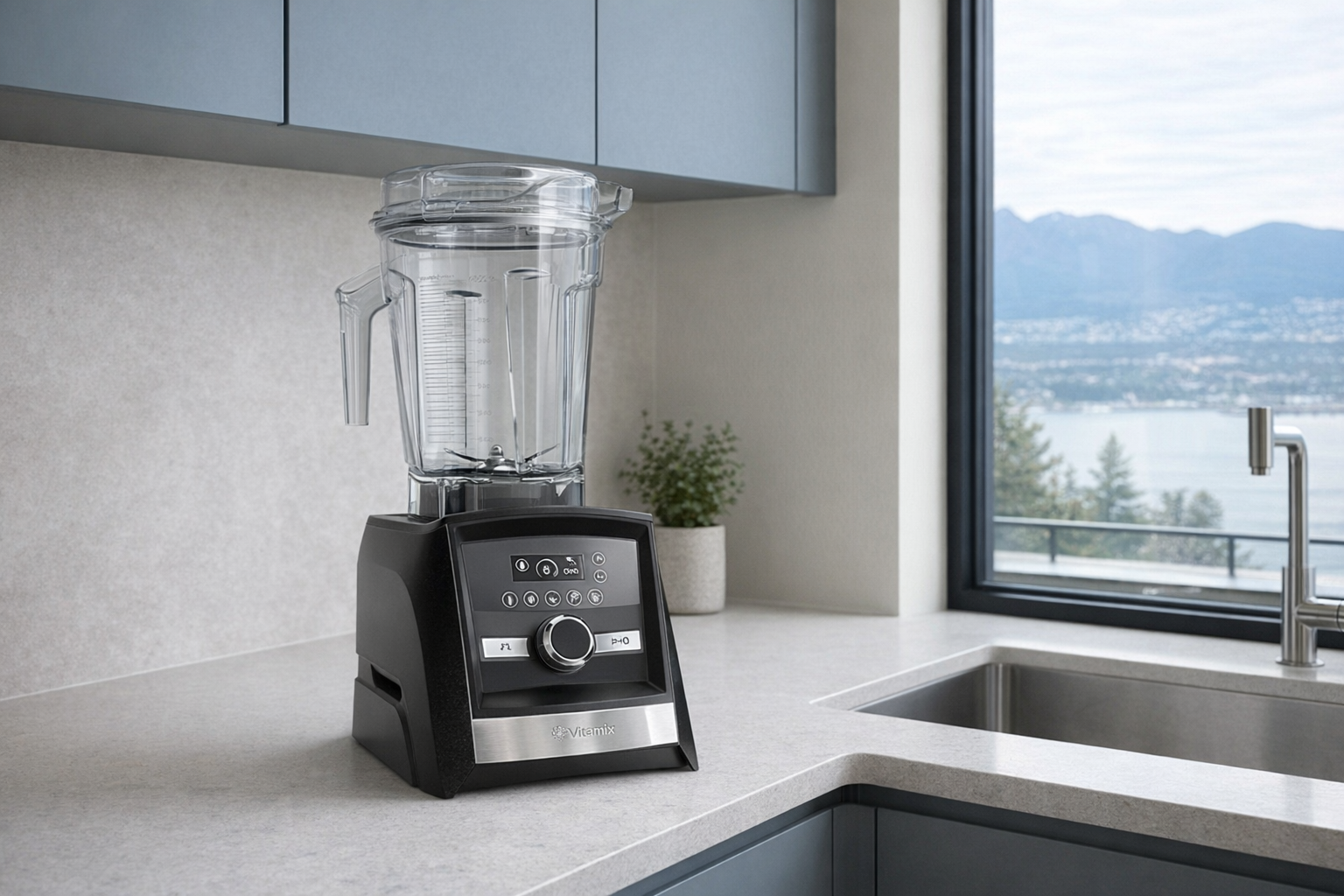
The Vitamix A3500 Ascent Series Smart Blender is a good example of a product that belongs in a PFAS-aware conversation without pretending PFAS is its headline. The listing focuses on five program settings — Smoothies, Hot Soups, Dips & Spreads, Frozen Desserts, and Self-Cleaning — plus built-in wireless connectivity, a programmable timer, touchscreen controls, and a 64 oz low-profile container. None of that is a PFAS claim. And that's fine.
Why include it, then? Because one of the most practical ways to build a lower-drama kitchen is to favour products where the food-contact story is simple. A blender is not a non-stick pan. The main question is less about fluorinated coatings and more about whether the core food-contact materials are straightforward and well-established. That's what makes Vitamix easier to reason about than some niche wellness appliance with a vague coating and a lot of branding. The listing doesn't say "PFAS-free," and this guide isn't going to invent that for them. But the overall product type lives in a cleaner mental category than heated non-stick cookware.
There is also a useful editorial point here: high-performance kitchen gear can reduce your dependence on questionable convenience gadgets. A serious blender often replaces a cluster of lower-quality single-use tools. If you're making soups, sauces, nut-based dressings, frozen desserts, and smoothies in one 64 oz container, you may end up buying fewer cheap appliances with murkier materials disclosure. At roughly $230 CAD and a 4.6/5 source rating, it is clearly not a budget choice, but it is easier to defend than most "smart kitchen" products because its value proposition is still fundamentally mechanical, not gimmicky.
- Best for: buyers who want one durable prep tool instead of a drawer full of compromised small appliances
- Full explainer: Vitamix A3500 Ascent Series Smart Blender on Celmin · Directory: product page
Greater Goods Scale — the quiet example of why material simplicity matters
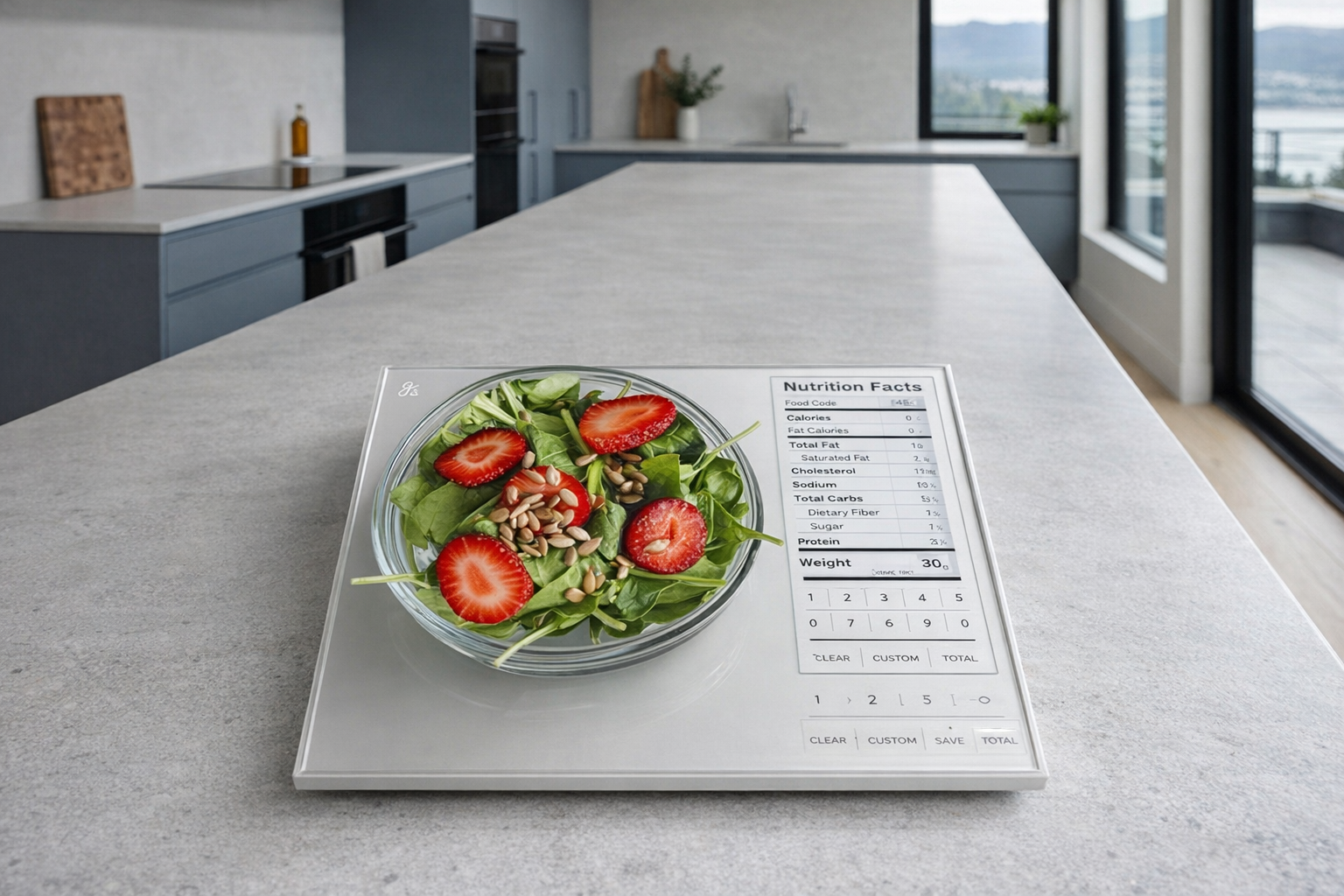
The Greater Goods Nutrition Scale is not an obvious PFAS product, which is exactly why it's useful in this guide. It has a food-safe glass surface, capacitive touch buttons, precision down to 0.1 g, nutrition data for 2,000 foods, and room for 99 custom entries. Its body measures 9.33 x 6.02 x 0.91 inches, and at about $59 CAD it sits in the "serious but not absurd" range for a nutrition-focused kitchen scale.
This is what a low-drama kitchen tool looks like. A glass weighing surface is simple to understand, simple to clean, and not the kind of material that sets off a whole second round of consumer detective work. Not every product needs to be sold as PFAS-free if its design already avoids the issue in practice. That's a more mature standard for buyers to adopt. The scale also shows why some material decisions deserve more emotional energy than others. If you're worried about PFAS, replacing a scratched old non-stick pot matters far more than agonizing over a glass-topped scale. But if you're buying new anyway, choosing glass over mystery plastic trim and vague coatings is the sane move.
The broader opinion here is that kitchen wellness often gets sold backwards. People are pushed toward supplements, pods, and niche health gadgets before they fix the basics. A nutrition scale isn't glamorous, but it can quietly support better cooking habits and simpler prep without introducing much materials ambiguity. That's a more honest design than a lot of app-heavy kitchen nonsense.
- Best for: meal-prep households that want precise portioning without adding another coated cooking surface
- Full explainer: Greater Goods Nutrition Scale on Celmin · Directory: product page
Tier 3 — The listings that are too vague for comfort
Bartesian — a good reminder that "unclear" is not the same as "safe"
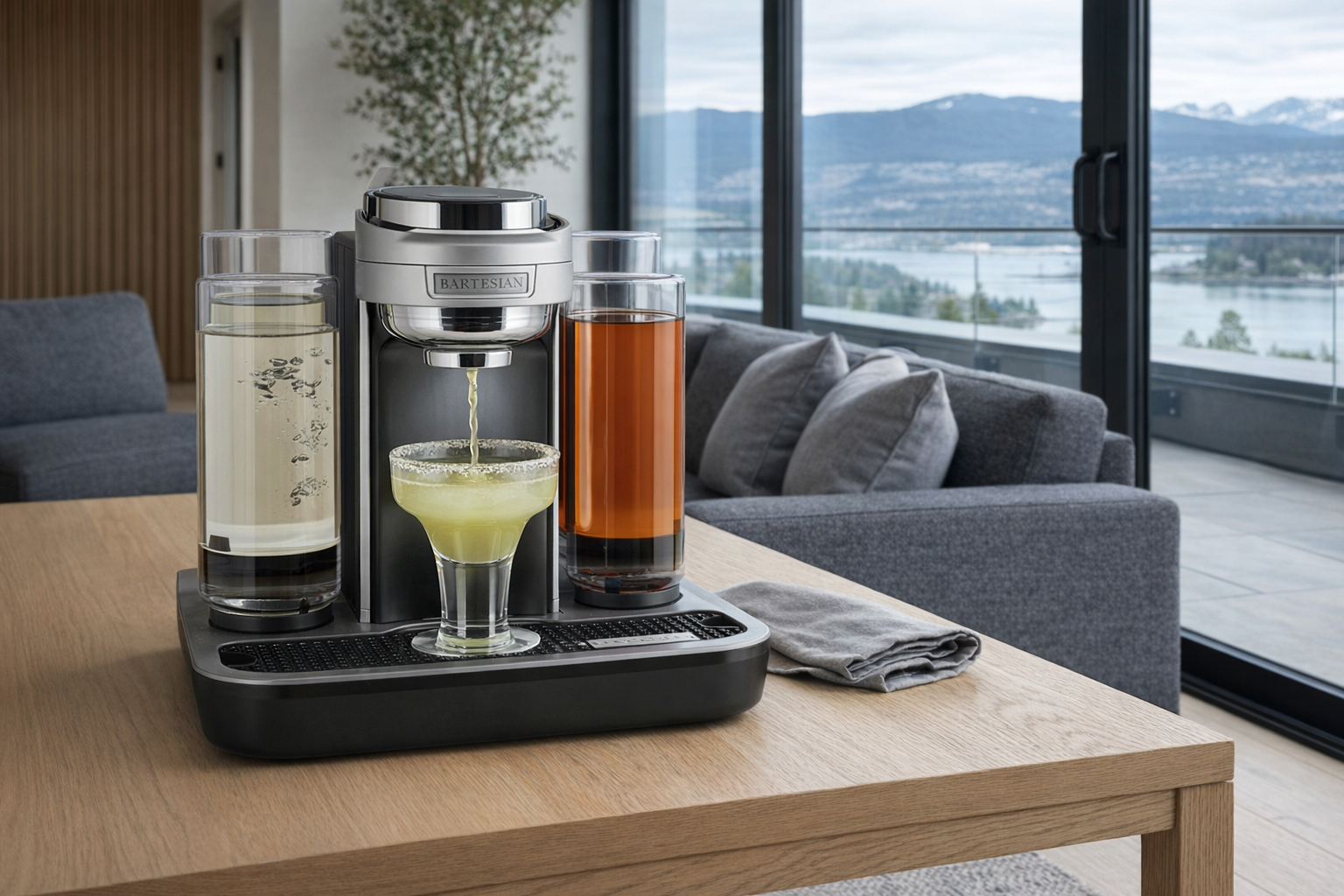
The Bartesian Premium Cocktail Maker is here to represent the category of kitchen-adjacent appliance that may be perfectly fine, but whose supplied listing tells you almost nothing useful about materials. The dossier gives a ~$99 CAD price point, a 4.4/5 source-listing rating, and little else beyond the product name and category. That is not enough for a PFAS-aware buyer. Full stop.
This is where a lot of people talk themselves into a purchase because the machine seems low-risk or "probably mostly plastic and tubing." Maybe. But that guesswork is exactly what you should stop doing if you're trying to build a cleaner-materials kitchen. With a cocktail machine, you would want to know what the liquid pathways are made from, what parts contact alcohol or acidic mixers, whether any pods or inserts use coatings, and how much of the system is designed for easy cleaning. The provided listing doesn't answer that. So the right editorial stance is not fearmongering. It's restraint. If the materials page is vague, ask questions or buy something simpler.
There's also a broader judgment worth making: automated cocktail makers are narrower-use appliances than the marketing suggests. If your actual goal is reducing questionable coatings and kitchen clutter, this is not where most households should spend their next $99. It may be fun. It may even be well made. But from a PFAS-aware buying perspective, it's a "verify first, and maybe skip altogether" product.
- Best for: buyers willing to verify materials directly before treating it as compatible with a PFAS-conscious kitchen plan
- Full explainer: Bartesian Premium Cocktail Maker on Celmin · Directory: product page
The order to buy these in
One mistake people make when they get serious about PFAS is trying to replace an entire kitchen in one weekend. That's expensive, wasteful, and usually driven by anxiety more than reason. A smarter approach is to replace by risk and frequency of use.
- Rice Robot Personal Rice Cooker PFAS-free ($50) — running total: **$50**
Start with the cheap heated coated surface that actually tells you what it is. - Greater Goods Nutrition Scale ($59) — running total: **$109**
Not because it's urgent, but because it adds a simple, low-ambiguity prep tool. - Our Place Wonder Oven 6-in-1 Air Fryer & Toaster ($179) — running total: **$288**
Add this once you've verified the current materials details you care about. - Vitamix A3500 Ascent Series Smart Blender ($230) — running total: **$518**
This is the premium upgrade, not the first one. Buy it if you'll actually use the 5 programs and 64 oz capacity. - Bartesian Premium Cocktail Maker ($99) — running total: **$617**
Only after verifying materials directly, and only if it fills a real use case rather than a "looks fun" gap.
A realistic stopping point for most readers is step 3, around $288 CAD. At that point you've replaced one high-relevance coated appliance, added a low-drama prep tool, and upgraded your countertop cooking setup without going full kitchen-purge mode.
The three questions worth asking before you buy anything
- Does this product heat food in a coated vessel or on a coated tray?
If yes, materials clarity matters more. A coated rice cooker bowl deserves more scrutiny than a glass scale surface. - Am I buying a verified material story, or filling in gaps with brand vibes?
"Ceramic," "healthy," "clean," and "non-toxic" are not interchangeable. Look for an actual PFAS-related claim or clearly stated materials. - Am I replacing a real daily-use item, or just shopping aspirationally?
If you use a rice cooker three times a week, that is a rational first swap. If a cocktail machine might come out twice a month, it is not.
Got Questions About PFAS-aware kitchen buying? Let's Clear Things Up.
Is this a hands-on review?
No. This is an editorial guide to PFAS-aware kitchen buying using products already covered on Celmin. It is meant to help you interpret listings, claims, and materials categories more realistically — not to substitute for the current manufacturer spec page or regulatory documentation.
What does PFAS-free actually mean on a product listing?
It means the seller is making a specific claim, and that is better than silence. But it doesn't mean every part of the product has identical material relevance. Focus on the food-contact surfaces, especially those exposed to heat. A PFAS-free claim on a rice cooker's non-stick bowl is much more meaningful than a broad wellness halo around an entire brand.
Is "ceramic non-stick" automatically safe?
Not automatically, and that's where consumers get misled. "Ceramic" is often better framed as a different coating story, not as an invitation to stop asking questions. The useful part is when a listing is explicit, as with the Rice Robot's PFAS-free ceramic non-stick surface. The less useful part is when brands use ceramic language as a mood board instead of a materials disclosure.
Should I throw out all my old non-stick cookware immediately?
For most people, no. Start with the pieces you use most often and the ones that show visible wear. A calm audit beats a panic purge. Prioritize older or scratched coated items, countertop appliances with heated bowls or trays, and anything with unclear material disclosure. Replace in stages.
What does the Canadian regulatory picture look like right now?
The important short version is that Health Canada has proposed PFAS-related regulation, but proposed is not the same as fully in force across every consumer product category. So for now, buyers still need to read listings carefully, verify current material claims, and avoid assuming the market has already cleaned itself up.
Are stainless steel, glass, and Tritan better bets than vague non-stick claims?
Often yes, because they reduce ambiguity. That's why products like the Vitamix and Greater Goods scale are relevant here even without shouting "PFAS-free." The point isn't that every material question disappears. It's that the food-contact story is usually simpler and easier to evaluate than with unspecified coated surfaces.
Where should I buy these to verify the latest details?
Check current pricing, accessories, and material disclosures directly before buying: Rice Robot Personal Rice Cooker PFAS-free · Our Place Wonder Oven 6-in-1 Air Fryer & Toaster · Vitamix A3500 Ascent Series Smart Blender · Greater Goods Nutrition Scale · Bartesian Premium Cocktail Maker
What would Celmin recommend as a first purchase?
The most sensible low-cost first move is the Rice Robot Personal Rice Cooker PFAS-free at about $50 CAD. It targets a heated food-contact surface, makes a direct PFAS-free claim, and doesn't ask you to rebuild your whole kitchen to get one meaningful improvement.
If you're building a smarter home in Canada and want honest comparisons of gadgets worth considering — plus the ones worth skipping — Celmin covers the full catalog without the marketing theater. More comparisons, reviews, and buyer guides at https://celmin.ca.
Discussion
Sign up or sign in to join the conversation.