
The Vitamix A3500 Ascent Series Smart Blender sits in an interesting corner of the blender market: not the cheap smoothie-maker tier, and not just a brute-force professional blender either, but a premium countertop blender that tries to add a layer of intelligence on top of the usual Vitamix ...
The Vitamix A3500 Ascent Series Smart Blender sits in an interesting corner of the blender market: not the cheap smoothie-maker tier, and not just a brute-force professional blender either, but a premium countertop blender that tries to add a layer of intelligence on top of the usual Vitamix formula. That means presets, wireless container detection, a touchscreen, and a more polished interface than the old-school dials and switches many people still associate with the brand. The obvious question is whether any of that actually makes blending better, or whether it mostly makes a serious kitchen tool look more futuristic on a product page.
This is not a hands-on review. Nothing here is based on personally using the machine. Instead, this is a plain-English breakdown of what the listed features suggest, how the A3500’s “smart” layer likely affects real kitchen use, and where it genuinely differs from a more traditional model like the Vitamix 5200. If you are trying to decide whether the smart features earn their keep — or whether you are better off with a simpler Vitamix — this is for you.
📺 Watch: Vitamix A3500 Ascent Series Smart Blender in context
Quick snapshot
| Question | What the Vitamix A3500 Ascent Series Smart Blender actually is |
|---|---|
| Category | Smart Kitchen |
| Made by | Vitamix |
| Typical price | ~$230 CAD (listing at the time of writing — verify current pricing) |
| Rating signal | 4.6/5 on the source listing |
| Best for | Home cooks who want preset convenience without giving up manual control |
| Skip if | You prefer simple physical controls, do not care about smart sensing, or mainly blend very basic smoothies |
Pro tip: If the words “wireless connectivity” make you assume this is some deeply app-dependent smart appliance, slow down — the most useful “smart” part here is probably the container sensing, not the software layer.
What the Vitamix A3500 Ascent Series Smart Blender actually is
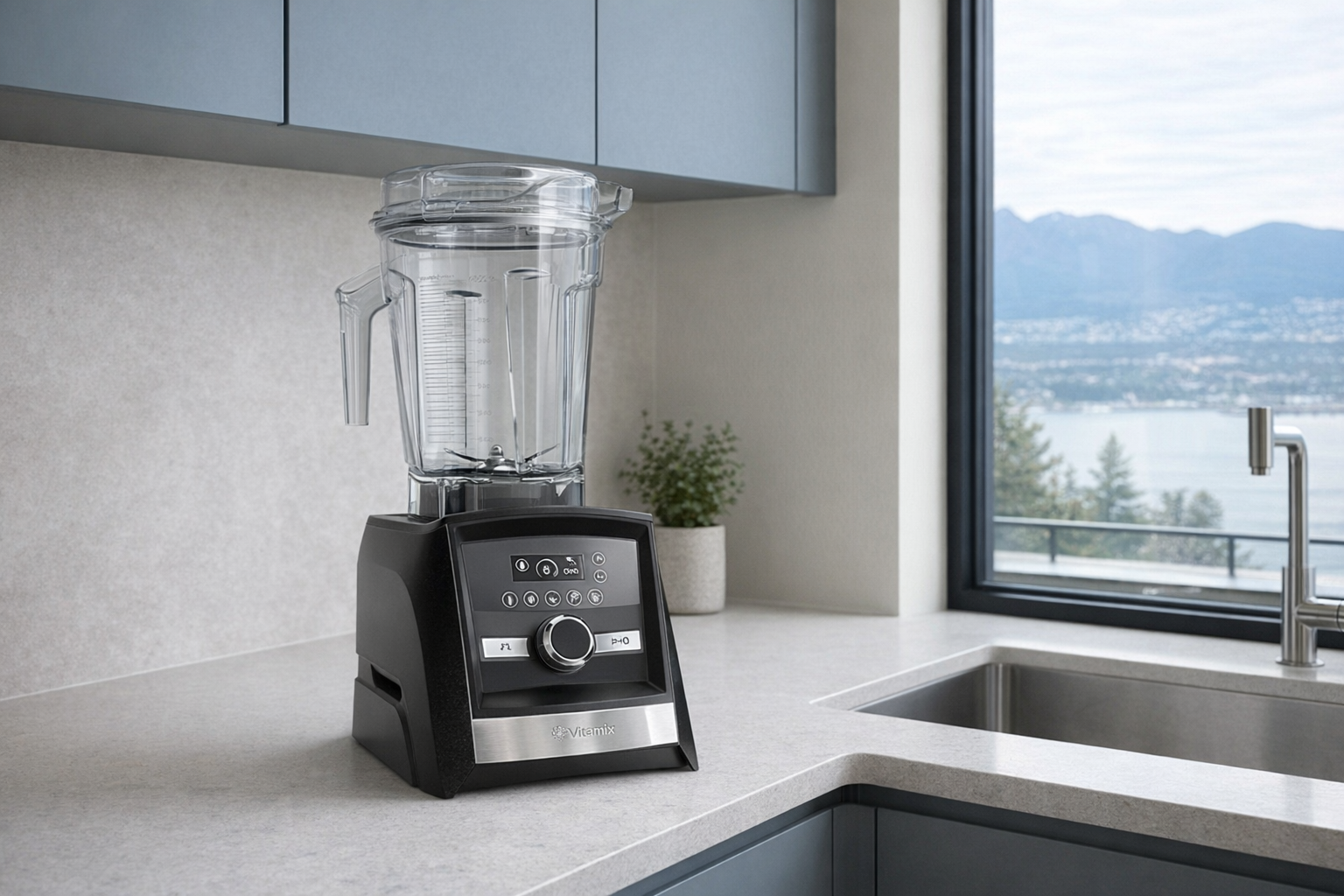
In plain English, the Vitamix A3500 Ascent Series Smart Blender is a high-end full-size blender that mixes classic Vitamix strengths — powerful blending, manual speed control, and a large family-size jar — with a more guided interface. Instead of asking you to do everything by feel, it adds 5 preset programs, a programmable timer, and a system that reportedly detects the container size and adjusts settings automatically. That is a practical kind of smart feature, at least on paper: less “talk to your blender” nonsense, more “help me not overrun this recipe.”
Five program settings for Smoothies, Hot Soups, Dips & Spreads, Frozen Desserts, and Self-Cleaning. Built-in wireless connectivity reads container size and adjusts settings automatically. Includes low-profile 64 oz container.
The important thing is that this is still, fundamentally, a Vitamix blender first. It is not a countertop computer that happens to puree things. The touchscreen and wireless sensing sit on top of a machine that is still meant to crush frozen fruit, blend fibrous greens, puree soups, and handle thicker mixes like nut butters or dips. That makes it different from a lot of “smart kitchen” products where the smart layer is the entire pitch. Here, the core appliance remains the point.
Compared with the Vitamix 5200, the A3500 looks like a more modern, more guided, more polished version of the same general idea. The 5200 is famously simple: physical switches, variable speed dial, no smart sensing, no touchscreen, and a reputation built on raw capability rather than interface design. The A3500 adds convenience and safety logic, but it also adds a bit more abstraction between the user and the machine. For some buyers, that is progress. For others, that is paying extra for polish.
Key features at a glance
- 5 program settings for Smoothies, Hot Soups, Dips & Spreads, Frozen Desserts, and Self-Cleaning
- Built-in wireless connectivity that reads container size and adjusts settings automatically
- Variable Speed Control for manual texture control
- Pulse feature for short bursts and chunkier results
- Programmable timer that turns the machine off automatically
- Touchscreen controls designed to wipe clean more easily
- Low-profile 64 oz container included in the box
How the Vitamix A3500 Ascent Series Smart Blender actually works
The A3500’s smart layer is not especially complicated, which is a good thing. Based on the listed features, there are really three pieces to understand.
First, there are the preset programs. These likely run the motor through pre-set speed and timing patterns designed for specific jobs: smoothies, soup, dips, frozen desserts, and cleaning. That matters because different recipes benefit from different blending curves. A smoothie wants a different ramp-up than a thick spread, and a self-cleaning cycle should obviously behave differently from either. This is the most straightforward convenience feature here, and probably the most useful for busy households.
Second, there is the wireless container sensing. According to the listing, the blender can read container size and adjust settings automatically. That is a more grounded feature than it sounds. In practice, the point is probably to prevent mismatches between the selected program and the container being used, while improving consistency and adding a safety layer. That is smarter than just slapping Bluetooth on a blender and calling it innovation.
Third, there is the manual control side: variable speed, pulse, and a programmable timer. This matters because serious blender users often stop trusting presets once they know what texture they want. A timed smoothie program is convenient, but if you want salsa with actual pieces left in it, or a soup that is hot but not completely overworked, manual control is still what keeps a machine flexible. The A3500 seems to understand that. It gives you automation, but it does not force you to use it.
A realistic way to think about the machine is this:
- Presets handle repeatable tasks like smoothies or self-cleaning.
- Container sensing adds guardrails so the machine better matches its settings to the vessel in use.
- Manual controls take over when you care more about texture than convenience.
- The timer reduces babysitting, which is quietly one of the most useful premium-blender features.
That is a more honest design than many competitors’ “smart” appliances, because it aims at repeatability and ease rather than novelty.
A realistic "day in the life" with Vitamix A3500 Ascent Series Smart Blender
Because this is an informational explainer, this is not a tested routine — just what the listed features imply a normal day might look like.
- Morning. Someone in the house makes a smoothie before work using the dedicated preset. The machine runs the cycle automatically, and the 64 oz container means it can handle more than one serving without feeling cramped. If mornings are rushed, the timer and auto shutoff matter more than the touchscreen styling.
- Midday. Lunch is a quick blended soup or dip. The Hot Soups or Dips & Spreads program takes some guesswork out of the process, especially for a user who does not want to stand there manually adjusting speeds the whole time. This is where presets earn their keep: same task, repeated often, minimal fuss.
- Afternoon. A more particular cook uses variable speed control and the pulse feature instead of any preset because they want texture control for something chunkier, like a rustic sauce or a less-uniform spread. That is the reminder that this is still a serious blender, not just a one-button appliance.
- Evening. Cleanup is handled with the Self-Cleaning setting. That may sound small, but on a machine used daily, friction matters. A blender that is annoying to clean tends to get used less, and premium appliances should reduce that friction, not add to it.
Who the Vitamix A3500 Ascent Series Smart Blender is actually for (and who it isn't)
Great fits
- Home cooks who make the same few things repeatedly — smoothies, soups, frozen desserts — and want consistency without fiddling every time.
- Families using a full-size blender regularly enough to appreciate a 64 oz container rather than a single-serve cup system.
- Buyers who like the Vitamix reputation for serious blending but want a more modern interface than the old dial-and-switch look.
- People who want premium-kitchen convenience features that are actually practical, like timed shutoff and automatic program logic.
- Design-conscious kitchens where the easier-to-wipe touchscreen and cleaner silhouette genuinely matter.
Poor fits
- Shoppers who mainly make one-person protein shakes and would be better served by a smaller, cheaper personal blender.
- Anyone who prefers the mechanical simplicity and serviceable feel of a model like the Vitamix 5200.
- Cooks who do not use presets and instinctively go manual every single time; the smart layer may just be extra cost and extra complexity.
- Budget-focused buyers who want maximum blending performance per dollar and do not care at all about interface polish.
- People who dislike touch controls on principle, especially in kitchens where wet hands and quick tactile feedback matter.
Practical trade-offs
Smart features vs actual value
This is the central issue with the A3500. The 5 presets and container sensing are useful if you want repeatability, convenience, and a bit of guardrail logic. But not all “smart” value is equal.
The container-size reading sounds like the most genuinely useful smart feature because it affects how the machine behaves behind the scenes. The touchscreen looks modern, but that is mostly interface polish. And any app-adjacent smart branding should be judged carefully. A blender does not become better just because it can be described with connected-tech language. Evaluate the A3500 like a kitchen tool with a smarter control system, not like a breakthrough appliance category.
Controls and usability
Touchscreens always sound cleaner and sleeker than physical controls, and in one sense they are: fewer crevices, easier wipe-downs, more modern appearance. In a kitchen, though, tactile controls still have real advantages. A physical dial lets you make adjustments without looking too hard. Touch controls can be elegant, but they can also be less forgiving when your hands are wet or sticky.
That does not make the A3500 badly designed. It just means the polished interface is not automatically better for every cook. If you like clean surfaces and guided programs, it will probably feel more premium. If you value blind adjustments and old-school directness, the 5200 may still make more sense.
Size, counter space, and kitchen reality
The included low-profile 64 oz container is large enough for family use and batch blending, but a full-size Vitamix is still a full-size Vitamix. This is not the kind of blender you casually tuck into a tiny condo cabinet if your kitchen storage is already under pressure.
There is also the practical reality of noise, mess, and frequency of use. Powerful blenders tend to be loud, and large jars encourage larger batches. That is great for soups, smoothie prep, and dips for a crowd. It is less ideal if your real use case is one small drink every other morning. Premium blender buyers sometimes overestimate their future enthusiasm. Be honest about whether you are buying for the life you actually live or the healthier, more organized version of yourself.
Where the Vitamix A3500 Ascent Series Smart Blender fits in a modern kitchen
The A3500 makes the most sense in a kitchen that already leans toward batch cooking, meal prep, and full-size countertop appliances. It fits well alongside things like an Instant Pot, a quality food processor, or a stand mixer — tools used often enough that convenience features pay off over time.
It also fits neatly into a household using recipe ecosystems and semi-structured cooking routines. If your kitchen style is “repeatable breakfast smoothie, weekend soup, weekday dip, occasional frozen dessert,” the presets and timer start to look genuinely useful. If your style is more improvisational and hands-on, it works too — but then you are leaning more on manual speed and pulse, which starts to make the “smart” layer feel optional.
In that sense, the A3500 is not really the centre of a smart kitchen. It is better understood as a premium blending workhorse with some useful automation. Let your phone, tablet, or smart display handle recipe browsing. Let your smart plugs and kitchen timers handle broader workflow if you like. The blender’s job is still blending. The smartest thing it can do is make that less fiddly.
The buying decision, in plain terms
Before buying the Vitamix A3500 Ascent Series Smart Blender, three questions usually clarify things quickly:
- Do you actually want presets, or do you mostly blend by instinct?
If presets for smoothies, soup, and cleaning sound genuinely useful, the A3500 makes sense. If you know you will ignore them, a simpler model may be the better buy. - Do you value polished design enough to pay for it?
The touchscreen, modern silhouette, and smart sensing are part of the package. If you just want maximum utility and do not care about elegance, the Vitamix 5200 remains the more stripped-down benchmark. - Will you use a full-size 64 oz blender often enough to justify the space and cost?
This is the big practical question. A premium blender is sensible when it becomes part of normal cooking, not when it spends months as a countertop monument to good intentions.
If you want a Vitamix with convenience features that are mostly practical rather than flashy, the A3500 looks sensible; if you want pure function with fewer layers, the 5200 is still the cleaner answer.
Got Questions About the Vitamix A3500 Ascent Series Smart Blender? Let's Clear Things Up.
Is this a hands-on review?
No. This is an informational explainer based on the listed features, the product description, and what those features likely mean in real kitchen use. It is meant to help you decide whether the A3500’s smart layer sounds useful to you before digging deeper.
What does the “smart” part actually mean here?
Based on the listing, the smart elements are mainly the wireless container-size sensing, preset programs, and a more guided control system. This is not smart in the sense of replacing your cooking judgment. It is smart in the sense of adding automation and consistency to common blending tasks.
Is the wireless connectivity actually useful, or mostly marketing?
It looks like a bit of both. The most credible value is that the blender can read container size and adjust settings automatically, which is a practical safety-and-consistency feature. That said, not every buyer needs that, and it is fair to view some of the smart branding as premium polish rather than a necessity.
How is it different from the Vitamix 5200?
The Vitamix 5200 is the more traditional, manual-control-first model with physical switches and no smart sensing. The A3500 adds presets, touchscreen controls, a timer, and wireless container logic. If you want simplicity and direct control, the 5200 is still appealing; if you want more guidance and convenience, the A3500 is the more modern option.
Is the 64 oz container too big for everyday use?
That depends on your kitchen habits. A 64 oz container is great for families, meal prep, soups, and making multiple servings at once. For one-person, occasional blending, it may feel larger than necessary, which is why smaller personal blenders remain popular.
Where can I verify the current listing or buy it?
The current retailer link provided for this product is Amazon here: Vitamix A3500 Ascent Series Smart Blender. That is the best place to verify the latest price, feature wording, and listing details, since retail pages can change over time.
What does it cost in Canada?
At the time of writing, the listing price is ~$230 CAD. As always with marketplace pricing, verify the current amount on the retailer page before buying, because blender pricing can swing with sales, bundles, and seasonal promotions.
Where is the Celmin Directory listing for this product?
For a catalog-style view of the same product — structured specs, pros and cons, similar picks, and FAQ — see Vitamix A3500 Ascent Series Smart Blender on Celmin Directory.
If you're building a smarter home in Canada and want honest explainers on gadgets worth considering — plus the ones worth skipping — Celmin covers the full catalog without the marketing theater. More reviews, comparisons, and buyer guides at https://celmin.ca.
Discussion
Sign up or sign in to join the conversation.