
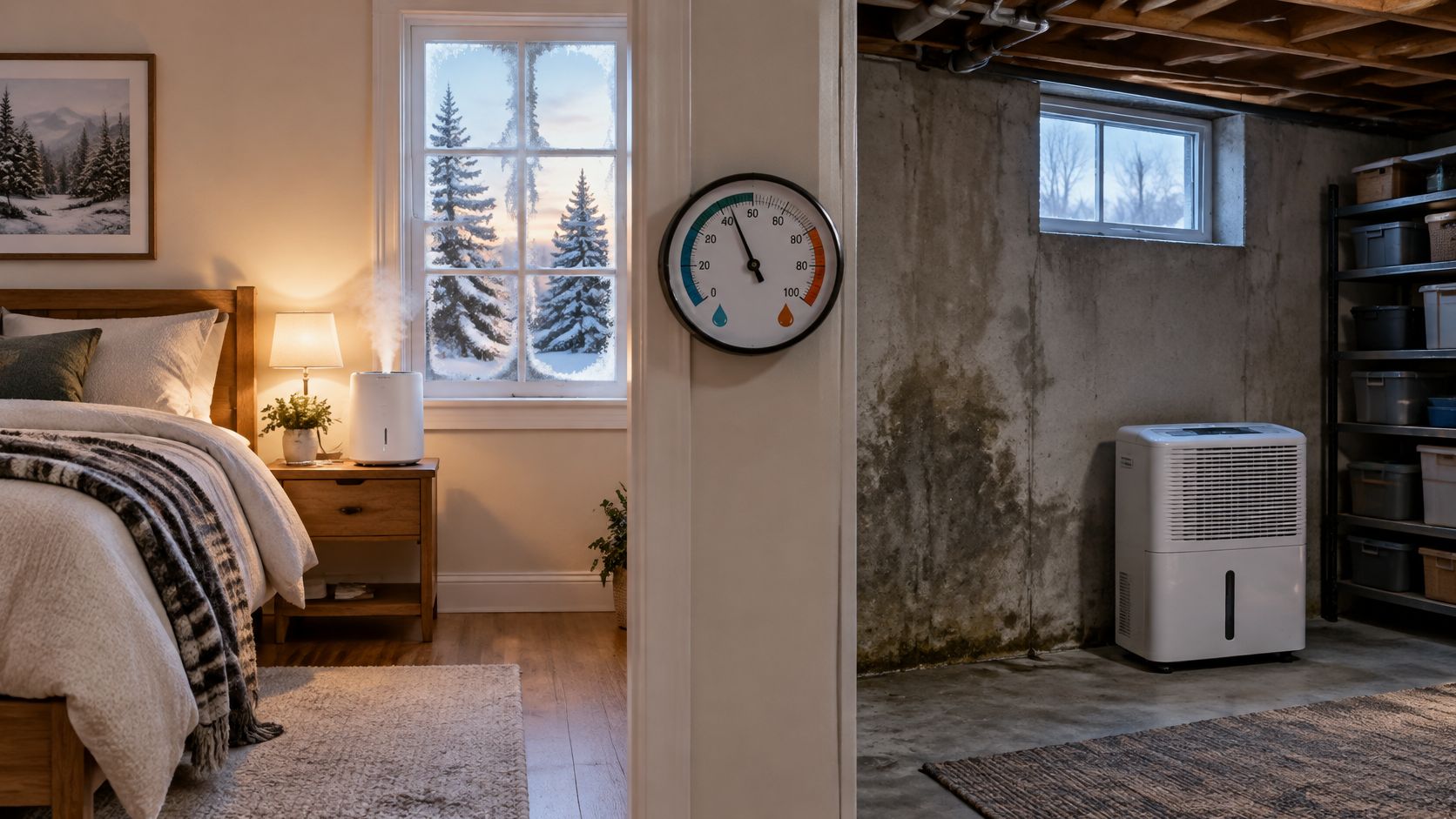
A 2025 forecast from TechSci Research projected a compound annual growth rate of 7.68% for the Canadian dehumidifier market through 2030, covering residential and commercial demand. That growth is being booked in a country whose winter is usually described as bone dry, and both things are true at once. Winter doesn't push moisture in one direction through a Canadian house. It pushes it from room to room.
A bedroom over a furnace vent loses humidity all night. A basement one floor below picks it up from laundry, showers, and a foundation sitting in wet soil. Ask whether you need a humidifier or dehumidifier for winter and the season is the wrong variable. The hygrometer reading is the right one, and fog on the glass has the final vote. What follows works through both directions of winter moisture, the numbers that separate them, and the trade-offs that decide which machine earns a place in which room.
Table of Contents
- Winter Air Runs Dry in Some Homes and Damp in Others
- Indoor Humidity Readings and the Winter Action to Take
- Humidifier and Dehumidifier Compared on Winter Criteria
- When a Humidifier Earns Its Place in Winter
- How to Set Humidity Without Causing Condensation
- When a Dehumidifier Is the Right Choice in Winter
- Confirm Your Readings and Choose the Unit
Winter Air Runs Dry in Some Homes and Damp in Others
Start with the measured indoor reading. A room below about 30% relative humidity with no condensation calls for a humidifier. A room above 50%, or any room where moisture beads on cold glass, calls for a dehumidifier. The season does not decide this. The hygrometer sets the first move, and condensation can reverse it.
Many Canadian homes are never measured at all, which is why the wrong device gets bought. Without a hygrometer, a dry bedroom and a damp basement look like the same winter problem, so one machine gets purchased for a whole house that is running in two directions.
The two winter failure modes look nothing alike. Dry appears in a heated house once outdoor temperatures fall. Cold air holds very little moisture, and warming it to room temperature does not add any: static shocks at the light switch, cracked knuckles, a sore throat in the morning, a hardwood floor that opens gaps at every seam. Damp appears in sealed, cool houses where showers, cooking, laundry, and a damp basement load moisture into air that has nowhere to go. That moisture finds the coldest surface available, usually a window pane or a basement wall.
You probably don't need a verdict on the whole house. You need one on the room that feels wrong, whether it's stuffy and dry or clammy and smelling of wet concrete. A dry bedroom and a wet basement can sit in the same house, and each needs the device that matches the direction moisture is moving there.
Measure the room, not the season.
Work through four steps per room: read the hygrometer, compare that number with the target band, check the windows for condensation, then choose the device. A house with a dry bedroom and a wet basement can end up with one of each machine.
Indoor Humidity Readings and the Winter Action to Take
| Measured indoor RH | Typical winter condition | What to do |
|---|---|---|
| Below 30% | Dry air, static shocks, cracked skin, dry throat | Add humidification gradually toward 30% to 35% |
| 30% to 35% | Health Canada winter target band | Hold steady; no change needed |
| 35% to 40% | Upper end of the cold-weather band | Keep humidifier low and watch windows |
| 40% to 50% | Acceptable in most homes, condensation risk rises in cold snaps | Reduce humidifier; ventilate if fog appears |
| Above 50% | Above the recommended ceiling | Run a dehumidifier and improve ventilation |
| Condensation on windows at any reading | Surface temperature too cold for the moisture level | Lower humidity or ventilate, whatever the RH |
The band worth aiming for is narrower than commonly assumed, and it moves. Health Canada's guidance on humidity in the home sets the winter target at approximately 30% to 35% relative humidity, sitting inside a broader healthy-home range of 30% to 50% that shifts with outdoor temperature, building construction, and condensation risk. Below the band, that same guidance lists what dry air does: cracked skin, eye irritation, more static electricity, wood floors and furniture that contract, and potentially better survival conditions for some viruses.
Read the table from the top. Under 30% you are in dry-air territory, and the fix is a humidifier worked slowly, a few points at a time with a day in between to see what the glass does. At 30% to 35% you have arrived, so leave the setting alone. Between 35% and 40% the unit should be running low, because that is the top of the practical cold-weather band and the margin is thin.
From 40% to 50% the air is still acceptable in most homes, but the condensation risk climbs fast in a cold snap, so dial the humidifier back and ventilate if a window fogs. Above 50% you are over the ceiling and the tool changes: a dehumidifier plus better ventilation, not a bigger humidifier.
Why a Comfortable Reading Can Still Fog a Window
Condensation is a surface problem, not an air problem. When outdoor temperatures plunge, the inside face of a window frame, a foundation wall, or a cold water pipe drops far below room temperature, and the moisture in the air condenses there first. That same guidance notes that in very cold weather even RH above 30% can produce excessive condensation on windows, exterior walls, foundations, and pipes. A reading that holds comfortably through a mild cold snap can fog glass once the deep freeze arrives, which is why the target drifts downward as the outdoor mercury drops.
There is a real comfort payoff at low humidity and a real building penalty at high humidity. Air that is too dry feels colder than it is, and air that is too wet finds every cold surface in the envelope. The crossover between those two states depends on the weather outside your wall, and on how well that wall is built.
Practical rule: fogging overrides the reading. If glass sweats or frosts, lower the moisture level even when the hygrometer looks perfectly reasonable, because the surface is telling you what the sensor cannot.
To read any of this you need a number, and household humidity cannot be judged by feel. Mount a digital hygrometer such as the Temppro TP50 away from the humidifier, exterior walls, and vents, because a sensor sitting in a mist plume reads the machine, not the room.
Humidifier and Dehumidifier Compared on Winter Criteria
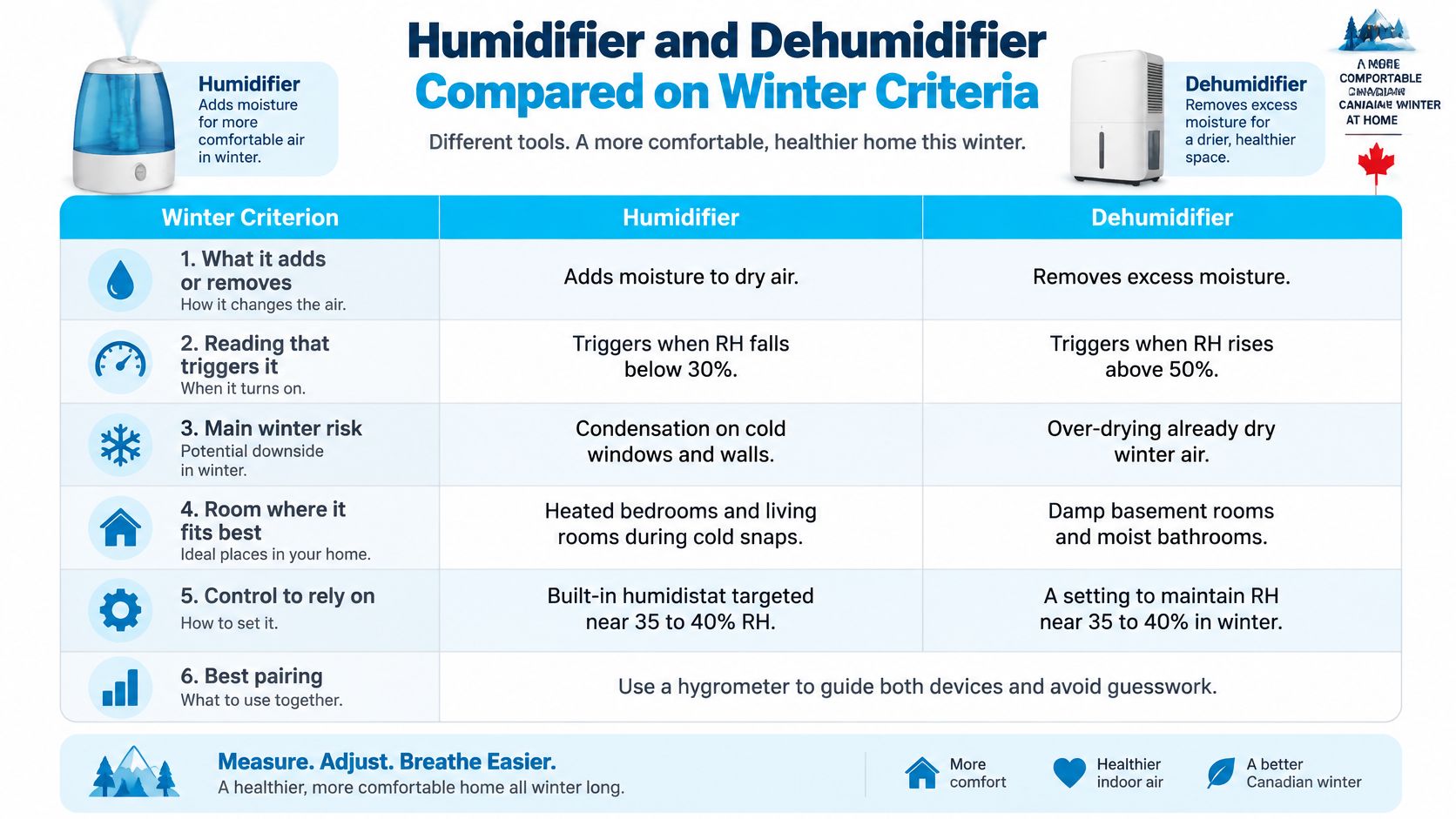
| Criterion | Humidifier | Dehumidifier |
|---|---|---|
| Adds or removes moisture | Adds moisture to dry air | Removes moisture from damp air |
| Typical winter trigger | Measured RH below about 30% | RH above 50% or condensation on cold windows |
| Main winter risk | Window condensation and mould if run too high in cold snaps | Over-drying an already dry home, or running in a cold basement without a drain plan |
| Best location | Heated bedrooms and living rooms | Basements, laundry rooms and coastal homes |
| Control to rely on | Hygrometer plus humidistat with automatic shutoff | Built-in humidistat and a hygrometer in the same room |
| Winter maintenance | Clean tank and filter regularly to limit microbial growth | Empty or drain the collection tank and clean the filter |
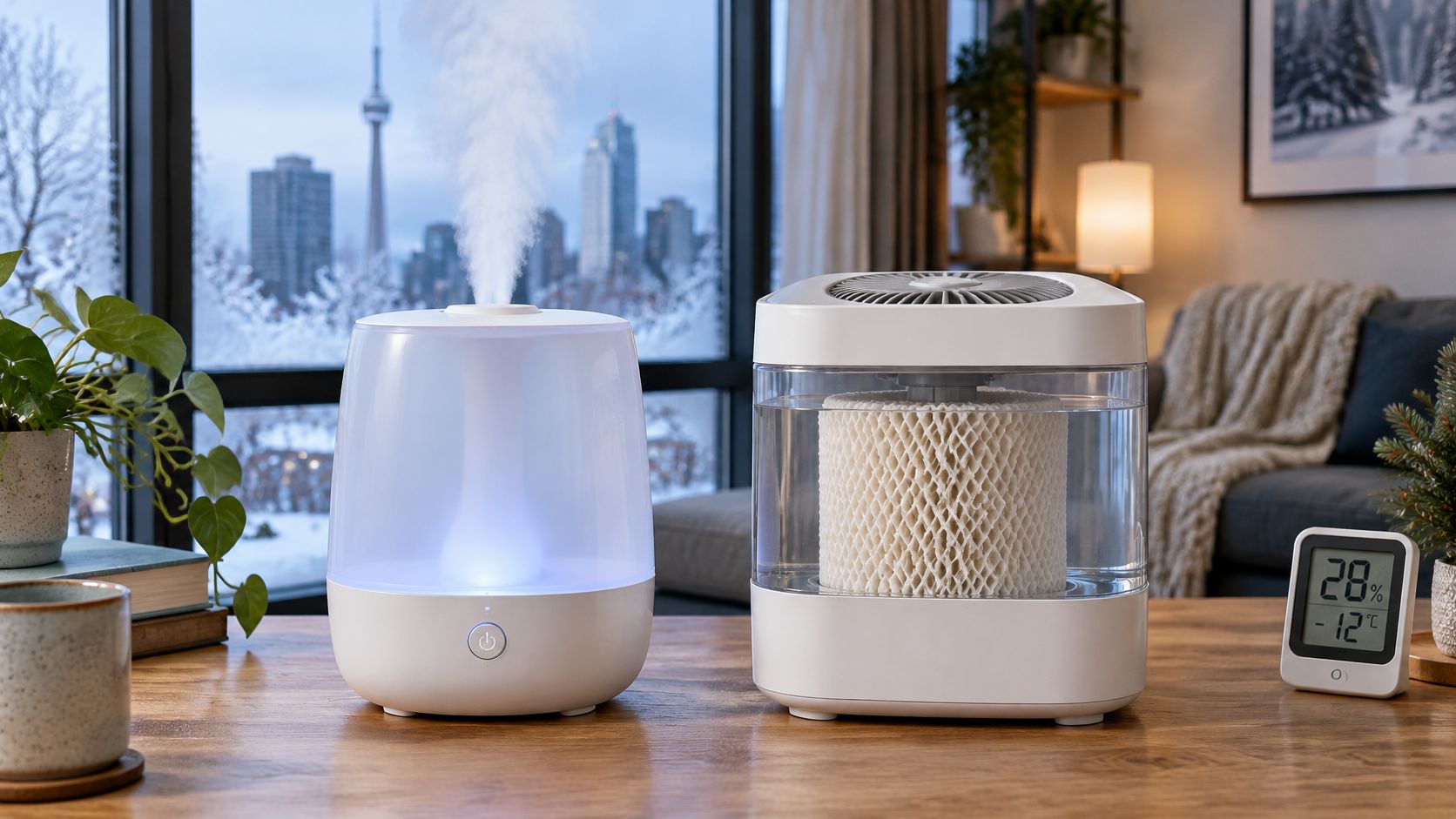
The two machines fail in opposite directions, and that asymmetry is the whole comparison. A humidifier fails by succeeding, adding moisture until the air can no longer hold it at window temperature, at which point you get fog, frost, wet frames, and eventually mould in the wall cavity behind them. A dehumidifier fails by being pointed at the wrong room, drying air that was already below the band, or running in a cold basement with a tank that fills overnight and shuts the unit off before morning.
Here is the same table drawn out.
Where Each Machine Goes Wrong
The humidifier's failure mode is visible, which is its saving grace: you'll see the fog on the glass before the mould starts. The dehumidifier's failure mode is invisible, because dry air doesn't announce itself until someone wakes with a raw throat or the wood floor gaps.
Maintenance splits the same way. A humidifier tank is a warm, wet container sitting in a heated room, which is a fine place for microbial growth if you refill and never scrub. A dehumidifier is a cold coil and a collection tank, so the schedule is about emptying and cleaning the tank and rinsing the filter, not disinfecting a reservoir you breathe from.
The differentiator: a humidifier is chosen by a dry reading and limited by window condensation, while a dehumidifier is chosen by a damp reading and limited by how dry the air becomes.
Note what's absent from that sentence: any reference to the month. A dehumidifier running in a Vancouver basement in February is doing the same job it does in July, just against a smaller moisture load. A humidifier running in a Saskatoon bedroom in February is doing a job that stops the moment the window frosts.
Plenty of Canadian homes need both, in different zones, on separate setpoints. Whether yours is one of them comes down to three specific rooms.
When a Humidifier Earns Its Place in Winter
Say a condo bedroom's hygrometer reads 24% at 2 a.m. in January. The furnace has been cycling since October, the window is a sealed double-pane unit with no condensation, and the occupant wakes with a dry throat, shocks themselves on the door handle, and has watched a hardwood seam open by a millimetre since November. That's a room where a humidifier earns its place: set near 30%, run overnight, checked against the glass each morning.

That scenario is the common one, not the exotic one. Heated bedrooms and living rooms in a cold snap are where humidity falls furthest, because the furnace is running hardest against the driest outdoor air of the year. The complaints arrive in a predictable order: static shocks first, then cracked skin and irritated eyes, then the sore throat on waking, then the observations about the house itself, like wood floors and furniture that shrink and gap.
Which Rooms to Prioritise
Bedrooms, nurseries, and the living room, in that order, because those are the rooms where people spend the most consecutive hours breathing. A bedroom gets eight hours a night, which is more exposure than any kitchen. If you can only run one unit, put it where you sleep.
Older houses complicate this. An upstairs bedroom can read dry on the hygrometer while its exterior wall is the coldest surface in the house, so adding humidity there produces condensation on the window before it produces comfort. In that room, start lower than you think you need to and let the glass arbitrate.
Whatever type you choose, evaporative or ultrasonic, the essentials are the same: a humidistat with automatic shutoff so the unit stops itself at the setpoint, and a cleaning schedule you follow. A humidifier without a humidistat is a moisture source with no off switch.
If you'd rather hear the reasoning on tank hygiene and overnight use from someone walking through it, this covers the practical routine.
The Test That Says Stop Adding Moisture
Run the unit at target for a week and watch two things: the hygrometer and the glass. If the reading holds near 30% and the windows stay clear, the room was dry and the device is doing its job.
If the reading won't climb even with the unit running continuously, more humidity isn't the answer. That pattern usually means the moisture is escaping, through an unsealed attic hatch, a drafty window frame, or a leaky exterior penetration, and the fix is air sealing rather than a larger machine. Buying a bigger humidifier to fight a draft is how people end up with a wet window and an unchanged hygrometer.
How to Set Humidity Without Causing Condensation
Natural Resources Canada recommends approximately 30% to 40% relative humidity in colder climates to reduce window condensation, and that band is the practical ceiling for most Canadian bedrooms in January. The routine below keeps you inside it without guesswork.
- Put the hygrometer where the decision gets made. That's the room you're treating, at sitting or sleeping height, away from the unit itself and off exterior walls. A sensor on a window ledge reads the coldest surface in the room, not the air you breathe.
- Log 24 hours before changing anything. Winter readings swing with the furnace cycle, cooking, and showers, and a single afternoon snapshot will mislead you into buying a device you don't need.
- Start the humidifier near 30% and set the humidistat to hold it there. Starting low and climbing is reversible. Starting at 45% in a cold snap means cleaning up condensation you created.
- Raise in small steps only if the glass stays clear for 24 hours. Glass is the cheapest humidity sensor in the house: it reacts to surface temperature and moisture together, which is exactly the combination that damages finishes and feeds mould.
- Drop the setting when outdoor temperatures fall sharply. Condensation risk is set by the temperature of the coldest surface, and a deep cold snap drops every window frame, foundation wall, and pipe in the house at once.
- Stop or reduce the moment frost or fog appears. Frost on the inside of glass means the air is too humid for that surface temperature, full stop. Ventilate the room while you wait for the reading to fall, using a bath fan or kitchen fan, or an HRV system if the house has one and the problem is house-wide.
- Clean the tank on a fixed schedule, not when it looks bad. Warm water plus a heated room is a growth medium, and the unit then distributes whatever grows in it across the room.
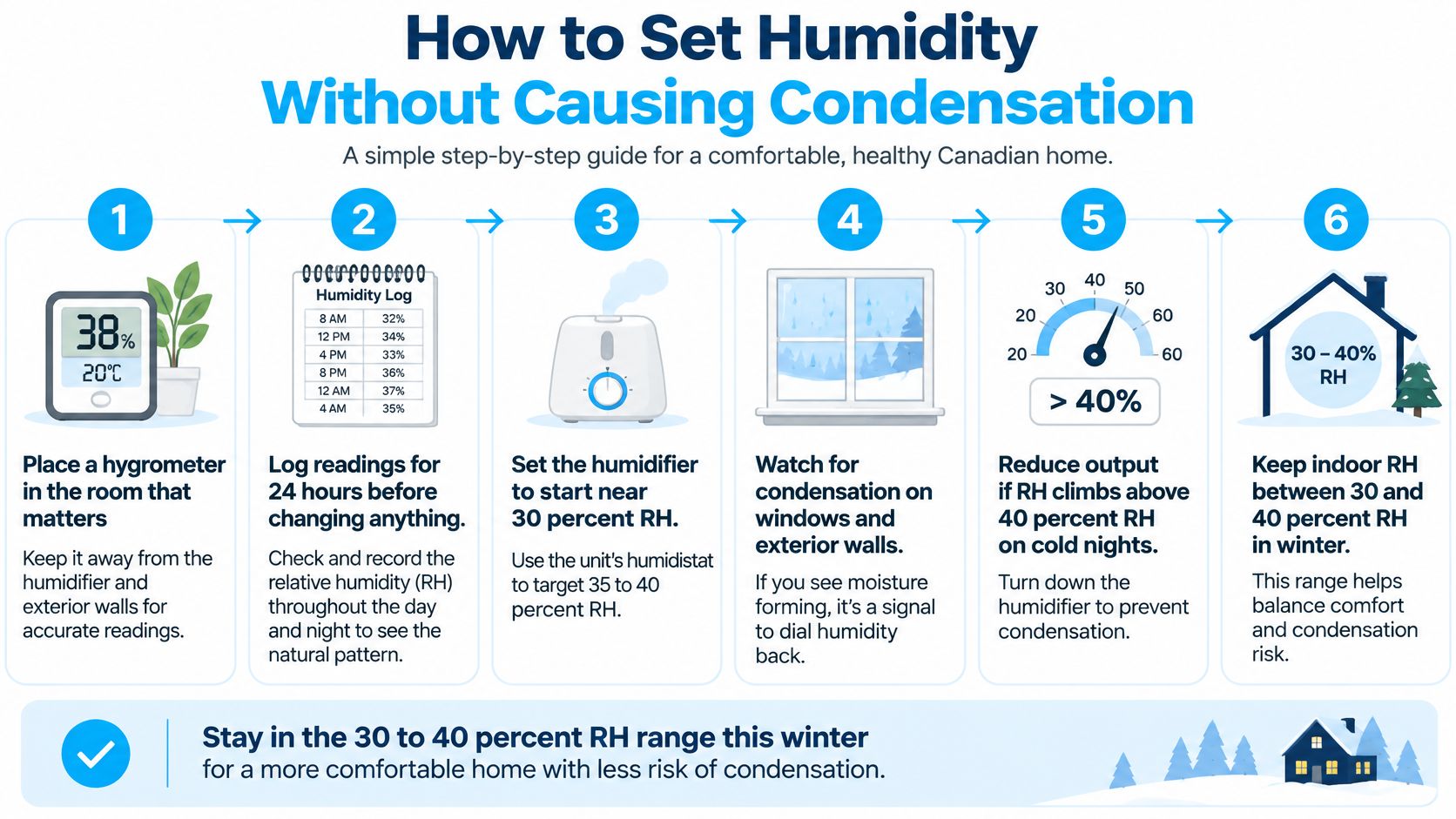
Practical rule: if glass fogs within an hour of raising the setting, you've found the ceiling for today's outdoor temperature. Back off two points and leave it there until the weather moderates.
Three signs tell you the routine is working. No fogging or frost on any window, including the corners of frames where cold bridges live. Readings that sit steady near 30% to 35% rather than bouncing. And no musty odour anywhere in the room, because a smell is moisture finding something organic to sit on.
When a Dehumidifier Is the Right Choice in Winter
A basement reading 60% with a musty smell in January is a cold concrete box with laundry venting into it, a foundation in contact with wet soil, and no ventilation path, so the moisture from three showers a day has nowhere to go except into the joists and the stored boxes. A dehumidifier set to hold 45% to 50% changes that picture within days.
That situation is common enough to plan for. Health Canada's guidance on moisture and mould in the home advises keeping indoor RH between 30% and 50% and recommends a dehumidifier when moisture condenses on cold window panes or RH exceeds 50%. It also notes that mould exposure can irritate the eyes, nose, and throat and worsen asthma symptoms, which makes moisture control a health measure rather than a comfort preference.
Why a Coastal Basement Runs Wet in February
Dehumidifiers reduce indoor dampness in Canadian homes, and in milder coastal areas the case for running one through the year is stronger. February air on the Pacific coast is mild and wet rather than cold and dry, so it keeps feeding the same foundation and the same musty basement, and the unit keeps pulling water out while interior homes have already switched theirs off.
Interior homes run a shorter season. In a Prairie or Ontario basement, the dehumidifier typically earns its keep when RH crosses 50% or when windows fog, and sits idle the rest of the winter. Coastal and damp-basement homes don't get that break.
Drainage decides whether a basement unit works. A basement dehumidifier with a drain hose runs continuously without a tank to empty, which matters in a space you visit once a week. Set the target near 45% to 50% and let the hose carry the water away.
Rule of thumb: dehumidify where the moisture starts, not where you notice it. If the upstairs bedrooms already read dry, running one machine for the whole house just dries the living space while the basement stays wet.
Confirm Your Readings and Choose the Unit
| Winter situation | Likely unit | Check first |
|---|---|---|
| Dry heated home with static and a sore throat | Humidifier | Hygrometer reading below 30% |
| Windows fog most mornings, RH between 40% and 50% | Reduce humidifier or ventilate; no new unit | Condensation pattern and indoor moisture sources |
| Damp basement with a musty smell | Dehumidifier | Basement RH above 50% |
| Coastal home with persistent winter damp | Dehumidifier, running year-round in mild areas | Moisture readings over several weeks |
| Dry bedroom with condensation on the window during a cold snap | Humidifier on a lower setting | Surface condensation before raising the setting |
| Dry upstairs rooms and a damp basement | One humidifier and one dehumidifier, each in its zone | Separate hygrometer readings per floor |
Match your room to a row and the buying decision mostly makes itself. The rule underneath the table is the one to carry: a humidifier when measured RH stays below about 30% and no condensation appears; a dehumidifier when RH sits above 50% or moisture condenses on cold surfaces; ventilation or reduced moisture when the reading falls in range but the windows still fog, because that fog is coming from showers, cooking, or drying laundry indoors rather than from the air being too wet overall.
Mixed houses need two devices, and there's no contradiction in that. A humidifier in a heated bedroom and a dehumidifier in a damp basement are solving two different problems in two different zones, and each should run on its own humidistat rather than a shared setting someone adjusts once and forgets.
When you do buy, judge the controls before the capacity. A built-in humidistat with automatic shutoff, a tank you can see and lift without disassembling anything, and a filter you can rinse are worth more in a Canadian winter than a higher output rating you'll never need. Confirm the price in CAD at a Canadian retailer before you commit, since cross-border listings and duty can move the total well past what the sticker suggests.
Then do the three-day version. Record readings morning and evening in the room that worries you, note whether the glass fogs when outdoor temperatures drop, and match the pattern to the table above. Shortlist one unit for that room, run it at a conservative setpoint, and let the windows confirm the choice.
Celmin publishes Canada-focused buying guides for humidifiers, hygrometers, and dehumidifiers, with CAD pricing and availability checked against retailers that ship here, which is the difference between a shortlist you can act on and one you can't. If your three-day readings point to a dry bedroom, the Celmin humidifier guides walk through winter setpoints and tank care in the same seasonal context this article uses. Start with the room that reads wrong and work outward from there.

Sign up or sign in to join the conversation.