
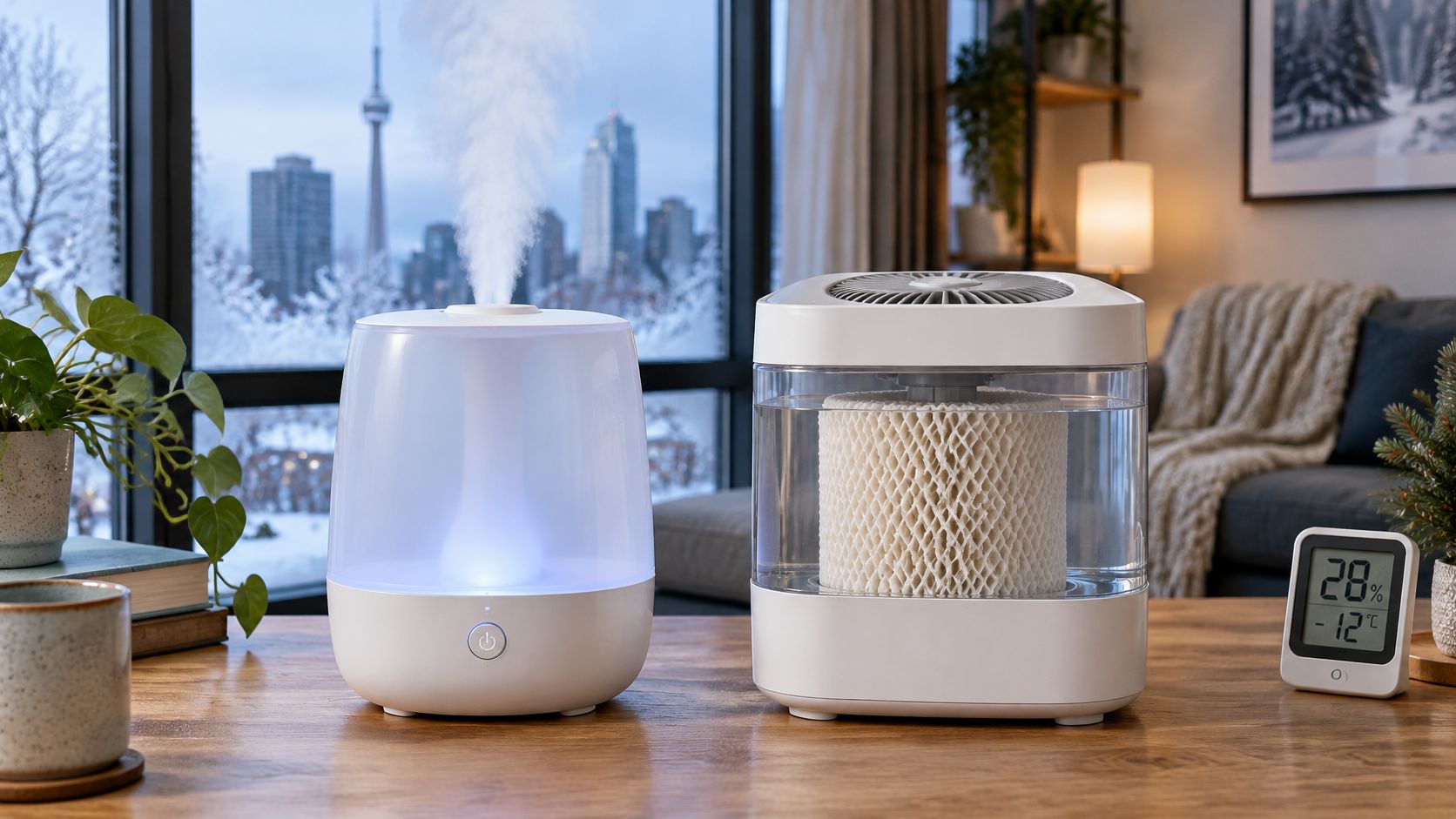
The quietest humidifier isn't automatically the best one for a Canadian winter. Neither is the model that produces the biggest cloud of mist. In the ultrasonic vs evaporative humidifiers comparison, your tap water and your coldest window matter more than either selling point.
Table of Contents
- Why the Quieter Humidifier Can Be the Wrong Buy
- How Ultrasonic and Evaporative Humidifiers Work
- Minerals White Dust and What Reaches the Air
- Winter Humidity Targets That Protect Your Home
- Choosing by Room Size Sleep and Daily Use
- Energy Noise Safety and the Real Cost in CAD
- A Practical Pick for Canadian Homes
Why the Quieter Humidifier Can Be the Wrong Buy
A closed condo bedroom, a dry throat by morning, and a shopping page sorted by quiet operation. That's an understandable starting point. It's also an incomplete way to choose an appliance that changes both the air you breathe and the moisture your home has to handle.
Both technologies can add humidity. The useful question is whether you can control that moisture without creating another problem: mineral residue, a burdensome refill routine, or wet windows.
Buy for the room you actually have
Canadian heating-season dryness isn't just a comfort complaint. Federal guidance explains that ventilation and air leakage replace indoor air with cold outdoor air containing little moisture, helping explain why homes become dry in winter. The same Natural Resources Canada moisture guide treats humidity as something to manage alongside the house, not independently of it.
That changes the shopping order. Before comparing mist settings, find out what's in your water and look at the window beside the intended location. A machine can fit neatly on a dresser and still be poorly matched to the room.
| Buying question | What to establish before shopping |
|---|---|
| What water will you use? | Check municipal hardness or total-dissolved-solids information |
| Can the room accept more moisture? | Measure humidity and inspect glass and cold corners |
| What maintenance will you actually do? | Decide whether buying water or maintaining a wick is realistic |
| How will output stop? | Look for automatic humidity control, not just a timer |
A hygrometer is essential equipment for either type. Treat it as part of the purchase, not an optional accessory after the windows start dripping.
Don't confuse moisture with cleaner air
Be clear about the job, too. If you're trying to address airborne particles rather than dryness, start with this air purifier vs humidifier comparison before adding another appliance.
The buying decision should survive ordinary household behaviour. Will someone fetch low-mineral water when the tank runs empty late at night? Will replacement filters remain on the shopping list? Will anyone notice condensation behind the bedroom blind?
Those questions are less exciting than a silent mist plume. They're also more useful than choosing a winner from a product photo.
How Ultrasonic and Evaporative Humidifiers Work
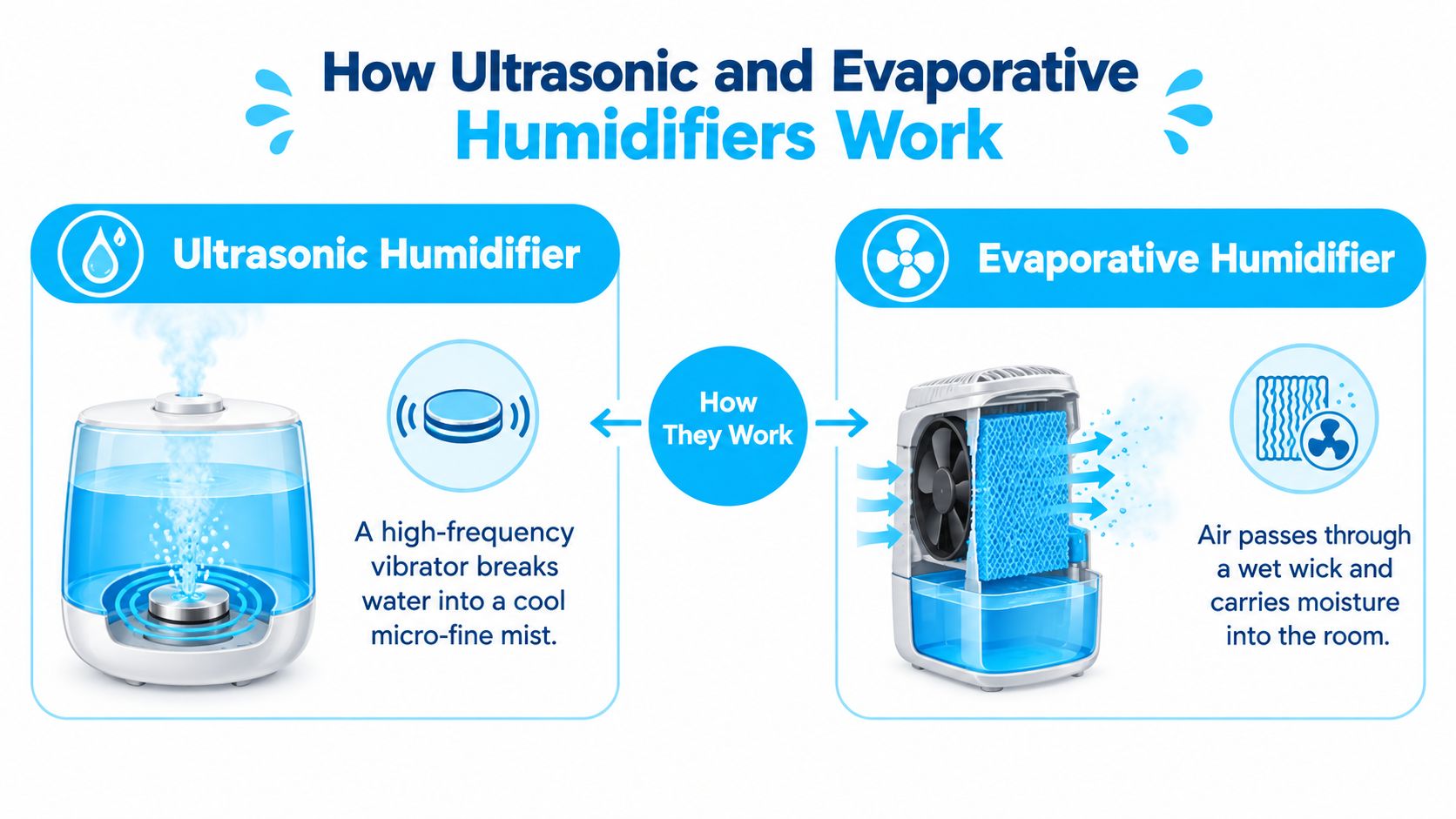
An ultrasonic humidifier uses high-frequency vibration to break water into a cool, micro-fine mist. Those droplets leave the machine and evaporate into the room. Health Canada's cool-mist humidifier guidance describes this process and notes that particle release is generally much lower when distilled water is used.
An evaporative humidifier takes a different route. Water wets a wick or filter, and a fan moves room air across that surface. Water evaporates into the passing air rather than being mechanically dispersed as a mist.
This diagram shows the difference at the water-contact surface.
Why their output behaves differently
Evaporation slows as the surrounding air becomes more humid. An evaporative machine therefore has a useful physical restraint on its output. It isn't delivering the same quantity of droplets regardless of room conditions.
An ultrasonic unit can continue making mist at the selected setting unless its controls interrupt operation. That's why an effective humidistat, which switches output according to measured humidity, matters more than a generous list of mist levels.
Evaporative output naturally eases as humidity rises. That's a useful safeguard, not permission to operate without measurement.
Don't confuse self-limiting evaporation with precise control. A fan-and-wick design still needs a sensible setting and an independent check of room conditions. Likewise, an ultrasonic model with good controls shouldn't be judged solely by the limitations of a basic manually adjusted unit.
Follow the water through the machine
For a shopper, the most useful sequence is straightforward:
- Ultrasonic: Water becomes droplets, so the contents of the fill water matter beyond the tank.
- Evaporative: Water leaves through evaporation, while most dissolved minerals remain in the wick or reservoir.
- Either design: The tank still needs attention; changing the moisture-making mechanism doesn't remove the maintenance job.
The distinction isn't visible mist versus no visible mist. It's mechanical droplet production versus evaporation.
Keep two questions separate when comparing models. First, what else can travel into the air with the water? Second, how does the appliance respond when the room has enough moisture? A favourable answer to one doesn't automatically settle the other.
Minerals White Dust and What Reaches the Air
White dust isn't merely a housekeeping nuisance. With an ultrasonic humidifier, it can be visible evidence that material from the fill water has left the tank and entered the room.
Ultrasonic nebulization doesn't selectively remove dissolved substances. Calcium, magnesium, sodium, sulphate, trace metals, and microorganisms present in the reservoir can travel in droplets. After those droplets evaporate, remaining material can stay airborne or settle on furniture and electronics.
Water quality changes the comparison
Research reported particle concentrations of 438–521 µg/m³ with high-total-dissolved-solids water, while a separate comparison described evaporative emissions as roughly 100 times lower than ultrasonic emissions across several water types. These are findings from particular test conditions, not predictions for every bedroom, as discussed in the review of humidifier-generated aerosols and water quality.
The mechanism matters more than treating either result as a universal multiplier. An ultrasonic unit can turn a water-quality issue into an airborne-particle issue. Evaporation generally leaves the mineral-management problem inside the appliance.
Public Health Ontario's humidifier evidence brief distinguishes evaporative units from ultrasonic and impeller designs, noting that evaporative humidifiers aren't expected to aerosolize mineral products in the same way.
What Each Humidifier Sends Into the Room
| Decision point | Ultrasonic | Evaporative |
|---|---|---|
| Mineral behaviour | Dissolved material can leave in droplets | Most dissolved minerals remain in the wick or reservoir |
| Water requirement | Prefer distilled or demineralized water | Usually more forgiving of ordinary tap water |
| White-dust risk | A concern with mineral-rich fill water | Much lower mineral-aerosol concern |
| Cleaning burden | Tank and mist-producing components need cleaning | Reservoir and wick need attention; mineral deposits remain inside |
Check the utility report before the product listing
Look for hardness and total dissolved solids, often shortened to TDS, in your municipality's drinking-water information. They're relevant measures, but don't treat them as interchangeable labels. Use whichever information your utility provides to understand the mineral burden you'd be putting into the tank.
Don't assume Canadian tap water behaves uniformly. A recommendation that works with one water supply may create an annoying dust problem with another.
A built-in demineralization cartridge also isn't a blanket guarantee of mineral-free output. Before relying on one, check its stated purpose, replacement instructions, and whether replacements are available locally. Don't equate the presence of a cartridge with consistently filling the machine with distilled or demineralized water.
My buying rule is simple: if you won't manage the fill water consistently, don't choose ultrasonic on the assumption that wiping furniture solves the underlying issue.
Winter Humidity Targets That Protect Your Home
A humidity target has to suit the building, not just the person sleeping inside it. Outdoor cold, window quality, insulation, ventilation, and proximity to exterior walls can make the same setting workable in one room and condensation-producing in another.
Canadian figures also need context. A National Research Council study of Canadian houses observed minimum monthly indoor relative humidity generally maintained around 25%–30% in cold regions; the accompanying Canadian guidance gives broader winter ranges of 30%–55%, with 30%–50% as a practical federal band. Those aren't instructions to push every cold bedroom towards the upper limit.
Start low and let the windows set the limit
For heating-season operation in cold cities such as Ottawa, Saskatoon, and Winnipeg, roughly 30%–40% relative humidity is a more practical starting target than aiming for 50% or higher, consistent with the Canadian winter context in the NRC housing report.
Use a room-by-room routine rather than copying a setting throughout the home:
- Measure first: Check the room before assuming discomfort means it needs more moisture.
- Inspect cold surfaces: Look at glass, window edges, exterior-wall corners, and areas behind blinds.
- Increase cautiously: Make adjustments based on the room's response, not the appearance of the plume.
- Reduce output when condensation appears: Don't keep humidifying to reach a preferred number while surfaces become wet.
The operating sequence is simple enough to keep beside the appliance.

Check the room, not just the machine
An independent display makes this routine easier. The TempPro TP50 digital hygrometer and indoor thermometer guide explains a specific monitoring tool you can consider alongside other indoor hygrometers.
Use that separate reading to assess whether the humidifier's built-in control reflects conditions where you sleep. Don't assume a sensor attached to the appliance represents every corner of the room.
Practical rule: If the glass gets wet, lower the humidity setting. A comfort target doesn't override visible condensation.
The control behaviour described earlier matters here. Rapid ultrasonic output calls for attentive placement and reliable shut-off control. Evaporative operation offers more forgiveness, but it doesn't make cold surfaces immune to excess moisture.
Choosing by Room Size Sleep and Daily Use
Choose for the occupied room, not the largest coverage claim you can afford. A bedside appliance, a nursery humidifier, and a unit serving a shared living area face different practical demands.
These room layouts illustrate why placement and everyday use belong in the decision.

A small condo bedroom
Ultrasonic is reasonable when quiet, compact operation matters, and you'll follow through on the water and monitoring requirements already described. It's a conditional recommendation, not an automatic bedroom winner.
A small footprint doesn't mean gentle output. In a closed room with a cold window, a physically compact unit can still be a poor match if its lowest useful setting is difficult to control. Look for adjustable output and a working humidistat rather than assuming smaller means safer.
If buying special water will become an abandoned chore, I'd accept an evaporative fan instead. Compare the sound on its low setting, because that's the setting you'll want to live with while sleeping.
A nursery or bedside setup
Don't position a humidifier so its plume is directed towards bedding or a sleeping occupant. Keep the surrounding area dry and avoid crowding the appliance against a cold exterior wall. Follow the model's placement instructions rather than arranging it solely for convenient refilling.
For a nursery, make maintenance a shared household responsibility. Decide who checks the tank, who cleans it, and who notices damp surfaces. An appliance used close to occupants for long stretches deserves more attention, not less, regardless of the technology.
This video provides an additional visual reference for the comparison.
A larger shared room
In a living room or open shared area, fan sound may be easier to accommodate than beside a pillow. That makes an evaporative design worth considering without treating its fan as a disqualifying flaw.
Check whether the unit can maintain the intended room conditions on a setting you'll tolerate. A coverage label isn't a substitute for watching the hygrometer after installation.
Renters should be especially conservative about output. If you can't replace poor windows or alter ventilation, a higher mist rate won't resolve that constraint. Choose controllability and practical placement over excess capacity, then operate within what the room can handle.
Energy Noise Safety and the Real Cost in CAD
A low purchase price doesn't establish a low ownership cost. Price the routine you're committing to, including consumables, cleaning access, and the inconvenience of keeping supplies available.
Ultrasonic models are typically quiet and energy-efficient, but those advantages don't cancel the water-management requirement. Evaporative units add fan sound and wick maintenance, but they generally make ordinary tap-water use more practical.
Build a real shopping comparison
Use current Amazon.ca or local-retailer listings rather than an old price in a cross-border ranking. Record the humidifier's price in CAD, then add the consumables you'd buy at their current listed prices.
- For ultrasonic: Include distilled or demineralized water, or the specified replacement cartridges if you intend to rely on them.
- For evaporative: Find the exact replacement wick or filter and confirm Canadian stock before buying the machine.
- For either: Check tank access, cleaning instructions, and whether replacement parts can be ordered without an awkward import process.
Don't invent a universal filter interval for your budget. Use the manufacturer's instructions and account for the water you'll use. Likewise, don't treat a model described as filter-free as maintenance-free.
Energy use belongs in the comparison, but without verified model-specific consumption figures, there's no honest basis for declaring a precise electricity saving. Compare published specifications for the actual candidates rather than assigning a blanket dollar advantage to either technology.
Cleaning is part of safety
Both designs need regular cleaning because stagnant reservoir water can support microbial growth. Follow the appliance's instructions, empty and dry the tank regularly, and don't keep topping up a neglected reservoir.
Look closely at the opening before purchasing. If you already dislike the prospect of reaching the tank's interior, choose a design you can clean more comfortably.
The cheaper machine is the one whose maintenance your household will actually do, not necessarily the one with the lowest shelf price.
Avoid leaving either design running unattended at a high setting through a cold night without humidity feedback. Automatic control should support sensible operation, not encourage you to ignore the room.
Noise is equally personal. A fan you tolerate in the living room may be unacceptable beside the bed. Compare that friction against the effort of supplying suitable water, because the routine you abandon is the one that makes the purchase poor value.
A Practical Pick for Canadian Homes
My default for a Canadian household using hard tap water is evaporative. It's the more practical starting point when you want sustained winter use without making special water a recurring shopping task. That recommendation follows from compatibility and upkeep, not from declaring one technology universally superior.
Choose ultrasonic when quiet, compact bedroom use matters enough to justify its operating requirements. If you'll consistently provide suitable water, check the room's humidity, and clean the machine, it can be the right tool. Don't buy it on the promise of convenience while rejecting the routine that makes it appropriate.
Make the decision before comparing models
Use these situational picks to narrow the field:
- Choose evaporative for tap-water convenience: Especially when you expect long stretches of winter use and don't want to manage a separate water supply.
- Choose ultrasonic for a specific quiet-room need: Only when the water and monitoring commitments fit your actual habits.
- Choose neither as a set-and-forget fix: If windows are already showing condensation, resolve the operating conditions before adding moisture.
A home can also need different moisture strategies in different places or seasons. If your problem is excess moisture downstairs rather than dry bedroom air, a basement dehumidifier with a drain hose addresses the opposite job. Don't assume the entire property needs the same treatment.
Finish with a Canadian shortlist
Before buying, open your municipality's water report and note its hardness or TDS information. On a cold night, measure the bedroom and inspect the window. Those checks should determine your shortlist before a discount or a dramatic mist photo does.
Then compare in-stock Canadian models for humidistat control, a usable low setting, tank access, and replacement-part availability. Check CAD prices at Amazon.ca or a local retailer, including the supplies you'll need to keep using the appliance properly.
Celmin is one Canada-first editorial option for humidifier and air-quality buying guides, alongside manufacturer documentation and municipal water information. Its focus on CAD pricing, Canadian availability, and seasonal household constraints is useful for checking whether a recommendation fits your home rather than a different market.
Your next buying step is concrete: identify your water supply, check the coldest bedroom window, and eliminate models whose maintenance you already know you won't do.
Visit Celmin for Canadian humidifier comparisons and air-quality buying guides that account for CAD pricing, local availability, and winter household constraints. Bring your water-report findings and bedroom humidity reading, then compare models that fit those conditions rather than shopping by mist volume alone.
Sign up or sign in to join the conversation.