
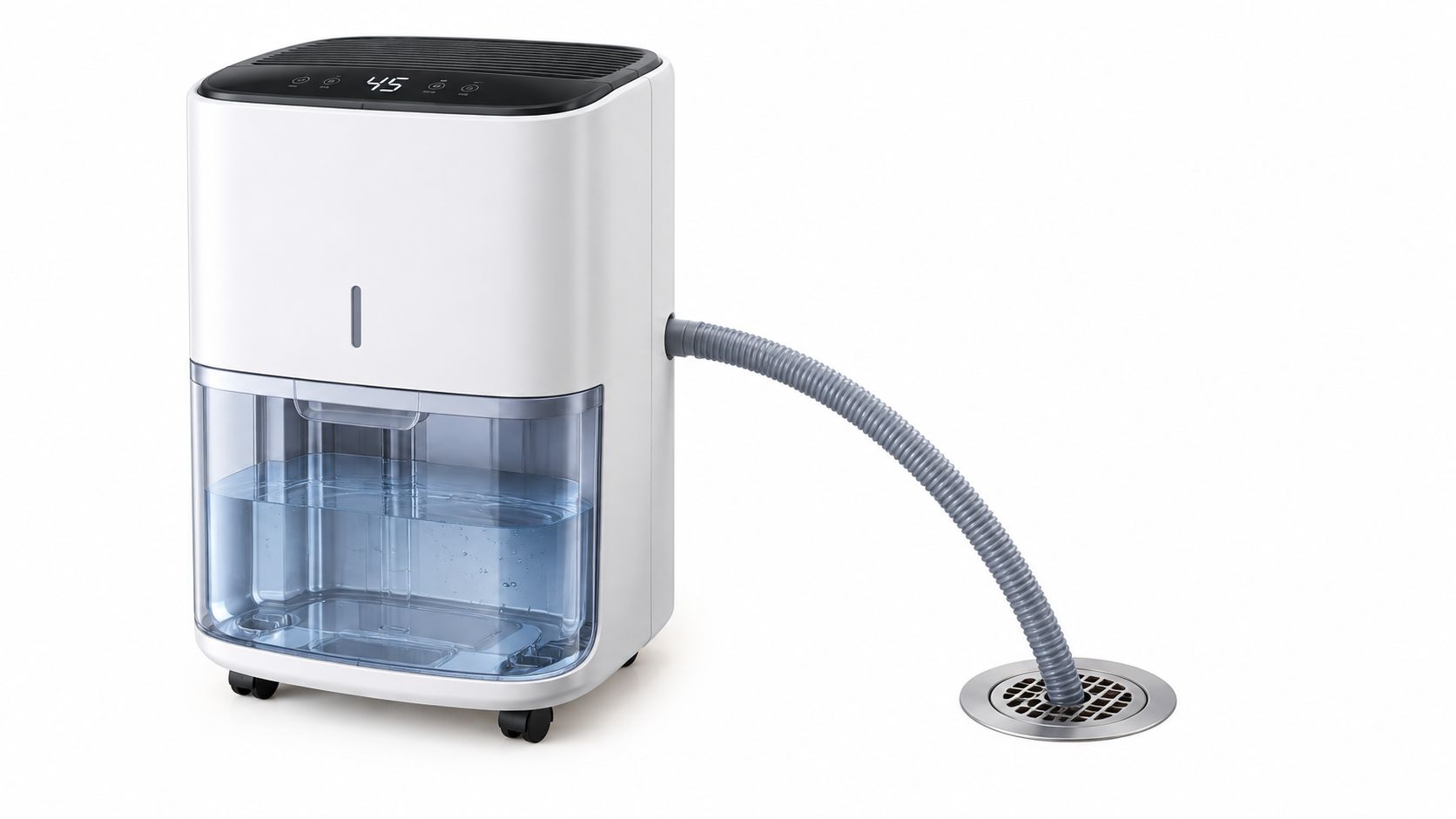
You've got a musty basement, cool foundation walls and a dehumidifier whose bucket fills faster than you can remember to empty it. A drain hose sounds like the obvious fix, until you realise the floor drain is higher than the unit, the hose has to pass a cold wall, or the water has nowhere safe to go.
A dehumidifier for a basement with a drain hose can run with less hands-on emptying, but the hose alone doesn't guarantee reliable drainage. The layout matters: gravity needs a continuous downhill route, a higher discharge point usually calls for a pump, and a kink or frozen line can bring the whole setup to a stop.
| Basement layout | Drainage setup to consider | Main thing to check |
|---|---|---|
| Low floor drain close to the unit | Gravity hose | The hose stays downhill all the way |
| Sump basin nearby | Gravity hose or pump-assisted discharge | The hose is secure and doesn't obstruct sump operation |
| Drain sits above the dehumidifier | Built-in or external condensate pump | The pump can reach the discharge point |
| Cold route along an exterior wall | Reroute indoors or use a shorter protected route | The line won't freeze or sag |
Table of Contents
- Why Basement Drain Hose Setups Trip Up Canadian Homeowners
- How Canadian Basements Get Humid in the First Place
- Sizing the Unit to Your Basement and Dampness Level
- Choosing Between Gravity, Floor Drain, Sump, and Pump Drainage
- Energy Use and the Canadian IEF Rating That Actually Matters
- Running a Drain Hose Through a Canadian Winter
- Matching Models to Three Real Canadian Basement Scenarios
- Maintenance Routine and When to Call a Professional
Why Basement Drain Hose Setups Trip Up Canadian Homeowners
A hose solves one particular problem: it carries collected water away from the dehumidifier. It doesn't guarantee that water will keep flowing, and it doesn't tell you whether the destination is appropriate. If the hose slopes upward, kinks behind stored boxes, or ends somewhere that can overflow, the unit may stop draining properly while the basement remains damp.
That's why “continuous drain” should be treated as a plumbing-layout decision, not a feature checkbox. Before shopping, find the dehumidifier's likely location, identify the drain or sump, and trace a route between them. Check whether the hose can stay downhill without crossing a doorway, running along a freezing foundation wall, or being crushed under storage.
In a typical Canadian basement, cool surfaces and seasonal humidity can keep moisture management on the list long after the weather changes. A reservoir that fills repeatedly is inconvenient, but a hose installed without a reliable route can be worse: it may appear to be working until a backup or disconnect leaves water where you didn't want it.
Start with the route, not the product page. If you can't describe where the water will go and how it will get there, you're not ready to choose between gravity drainage and a pump.
A good unit has an adjustable humidistat and a drainage option that suits the basement. But if water is entering through a leak, foundation crack or failing drainage system, the dehumidifier is managing the air, not repairing the building.
How Canadian Basements Get Humid in the First Place

Say you run your new unit for a week and the hose keeps dripping steadily into the floor drain. Good. Now ask the harder question: where was that water coming from, and is the dehumidifier fixing it or just mopping up after it? The answer decides whether continuous drainage is a convenience or a band-aid.
Moisture gets in four ways. It diffuses through concrete walls and floors, wicks upward by capillary action, seeps through cracks and floor joints, and rides in on humid summer air that condenses the moment it hits cool basement surfaces. You generate a big share of the load yourself. Natural Resources Canada estimates a family of four puts about 50 litres of water per week into the air through cooking, bathing, cleaning and breathing. The same federal guidance sets 30–50% relative humidity as the practical indoor target, lower in winter, higher in summer (Natural Resources Canada's guidance on indoor humidity and moisture).
Here's my line in the sand. Damp air is a dehumidifier problem. Bulk water is a building problem. Musty smell and clammy walls with no visible pooling? Run the unit, set up the hose, done. Water tracking across the floor after every rain? Stop shopping for appliances and find the entry point first.
The National Research Council measured roughly 2–3 litres per day diffusing inward through the walls and floor of an average house basement. That trickle is exactly why a drain hose earns its keep during a long humid stretch. The same research found an exposed earth floor in a wet basement can release as much as 45 litres per day, a volume no household unit should be expected to swallow (the National Research Council's basement moisture study).
One more thing homeowners mix up: moist air and dirty air are separate complaints. If you're not sure which you're dealing with, Celmin's comparison of air purifiers versus dehumidifiers sorts out which machine does which job.
Sizing the Unit to Your Basement and Dampness Level
Two basements with identical floor plans can need completely different machines. A dry, finished rec room and a damp space that smells musty every time it rains will tax a dehumidifier in very different ways, so square footage is only the starting point. Condition of the space is what tells you how hard the unit will run, and how much you'll come to appreciate a drain hose.
Start with the room, then assess the moisture
Measure the floor area, but also look at how the air moves. An open basement behaves differently from a finished space chopped up by walls and doors, and a partitioned rec room may need the unit placed where the damp air lives rather than where the outlet happens to be. Compare models within the same capacity class instead of chasing the biggest headline number on the box.
Then get honest about what you're dealing with:
- Mildly humid: Stale, clammy air, no recurring wet spots. A standard unit sized to the space with a working humidistat is all you need.
- Damp after rain: The basement turns musty during rain or spring thaw. Size the unit properly, run the hose, and if the dampness keeps coming back, look outside at grading, downspouts and the foundation.
- Persistently wet: Water shows up at a wall joint or near the sump, or the unit never stops collecting. As I said earlier, that's a building problem. Sort the entry point first.
An undersized unit runs constantly and still can't hit your setpoint. The hose makes that running painless, but it adds zero capacity. Oversizing carries its own trap: in a cool basement, refrigerant coils can frost over, so check the manufacturer's low-temperature rating and insist on auto defrost.
On the humidity target itself, don't park the machine on continuous and forget it. The federal 30–50% range covered earlier is the working envelope, and I tell customers to dial in around 45–50% RH to start, then trim the setpoint down in winter to keep condensation off the windows and ease it up in summer.
Choosing Between Gravity, Floor Drain, Sump, and Pump Drainage
Pick the drainage method based on where the dehumidifier will sit and where the water can safely go. A gravity hose works only when the route keeps descending from the appliance to the drain. If the hose has to climb over a ledge or rise to reach a standpipe, choose a pump-assisted setup instead of hoping gravity will do the job.
| Drainage mode | Needs downhill slope | Pump required | Best for |
|---|---|---|---|
| Gravity to a floor drain | Yes, continuously | No | A nearby drain lower than the unit |
| Gravity to a sump basin | Yes, continuously | No, if the route descends | A sump close enough for a secure downhill hose |
| Pump to a drain or approved discharge | No continuous downhill route from the unit | Yes | A drain or discharge point higher than the appliance |
| Bucket-only operation | No hose route | No | Occasional use where regular emptying is practical |
Gravity to a floor drain or sump
For gravity drainage, route the hose continuously downhill from the unit's outlet. Avoid loops, pinched sections, loose fittings and upward bends. A small sag can hold water and collect debris; a kink can restrict flow. Keep the end secure so it can't slip out of the drain or move into a position that sends water onto the floor.
A sump basin can be a sensible destination when the hose can reach it safely. Don't let the hose interfere with the sump's operation, and check that the basin and pump are maintained. If a power interruption disables the sump pump, water management may change, so don't assume the dehumidifier hose makes the basement floodproof.
When the drain sits higher
If the route has to rise, use a dehumidifier with a built-in condensate pump or a compatible external pump. Check the manufacturer's specifications for the pump and the hose connection before buying. The discharge destination also matters: don't direct water where it can leak into a finished area, damage a neighbour's property, or create an overflow risk.
Laundry standpipes and shared drains aren't automatic options. Renters and condo residents should get permission before routing a hose to shared plumbing, and should confirm that the connection is allowed and secure. Health Canada's moisture guidance recommends managing humidity and addressing moisture sources, while also ensuring collected water drains appropriately or the pan is emptied regularly (Health Canada's guidance on addressing moisture and mould).
A hose can fail without making much noise. Inspect the route for kinks, blockage, disconnection and lost slope instead of assuming “continuous drain” means maintenance-free.
Energy Use and the Canadian IEF Rating That Actually Matters
Capacity tells you how much moisture a unit is designed to remove under its stated test conditions. It doesn't tell you how efficiently it uses electricity. For that comparison, look at the Integrated Energy Factor (IEF) on Canadian product information. Natural Resources Canada defines IEF as litres of water removed per kilowatt-hour, so a higher IEF indicates more moisture removal for the energy used (NRCan's EnerGuide appliance guide).
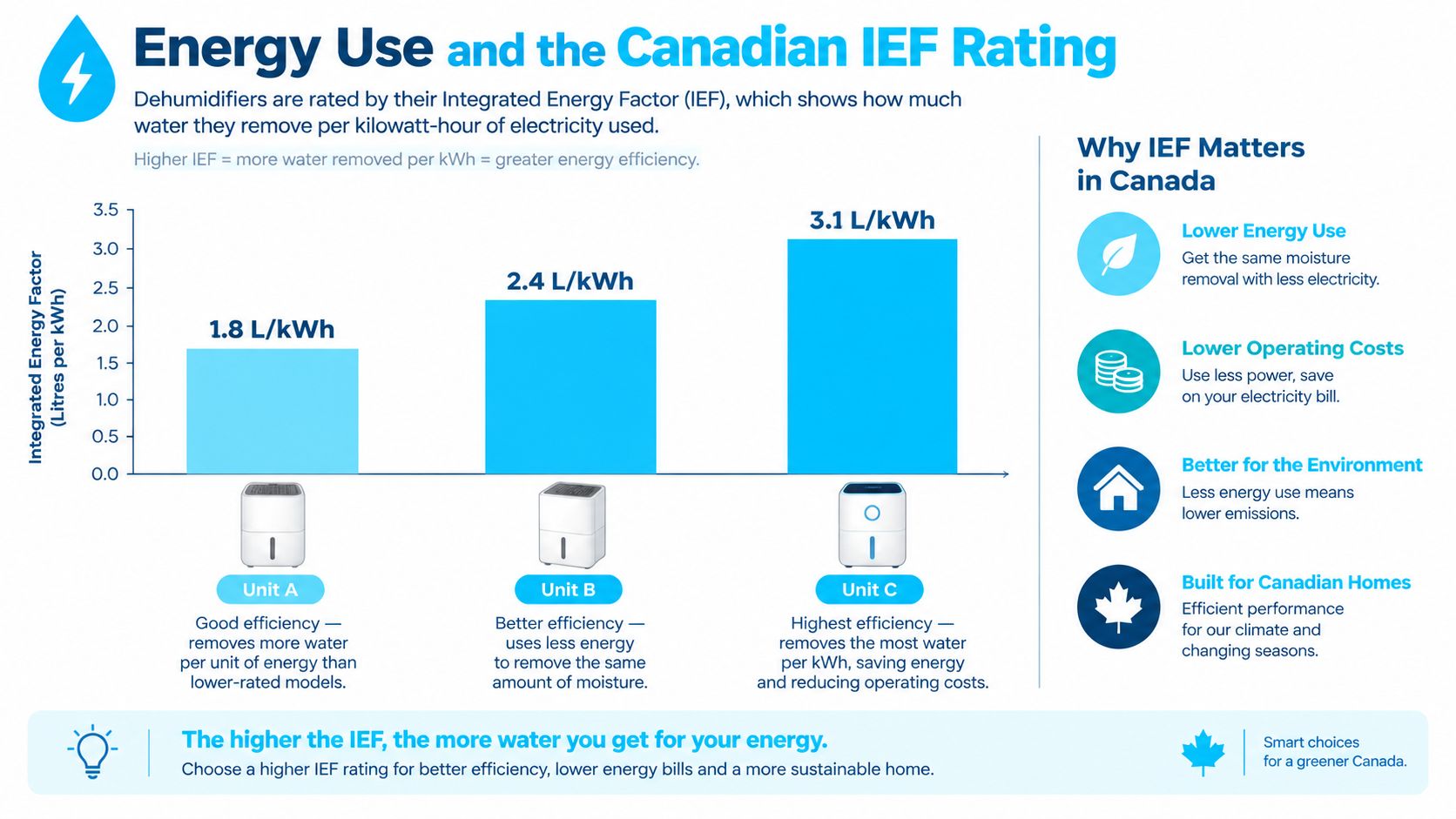
Compare models within similar capacity classes, and use the Canadian-listed rating rather than assuming a rating or capacity claim from another market applies to the Canadian version. A larger capacity number isn't automatically a better buy if the unit's efficiency is poorer or it lacks humidity control. If you're comparing two plausible choices, check both the IEF and the humidistat, then confirm that the drain setup fits your basement.
ENERGY STAR-certified dehumidifiers use nearly 15% less energy on average than standard models, according to the same NRCan guide. That makes certification worth checking when the appliance may run through humid periods, but it doesn't excuse a poor installation. A unit that runs continuously because it's undersized, badly placed, or set without a humidity target can still waste energy.
The simple buying rule is this: choose a capacity that matches the room and its moisture load, then favour a higher IEF among comparable options. Make sure the humidistat can cycle the unit automatically and that the drain arrangement won't leave it stopping on a full tank. If the product listing doesn't clearly show the Canadian IEF or explain how the hose drains, don't fill in the gaps with marketing language. Ask the retailer or check the manufacturer's documentation before you buy.
Running a Drain Hose Through a Canadian Winter
I've seen this failure more times than I can count. A homeowner runs a drain hose along an exposed foundation wall in November, the water inside freezes solid in January, and the dehumidifier fills its tank and shuts off. By March the basement smells like a locker room and nobody knows why.
Cold changes two things at once. A standard refrigerant dehumidifier struggles to operate when the room gets cold, and any water sitting in a low spot of the hose can freeze against a cold wall. Check the unit's stated minimum operating temperature and whether it has an automatic defrost cycle. A "basement ready" sticker means nothing if the spec sheet doesn't back it.
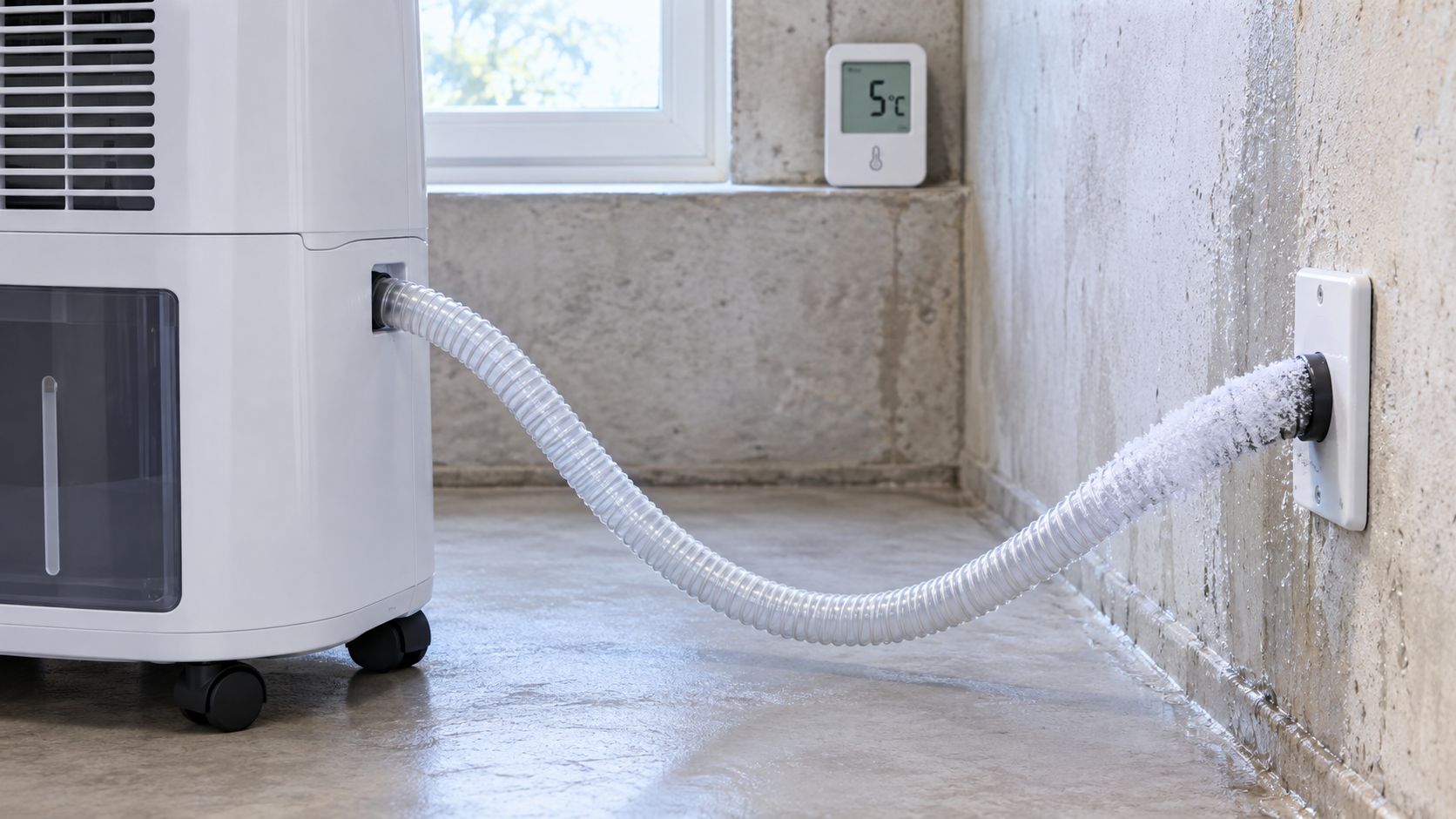
Route the hose through warm interior space rather than along an exterior foundation wall wherever you can. Keep the run short and the downhill slope continuous, because every sag becomes a puddle that turns into an ice plug. If the discharge can't descend by gravity, a pump-assist model works, but only if the pump discharge line gets the same freeze protection.
A practical winter check
- Measure the room, not the weather: A thermometer in the basement tells you more than the forecast. Compare the reading to the unit's minimum operating temperature.
- Look for coil frost: A unit that keeps icing over and stopping is telling you it's wrong for that space. Check the manual for a low-temperature rating.
- Trace the hose end to end: Feel for cold spots, look for standing water in sags, and check for kinks that trap water where it can freeze.
- Set a seasonal humidity target: The federal range noted earlier still applies, with lower levels generally preferred in winter. Don't run the unit flat-out without checking conditions.
- Verify the restart after an outage: Power blips happen all winter. Confirm the dehumidifier restarted, the humidistat kept its setting, and any pump or sump is still working.
If the basement stays cold enough that the unit frosts repeatedly, stop fighting it. Move the appliance to a warmer corner or buy equipment rated for those conditions. Keep windows and doors shut while it runs so you're not paying to dry outdoor air.
Matching Models to Three Real Canadian Basement Scenarios
The right setup depends on the building, not the city name. These examples are decision patterns, not brand recommendations. The verified information available here doesn't establish current Canadian model prices or comparable price bands, so check live Canadian listings rather than treating an unverified dollar estimate as buying advice.
| Scenario | Recommended drainage | Capacity class | Approx. CAD price |
|---|---|---|---|
| Finished GTA rec room with a nearby low floor drain | Gravity hose | Match the unit to the room and dampness | Check current Canadian listings |
| Damp Halifax basement with a sump basin but no floor drain | Gravity if the hose descends, otherwise pump-assisted | Match the unit to persistent moisture and space | Check current Canadian listings |
| Cold Prairie basement with winter frost concerns | Short, protected route; pump only if the discharge needs lifting | Choose a cold-suitable unit with defrost | Check current Canadian listings |
Finished rec room with an accessible drain
For a finished basement with no active water entry and a nearby floor drain, a mid-capacity ENERGY STAR model with a humidistat and gravity drainage is a sensible starting point. Verify that the hose outlet can stay lower than the appliance connection all the way to the drain, and check the Canadian IEF before comparing models. Don't pay for a pump you don't need if gravity can do the job reliably.
Damp space with a sump basin
In a basement where dampness returns after rain, first inspect the walls, floor and exterior drainage for signs of water entry. If the sump is close and lower than the appliance outlet, a gravity hose may work. If the route has to rise or cross a ledge, use pump-assisted drainage and make sure the discharge won't interfere with the sump or create a leak.
Cold basement with winter frost risk
For a cold Prairie basement, prioritize operating-temperature guidance and an appropriate defrost function. Keep the hose route short and away from cold wall surfaces where possible. If the moisture issue is severe, don't assume a larger standard unit is the answer; confirm that its design suits the actual temperature and inspect the source of the moisture.
Use Celmin's dehumidifier buying guide to compare basement-relevant features, then verify the exact Canadian model listing for capacity, IEF, drainage and cold-weather operation.
Maintenance Routine and When to Call a Professional
A hose setup needs inspection. Check the filter and hose regularly, especially during humid spells. Look for debris or buildup inside the tubing, loose connections, kinks, low spots holding water, and any sign that the discharge point is backing up. If the hose has to pass through a cold area, check it during cold weather rather than waiting for the unit's tank-full light.
Keep the floor drain clear and its trap maintained. At seasonal changes, compare the dehumidifier's humidity reading with a separate hygrometer elsewhere in the basement. If the unit shows a reading that doesn't match the room, adjust placement or check the sensor and settings.
Know when the building needs attention
A dehumidifier is not the fix for every moisture problem. Call a qualified professional to investigate if you notice:
- Standing water: Find the source and check the foundation, plumbing and drainage before relying on an appliance.
- Efflorescence on walls: Have the affected area assessed for moisture movement through masonry.
- A sump that runs constantly: Ask a drainage or foundation professional to check the sump system and where water is coming from.
- Visible mould growth: Address the moisture source and get appropriate advice on safe assessment and remediation.
For a basic month-one routine, confirm the humidistat setting, test the drainage route, clean the filter and check the discharge destination. If you want earlier warning of water where it shouldn't be, Celmin's smart water leak detector review covers a separate monitoring option. A detector can alert you to a leak, but it won't repair one.
Celmin publishes Canadian-focused appliance reviews and practical buying guides, including advice on basement dehumidifiers and continuous drainage. If you're comparing units for a Canadian basement, visit Celmin to review the buying guidance and weigh the features that matter for your layout.
Sign up or sign in to join the conversation.