
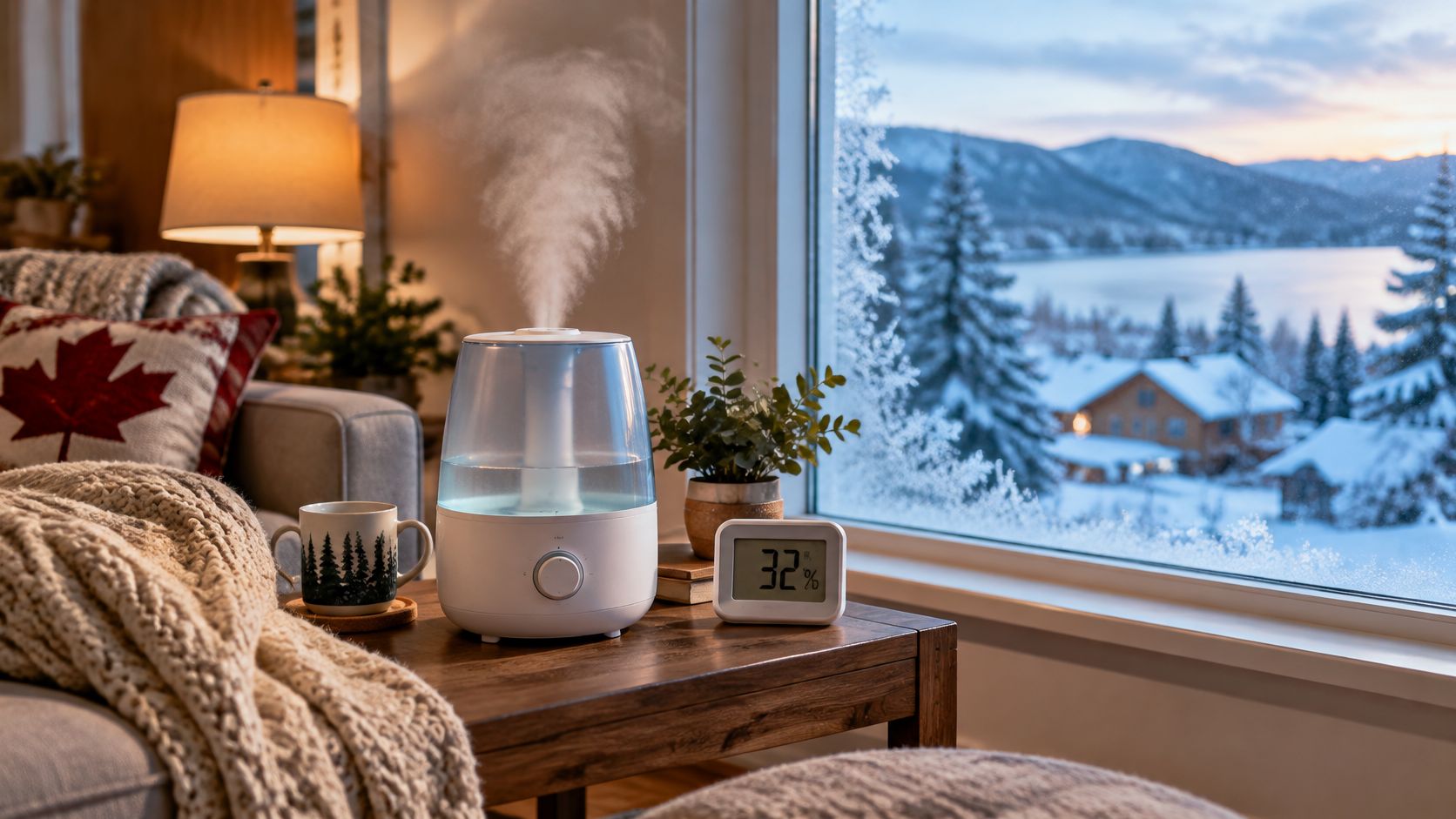
It's mid-January, the furnace has been running for three weeks straight, and the hygrometer on your dresser reads 22%. You wake with a dry throat, the cat's fur crackles when you touch it, and the hardwood near the closet has opened a gap wide enough to see a shadow through. So you fill the humidifier, crank it to maximum, and go to bed. By morning the bedroom windows are streaming and the frames are wet to the touch.
That swing, from too dry to too wet in a single night, is the usual failure. Raising humidity in a Canadian house isn't about adding more moisture. It's about adding the right amount for the temperature outside, then knowing when to stop.
Table of Contents
- Target Humidity Levels for Canadian Winters
- Quick Fixes Without a Humidifier
- Choosing a Portable or Whole-House Humidifier
- How to Raise Humidity Step by Step
- Spotting Condensation and Mould Before It Spreads
- Keep the Unit Clean and Confirm Your Next Step
Target Humidity Levels for Canadian Winters
A bedroom in Victoria can sit at 45% relative humidity all January and feel perfect. Move the same house, same humidistat setting, to Saskatoon during a minus 30°C snap and you'll find a fringe of frost along every window frame by morning. Nothing changed inside except the temperature of the glass, and that's the entire problem.
Healthy indoor relative humidity sits somewhere around 30% to 50%, but the top of that band isn't a target. It's a ceiling that moves with the weather. Natural Resources Canada's condensation guidance puts numbers on it: at about 20 to 21°C indoors with conventional double-glazed windows, maximum humidity is about 50% when it's 0°C outside, 38% at minus 10°C, 26% at minus 20°C, 18% at minus 30°C and 12% at minus 40°C, as listed in Natural Resources Canada's condensation guidance.
Maximum indoor humidity by outdoor temperature
| Outdoor temperature | Max indoor RH | What it means |
|---|---|---|
| 0°C | about 50% | Mild coastal winter, most homes stay comfortable |
| Minus 10°C | about 38% | Typical cold snap in southern Ontario or the Prairies |
| Minus 20°C | about 26% | Hold near the low end to avoid window frost |
| Minus 30°C | about 18% | Dry air is normal, keep humidity low |
| Minus 40°C | about 12% | Extreme cold, avoid adding moisture |
The table is a lookup, not a lecture. Check tonight's forecast low before bed, find the nearest row, and set the humidistat to that number as an upper limit. If the forecast says minus 22°C, your ceiling is about 26%, and a room reading of 24% is fine. It will feel drier than a Vancouver January and that is the correct outcome.
The rule I'd follow: the forecast low sets the ceiling for tonight. If you can't hit 30% without condensation, accept the drier room and protect the building.
Health Canada's cool-mist humidifier guidance takes the same measured view, advising homeowners to measure with a hygrometer and aim for roughly 30% in winter and 50% in summer. That winter figure isn't a floor to fight for. It's a sensible landing zone for a house with modern windows and a moderate outdoor temperature.
What matters more than the exact number is the method. Whether you run a humidifier for winter or summer, the setting should follow the forecast rather than the calendar. Measure the room, raise output in small steps over a few days, and back off the moment you see condensation on glass or frames. A hygrometer costs less than a tank of gas and it's the only way to know what your house is doing.
Quick Fixes Without a Humidifier
There's a stretch every winter when the air is dry, the humidifier hasn't arrived, and you want relief tonight. These stopgaps work for a dry week. None of them is a long-term fix, and every one of them should be run with a hygrometer on the wall so you can see what you've done.
- Dry laundry indoors on a rack. Hang a full load in a closed room and let it release moisture over the day. It's the most predictable of the lot because you know roughly how much water went into the wash.
- Simmer a pot of water on a back burner. Add citrus peel or cinnamon if you like the smell. Never leave it unattended, and set a timer so you don't boil the pot dry.
- Set open trays of water near a radiator. Wide, shallow containers evaporate faster than deep ones. They also spill, so put them on a stable, dry surface rather than balanced on the radiator itself.
- Group your houseplants in one room. Plants release moisture through transpiration, and a cluster does more than a single fern in a corner.
- Run a hot shower with the bathroom door open. Five minutes of steam, then ventilate so the room doesn't stay saturated.
Here's where each one fails. Laundry and showers can spike humidity fast and overshoot badly in a tight, modern house, which is exactly the scenario that puts water on cold glass. Plants and trays add moisture so slowly you'll struggle to measure the change on a basic hygrometer. And none of these methods can be set, scheduled or stopped automatically at 2 a.m. when the temperature outside drops another eight degrees.
A pot on the stove has no humidistat. You are the humidistat, and you're asleep.
Use them for comfort during a dry spell. If the hygrometer shows the room stuck below target for several days running, stop improvising and look at a real unit.
Choosing a Portable or Whole-House Humidifier
The decision comes down to scope. A portable unit treats one room and moves where you need it. A whole-house system ties into the furnace ductwork and serves every floor, but only while the furnace fan is running and only if someone services it.
| Type | Coverage | Upkeep | Best for |
|---|---|---|---|
| Ultrasonic cool-mist portable | One room | Daily tank change, weekly descale | Bedrooms, nurseries |
| Evaporative wick portable | One to two rooms | Replace wick, empty tank daily | Living rooms, self-regulating |
| Warm-mist portable | One room | Daily tank change, scale control | Cold rooms, needs hot surface care |
| Whole-house furnace-mounted | Entire house | Annual service, filter and drain check | Multi-storey homes, cold basements |
A cool-mist ultrasonic unit on a nightstand is the quietest option and the cheapest to run.
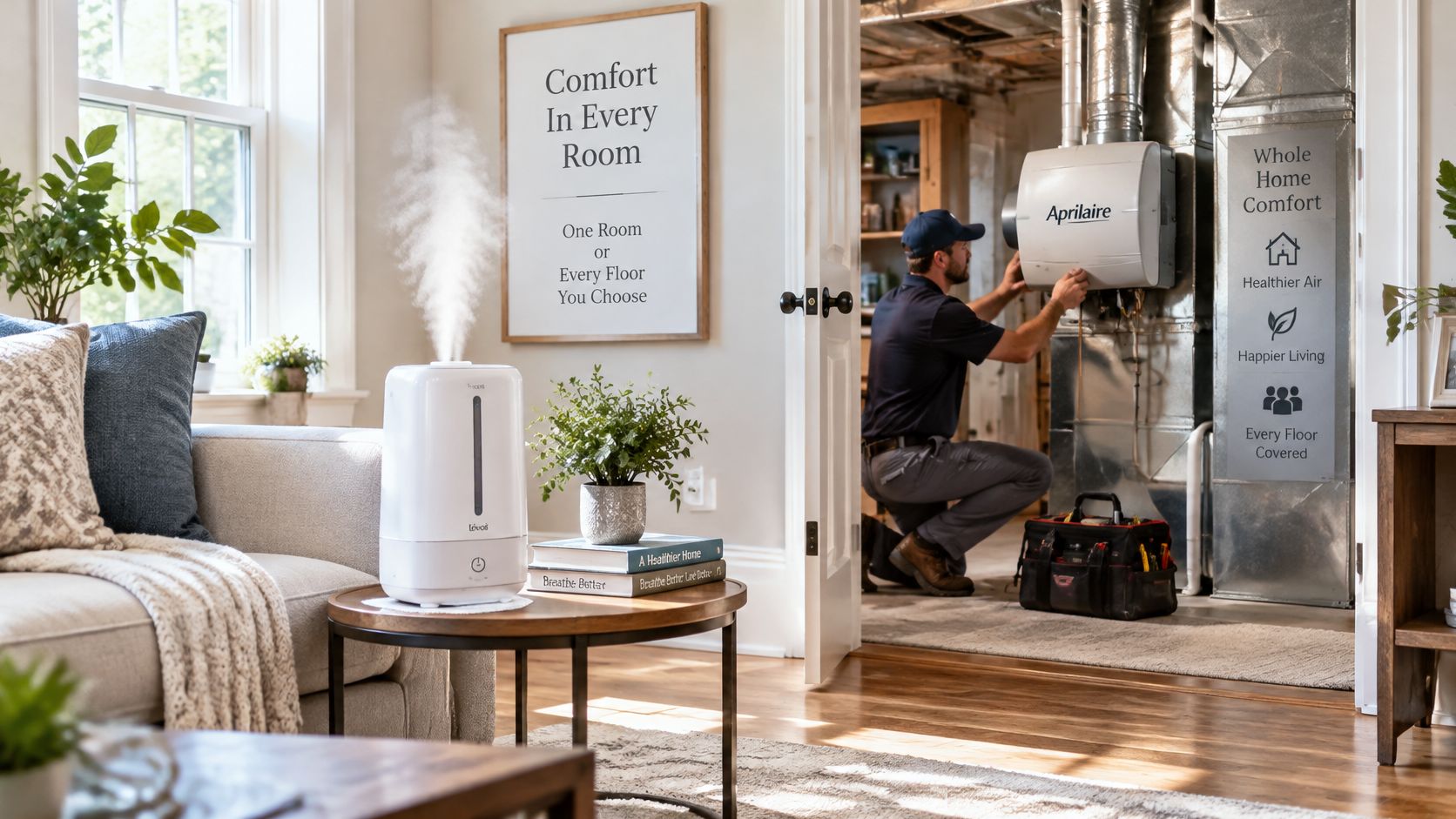
The trade-off is white dust. In a hard-water city, an ultrasonic cold mist humidifier throws mineral powder across every surface in the room, so distilled water isn't optional, it's the price of admission.
Evaporative wick units self-regulate in a way the others don't. The fan pushes air through a wet wick, and the air takes only what it can hold, so a bedroom unit tends to stall before it over-humidifies. You pay for that safety with a wick you'll replace once or twice a season. Warm-mist units suit a cold room, but the heating element means scale control and careful placement away from anything a child can reach.
Whole-house systems serve a three-storey house with a cold basement better than any stack of portables, and they need a water line, a drain and an annual service call before the first cold snap. Sizing is where many homeowners get it wrong: one portable for a bedroom, two for an open main floor, and a whole-house unit for a multi-storey home where the basement stays cold. Check the rated coverage in square metres against the room you're heating, and confirm current Canadian pricing at the retailer before you commit.
How to Raise Humidity Step by Step
Fixing losses comes before buying a bigger unit. A house that leaks its moisture to the outdoors will defeat a larger humidifier just as quickly as a smaller one.
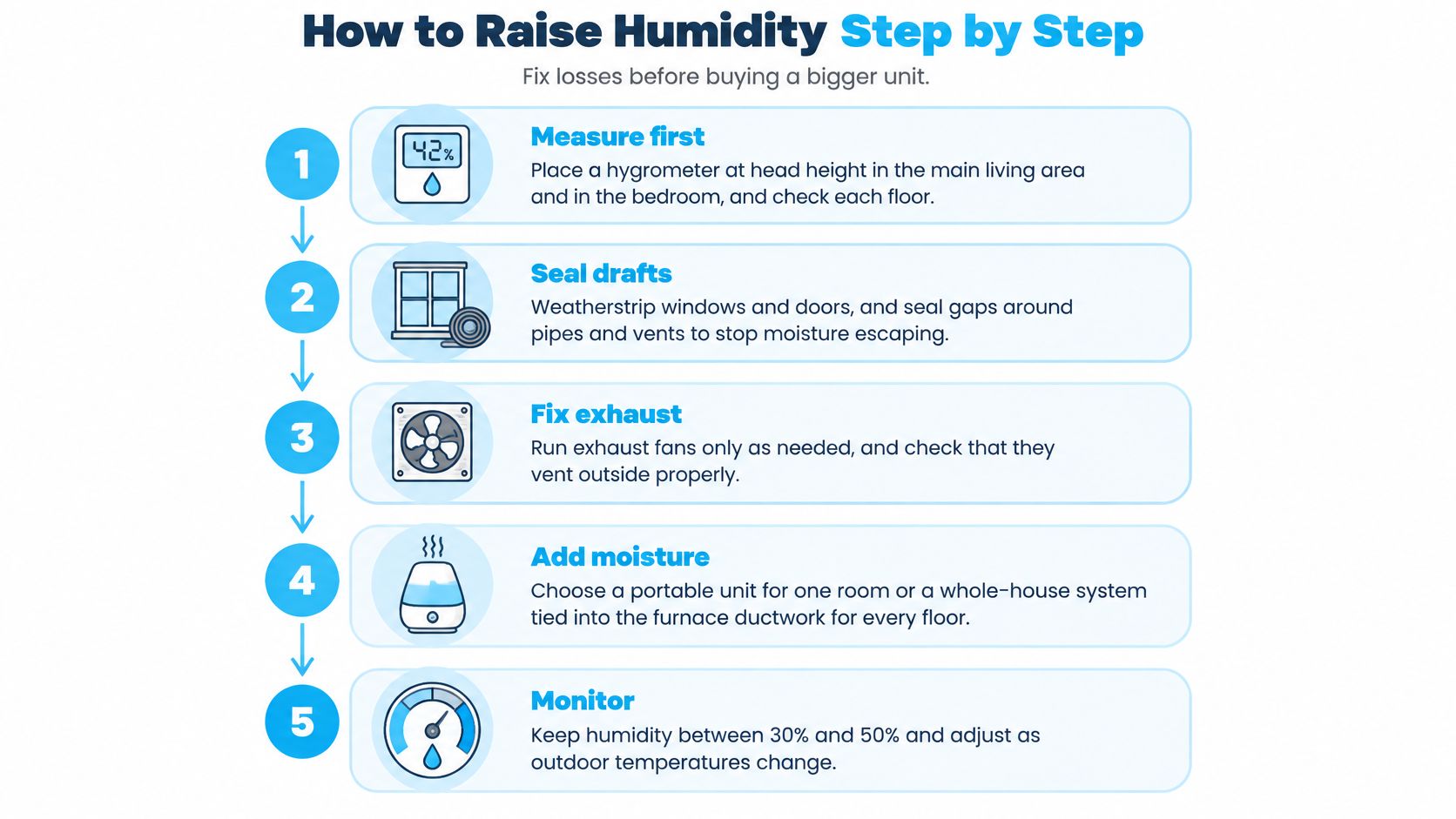
- Measure first. Put a hygrometer at head height in the main living area and in the bedroom, and check each floor of a two-storey house. A sensor sitting next to the appliance will flatter the whole house.
- Close doors to rooms you don't need to humidify, but let shower steam work for you. Leave the bathroom door open during a hot shower so the moisture drifts into the dry rooms instead of staying trapped behind a closed door.
- Open blinds and curtains near windows. Health Canada notes that heavy coverings can trap cold, moist air and increase condensation, which is the opposite of what you want at the glass.
- Place the unit on a stable, water-resistant surface. Keep it away from electronics and at least a metre from exterior walls, where the air is coldest.
- Fill with clean or distilled water and start low. Two days at a modest setting tells you more than one night at maximum.
- Run it with a humidistat or an independent hygrometer. Never leave it running continuously without a control that can shut it off.
- Stop raising output once occupied rooms reach about 30 to 35 percent in winter, or lower still if the outdoor-matched ceiling is lower than that. Federal guidance broadly identifies 30% to 50% as the health-oriented range, but cold weather pushes you to the bottom of it.
The reasons matter as much as the steps. A warm room beside a cold exterior wall will show condensation first, long before the middle of the room feels damp. A TempPro TP50 digital hygrometer sitting on a shelf gives you a trustworthy reading, and the full guidance on moisture, mould and ventilation is set out in Health Canada's advice on addressing moisture and mould in your home.
Spotting Condensation and Mould Before It Spreads
Condensation is the house telling you the setting is wrong. Read the symptom, match it to the cause, and make one change at a time so you know which fix worked.
| Symptom | Likely cause | Fix |
|---|---|---|
| Water beads on inside of double-glazed windows | Indoor RH above the outdoor-matched limit | Lower the setting, open blinds, re-check with a hygrometer |
| Frost or wet patches on window frames | Cold glass with humid air against it | Drop humidity to the lower end of the target, improve air movement |
| Musty smell or dark spots behind furniture | Moisture trapped on cold exterior walls | Move furniture, ventilate, clean the surface and fix the source |
| White dust on furniture near the unit | Hard water minerals from ultrasonic output | Switch to distilled water, clean the tank weekly |
Timing tells you more than the water itself. Condensation that appears only on the coldest mornings means the setting is fine in mild weather but over the ceiling when the temperature drops. Check the hygrometer against that night's outdoor low before you change anything, because the fix is a lower target on cold snaps rather than a permanently dry house.
The health case for staying on top of this is stronger than it looks. Canada's National Research Council identified 13 studies evaluating the health effects of indoor humidity and temperature in dwelling units, and 11 of the 13 found some health effect associated with humidity, in the National Research Council's 2024 review.
Ventilation changes the picture too. Homes with heat-recovery ventilators tend to run lower winter humidity than those without, so dry air can be a ventilation setting rather than a humidifier shortfall. If you have an HRV, check its speed and balance before adding output. You may be fighting your own ventilation system.
What I'd do first: move the sofa 10 cm off the exterior wall and watch that corner for two weeks. Dark spots that stop spreading confirm an air-circulation problem rather than a leak.
For mould you can already see, clean the surface with a proper cleaner and fix the moisture source. Bleaching the stain without changing the conditions that produced it buys you a few weeks at best. If the same patch returns after cleaning and a lower setting, the moisture is in the wall or window assembly itself, and no humidistat adjustment will solve it.
Keep the Unit Clean and Confirm Your Next Step
A humidifier is a wet box with a fan. Left alone, it grows a biofilm that gets blown into the room it's supposed to be helping, so the maintenance schedule isn't housekeeping, it's the difference between cleaner air and a microbial source on your nightstand.
- Daily: empty and dry the tank, and refill with clean or distilled water.
- Weekly: descale with a manufacturer-approved solution and wipe the interior surfaces.
- Monthly: inspect the wick, filter or transducer for scale, film or odour and replace what's worn.
- Seasonally: for whole-house systems, book service before the first cold snap and check the drain line for clogs.
- Every refill: look for standing water in the base, which is where odour starts.
Sizing deserves a second look once you've lived with the unit for a week. If a single portable can't lift the bedroom to target, a second unit in the main living area usually works better than swapping in one oversized model, because coverage ratings are quoted for open space and a closed bedroom door defeats them.
Here's the action I'd take today. Buy or borrow a hygrometer, put it at head height in the room where you sleep, and record the reading for three cold mornings alongside the overnight low. Match the coldest of those mornings to the outdoor temperature that night, then set the humidistat to the row that fits. That single habit replaces the fixed 50% target with a number your windows can live with.
Celmin publishes Canada-focused reviews and buying guides for humidifiers, hygrometers and the rest of the home tech that keeps a house comfortable through a Prairie cold snap, with pricing in CAD and availability checked against Canadian retailers. If you're still deciding between a portable unit for the bedroom and a whole-house system tied into the furnace, the site's head-to-head comparisons break down coverage, upkeep and noise before you spend anything. Start at Celmin and set your ceiling from tonight's forecast.
Sign up or sign in to join the conversation.