
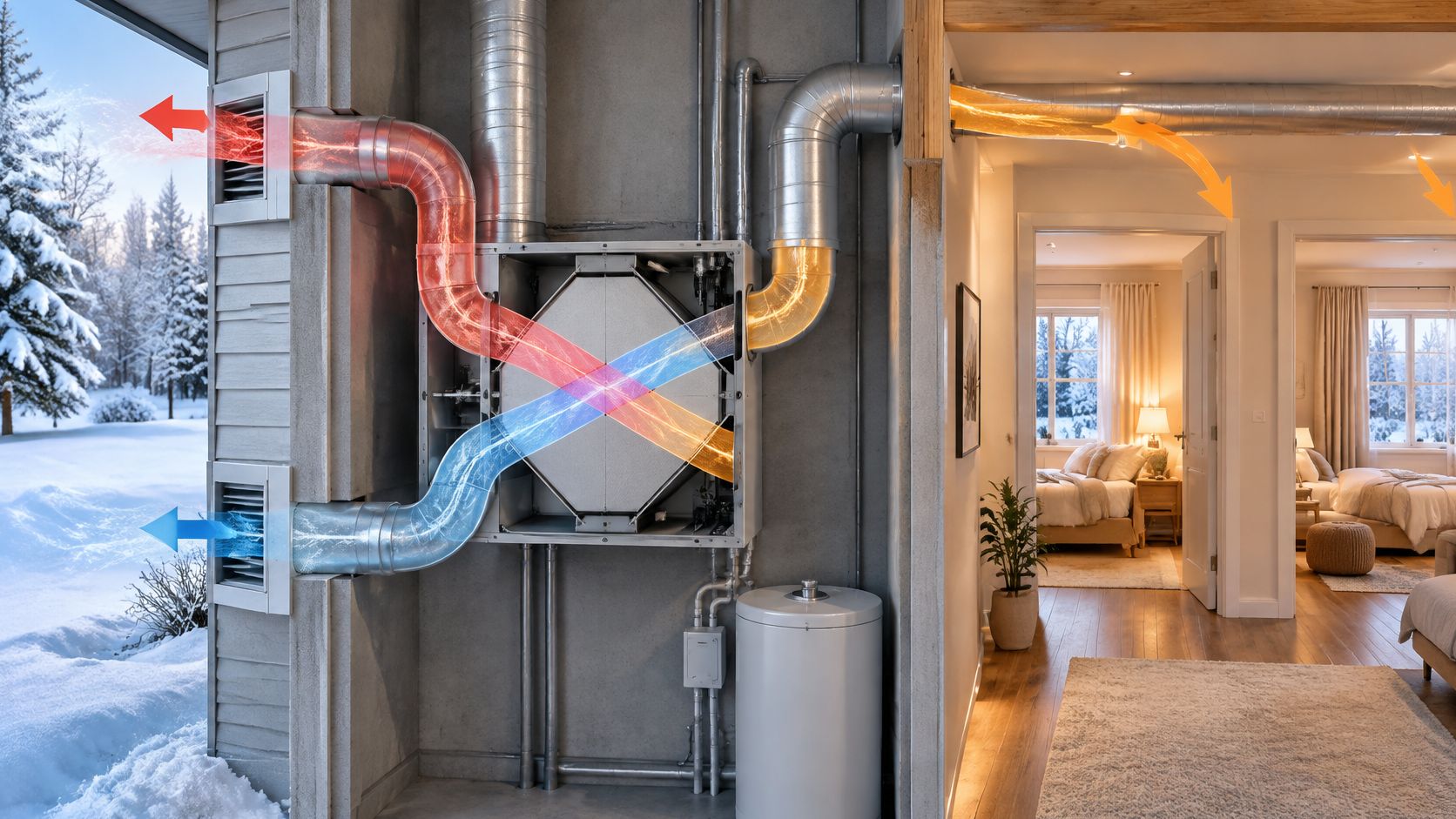
An HRV is a balanced ventilation system that exchanges heat between the stale air it pushes out and the fresh air it pulls in, recovering roughly 60 to 90 percent of the heat in that exhausted air. The two airstreams pass through a core and never mix, so the moisture from your shower leaves the building while the warmth it carried largely stays.
So why does a homeowner with a brand new unit still complain about a cold bedroom and a hydro bill that crept upward? Because the number on the box describes a heat exchanger tested under lab conditions, not a ventilation system installed in a Canadian house. What decides whether you get fresh air and real savings is how much air the system moves, where the ducts run, how the unit behaves at minus 25, and whether anyone measured the airflow after the installers packed up.
That gap between the box and the basement is the whole story here. Whether you're comparing quotes for a detached house in Ottawa or sorting out ventilation in a two-bedroom condo, the same handful of questions decides whether an HRV earns its place.
Table of Contents
- What an HRV System Is and Why Homes Need One
- How an HRV Moves Air and Recovers Heat
- HRV, ERV and Exhaust Fans Compared
- Where an HRV Saves Energy and Where It Falls Short
- How to Size and Install an HRV Correctly
- What an HRV Costs in Canada and What to Maintain
- Decide Whether an HRV Suits Your Home
What an HRV System Is and Why Homes Need One
An HRV, or heat recovery ventilator, is a balanced ventilation unit that continuously replaces stale indoor air with fresh outdoor air. It passes heat from the outgoing airstream to the incoming one through a core where the two never mix.
The easiest way to picture it is a revolving door with a heat sponge built into it. Air travels through in both directions at once, and most of the warmth stays on your side of the wall.
The problem it solves is moisture and stale air, not cold. A house built to modern airtightness standards holds everything you produce inside it: steam from a ten-minute shower, fumes from frying, carbon dioxide from a full living room, laundry lint, cooking odours. Cracking a window in January fixes the air and throws away heat you paid for. An HRV handles both jobs at once.
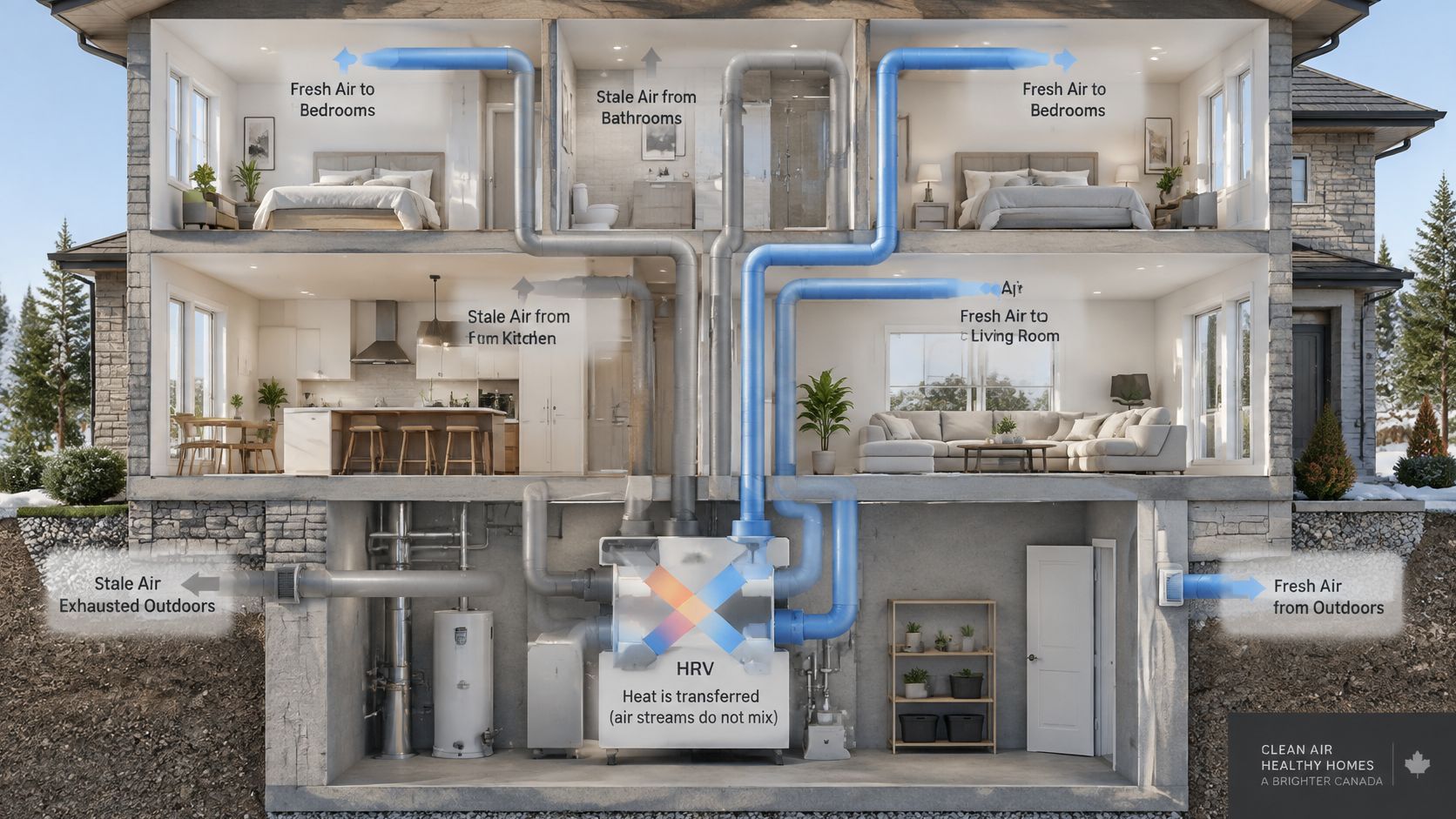
You'll see two separate paths in a finished installation. The supply duct carries filtered outdoor air to bedrooms, living rooms and hallways. The exhaust duct pulls from the places where stale air collects: bathrooms, the kitchen and the laundry.
The unit itself is a metal box, usually in a basement, utility room or closet, about the size of a large suitcase. Two low-power fans move air through it, and a wall controller or an app sets the speed.
Search what is an HRV system and you'll find two different answers competing for the same page: the ventilation appliance, and heart rate variability. For a Canadian household reading a home-improvement guide, the box in the basement is the one that matters. If you're working through the wider picture, our guide to improving indoor air quality at home covers the pollution sources ventilation alone won't fix.
Three things an HRV is not:
- Not a heater. It moves heat that's already in your house. It can't raise supply air above room temperature.
- Not a humidifier. It carries moisture out with the exhaust, which is why some Canadian homes feel drier after installation.
- Not a bathroom fan with better marketing. A bath fan pushes air out and lets cold air find its own way in through cracks.
Carry one idea forward: an HRV is a ventilation system that saves heating energy. Judge it on the air it delivers and the energy the whole system uses, not on the badge.
How an HRV Moves Air and Recovers Heat
Follow a single parcel of air and the machine stops being mysterious. Start with where the air comes from.
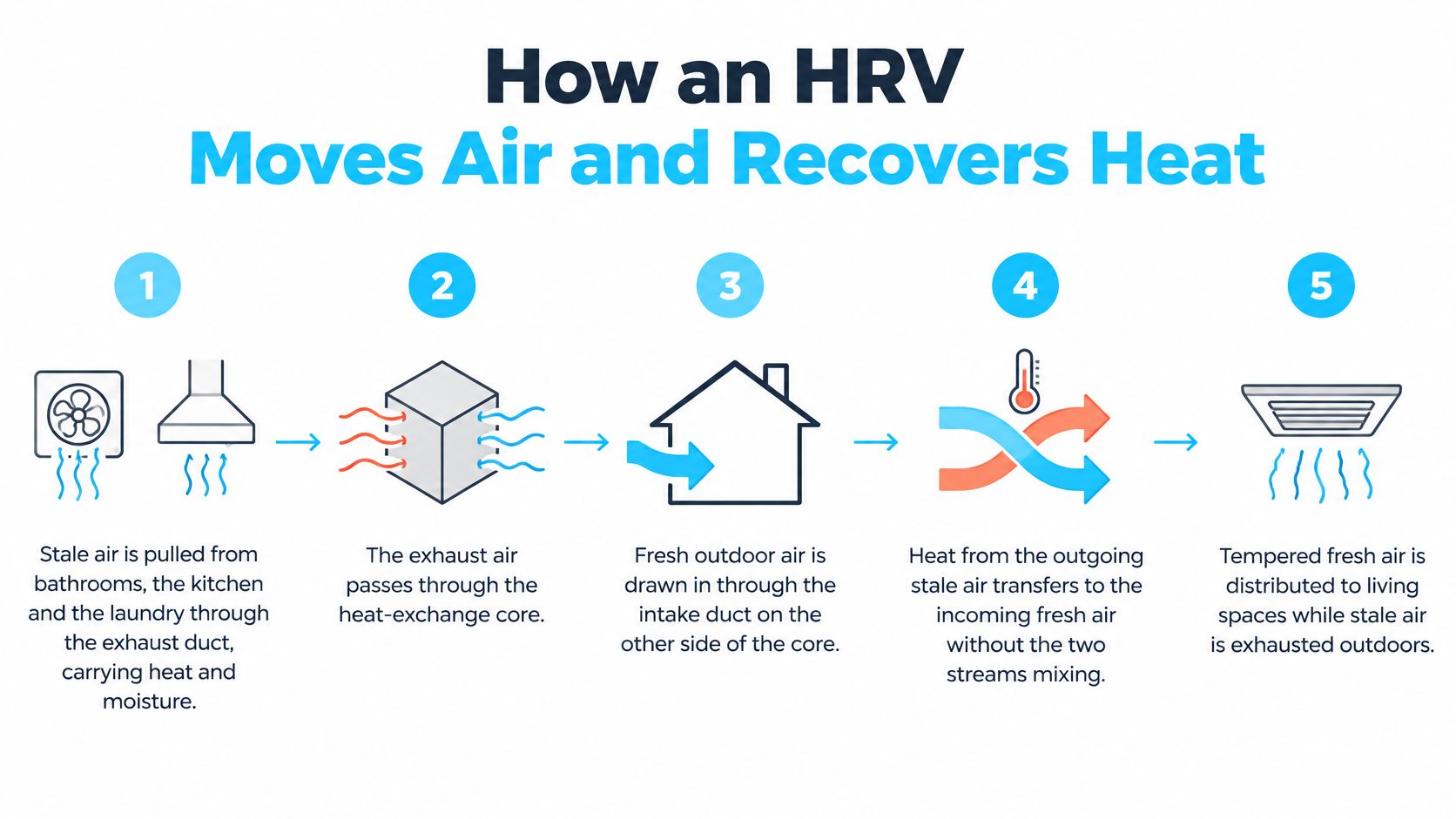
Step 1. Stale air leaves the rooms. The exhaust fan pulls from bathrooms, the kitchen and the laundry, where moisture, odours and particles concentrate. That air is warm because you paid to heat it.
Step 2. It crosses one side of the core. The core is a stack of thin plates or a rotating wheel, depending on the design. Exhaust air flows through one set of channels.
Step 3. Fresh air enters the other side. Outdoor air arrives through an insulated intake hood on an exterior wall, travels to the unit and passes through the alternating channels. Metal or plastic separates the streams, so they swap heat without swapping air.
Step 4. Heat crosses. Air doesn't. In winter, warmth moves from exhaust channels into supply channels and preheats the incoming air. In summer the same hardware works in reverse, shedding some heat from hot outdoor air into the cooler exhaust stream before it reaches your rooms.
Step 5. Tempered air is distributed. The supply fan pushes filtered air to bedrooms and living areas through registers. In deep cold, a frost-control cycle briefly slows or interrupts recovery so the core doesn't ice over. That cycle is why efficiency at minus 25 says more about your winter than efficiency at room temperature.
Natural Resources Canada's housing glossary reports that heat and energy recovery ventilators can recover approximately 60 to 90 percent of the heat in exhausted air, with actual savings depending on airflow, exchanger effectiveness, frost-control strategy, duct leakage, fan power and climate (NRCan EnerGuide housing glossary).
Why balance is the whole point
A balanced unit moves roughly equal volumes in and out, so the house stays at its normal pressure. That's the difference between an HRV and a bathroom fan left running all day.
Check this on your own unit: hold a tissue against each supply register. It should flutter steadily. A register that barely moves air, or one clearly weaker than the others, usually means a damper left closed or a duct run nobody balanced.
An exhaust fan alone pushes air out without replacing it, so the house draws replacement air through cracks, the fireplace damper and the garage door seal. In February that shows up as a cold floor near the door and a furnace working harder than it should.
Here's how the cycle looks in a real installation, including the duct layout you'll recognise in your own basement.
You can confirm the system works without instruments. Registers deliver steady airflow, the filter is clean, and there are no cold drafts near supply outlets. The reliable proof is a measured airflow reading at every register, taken with a balancing hood during commissioning and written down for you.
HRV, ERV and Exhaust Fans Compared
The right ventilation system depends partly on what your home needs to do with indoor moisture. An HRV transfers heat between outgoing and incoming air but removes moisture. An ERV transfers heat and retains some moisture. An exhaust fan removes air without recovering heat or supplying fresh air directly.
| System | Heat recovery | Moisture transfer | Typical fit |
|---|---|---|---|
| HRV (heat recovery ventilator) | Yes, sensible heat only | No, moisture is exhausted | Homes with excess winter moisture from showering and cooking |
| ERV (energy recovery ventilator) | Yes, sensible and latent heat | Yes, partly retained | Homes where indoor humidity stays above about 25 percent; below that, pair with a humidifier |
| Exhaust fan only | No | No | Older, leaky homes with low occupancy; can depressurize airtight homes |
An exhaust fan can clear bathroom steam, but it does not bring in replacement air through a controlled supply. In a leaky older home, outdoor air may enter through many gaps. In a tighter home, the fan can draw air through unintended openings, creating drafts.
When moisture decides the choice
A Canadian cold-climate study found that ERVs significantly improve indoor relative humidity compared with HRVs when indoor RH exceeds 25 percent, with a smaller improvement at lower humidity. The study also found similar sensible effectiveness for the two core types, while differences in energy effectiveness were inconclusive (NRC cold-climate ventilation research). An ERV may therefore suit homes where indoor humidity stays above about 25 percent. Below that level, a humidifier may be needed.
The same research found that median air-change rates rose from 0.19 to 0.36 per hour after an HRV or ERV was installed. Homes with indoor humidity below about 25 percent are better candidates for an HRV paired with a humidifier than for relying on an ERV to add moisture.
Consider a Toronto semi with frosted windows in January, damp bathroom walls and a family of four showering back to back. An HRV can help remove excess moisture while recovering heat from outgoing air.
A Winnipeg bungalow with static shocks, dry skin and a hygrometer reading of 22 percent in February has the opposite problem. A humidifier can add moisture; an ERV may retain a little more, but it does not replace deliberate humidification.
Where an HRV Saves Energy and Where It Falls Short
A high efficiency rating describes a heat exchanger core. It says nothing about your heating bill.
Core efficiency is measured on the core alone. Whole-system energy use adds the fans, the preheater, the supply-air heater, the defrost damper and the controls. Those two numbers can sit far apart, and the gap widens exactly where Canadian homeowners need the system most.
The distinction that matters: a lab rating tells you how well a core moves heat. It doesn't tell you what the system draws from the panel in February.
What the Iqaluit numbers show
NRC testing in extremely cold Iqaluit found an HRV's average sensible recovery efficiency was 72 percent, but the complete system's efficiency fell to 35 percent once preheaters and a supply-air heater were counted. Over two winter months the system consumed 390 kWh, or 6.30 kWh per day, at the tested low ventilation rate (NRC Arctic ventilation study).
That's the correction to the buying-guide fantasy. A 72 percent rating didn't produce 72 percent savings in a northern house, because keeping the core from icing costs energy of its own.
Where the savings quietly disappear
Infiltration is the first leak in the arithmetic. A 2025 simulation of an HRV retrofit in a Vancouver house found a break-even infiltration rate of 0.281 air changes per hour for avoiding increased space-heating energy use (Energies 2025 simulation). A house leaking more than that already ventilates itself, so the HRV mostly duplicates work the cracks were doing for free.
Deep cold is the second. NRC reports that extreme cold can cause frost formation and operational problems in conventional HRV and ERV designs, and Canadian housing research keeps finding underperforming or failed ventilation systems in northern communities. Advice written for southern Ontario or coastal British Columbia doesn't transfer to a Nunavut winter.
The envelope matters as much as the box. Choosing windows for home energy efficiency changes how much heat there is to recover before the ventilator ever runs.
Summer flips the picture again. Coastal homes get modest cooling relief from the reverse exchange, prairie homes swing between humid heat and cold nights, and northern homes barely cool at all. Any savings claim should be read against the local season.
What improves regardless
- Air quality. Continuous fresh air dilutes carbon dioxide, cooking particles and volatile compounds that build up in a sealed house.
- Winter moisture control. Bathroom and kitchen steam leaves rather than condensing on window frames and exterior walls.
- Mould risk. Drying the air at the source beats wiping condensation off the sill every morning.
- Drafts. A balanced system avoids the cold-floor effect that comes from exhaust-only ventilation.
How to Size and Install an HRV Correctly
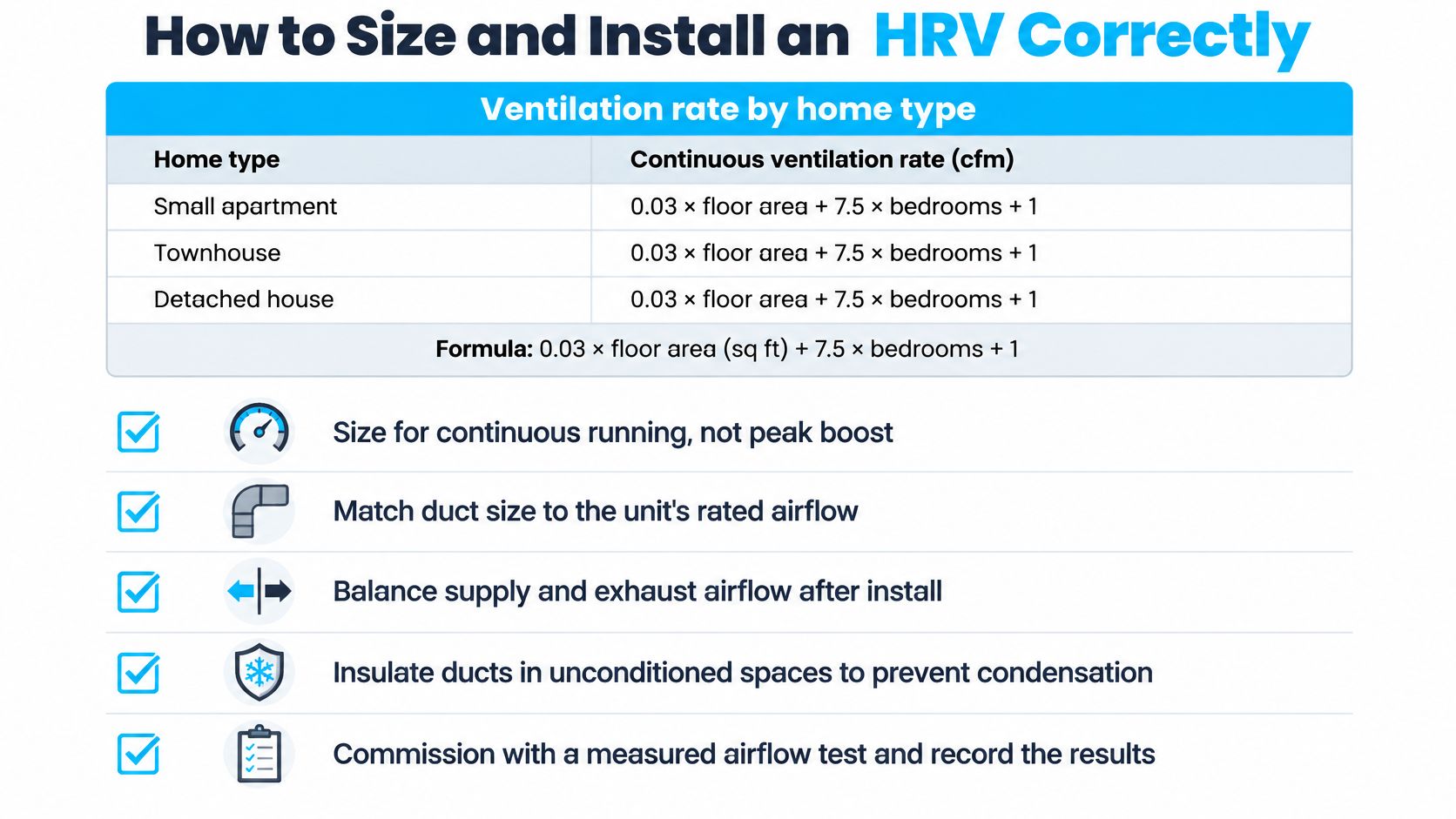
Sizing starts with arithmetic, not with a salesman's guess. A common continuous-ventilation estimate is 0.03 times the floor area in square feet, plus 7.5 times the number of bedrooms plus one.
| Home example | Ventilation rate (cfm) | Unit guidance |
|---|---|---|
| Townhouse, 2 bedrooms, 1,000 sq ft | 52.5 cfm | Small whole-home HRV |
| Detached house, 3 bedrooms, 1,500 sq ft | 75 cfm | Mid-size HRV with dedicated ducting |
Work it through once. For the townhouse: (0.03 × 1,000) + 7.5 × (2 + 1) = 30 + 22.5 = 52.5 cfm. For the detached house: (0.03 × 1,500) + 7.5 × (3 + 1) = 45 + 30 = 75 cfm. Treat those as a starting point and have the installer confirm the figure with a load calculation and CSA F326 requirements.
The five checks in order
- Confirm dedicated ducting. NRCan notes that dedicated HRV ducting can avoid running the furnace fan for distribution and may significantly reduce ventilation energy use. Ask whether the quote assumes furnace-fan operation, because that changes the electricity story.
- Read the certified test data, not the brochure. NRCan's Canadian ENERGY STAR technical specification sets the heating-zone benchmark at at least 65 percent sensible recovery efficiency at 0°C and 60 percent at minus 25°C, with fan efficacy of 0.57 L/s/W (1.2 cfm/W) when efficiency is below 75 percent, or 0.38 L/s/W (0.8 cfm/W) at 75 percent or higher (NRCan HRV technical specification). Sensible recovery efficiency is adjusted for fan energy, leakage, airflow imbalance, exhaust-air transfer and frost control.
- Measure and balance at every register. A 2025 field study in Frontiers in Public Health evaluated HRV performance in 16 existing houses in the National Capital Region across the winters of 2020 to 2021 through 2022 to 2023 (Frontiers in Public Health field study). Installed systems vary, which is why the balancing report matters more than the spec sheet.
- Place the intake sensibly. Keep the outdoor hood away from dryer outlets, exhaust vents and the driveway side where snow and car exhaust collect. A short, insulated, sloping intake run beats a long one.
- Set the controls and label the unit. Filter schedule, defrost settings, low-occupancy mode, and a sticker with the model, the balanced airflow and the commissioning date.
Ask for test data because the rules don't guarantee it for you. Natural Resources Canada reported in 2024 that energy- and heat-recovery ventilators manufactured from January 1, 2020 are subject to reporting and verification requirements, but not mandatory energy-efficiency standards (NRCan recovery ventilator regulations). Nobody is stopping a weak unit from being sold.
What an HRV Costs in Canada and What to Maintain
Prices swing widely by province, home layout and whether ducting already exists, so compare at least three written quotes rather than accepting the first number. What matters is knowing which line items move the total.
| Cost item | What sets your quote (CAD) |
|---|---|
| Compact HRV for a condo or small home, equipment only | Rated airflow at your design point and whether a wall controller is included |
| Installed whole-home HRV, labour and standard ducting | Number of supply and exhaust points, run lengths, and electrical work for a dedicated circuit |
| Ducting repair or new runs | Whether existing ducts can be reused or need resizing for the unit's rated airflow |
| Replacement filter set | Core type and filter size, so ask for the part number before you sign |
| Electricity to run the fan per year | The fan's power draw at your normal speed, multiplied by the hours it runs |
That last row is where buyers get caught. The fan runs continuously, so ask the installer for the wattage at low and high speed and check whether the controller offers a low-occupancy setting instead of estimating running cost from the purchase price.
A maintenance habit that pays: write the filter change date on the unit with a marker. Filters are cheap, and a clogged one quietly strangles everything downstream.
Upkeep is short and unglamorous:
- Filters. Clean or replace every three to six months, more often in a dusty renovation or a home with pets.
- Core. Wash it once a year, or on the manufacturer's schedule, in lukewarm water and let it dry fully.
- Condensate drain. Check it where fitted, especially before winter, so water doesn't back up into the cabinet.
- Registers. Confirm every supply and exhaust grille is open and unobstructed by furniture or rugs.
- Rebalancing. Recheck airflow after any furnace, duct or major renovation work.
Skipped maintenance raises the cost of the system. A dirty filter cuts airflow, which cuts both fresh air delivery and heat recovery, so you pay for electricity and get a fraction of the ventilation.
Decide Whether an HRV Suits Your Home
Does your home need balanced ventilation, or would a simpler option address the problem? Start with the house's airtightness, indoor humidity and ventilation needs, then consider whether you can install and maintain the system properly.
An HRV may suit a reasonably airtight home where indoor humidity is high enough to fog windows or encourage mould, and the occupants need more ventilation. Condos with frequent showering and cooking can face these conditions.
An ERV may suit a home where winter indoor humidity stays above roughly 25 percent and retaining some moisture is welcome. If the air is drier, an ERV may not solve the problem. A humidifier may be more appropriate; see our guide to raising humidity in your house.
A leaky older home with one or two occupants may need only an exhaust fan, provided it can remove stale air without depressurizing the building.
An HRV is a poor fit if there is no practical plan for dedicated ducting and balanced airflow. Condo strata rules may also prevent new ductwork or exterior penetrations. And if you are unlikely to change filters, a simpler system may be a better choice.
Before buying, measure humidity through the winter with a hygrometer in the main living area and a bedroom. Readings over time give a clearer picture than a single cold morning.
Then ask contractors for a load calculation, an airflow test and a written balancing report. Get three written quotes, each stating certified efficiency at 0°C and at minus 25°C, fan efficacy, warranty terms, and whether the estimate assumes the furnace fan will run.
Ask each installer what supply airflow they expect at the registers and how the system's frost control will operate at your local design temperature. Those answers help show whether the proposal accounts for the home as a whole, rather than only the HRV's rated efficiency.
Celmin publishes Canadian buying guides with CAD pricing and local availability. Its coverage includes ventilation, humidity and other home-air-quality topics, helping Canadian buyers compare the trade-offs between an HRV and an ERV.
Sign up or sign in to join the conversation.