
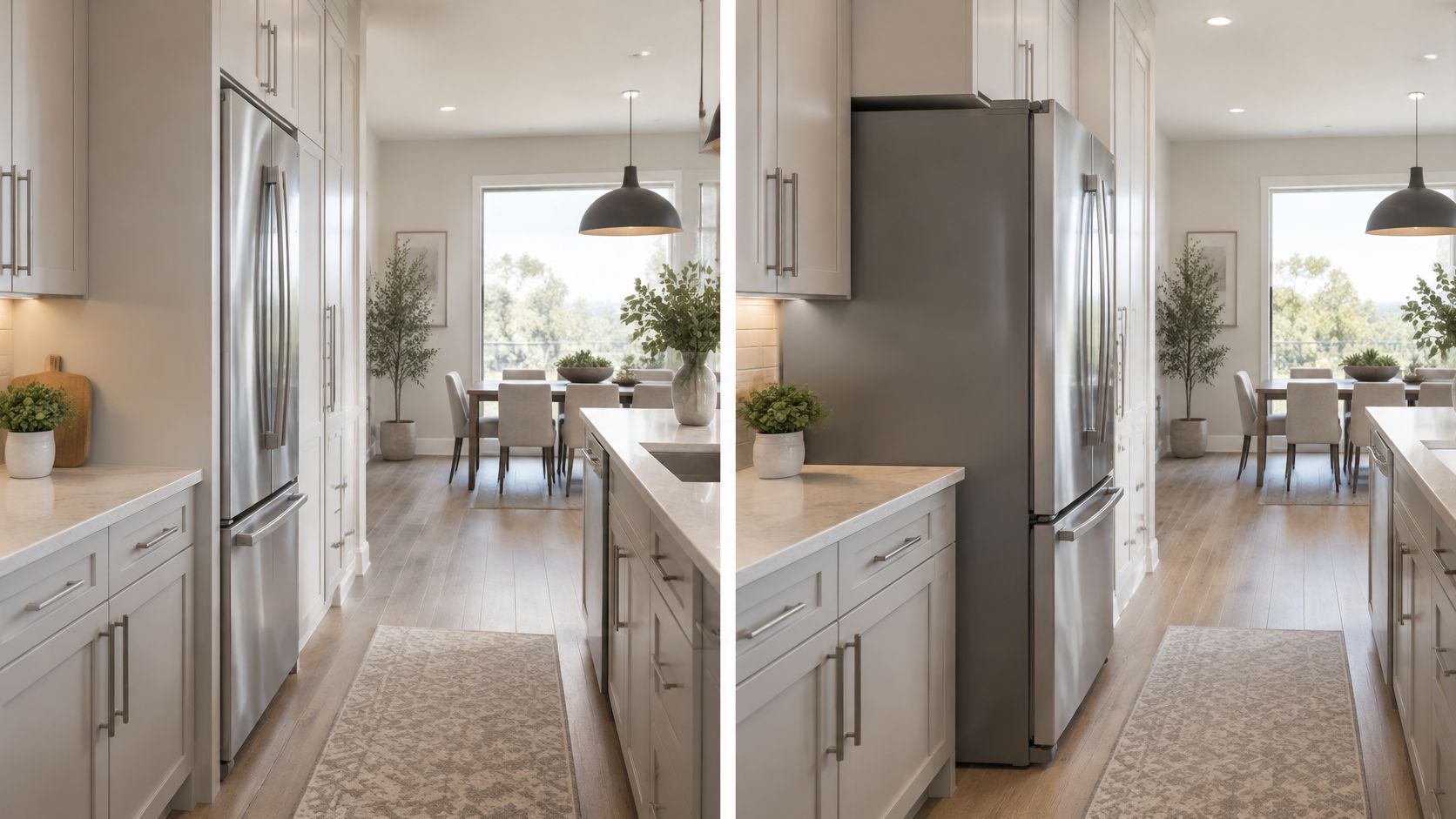
The usual advice, buy counter-depth for looks and standard-depth for storage, misses the decision that matters most: how much of your kitchen can the installed refrigerator occupy? A fridge that looks tidy but won't hold your cooking containers is a poor fit. So is a bargain with generous shelves that blocks the route between the sink and island.
Treat counter depth vs standard depth as a space-management choice, not a contest between small and large refrigerators. Start with the finished appliance, including doors, handles and installation gaps. Then decide whether its usable storage justifies the space it takes from your kitchen.
Table of Contents
- Counter Depth vs Standard Depth at a Glance
- Depth Projection and Aisle Clearance
- Capacity You Keep When the Box Gets Shallower
- What Depth Costs in Canadian Dollars
- Kitchens That Suit Each Refrigerator Depth
- Pre-Order Checklist and Final Verdict
Counter Depth vs Standard Depth at a Glance
Counter-depth doesn't automatically mean a small fridge. Choose it when the appliance needs to stay close to the cabinet line. Choose standard-depth when deeper storage and capacity for the money matter more than keeping the walkway clear.
Counter-depth and standard-depth at a glance
| Criterion | Counter-depth | Standard-depth |
|---|---|---|
| Cabinet depth before doors and handles | Shallower body intended to sit near the cabinet line | Deeper body that extends farther into the room |
| Depth once doors and handles are included | Check the complete dimension; freestanding and built-in designs aren't interchangeable | Check the complete dimension, not just cabinet depth |
| Projection past a 24-in cabinet | Body can align closely; doors and handles still project | Allow for a substantial projection beyond the cabinet line |
| How makers recover space | Wider or taller cabinets can recover volume | Deeper box supplies front-to-back storage |
| Storage pattern | Less room for deep containers | More front-to-back storage |
| Aisle and look | Keeps the walkway clearer and creates a more continuous cabinet line | Uses more traffic space and island clearance |
| Canadian price pattern | Compare the actual model price; don't assume a fixed premium | Often worth screening first for capacity per dollar |
The category labels overlap. Samsung Canada's refrigerator guide gives general depth ranges of 24–30 inches (61–76 cm) for counter-depth and 24–34 inches (61–86 cm) for standard refrigerators. Those broad bands are a reason to open the specification sheet, not evidence that the categories are interchangeable.
Use the label to shortlist, not to approve the purchase
Retailer filters help you eliminate unsuitable products, but they don't describe the installation completely. A listing may display cabinet depth prominently while putting depth with handles in a separate specification field. Another may show an overall product dimension without the required space behind it.
At Celmin, we use snapshot tables and plain-language verdicts to make trade-offs visible. The verdict here is straightforward: protect the walkway first, then maximise storage within the remaining space.
Shopping rule: A counter-depth badge isn't a promise of a flush installation. The manufacturer's installation drawing is the document that decides whether it fits.
Don't confuse counter-depth with built-in, either. A freestanding appliance can sit close to adjacent counters without being designed for an integrated cabinet installation. A true built-in needs its own opening, ventilation arrangement and installation plan.
Use the comparison table to choose a direction. Before paying, confirm where the handle will sit, whether the doors can open fully and whether you can remove the interior drawers. An appliance can fit between the cabinets and still fail as a working refrigerator.
Depth Projection and Aisle Clearance
Canadian cabinet geometry provides a useful starting point. William Millwork's Canadian cabinet-sizing guide describes base cabinets as typically 24 inches (610 mm) deep, with finished counters commonly extending to about 25.5 inches (648 mm) once fronts and overhangs are accounted for.
That difference matters because the cabinet face and countertop edge aren't the same reference line. Measure both in your kitchen rather than assuming the refrigerator should finish flush with either.
Use this diagram to distinguish the cabinet body from the finished counter projection.
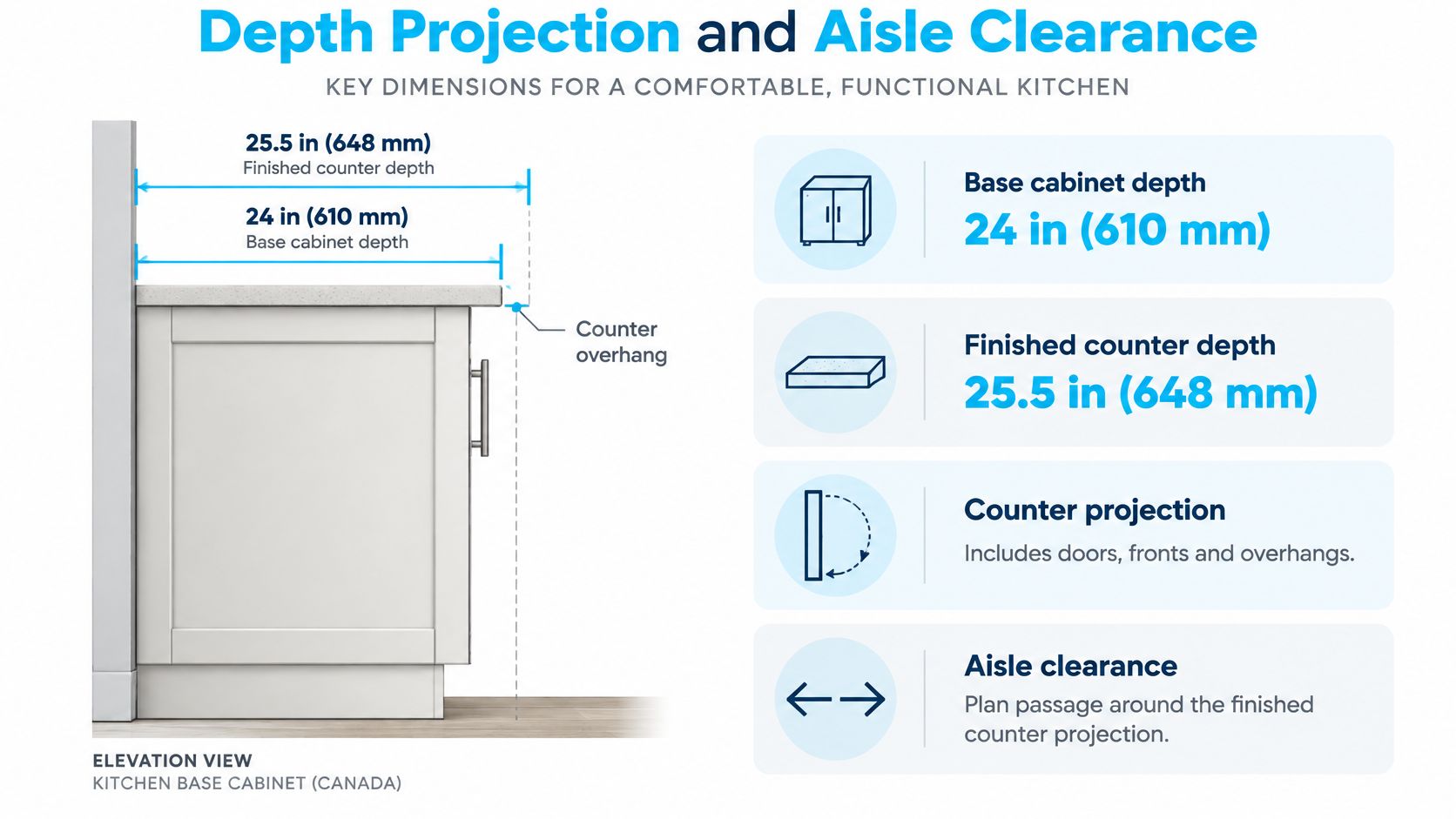
Separate body depth from finished projection
Samsung Canada's terminology guide describes counter-depth cabinet bodies as generally 24–25 inches (61–64 cm) and standard-depth bodies as 27–31 inches (69–79 cm), excluding doors and handles. Its guidance also describes standard-depth units as commonly projecting about 6 inches (15 cm) beyond the counter.
Don't subtract cabinet depth from an overall refrigerator dimension and assume you've calculated the installed projection. You also need the rear gap, the actual counter edge and the correct endpoint on the appliance. A handle measurement and a door-front measurement answer different questions.
Published Canadian refrigerator depth ranges
| Source | Counter-depth | Standard-depth | What the figure covers |
|---|---|---|---|
| Samsung Canada terminology guide | Shallower cabinet-body range stated above | Deeper cabinet-body range stated above | Excludes doors and handles |
| Samsung Canada refrigerator guide | Broad category range | Broad category range | General shopping guidance, not an individual installation drawing |
| Whirlpool Canada sizing guide | Confirm the selected model's depth fields | 28 3/4–34 5/8 inches, according to Whirlpool Canada's sizing guide | Standard refrigerator depths as listed |
| Whirlpool full product configuration | Separate built-in specifications from freestanding specifications | Confirm the full configuration on the model drawing | Complete appliance configuration, not cabinet box alone |
These published ranges conflict if you treat every depth field as the same measurement. Don't average them. Use category guidance to understand the options, then use the selected model's dimensioned drawing to resolve the purchase.
Test the aisle with the refrigerator closed and open
Say a condo galley has an island stool opposite the refrigerator. Tape the proposed handle line onto the floor, pull the stool into its normal position and walk through carrying a grocery bag. That test reveals an obstruction a clean floor plan can hide.
Then simulate opening the doors. Stand where you'd reach for milk, crouch where you'd use the freezer and check whether someone else could pass without squeezing against the island. A French-door arrangement doesn't guarantee clearance just because each door is narrower.
Measure the space people use, not just the space the appliance occupies.
The landing area matters too. You need somewhere practical to set groceries while loading the fridge, and somewhere to put a container while rearranging a shelf. A protruding appliance can make an adjacent counter awkward to reach even when passage remains possible.
Record these measurements with a tape measure and a simple sketch:
- Opening width and height: Measure at several points and note uneven floors, trim and overhead obstructions.
- Finished counter depth: Mark the actual front edge, including any overhang.
- Rear and side spaces: Take ventilation requirements from the model's installation manual.
- Door and drawer envelope: Include handles, nearby walls, pantry panels and the island.
- Delivery route: Check the suite entrance, elevator, corridors and turns, not just the kitchen opening.
Keep your notes in the same units as the manufacturer's drawing. Don't let an approximate retailer dimension override a more detailed installation requirement.
Capacity You Keep When the Box Gets Shallower
A deep stockpot is a better capacity test than an empty showroom shelf. If your household regularly refrigerates a pot of soup, check whether it fits with the door closed and the shelves arranged for everyday use. A generous capacity figure won't help if accommodating that pot forces you to remove a shelf you need.
The same applies to pizza boxes, roasting dishes and meal-prep containers. Usable storage is about shape as well as volume. Door bins help with bottles and condiments, but they don't replace an unobstructed main shelf.
Width and height can recover volume
Removing cabinet depth reduces front-to-back space. Manufacturers can recover some of that volume by making the appliance wider or taller, so counter-depth isn't a reliable synonym for lower total capacity.
Samsung Canada's refrigerator terminology guidance notes that counter-depth refrigerators are often around 36 inches wide and may be taller than standard-depth designs. That makes opening width and overhead clearance part of the capacity decision, not merely installation details.
A wider appliance can provide useful side-by-side shelf space, but it won't solve a narrow replacement opening. A taller model may put storage beyond comfortable reach or leave insufficient room beneath an upper cabinet. Don't count inaccessible shelves as an improvement.
Separate freestanding counter-depth products from true built-ins as well. Grifglo's counter-depth refrigerator guide describes freestanding counter-depth units as roughly 28 inches deep, compared with about 24–25 inches for built-in designs, which are often taller. These are different installation approaches, not different trim packages.
Compare storage against the space surrendered
Use a small comparison worksheet rather than judging the interior by appearance.
| Check | What to record | Why it matters |
|---|---|---|
| Published capacity | Total, refrigerator and freezer capacity in matching units | A large freezer can disguise a fresh-food compartment that's too small |
| Installed depth | Handle-inclusive depth plus required rear clearance | Shows the appliance's actual reach into the kitchen |
| Shelf usability | Clear shelf depth, shelf width and adjustment positions | Tests whether your regular containers fit |
| Access | Drawer extension and shelf-removal requirements | Confirms the interior remains usable beside walls and panels |
For a quick screening metric, divide the manufacturer's published capacity in litres by the installed depth, using the same depth unit for every candidate. That gives you litres per unit of kitchen depth. It isn't a universal efficiency rating, and it doesn't replace the container test, but it makes an oversized exterior easier to spot.
Keep energy use separate. Compare each model's Canadian energy label rather than assuming a shallower cabinet consumes less electricity. Compressor design, insulation, configuration, ice-making equipment and capacity all affect the result.
A counter-depth model can match a smaller standard-depth model on litres while fitting the room differently. Choose the arrangement that stores your food without making access difficult.
What Depth Costs in Canadian Dollars
Whirlpool Canada's refrigerator catalogue lists a starting price of $1,749.99 CAD for its 30–36-inch refrigerators offered in standard or counter depth. That catalogue floor isn't a matched-model comparison, and it doesn't establish a counter-depth surcharge.
Read the premium from the actual model pages. Don't budget around a fixed percentage attached to the category name.
Compare equivalent purchases
Start with appliances that will really fit in your space. Then compare capacity, compartment layout, finish, dispensing equipment and warranty terms. Otherwise, you may attribute a price difference to depth when you're really paying for an ice system or a different product tier.
For each finalist, calculate purchase price per published litre using matching capacity units. Treat that as a value screen, not a final verdict. A low price per litre doesn't compensate for shelves you can't use or a handle that obstructs the kitchen.
Our Canadian kitchen-appliance buying guide can help you place the refrigerator purchase alongside the other appliances competing for your budget. Spend on the constraints you can't fix later before paying for convenience features.
A lower sticker price is the wrong win if the refrigerator blocks the only practical route through the kitchen.
Ask for the installed total
Request a written quote that separates the appliance from the services and accessories. Check the following before comparing totals:
- Delivery conditions: Confirm condo access, elevator arrangements, stairs and any restrictions on bringing the appliance inside.
- Installation equipment: Ask whether the quoted configuration needs a water connection, hinge accessory, trim or other model-specific parts.
- Cabinet work: Include any changes needed for a built-in or panel-ready installation.
- Removal: Confirm whether disconnection and haul-away of the existing fridge are included.
- Purchase protection: Read return restrictions and damage-reporting procedures before delivery.
Check Amazon.ca and national appliance retailers using the exact Canadian model number, including its suffix. Similar-looking products can have different dimensions or equipment, so a photograph isn't enough to confirm a match.
Avoid treating a US listing as a Canadian price comparison. Currency conversion alone won't tell you about local stock, delivery, warranty eligibility or the model being supplied.
Finally, keep operating cost on its own line. Read the model-specific energy label and compare it separately from the purchase price. Neither a shallower cabinet nor a higher price guarantees a lower electricity bill.
Kitchens That Suit Each Refrigerator Depth
Match the refrigerator to the layout, then check the household's storage needs. A spacious kitchen and a compact galley shouldn't produce the same recommendation merely because their owners buy similar groceries.
Which depth fits the kitchen
| Kitchen | Choose | Why |
|---|---|---|
| Condo or galley with a narrow aisle | Counter-depth | Preserve walking clearance beside the closed appliance |
| Island close to the fridge run | Counter-depth | Reduce interference with door swing and the working area |
| Household that stores a week of food or large containers | Standard-depth | Prioritise deep shelves and capacity for the money |
| Open kitchen where the fridge is on show | Counter-depth or a true built-in | Give cabinet alignment greater weight |
| Existing narrow replacement opening | Measure before choosing either label | Width, height and hinges may eliminate the preferred category |
| New cabinet plan | Size the opening to the chosen model | Design access, ventilation and clearances into the cabinetry |
Use this layout guide to identify the constraint you need to solve.
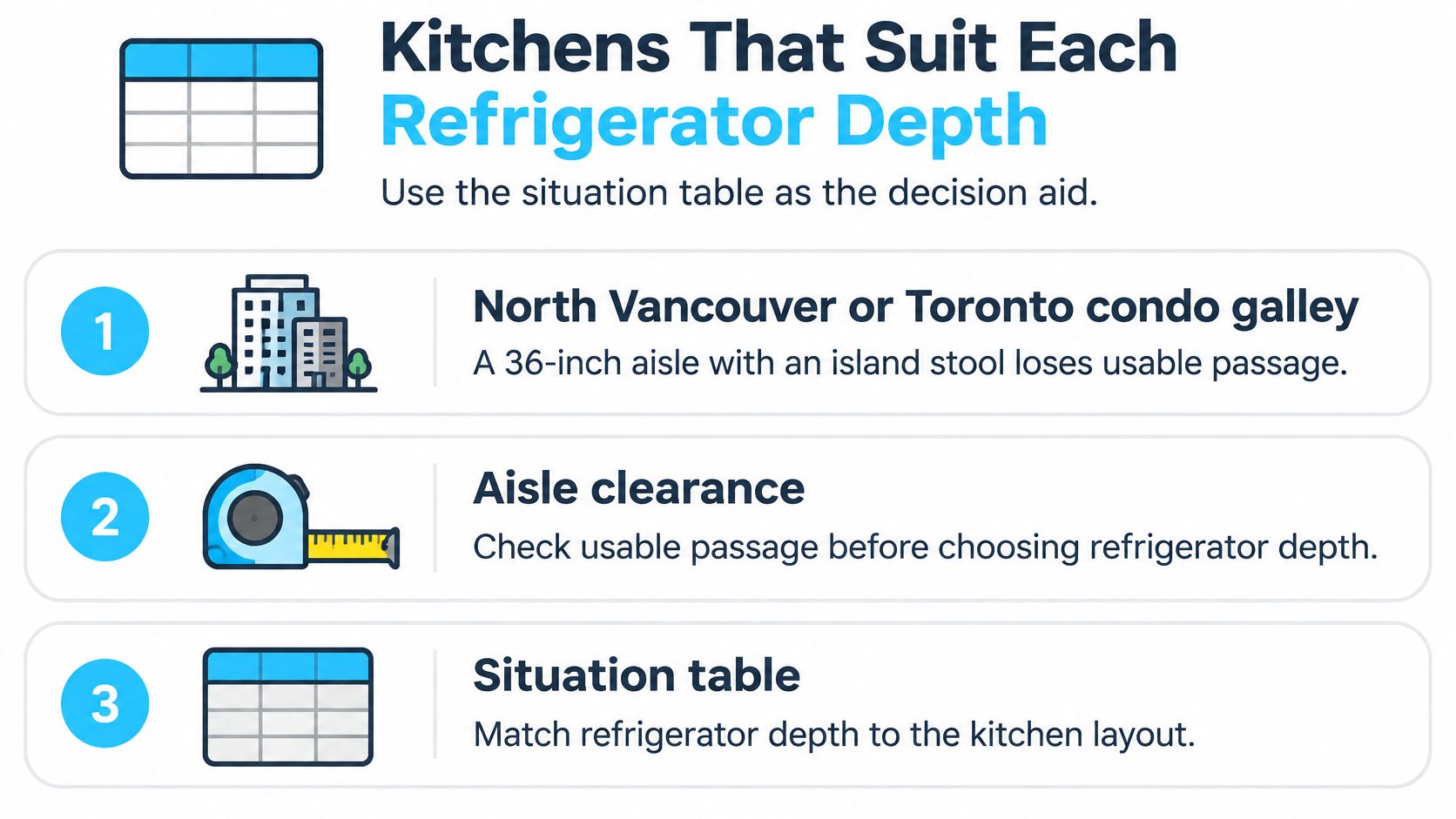
A condo galley needs passage before extra shelves
In a North Vancouver or Toronto condo, the refrigerator may sit directly beside the route to the living room. If opening it means moving a stool or asking someone to leave the aisle, prioritise counter-depth and check the door arrangement carefully.
Don't solve limited food storage by creating a daily obstruction. Adjust shelf organisation, freezer allocation or shopping habits only after confirming the appliance still meets your household's essential needs. Our guide to kitchen appliances for small spaces applies the same principle to the rest of a compact kitchen: permanent placement needs a practical justification.
A batch-cooking household needs container space
Standard-depth is the stronger starting point for households storing large cooking vessels, flat takeaway boxes and prepared meals. That recommendation holds only when the room can accommodate the finished appliance and someone using it.
Bring the dimensions of your largest regular containers when shopping. Test the shelf arrangement you'd use, rather than accepting an interior displayed with shelves removed.
For a visual comparison of refrigerator formats, watch the video below.
An open-plan kitchen rewards careful alignment
When the refrigerator faces the dining or living area, a shallower body can make the kitchen feel more orderly. That's a legitimate reason to choose counter-depth, provided the storage compromise is acceptable.
A renovation lets you design the opening around the chosen appliance. A rental or finished alcove usually doesn't. In a replacement project, check the upper cabinet, hinge-side wall and adjacent panels before deciding that a cleaner appearance is achievable.
Pay particular attention to French doors opposite an island. A cabinet body can fit neatly while the open doors or pulled-out freezer drawer still collide with the working area.
Circle the table row that best matches your kitchen. Ignore the recommendations aimed at layouts you don't have.
Pre-Order Checklist and Final Verdict
Choose counter-depth if the finished appliance would otherwise obstruct your main walkway or disrupt a cabinet line you value. Choose standard-depth if the aisle remains usable and deeper storage offers the better return for your household.
Choose a true built-in only when you need its integrated installation and have planned for the required cabinetry, access and total cost. Don't buy one just because a retailer groups it with counter-depth refrigerators.
Check the Canadian specification sheet
Use the same checklist for both finalists so a compelling feature list doesn't distract you from an installation problem.
Confirm the exact model. Save the Canadian product page, specification sheet and installation manual. Check that the retailer's model suffix matches those documents.
Verify width and height. Include hinges, levelling adjustments and overhead obstructions. Measure the opening at different points rather than assuming the sides are parallel or the floor is level.
Find depth with doors and handles. Add the rear clearance required by the manual when determining the installed position. Note where the front of the appliance will sit relative to your counter and island.
Check hinge and handle clearance. Confirm that doors open far enough to use and remove drawers. Look for interference from walls, end panels, nearby handles and perpendicular cabinets.
Read the ventilation requirements. Follow the selected model's rear, side and overhead requirements. Don't borrow installation gaps from a similar-looking refrigerator.
Approve delivery and ownership details
A successful fit includes getting the refrigerator into the home and being able to maintain it afterwards. Leave room to access connections and move the appliance for service.
- Map the delivery route: Confirm doorway openings, elevator access, turns and any building booking requirements with the delivery team.
- Check local supply: Verify Canadian stock, delivery arrangements and warranty coverage for the exact model.
- Read the energy label: Compare the model-specific rating, not a category-level assumption.
- Rank connected features last: Use our guide to smart appliances for the kitchen to assess connected functions after fit, storage and serviceability are settled.
Our research covers specifications, owner reviews, warranty terms and Canadian availability, cross-checked against listings and long-term feedback. That broader check matters because the installation drawing can confirm fit, but it can't tell you everything about living with the appliance.
Before ordering, tape the final installed outline onto the kitchen floor and repeat your normal movements around it. Buy the refrigerator whose doors, drawers and daily use your kitchen can accommodate, not the one with the most persuasive category label.
Celmin offers Canadian appliance comparisons that make dimensions, storage compromises, pricing and local availability easier to assess. Visit Celmin to narrow your shortlist, then compare your finalists against your measured opening and usable aisle space.
Sign up or sign in to join the conversation.