
If you're buying a small smart speaker for a kitchen in Canada in 2026, two products do most of the shortlisting: the Amazon Echo Dot (5th Gen) and the Apple HomePod Mini. There are other speakers that can sit on a counter and play music, sure, but once you narrow the job to timers, voi...
If you're buying a small smart speaker for a kitchen in Canada in 2026, two products do most of the shortlisting: the Amazon Echo Dot (5th Gen) and the Apple HomePod Mini. There are other speakers that can sit on a counter and play music, sure, but once you narrow the job to timers, voice control with wet hands, quick music, and casual smart-home control while cooking, these are the two that keep coming up. One is cheaper, broader, and more practical for mixed-platform homes. The other sounds better, feels more polished, and makes a lot more sense if your household already lives inside Apple's ecosystem.
This article isn't a hands-on review. It's an editorial comparison of what these two speakers are actually good at in a kitchen, where each one gets annoying, how music-service support changes the recommendation, and which type of household should buy which. By the end, you should know whether to get the cheap Alexa puck, the nicer-sounding Apple sphere, or skip both and think about a Sonos instead.
At a glance
| Echo Dot | HomePod Mini | |
|---|---|---|
| Price (CAD) | ~$47 | ~$129 |
| Rating signal | 4.7/5 on source listing | 4.7/5 on source listing |
| Made by | Amazon | Apple |
| Voice assistant | Alexa | Siri |
| Audio pitch | Clearer vocals and deeper bass than prior Dot | 360-degree audio with richer overall sound |
| Timer usefulness | Strong hands-free timers; very kitchen-friendly | Strong hands-free timers; great for Apple households |
| Music services | Amazon Music, Spotify, Apple Music, and more | Best fit with Apple services and AirPlay use |
| Smart-home stack | Broad Alexa smart-home integration | HomeKit smart-home control |
| Multi-room audio | With compatible Echo devices | AirPlay 2 multi-room |
| Extra hardware features | Motion sensor, indoor temperature sensor, mic-off button, 2.4/5 GHz Wi‑Fi, Bluetooth | S5 chip, U1 chip for Handoff, Intercom |
| Best for | Alexa-first or mixed-device households on a budget | iPhone households that want the better-sounding kitchen speaker |
| Skip if | You want the best sound or you're fully committed to Apple Home | You use Spotify as your main voice music service or you want platform flexibility |
Pro tip: Kitchen-speaker regret usually isn't about sound first — it's about whether the assistant understands you over a vent hood and whether your household actually uses that ecosystem already. Buy for assistant fit and music-service fit first. The sound quality matters, but it matters second.
What each one actually is
The Echo Dot at roughly $47 CAD is Amazon's compact Alexa speaker: small, inexpensive, and built around convenience more than audiophile ambitions. According to the listing, it offers improved audio for clearer vocals and deeper bass, supports hands-free Alexa features like timers and weather, and adds a couple of quietly useful extras for a kitchen or breakfast nook: a built-in motion sensor and an indoor temperature sensor for routines. That's a more honest product than a lot of smart speakers. It knows its job is to be useful, not precious.
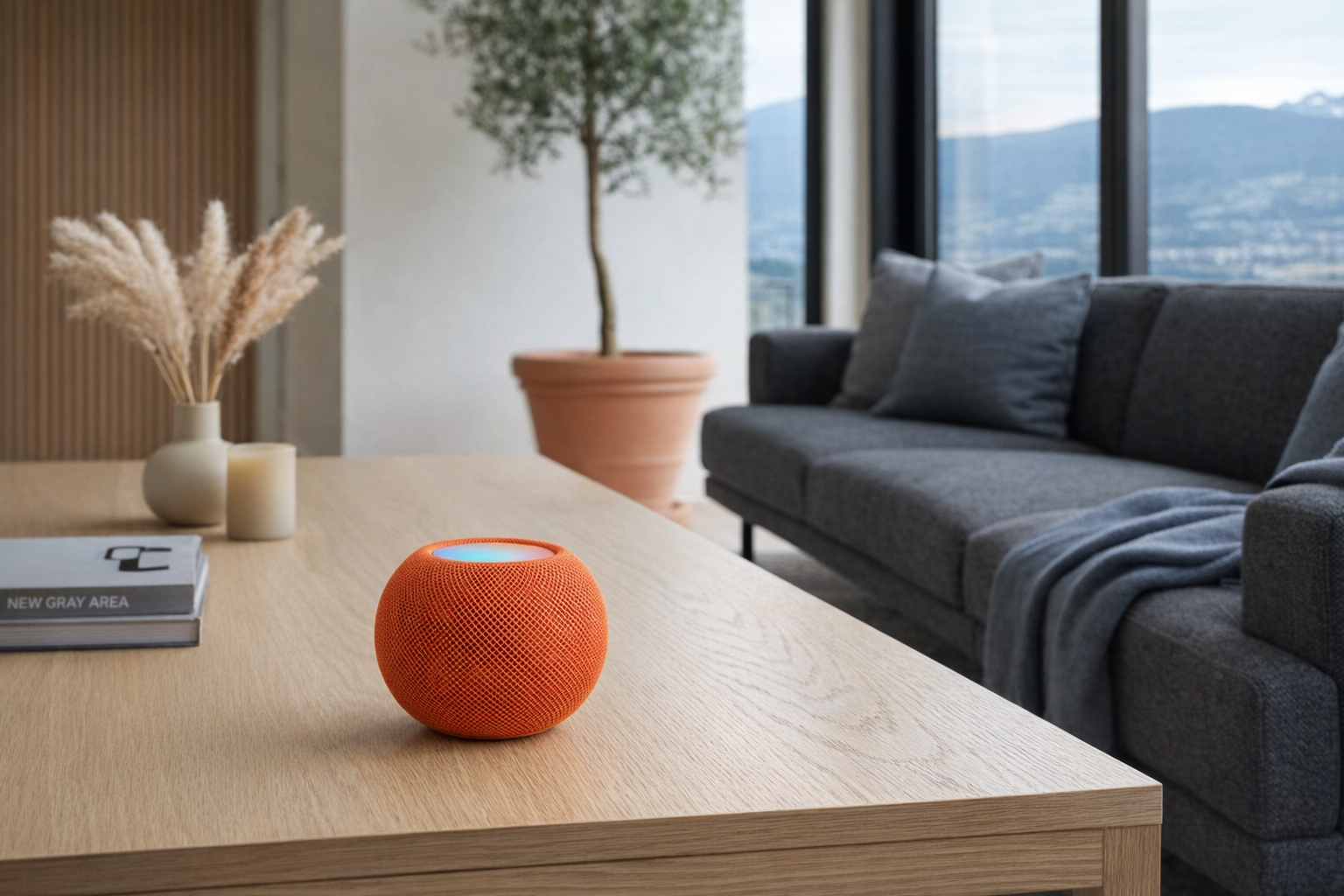
The HomePod Mini at roughly $129 CAD is Apple's compact Siri speaker, built around the S5 chip, 360-degree audio, AirPlay 2 multi-room playback, HomeKit control, and the U1 chip for Handoff from nearby Apple devices. It's the more expensive speaker by a wide margin, and Apple is plainly asking you to treat it as both a smart speaker and a small, good-sounding room speaker. That's not nonsense, either — the pitch is narrower, but it is clearer.
The fundamental difference: Echo Dot is the better cheap kitchen assistant; HomePod Mini is the better kitchen speaker if your household already speaks Apple.
The eight battlegrounds
1. Kitchen timers — both are good, but not in quite the same way
For kitchen duty, timer quality matters more than spec-sheet poetry. You need to be able to shout from across the room with messy hands and get a result immediately.
Both products are strong here because both are designed around hands-free voice use, and both can handle the obvious kitchen commands people actually use. In practical terms, either one can serve as your pasta timer, oven reminder, or "remind me to take the bread out" speaker better than your phone, because your phone is usually in a pocket, on the counter face-down, or covered in flour.
Where the decision gets more specific is household habit. Alexa has the reputation for being the more kitchen-native assistant, partly because Amazon has spent years pushing Echo speakers into exactly this room and exactly this use case. The Echo Dot's whole identity is "ask me things while your hands are busy." The HomePod Mini is also good at timers, but its appeal is less "best timer gadget" and more "part of the Apple house."
So the winner here is slightly Echo Dot, not because HomePod Mini is weak, but because Alexa as a kitchen helper remains a more natural fit for more homes.
2. Voice assistant responsiveness while cooking — Alexa is broader, Siri is better if you're already in Apple's lane
This is the part marketing always overcomplicates. You don't need a dissertation on AI in a kitchen. You need the speaker to hear "set a timer for 12 minutes," "add olive oil to my shopping list," or "play something in the background" without turning it into a negotiation.
Echo Dot benefits from Alexa's broader smart-home and general-assistant posture. The product description leans into timers, weather, and smart-home control because that's exactly the role it fills best. For mixed households — Android phones, iPhones, different music apps, maybe a few smart plugs from random brands — Alexa is usually the less fragile option. It tends to fit messy real life better.
HomePod Mini makes more sense when your household is already iPhone-heavy and comfortable with Siri. Then the friction drops: Intercom makes sense, Handoff makes sense, HomeKit scenes make sense. If you are not already an Apple-home person, Siri's strengths are less compelling. That's the issue with Apple smart-home gear generally: when it fits, it fits beautifully; when it doesn't, it feels narrow very quickly.
Winner: Echo Dot for broad usefulness, HomePod Mini for Apple households specifically.
3. Sound quality for music while cooking — HomePod Mini wins, and it's not subtle
This is the cleanest category in the whole comparison.
The HomePod Mini is the better-sounding speaker. Apple markets 360-degree audio, and even allowing for usual smart-speaker exaggeration, the intent is clear: it is meant to fill a room more evenly and sound fuller from a small enclosure. If the kitchen speaker is also your morning playlist speaker, dinner-party background speaker, or podcast speaker while cleaning up, the HomePod Mini is the one that feels less like a compromise.
The Echo Dot says it has clearer vocals and deeper bass than before, which is fair enough, but this is still a ~$47 CAD compact Alexa puck. It is supposed to sound competent, not luxurious. And that's fine. Plenty of people do not need premium sound from a device whose main jobs are timers, radio, and weather.
But if you're spending more because you actually care what music sounds like while you're cooking, buy the HomePod Mini. That's what the extra ~$82 is buying more than anything else. Not magic. Just noticeably better audio from a small speaker.
4. Music-service compatibility — this is where some buyers accidentally choose wrong
A kitchen speaker is only useful if it works cleanly with the service you already pay for. That sounds obvious, but people still buy smart speakers the way they buy mugs: based on colour, not workflow.
The Echo Dot is the easier recommendation for households using Spotify, Amazon Music, Apple Music, or a mix of services. The listing explicitly names Amazon Music, Spotify, Apple Music, and more, which tells you the product's basic posture: Alexa is trying to meet users where they already are. That's the practical design.
The HomePod Mini is much more comfortable in an Apple-centric setup. It makes the most sense if your music life already runs through Apple services and AirPlay 2. That can be excellent. But it is not the same thing as broad neutrality. If your household mainly uses Spotify and expects identical convenience everywhere, the HomePod Mini becomes a more conditional recommendation.
For Canadian buyers, where Spotify is common and mixed-platform households are common, this matters a lot. Echo Dot is the safer service-compatibility choice. HomePod Mini is the better choice only when you already know Apple is your home base.
5. Multi-room audio — HomePod is cleaner inside Apple; Echo is more flexible outside it
Both products do multi-room, but they do it in the style of their parent company.
Echo Dot supports multi-room music and device pairing with compatible Echo devices. That's broad, accessible, and relatively easy to understand: buy more Echo speakers, put them in more rooms, group them, done. If your household wants kitchen music that can also follow you into the dining room or office without caring what phones people own, this is the more open and forgiving route.
HomePod Mini supports multi-room audio with AirPlay 2, which is excellent if your home already revolves around Apple gear. AirPlay is a genuinely good system when you're living in that world. But it is also Apple-shaped. That's not a flaw so much as a boundary.
So the winner depends on the house:
- HomePod Mini wins for all-Apple homes that already use AirPlay.
- Echo Dot wins for everyone else.
And for a lot of families, "everyone else" is a bigger category than Apple marketing would like to admit.
6. Smart-home control in a kitchen — Echo Dot does more for less, but HomePod Mini is cleaner for HomeKit homes
The kitchen is one of the most common rooms for quick smart-home commands: turn on under-cabinet lights, start a coffee routine, switch off downstairs lamps at night.
Echo Dot is very aggressive on value here. For ~$47, you're getting Alexa control plus a motion sensor and indoor temperature sensor that can support routines. That matters more than it first appears. A kitchen Echo that triggers routines based on motion or temperature is quietly more capable than its low price suggests. That's good product planning.
HomePod Mini gives you HomeKit control, which is excellent if you already buy into Apple's smart-home approach. It's cleaner, more privacy-forward in reputation, and often less cluttered than the Alexa universe. But it is also less forgiving if your devices and services are scattered.
Winner: Echo Dot on value and flexibility, HomePod Mini on elegance for HomeKit users.
7. Privacy and data handling — Apple has the cleaner story, Amazon gives you the hardware controls
A smart speaker in a kitchen is always listening for a wake word. If that bothers you, it should. Skepticism is healthy here.
The Echo Dot includes privacy controls including a mic off button, and that physical control matters. Hardware mute buttons are better than menu settings because they are immediate and unambiguous. Amazon at least knows people are wary.
The HomePod Mini benefits from Apple's broader reputation for tighter ecosystem control and a more privacy-centric pitch. If you're the kind of buyer who feels uneasy about an always-listening assistant near the place your family actually gathers, Apple will probably feel like the more comfortable bet.
My view: if privacy anxiety is high in your home, HomePod Mini has the stronger trust story, even if the Echo Dot's physical mic-off control is exactly the kind of feature every smart speaker should have.
8. Five-year cost and upgrade logic — Echo Dot is easier to justify, HomePod Mini is easier to love
Over five years, these two products occupy very different psychological categories.
An Echo Dot at ~$47 is easy to justify as a utility purchase. If it ends up being mostly a timer, radio, and weather puck, that's still fine. The price is low enough that it doesn't need to become the emotional centrepiece of your home.
A HomePod Mini at ~$129 asks for a different kind of decision. It has to be both useful and enjoyable. The good news is that it probably can be, especially if you value better sound and already use Apple devices. The bad news is that if you buy it just because it looks nicer, and your household actually lives on Spotify plus random smart-home gadgets, you may end up paying nearly 3x the Echo Dot price for a speaker that fits your life worse.
Winner on pure value: Echo Dot.
Winner if the ecosystem already matches and you care about sound: HomePod Mini.
The three questions that actually decide this
- Is your household primarily iPhone, AirPlay, and HomeKit? Yes → HomePod Mini. No → continue.
- Do you mainly want a kitchen helper for timers, voice commands, and casual music at the lowest sensible price? Yes → Echo Dot. No → continue.
- Do you care enough about better sound in a kitchen to pay ~$129, and are you comfortable with Apple's narrower ecosystem? Yes → HomePod Mini. No → Echo Dot.
The verdict, by household
| If this sounds like you... | ...buy this |
|---|---|
| iPhone household using HomeKit and AirPlay already | HomePod Mini |
| Alexa-first home with smart plugs, routines, and mixed devices | Echo Dot |
| Small apartment kitchen where budget matters more than audio quality | Echo Dot |
| Open-concept kitchen where the speaker also handles most casual music listening | HomePod Mini |
| Spotify-heavy household that doesn't want ecosystem friction | Echo Dot |
| Apple household that wants Intercom and Handoff convenience | HomePod Mini |
| You want the best kitchen audio and may add more rooms later, but you don't want to be boxed into Alexa or Apple | Honestly, consider Sonos instead |
Got Questions About Echo Dot vs HomePod Mini? Let's Clear Things Up.
Is this a hands-on review?
No. This is an editorial comparison based on the listed features, ecosystem behavior, pricing, and the practical implications of using these speakers in a kitchen. It's meant to help you choose the right fit, not to simulate side-by-side lab testing.
Is the Echo Dot the same thing as a full-size Echo speaker?
No. That's an easy buying mistake. The Echo Dot is Amazon's compact speaker, priced here around $47 CAD, and it is designed around convenience and voice use first. A larger Echo may deliver stronger audio, but that's a different product class and a different counter-space decision.
Is the HomePod Mini basically a smaller version of the old larger HomePod?
Broadly yes in positioning, but you should think of it as Apple's compact smart speaker, not a miniature replacement for a larger room speaker. The key listed features here are 360-degree audio, the S5 chip, AirPlay 2, HomeKit, and the U1 chip for Handoff. The point is quality and integration, not raw speaker size.
Which one is better for a kitchen specifically?
For pure kitchen utility, Echo Dot has the edge because Alexa remains the more broadly practical kitchen assistant and the price is low enough to make it an easy recommendation. For a kitchen that is also a serious everyday music space, HomePod Mini is better because the sound quality is the stronger reason to buy it.
What about Canadian music-service compatibility?
This is one of the biggest real-world decision points. The Echo Dot explicitly supports Amazon Music, Spotify, Apple Music, and more, which makes it the safer recommendation for mixed-service households. The HomePod Mini fits best with Apple's own ecosystem and AirPlay 2 habits. If you already know your house is Apple-first, that's fine. If not, Echo is the safer pick.
What does setup usually involve?
Neither of these products is being sold as a difficult install. These are countertop smart speakers, not in-wall devices. The practical setup questions are less about tools and more about ecosystem: Wi‑Fi connection, account sign-in, music-service linking, and smart-home app setup. On the Echo Dot side, note the listed dual-band Wi‑Fi (2.4 and 5 GHz) and Bluetooth support. On the HomePod Mini side, the main setup appeal is Apple's tighter device-to-device flow.
Should I buy one from Apple/Amazon directly or from a retailer?
The safest advice is to verify current price and service details directly from the current retailer pages before buying, especially because smart-speaker pricing can swing a lot. Direct sources here: Echo Dot · HomePod Mini
When should I stop comparing these and buy a Sonos instead?
When your kitchen speaker is really part of a broader whole-home audio plan. If what you actually want is better sound than either of these, strong multi-room behavior, and less dependence on a single voice-assistant ecosystem, a Sonos starts making more sense. That's especially true in open-concept homes where the kitchen speaker is doing real music duty, not just timers.
Which would Celmin pick?
For the average Apple household, HomePod Mini is the pick. It sounds better, feels more cohesive in a kitchen, and its Apple-only nature is a feature rather than a bug if your home already runs that way.
For the average mixed-device or Alexa-first household, Echo Dot is the smarter buy. It's much cheaper at ~$47 CAD, supports more music-service situations cleanly, and does the core kitchen jobs without asking you to reorganize your digital life around it.
The speakers, one by one
Echo Dot — the practical budget kitchen helper
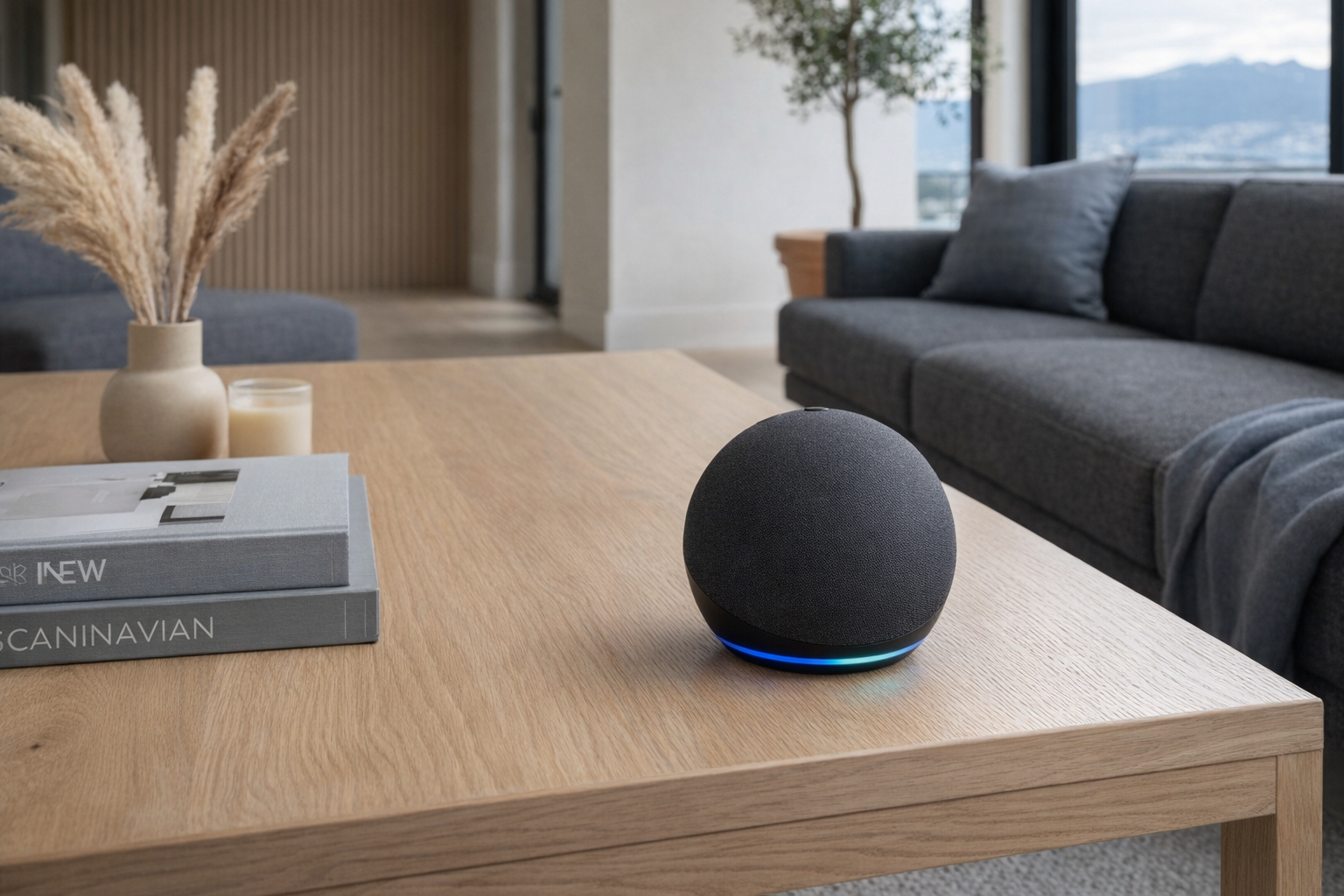
The Echo Dot is the more aggressively practical choice in this comparison. For about $47 CAD, Amazon gives you a compact speaker with Alexa, improved audio, multi-room music, Bluetooth, dual-band Wi‑Fi, and two features that are especially useful in a kitchen: a motion sensor and an indoor temperature sensor. That is a lot of function for not much money.
Its strongest case is not that it sounds amazing. It probably doesn't, at least not compared with the HomePod Mini. Its strongest case is that it is very easy to justify. If all you want is a speaker that can set timers, answer quick questions, run routines, and play Spotify while you cook, the Echo Dot is hard to argue against. It is the least romantic product here and, for many people, the most sensible.
The downside is equally clear: it is still an Alexa puck. If you're buying this hoping for premium room-filling sound or a beautifully integrated Apple-style experience, you're buying the wrong thing. The Dot is better evaluated as a kitchen tool with music abilities than as a mini hi-fi.
- Full explainer: Echo Dot on Celmin · Directory: product page
HomePod Mini — the better-sounding Apple kitchen speaker
The HomePod Mini is the more expensive and more appealing object here, at around $129 CAD. Apple builds it around 360-degree audio, the S5 chip, Siri, HomeKit, AirPlay 2, Intercom, and the U1 chip for seamless Handoff. Unlike the Echo Dot, which is trying to win on utility and affordability, the HomePod Mini is trying to make the kitchen feel a little nicer.
And honestly, that's a fair pitch. A kitchen is often where people spend more casual time than they expect: morning coffee, weeknight prep, cleanup, background music, podcast listening. A speaker that sounds better in that room is not a ridiculous indulgence. The HomePod Mini's problem is not quality. Its problem is audience. It is for a narrower set of homes than its design suggests.
If your household uses iPhones, AirPlay, and HomeKit already, this is likely the right pick. If your household is a mix of Spotify users, Alexa routines, Android phones, and random smart-home brands, the HomePod Mini can start to feel like a very elegant answer to someone else's question.
- Full explainer: HomePod Mini on Celmin · Directory: product page
If you're building a smarter home in Canada and want honest comparisons of gadgets worth considering — plus the ones worth skipping — Celmin covers the full catalog without the marketing theater. More comparisons, reviews, and buyer guides at https://celmin.ca.
Discussion
Sign up or sign in to join the conversation.