
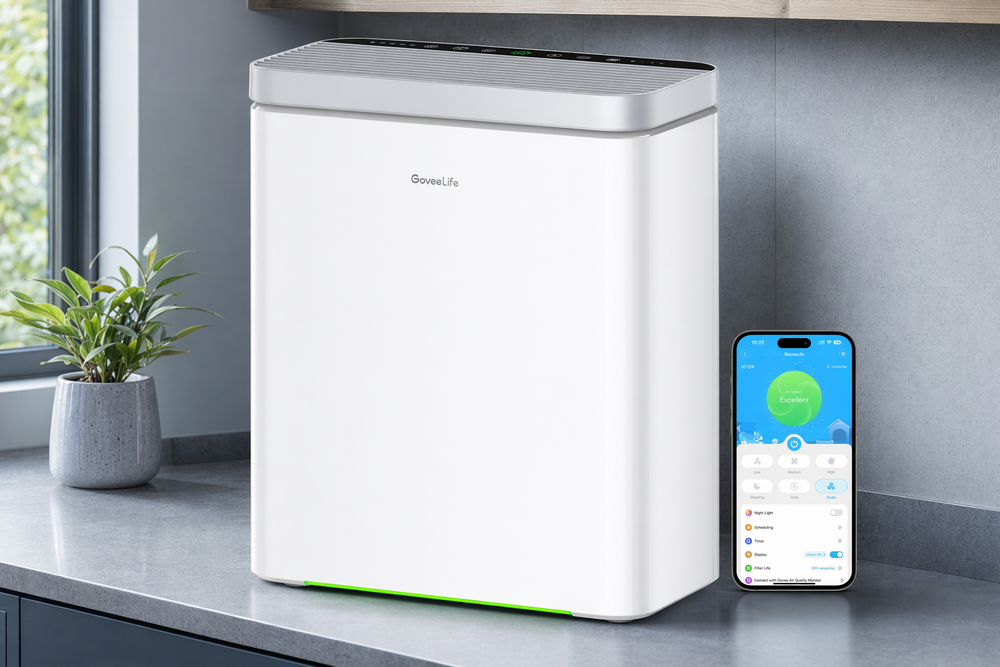
Two buyers walk into the same Amazon aisle with the same problem — winter dust, spring pollen, wildfire haze — and walk out with the wrong machine. The first lives in a downtown loft with open sightlines from kitchen to sofa and assumes an app-connected purifier will "watch the air" everywhere at...
Two buyers walk into the same Amazon aisle with the same problem — winter dust, spring pollen, wildfire haze — and walk out with the wrong machine. The first lives in a downtown loft with open sightlines from kitchen to sofa and assumes an app-connected purifier will "watch the air" everywhere at once. The second finishes a 1,200 ft² basement rec room and buys the biggest coverage number on the page, then wonders why the upstairs bedroom still smells like the litter box.
Neither person failed. The category failed them by selling philosophies disguised as square footage. Every portable purifier is a bet on how you want to interact with your air: close the loop with a sensor and software, or move a large volume through filters with simple controls and washable economics. The GoveeLife Smart Air Purifier and TEBILD Air Purifier sit at opposite ends of that bet. This essay is not a spec shootout. It is a map of two ways Canadian homes actually live with clean air — and how to know which map is yours.
If you want the CADR and PM2.5 primer before choosing a camp, start with our field guide: The Canadian Air Purifier Field Guide. If you already speak ACH and filter cartridges, stay here.
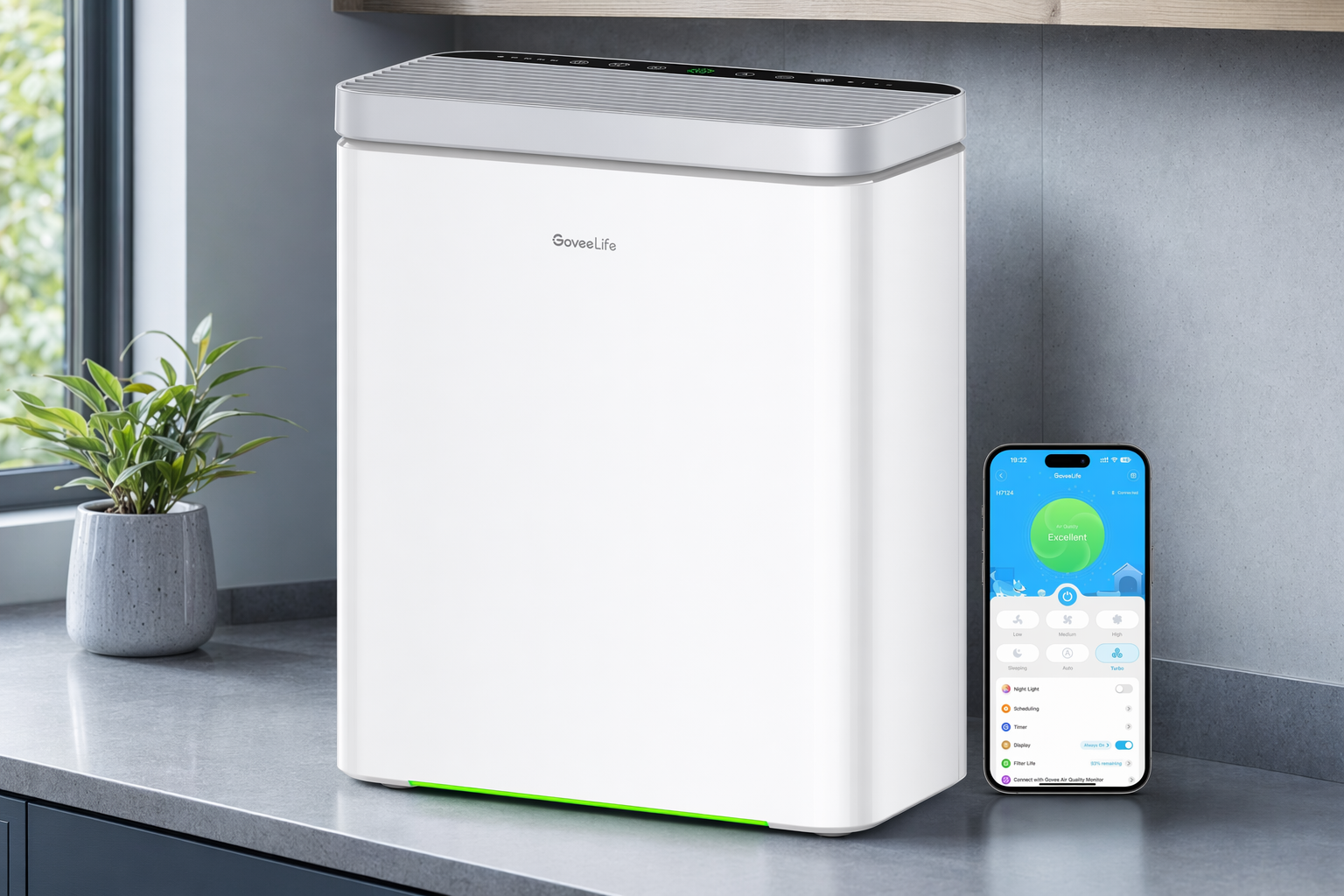
The split: watch the air vs move more air cheaply
Consumer purifiers share the same physics. Dirty air enters, HEPA and carbon trap particulates and some odours, cleaner air exits. The divergence is what you optimize after filtration.
Sensor-driven automation treats the purifier as a feedback device. PM2.5 rises — fan speed follows. Levels drop — the machine eases off. Historical graphs, schedules, and voice commands extend that loop into daily life. You are buying visibility and hands-off response in the room where the unit sits.
Coverage-and-economics treats the purifier as a zone workhorse. Dual intakes, high turbo airflow, washable pre-filters, and remotes replace app dashboards. You are buying volume and low-friction ownership in a large single space — basement, open main floor, big office — without adding another device to your Wi-Fi troubleshooting list.
Both approaches use PM2.5 sensors. Both claim impressive square footage. The difference is what happens when you stop reading the listing and start living with the machine.
Side by side: which problem are you solving?
| Question | GoveeLife camp | TEBILD camp |
|---|---|---|
| Core bet | Closed-loop automation + app | Big-zone airflow + simple controls |
| How you interact | Auto mode, phone graphs, Alexa | Touch panel, remote, colour ring |
| Best space | Bedroom, nursery, medium open living | Finished basement, large main floor |
| Claimed coverage | 1,046 ft² (~97 m²) | 2,500 ft² |
| Filter economics | ~$36–40 CAD per cartridge | ~$30 CAD per cartridge |
| Unit price (CAD) | ~$130–150 | ~$100–110 |
| Wi-Fi required? | For full features; buttons work after setup | No |
| Deep dive | GoveeLife buyer guide | TEBILD buyer guide |
The table is deliberately not a winner column. A basement family and a bedroom allergy sufferer need different philosophies even if both buy "an air purifier."
The GoveeLife camp: when automation pays off
The GoveeLife H7124 is for people who want the machine to pay attention so they do not have to. PM2.5 drives auto mode. The Govee app shows you the drop after vacuuming, the spike after searing steak, the slow overnight recovery in the nursery. Schedules dim the RGB ring for light-sensitive sleepers. Alexa integration fits renters and homeowners already running smart lights.
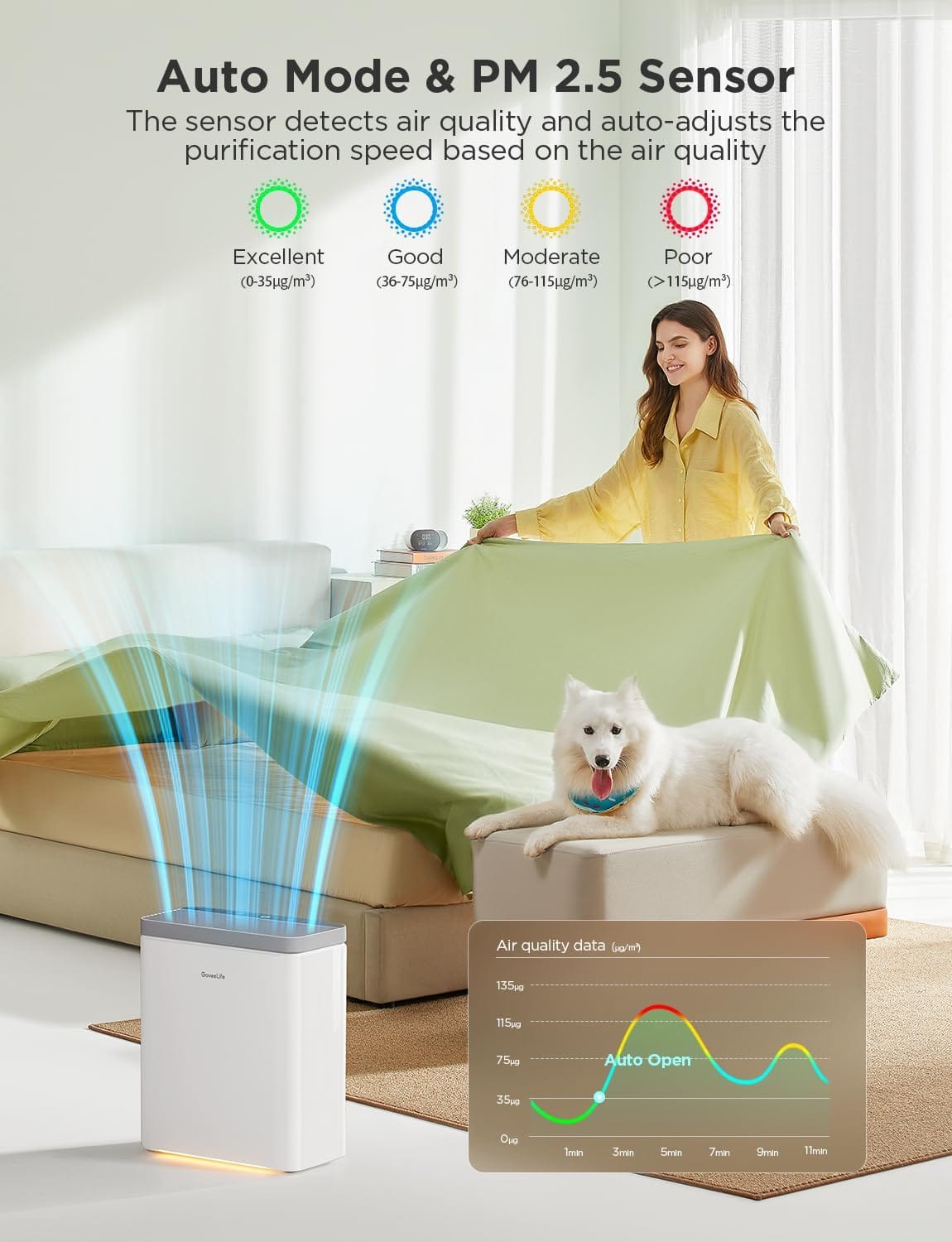
That loop shines in medium zones where you breathe for hours — master bedroom, home office, open kitchen-living up to roughly 400–600 ft² of real occupancy. With ~135 CFM CADR, the math works: enough air changes per hour to matter when the door is closed and ceilings are normal. The machine is not magic in a hallway; it is excellent beside the bed.
Automation pays off when you will actually leave auto mode on. Buyers who disable smart features and run manual low all day would be better served asking why they paid for a sensor. The GoveeLife rewards set-and-forget behaviour — check filter percentage monthly, rinse the pre-filter, replace the cartridge when the app says so.
Friction is equally predictable. Wi-Fi setup demands 2.4 GHz. Replacement filters cost more than TEBILD's. Turbo is loud — correct for smoke events, wrong for sleeping. Advanced Govee automations occasionally expect a separate monitor despite the built-in sensor — a ecosystem quirk, not a daily-use problem for most households.
Philosophy in one sentence: you trust software to modulate airflow based on what the room is doing right now.

The TEBILD camp: when coverage and washable economics win
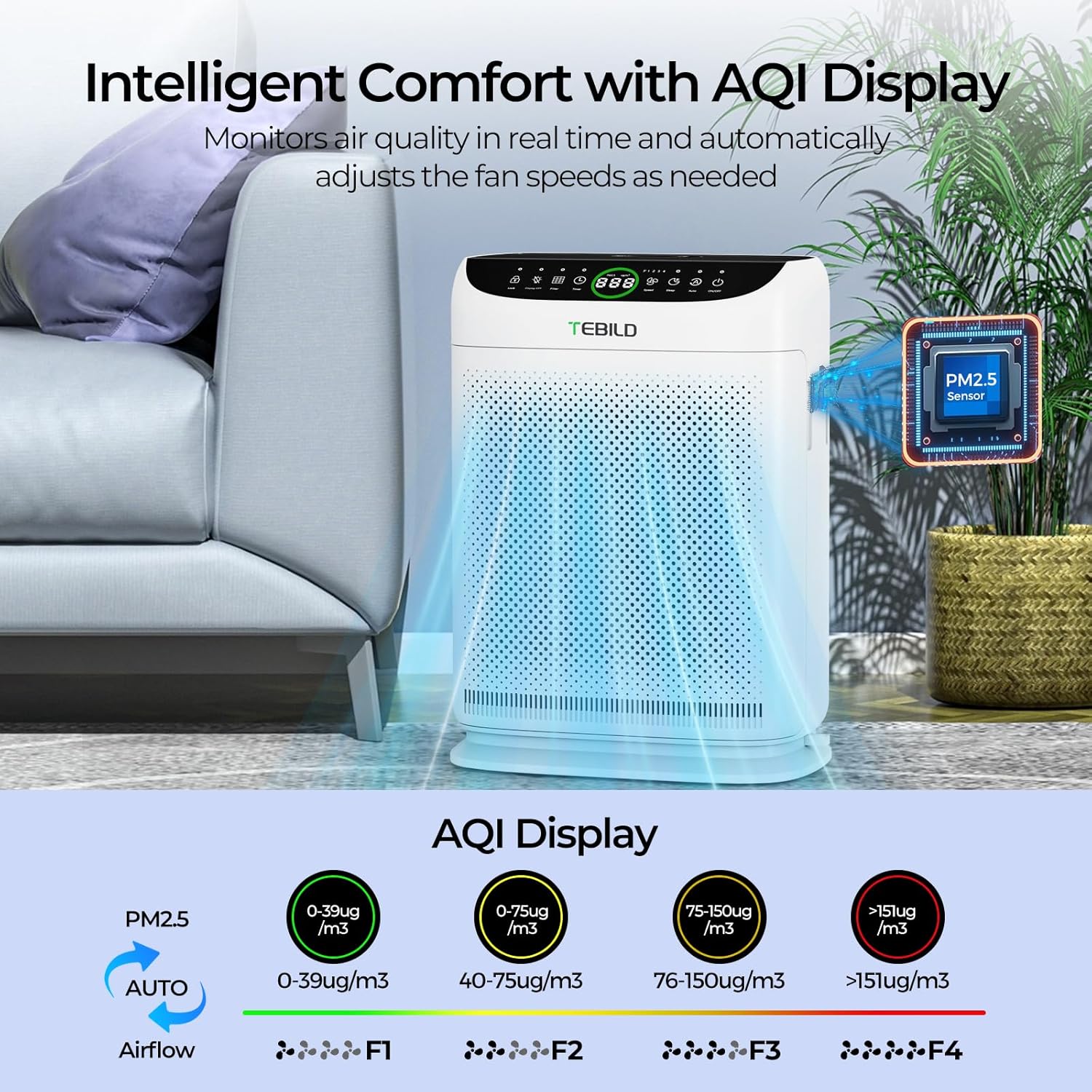
The TEBILD ZX001 is for people who want more air through the filter and fewer passwords. Dual-sided intake moves a visible volume on high. The PM2.5 ring turns abstract "clean air" into green-yellow-red feedback without opening an app. Remote control — hidden in the unit cavity on arrival — handles speed from the couch. No Wi-Fi pairing, no 2.4 GHz essay, no firmware surprise.
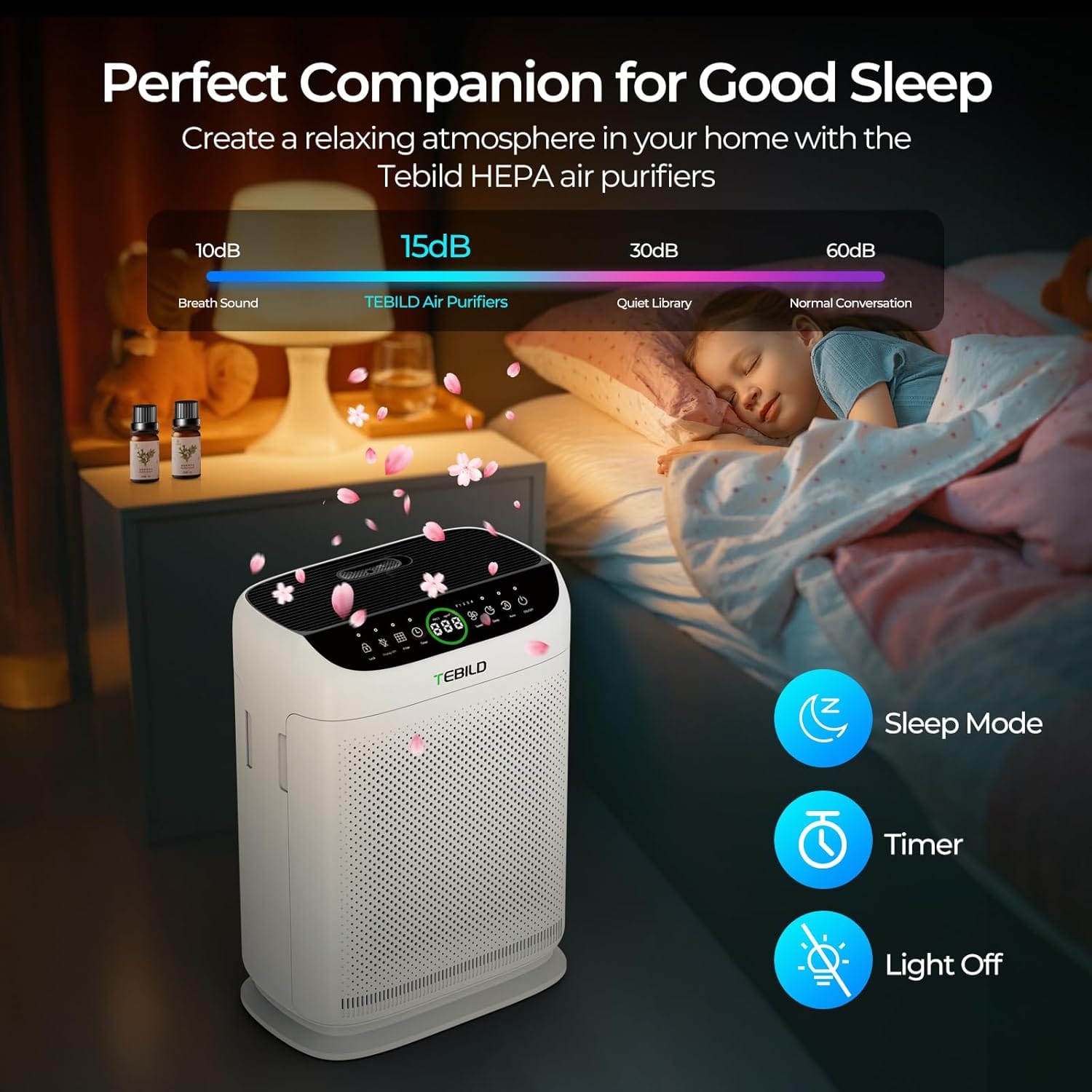
That philosophy wins in large single zones where people congregate for long stretches: finished basements, open main floors, playrooms, shared home offices. The 2,500 ft² headline is a ceiling derived from one-air-change-per-hour math at max speed — not a promise that every closed door upstairs synchronizes overnight. Buyers who treat TEBILD as a 600–1,000 ft² workhorse report the best alignment between expectation and outcome.
Washable pre-filters are the long-game play. Rinse every few weeks; the HEPA core breathes easier and lasts longer. Replacement cartridges around ~$30–35 CAD undercut many competitors — meaningful if you plan to run the unit through multiple Canadian winters and wildfire seasons.
Friction looks different here. Brand recognition is lower than Levoit or Coway. The display can be bright until you dim it for night. Auto mode ramps aggressively when cooking — correct sensor behaviour that surprises people expecting whisper mode during dinner prep. Aromatherapy tray opinions split the room; ignore it if you do not diffuse oils.
Philosophy in one sentence: you want maximum airflow and minimum ecosystem in the biggest room you actually use.
Four scenarios, two philosophies
Bedroom allergy season. Pollen and dust matter most where you sleep eight hours. Close the door, run auto, let PM2.5 drive fan speed overnight. The GoveeLife camp wins: sleep-mode quiet, app schedules for lights-off, enough CADR for a typical Canadian bedroom with headroom. TEBILD works too — but app-averse sleepers may prefer GoveeLife's finer schedule control; remote-only households may prefer TEBILD's simplicity. Size the room honestly; both are overkill in a 120 ft² nursery in a good way.
Open basement rec room. Concrete, furnace dust, kids, TV marathon, litter box in the adjacent utility corner — one large air mass that does not talk to upstairs. Move volume. TEBILD's dual intake and turbo behaviour target the zone you inhabit, not the hallway outside. Place centrally, wash pre-filters monthly, accept that bedrooms one floor up are a second problem.
Wildfire week. Windows stay shut. Particulate spikes; filters degrade faster. Both machines help in closed zones — neither replaces a respirator outdoors. GoveeLife gives you historical graphs that confirm when indoor PM2.5 finally drops; TEBILD gives you aggressive turbo without reaching for a phone. Budget extra filter replacements after heavy smoke either way.
Pet apartment, open kitchen-living. Odour and fur travel with air currents. A single GoveeLife in the living zone handles moderate open layouts with sensor feedback when you fry food or the dog shakes out. If the space truly exceeds ~800 ft² of continuous open area, TEBILD's airflow philosophy catches particulate faster near the unit — still not whole-apartment uniform without placement luck or a second unit.
What neither philosophy fixes
Clarity requires naming the gaps.
Whole-house duct integration — Portable purifiers do not replace HVAC filtration or balanced ventilation. They improve local zones.
Radon and mould — HEPA captures particulates; it does not remediate gas or structural moisture problems.
Multi-storey uniformity — Stairs and closed doors partition air masses. One philosophy cannot unify floors without multiple units.
Medical-grade requirements — Consumer purifiers are general wellness tools. Severe respiratory conditions need clinician guidance, not Amazon marketing.
Silent-maximum obsession — Turbo modes are loud on both machines because moving air fast is noisy. Smoke events need speed; sleep needs low — not the same setting.
Understanding the boundary prevents the most common regret: expecting either philosophy to behave like central air.
Verdict framework: choose your camp
Choose GoveeLife if:
- Your priority room is a bedroom, nursery, or medium open living space
- You want PM2.5 graphs, schedules, and optional Alexa on a ~$130–150 CAD budget
- You will leave auto mode on and replace ~$36–40 filters on schedule
- You already tolerate 2.4 GHz smart-home setup
Choose TEBILD if:
- Your priority zone is a large basement, main floor, or office — think 600–1,000 ft² of real use
- You prefer remote and buttons over apps and voice assistants
- Filter cost matters over five years (~$30–35 replacements)
- You need aggressive airflow without ecosystem lock-in
Consider both if you have distinct zones — GoveeLife upstairs, TEBILD in the basement — rather than one heroic purifier pretending to be whole-home HVAC.
Consider neither if you need duct integration, professional remediation, or refuse ongoing filter spend. A clogged HEPA is an expensive fan.
For CADR math, filter-type primer, and sizing worksheets, the field guide goes deeper than this essay needs to. For day-to-day ownership — quirks, filter part numbers, warranty notes — the individual GoveeLife and TEBILD buyer guides carry the rest.
Frequently asked questions
Is GoveeLife "better" because it has an app?
No — it is different. The app closes the feedback loop for people who want visibility and automation. If you will never open the app, TEBILD's philosophy may match your habits better despite fewer smart features.
Does TEBILD's 2,500 ft² claim beat GoveeLife's 1,046 ft²?
Larger marketing coverage does not automatically mean better performance in your room. Both numbers assume one air change per hour at maximum CADR in ideal conditions. Match the machine to the zone you occupy, then read CADR and filter economics — covered in the field guide.
Can I use one purifier for my whole house?
One unit improves its zone first. Multi-storey Canadian homes with closed bedroom doors need multiple units or sharply adjusted expectations. Neither philosophy defeats stairwells.
Which has cheaper long-term ownership?
TEBILD typically wins on replacement filter price ($30–35 vs ~$36–40). GoveeLife wins on initial unit cost ($130–150 vs ~$100–110). Run the five-year math for your expected filter change frequency — wildfire and pet households replace sooner.
The bottom line
The wrong purchase is not GoveeLife instead of TEBILD — it is buying coverage square footage when you needed sensor automation, or buying smart features when you needed basement airflow. Name the room where you breathe the longest. Decide whether you want software watching PM2.5 or a remote controlling turbo. Budget for filters either way.
Two philosophies, one physics. Pick the map that matches your floor plan — then read the field guide for the numbers that make the choice stick.
Discussion
Sign up or sign in to join the conversation.