
If you're buying a smart oven in Canada in 2026, three products keep surfacing for very different reasons: the Dreo ChefMaker Combi Fryer, the Typhur Dome 2 AI Smart Air Fryer, and the Tovala Smart Oven Pro. The problem is that they are not really direct rivals in the normal sense. On...
If you're buying a smart oven in Canada in 2026, three products keep surfacing for very different reasons: the Dreo ChefMaker Combi Fryer, the Typhur Dome 2 AI Smart Air Fryer, and the Tovala Smart Oven Pro. The problem is that they are not really direct rivals in the normal sense. One is a combi-style countertop cooking system trying to automate chef-ish techniques. One is basically an air fryer that got far smarter than air fryers usually need to be. One is a connected countertop oven whose biggest selling point is that it works with a meal ecosystem. They share a category label, but not the same job description.
This article isn't a hands-on review. It's an editorial comparison of what these three products are actually built to do, what their listed features imply in a real kitchen, where the smart features are genuinely useful versus pure theater, and which kind of household each one honestly fits. By the end, you should know whether to buy the Dreo, the Typhur, the Tovala — or skip all three and buy a normal air fryer or toaster oven instead.
At a glance
| Dreo ChefMaker | Typhur Dome 2 | Tovala Smart Oven Pro | |
|---|---|---|---|
| Price (CAD) | ~$499 | ~$471 | ~$813 |
| Rating signal | 4.3/5 on source listing | 4.6/5 on source listing | 3.9/5 on source listing |
| Made by | DREO | Typhur | Tovala |
| Core idea | Combi-style smart cooker with probe, water atomization, and convection | AI-heavy air fryer with dual heating and app-led automation | Connected countertop oven tied to scannable groceries and meal subscription |
| Cooking modes | 3 modes: Chef, Classic, Probe | 15-in-1 multifunctional cooking | 6-in-1: Air Fry, Steam, Bake, Broil, Reheat, Toast |
| Signature hardware | Precise cook probe + water atomization + super convection | Top and bottom heating, flat basket, 55dB operation | Steam capability and app-driven multi-stage cook cycles |
| Smart features | Guided recipes, remote monitoring, algorithm-driven cooking | AI recipe generation, notifications, Wi‑Fi app control | Scan-to-cook groceries, app presets, Tovala meal integration |
| Cleaning story | Dishwasher-safe design, glass basket | Self-cleaning regular and deep clean modes | Includes basket and sheet pan; cleaning is more like a small oven than a fryer |
| Best for | People who actually want automation for proteins, not just fries | Air-fryer-heavy households wanting speed and low noise | Busy households willing to buy into a meal ecosystem |
| Skip if | You mostly toast bagels or reheat frozen snacks | You want a true oven replacement rather than a premium air fryer | You don't want subscription gravity around your appliance |
Pro tip: Before you compare "smart" features, decide what format you actually want on your counter: basket cooker, air fryer, or mini oven. Most buyer regret here comes from choosing the wrong shape of appliance, not the wrong app.
What each one actually is
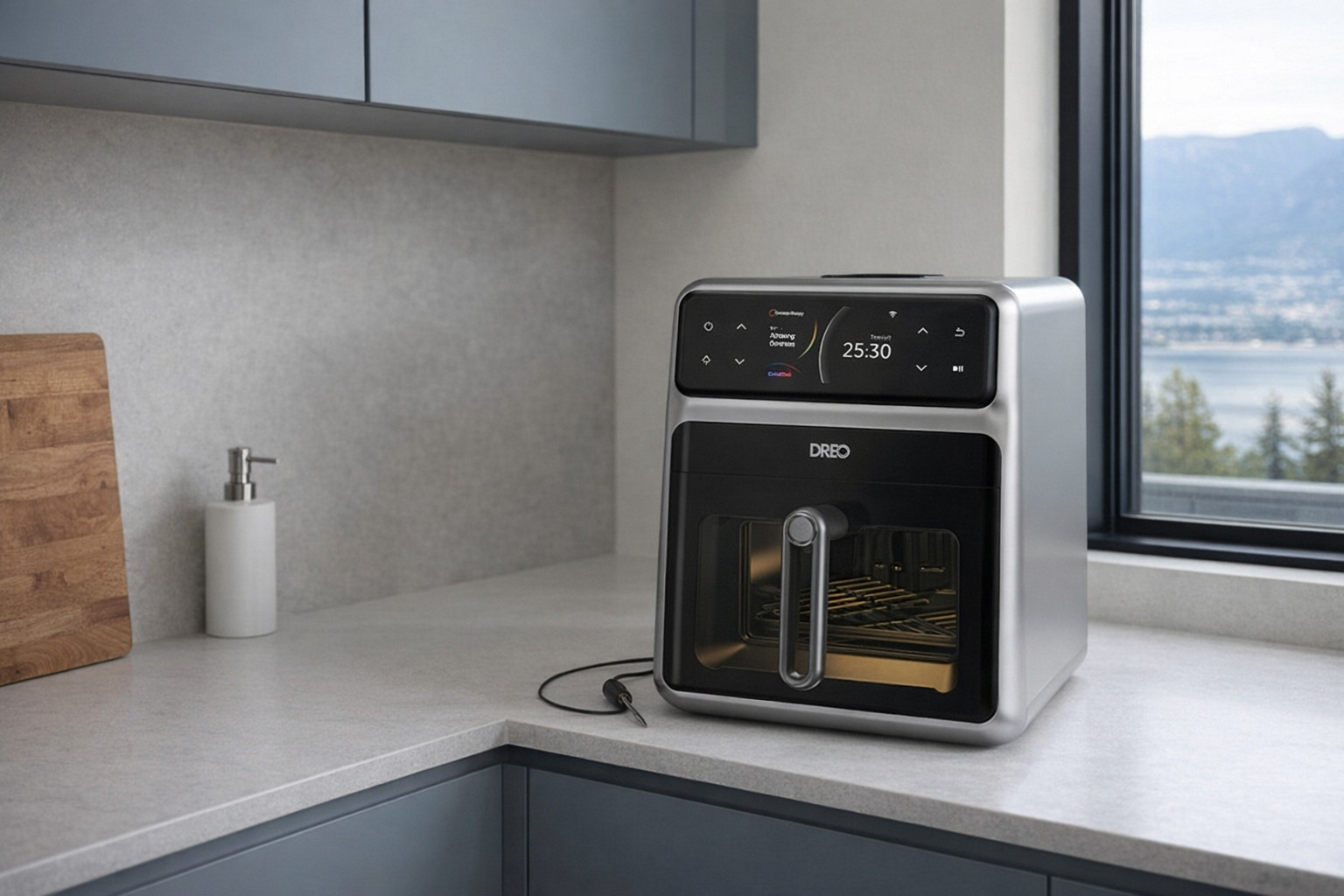
The Dreo ChefMaker Combi Fryer at about $499 CAD is the most ambitious cooking machine of the three. According to the listing, it uses CombiCook technology that combines a precise cook probe, water atomization, and super convection heating to automate cooking more like a guided countertop combi oven than a standard air fryer. It has Chef Mode, Classic Mode, and Probe Mode, plus a 4.3-inch display, app recipes, and remote monitoring. This is the one trying to make chicken breast, steak, and other easy-to-overcook foods less punishing.
The Typhur Dome 2 AI Smart Air Fryer at about $471 CAD is not pretending to be a steam oven or a meal platform. It is, more honestly, a premium smart air fryer with top and bottom heating, 15-in-1 cooking, app control, 55dB whisper-quiet operation, and a large flat cooking area that reportedly fits a 12-inch pizza or steaks. The AI angle is front-and-centre, including recipe generation from a photo, but the more important part is the hardware layout: this looks like an air fryer designed to cook food more evenly and faster than the cheap basket models flooding the market.
The Tovala Smart Oven Pro at about $813 CAD is the outlier. It is a 6-in-1 smart oven with Air Fry, Steam, Bake, Broil, Reheat, and Toast, but its real identity is the software and meal ecosystem around it: the app supports 1,000+ scannable groceries, it works with a Tovala meal subscription, and each oven includes a $50 credit for those meals. This is less about gadgety cooking experimentation and more about removing weekday friction.
The fundamental difference: Dreo is trying to cook better, Typhur is trying to air-fry smarter, and Tovala is trying to make dinner decisions disappear.
What each one actually is, product by product
Dreo ChefMaker — the smartest actual cooking tool here
The Dreo ChefMaker Combi Fryer is the anchor product here because it is the one most likely to be misunderstood. The name makes it sound like another upscale air fryer. The feature list says otherwise. A cook probe, water atomization, and super convection heating is a much more serious cooking proposition than the usual "12 presets and an app" formula. If the listed system behaves the way Dreo says it should, the point is not merely faster frozen food — it's better control over doneness and moisture.
That makes the Dreo the most interesting product of the three for people who actually cook proteins regularly. Probe-based cooking is not glamorous marketing, but it is a more honest route to better results than slapping "AI" on a fryer lid. The Chef Mode, Classic Mode, and Probe Mode split is also sensible. It gives beginners presets, but still leaves room for direct control. That's a more mature design than many smart kitchen products, which often assume every user wants to be locked into an app workflow forever.
The caveat is obvious: this is still a $499 countertop appliance. If your cooking pattern is "hash browns, nuggets, and the occasional reheated slice," this is overkill. The Dreo makes the strongest case when your frustration is unevenly cooked meat or dried-out food, not when your frustration is waiting 18 minutes for fries.
The 4.3-inch display and guided app recipes suggest Dreo knows this appliance has to teach people why it exists. That is good. A product this feature-dense needs onboard clarity. The dishwasher-safe design and see-through glass basket also matter more than they sound. A premium countertop cooker that is annoying to clean stops being premium around week three.
- Full explainer: Dreo ChefMaker Combi Fryer on Celmin · Directory: product page
Typhur Dome 2 — the premium air fryer for people who know they want an air fryer
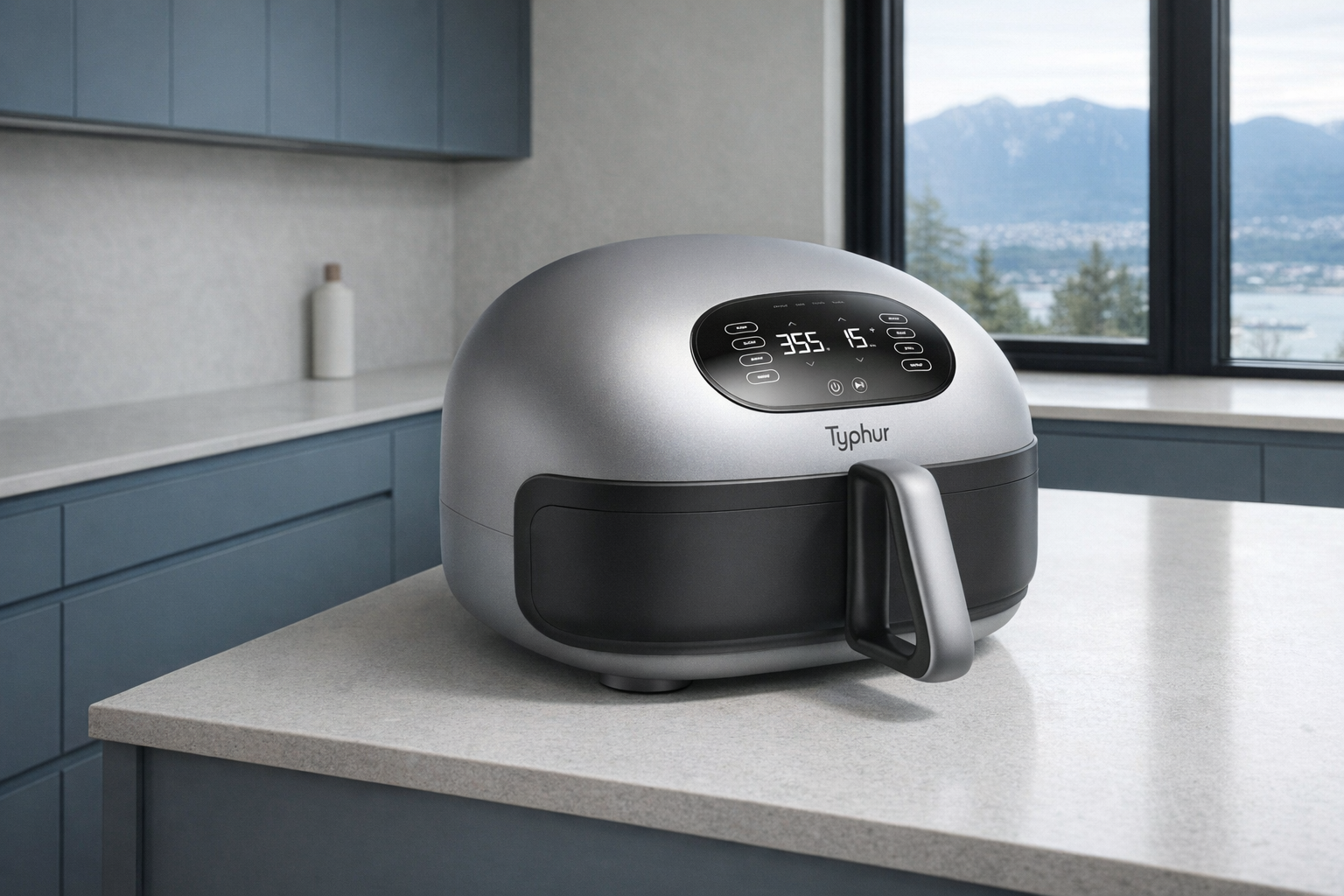
The Typhur Dome 2 AI Smart Air Fryer is the easiest one to position clearly: it is a very expensive air fryer that appears to be trying to justify that price with smarter software, stronger heating design, and a more useful cooking geometry. The headline features are dual top and bottom heating, a claimed 30% faster cooking speed than traditional air fryers, 55dB noise, self-cleaning modes, and a basket that reportedly fits a 12-inch pizza. Those are not trivial upgrades if you use an air fryer daily.
The strongest case for the Typhur is not the AI recipe generation. Frankly, that's the least persuasive part. Snapping a photo of ingredients and getting recipe suggestions is cute, but not what makes a kitchen appliance worth ~$471 CAD. The better argument is the hardware: top-and-bottom heating should matter for browning; a flatter, wider cooking area is often more useful than a deep bucket; and lower noise matters in open kitchens more than spec sheets usually admit.
This is also the most single-purpose product of the three, despite the 15-in-1 branding. Yes, it has multiple modes. No, that does not make it the same thing as a steam-capable mini oven or a probe-driven combi cooker. It is still best evaluated as an air fryer first. That's not a criticism. In fact, it's a strength. A lot of kitchen appliances get worse by trying to be everything. Typhur's narrower identity makes it easier to recommend — but to a narrower group.
That narrower group is the household that already knows an air fryer is its most-used appliance and wants a nicer one. If that's you, the Typhur is more coherent than it first appears. If it isn't, this can turn into a premium-priced curiosity.
- Full explainer: Typhur Dome 2 AI Smart Air Fryer on Celmin · Directory: product page
Tovala Smart Oven Pro — the meal-system oven, not the enthusiast's oven
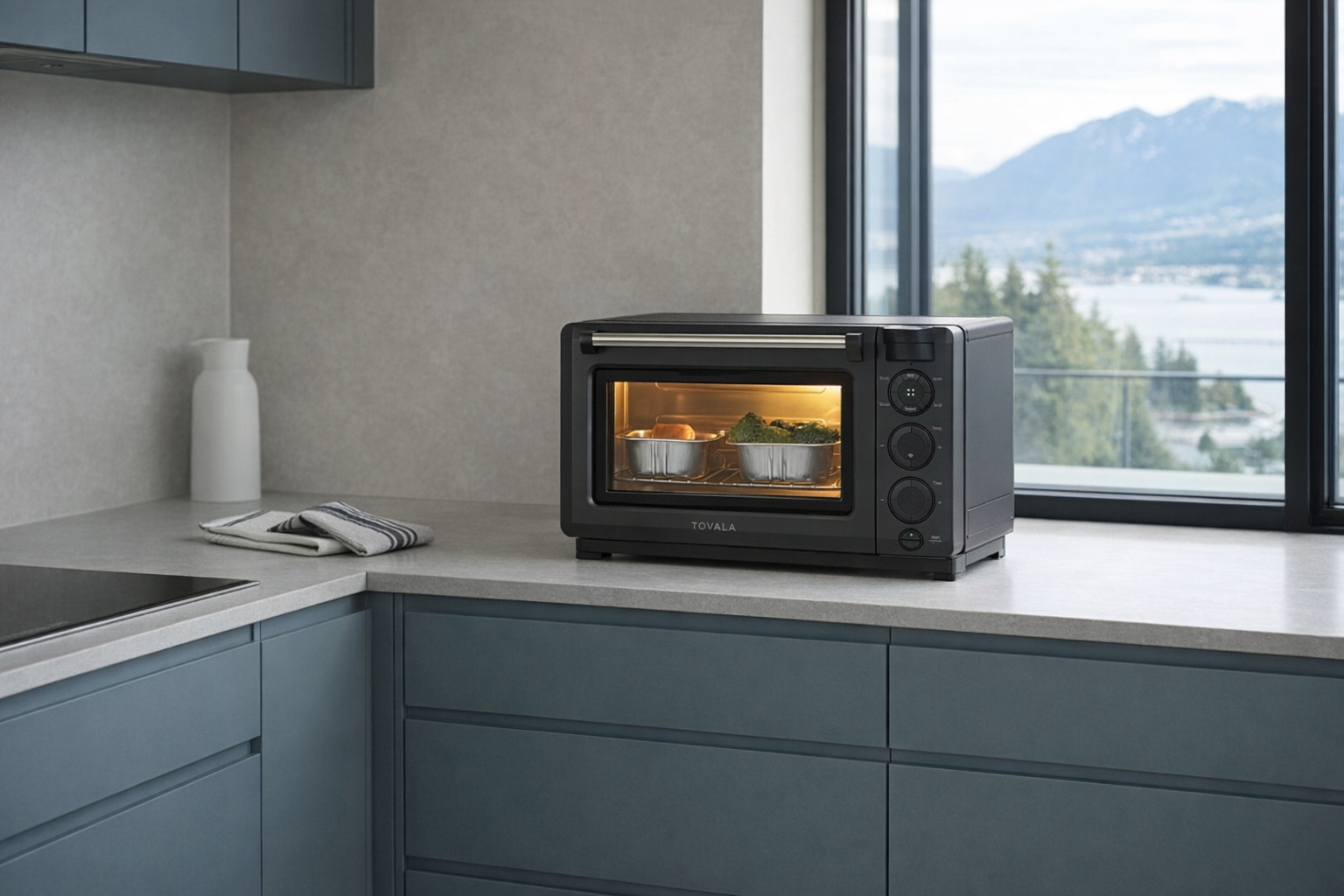
The Tovala Smart Oven Pro is the most polarizing option here because it asks you to think differently about what you're buying. On paper, it is a 6-in-1 countertop oven with Air Fry, Steam, Bake, Broil, Reheat, and Toast. In practice, the listing makes it clear that the ecosystem is a major part of the product: 1,000+ scannable groceries, a Tovala meal subscription, and a $50 meal credit in the box.
That can either be a convenience dream or a hard pass. There isn't much middle ground. For a busy household that hates meal planning more than it hates paying for convenience, Tovala's approach is completely rational. The barcode-scanning grocery support is also smarter than it sounds. If a product can recognize packaged groceries and run a suitable preset automatically, that's a genuinely useful form of "smart," especially compared with gimmicky app dashboards nobody opens after month one.
The problem is price and lock-in gravity. At ~$813 CAD, Tovala is easily the most expensive machine here and also the one whose value proposition depends most on whether you want to live inside its ecosystem. That's a risky combination. Even if the oven hardware is good, the business model sits in the middle of the ownership experience. Some people love that. Others will resent it by week two.
Tovala is also the least attractive choice for people who enjoy cooking as a hobby. Its appeal is not depth of manual experimentation. Its appeal is reducing decisions. That's an important distinction, and the marketing around "smart ovens" often blurs it.
- Full explainer: Tovala Smart Oven Pro on Celmin · Directory: product page
The seven battlegrounds
1. Product concept — the one that decides the whole category question
This matchup only makes sense once you admit these are three separate product concepts.
The Dreo ChefMaker is for people who want a machine to improve actual cooking outcomes, especially on proteins and other foods where timing and moisture matter. The Typhur Dome 2 is for people who want a premium air fryer with better heating layout and more convenience. The Tovala Smart Oven Pro is for people who want a smart meal system as much as they want an oven.
That means there is no universal winner here. The winner depends on whether your problem is food quality, air-fryer throughput, or meal friction. If you don't define that first, the comparison becomes nonsense. Retail listings won't help you here because they all call themselves "smart ovens" or some cousin of that phrase. That's marketing taxonomy, not kitchen reality.
If forced to name the most broadly sensible concept, it is the Dreo. It is the least dependent on a brand ecosystem and the most grounded in actual cooking mechanics rather than recurring-service logic.
2. Smart features — useful automation versus smart-home theater
This is where the category gets messy fast. A lot of kitchen tech uses "smart" as a synonym for "there's an app." That is not enough.
The Dreo has the strongest claim to useful intelligence because its smart features are tied to physical cooking systems: probe-based temperature control, water atomization, and guided cooking logic. That's smart in a meaningful way. It changes how heat is managed. It is trying to reduce overcooking, not just send a phone notification.
The Typhur sits in the middle. Wi‑Fi notifications are fine. Shake reminders and cook detection are plausible conveniences. The AI recipe generation is the sort of thing that sounds better in a keynote than in a Tuesday dinner rush. It may be fun; it is not why anybody should spend nearly $500.
The Tovala also does something genuinely useful, but in a different direction: barcode scanning for 1,000+ groceries and app-driven cook cycles. That is less about culinary intelligence and more about workflow intelligence. For the right user, it might be the smartest feature set in the group. For the wrong user, it's just dependence wearing a convenience badge.
Winner: Dreo, with Tovala a close second if you specifically want automation around packaged food and meal planning.
3. Cooking flexibility — who can actually replace more appliances
On raw mode count, the Typhur has 15-in-1, the Tovala has 6-in-1, and the Dreo has 3 modes. But mode count is a terrible way to judge flexibility. Every countertop appliance brand inflates that number. "Reheat" and "toast" are not a philosophical breakthrough.
The more relevant question is what kind of flexibility each machine enables.
The Dreo offers Chef Mode, Classic Mode, and Probe Mode, but those three modes cover a lot of serious cooking territory because they are tied to a probe and moisture control. That is a better kind of flexibility than a 15-badge list of presets. The Tovala adds steam, which matters. Steam is one of the few countertop-oven features that can genuinely expand what an appliance does well. That gives Tovala a broader oven-style role in the kitchen than Typhur.
The Typhur likely wins for air-fryer versatility and everyday convenience cooking, but it still looks like an air fryer first. If you want something that can plausibly feel like a mini cooking system rather than a snack machine, Dreo and Tovala are more convincing.
Winner: Dreo for flexible cooking logic, Tovala for flexible oven functions, Typhur only if your universe revolves around air frying.
4. Ease of ownership — setup, cleaning, and daily friction
People obsess over features and forget the obvious question: which one will become annoying?
The Typhur Dome 2 makes a strong case here. Self-cleaning with regular and deep-clean modes, 55dB noise, and a PFAS-free ceramic basket all suggest it is designed around everyday use, not just demo-day impressiveness. A quiet appliance is a quality-of-life feature, not a luxury extra. In small condos and open-plan kitchens, it matters more than another preset ever will.
The Dreo also looks well-considered. A dishwasher-safe design and see-through glass basket are practical, grounded choices. The catch is that a more complex cooking system can also mean more expectation from the user. Probe cooking is excellent, but it asks for a little more engagement than dumping fries in a basket and pressing start.
The Tovala is probably the most binary. If you use the scanning and meal ecosystem as intended, it may feel incredibly easy. If you don't, it's still an $813 mini oven you have to justify. That makes its ownership story less universally smooth than the others.
Winner: Typhur, because it appears to ask the least from the user while still offering premium convenience.
5. Value for money — where the category starts getting uncomfortable
None of these is cheap. That's worth saying plainly.
At ~$471, the Typhur is expensive for an air fryer, no matter how smart it is. At ~$499, the Dreo is expensive for something many shoppers will still mentally place in the air-fryer aisle. At ~$813, the Tovala is expensive for almost any countertop oven unless its ecosystem genuinely changes your weeknight routine.
The best value depends on whether the appliance's main trick addresses a real pain point.
If your pain point is overcooked meat and inconsistent results, the Dreo makes the most coherent value argument. You're paying for a more advanced cooking system, not just a shinier shell. If your pain point is that you air fry constantly and hate loud, uneven, deep-basket designs, the Typhur may be worth its price to the right buyer. If your pain point is planning and cooking dinner at all, the Tovala can make sense — but only if you embrace the model fully. Half-buying into Tovala is the fastest way to overpay.
Winner: Dreo for the broadest value case. Tovala is the easiest to overbuy.
6. Ecosystem dependence — how much of your kitchen belongs to the brand
This category matters more for ovens than people expect. A fridge can be dumb and still be useful. A "smart" oven that leans heavily on a proprietary app or meal service is a different kind of commitment.
The Dreo appears the least ecosystem-dependent. Yes, it has an app with video-guided recipes and remote monitoring, but the appliance's core value still comes from its onboard cooking system and 4.3-inch display. That is healthy product design. You should not need a cloud relationship to roast a chicken properly.
The Typhur is also relatively safe here. App control and notifications are useful add-ons, but the product's core proposition remains "premium air fryer with better heating." That's manageable even if the app ends up becoming secondary over time.
The Tovala is, by design, the most tied to its ecosystem. That is not necessarily bad. It is just the truth. The scannable grocery library, meal subscription, and custom cycles are not side perks — they are the centre of the pitch. If you dislike recurring-service gravity, this is the wrong product.
Winner: Dreo, then Typhur. Tovala is intentionally a walled-garden-adjacent experience.
7. Long-term fit — which one still makes sense after the novelty wears off
A lot of smart kitchen products are exciting in month one and strangely irrelevant by month six. The long-term question is not "which has more features?" It's "which still makes sense when the app honeymoon ends?"
The Dreo has the best odds here because probe-based cooking and moisture-aware heating are useful even after the novelty fades. Good cooking outcomes age well. That's a more durable benefit than recipe-generation gimmicks.
The Typhur also has a good long-term argument if you are already an air-fryer household. Faster cooking, quieter operation, and a better basket shape are not glamorous, but they are durable benefits. This is probably the least likely to disappoint someone who knows exactly what they want.
The Tovala has the most upside and the most risk. If the meal ecosystem becomes part of your routine, it may become indispensable. If you drift away from it, the value proposition collapses faster than the other two.
Winner: Dreo for most households, Typhur for dedicated air-fryer users.
The three questions that actually decide this
- Do you want a machine that improves how food is cooked, especially meat and other easy-to-overcook dishes? Yes → Dreo ChefMaker Combi Fryer.
- Do you mainly want the nicest possible air fryer, not a meal platform and not an oven experiment? Yes → Typhur Dome 2 AI Smart Air Fryer.
- Do you want dinner convenience and scan-to-cook simplicity enough to accept ecosystem dependence and a much higher price? Yes → Tovala Smart Oven Pro.
The verdict, by household
| If this sounds like you... | ...buy this |
|---|---|
| You cook chicken, steak, salmon, and want better doneness with less guesswork | Dreo ChefMaker Combi Fryer |
| You already use an air fryer constantly and want a quieter, flatter, smarter premium model | Typhur Dome 2 AI Smart Air Fryer |
| You are busy, tired of meal planning, and open to a branded meal ecosystem | Tovala Smart Oven Pro |
| You mostly want toast, frozen snacks, and basic reheating | Honestly, skip all three and buy a cheaper conventional air fryer or toaster oven |
| You hate relying on apps for kitchen appliances | Dreo, or skip the category entirely |
| You want the broadest feature set without buying into a subscription-centric system | Dreo ChefMaker Combi Fryer |
| You care most about noise and cleanup in a small kitchen | Typhur Dome 2 |
| You enjoy cooking manually and don't need automation | Skip these and buy a strong conventional countertop oven |
Got Questions About Dreo ChefMaker vs Typhur Dome 2 vs Tovala Smart Oven Pro?
Is this a hands-on review?
No. This is an editorial comparison based on the current listings, stated features, pricing, and what those features realistically imply in a home kitchen. It is meant to help you decide which product concept fits you, not to simulate side-by-side lab testing.
Is the Dreo ChefMaker basically just another air fryer?
Not really. That's the easiest buying mistake here. The Dreo ChefMaker Combi Fryer does include convection-style cooking, but its listed identity is built around CombiCook, a cook probe, and water atomization. That's a more serious cooking setup than the average air fryer. If you compare it only as a fryer, you miss why it costs ~$499.
Is the Typhur Dome 2 a real oven competitor?
Not in the same way the marketing language may imply. The Typhur Dome 2 AI Smart Air Fryer has 15-in-1 functions, dual heating, and app smarts, but it still makes the most sense as a premium air fryer. That's not a downgrade. It's just a more honest way to understand it. Buy it because you want a better air fryer, not because you think it replaces every countertop oven role.
Is the Tovala Smart Oven Pro worth it without the meal subscription?
Maybe, but this is exactly the question that should make you pause. The Tovala Smart Oven Pro has real hardware value with Air Fry, Steam, Bake, Broil, Reheat, and Toast, plus app-driven cook cycles and 1,000+ scannable groceries. But the meal ecosystem is so central to the pitch that anyone already suspicious of subscription gravity should think hard before spending ~$813 CAD.
Which one makes the most sense for a smaller condo kitchen?
Usually the answer is the one aligned with your actual habits, not the one with the most features. If you mostly air fry, the Typhur looks strongest because of its low 55dB noise and everyday ease. If you actually cook proper meals and want automation that affects food quality, the Dreo is the better use of counter space. The Tovala only makes sense in a small kitchen if you truly value its meal workflow enough to let it dominate that space.
Are these easy to buy in Canada?
Availability shifts, and one of these products links to a U.S. retailer page in the supplied dossier, so check the live retailer listings before assuming local stock or shipping terms. Current sources: Dreo ChefMaker Combi Fryer · Typhur Dome 2 AI Smart Air Fryer · Tovala Smart Oven Pro. Also verify current pricing, warranty details, and import/shipping implications before buying.
What does this kind of appliance really cost to own?
Electricity differences between these three are not the headline issue based on the provided data. The bigger ownership costs are the upfront appliance price — ~$471, ~$499, or ~$813 — and whether a product pulls you into ongoing behavior. The Tovala is the clearest example because the meal subscription sits right in the value proposition. With the others, the main cost is simply whether the appliance earns its counter space.
Which would Celmin pick?
For the average household spending real money on a "smart oven," Dreo ChefMaker Combi Fryer is the most convincing buy. It has the most sensible balance of ambition, hardware-backed smart features, and independence from a service ecosystem. The Typhur Dome 2 is a good pick for a narrower buyer who knows they want a premium air fryer specifically. The Tovala Smart Oven Pro is for an even narrower buyer who actively wants the meal-platform experience. That's a legitimate audience, but it's not most people.
If you're building a smarter home in Canada and want honest comparisons of gadgets worth considering — plus the ones worth skipping — Celmin covers the full catalog without the marketing theater. More comparisons, reviews, and buyer guides at https://celmin.ca.
Discussion
Sign up or sign in to join the conversation.