
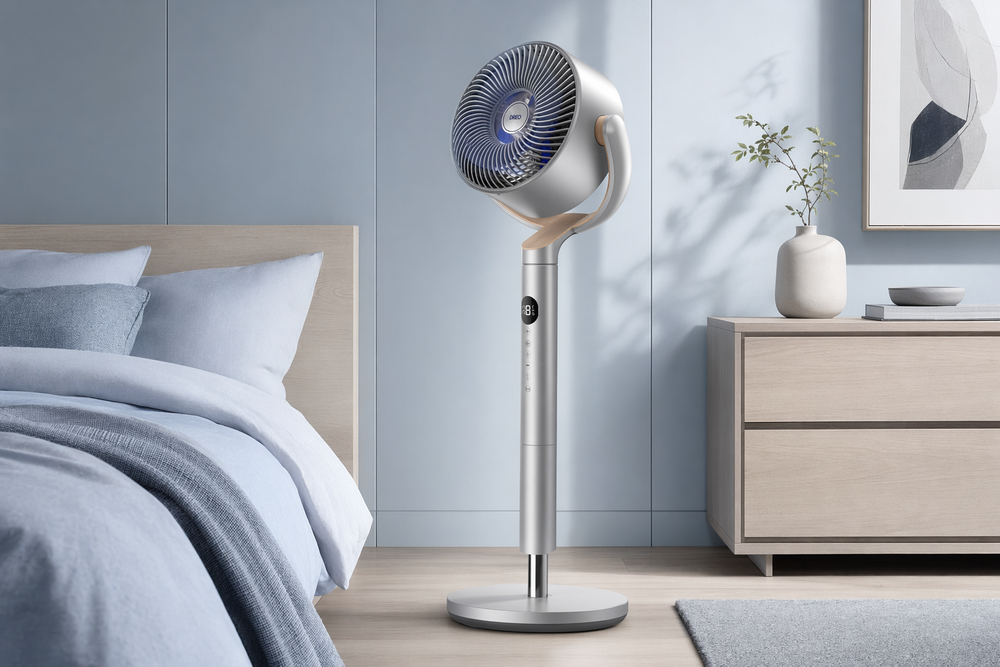
Two carts leave the same Amazon session with the same intention — fix the bedroom — and arrive at opposite conclusions. The first buyer wakes up in February with a bloody nose and static-shocked hair; they add a pedestal fan because the room "feels wrong." The second buyer sweats through August w...
Two carts leave the same Amazon session with the same intention — fix the bedroom — and arrive at opposite conclusions. The first buyer wakes up in February with a bloody nose and static-shocked hair; they add a pedestal fan because the room "feels wrong." The second buyer sweats through August with the windows cracked; they order a humidifier because moisture sounds like relief. Both machines arrive. Neither solves the problem. The fan blows dry winter air faster across chapped skin. The humidifier steams an already-warm summer room into a tropical greenhouse.
Neither person failed. The category failed them by selling comfort without naming which physical variable each product controls. Every bedroom appliance is a bet on how you want to interact with your environment: accelerate evaporation on your skin and stir stagnant air, or raise relative humidity and protect tissue and wood. The DREO Smart Omni Oscillating Fan and DREO Smart Humidifier 4L Top Fill sit on opposite sides of that bet. This essay is not a spec shootout. It is a map of two philosophies Canadian bedrooms actually need — and a decision tree for knowing which map is yours.
If you want the RH targets, sizing notes, and maintenance cadence before choosing a camp, start with our field guide: Bedroom Climate in Canada: Fans, Humidity, and When You Need Which. If you already know that fans cool people and humidifiers add water, stay here.
The split: circulation vs relative humidity
Bedroom comfort stacks three variables — temperature, humidity, airflow — that marketing copy happily blurs.
Evaporative cooling and circulation treat the room as a volume of air that must move across your skin. A fan does not subtract heat from that volume in any meaningful way. It increases the rate at which moisture on your body evaporates, which your nervous system interprets as coolness. It also mixes hot and cold layers, reduces stuffiness, and — for many sleepers — provides the white noise that masks urban Canada. The philosophy is body-first: make the human thermally comfortable without changing the room's energy balance.
RH management treats the room as a moisture reservoir that winter heating and summer AC deplete. Relative humidity — the percentage of water vapour present relative to what the air could hold — drops into the twenties when Calgary outdoor air gets heated indoors. Mucous membranes crack. Wood shrinks. Static accumulates. A humidifier adds water until the reservoir returns to the 40–50% band where human tissue and furniture are happiest. The philosophy is air-first: change what you breathe, not how fast it moves.
Both philosophies can coexist in one home. They should not be confused in one diagnosis.
The wrong purchase is not fan instead of humidifier — it is buying airflow when you needed moisture, or buying mist when you needed evaporation.
Physics primer: why fans work on skin and dry air is a winter problem
Why fans feel cool. Your body constantly loses heat through convection, radiation, and evaporation. When ambient air is still, a boundary layer of warm, moist air clings to skin. Moving air strips that layer and accelerates evaporation. The effect is powerful enough that 22°C with a breeze feels pleasant while 22°C in still air feels stale — same thermometer, different perceived comfort. That is why ceiling fans have a summer/winter direction switch: summer pushes air down for cooling; winter circulates without the same evaporative penalty.
Why dry air hurts in Canada. Cold outdoor air carries little absolute moisture. Heat it without adding water, and relative humidity plummets. A home at 21°C and 25% RH feels fine to a thermostat and brutal to a sinus. Summer adds a twist: air conditioning coils condense moisture out of indoor air while cooling it, so a closed bedroom can be dry even when Ottawa is humid outside.
Fans and humidifiers address different points on that diagram. A fan helps when evaporative cooling is the lever — warm skin, stagnant air, need for sound. A humidifier helps when RH is below target — nosebleeds, static, cracking instruments, desert-throat mornings.
Neither replaces the other. A fan in a 22% RH room may worsen dryness by increasing evaporation from skin. A humidifier in a 28°C room may push RH past comfort without lowering temperature.
Fan philosophy: white noise, sleep, and the stuffy condo
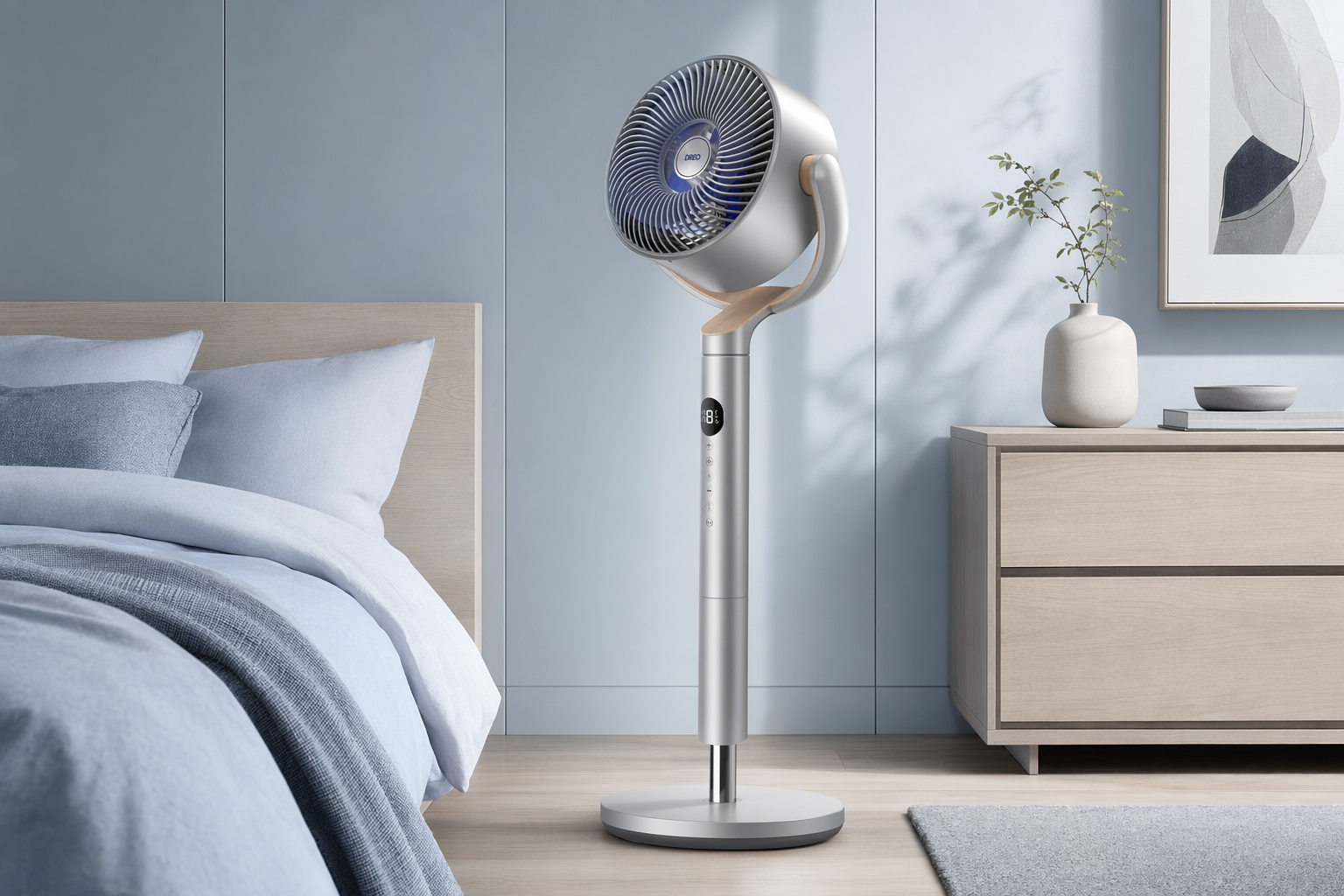
The DREO Omni fan embodies the circulation camp. Its bet is that Canadian bedrooms overheat in predictable ways — upper floors, west windows, heat islands in July — and that whole-room sweep matters more than a single cold stripe across the floor.
Dual-axis oscillation — 120° horizontal plus 120° vertical — distributes airflow through the sleeping volume instead of along one plane. A DC motor keeps low speeds near 20 dB, which is why bedroom and nursery buyers cluster in speeds 2–5 overnight. Top speeds are louder because moving air fast is noisy physics, not a defect.
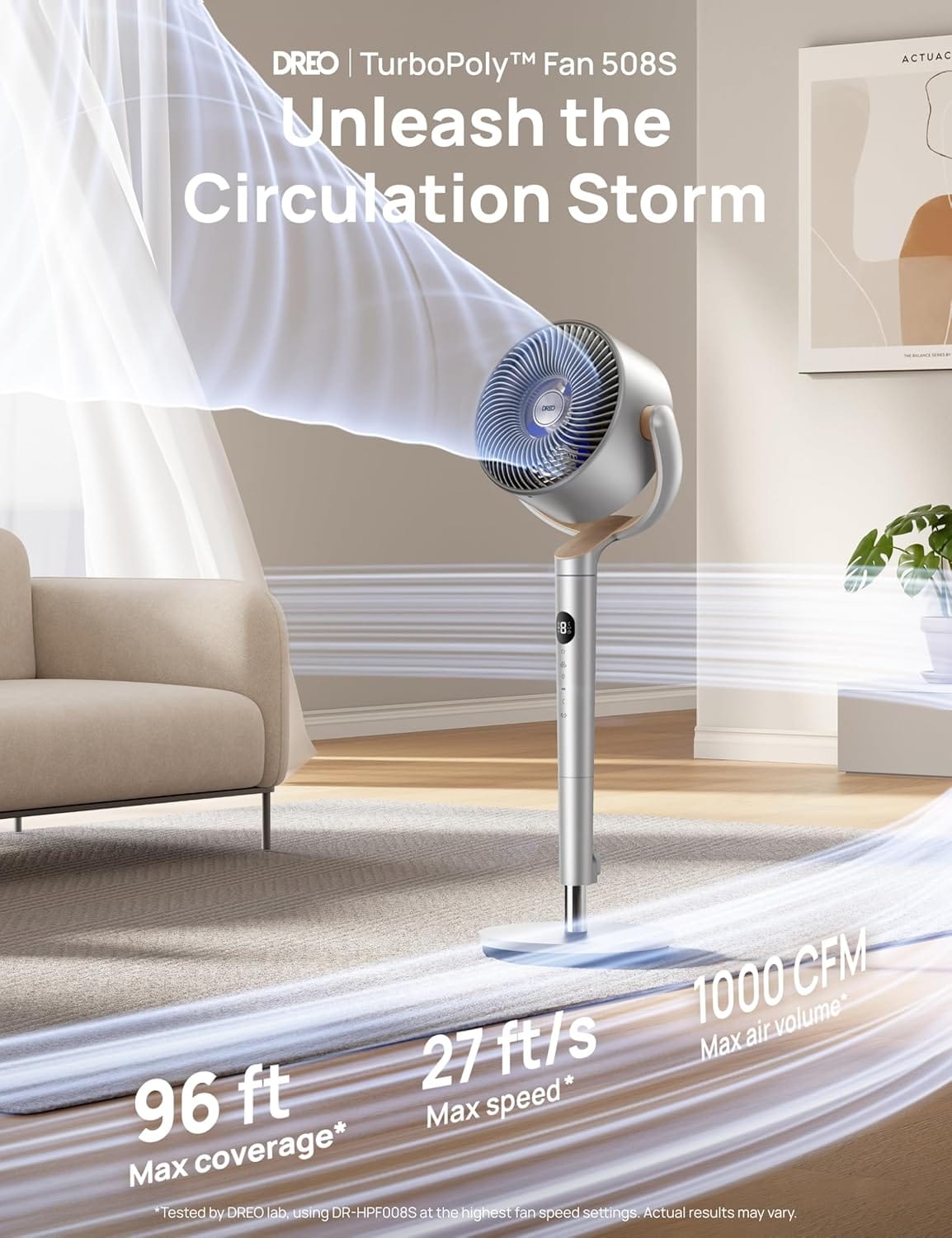
The smart layer serves sleep rituals: ramp down after midnight, voice-off from bed, 8-hour timer caps. RGB at the base is polarizing — disable it on night one if you sleep in darkness. Wi-Fi wants 2.4 GHz like every Canadian smart gadget; local remote still works when the router reboots.
Philosophy in one sentence: you want air to find you quietly while the room stays warm on the thermostat.
When the fan camp wins:
- July and August bedrooms that overheat without AC
- Stuffy sealed condos where air feels dead but RH is normal
- Hot sleepers who need directional breeze without rewiring HVAC
- Households that want fan schedules in Alexa or Google
- Sleepers who use fan hum as white noise
When the fan camp disappoints:
- February dryness — more airflow without moisture accelerates discomfort
- Buyers expecting room temperature to drop measurably
- Large open lofts where one pedestal cannot stir enough volume
- Budget buyers who only need occasional desk breeze
For noise curves, oscillation geometry, and Wi-Fi troubleshooting, the DREO fan buyer guide goes deeper than this essay needs.

Humidifier philosophy: 40–50% RH and the maintenance reality
The DREO 4L humidifier embodies the moisture camp. Its bet is that the hardest part of owning a humidifier is not mist output — it is refilling and cleaning without abandoning the habit by week three.
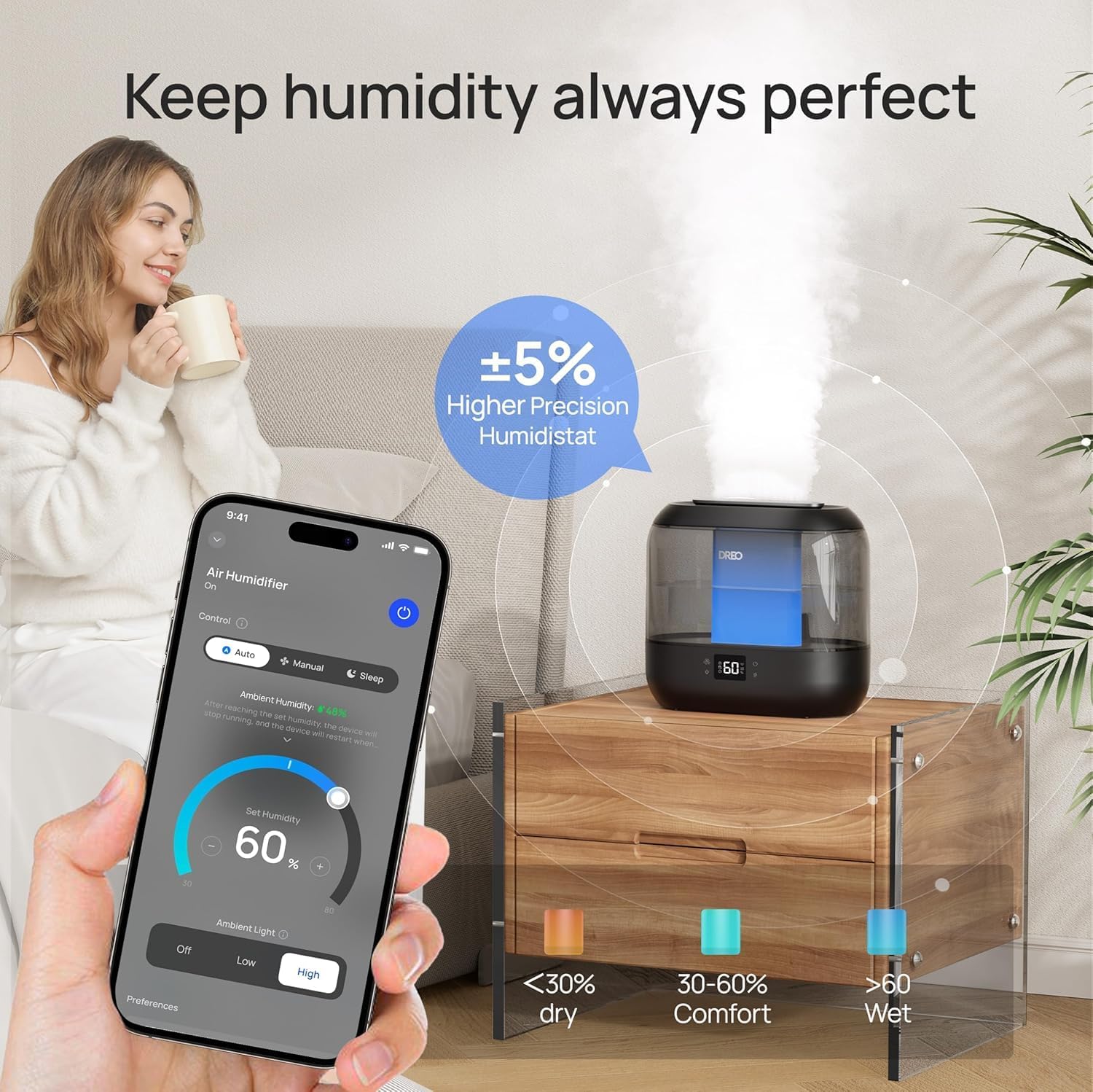
Top fill removes the category's worst UX: lift tank, invert over sink, trail water, misalign gasket, leak on hardwood. Pour from a pitcher while the unit sits on the dresser. Modular internals and an included brush signal that weekly cleaning is part of the philosophy, not an afterthought. Skip maintenance and ultrasonic humidifiers grow biofilm; the philosophy collapses into mould anxiety.

Smart humidity targeting closes the loop: set 45% in the app, let auto mode mist and pause. The onboard sensor is room-local — humidity ten feet away may differ, which is normal. Enclosed bedrooms up to roughly 200–250 ft² see the best results; open doors dilute effectiveness.
Water choice is philosophy, not trivia. Hard Canadian tap water produces white dust on dark furniture when ultrasonic mist carries minerals. Distilled or filtered water is strongly recommended in mineral-heavy cities. Cartridge consumables add ongoing cost — budget water and parts as ownership, not just electricity.
Noise near 28 dB at sleep settings — a soft hiss acceptable in nurseries. Night light disable-able from the app. Cool mist only: safer around kids, no warm-steam medical claims.
Philosophy in one sentence: you want the air you breathe to carry enough moisture that your body and your furniture stop protesting winter.
When the humidifier camp wins:
- Furnace season dryness — November through March in most provinces
- AC-dried summer bedrooms with closed doors and vents
- Nurseries where parents want stable RH without midnight tank wrestling
- Wood instruments and furniture needing seasonal stability
- Buyers who will clean weekly and use decent water
When the humidifier camp disappoints:
- Hot humid August nights when RH is already high
- Large open floor plans a 4L tank cannot normalize
- Buyers expecting the unit to cool the room
- Households unwilling to maintain gaskets, cartridges, and scrub schedules
The DREO humidifier buyer guide covers leakage troubleshooting, hard-water city notes, and replacement cartridge listings.
When both appear on the same cart
Shoulder season makes philosophers of us all. April in Vancouver: dry nights, warm afternoons. October in Toronto: furnace clicking on while afternoons still flirt with 18°C. Baby room debates: paediatric guidance often mentions humidity; parents also fear overheating.
Owning both is legitimate when symptoms split by season or time of day — humidifier on low for RH, fan on speed 2 for white noise and skin cooling in a closed bedroom. Many Canadian households eventually do.
Running both badly is equally common:
- Fan blasting across the humidifier nozzle at high speed — wastes mist and confuses the sensor
- Humidifier on high with windows sealed in summer — condensation risk on cold walls
- Chasing heat with mist instead of AC or a cooling blanket when RH is already fine
Order of operations: establish RH first in auto mode, then add fan for sleep preference. Not the reverse.
Side by side: which problem are you solving?
| Question | Fan camp | Humidifier camp |
|---|---|---|
| Core bet | Evaporative cooling + circulation | RH targeting + top-fill maintenance |
| Primary symptom | Hot, stuffy, need breeze or sound | Dry nose, static, cracking wood |
| Best months | May–September | November–March (+ AC-dried summer) |
| Noise at sleep | ~20 dB low — white-noise friendly | ~28 dB — soft mist hiss |
| Smart hook | Schedules, speed presets, voice | Auto humidity %, remote mist control |
| Ongoing cost | None (dust blades) | Water quality, cartridges, cleaning time |
| Price (CAD) | ~$140–150 | ~$60–70 |
| Deep dive | DREO fan guide | DREO humidifier guide |
The table deliberately avoids a winner column. A February nosebleed and a July heat wave need different philosophies even if both say "bedroom comfort" on the invoice.
Four scenarios, two philosophies
February master bedroom. RH at 24%, static at the switch — humidifier camp wins on auto toward 45% with a closed door. Fan accelerates dry-skin evaporation.
August upstairs apartment. RH at 45%, west sun makes 23°C feel hot — fan camp on speeds 2–4. Humidifier adds moisture you do not need.
Nursery year-round. Humidifier for RH stability; fan on low for sound — never high-speed airflow at the crib while over-misting.
AC-heavy condo, July. Cool but parched — humidifier on low auto first; fan optional. Cool and dry is not comfortable.
Decision tree: symptom to tool
Work through these questions in order. A $15 hygrometer removes guesswork.
START: What bothers you most at night?

├─ "I'm hot / air feels dead / I need sound"
│   ├─ RH above 40%? → FAN (DREO Omni) — or AC if heat is extreme
│   └─ RH below 35% AND hot? → HUMIDIFIER first to 45%, then FAN on low
│       (dry heat is still dry)
│
├─ "I'm dry — nose, throat, static, wood cracking"
│   ├─ RH below 40%? → HUMIDIFIER (DREO 4L) — target 40–50%
│   └─ RH already 45%+? → Not a humidity problem; check ventilation or mould
│
├─ "I'm hot AND dry" (common in AC bedrooms)
│   → HUMIDIFIER to 45% first, then FAN on low for sleep
│
└─ "I'm hot under covers but air feels fine"
    → Neither camp alone; consider cooling bedding + optional low fan
        (see Elegear cooling blanket guide)
Quick seasonal defaults for Canada:
- November–March: humidifier-first household unless RH consistently above 40%
- June–August: fan-first unless AC is drying you out
- April/May and September/October: measure RH; shoulder season punishes assumptions
What neither philosophy fixes
Naming gaps prevents the most common regret.
Refrigerant cooling — Fans and humidifiers do not replace AC during heat warnings. Evaporative comfort has limits.
Whole-home humidity — A 4L bedroom unit does not humidify a 2,000 ft² open main floor. Furnace-integrated humidifiers exist for that scale.
Mould and water intrusion — Humidifiers add moisture; they do not fix roof leaks or bathroom exhaust failures. Above 55–60% RH sustained, reassess.
Medical-grade respiratory needs — Consumer cool mist is general wellness. Clinical conditions need clinician guidance.
Partner wars over thermostat — Philosophy cannot fix building insulation. It can only optimize the room you control.
Verdict framework: choose your camp
Choose the DREO Omni fan if:
- Your priority symptom is heat, stuffiness, or sleep noise
- You will use speeds 2–5 overnight and schedules in the app
- RH is already in the 40–50% band or you own a humidifier for winter
- You accept ~$140–150 CAD for quiet DC airflow and omni sweep
Choose the DREO 4L humidifier if:
- Your priority symptom is dryness — nose, throat, static, wood
- RH reads below 35–40% in the sleeping room
- You will clean weekly and use filtered or distilled water
- You want top-fill convenience and auto humidity near ~$60–70 CAD
Choose both if:
- Seasons split your symptoms — classic Canadian ownership path
- You run humidifier for RH and fan on low for sound, without cross-blasting mist
Choose neither if:
- You need AC or whole-house HVAC solutions
- You refuse humidifier maintenance or expect fans to lower room temperature dramatically
For RH math, sizing worksheets, and maintenance cadence, the field guide goes deeper than this essay. For day-to-day ownership — quirks, Wi-Fi notes, leakage fixes — the individual buyer guides carry the rest.
Frequently asked questions
Is the fan "better" because it costs more?
No — it solves a different problem. The fan's price reflects DC motor, omni oscillation, and smart features for air movement. The humidifier is cheaper because its job — mist and RH — requires less airflow engineering. Compare against your symptom, not the receipt total.
Can I use a humidifier in summer?
Yes, when AC or closed windows dry the room despite outdoor humidity. No, when RH is already above 50% and you feel muggy — you need dehumidification or cooling, not more mist.
Will the fan help my winter bedroom?
It helps if stuffiness or white noise is the issue. It hurts if dryness is the issue and RH is low — pair with a humidifier or skip the fan overnight.
DREO fan or DREO humidifier — which first?
Follow the calendar and the hygrometer. Buy humidifier first if furnace season dryness is immediate. Buy fan first if July heat is the pain point. When in doubt, measure RH — below 40% is moisture; above 40% with heat is airflow.
The bottom line
The wrong purchase is not fan instead of humidifier — it is buying circulation when you needed relative humidity, or buying mist when you needed evaporation across your skin. Name the symptom. Measure if you can. Pick the philosophy that matches the season you are living in.
Two levers, one bedroom. Choose the camp that fits your Canadian calendar — then read the field guide for the numbers that make the choice stick.
Sign up or sign in to join the conversation.