
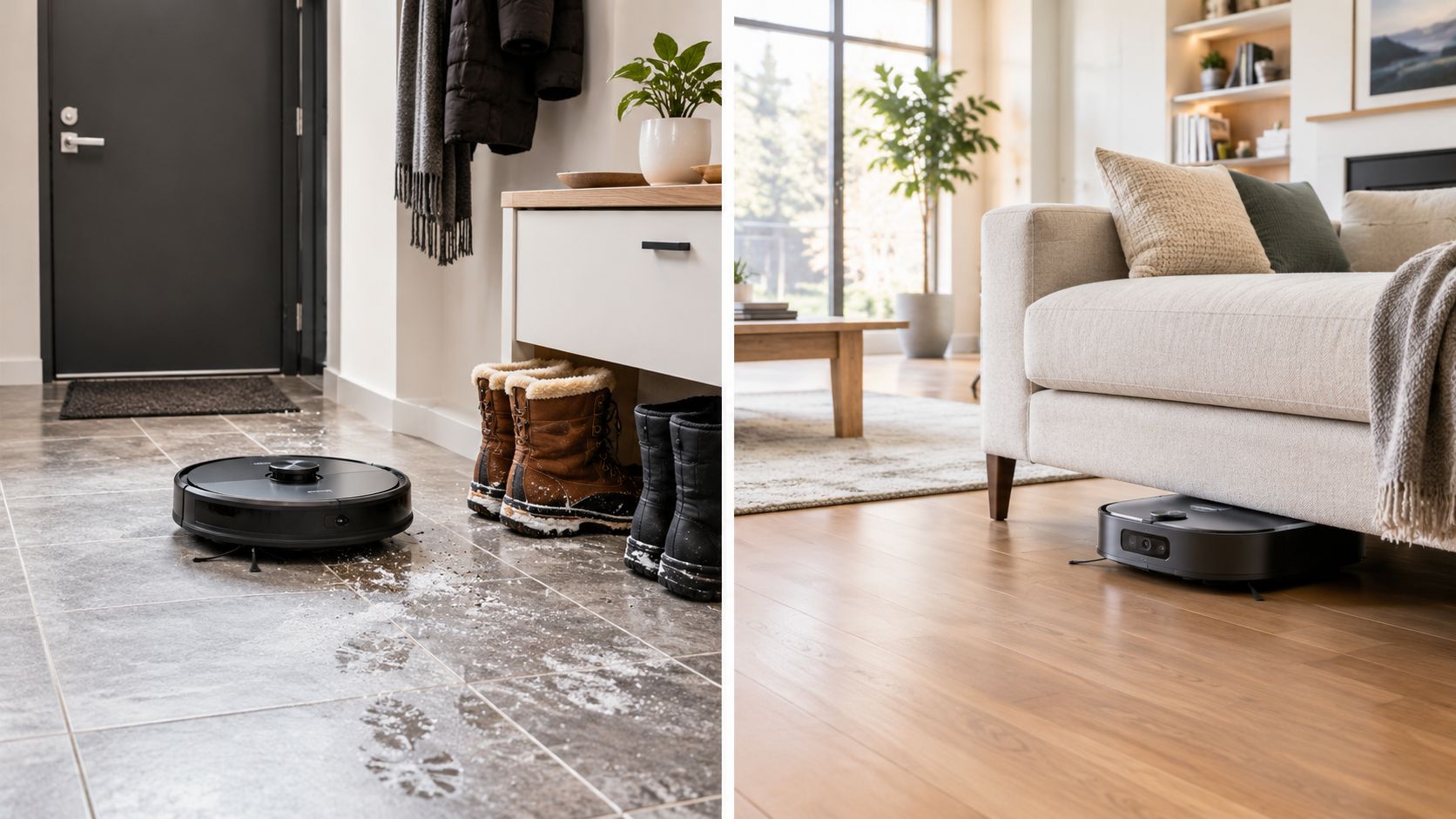
A winter entryway can expose the limits of a robot vacuum faster than a showroom test. Salt granules collect beside the mat, sand works into the floor joints, and damp marks appear around the dock before you've finished your morning coffee. In a condo, that debris may be concentrated in one small entrance. In a house, it can travel through several rooms before the robot starts its scheduled run.
A useful robot vacuum comparison for Canadian shoppers therefore has to go beyond suction claims. Navigation, debris pickup, mopping, dock design, app control, noise, service support, and seasonal maintenance all affect whether a model remains useful after the novelty fades. CAD pricing and Canadian availability matter too, because a model sold widely elsewhere may have a different warranty, parts supply, or retailer presence here.
This guide compares those trade-offs for condos and houses, with separate attention to mixed flooring, pet hair, winter grit, limited storage, and automated docks. If you're still deciding whether the category fits your routine, Celmin's guide to whether robot vacuums are worth it offers useful context before you compare models.
Table of Contents
- Introduction to Robot Vacuum Comparison
- Overview of Canadian Robot Vacuum Market
- Choosing Comparison Criteria
- Model Feature Comparison
- Use Cases and Best Models
- Maintenance and Cost Analysis
- Final Recommendations for Condos vs Houses
Introduction to Robot Vacuum Comparison
The most important question isn't “Which robot has the strongest suction?” It's “What will this robot face repeatedly in your home?” A compact condo with hardwood floors needs reliable mapping, a dock that doesn't dominate the entryway, and sensible obstacle avoidance. A multi-room house places more pressure on battery management, dust capacity, carpet pickup, and the robot's ability to resume cleaning without creating missed areas.
Canadian conditions add another layer. Road salt, sand, moisture, and tracked-in grit can reach the brush roll, wheels, filters, sensors, and dock. A robot that performs impressively on controlled dust may still require frequent cleaning if it encounters damp winter debris every day.
Practical rule: Treat automated cleaning as a maintenance system, not a replacement for every manual vacuuming task.
The comparison below uses a Canadian buying lens. It considers measured pickup where data is available, then weighs the less visible ownership factors that shape daily satisfaction. The result should help first-time buyers choose between a simpler vacuum-only machine, a premium vacuum-and-mop system, and a model whose lower purchase price may involve more hands-on care.
Overview of Canadian Robot Vacuum Market
A robot vacuum bought for a downtown condo and one bought for a detached house often enter different ownership patterns from the first winter. Condo owners usually feel dock size, noise, and bin capacity first. Households with more rooms notice battery behaviour, parts wear, and whether the robot can keep handling tracked-in grit after repeated runs. That difference matters in Canada because the category is growing, but it is still unevenly understood by shoppers and retailers.
One Canada-focused outlook estimated revenue at approximately US$133.4 million in 2021 and projected US$827.1 million by 2030, with a forecast compound annual growth rate of 22.5% from 2022 through 2030, according to the Canada eco-friendly robot vacuum market outlook. Those figures are best read as a directional market estimate, not a precise count of every unit sold in Canada.
A separate market estimate suggested household adoption of roughly 15–20% in 2026. It also described Ontario, Quebec, and British Columbia as accounting for approximately 70–80% of national demand, with a typical replacement cycle of about 3–5 years. That mix points to a market where many buyers are still comparing their first robot vacuum, while a smaller group is weighing whether newer mapping, mopping, or self-empty docks reduce enough weekly maintenance to justify replacing an older machine.
Why Canadian availability changes the decision
Canada is a net importer of robot-vacuum sets, so local stock, warranty handling, and consumables can look different from the U.S. or European retail situation. An industry estimate recorded a 19.00% year-over-year increase in Canadian imports between 2023 and 2024, after a 5.53% compound annual growth rate from 2020 to 2024, as reported in the Canadian robot-vacuum import analysis.
That affects ownership costs in ways product pages rarely show. A low advertised price can be offset by hard-to-find bags, filters, side brushes, batteries, or dock components. Cross-border service can also turn a routine repair into a longer interruption.
The same estimate projects potential household penetration of 30–40% by 2035. If adoption expands on that path, the stronger differentiator in Canada will not be suction claims alone. It will be whether a model remains easy to maintain through winter debris, spring grit, pet hair, and everyday replacement-part needs, especially when comparing compact condos with larger homes.
Choosing Comparison Criteria
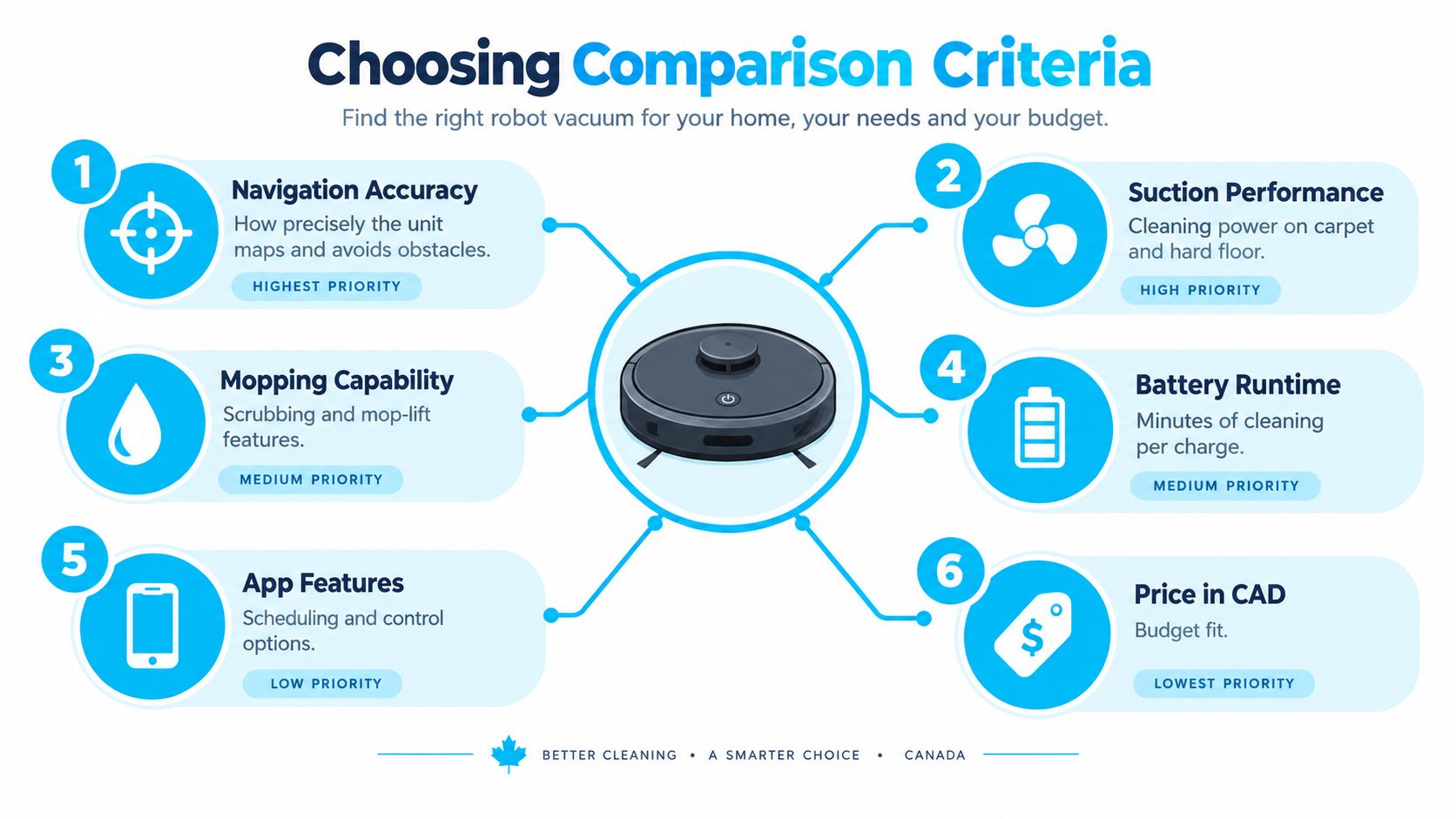
Start with the floor plan, not the product page. A condo shopper may prioritise quiet operation, dock footprint, and reliable mapping around furniture. A homeowner with several rooms, carpets, and pets may value battery management, dust capacity, brush design, and consistent edge coverage more heavily.
Rank the criteria by household impact
Navigation accuracy comes first. A robot that maps rooms correctly can clean in an organised pattern, return to its dock, and avoid repeatedly missing the same area. Obstacle avoidance matters around charging cables, pet bowls, shoes, and winter footwear. In a small home, poor navigation wastes a larger share of the available cleaning area.
Measured pickup matters more than a headline Pa figure. Suction pressure is only one component of performance. Brush design, airflow, floor contact, navigation coverage, and edge behaviour determine how much debris reaches the dustbin. Look for repeatable tests using more than fine dust.
Mopping should match the mess. A basic damp pad can handle light marks on hard flooring, but it shouldn't be treated as a substitute for cleaning a wet, gritty entryway. Mop lifting, water management, washing, and drying are more relevant than the presence of a mop attachment alone.
Battery and recharge behaviour matter most in houses. A larger home benefits from a robot that can recharge and resume without losing its map or skipping rooms. Condo owners may care less about maximum runtime than about dependable completion of a shorter route.
Don't ignore the dock
Dock footprint can decide whether a robot works in a condo at all. Measure the space around the dock, including room for the robot to approach and for you to remove a dust bag or water tank. Noise also matters when the base empties debris or dries mop pads near a living area.
App features should support the routine rather than distract from it. Room selection, no-go zones, scheduling, suction control, and map editing are practical tools. A complicated app can't compensate for a robot that misses the entryway or becomes tangled in the same obstacle.
Energy use is measurable but rarely the deciding factor. A Canada-focused audit estimated the Dreame X50 Ultra at 47.9 kWh annually, costing CAD 8.14 under its stated assumptions, compared with CAD 5.30 for a 1,200 W upright vacuum. The audit's robot-vacuum energy and water analysis also shows why scheduled operation and dock functions can raise total consumption despite a lower power draw during an individual cleaning pass.
For a broader household comparison, see Celmin's discussion of robot vacuums versus stick vacuums. The practical lesson is simple: prioritise pickup, navigation, serviceability, and maintenance before electricity cost.
Model Feature Comparison
A feature table can flatten differences that matter in daily use. Canadian buyers are not only comparing suction and dock specs. They are also comparing how much upkeep each system adds through winter grit, spring moisture, pet hair, condo storage limits, and the simple question of whether the dock becomes one more appliance to manage.
| Model | Most relevant strength | Canadian comparison caveat |
|---|---|---|
| Roborock S8 MaxV Ultra | Strong measured pickup with advanced automation | Premium complexity can mean more dock and consumable maintenance |
| Roborock Q7 Max+ | Lower-cost option with solid measured pickup | Lower scores than the S8 MaxV Ultra, especially on carpet |
| Dreame X50 Ultra | Feature-rich dock system and documented energy scenario | Ownership cost depends on dock operation, water use, and consumables |
| iRobot Roomba j7 Plus | Obstacle-focused approach and self-emptying convenience | Verify Canadian pricing, parts, and current availability |
| Ecovacs Deebot X1 Omni | Integrated vacuum-and-mop concept | Dock upkeep and service support deserve close checking |
The evidence here separates measured pickup from broader ownership assumptions. The clearest Canadian performance comparison in this group comes from the two Roborock models. The Dreame X50 Ultra adds a useful reference for operating cost and dock behaviour. The iRobot Roomba j7 Plus and Ecovacs Deebot X1 Omni are more useful as examples of different design priorities than as directly comparable pickup leaders. CAD pricing, stock, runtime, noise, and service terms still need to be checked at the retailer level.
Roborock S8 MaxV Ultra
The S8 MaxV Ultra is the benchmark model in this comparison for raw cleaning performance. In testing described by Celmin's Canadian robot-vacuum performance comparison, it scored 95/100 on carpet and 97/100 on hard flooring. The tests used fine dust, rice, cereal, coffee beans, embedded sand, synthetic pet hair, and edge debris, with repeated runs and weight-based measurement before and after cleaning.
Those results matter most in homes where debris changes with the season. A detached house with carpeted bedrooms, an entryway that collects sand or salt, and a pet shedding through winter asks much more from a robot than a one-bedroom condo with mostly hard floors. In that context, the S8 MaxV Ultra offers the strongest margin for missed passes, brush wear, and less-than-perfect routing.
That margin comes with a maintenance trade-off. A premium dock can reduce day-to-day emptying and pad handling, but it also adds more components that need periodic cleaning, refilling, inspection, and replacement. For some buyers, especially in larger homes, that exchange is reasonable. In a condo, the same dock can feel oversized if storage is tight or if the base runs near the kitchen or main living area.
Roborock Q7 Max+
The Q7 Max+ scored 90/100 on carpet and 94/100 on hard flooring in the same comparison. That leaves it behind the S8 MaxV Ultra by 5 points on carpet and 3 points on hard flooring, a real gap in measured pickup but not necessarily a reason to overspend for every household.
Its value case is clearer in smaller spaces. A condo owner who wants structured navigation, scheduled cleaning, and automatic bin emptying may get most of the practical benefit here without taking on the cost and upkeep of a more elaborate dock. The Q7 Max+ also fits a common Canadian routine where the robot handles frequent surface cleaning while a corded or stick vacuum handles occasional deep carpet work.
The limits show up faster in homes with more carpet, more embedded grit, or more debris tracked in from outside. If winter entryway mess is part of the household pattern, the lower carpet score matters more than it does in a hard-floor apartment.
Dreame X50 Ultra
The X50 Ultra is less useful as a pure pickup reference and more useful as a case study in ownership burden. The earlier energy audit estimated 47.9 kWh of annual use and CAD 8.14 in electricity under its stated assumptions. That should be treated as a scenario, not a fixed Canadian outcome, because schedules, provincial rates, suction settings, mop washing, drying cycles, and standby time all change the result.
The more revealing issue is what the dock asks from the owner over a full year. Water tanks need filling. Dirty-water tanks need emptying and cleaning. Bags, filters, brushes, and mop parts still wear out. In a house, that workload may be acceptable because the automation covers more floor area and reduces manual mopping. In a condo, the same system can create friction through noise, moisture management, and the need to keep the dock accessible rather than tucked away.
iRobot Roomba j7 Plus
The Roomba j7 Plus stands out for obstacle handling rather than a documented pickup advantage in this section's evidence base. That distinction matters in lived conditions. A robot with slightly lower cleaning performance can still be the more dependable machine if it completes its run instead of stopping at cables, shoes, pet bowls, or children's items.
This makes the j7 Plus easier to justify in cluttered households where failed runs are the main source of frustration. A buyer is not just paying for a vacuum. They are paying for fewer rescues and fewer incomplete maps.
The practical caution is support. Canadian shoppers should confirm current pricing, bag and filter availability, and warranty handling before purchase. A model that performs predictably and has easy-to-find consumables can be less expensive over time than one with stronger headline features but harder-to-source parts.
Ecovacs Deebot X1 Omni
The Deebot X1 Omni represents the integrated vacuum-and-mop approach, with the dock doing much of the system's work. For homes with a lot of hard flooring, that can reduce manual mop setup and make routine cleaning more consistent.
It also shifts the maintenance burden to the base station. The water path, dirty-water container, mop pads, and drying area all need regular attention. That is a manageable routine for buyers who want automated mopping as part of weekly cleaning. It is less attractive for households that mainly care about carpet pickup and want the simplest long-term ownership pattern.
Canadian buyers should also treat after-sales support as part of the comparison, not an afterthought. Parts availability and warranty execution affect the overall cost of ownership almost as much as the feature list on the box.
Use Cases and Best Models
A condo entryway in February and a two-storey house in shedding season create very different tests. One concentrates salt, grit, and wet debris in a small zone. The other asks a robot to cover longer routes, transition across surfaces, and keep carpeted rooms under control. Because many Canadian buyers are still on their first robot, warranty handling, replacement parts, and consumables deserve nearly as much weight as suction claims.
| Use Case | Model | Key Feature | Price (CAD) |
|---|---|---|---|
| Small condo with mostly hard flooring | Roborock Q7 Max+ | Structured navigation and measured hard-floor pickup | Verify current retailer price |
| Mixed-floor house with carpet | Roborock S8 MaxV Ultra | Highest supplied pickup scores on carpet and hard flooring | Verify current retailer price |
| Automated vacuum-and-mop routine | Dreame X50 Ultra | Dock-led washing and drying workflow | Verify current retailer price |
| Cluttered home with pets or frequent obstacles | iRobot Roomba j7 Plus | Obstacle-focused navigation approach | Verify current retailer price |
| Hard-floor home seeking an integrated mop system | Ecovacs Deebot X1 Omni | Combined vacuum-and-mop dock concept | Verify current retailer price |
Condos and apartments
The Q7 Max+ is the sensible starting point for a smaller home where the main goal is dependable daily pickup. In a condo with mostly hard flooring, shorter runs, and limited carpet, the gap between good pickup and top-tier pickup often matters less than whether the robot finishes consistently and fits the space without forcing awkward dock placement near the entrance.
That matters in Canadian winters. A condo can funnel nearly all outdoor debris through one doorway, so the robot may face concentrated grit instead of light dust spread across a large floorplan. A simpler vacuum-only setup is often easier to manage in that pattern, especially for owners who would rather spot-clean damp entryway messes by hand than add water tanks and mop pads to the routine.
The Roomba j7 Plus makes more sense when clutter is the recurring problem. Pet bowls, cables, socks, and small household items can interrupt a run more than raw pickup limits do. In that scenario, obstacle handling has practical value because it reduces failed jobs and the need to restart the machine. It still works best in homes where wet boots, loose cords, and children's items are picked up before scheduled cleaning.
Houses with mixed flooring
The S8 MaxV Ultra is the stronger fit when carpet performance and hard-floor pickup both affect the buying decision. Its 95/100 carpet score and 97/100 hard-floor score point to stronger measured cleaning than the Q7 Max+ in the supplied testing. That advantage is more meaningful in houses with several bedrooms, area rugs, and pet hair that migrates from hard surfaces onto carpet.
The trade-off is ownership friction. A larger dock and a more complex system can save labour during routine cleaning, but only if the household keeps up with bags, filters, brushes, and dock care. For buyers who already use an upright vacuum for periodic deep cleaning, the Q7 Max+ may remain the better value because it covers the weekly workload without bringing as much maintenance overhead.
Homes centred on mopping
The Dreame X50 Ultra and Ecovacs Deebot X1 Omni suit homes where hard-floor maintenance is the priority and owners want the dock to handle part of the mopping cycle. That can make scheduled cleaning more regular, especially in kitchens, hallways, and open-plan main floors.
The hidden cost is not electricity. It is the time spent managing water, pads, residue, and the mess that winter leaves behind. Salt dust and damp debris are harder on a mop system than ordinary dry dirt. For that reason, these models fit best in households that want frequent light mopping and are willing to clean the dock regularly, not in homes expecting a robot to roll through slush-prone entryways without extra care.
Maintenance and Cost Analysis
The hidden cost of a robot vacuum is usually labour, not electricity. Owners empty bins, replace bags, wash filters, clear brush rolls, wipe sensors, clean wheels, inspect charging contacts, and keep the dock free of accumulated debris. A premium dock reduces some tasks but adds others, especially when it washes and dries mop pads.
Canadian winter makes that distinction sharper. Existing Canadian coverage notes that salt and moisture can accumulate in brushes and docks, increasing filter and part replacement needs beyond what controlled dust tests suggest. The Canadian winter robot-vacuum buying guide also highlights why picking up salt isn't the same as safely running a machine through damp slush.
The seasonal maintenance pattern
During dry periods, fine dust and pet hair mainly affect filters, rollers, and the dust path. In winter, abrasive grit can work into moving parts while moisture creates a different risk around sensors, contacts, and dock components. Condo entryways can be especially demanding because a small area concentrates the debris that people track indoors.
Use a simple maintenance rhythm:
- After gritty runs: Inspect the main brush, side brush, wheels, and intake for sand or salt.
- Around the dock: Empty dirty water, wipe residue, and allow damp components to dry according to the manufacturer's instructions.
- For navigation: Keep sensors and charging contacts clean. Celmin's guide to cleaning robot-vacuum sensors explains why a small maintenance task can prevent mapping and docking problems.
- Before wet cleaning: Remove visible slush and pooled moisture instead of expecting the robot to process it safely.
- For consumables: Check Canadian replacement prices for bags, filters, brushes, and mop pads before committing to a model.
The typical replacement cycle cited in the Canadian market outlook is about 3–5 years, but that doesn't mean every robot will deliver the same ownership value over that period. A machine with lower electricity use can still cost more in time and consumables if its dock becomes dirty, its brush tangles frequently, or parts are difficult to obtain.
What the electricity figures leave out
The energy comparison involving the Dreame X50 Ultra and an upright vacuum shows that scheduled automation can raise annual electricity use despite the robot's low per-cleaning power draw. Yet electricity is only one line in the ownership calculation. Bags, filters, batteries, brushes, dock cleaning, failed runs, and the time required to dry or clean components can matter more to the buyer.
Warranty language deserves special attention. Check whether the manufacturer covers liquid damage, corrosion, battery degradation, dock faults, and parts supplied through Canadian channels. A robot that performs well in a laboratory-style pickup test may be a poor year-round choice if the warranty excludes the conditions that define your entryway.
Final Recommendations for Condos vs Houses
For a small condo with mostly hard flooring, start with the Roborock Q7 Max+. Its measured hard-floor pickup is strong enough to make it a credible daily-maintenance option, while its simpler positioning avoids paying for a premium dock before you know whether you need one. Keep the dock away from the wettest part of the entryway and use no-go zones around shoes, cables, and water bowls.
Choose the iRobot Roomba j7 Plus when navigation around objects is the main frustration. Its value depends less on maximum debris scores and more on whether obstacle recognition prevents failed cleaning runs in your particular home. Confirm Canadian parts, support, and current CAD pricing before buying.
For a larger house with carpet and mixed floors, the Roborock S8 MaxV Ultra is the strongest evidence-based recommendation in this comparison. The supplied dataset gives it the highest scores, 95/100 on carpet and 97/100 on hard flooring, making it the better fit where embedded debris, bedroom carpet, pet hair, and winter grit all matter. Its trade-off is complexity. More dock functions mean more water, waste, pads, filters, and components to maintain.
The Dreame X50 Ultra or Ecovacs Deebot X1 Omni makes sense when automated mopping is central to the purchase. Don't choose either solely because the dock looks convenient. Confirm where dirty water will be emptied, how mop pads dry, which consumables are stocked in Canada, and whether the system can be kept away from damp entryway debris.
Decision shortcut: Condos should prioritise footprint, noise, navigation, and hard-floor reliability. Houses should prioritise mapping, carpet pickup, battery management, dust capacity, and serviceable parts.
No robot vacuum is maintenance-free, and none should be treated as a safe solution for standing water or wet slush. The most dependable Canadian choice is the model whose cleaning strengths match your floors and whose maintenance routine you'll commit to following through every season.
Celmin publishes Canadian robot-vacuum comparisons, practical buying guides, and seasonal home-tech advice that help you weigh CAD availability, performance, maintenance, and ownership trade-offs. Visit Celmin to compare more household technology before you buy.
Sign up or sign in to join the conversation.