
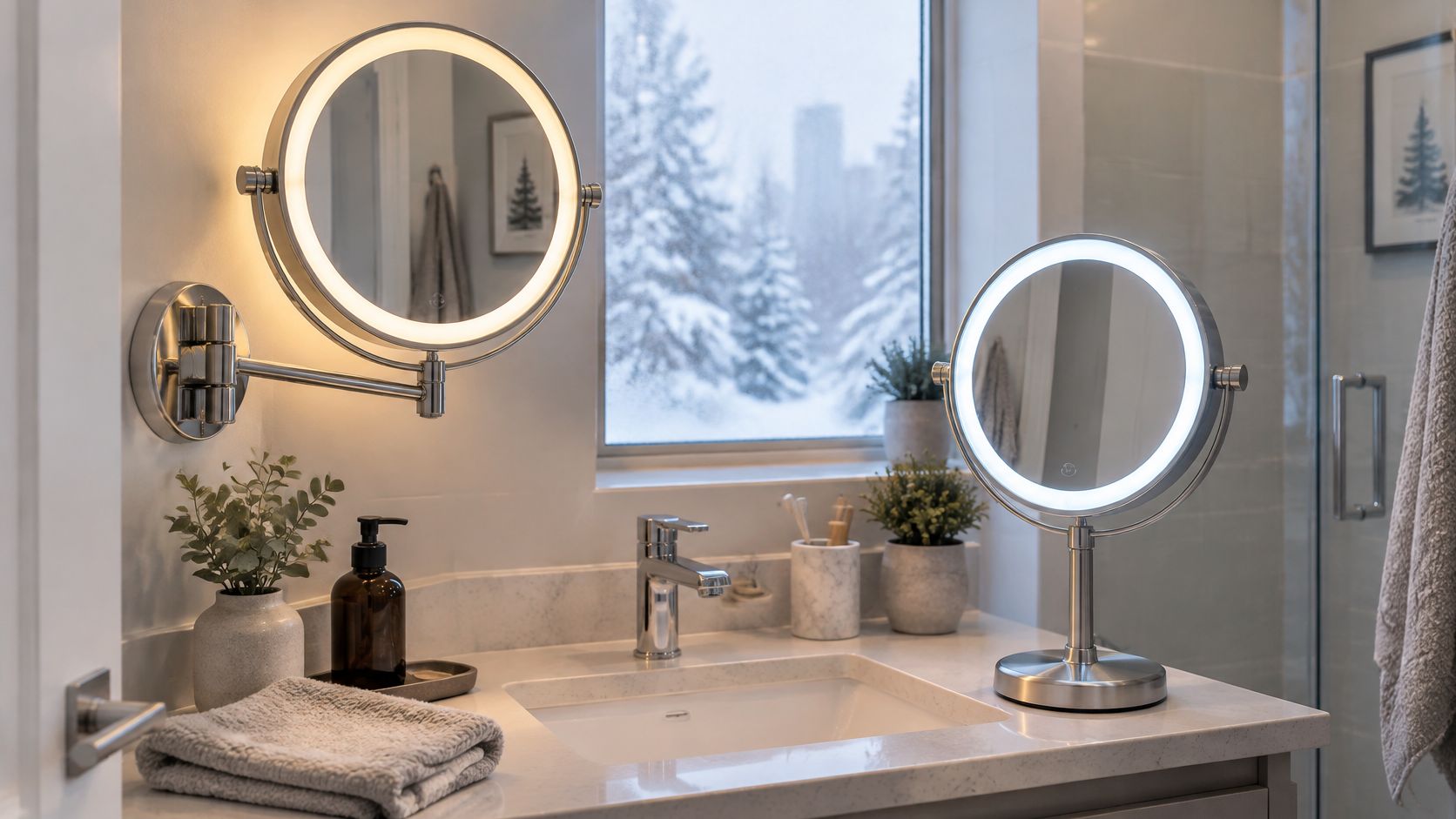
It's still dark when your alarm goes off in January, the bathroom window is black, and you're leaning over the sink trying to shave, blend foundation, or check irritated skin under a ceiling light that puts your own head between the bulb and your face. You move closer. The shadow moves with you. Colours that looked even indoors look wrong in the office elevator, and the patch you missed with the razor only shows up in your car's rear-view mirror.
That's not a technique problem. It's a lighting geometry problem, and it's why a magnifying mirror with light should be judged as a task-lighting fixture, not a vanity accessory. Mounting, moisture ratings, reach, and where the light lands matter as much as magnification.
Table of Contents
- Why Bathroom Lighting Fails at Close-Up Tasks
- Matching Magnification and Lumens to Real Needs
- Electrical Safety and Moisture Ratings Explained
- Wall-Mounted Versus Standing Models for Small Spaces
- Accessibility Features That Improve Usability for Everyone
- Energy Efficiency and Long-Term Ownership Costs
- Situational Recommendations for Canadian Buyers
Why Bathroom Lighting Fails at Close-Up Tasks
Most Canadian bathrooms were lit for finding the sink, not for examining a face at close range. A central ceiling fixture or a row of bulbs above the main mirror throws light downward. Your brow, nose, and chin cast shadows exactly where you need contrast for tweezing, eyeliner, contact lenses, or a clean shave.
In a condo ensuite I've tested in winter, the overhead light was perfectly adequate for showering. For close work it failed in three predictable ways. It lit the top of the head more than the front of the face, it forced users to lean in until posture replaced the mirror's job, and it changed colour judgement because the face wasn't evenly lit from the front.
Ambient light and task light do different jobs
Ambient light fills a room. Task light puts controlled, frontal illumination on a small working area at a known distance. A lighted magnifying mirror works when it does the second job well, with LEDs in front of your face rather than only glowing behind glass for effect.
That distinction also explains the broader shift in Canadian homes. Natural Resources Canada household lighting data shows the average home contained 40.9 light bulbs in 1997, falling to 25 by 2011, as households moved from general incandescent lighting toward more targeted sources. Bathrooms often missed that upgrade. They kept one overhead point while kitchens and desks gained dedicated task lights, a pattern worth copying from practical home office lighting ideas where light is placed for the work surface, not the ceiling.
- Shadow test: Stand at your normal grooming distance. If your eye sockets or jawline fall into shadow, magnification alone won't fix it.
- Colour test: Check makeup or skin redness under your bathroom light, then near a window later in the day. A noticeable mismatch points to uneven frontal light, not a bad mirror.
- Posture test: If you're hunching over the counter to get close enough, you need reach from an arm or a closer mirror position, not stronger magnification.
A magnifying mirror can't reveal detail that your lighting has already hidden in shadow.
Matching Magnification and Lumens to Real Needs
Buyers over-specify magnification more than any other feature. Higher power shrinks your field of view and shortens the distance where the image stays sharp. A mirror that's brilliant for a single eyebrow hair can be disorienting for applying foundation across a cheek, because you lose context and have to keep repositioning.
Start with the task you do most often, then choose the lowest magnification that makes that task comfortable. Lower power keeps more of your face visible and is easier for general grooming. Mid-range power suits everyday makeup, skincare, and shaving for a wide audience. The highest powers earn their place for contact lenses, precise brow work, or checking a specific spot, but they're poor daily drivers if they're your only mirror.
Brightness is usable light on your face
Lumens describe light output, but placement determines whether that output helps. A ring or perimeter array aimed forward lights both sides of the face. Backlit-only designs can look striking on a wall while leaving your face comparatively dim. Don't judge by wattage alone, because diffuser losses and LED layout change what reaches your skin.
Ask two questions before believing a brightness claim. Does the figure describe the complete mirror or only the LED strip? Was it measured at full power or at the default setting you'll use after dimming? Sellers don't always make that distinction clear, and it matters at close range where too little light forces eye strain and too much creates glare.
Canadian-market guidance on LED bathroom mirror brightness recommends approximately 800 lumens for a small single-vanity mirror when it is the only vanity light, and roughly 1,200 to 1,500 lumens for a larger 900 to 1,200 mm double vanity. Supplemental ceiling or side lighting reduces what the mirror itself must supply.
Magnification and Brightness by Use Case
| Primary Task | Recommended Magnification | Minimum Lumens | Light Position |
|---|---|---|---|
| General grooming and quick checks | Low | Below sole-source level if paired with vanity light, about 800 if alone on a single vanity | Forward-facing ring |
| Everyday makeup and skincare | Moderate | About 800 as the only single-vanity light | Even frontal perimeter |
| Wet shaving and detailed eye makeup | Moderate to high | About 800 single vanity, higher if shared across a double vanity | Front-facing, dimmable |
| Contact lenses and precision brow work | High | About 800 focused at close distance, with dimming to control glare | Close, forward-facing |
| Double-vanity detailed work | Moderate | 1,200 to 1,500 across the larger vanity | Frontal plus supplemental room light |
Dimming isn't a luxury feature here. The same mirror gets used in a pitch-black winter morning and on a bright summer evening. At night, full output can wash out subtle colour differences and reflect harshly off wet skin after a shower. Dimmed too far, fine hair and missed stubble disappear again.
Treat the table as a floor for comparison, not a promise. A compact mirror with modest output can work well beside a proper vanity fixture. A full-size illuminated mirror that's expected to carry the room should publish its lumen output clearly. If a listing hides that number behind vague brightness language, assume you'll need another light source.
Electrical Safety and Moisture Ratings Explained
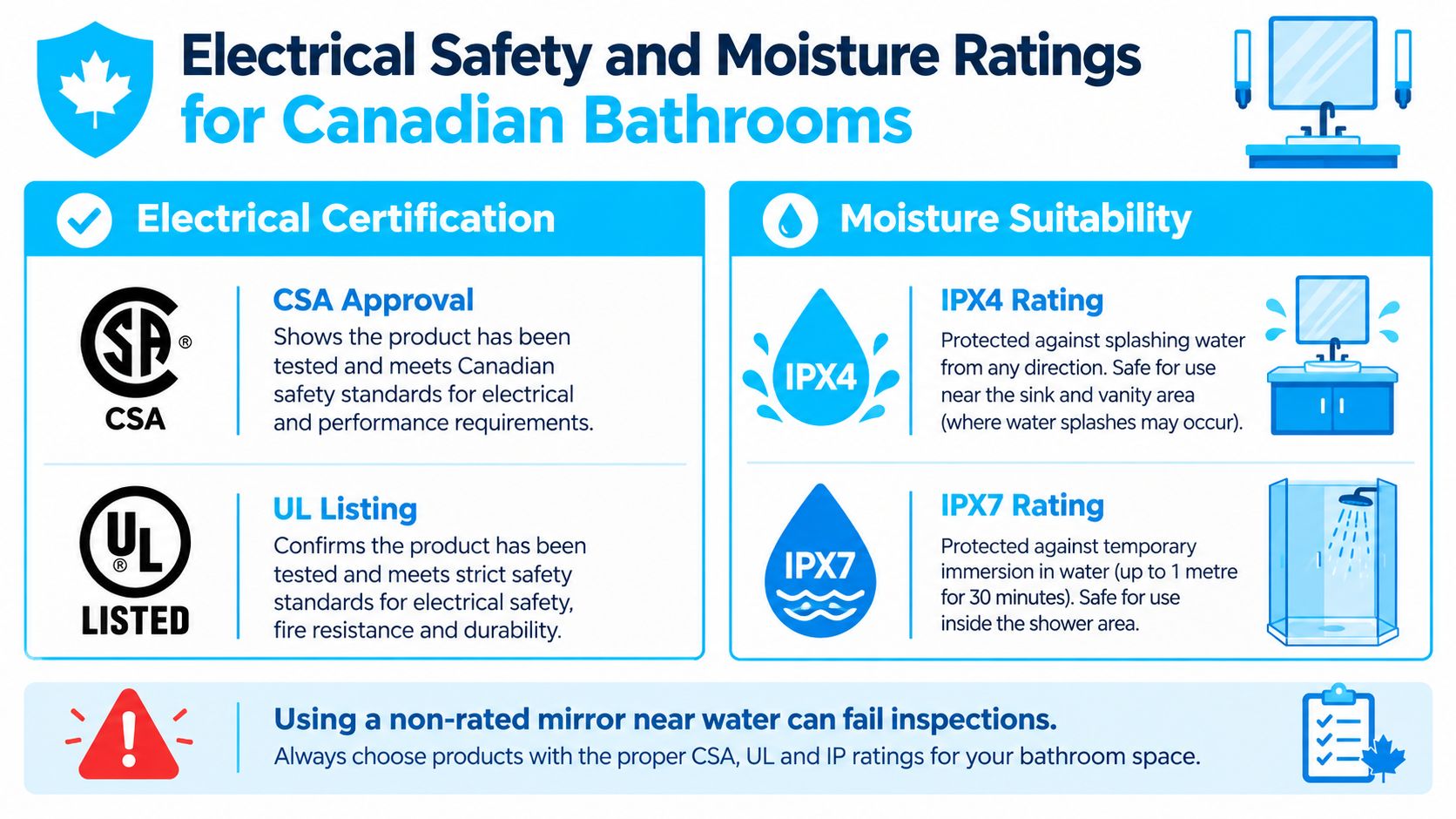
Two separate questions decide whether a lighted mirror belongs in your bathroom. Was it evaluated for electrical safety in Canada? Is it suited to the moisture where you'll mount it? Listings often blur those questions because one reassuring badge is easier to sell than a complete answer.
Look for a CSA, cUL, cULus, or cETL mark that applies to the Canadian market. That mark addresses evaluation against applicable electrical standards. It doesn't, by itself, prove the mirror is appropriate beside a shower, over a soaking tub, or in the splash zone of a busy family sink.
Read the IP rating before the marketing copy
Canadian vanity lighting guidance on IP ratings identifies IP44 as protection against objects larger than 1 mm and splashing water from any direction, while fixtures exposed to more direct spray may need a higher rating such as IP65. Exact requirements depend on placement and provincial electrical rules.
That difference is practical, not academic. Integrated power supplies, touch switches, demisting pads, and hardwired drivers all sit close to steam and splashes. A dry-rated product can carry a legitimate certification mark and still be the wrong choice near a shower or bathtub.
- Certification mark: Confirm it's a Canadian-recognised mark on the product or its official specification, not only in marketplace photos.
- Location rating: Look for explicit damp-location or wet-location language matched to where the mirror will sit.
- Power details: Check voltage information and installation instructions before ordering, especially for hardwired models.
- Receptacle protection: For plug-in models, bathroom outlets near water need GFCI protection, and the circuit must meet applicable Canadian requirements.
Screening rule: Reject a listing that says only "waterproof" but won't state an IP rating, Canadian certification, voltage, and installation method.
Renovators should settle this before tile or drywall closes. Swapping a hardwired mirror after an inspection concern is far more disruptive than choosing a properly rated plug-in model at the start. Renters face the opposite constraint. A plug-in mirror avoids opening walls, but the cord route, outlet location, and splash exposure still have to make sense.
Wall-Mounted Versus Standing Models for Small Spaces
In a compact condo bathroom, a mirror can solve one problem and create another. A wall-mounted model clears the counter but needs a suitable fixing point. A standing model avoids drilling and moves between rooms, but takes up space where toiletries and grooming tools already compete for room.
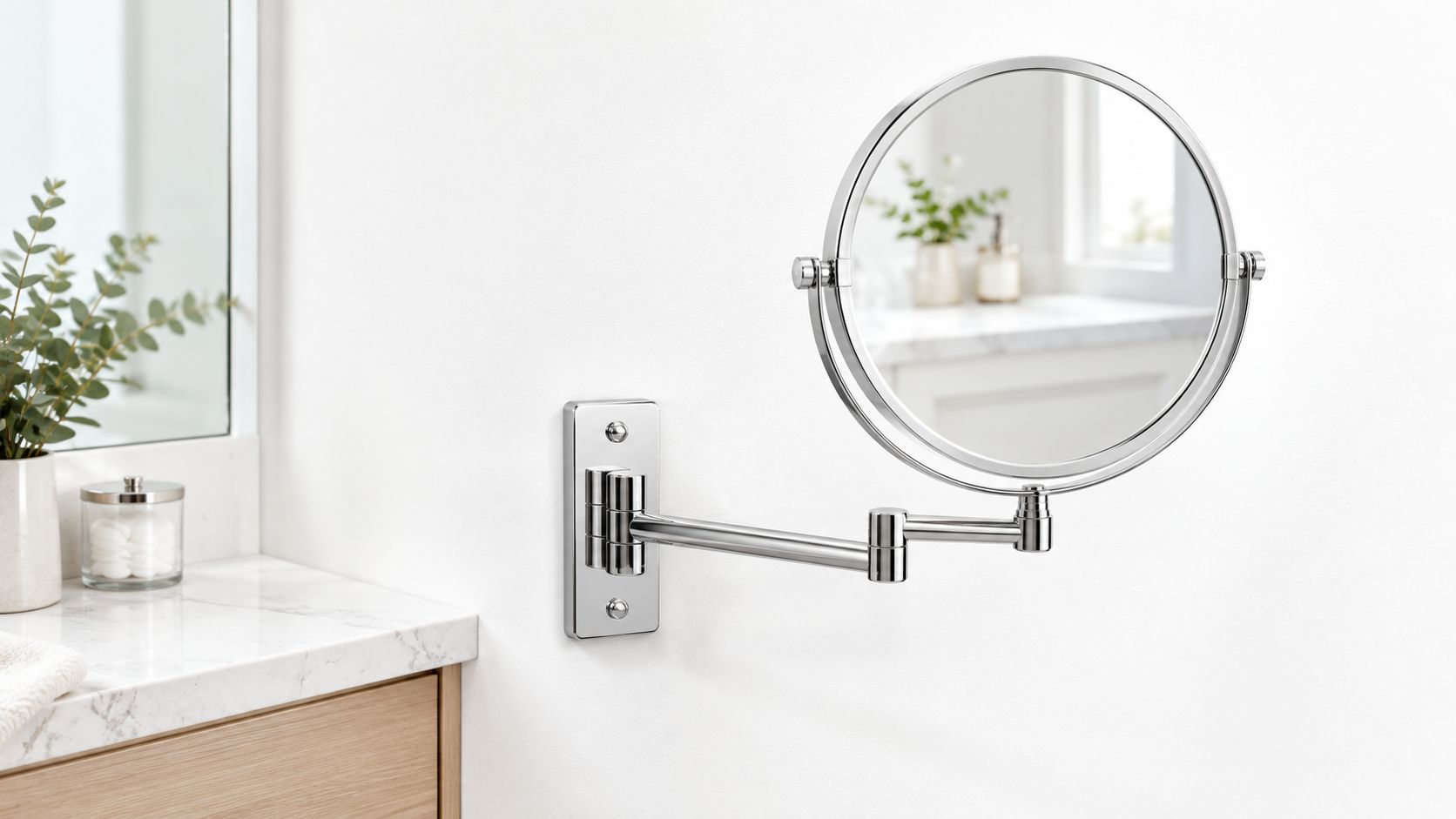
An articulated wall mirror works well for a regular grooming spot. Pull it closer for shaving or makeup, then fold it flat to free the counter. Check that the arm reaches your preferred viewing distance and that its full swing clears the faucet, cabinet doors, and anyone using the sink beside you. In older condos, confirm the wall can support the mount before drilling into tile.
Standing mirrors suit renters and shared homes where flexibility matters more than a clear counter. They need a stable base and a safe place to sit, especially in a busy bathroom where a bump can send one tipping. A model that charges by USB can avoid a visible cord during use, but it still needs a convenient place to recharge.
Let the room decide
Before buying, tape out the base footprint on the counter and use the space through a normal morning. For a wall model, measure the arm's reach and folded depth, then check the whole movement path. Include the cord route: a plug-in mirror is a poor fit if its cord must cross the sink or hang where it can be snagged.
Choose a wall-mounted mirror when the grooming spot is fixed and suitable wall support is available. Choose a standing model when you need to move it between rooms, cannot make permanent changes, or want to try magnification before installing a fixture. If a renovation is underway, a hardwired model may be easier to plan while the wall is open. A plug-in model offers a reversible setup, provided the cord can stay clear of water and foot traffic.
In a tight bathroom, judge the mirror by its folded profile or counter footprint, not its appearance in a product photo. If the mount, cord, or base gets in the way of the daily routine, the mirror is unlikely to stay in use.
Accessibility Features That Improve Usability for Everyone
A mirror mounted for a standing adult may sit too high for someone using a wheelchair, a child, or a person recovering from surgery. Before choosing a model, check whether users can bring it close, adjust its angle, and see their face without leaning over the counter.
CMHC accessible bathroom guidance recommends a mirror lower edge no higher than 1,000 mm (39 in.) above the floor, extending down to the countertop. It also recommends placing outlets within reach of seated and standing users, and identifies magnifying mirrors as useful for people with visual limitations.
Test the mirror from a seated position. Can you reach it and tilt it with one hand? Does its light fall on your face rather than past it? Try a familiar task, such as shaving, applying skincare, or reading a medication label. A mirror that works from a chair is often easier to adjust for standing users, too.
Controls and light quality matter as much as reach. Touch switches should be easy to locate by feel and operate with damp hands. Diffused, dimmable light can reduce harsh reflections; guidance on reducing eye strain during close-up tasks can help you assess comfort beyond brightness alone.
Choose a mount that stays in position with light pressure and can be adjusted without tools. Check that the mirror supports the household's actual tasks, including facial-hair grooming and wound checks, rather than judging it only by makeup detail. For aging-in-place planning, independent adjustment is a practical measure of usability: each person should be able to position the mirror without assistance.
Energy Efficiency and Long-Term Ownership Costs
A mirror used for a few minutes each morning will have a small effect on a home's electricity use. The larger ownership cost is often replacing a unit when its light or moving parts fail. In a Canadian condo bathroom with limited ambient lighting, reliable, even illumination may matter more than a small difference in power consumption.
Statistics Canada reported that 53% of Canadian households used LED lights in 2021, up from 30% in 2015. LEDs are now familiar in household lighting, but a lighted magnifying mirror poses a separate question: can you repair its light source, or must you replace the whole fixture?
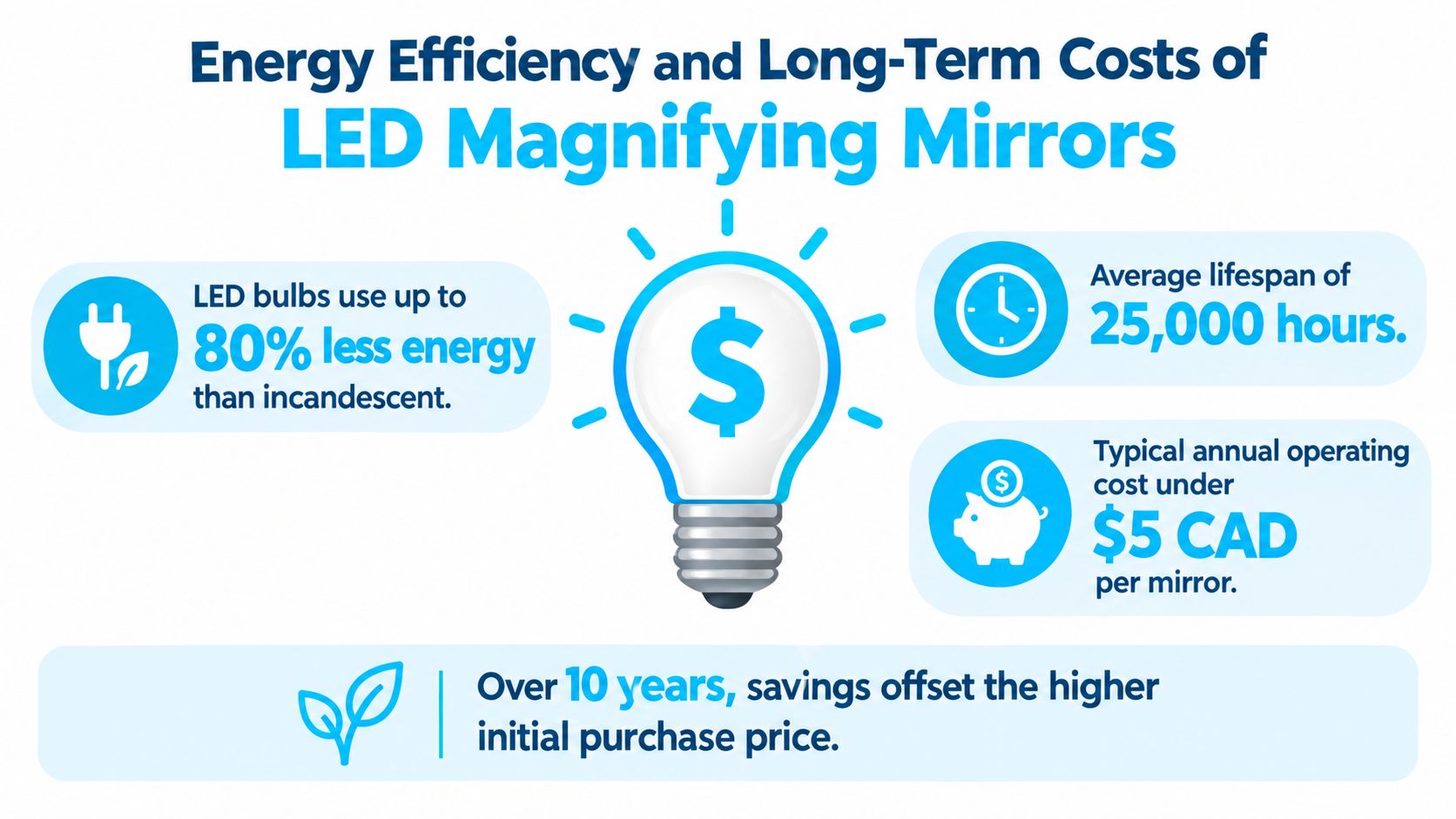
Integrated LEDs keep the mirror slim and can spread light evenly across the face. The trade-off is serviceability. If the driver fails or the LEDs dim unevenly, some models require replacing the entire mirror. Before buying, check the warranty and whether the manufacturer sells replacement LED modules or drivers.
For a primary bathroom used every day, sturdy joints, a dependable switch and smooth dimming can matter more over time than a lower upfront price. A guest-bathroom mirror used occasionally may not justify the same investment. Battery-powered models avoid installation costs, but add charging or battery replacement to routine upkeep.
Pay attention to what the mirror does at the settings you'll use:
- Dimming: The light should reduce smoothly without flicker. If the mirror is uncomfortable at a low setting, its full brightness offers little practical value.
- Colour consistency: Check that the light's colour stays steady as you dim it, so skin and grooming details remain easy to assess.
- Power controls: Confirm that touch controls switch the light fully off. Features such as a demister can draw power when left on.
- Repair options: Ask whether the LED module or driver can be replaced. If neither is serviceable, account for the cost of replacing the whole mirror.
LED lighting is a sensible choice for a frequently used mirror, but efficiency claims alone do not make a model a good buy. Prioritise even illumination, reliable controls and joints that hold their position. Those details determine whether the mirror remains useful through years of daily use.
Situational Recommendations for Canadian Buyers
No single model wins every bathroom. The right recommendation follows from tenure, space, power access, and who has to use the mirror without assistance. Use the profiles below as decision shortcuts, then verify the shortlisted model against the safety and brightness checks already covered.
Condo renters should start with a standing or plug-in model that doesn't require drilling, then confirm cord routing and outlet reach before buying. Prioritise a compact footprint, forward-facing dimmable light, and moderate magnification. If counter space disappears during your tape test, don't convince yourself you'll store it faithfully every day. You won't, and an unused mirror has no useful magnification at all.
Homeowners renovating a primary ensuite can justify a wall-mounted or hardwired installation because the wall is already open. Plan the mounting height, power location, and moisture rating together. If considering a larger illuminated centrepiece, reading how thin cast smart mirror technology works helps separate genuine added function from features you'll configure once and ignore.
When usability should outrank specifications
Aging-in-place planners and households with visual limitations should choose adjustable reach, low mounting flexibility, easy controls, and diffused dimmable light before chasing the highest magnification offered. Run the seated test with the actual tasks involved, including skincare and medication checks. A mirror that a person can position independently is safer and more useful than a stronger mirror fixed at the wrong height.
Budget-conscious students and first-apartment buyers should keep expectations narrow and honest. Buy for one repeat task, accept that a modest mirror needs help from existing vanity lighting, and favour portability over installation. Spend first on even frontal light and a stable base or arm. Skip paying extra for extreme magnification that narrows the view for the grooming you'll do most days.
Across every profile, walk away from listings that won't publish lumen output, IP rating, Canadian certification, and mounting requirements in plain language. Those omissions aren't minor paperwork gaps. They're the difference between a mirror that suits a Canadian bathroom through dark winters, steamy showers, and daily close work, and one that only performed well in a brightly lit product photograph.
If you're narrowing down a magnifying mirror for a condo, rental, or renovated ensuite, Celmin publishes Canadian buying guides and home tech reviews grounded in local availability, seasonal use, and the practical constraints of real households. Visit to compare related bathroom and smart home guidance before you commit to a model, mount, or installation route.
Sign up or sign in to join the conversation.