
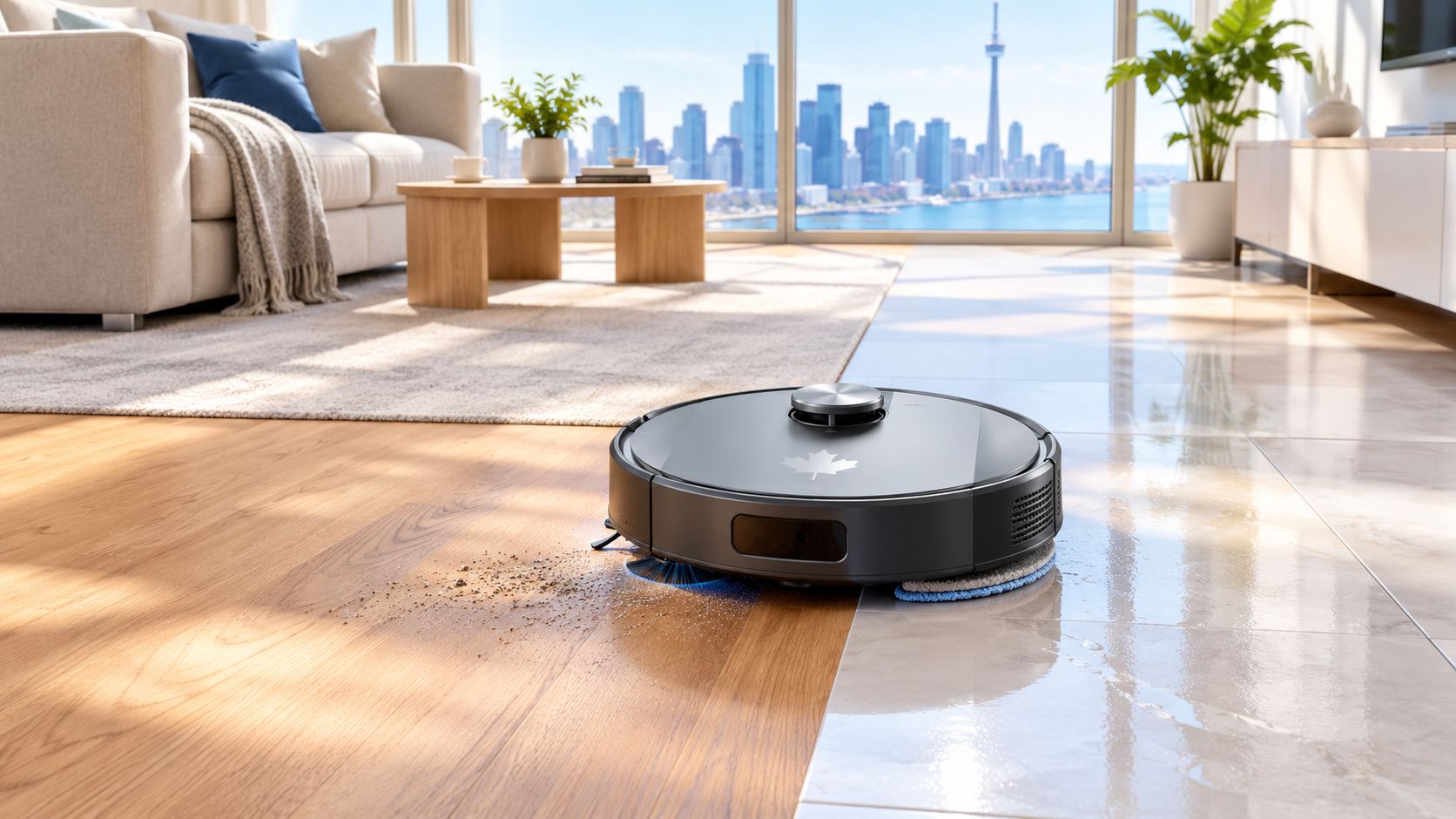
A robot vacuum and mop can take over recurring floor maintenance in a Canadian home, but it won't replace deep cleaning. The practical benchmark is whether it reduces part of a workload that averaged 12 hours and 15 minutes of household chores per week for Canadians aged 15 and older in Statistics Canada's historical survey data, with indoor cleaning averaging 3 hours and 9 minutes weekly (Statistics Canada household chore data).
You notice the value on an ordinary winter evening. Salt has dried into the entryway, grit has travelled across the hallway, and crumbs are collecting under the kitchen table. You could vacuum again, mop again, and empty the machine, or you could have a robot handle the routine pass while you deal with the jobs it can't do.
That distinction matters. A robot is a floor-maintenance appliance, not a complete cleaner. It won't properly wash stairs, clean upholstery, reach every edge, or replace periodic manual work. The best robot vacuum and mop Canada buyers can choose is therefore not necessarily the machine with the loudest suction claim. It's the one that handles your floors, thresholds, rugs, moisture, dock maintenance, privacy expectations, and Canadian after-sales support without becoming another chore.
Table of Contents
- Why Canadian Homes Need Smarter Floor Cleaning
- Top Robot Vacuum and Mop Combos Sold in Canada
- How Suction, Mopping, and Navigation Affect Real Use
- Which Robot Vacuum and Mop Fits Your Home Type
- Long-Term Ownership Costs and Repair Reality in Canada
- Final Recommendations by Priority and Budget
- Setup, Placement, and Maintenance Tips for Canadian Homes
Why Canadian Homes Need Smarter Floor Cleaning
A slushy January entry, a condo hallway that traps grit, a kitchen that picks up crumbs after every meal. That is normal floor care in Canada. A robot vacuum and mop earns its place in that routine because Canadian homes deal with repeat mess, mixed surfaces, and long heating-season dust, not because a spec sheet promises big suction.
Home layout changes what “useful” looks like. A downtown condo with engineered hardwood, low-pile rugs, tight chair legs, and limited storage needs a machine that can map cleanly, avoid getting stranded, and keep dock mess under control. A detached house with carpeted bedrooms, tile near the door, and a basement threshold asks for better threshold handling, steadier carpet behaviour, and parts you can replace when a brush, wheel, or dock component wears out. Those ownership details matter more than shoppers expect.
The same Statistics Canada survey cited earlier showed how much weekly chore time goes to recurring household work. That is the practical case for automation. You do not need a robot to replace cleaning. You need it to take the boring floor passes off your list often enough that the home stays under control between proper cleans.
Canadian cleaning habits point the same way. In Ipsos cleaning habits data for Canada, 78% of Canadians said they thoroughly cleaned their home at least weekly, including 24% daily and 53% weekly. The same source also found 40% of respondents cleaned because they could see dust or dirt on the floor. Scheduled robot runs solve that exact problem. They pick up the visible buildup before it spreads from the entry to the kitchen and living area.
What a robot handles well
A good unit is best at repeat floor maintenance, especially in homes where dirt arrives in small amounts all day instead of one big mess on weekends:
- Daily dust and crumbs: Regular vacuum runs keep hard floors and low-pile rugs looking presentable without pulling out a full-size vacuum.
- Entryway grit: Robots work well on the zone where salt, fine gravel, and dirt first land, as long as the mat and threshold do not stop them.
- Light kitchen residue: A mop function helps with routine film and small spots, but large spills still need manual cleanup first.
- Pet hair: Self-empty docks cut down bin handling, and anti-tangle brush designs reduce the time spent cutting hair off rollers.
- Under-furniture cleaning: Low-profile robots reach beds, sofas, and media units that are annoying to vacuum by hand.
Buy for the jobs above, and ownership gets easier. Buy for promises of total cleaning, and the machine becomes one more thing to maintain.
That boundary is the point. A robot keeps accessible floors in better shape with less effort, but stairs, edges, deep scrubbing, heavy winter slush, and upholstery still need manual work. If you want a realistic sense of the trade-off, this Canadian guide to whether robot vacuums are worth it is a useful gut check before you compare models.
Top Robot Vacuum and Mop Combos Sold in Canada
A robot looks great on a spec sheet. Then February hits, the entryway fills with salt dust, a rug edge catches a damp mop pad, and you find out very quickly whether you bought a machine that suits a Canadian home or one that only sounds impressive online.
The strongest options sold here separate themselves on repairability, parts access, dock maintenance, carpet behaviour, and winter-friendly daily use. Suction still matters, but ownership gets expensive fast if bags, pads, brushes, or dock parts are hard to replace in Canada, or if the dock needs constant cleaning to keep working. Best Buy's Canadian category pages also make it clear that shoppers are comparing machines across a wide performance and feature spread, not one uniform class of product (Best Buy Canada's robot vacuum and mop selection).
| Model | Suction (Pa) | Mopping System | Carpet Detection | Typical CAD Price Position | Key Trade-off |
|---|---|---|---|---|---|
| Roborock Qrevo series | 10,000 Pa class | Dual rotating mop pads with auto washing and drying on many versions | Strong fit for mixed floors if pad lift is high enough for your rugs | Upper mid-range to premium | Well-rounded, but the dock adds ongoing cleaning and replacement-part costs |
| Dreame L20 Ultra | 7,000 Pa class | Mop pads with automated washing, drying, and pad handling | Strong option for homes with rugs and hard flooring | Premium | Excellent automation, but there is more dock complexity to maintain over time |
| Ecovacs DEEBOT T30S family | 11,000 Pa class | Pad washing and drying dock system | Good on paper, but model-to-model behaviour needs checking | Upper mid-range to premium | Feature-heavy, though support and app experience can feel less consistent |
| Narwal Freo family | 8,000 Pa class | Mopping-first system with automated pad care | Better suited to hard-floor homes than rug-heavy layouts | Upper mid-range to premium | Strong everyday mopping, weaker choice if carpet cleaning is your main concern |
| iRobot Roomba Combo 10 Max | 10,000 Pa class | Combo dock with auto-emptying and pad washing on current premium setup | Worth a close look for homes that need familiar app support and service channels | Premium | Easy brand recognition, but Canadian parts and repair reality still deserve scrutiny |
How to read the shortlist
For condos, keep the dock in check. A huge base can eat up the same floor space you are trying to keep clear, and some premium docks need more rinsing than buyers expect. In a smaller home with mostly hard floors, a quieter robot with dependable mapping and simple pad care is often the smarter buy than the flashiest flagship.
For detached homes with a mix of hardwood, tile, and area rugs, buy around carpet handling first. You want reliable rug detection and mop lift that clears the pile in your house, not just in marketing photos. If your rugs are thicker or have fringes, test return policies carefully because that is where ownership frustration starts.
Pet owners should focus on hair paths, not just headline power. Self-emptying helps, but it does not stop tangles around the main brush, side brush, caster wheel, and dock intake. A machine that is easier to open, wipe down, and reassemble usually costs less time over the next year than a more complicated unit with one extra feature you rarely use.
Winter matters too. Robots are excellent at staying ahead of fine salt dust and daily grit, but only after wet slush, pebbles, and soaked mats are handled manually. If your reality is a Toronto condo entry, a Calgary mudroom, or a Montreal duplex with lots of tracked-in debris, choose a model that makes frequent dry vacuum passes easy and treat mopping as maintenance, not rescue cleaning.
If you want a wider side-by-side look at what Canadians can buy, Celmin's Canadian robot vacuum comparison is a practical place to narrow your shortlist by floor type, navigation style, and ownership fit. The right pick is the one you can maintain without hassle, get parts for without a long wait, and trust to run through a Canadian winter without becoming another appliance project.
How Suction, Mopping, and Navigation Affect Real Use
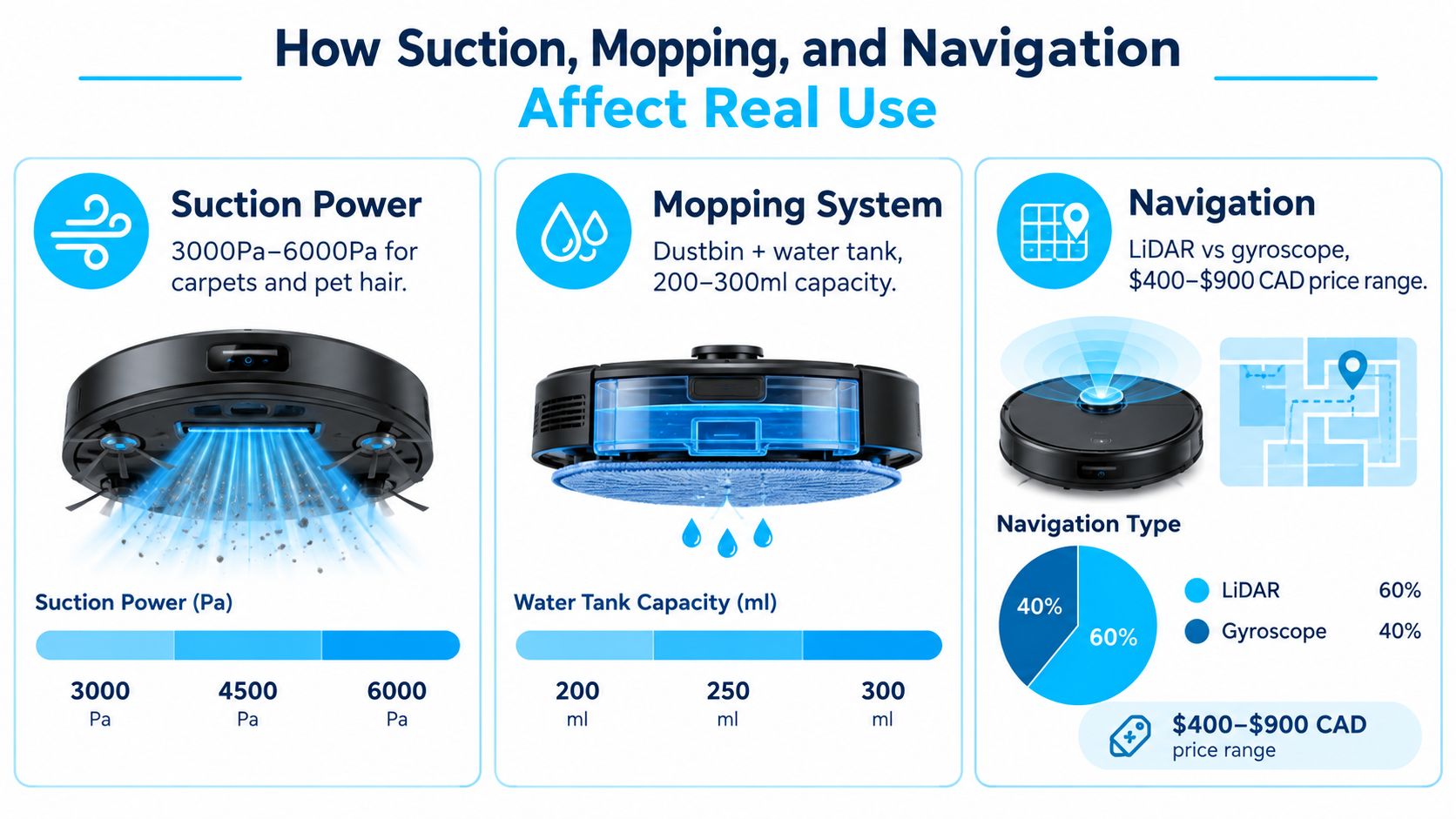
A robot earns its keep in the ordinary mess, not on a spec sheet. In a Canadian home, that usually means fine dust along baseboards, grit at the entry, crumbs in the kitchen, pet hair on area rugs, and the daily debris that builds up between full cleanups. Suction matters, but only if the machine can stay in contact with the floor, keep its brush working properly, and finish a run without getting stuck or stranded.
Retail buying guides rank carpet detection, threshold handling, wheel design, and clearance alongside suction. That matches real ownership. A machine with slightly lower advertised power but better rug behaviour and doorway clearance will usually clean more of your home, more often, with less babysitting.
Mopping is a system, not a checkbox
The mop matters less than the whole routine around it. A pad has to loosen light residue, manage water properly, avoid soaking the floor, and stay clean enough for the next pass. If any part of that chain fails, mopping turns into streaking, smeared dirt, or a damp smell from the dock.
That is why test method matters. RTINGS robot-vacuum test methodology separates stain removal, smearing, residual moisture, and navigation instead of treating “mopping” as one vague feature. That approach is useful for Canadian buyers because winter changes the job. On dry days, a mop can maintain kitchen and bathroom floors well. During wet months, too much moisture left behind can create odour, slippery spots, or extra fuss on sensitive flooring.
Use this order when judging a mopping robot:
- Reliable carpet protection: It lifts or removes the pad before crossing rugs.
- Controlled water output: It leaves the floor damp, not visibly wet.
- Effective agitation: It loosens everyday residue instead of dragging it around.
- Clean dock routine: The base washes and dries the pad so the next run starts clean.
Published product specs can still be useful. iRobot Canada's support information lists mop washing at 165°F/75°C and drying at 122°F/50°C for one combo model. Treat those details as a comparison point, not proof that one unit automatically cleans better than every rival.
Navigation determines whether power gets used
Good navigation saves time, battery life, and maintenance effort. LiDAR usually gives steadier mapping. Camera-based systems can be better at spotting objects left on the floor. Neither fixes a bad layout, a cluttered dining area, or a dock tucked into a narrow corner.
The video below shows how navigation behaviour and mop handling affect coverage, obstacle approach, and day-to-day usability more than headline power alone.
Noise counts too. If a robot interrupts calls, wakes light sleepers, or bothers condo neighbours, it gets scheduled less often. A quieter machine that runs predictably several times a week usually keeps floors cleaner than a louder one with stronger peak performance.
Which Robot Vacuum and Mop Fits Your Home Type
You notice the difference on a February evening. Salt has dried near the condo entry, crumbs are under the stools, and the living room rug edge keeps catching cheap robots. The right machine is the one that keeps up with your layout without turning weekly cleaning into another maintenance job.
Condo living
In a condo in Vancouver or Montréal, compact size and predictable behaviour matter more than oversized specs. Put the dock near the middle of the main living area if you can, but keep it clear of a wet entry zone where grit, slush, and salt can dirty the base fast. Measure threshold lips, rug edges, radiator clearance, and the gap under low furniture before you buy. If the robot cannot get from the kitchen tile to the hall or under the bed frame, the app features will not save it.
A practical condo pick is a slimmer unit such as the Roborock Q7 series if low clearance is your main problem. If your place has area rugs mixed with hard flooring, a model such as the Roomba Combo 10 Max makes more sense because the mop pad handling is better suited to homes where rugs interrupt the route.
Choose:
- Low manual overhead: Self-emptying helps in small homes, but only if bags, filters, and pads are easy to buy in Canada.
- Predictable mapping: Room-based schedules work well when you want a quick kitchen pass without hearing the robot tour the whole condo.
- Mop control: Regular light mopping suits condo hard floors. Reliable pad lifting matters if rugs sit close to dining or sofa areas.
- Moderate noise: In shared buildings, a quieter robot usually gets used more often.
Townhouses and basement-level homes
A townhouse asks more from a robot than a one-level condo. You have stair landings, mixed floor materials, and transitions that look minor until the robot hits them at an angle and stops. Treat each floor as its own cleaning zone unless you are willing to carry the unit between levels.
For this layout, prioritize threshold handling, recharge-and-resume, and carpet detection. Those features matter more than headline suction because the robot has to finish a real route, not win a spec-sheet contest. A Roborock Q Revo can be a sensible fit for larger main floors that need dock support and longer runs. A Roomba Combo 10 Max is a stronger match if the main challenge is mixed rugs and hard flooring on the busiest level.
Basements need extra caution. Uneven flooring, transition strips, and dust around utility areas expose weak wheels and poor mapping quickly.
Pet homes and busy kitchens
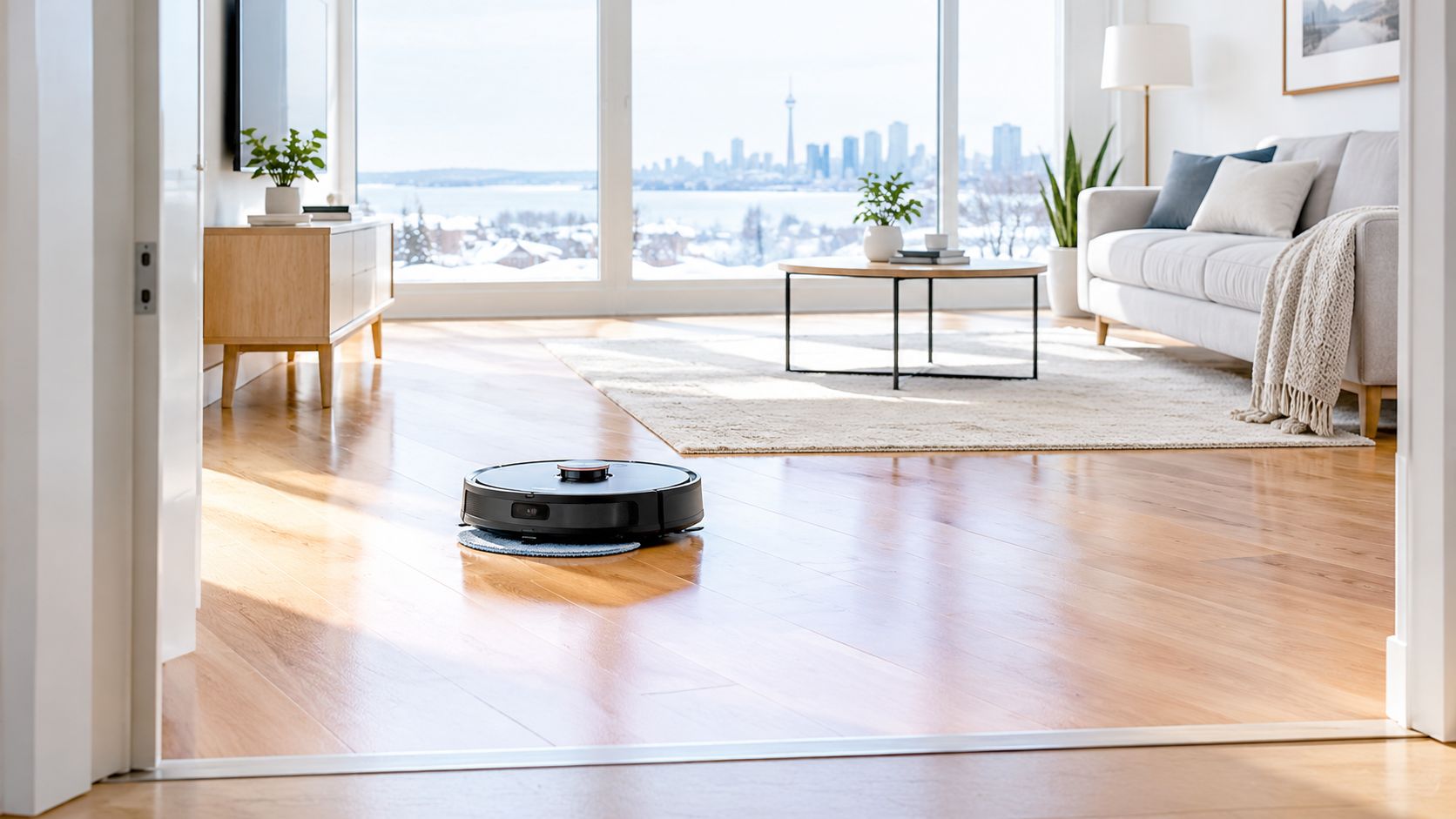
Pet hair reveals bad ownership economics fast. Brushes clog, filters load up, and small bins become annoying within days. Pick a model with an anti-tangle roller, brush ends you can open without tools, and a dock that can handle the debris your home produces. For heavy shedding, a self-emptying Roomba or Roborock usually makes more sense than a basic combo that needs constant bin clearing.
Busy kitchens are a separate test. A robot is good at staying ahead of crumbs and everyday marks. It is a poor choice for wet spills, dropped sauces, and pet accidents. Clear the mess first, then let the robot maintain the floor.
A robot earns its keep through regular ordinary runs. Judge it by how little effort it adds to your week, not by whether it can recover a neglected floor in one heroic pass.
Long-Term Ownership Costs and Repair Reality in Canada
A robot that cleans well for six months and turns into a parts hunt by winter is expensive, even if the sticker price looked reasonable. In Canada, the true ownership test is simple. Can you get the wear parts, battery, and dock support without weeks of hassle or a cross-border runaround?
That matters more with combo units because more moving parts means more failure points. You are not just buying suction and mopping. You are buying rollers, filters, side brushes, pads, a battery, water lines, seals, sensors, wheels, and often a dock with its own pump, fan, and drying hardware.
Before you buy, ask five blunt questions:
- Consumables: Are filters, rollers, side brushes, bags, and mop pads easy to buy in Canada?
- Battery: Is a replacement battery sold here, and can the owner or a service centre install it?
- Dock: If the dock pump, fan, or drying system fails, can the dock be repaired on its own?
- Warranty: Who handles the claim, and who pays return shipping?
- Geography: Do the warranty terms and parts support apply in your province?
As noted earlier in the article, iRobot's Canadian support policy raises a specific after-sales concern for Quebec. That does not automatically rule out a Roomba. It does mean you should treat repairability and replacement parts as a first-tier buying factor, not a footnote. Brand recognition does not give you a local repair path.
Use an ownership-risk score
Score each model before you commit. Give points for Canadian consumables, clear battery support, a mop system you can replace without drama, transparent warranty terms, and a dock that does not become disposable when one component fails. Mark down anything that relies on cross-border parts, vague shipping responsibility, cloud dependence for basic operation, or a dock that is cheaper to replace than repair.
Retail listings can sound reassuring while staying vague. For example, some Best Buy Canada listings describe a one-year repair warranty, but that phrase still leaves open who performs the repair, where the unit goes, and how long you will be without it. Read the actual warranty terms, keep your invoice, and check your provincial consumer protection rules.
For many Canadian buyers, the smarter long-term pick is the less elaborate machine with a clear parts channel and fewer dock complications. Condo owners and renters feel this fastest. A dead dock takes up floor space immediately, and a machine that needs constant consumables hunting stops feeling convenient very quickly.
Final Recommendations by Priority and Budget
There isn't one universal winner. The strongest recommendation depends on what you want the robot to do repeatedly and what you're willing to maintain when automation stops.
Best overall value
Choose a mid-range vacuum-and-mop with dependable mapping, carpet detection, accessible consumables, and a straightforward dock. Don't pay for every premium feature if your home has simple hard floors and modest traffic. Reliable daily coverage beats an impressive specification that adds cost without solving a problem.
Best for condos and thresholds
Prioritise compact dock placement, obstacle clearance, precise room mapping, and quiet operation. Measure doorway transitions and rugs first. If the robot can't cross your most-used thresholds, buy for the rooms it can clean well or choose a model with stronger wheel and clearance design.
Best for heavy pet hair
Choose the model with the best anti-tangle brush and the most practical self-emptying system, not merely the highest suction rating. You'll still inspect the roller and filters, but a design that channels hair efficiently can prevent the most aggravating maintenance failures.
Best for mopping
For mostly hard floors, favour a robot with controlled water delivery, genuine pad washing, drying, and strong stain agitation. A cleanable dock matters because dirty or damp pads turn repeated mopping into residue spreading. Avoid treating a basic wipe attachment as equivalent to a managed washing system.
Best for long-term reliability
Choose the model with the clearest Canadian parts, warranty, and repair path. Accept fewer cameras, modes, or dock tricks if that makes ownership easier. A machine that remains serviceable is a better long-term purchase than a premium unit that becomes disposable after one major failure.
Setup, Placement, and Maintenance Tips for Canadian Homes
Put the dock on a level, hard surface with a clear approach. Avoid narrow corners, heat sources, wet entryways, and areas where winter grit can enter the base. Leave enough room for the robot to leave and return without clipping furniture.
Create room boundaries before the first full run. Keep cords, socks, pet toys, and loose mats off the floor. Use no-go zones around water bowls and delicate rugs, and set lower water output for flooring that shouldn't stay damp.
Keep a small maintenance routine
- After messy weather: Inspect the wheels, intake, and sensors for salt or grit before the next scheduled run.
- For mop hygiene: Empty dirty water promptly, rinse the tray, and let removable parts dry when the dock doesn't provide dependable drying.
- For navigation: Wipe the sensors and camera surfaces with a soft, dry cloth. Celmin's robot vacuum sensor-cleaning guide provides a practical reference for this job.
- For ownership records: Save warranty details, model numbers, consumable links, and purchase receipts in one place.
- For Wi-Fi privacy: Check whether the robot can complete basic cleaning and docking without an internet connection, and review account, camera, mapping, and data-deletion settings.
A LiDAR robot may avoid visual imagery, but its map still describes your home. Camera-equipped models can offer object recognition, while creating a different privacy question. Choose the navigation system whose data practices and offline behaviour you can accept, rather than the one with the most advanced app.
Celmin publishes Canadian buying guides, comparisons, reviews, and setup advice for smart home devices, including robot vacuum-and-mop systems. Visit Celmin to compare models sold for Canadian homes and find practical guidance for setup, maintenance, and everyday use.
Sign up or sign in to join the conversation.