

The ULTIMEA 5.1CH Surround Sound Bar Dolby Atmos 300W sits in a very crowded corner of home audio: the affordable TV soundbar system that promises a bigger, more cinematic sound without asking you to build a full AV-receiver setup. That category matters because most modern TVs still look bett...
The ULTIMEA 5.1CH Surround Sound Bar Dolby Atmos 300W sits in a very crowded corner of home audio: the affordable TV soundbar system that promises a bigger, more cinematic sound without asking you to build a full AV-receiver setup. That category matters because most modern TVs still look better than they sound. Thin panels leave very little room for decent speakers, so even a mid-range soundbar can make dialogue clearer, bass fuller, and movie night noticeably less flat. What makes this ULTIMEA model stand out on paper is the mix of Dolby Atmos, a claimed 300W output, a wired wooden subwoofer, app-based EQ, and a simplified 5.1-channel layout with five built-in speakers.
This is not a hands-on review. Nothing here is based on personally using or testing the product. The goal is simpler: explain what the ULTIMEA 5.1CH Surround Sound Bar Dolby Atmos 300W actually is, what its listed features likely mean in a real living room, how it compares to better-known alternatives, and who it genuinely makes sense for. If you're looking at this as an upgrade for a condo TV, basement setup, or budget home-theater system and want a calmer read than the product page, this is for you.
📺 Watch: ULTIMEA 5.1CH Surround Sound Bar Dolby Atmos 300W in context
Quick snapshot
| Question | What the ULTIMEA 5.1CH Surround Sound Bar Dolby Atmos 300W actually is |
|---|---|
| Category | Electronics |
| Made by | ULTIMEA |
| Typical price | ~$234 CAD (listing at the time of writing — verify current pricing) |
| Rating signal | 4.5/5 on the source listing |
| Best for | TV owners who want fuller sound, stronger bass, and better dialogue without spending AV-receiver money |
| Skip if | You want true rear-speaker immersion, audiophile-grade tuning, or a fully wireless surround package |
Pro tip: If you're considering this model mainly for Dolby Atmos, make sure your TV actually supports HDMI eARC and that your streaming app outputs Atmos on your plan tier. Otherwise, you're paying for a feature you may barely use.
What the ULTIMEA 5.1CH Surround Sound Bar Dolby Atmos 300W actually is
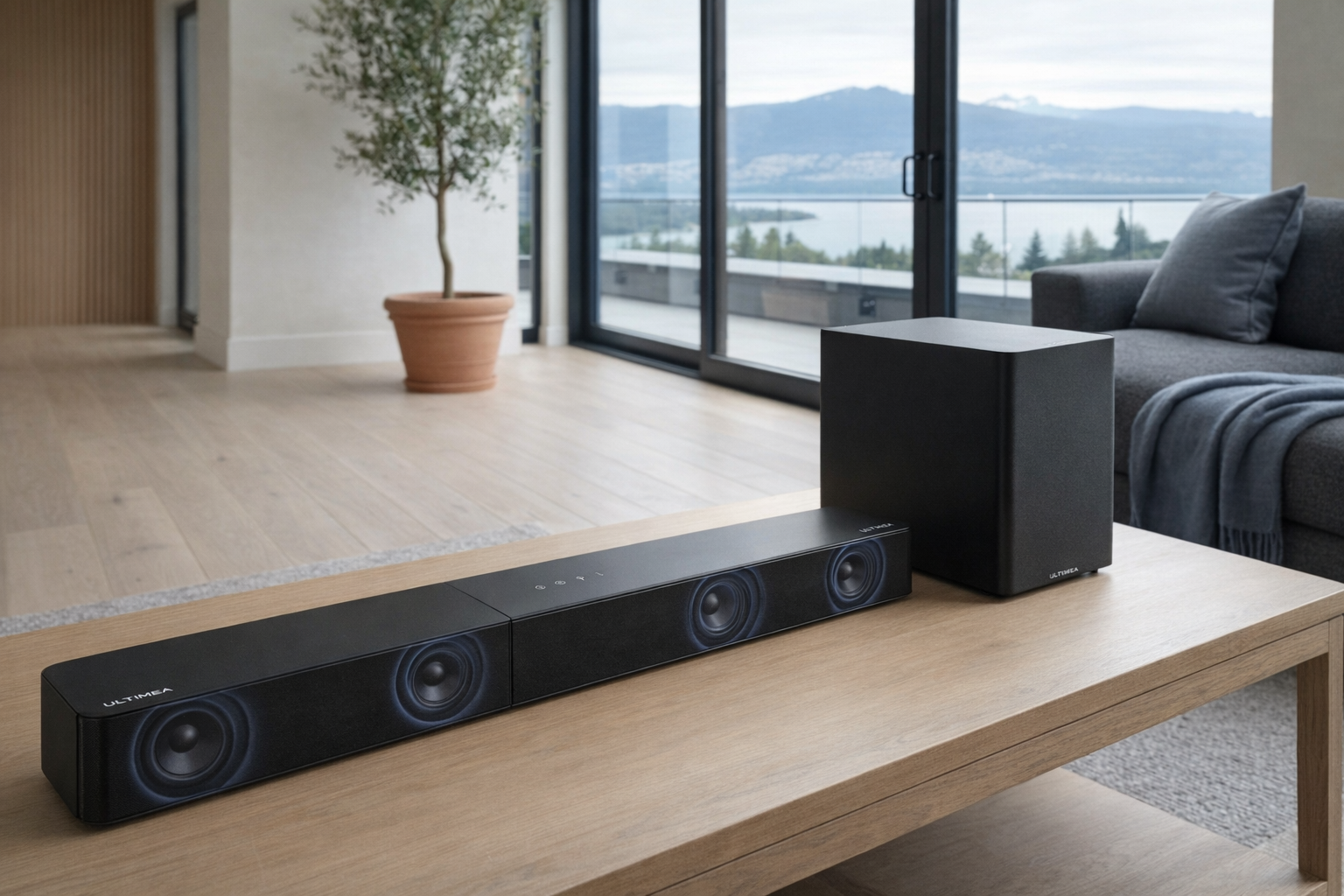
In plain English, this is an all-in-one TV audio upgrade aimed at people who want more than a basic bar but less hassle than a traditional home-theater system. It combines a main soundbar, a wired subwoofer, built-in multi-driver speaker layout, and software-based sound shaping to create something that should sound wider, heavier, and clearer than your TV speakers. The headline terms here are familiar but worth translating: 5.1-channel means it is trying to create left, centre, right, and surround-style effects plus bass; Dolby Atmos means it can process object-based audio formats when fed the right signal; and 300W suggests it is meant for medium-size rooms rather than just bedroom TVs.
ULTIMEA 5.1CH Surround Sound Bar with Subwoofer, Dolby Atmos, VoiceMX, BassMX, APP, 300W Soundbar for Smart TV, Home Theater Surround Sound System for TV, BT 5.4, Poseidon M60 (2025 Model)
The most important thing to understand is that this is still a soundbar system, not a full discrete speaker package. The listing says it uses five built-in speakers including two side-firing drivers, which implies it is creating width and some surround impression from the front of the room rather than placing speakers behind you. That's a common and sensible compromise at this price. It is cleaner to install, easier to fit in an apartment, and usually more realistic for buyers under $300 CAD.
A useful comparison is the Vizio 5.1 Soundbar SE class of product, which often uses separate rear speakers to create a more literal surround effect. The ULTIMEA approach sounds more compact and simpler, but probably less convincing if your only goal is "sound behind me." On the other hand, the inclusion of HDMI eARC, 10-band EQ, and 121 sound presets is more tweakable than many ultra-budget bars. That's a more honest trade-off than some competitors make: easier setup, less speaker clutter, but also less magic than a true rear-speaker package.
Key features at a glance
- Simplified 5.1-channel Dolby Atmos setup with five built-in speakers
- Two side-firing drivers to widen the soundstage
- VoiceMX dialogue enhancement for clearer voices
- 300W output with a 6-driver system
- Wired wooden subwoofer for deeper low-end
- 18 mm high-excursion driver with BassMX technology
- HDMI eARC for Dolby Atmos and higher-quality TV audio return
- App control with 10-band EQ and 121 sound presets
- Bluetooth 5.4 for lower-latency wireless streaming
How the ULTIMEA 5.1CH Surround Sound Bar Dolby Atmos 300W actually works
At a basic level, the system takes audio from your TV through HDMI eARC, processes it inside the bar, splits different parts of the sound across its internal drivers, and sends bass to the wired subwoofer. That sounds simple because it is. The point of a product like this is to avoid a receiver, speaker wire runs across the room, and the general sprawl of classic home theater.
There are a few product-specific pieces worth unpacking. First, the centre-channel effect matters more than the Atmos logo for a lot of buyers. In most living rooms, the daily complaint is not "I lack vertical object-based audio." It is "why are voices muddy?" ULTIMEA's VoiceMX feature is clearly aimed at that exact problem. In plain terms, it is a dialogue-enhancement mode or tuning layer designed to pull speech forward so you are not constantly riding the remote during movies and streaming shows.
Second, the BassMX branding and the mention of an 18 mm high-excursion driver tell you ULTIMEA wants the low end to feel punchier than a bare soundbar can manage on its own. Since the included subwoofer is wired and described as wooden, this suggests a more traditional sub design than the tiny plastic wireless cubes bundled with some entry-level systems. Wired is less elegant, but it can also be less finicky. No pairing headaches, no random wireless dropouts, and usually lower setup drama.
Third, the side-firing drivers are doing a lot of the spatial work. Instead of putting speakers behind your couch, the system bounces or spreads audio sideways to make the room feel wider. In the right room — flat walls, not too open, seating fairly central — that can work surprisingly well. In a very open-plan living room, the effect is often less dramatic. That's not a flaw unique to ULTIMEA; it's just the physics of virtual surround.
The app is the other meaningful piece here. A 10-band EQ is more granular than the simple "movie/music/news" presets you get on many budget bars, and 121 sound presets suggests lots of user tuning options. That is useful if your room is boomy, your TV cabinet reflects too much treble, or one person's "clear dialogue" is another person's "harsh and thin." Evaluate that app like a useful tuning tool, not a miracle worker.
A realistic "day in the life" with ULTIMEA 5.1CH Surround Sound Bar Dolby Atmos 300W
Because this is an informational explainer, the scenario below is based on the listed features and typical soundbar behaviour — not a tested account.
- Morning. You turn on the TV for news or a morning talk show. Instead of thin, downward-firing TV audio, the VoiceMX dialogue enhancement would likely make anchors and hosts easier to understand at lower volume, which matters if others in the home are still asleep.
- Midday. Someone uses the soundbar as a Bluetooth speaker while cleaning or working from the kitchen table. With Bluetooth 5.4, the connection should be more stable than older Bluetooth versions, and latency should be low enough for casual streaming, though TV use is still best over HDMI.
- Afternoon. A kid's movie or a console game gets the full system working harder. The side-firing drivers widen the presentation, and the wired subwoofer handles explosions, music cues, and rumble that a TV simply cannot produce by itself.
- Evening. Movie night is when HDMI eARC and Dolby Atmos matter most. If the TV, app, and content all support Atmos correctly, the system should deliver a more spacious front-heavy cinematic effect than standard stereo, with extra impact from the 300W system power and bass tuning.
Who the ULTIMEA 5.1CH Surround Sound Bar Dolby Atmos 300W is actually for (and who it isn't)
Great fits
- People upgrading from built-in TV speakers who want an immediate quality jump without learning receiver menus.
- Condo or apartment households that want stronger bass and clearer dialogue but cannot justify a bulky speaker package.
- Movie and streaming fans who mainly use Netflix, Disney+, Prime Video, or a game console through a modern TV with eARC.
- Budget-conscious buyers who still want more control than basic soundbars offer, especially the 10-band EQ and large preset library.
- Parents or older viewers who struggle with inconsistent dialogue levels and want a dedicated speech-enhancement option.
Poor fits
- Buyers expecting true theatre-style surround from actual speakers behind the couch.
- Audiophiles who want precise channel separation, room correction, and higher-end components from brands like Sonos, Samsung, or Klipsch.
- Minimalists who hate cable management, because the wired subwoofer still needs physical placement and a cable run.
- Shoppers with older TVs lacking HDMI eARC, who may not get the cleanest version of the advertised Atmos experience.
- People who mostly watch YouTube clips and daytime TV and would be perfectly happy with a much cheaper 2.1 soundbar.
Practical trade-offs
Install and room layout
This product sounds simpler than a full surround setup, but it is not cable-free. The bar itself sits under or in front of the TV, and the wired subwoofer needs to live somewhere nearby with access to both power and its cable path. For some rooms that is easy. For others, especially wall-mounted TVs with very tidy furniture, it creates one more visible wire problem to solve.
Room shape also affects performance more than marketing pages admit. Side-firing drivers work best when the sound has walls to reflect off. If your TV sits in a huge open basement or one side of the room spills into the kitchen, the "surround" effect may be more subtle than the product name suggests.
Dolby Atmos expectations
The honest version: Dolby Atmos on a soundbar under $234 CAD is not the same thing as a full Atmos speaker layout with dedicated height channels around the room. What you are getting is format support and some spatial processing, helped by driver placement and room reflections. That can absolutely sound better than standard TV audio, but it should be evaluated like a smart compromise, not like a multiplex cinema transplant.
The good news is that HDMI eARC is the right connection to have if you want the best shot at proper audio pass-through from a modern TV. That's more future-friendly than older optical-only bars. But your source chain still matters: TV settings, streaming app support, and subscription tiers can all limit what reaches the bar.
Bass, neighbours, and everyday use
A 300W system with a real subwoofer is enough to make itself known in a small or medium room. That is a feature, but also a practical warning if you share walls. Plenty of buyers want "cinematic bass" until the first late-night action scene rattles the media console or annoys the downstairs neighbour.
The upside is that the app-based EQ and presets should let you tame that. That flexibility matters. A soundbar that only has one aggressive tuning can become tiring fast. Here, at least on paper, you have a better chance of shaping it for sports, talk-heavy TV, or quieter nighttime watching.
Where the ULTIMEA 5.1CH Surround Sound Bar Dolby Atmos 300W fits in a smart home
This product makes the most sense as the audio layer for a mainstream TV setup, not as some central smart-home hub. Pair it with a Google TV, Apple TV 4K, Fire TV Stick 4K Max, or a recent smart TV from Samsung, LG, Sony, or TCL, and it becomes the thing that makes everyday viewing feel less cheap. That's its job.
A realistic setup might look like this:
- TV with HDMI eARC handles video and passes higher-quality audio back to the bar
- Streaming box or console such as PlayStation 5 or Xbox Series X supplies movie and game audio
- ULTIMEA soundbar + wired subwoofer handles the heavy lifting for speech, impact, and width
- Smart home platform like Alexa, Google Home, or Apple Home continues managing lights and routines
That division is healthy. Do not buy this because it says "home theater" and assume it solves your whole entertainment stack. Buy it because you want your existing TV setup to sound more substantial. In a bedroom TV setup, it may be overkill. In a living room with a 55-inch or 65-inch TV, it makes a lot more sense.
The buying decision, in plain terms
Before buying, three questions usually make the answer obvious:
- Does your TV support HDMI eARC, and do you actually watch Atmos-capable content? If yes, this model's audio format support is meaningful. If not, a cheaper non-Atmos bar may give you almost the same real-world benefit.
- Do you want stronger bass badly enough to place a wired subwoofer somewhere in the room? If yes, this is likely a worthwhile upgrade over slim all-in-one bars. If no, the cable and box may become a daily annoyance.
- Are you solving a real problem — weak TV audio, muddy dialogue, flat movie sound — or just chasing logos? If it is the first one, this looks sensible. If it is the second, spend carefully.
Three yeses make this a reasonable value pick for mainstream TV use. If any answer is a firm no, a simpler 2.1 bar or a step-up system with real rear speakers may fit better.
Got Questions About the ULTIMEA 5.1CH Surround Sound Bar Dolby Atmos 300W? Let's Clear Things Up.
Is this a hands-on review?
No. This is an informational explainer based on the product listing and what those features usually mean in practice. It is meant to help you decide whether the product category and feature set match your room and habits.
Does this system have real rear speakers?
Based on the provided feature set, it uses five built-in speakers including two side-firing drivers rather than separate rear speakers placed behind the seating area. That means it is aiming for simplified surround from the front of the room. It may sound wide and more immersive than TV speakers, but it is not the same as a true discrete rear-speaker layout.
What does HDMI eARC actually do here?
HDMI eARC is the best connection option for a soundbar like this because it can return higher-quality audio from your TV to the soundbar, including better support for formats like Dolby Atmos. It also simplifies control, since many TVs can pass volume commands over HDMI. If your TV lacks eARC, check the current spec page to see what fallback options are supported.
Is 300W actually enough for a living room?
For most small to medium living rooms, 300W is more than enough to sound substantially bigger than built-in TV speakers. The included subwoofer should also help the system feel fuller at lower volumes. It does not guarantee premium sound quality by itself, but it is a healthy number for this price tier.
Is the app control actually useful, or just extra clutter?
On a product like this, the app is useful if you care about tuning. A 10-band EQ gives you more control than the basic sound modes found on cheaper bars, and 121 sound presets suggests lots of adjustment options. If you never change settings, you may barely use it, but for dialogue-heavy TV or bass-heavy rooms, it can be genuinely helpful.
Where can you verify the current listing or buy it?
The product listing referenced here is on Amazon at this link. That is the best place to verify current pricing, bundled accessories, and any spec changes. As always, check the live listing before buying, since availability and details can shift.
What does it cost in Canada?
At the time of writing, the listed price is roughly ~$234 CAD. That puts it firmly in the budget-to-lower-midrange soundbar category. Verify current pricing before purchase, especially if exchange rates or marketplace sellers are involved.
Where is the Celmin Directory listing for this product?
For a catalog-style view of the same product — structured specs, pros and cons, similar picks, and FAQ — see ULTIMEA 5.1CH Surround Sound Bar Dolby Atmos 300W on Celmin Directory.
If you're building a smarter home in Canada and want honest explainers on gadgets worth considering — plus the ones worth skipping — Celmin covers the full catalog without the marketing theater. More reviews, comparisons, and buyer guides at https://celmin.ca.






Discussion
Sign up or sign in to join the conversation.