
The Crustello sits in an odd but increasingly real category: the smart baking gadget that is not trying to knead, mix, or bake anything for you. Instead, it is focused on one narrow, frustrating part of breadmaking — fermentation timing. If you have ever looked at a bowl of dough and wondered...
The Crustello sits in an odd but increasingly real category: the smart baking gadget that is not trying to knead, mix, or bake anything for you. Instead, it is focused on one narrow, frustrating part of breadmaking — fermentation timing. If you have ever looked at a bowl of dough and wondered whether it needs 20 more minutes, 2 more hours, or whether your kitchen's winter dry air has thrown the whole schedule off, that is the problem Crustello is trying to solve.
This is not a hands-on review. Nothing here is based on personally using the device. The goal is simpler and, for most buyers, more useful: explain what Crustello actually is, what the listed features suggest about daily use, where it might genuinely help, and where it risks becoming another app-dependent kitchen accessory. If you are trying to decide whether this is a serious baking tool or just smart-home theatre for sourdough people, this is the calmer version of that conversation.
📺 Watch: Crustello in context
Quick snapshot
| Question | What the Crustello actually is |
|---|---|
| Category | Smart Kitchen |
| Made by | Crustello |
| Typical price | ~$135 CAD (listing at the time of writing — verify current pricing) |
| Rating signal | Check current reviews |
| Best for | Home bakers who regularly ferment dough, sourdough hobbyists, people who want alerts instead of guesswork |
| Skip if | You only bake occasionally, prefer intuition over apps, or do not want another Wi-Fi/Bluetooth device in the kitchen |
Pro tip: If you are considering Crustello, think of it as a fermentation monitor, not a magic bread improver. It can help you read the dough more consistently, but it will not fix bad flour, weak technique, or unrealistic expectations.
What the Crustello actually is
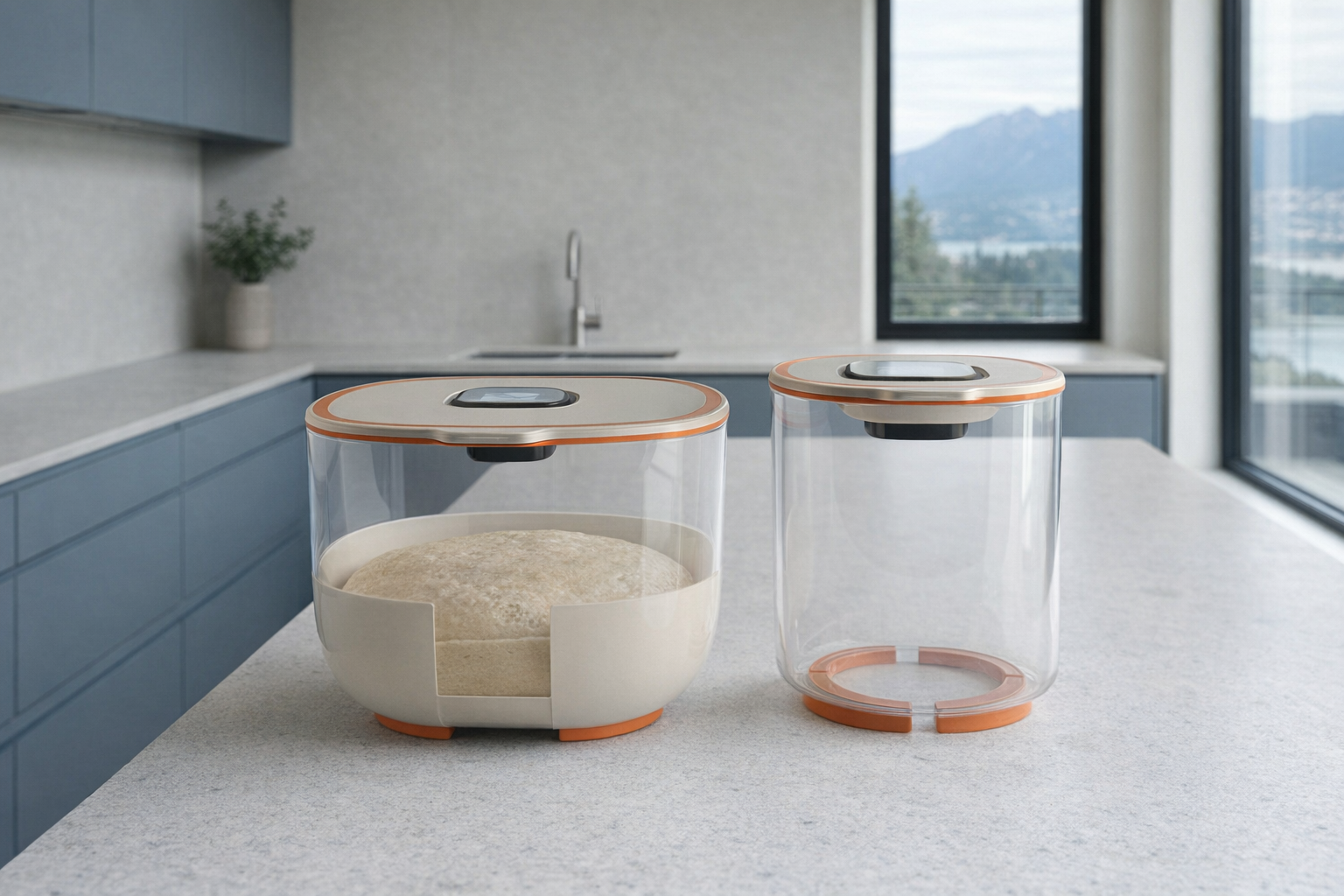
In plain English, Crustello is a connected sensor tool for bakers who care about fermentation timing and want something more precise than poking dough and hoping for the best. The core idea is straightforward: instead of relying only on visual judgment, room feel, and habit, Crustello tracks how dough volume changes over time while also monitoring temperature and humidity. It then uses that data to estimate when the dough or starter is ready for the next step.
Crustello is a smart baking tool that removes the guesswork from fermentation by tracking volume, temperature, and humidity in real time. With precise sensor data and a powerful AI-powered app, you always know when your dough or sourdough starter is ready.
That is a much narrower promise than many connected kitchen products make, and that is actually a point in its favour. Crustello is not pretending to replace a stand mixer, a proofing box, or your oven. It is trying to be the data layer for fermentation. At ~$135 CAD, that puts it in a more specialized position than a generic kitchen thermometer, but far below the cost of buying a full pro-style proofing setup. A useful comparison is the Brød & Taylor Sourdough Home: that product actively controls fermentation temperature, while Crustello appears to focus on monitoring and prediction. That is a more modest and, frankly, more honest role.
Key features at a glance
- Real-time dough rise tracking
- Temperature and humidity sensors
- AI-powered fermentation predictions
- Custom alerts for shaping and baking
- 700+ hours offline data storage
- Wi-Fi and Bluetooth connectivity
How the Crustello actually works
The logic behind Crustello is pretty easy to understand even if the marketing leans on "AI." Fermentation changes dough volume over time, and that rise is affected heavily by environmental conditions — especially temperature and humidity. Crustello's job is to measure those variables, log them, and feed them into an app that tries to predict readiness more accurately than a timer alone can.
There are really three layers to how it appears to work. First, the device monitors the dough's rise in real time. Second, it tracks the room or proofing environment through its temperature and humidity sensors. Third, the app takes that sensor history and turns it into practical prompts: your dough is approaching shaping, your starter is ready, or it may be time to bake. That makes it less like a smart scale and more like a fermentation coach with data attached.
The 700+ hours of offline data storage is one of the more interesting details here. That suggests Crustello is not completely dependent on a perfect Wi-Fi connection every minute of the day. If your kitchen Wi-Fi drops, the device can reportedly keep logging data and sync later. That's a better design than the usual cloud-first kitchen gadget that becomes half-useful the moment your router acts up.
The dual Wi-Fi and Bluetooth connectivity also makes sense for setup and daily use. Bluetooth likely handles nearby pairing and communication, while Wi-Fi supports remote access, syncing, and app-based alerts when you are not standing in the kitchen. For a fermentation tool, that matters: dough rarely finishes rising exactly when it is convenient for you to check it.
A realistic "day in the life" with Crustello
Because this is an informational explainer, not a test report, the best way to picture Crustello is through a realistic routine based on the listed features.
- Morning. You feed a sourdough starter or mix a dough before work. Crustello begins tracking rise, along with the kitchen's temperature and humidity, rather than leaving you to guess how a cooler morning will affect timing.
- Midday. While you are away from the counter, the app checks the fermentation trend and sends a custom alert that the dough is nearing the point where shaping makes sense. That is the practical value of the prediction layer: not pure automation, just a better nudge.
- Afternoon. If your Wi-Fi has been patchy, Crustello keeps collecting data locally thanks to its 700+ hours of offline storage. Later, it syncs back to the app so the fermentation history is not lost.
- Evening. Instead of staring at dough and trying to decide whether it is underproofed or just slow because the house is dry, you use the tracked rise plus the environmental data to decide whether to shape, retard, or bake. That does not remove judgment, but it gives your judgment more context.
For someone who bakes every week, that flow makes sense. For someone who makes pizza dough six times a year, it may be overkill.
Who the Crustello is actually for (and who it isn't)
Great fits
- Home sourdough bakers who already keep notes and want better data than "left it on the counter for 4 hours."
- People with inconsistent kitchen conditions — cold basements, dry winter homes, drafty counters, or seasonally shifting fermentation behaviour.
- Busy parents or remote workers who cannot babysit dough all afternoon and would rather get an alert at the right moment.
- Bakers who are still learning fermentation and want a calmer bridge between instinct and consistency.
- Gift buyers shopping for someone who is genuinely bread-obsessed, not just vaguely interested in kitchen gadgets.
Poor fits
- Casual bakers who mostly use commercial yeast and follow simple same-day recipes a few times per year.
- Anyone hoping a smart device will substitute for understanding hydration, flour strength, shaping, or oven management.
- People who dislike using apps in the kitchen and want every tool to work independently with no account, syncing, or notifications.
- Minimalists with crowded counters who do not want another single-purpose gadget, even a relatively focused one.
- Bakers who already have a stable proofing routine and are happy trusting experience over data.
Practical trade-offs
Precision vs. dependence on the app
Crustello's value seems tied heavily to the app. The sensors are only useful if the software translates the readings into something practical, like estimated readiness and custom alerts. That means you are not just buying a sensor; you are buying into Crustello's software interpretation of fermentation.
For some people, that is exactly the appeal. For others, it is a weakness. If the app is excellent, the product makes sense. If the app is clunky, limited, or eventually neglected, the hardware becomes much less compelling. That is the recurring reality of connected kitchen gear: the software is not extra, it is the product.
Kitchen setup and workflow friction
A good baking tool should reduce stress, not add another ritual. Crustello likely asks you to place it properly, pair it, monitor it through the app, and incorporate its readings into your routine. None of that sounds difficult on paper, but even small setup steps matter in a flour-dusted kitchen when your hands are busy and your timing is already tight.
This is why it will probably appeal more to repeat bakers than beginners who are still just trying not to overwork dough. If you already do regular bulk fermentation, cold proofing, and starter maintenance, adding one more measurement layer is reasonable. If you are still deciding whether you even enjoy making bread, simpler tools are usually the better buy.
Long-term support and trust in predictions
The phrase "AI-powered" should always trigger at least mild skepticism. In Crustello's case, the practical question is not whether the app uses AI in some technical sense. The real question is whether the predictions are trustworthy enough to change how you ferment dough.
That trust takes time to earn. Fermentation is messy because flour, hydration, starter strength, recipe style, and room conditions all vary. A tool that tracks temperature, humidity, and rise has a solid foundation, but it is still giving guidance, not gospel. Evaluate it like a smart thermometer with pattern recognition, not like a robotic baker. That mindset keeps expectations realistic.
Where the Crustello fits in a modern kitchen
Crustello makes the most sense in a kitchen that already has a few boring, reliable basics in place. Think of it as a specialist layer on top of a normal breadmaking setup, not the centrepiece.
A sensible stack might look like this:
- A digital scale for accurate ingredient measurement
- An instant-read thermometer for water temperature and finished bread checks
- A Dutch oven or baking steel for the actual bake
- Optional climate help, such as a turned-off oven with the light on or a dedicated proofer like the Brød & Taylor Sourdough Home
- Crustello for tracking the fermentation curve and sending readiness alerts
That division matters. Crustello does not knead, heat, or proof with active climate control. It observes and interprets. In a smart-home sense, it is closer to a sensor than an appliance. If you already use ecosystems like Alexa, Google Home, or Apple Home, Crustello is not replacing those either. It belongs in the phone-plus-counter-tool lane, alongside your scale and recipe app, not beside your smart speaker.
The buying decision, in plain terms
Three questions usually make the Crustello decision fairly clear:
- Do you bake fermented dough often enough to justify a dedicated tool?
If bread, pizza dough, or sourdough starter is part of your weekly routine, Crustello has a real use case. If not, it risks becoming a novelty. - Do you want data, or do you actually want automation?
Crustello seems built for monitoring and prediction, not active control. If you want the environment itself regulated, a proofing appliance may be a better match. - Are you comfortable trusting an app as part of your baking workflow?
The appeal here is sensor-backed guidance and alerts. If that sounds helpful, it may be worth the ~$135 CAD. If that sounds annoying, the answer is probably no.
If you answer yes to all three, Crustello looks like a sensible specialty tool; if you hesitate on two or more, stick with a scale, a thermometer, and experience.
Got Questions About the Crustello? Let's Clear Things Up.
Is this a hands-on review?
No. This is an informational explainer based on Crustello's listed features, pricing, and the broader category of connected kitchen tools. It is meant to help you understand what the product is for and what trade-offs come with it.
What does Crustello actually measure?
According to the listing, Crustello tracks volume, temperature, and humidity in real time. That combination is meant to give bakers a better read on fermentation progress than using time alone.
Does Crustello work without Wi-Fi?
It appears to support both Wi-Fi and Bluetooth, and the listing also mentions 700+ hours offline data storage. That suggests it can continue recording data locally even when your connection drops, then sync later. For a kitchen device, that is a practical feature rather than a flashy one.
Is Crustello mainly for sourdough, or can it help with regular dough too?
The product description specifically mentions both dough and sourdough starter. So while sourdough bakers are the obvious target audience, the same fermentation tracking idea should also apply to pizza dough, bread dough, and other recipes where rise timing matters.
Where can you verify the latest details or buy it?
The safest place to verify current features, app claims, and availability is the official retailer page here: Crustello. Since connected products can change over time, it is smart to check the current spec page and support details before buying.
Does Crustello replace learning how fermentation works?
No. It may help you read fermentation more consistently, but it does not eliminate the need to understand dough behaviour. Think of it as guidance built on sensors, not a substitute for technique.
What does it cost in Canada?
At the time of writing, Crustello is listed at ~$135 CAD. As with most niche kitchen gadgets, pricing can move around, so it is worth checking the official product page before ordering.
Where is the Celmin Directory listing for this product?
For a catalog-style view of the same product — structured specs, pros and cons, similar picks, and FAQ — see Crustello on Celmin Directory.
If you're building a smarter home in Canada and want honest explainers on gadgets worth considering — plus the ones worth skipping — Celmin covers the full catalog without the marketing theater. More reviews, comparisons, and buyer guides at https://celmin.ca.
Discussion
Sign up or sign in to join the conversation.