
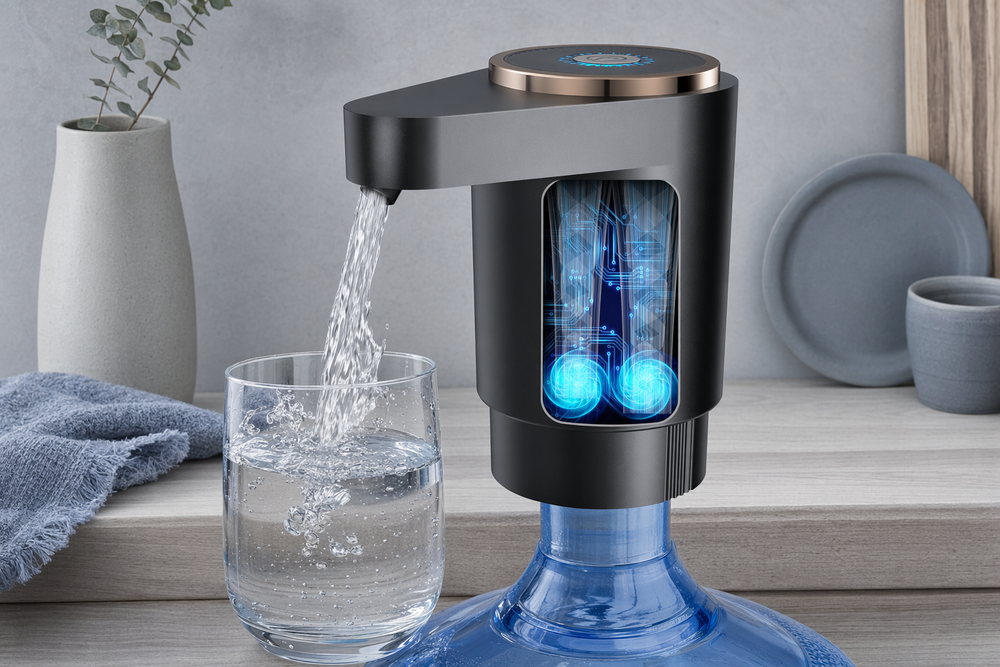
Every Canadian household that buys five-gallon water jugs knows the same awkward ritual. You hoist a 18-kilogram bottle onto a countertop stand, or you tilt the jug at an angle that guarantees a puddle, or you buy a bulky electric cooler that costs more than a year of refills. The jug itself is f...
Every Canadian household that buys five-gallon water jugs knows the same awkward ritual. You hoist a 18-kilogram bottle onto a countertop stand, or you tilt the jug at an angle that guarantees a puddle, or you buy a bulky electric cooler that costs more than a year of refills. The jug itself is fine — the delivery economics work, the water tastes clean, and you avoid single-use plastic by the case. The interface between jug and glass is where dignity goes to die.
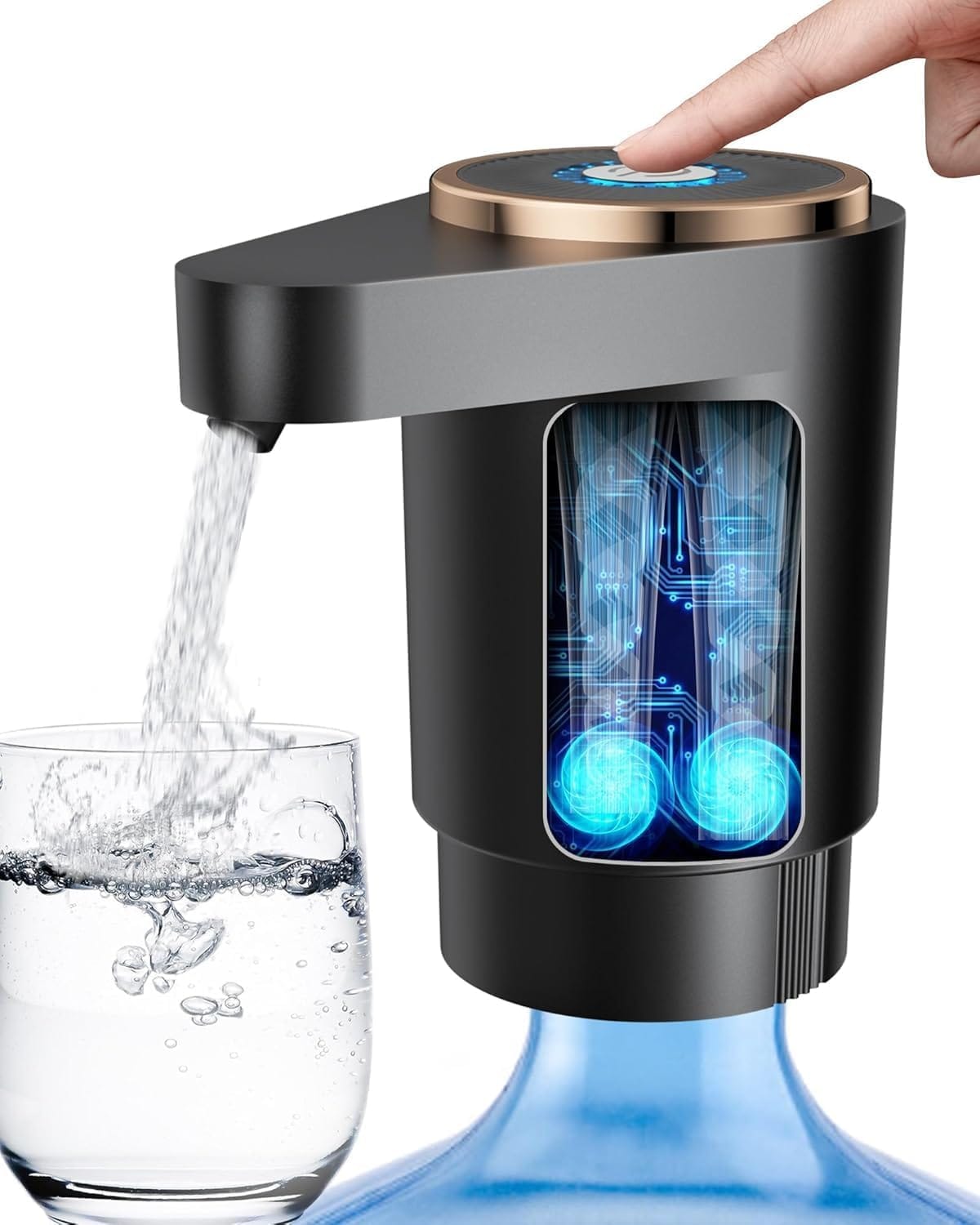
The USB rechargeable water dispenser pump is the category's honest answer: a small electric pump that sits on the bottle cap, dispenses water at the push of a button, and charges from any USB port. It is not glamorous. It will not impress dinner guests. But for kitchens, offices, cottages, and RVs where a five-gallon jug is already part of life, it removes the one part everyone hates. Understand what these pumps can and cannot do, and you'll know in a minute whether this is a $25 convenience or a $25 regret.

The snapshot
| USB Water Dispenser Pump | |
|---|---|
| What it is | Battery-powered pump that sits on standard 5-gallon (18.9 L) bottle necks |
| Power | USB rechargeable — typically 600–1200 mAh internal battery |
| Dispense | One-button flow; most units move 0.5–1 L per minute |
| Runtime | Roughly 30–60 full glasses per charge on typical units |
| Fit | Standard 55 mm bottle mouths (most Canadian delivery jugs) |
| Weight | ~200–350 g — small enough for a cottage bag |
| Real price (CAD) | ~$20–35 depending on brand and promotions |
What buyers on Amazon are saying
Listings in this category typically sit between 4.0 and 4.4 stars with hundreds to a few thousand ratings — enough volume that the patterns repeat even when individual brand names change. Amazon's review summaries for these pumps cluster around a handful of themes that match what owners describe in verified comments.
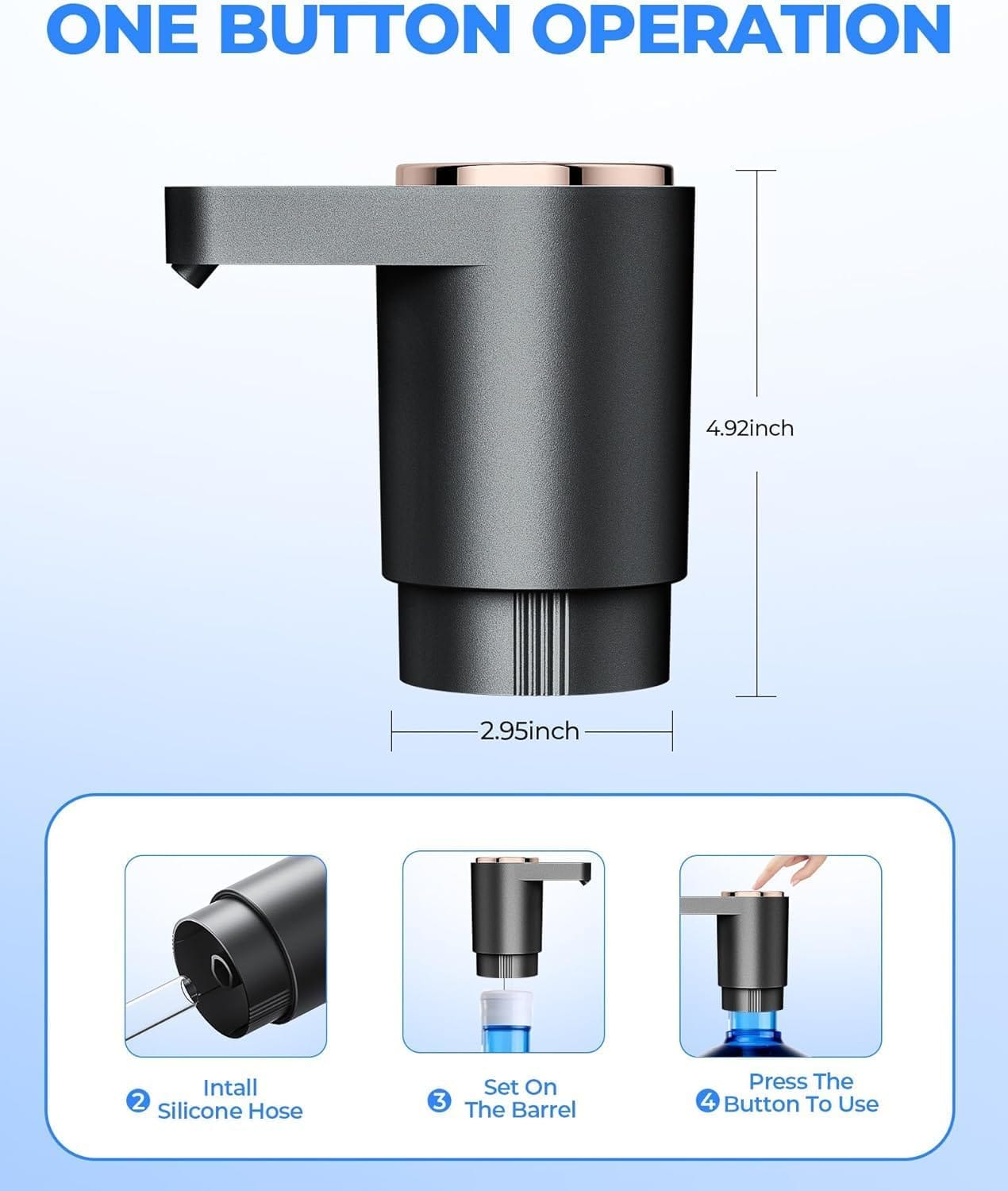
Convenience is the dominant positive. Buyers praise one-handed dispensing, especially for seniors, office break rooms, and anyone tired of lifting full jugs. "No more tipping the bottle" appears in some form in a large share of five-star reviews. Setup is described as minutes: charge the unit, press the silicone adapter onto the bottle neck, double-tap to prime, and pour.
Portability comes up often from cottage and RV owners. A pump that lives in a drawer and travels in a tote beats hauling a countertop stand to the lake. USB charging means a power bank or car adapter handles weekends away.
The friction shows up predictably:
- Battery life — Heavy households report needing a recharge every three to seven days. Light use stretches that to two weeks. A minority of buyers expected month-long battery life and were disappointed; these pumps sip power compared to a phone, but they still draw current every time you press the button.
- Flow rate — Impatient reviewers call the stream "slow." Most units fill a standard glass in 15–25 seconds. That is fine for drinking water and coffee; it is tedious for filling a pasta pot.
- Seal and fit — The silicone gasket must sit flat on the bottle mouth. Buyers with slightly non-standard jugs (some warehouse-club brands, older bottles with worn threads) report drips or a loose fit. The fix is usually repositioning the adapter or adding a thin compatibility ring — but not every jug is identical.
- Longevity — At this price point, pumps are consumable-adjacent. Most last 12–24 months of daily use before the motor weakens or the battery holds less charge. A small minority fail within weeks; return policies on Amazon.ca usually cover that.
Smaller recurring notes: the first prime after attaching sometimes needs two button presses; night-light versions exist but this listing is the basic pump; and cleaning means running a vinegar rinse through the tube every month or two if you taste plastic or stale water.
None of this replaces trying the pump on your actual bottles, but it is the honest shape of owner opinion: people who wanted hands-free dispensing from standard jugs tend to consider it money well spent; people who needed fast-fill or industrial durability tend to upgrade to a plumbed cooler instead.
What it's actually trying to do
A five-gallon jug is a storage vessel, not a faucet. Gravity-fed stands work, but they require lifting the full jug onto a platform — roughly 18 kg of water plus plastic — and they leave the bottom litre unreachable without tilting. Manual pump handles exist, but they are arm workouts disguised as kitchen tools.
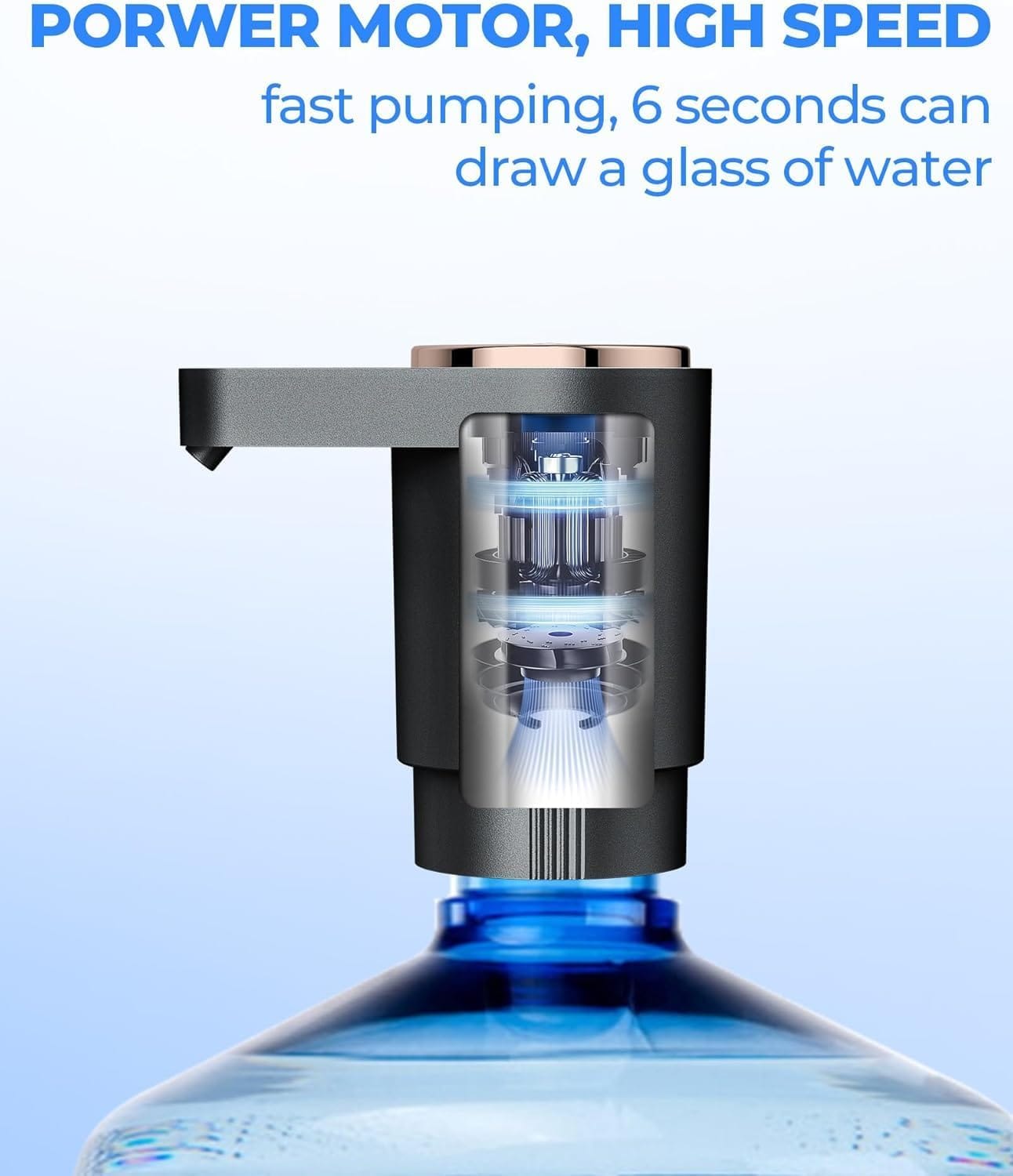
The electric pump's job is narrower: create a small pressure differential that moves water up a silicone tube and out a spout when you ask. The motor draws from an internal lithium cell, which is why USB recharge matters — you are not tethered to a wall socket, and you are not buying disposable batteries every month.
The engineering constraint is always the same: small motor, small battery, reasonable price. Nobody at $25 is shipping a pump that fills a stock pot in thirty seconds. The category optimizes for drinking-water convenience, not bulk transfer.
The battery math, explained properly
Buyers see "USB rechargeable" and assume phone-like endurance. These pumps are more modest.
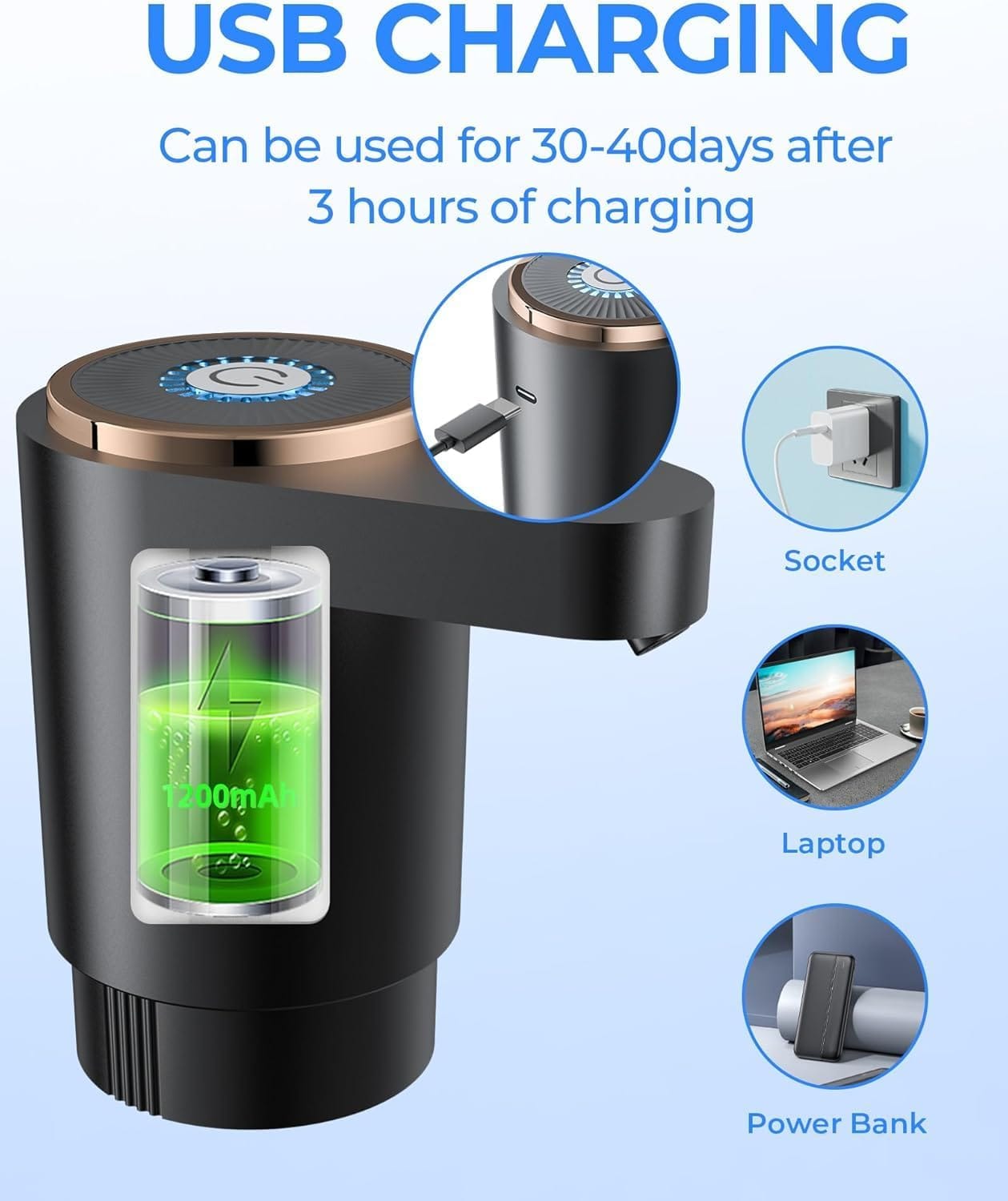
A typical session — filling a 500 ml bottle twice a day — draws far less energy than heating water or running a fan. Most units in this class ship with 600–1200 mAh cells. In practice that translates to roughly 30–60 glasses per charge, or about a week of family use before you plug in for two to three hours.
Two consequences worth internalizing:
- Dead battery means manual lifting again. There is no gravity bypass. Keep a USB cable in the kitchen drawer the way you keep spare filters.
- Cold cottages slow everything. Lithium batteries deliver less current below freezing. If you leave the pump in an unheated cabin over winter, expect shorter runtime until it warms up.
Charging from a 5W phone brick is fine; these pumps are not power-hungry. A laptop port or car USB adapter works equally well.
Fit, seals, and the bottle you already have
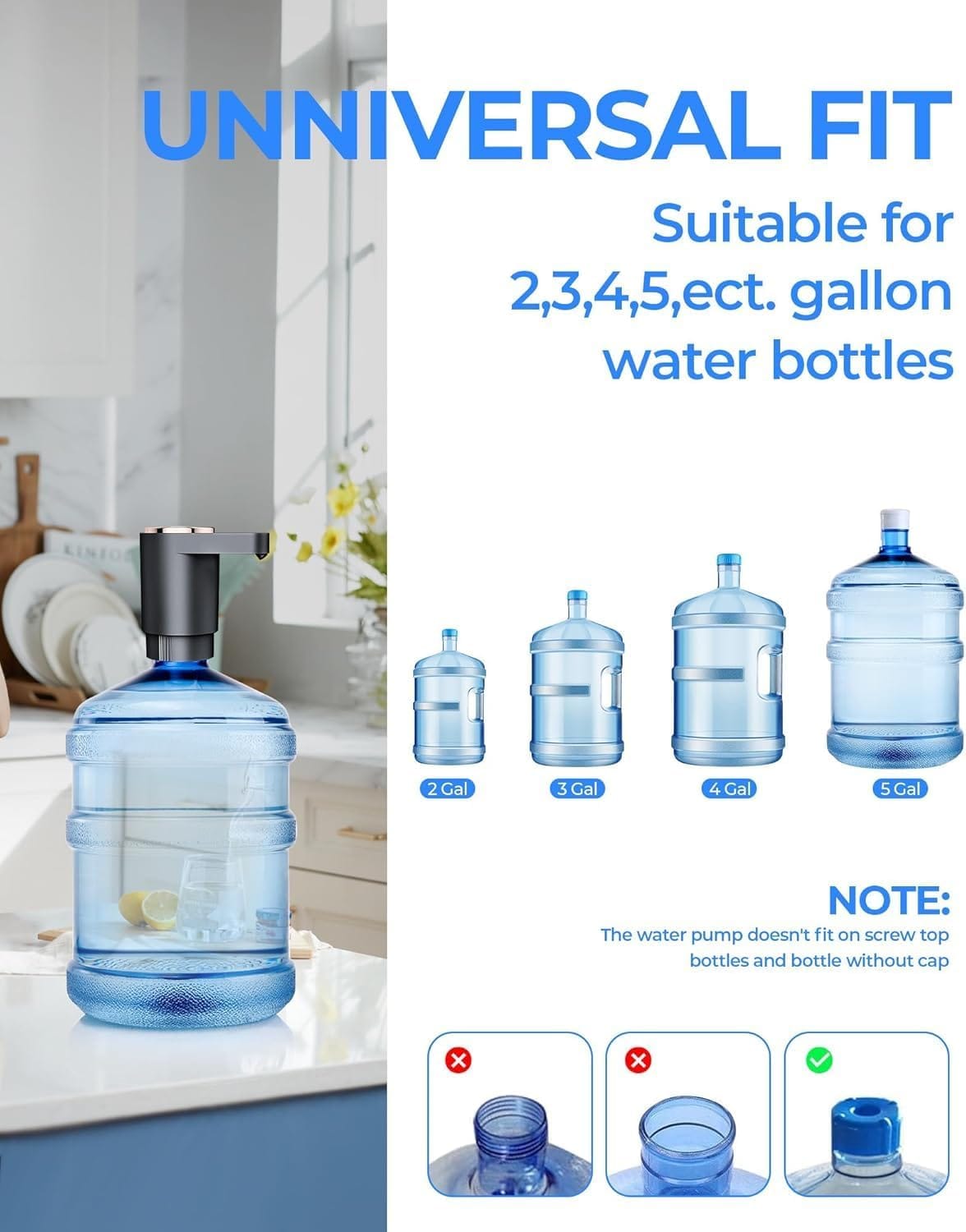
Canadian five-gallon delivery jugs mostly share a 55 mm neck, and this pump category is designed around that standard. If your supplier is Nestlé, Canadian Springs, Culligan, or a regional water company, you are likely compatible.
Where buyers get surprised:
- Slim-neck or sport-cap bottles — Some Costco or grocery-store refill containers use slightly different mouths. Read the listing's compatibility note; when in doubt, measure your bottle neck or check with the seller.
- Worn or chipped bottle rims — A silicone seal needs a smooth circle. Old jugs with gouges may weep. That is a bottle problem, not always a pump defect — but it feels like one when water tracks down the side.
- First-time priming — Air in the tube means nothing flows on the first press. Most units need one or two button cycles before water reaches the spout. Reviews titled "doesn't work" often stop testing before priming completes.
Run a vinegar-water flush when the pump is new, and again every four to six weeks if you taste anything off. Stagnant water in a silicone tube is the main flavour culprit, not the motor.
What it gets genuinely right
Strip away the trade-offs and the value proposition is clear for the right household:
- No more tilting a 40-pound jug — Elderly parents, post-surgery kitchens, and anyone with wrist issues feel this immediately.
- Desk and bedside use — A jug on the floor with a pump on top beats walking to the kitchen seventeen times while working from home.
- Cottage and RV portability — One pump in a drawer replaces a bulky stand that never fits in the car.
- Quiet operation — Compared to electric cooler compressors, these pumps hum briefly and stop. Office break rooms stay civil.
- Low entry cost — At roughly $20–35 CAD, even a twelve-month lifespan works out to a few dollars a month for daily convenience.
Who should buy it — and who really shouldn't
This is your pump if you're:
- Already on five-gallon delivery or refill and hate the tilt-and-pour ritual
- Setting up a home office, studio, or bedroom hydration station
- Equipping a cottage, camper, or boat where countertop coolers do not fit
- Buying for parents or grandparents who should not lift full jugs
- Wanting a backup dispenser while a main cooler is serviced
Walk away if you're:
- Filling large cookware daily — the flow rate will frustrate you
- Using non-standard bottle necks without verifying compatibility
- Expecting a decade of service from a sub-$30 plastic pump
- Needing hot and cold dispensing — this is room-temperature water only
- Already happy with a plumbed reverse-osmosis system
The decision, in three honest questions
- Do I already buy five-gallon jugs? If yes, this pump solves a real daily annoyance. If you are still buying cases of 500 ml bottles, fix that habit first — the pump does not change the economics.
- Who is lifting the jug now? If the answer is "someone who should not be," this is an accessibility upgrade, not a gadget.
- Can I accept a slow stream for drinking water? If you mostly fill glasses and kettles, yes. If you batch-cook with jug water, a faster plumbed solution is the better tool.
A few questions worth answering
Will it fit my water jug?
Most Canadian five-gallon delivery jugs use a standard ~55 mm neck. Regional brands and warehouse refill bottles occasionally differ — check the listing compatibility note or measure your bottle mouth before buying.
How long does the battery last?
Expect roughly a week of family use, or 30–60 glasses per charge, depending on how often you dispense. Recharging takes two to three hours over USB.
Why is nothing coming out the first time?
Air in the tube. Press the button twice to prime — most "dead on arrival" complaints resolve with priming and a full charge.
How do I clean it?
Run a dilute vinegar solution through the pump monthly, or whenever taste changes. Detach the silicone tube if the unit allows and rinse it separately.
What does it really cost in Canada?
Budget $20–35 CAD for the pump itself. Compare that to countertop electric dispensers at $150–300 and the pump looks like a low-risk experiment — just match your expectations to the category's limits.
Looking for buyer guides that tell you the trade-offs, not just the highlights? More honest, Canadian-focused gadget coverage lives at celmin.ca.
Sign up or sign in to join the conversation.