

The JBL Go 4 sits in a very crowded part of the audio market: the ultra-portable Bluetooth speaker that is cheap enough to be an impulse buy, but still expected to sound good enough to justify space on a shelf, kitchen counter, or coffee table. That category is full of vague promises about "b...
The JBL Go 4 sits in a very crowded part of the audio market: the ultra-portable Bluetooth speaker that is cheap enough to be an impulse buy, but still expected to sound good enough to justify space on a shelf, kitchen counter, or coffee table. That category is full of vague promises about "big sound" from tiny boxes. What makes the Go 4 worth looking at is not that it reinvents anything, but that it tries to do the basics well: small size, low price, recognizable brand, and a design that can move from living room to bathroom to backyard without much fuss.
This is not a hands-on review. Nothing here is based on personally using the speaker. Instead, this is a plain-English explainer built around the product listing, JBL's place in the portable-speaker market, and what a speaker like this realistically does well or poorly. If you are trying to figure out whether the JBL Go 4 is a smart little household speaker or just another tiny Bluetooth brick, this is the calmer version of that decision.
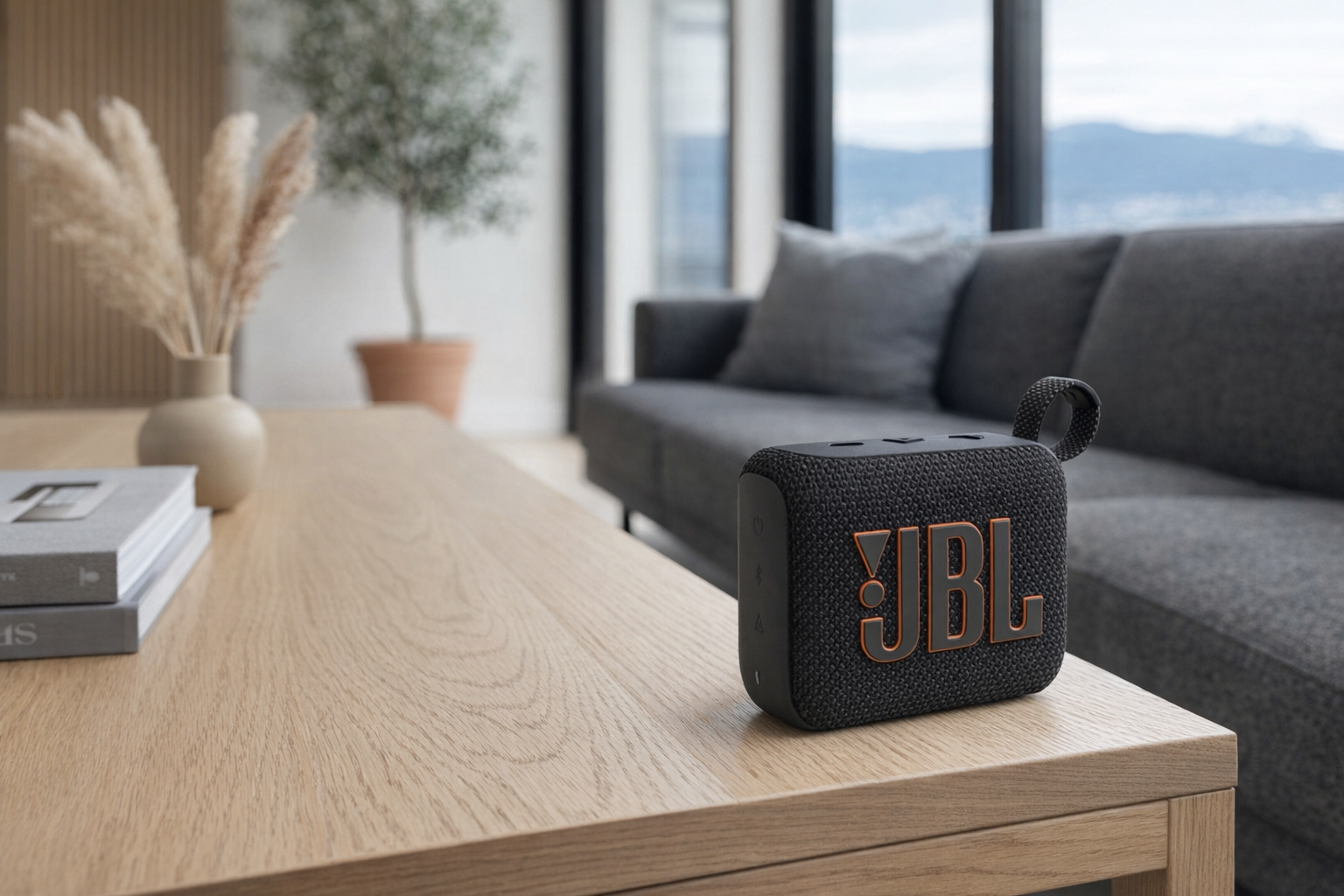
Quick snapshot
| Question | What the JBL Go 4 actually is |
|---|---|
| Category | Speakers & Audio |
| Made by | JBL |
| Typical price | ~$33 CAD (listing at the time of writing — verify current pricing) |
| Rating signal | 4.8/5 on the source listing |
| Best for | Casual listening in small rooms, portable household audio, travel bags, dorms, and gift buyers |
| Skip if | You want room-filling bass, TV replacement sound, smart-assistant features, or multi-room ecosystem depth |
Pro tip: Treat the JBL Go 4 like a personal or small-room speaker, not a mini home-theatre product. If you buy it for countertop music, podcasts, and quick portability, it makes sense. If you buy it hoping to replace a soundbar, it will disappoint.
What the JBL Go 4 actually is
The JBL Go 4 is a compact Bluetooth speaker from a company that has been making mainstream portable speakers for years. In plain English, it is the kind of speaker you leave on a side table, toss in a tote bag, or keep near the sink for music and podcasts while cooking or getting ready. The point is convenience first: no installation, no voice assistant, no wires beyond charging, and no illusion that this tiny speaker is meant to anchor a full stereo system.
What the listed details imply is a low-cost entry point into JBL's portable lineup rather than a flagship product. That matters, because a lot of buyers see the JBL name and assume every model is aiming for the same job. The Go 4 is clearly the small, simple one: the speaker you buy because you want something better than a phone speaker for around $33 CAD, not because you are chasing audiophile sound.
A useful comparison here is the JBL Clip 5, one of JBL's sibling portable speakers. The Clip line is usually aimed more at hanging from backpacks, belt loops, or shower caddies, while the Go line is more of a tiny block meant to sit somewhere. If your use case is mostly around the house, a Go 4-style shape can actually be more practical. If you want something to hook onto gear while moving around, the Clip 5 is the more obvious fit.
Key features at a glance
- Ultra-portable Bluetooth speaker design meant for easy room-to-room use
- Low-cost entry price in JBL's portable speaker range
- Simple wireless audio playback from phones, tablets, and laptops
- Small-footprint form factor suited to shelves, counters, desks, and nightstands
- Brand familiarity from a company with a long history in consumer portable audio
- Casual household versatility rather than full-size stereo ambitions
How the JBL Go 4 actually works
At its core, the JBL Go 4 is straightforward: you pair it with a Bluetooth source, play audio, and use it as a portable speaker wherever a phone or tablet's built-in speaker is not enough. That sounds almost too obvious to explain, but it is worth saying because this category is often cluttered with extra messaging about apps, ecosystems, and "immersive" sound. The Go 4 appears to be a small wireless speaker first, not a platform.
In a normal home setup, the process is simple. You charge it, pair it with your phone, then place it where you want better sound than a handset can provide. That might be beside the couch for background music, on a kitchen counter for podcasts, or in a bedroom for low-volume listening. The big practical advantage of this type of speaker is that it asks almost nothing from the room. There is no Wi‑Fi setup, no permanent mounting, and no smart-home compatibility problem to solve.
Where the Go 4 likely earns its keep is in the gap between a phone speaker and a more expensive tabletop audio product. A phone is convenient but thin-sounding. A full bookshelf or smart speaker setup sounds better but costs more, takes more room, and usually stays put. The JBL Go 4 is the compromise product: portable, cheap, simple, and good enough for casual use.
There is also a less glamorous truth about tiny speakers like this. Their limitations come from physics, not bad intentions. A very small enclosure can still produce clear vocals and decent general listening, but it will not create the deep low-end weight of a larger speaker. So the Go 4 makes the most sense with spoken audio, pop, light background listening, and general everyday use. Heavy bass music, party volume, or open outdoor spaces are a tougher ask.
A realistic "day in the life" with JBL Go 4
Because this is an informational piece, the scenario below is based on what the product category and listing suggest — not a tested diary.
- Morning. The JBL Go 4 sits on a bathroom or bedroom shelf while your phone streams a news podcast or morning playlist over Bluetooth. This is exactly the kind of low-stakes job a tiny speaker is good at: clearer audio than a phone, without needing a full smart speaker setup nearby.
- Midday. It moves to the kitchen counter while you cook lunch or work from home. In this role, the Go 4 is basically a utility speaker — something small enough not to dominate the room, but still noticeably better than propping up your phone against a mug.
- Afternoon. It ends up on a coffee table or desk for casual background music while you read, work, or clean. This is probably the most realistic living-room use: not a centrepiece, not a serious stereo, just a simple portable speaker that fills a small area well enough for one or two people.
- Evening. You throw it in a bag for a quick trip to a friend's place, a hotel, or a balcony hangout. That portability is one of the category's real strengths. A tiny speaker that is easy to move often gets used more than a better-sounding speaker that never leaves one shelf.
Who the JBL Go 4 is actually for (and who it isn't)
Great fits
- People living in small apartments or condos who want casual audio without dedicating space to larger speakers.
- Students in dorms who need a simple, inexpensive speaker for music, videos, and podcasts.
- Gift buyers who want something practical, recognizable, and not wildly expensive.
- Anyone who regularly moves between kitchen, bedroom, bathroom, and living room and wants one speaker that follows them.
- People who mostly listen at moderate volume and care more about convenience than deep bass.
- Travelers who want a small speaker for hotel rooms or short trips rather than a full travel audio setup.
Poor fits
- People expecting a TV upgrade. This is not a soundbar substitute, and dialogue from a television is a different use case.
- Anyone who wants smart-home voice control built into the speaker. This is not an Alexa or Google Assistant device.
- Buyers looking for big-room or outdoor party sound. Tiny speakers tend to disappear once the space gets large or noisy.
- Serious music listeners who are sensitive to bass depth and stereo width. Small mono-style portable speakers rarely satisfy that crowd.
- Households already invested in Sonos, Apple HomePod, or Google Nest Audio style ecosystems where app-based multi-room audio matters.
- Shoppers who think a low price means they are getting a "do everything" speaker. At ~$33 CAD, this is best understood as a convenience purchase.
Practical trade-offs
Sound scale
This is the most important trade-off, and it is the one marketing pages usually glide past. The JBL Go 4 may be perfectly fine for close-range listening, but its tiny size naturally limits how much air it can move. That means vocals, podcasts, and light music are likely the sweet spot, while bass-heavy tracks and larger rooms are where the compromises show up.
That does not make it bad. It just means you should evaluate it like a compact utility speaker, not like a premium living-room audio product. A speaker this small can be charmingly useful, but it will not cheat physics.
Portability versus permanence
The best thing about a speaker like the Go 4 is that it goes anywhere. The downside is that it is not really part of a stable home-audio system. There is no sense of permanent placement, left-right stereo imaging across a room, or TV integration that stays put and always works the same way.
For some buyers, that is ideal. For others, it becomes a small friction point: the speaker is always nearby, but not exactly integrated. If you want "pick it up and move it around," this design is honest. If you want "set it once and build a room around it," look higher up the ladder.
Battery and charging reality
Portable speakers are only as useful as their charge level. Even without supplied runtime specs here, the usual category pattern is easy to understand: a compact speaker is convenient until it is dead when you want it. Tiny speakers often get used in quick bursts across the day, which can mask battery habits until you suddenly need a charge.
That is not a JBL-specific issue; it is the trade-off for portability. Just assume the Go 4 is another small device in your house that joins the charging rotation, alongside phones, earbuds, and tablets. If that annoys you already, a plug-in speaker may be the more satisfying long-term choice.
Where the JBL Go 4 fits in a smart home
The JBL Go 4 fits best around a smart home rather than inside one. It is not a hub, not a voice assistant, and not the central speaker for a connected ecosystem. Its role is much simpler: it is the speaker you grab when you want audio somewhere a fixed speaker is not.
In a practical household setup, that could look like this:
- Apple HomePod mini or Google Nest Audio handles voice commands and smart-home routines in the main room.
- A Sonos Beam or another soundbar handles television audio.
- The JBL Go 4 becomes the flexible extra speaker for the kitchen, bathroom, balcony, craft room, or guest room.
That is where it makes the most sense. It is the audio equivalent of a good rechargeable flashlight: not glamorous, not central, but surprisingly handy. In a modern living room specifically, it works best as a secondary or overflow speaker — something for casual listening when you do not want to power up a larger setup, or something you can borrow from the living room and bring elsewhere.
If you are building a more polished audio environment, the Go 4 is not the foundation. But as a cheap, movable companion to a larger system, it is easier to justify. That's a more honest frame than pretending it is the only speaker most homes need.
The buying decision, in plain terms
Before buying the JBL Go 4, three questions usually tell you whether it fits.
- Do you want portability more than sound scale? If yes, the Go 4 makes sense. If no, a larger speaker will almost always be more satisfying.
- Is your main use case close-range listening in small spaces? Kitchens, desks, bathrooms, bedrooms, and travel are a good match. Large living rooms and outdoor gatherings are less so.
- Are you comfortable treating this as a simple Bluetooth speaker, not a smart-home product? If you want voice control, room correction, TV features, or app-heavy multi-room tools, this is the wrong category.
If those answers lean yes, the JBL Go 4 looks like a sensible, inexpensive little speaker. If not, spend more and buy something built for a bigger job.
Got Questions About the JBL Go 4? Let's Clear Things Up.
Is this a hands-on review?
No. This is an informational explainer based on the available listing details, JBL's product positioning, and the normal strengths and weaknesses of ultra-portable Bluetooth speakers. It is meant to help narrow the buying decision, not replace a full review.
What does the JBL Go 4 actually do best?
Its most likely strength is simple everyday audio in small spaces: podcasts, playlists, casual music, and general phone-to-speaker convenience. Products in this class are usually at their best when they are close to the listener and not trying to fill a large room.
Is the JBL Go 4 good for a living room?
Yes, but with limits. It makes sense in a living room as a secondary speaker for casual listening, side-table audio, or moving music from room to room. It makes less sense as the main speaker for movie nights or serious music sessions.
Does the JBL Go 4 replace a smart speaker?
No. It is a Bluetooth speaker, not a smart display or voice-controlled home assistant. If you want routines, smart-home commands, or built-in Alexa or Google Assistant features, you will need a different kind of device.
Where can I verify the current listing or buy it?
The current retailer page supplied for this article is on Amazon, and that is the first place to verify live pricing, colour availability, and current listing details. You can check it here: JBL Go 4 on Amazon.
What does it cost in Canada?
At the time of writing, the listing price supplied for this article is about ~$33 CAD. Pricing on small electronics changes often, especially during sales, so it is worth confirming the live amount before buying.
Is the JBL Go 4 a better buy than just using a phone speaker?
For many people, yes — but only if they actually want better sound often enough to justify another device. A dedicated speaker will usually sound fuller and carry better than a phone, but the upgrade is about convenience and modest improvement, not transformation. Evaluate it like a useful accessory, not a major audio investment.
Where is the Celmin Directory listing for this product?
For a catalog-style view of the same product — structured specs, pros and cons, similar picks, and FAQ — see JBL Go 4 on Celmin Directory.
If you're building a smarter home in Canada and want honest explainers on gadgets worth considering — plus the ones worth skipping — Celmin covers the full catalog without the marketing theater. More reviews, comparisons, and buyer guides at https://celmin.ca.



Discussion
Sign up or sign in to join the conversation.