

Run a humidifier in winter only when indoor relative humidity falls below about 30% and no condensation is forming on windows; don't run one in a humid summer, when a dehumidifier, air conditioning or better ventilation should handle excess moisture. The exception is an air-conditioned summer room that stays unusually dry.
A winter humidifier can create the moisture problem you bought it to solve. Your skin can feel dry while your window frames are wet, because comfort and the temperature of your home's coldest surfaces aren't the same thing. The right decision starts with a hygrometer and a look behind the curtains, not the calendar.
Table of Contents
- The Short Answer for Winter or Summer Use
- Target Humidity Ranges and What Your Hygrometer Reads
- Humidifier Types Compared for Canadian Bedrooms
- Summer Alternatives to a Humidifier
- Allergy, Comfort and Maintenance Trade-offs
- Room-by-Room Sizing and Seasonal Setup for Canadian Homes
- Confirm Your Setup Before You Buy
The Short Answer for Winter or Summer Use
A humidifier is mainly a winter tool for Canadian homes, and it's usually the wrong device in summer. Cold outdoor air contains little water vapour; when it enters through leaks and warms indoors, its relative humidity drops. Meanwhile, warm indoor air escapes through openings higher in the building.
The furnace doesn't burn moisture out of the air. Heating changes relative humidity, while air leakage replaces indoor moisture with drier outdoor air. That distinction matters: endlessly increasing humidifier output won't fix a draughty building envelope.
Summer usually reverses the problem. Showers, cooking and humid outdoor air add moisture that your home needs to exhaust or remove.
Humidifier verdict by season and indoor condition
| Season and indoor condition | Typical problem | Humidifier? | Better tool or action |
|---|---|---|---|
| Deep winter, heating on, RH below the dry-air threshold | Dry skin, static shocks, dry throat | Yes, with a humidistat | Confirm the reading with a hygrometer first |
| Winter, RH within the target band, no condensation | No clear moisture deficit | No need | Keep current settings |
| Winter, windows fogging or frost on glass | Moisture collecting on cold surfaces | No, reduce or stop | Exhaust ventilation; investigate persistent dampness before choosing a dehumidifier |
| Summer, RH above the target band | Musty smells and conditions favourable to mould and dust mites | No | Dehumidifier, air conditioning or suitable ventilation |
| Summer, air conditioning leaves RH persistently below the target band | Dry air and irritation | Only at low output | Verify sustained dryness before adding moisture |
| Spring and fall, RH swinging with weather | Changing comfort and condensation | Measure first | Hygrometer and window opening when outdoor air is drier |
Why the window matters
A room can have an acceptable average humidity reading while a cold window collects water. Glass, frames and exterior corners may be much colder than the air beside your bed.
Treat visible condensation as a stop signal, not permission to keep humidifying until the room reaches a preferred setting. The calendar is a weak trigger; a representative humidity reading combined with a surface inspection is much stronger.
Target Humidity Ranges and What Your Hygrometer Reads
The Natural Resources Canada moisture guide identifies 30% to 50% indoor relative humidity as a range that limits humidity-related health risks, generally favouring lower humidity in winter, and cites Health Canada winter guidance of 30% to 55%. Those are operating ranges, not instructions to push every Canadian bedroom towards the upper end.
Relative humidity describes how close air is to saturation at its current temperature. Cool that air against a window and it can reach saturation locally, even though the hygrometer elsewhere looks reassuring. That's why the condition of your windows and exterior walls overrides a comfortable-looking display.
Action by indoor relative humidity reading
| Indoor RH reading | What it means | Action |
|---|---|---|
| Below the lower end of the target band | Air is dry, commonly during winter heating | Add moisture cautiously with a humidistat-controlled humidifier |
| Within the target band | Generally suitable for health and comfort | Keep current settings and keep measuring |
| Above the upper end of the main target band | Excess moisture, often in summer or damp rooms | Remove moisture or improve suitable ventilation; inspect basements, bathrooms and exhaust fans |
| Any reading with condensation on windows | Moisture is condensing on cold surfaces | Reduce humidifier output even if the room reading looks low |
Measure the room, not the mist
Place the hygrometer near breathing height, away from the humidifier plume, direct sunlight, heating outlets and cold glass. A sensor on the windowsill measures a colder microclimate; a sensor beside the mist outlet measures the appliance's immediate output.
Check readings under normal living conditions, including with the bedroom door in its usual overnight position. For help interpreting the display and choosing a useful location, the TempPro TP50 digital hygrometer guide explains the practical setup.
A built-in humidistat is useful, but its sensor sits close to the appliance. Compare it with the separate room hygrometer rather than assuming both will agree.
The broader winter range isn't a summer allowance or a guarantee against condensation. Older windows, thermal bridges and poorly insulated corners can require a more conservative setting.
Humidifier Types Compared for Canadian Bedrooms
Choose the mechanism before choosing app features. Water quality, fan noise and access for cleaning will affect ownership more than a decorative mist display.
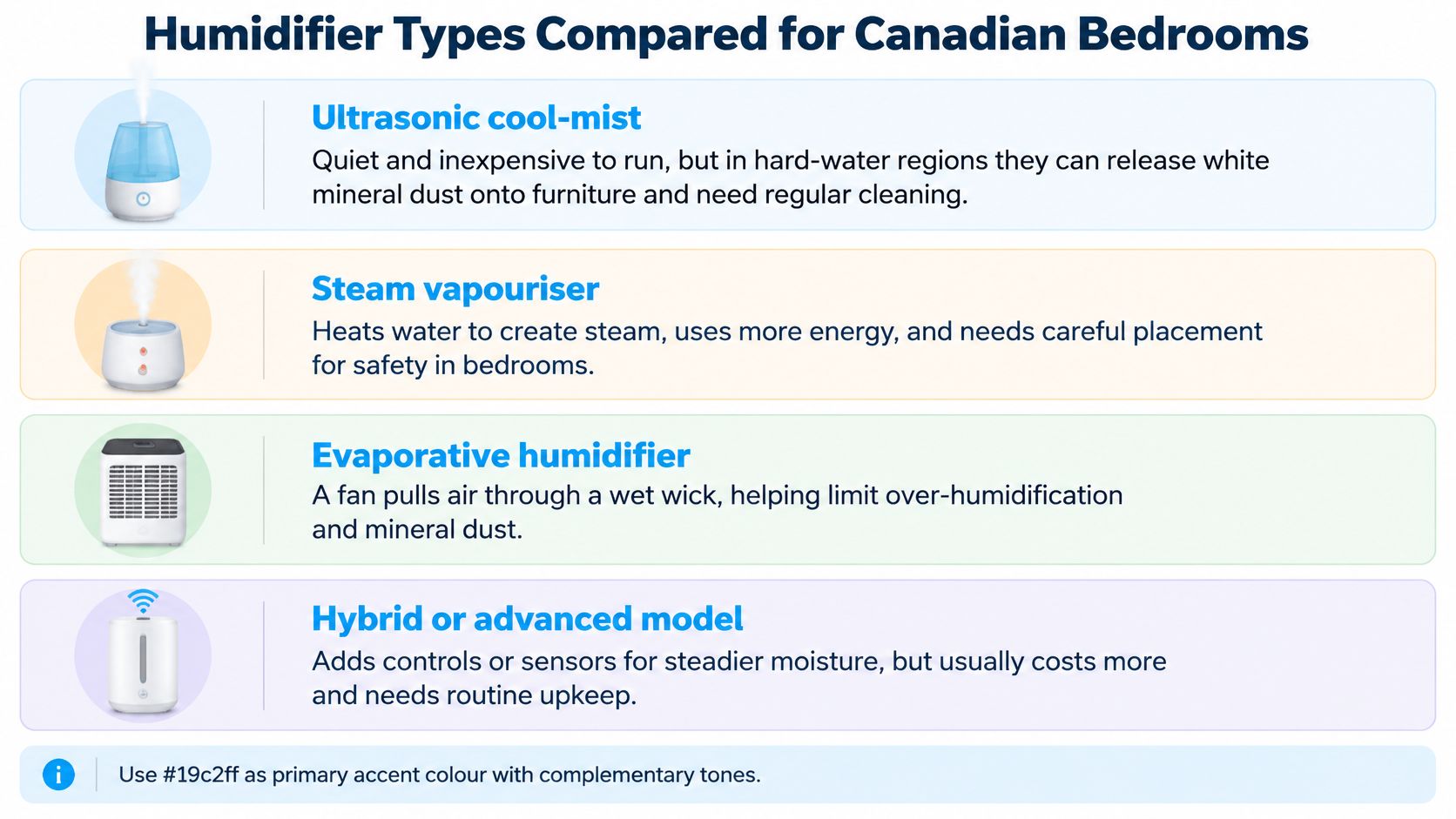
This chart provides a visual overview of common designs and control options.
Ultrasonic and evaporative units
Ultrasonic cool-mist humidifiers use a vibrating element to produce droplets. They're often quiet and use little electricity, but minerals in the water can leave white dust on furniture. A large tank reduces refilling, not the need to empty and clean the unit.
Check for a published decibel rating, a dimmable display and a genuine humidistat rather than mist-level controls alone. Quiet operation is less useful if the lowest output still overwhelms a closed bedroom.
Evaporative units draw air through a wet wick. Their fan is audible, and replacement wicks add an ongoing expense, but dissolved minerals generally remain in the wick rather than travelling out as mist.
Evaporative output naturally slows as room humidity rises. That makes it more forgiving in a small bedroom, but it doesn't replace a humidistat or condensation checks.
Warm-mist and impeller units
Warm-mist units heat water to produce vapour. Accessible heating chambers can be straightforward to descale, but boiling doesn't keep the entire appliance clean. They use more power than non-heating designs, and hot water or steam can scald children and pets.
Impeller units use a rotating disc to throw water into a diffuser. Check nighttime noise carefully; mechanical noise and water sounds can be intrusive. Fast output doesn't automatically make an impeller model suitable for a larger room: match its rated coverage and adjustable output to the space.
Humidifier mechanisms compared for a Canadian condo bedroom
| Mechanism | Noise | Refill and cleaning | Main trade-off |
|---|---|---|---|
| Ultrasonic cool-mist | Usually quiet; check the decibel rating | Empty after use; inspect the transducer and descale deposits | White mineral dust with mineral-rich water |
| Evaporative | Audible fan; check the sleep-speed rating | Refill according to output; replace the wick when required | Output slows as humidity rises, but filters cost money |
| Warm-mist | Possible bubbling or boiling noise | Clean the tank and descale the heating chamber | Higher power use and scald risk |
| Impeller | Mechanical and water noise can disturb sleep | Empty the reservoir and clean the disc and diffuser | Strong mist output requires careful control |
Refill frequency depends on usable tank capacity and the output you select, not the headline runtime alone. Confirm humidistat availability for each model; the mechanism doesn't guarantee one.
For a condo bedroom, I'd favour a controllable evaporative unit or a quiet low-output model. The ultrasonic versus evaporative comparison can help narrow that choice, but reject any design whose tank you can't reach properly to clean.
Summer Alternatives to a Humidifier
A Canadian summer moisture problem usually calls for removal, not addition. Health Canada's indoor air-quality guidance recommends 30% to 50% relative humidity and advises dehumidification in damp areas, where condensation occurs, or when RH exceeds 50%.
Start with the source of the moisture. An appliance can manage water vapour, but it won't repair a leaking foundation, dripping pipe or disconnected bathroom exhaust duct.
Remove water or cool the room
A compressor dehumidifier suits many damp basements. Choose continuous drainage if there's a suitable drain, or a condensate pump if water must travel uphill. Secure the hose, preserve the required slope for gravity drainage and check that water reaches the drain.
Check the appliance's operating-temperature range before buying for a cool basement. Cold conditions can reduce moisture removal and cause more defrost cycling. A full bucket also stops collection, so drainage arrangements matter as much as advertised capacity.
Air conditioning removes moisture while cooling. An oversized system can cool the room quickly and shut off before removing enough moisture, leaving the space cool but clammy. Try dry mode where available, but don't assume every model operates that mode identically.
Exhaust moisture where it starts
Run bathroom exhaust during showers and afterwards until lingering moisture clears. Use a kitchen hood that exhausts outdoors during cooking; a recirculating hood filters some airborne material but doesn't carry water vapour outside.
- Check the outlet: Exhaust ducts should discharge outdoors, not into an attic.
- Choose window opening carefully: Bringing muggy outdoor air into a cool basement can increase dampness.
- Use fans for comfort: Ceiling and box fans move air across your skin, but don't remove water from the home.
If you're comparing devices, the air purifier versus dehumidifier guide separates particle removal from moisture control. A purifier isn't a substitute for dehumidification.
Summer humidification is a narrow exception for an air-conditioned room that remains below the dry end of the target band. Verify that pattern before using low output, and stop if surfaces become wet or a musty smell develops.
Allergy, Comfort and Maintenance Trade-offs
A neglected tank can undermine an otherwise sensible humidifier purchase. Comfortable mist isn't proof that the reservoir, outlet and internal surfaces are clean.
Dry-air discomfort and damp-air discomfort can overlap, so symptoms alone aren't enough to choose an appliance.

Dry air can irritate your skin, throat and nasal passages. Excess moisture creates conditions favourable to mould and dust mites, which can aggravate allergies and asthma. Neither situation makes your discomfort imaginary, but they require different responses.
Comfort rule: A humidifier should correct measured dryness, not act as a general treatment for allergy symptoms in an already damp room.
Keep water and surfaces clean
Health Canada's cool-mist humidifier guidance advises emptying the reservoir whenever the unit is switched off and cleaning it regularly according to the manufacturer's instructions. Don't keep topping up yesterday's water.
In hard-water areas, inspect for scale and white dust. Use distilled or demineralized water if the manufacturer permits it, and descale with the approved method. Descaling removes mineral deposits; it isn't automatically the same as disinfecting.
- Empty after use: Discard remaining water, rinse accessible surfaces and let components dry.
- Clean thoroughly: Reach the tank corners, base and mist outlet with the tools and cleaning agents the manual allows.
- Replace consumables: Change wicks or filters when they become crusted, damaged or persistently odorous.
- Record room conditions: Keep a simple humidity log alongside notes about symptoms and wet surfaces.
For renters, moisture on walls, ceilings or window frames is a reason to stop humidifying and document the problem. Check the basement or storage area too, and report persistent dampness or suspected leaks to the landlord rather than masking the smell.
This accompanying video offers another visual reference for the topic.
Balanced humidity can make a dry room feel more comfortable, but it isn't a guaranteed heating-cost saving. Don't raise moisture to compensate for cold draughts or inadequate insulation.
Room-by-Room Sizing and Seasonal Setup for Canadian Homes
Size a humidifier for the space it will serve. A closed bedroom, an open-plan living area and a basement stairwell exchange air differently, so advertised coverage is a starting point rather than a promise.
Measure floor area and check the manufacturer's coverage rating, minimum output and control options. High ceilings, open doors and air leakage affect performance. An oversized appliance with coarse controls can overshoot in a small condo before its nearby sensor responds.
Bedrooms and living areas
For a bedroom, prioritise low minimum output, a humidistat, a dark display and easy tank access. Place it on a stable, water-resistant surface with clearance around the outlet. Keep mist away from bedding, curtains, walls, electronics and cold glass.
A living room may need more capacity, but only if its own readings justify humidification. Don't buy a larger machine just because the room opens onto a hallway. First establish whether you're trying to condition the living room or an entire connected floor.
Room sizing and seasonal setup for Canadian homes
| Room | Device class | Winter setup | Summer setup |
|---|---|---|---|
| Condo bedroom | Small, adjustable unit with humidistat, matched to measured floor area | Start near the low end of the target band only when measured dryness justifies it | Usually no humidifier; use a fan for comfort and air conditioning when needed |
| Living room | Medium-capacity unit only when the room requires it | Confirm persistent dryness with heating operating normally | Ceiling fan for comfort; remove moisture if the room stays damp |
| Basement | Dehumidifier with suitable drainage and temperature rating | Usually no humidifier; inspect cold surfaces and water entry | Dehumidify as needed and verify drainage |
| Bathroom | Exhaust fan, not a humidifier | Exhaust shower moisture | Run the fan during and after showers |
| Kitchen | Outdoor-vented range hood or exhaust fan | Remove cooking vapour | Use extraction during cooking |
Basements and moisture-producing rooms
The Department of National Defence's Canadian housing guidance gives a 30% to 55% operating range and recommends dehumidification in spring, summer and fall as needed. That broader housing range doesn't make a damp basement a suitable place for a humidifier.
Choose basement equipment around moisture-removal capacity, operating temperature and condensate handling. A continuous drain is useful only if it remains clear and properly routed. If walls or floors admit water, address that entry path as well.
Bathrooms and kitchens usually need source extraction rather than another humidity-control appliance. Check that the fan moves air and that its grille isn't clogged with dust or grease.
In coastal British Columbia and other damp climates, mild wet winters can leave the lower level damp while an upstairs heated bedroom feels dry. Measure those rooms separately. A single hallway sensor can't represent every floor of the home.
Confirm Your Setup Before You Buy
Buying a humidifier for winter or summer should follow a room check, not a seasonal shopping habit. Health Canada's healthy-home guide points towards humidity around 30% in cold conditions and below 50% in summer to help prevent condensation.
Use that guidance conservatively when your home has cold windows or exterior corners. More moisture isn't a repair for a poorly insulated surface.
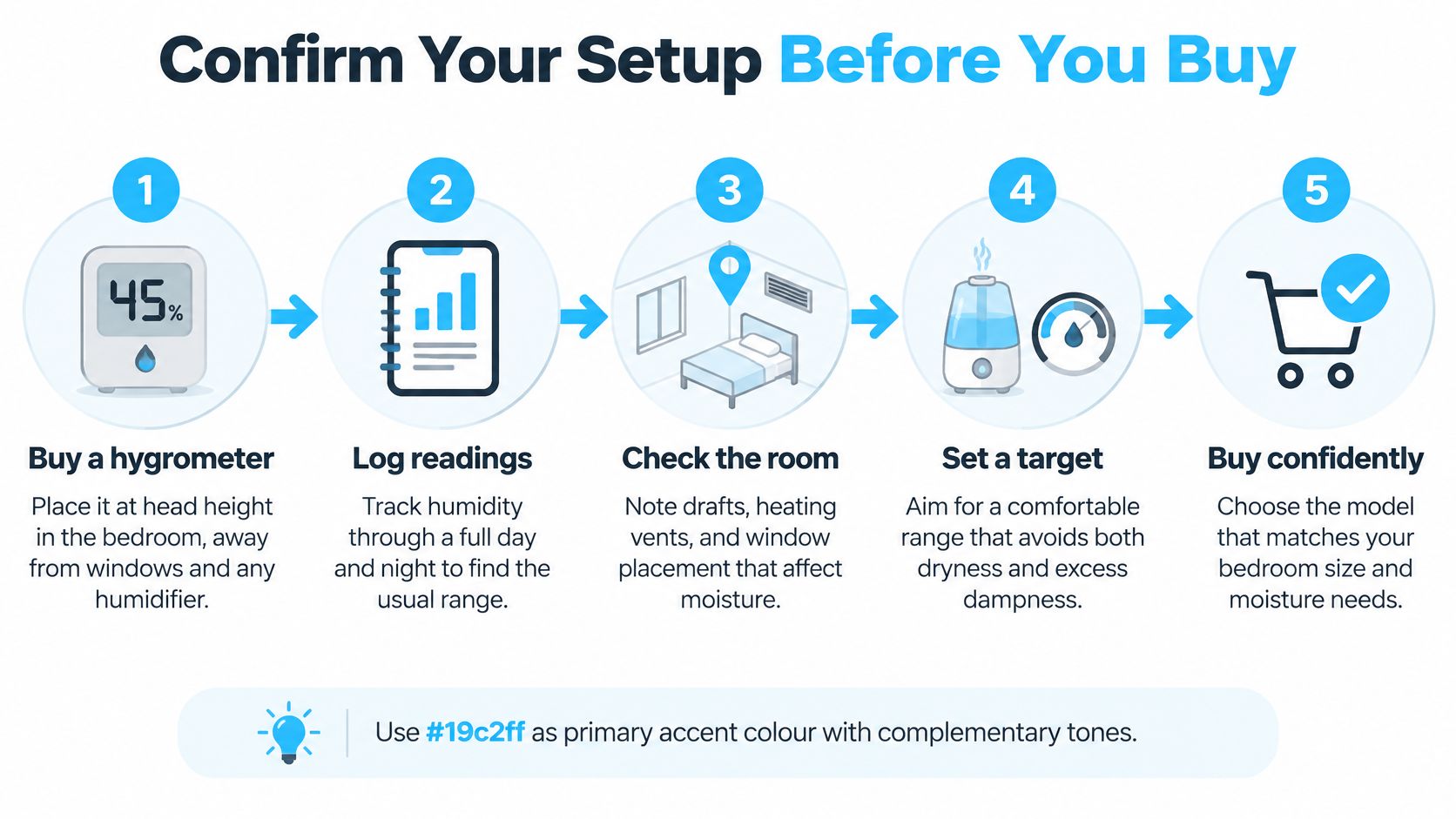
This buying checklist puts measurement ahead of appliance features.
Make the purchase conditional
- Position a hygrometer. Put it near head height in the bedroom, away from windows, supply vents and any mist plume. Leave it in a representative location rather than moving it between extremes.
- Record normal conditions. Note morning and evening readings through changing weather and ordinary heating use. Check the basement separately, and record whether the bedroom door stays open or closed.
- Match the device to the problem. Persistent dryness supports a humidifier purchase. Persistent dampness calls for moisture-source control, suitable ventilation, air conditioning or dehumidification.
- Inspect cold surfaces. Look behind curtains, around frames and in exterior corners. If moisture appears, stop adding water while you investigate.
- Choose controllable output. Buy for the measured room area, with a humidistat and a low setting that suits the space. Start conservatively rather than aiming for the top of a comfort range.
- Set the stop rule before use. Empty and clean the appliance routinely, and stop running it if condensation returns. Restart only after surfaces are dry and room measurements justify adding moisture again.
A humidifier earns its place by correcting a measured moisture deficit without wetting the building.
Check again when outdoor temperatures change sharply, when you change heating settings or when you close a room that previously stayed open. Revisit the decision regularly rather than leaving the appliance on automatic throughout the season.
If windows remain wet after humidification stops, investigate ventilation, indoor moisture sources and cold-surface defects. In cold winter rooms, don't assume a portable dehumidifier will be an effective substitute for fixing those conditions.
Celmin publishes Canadian home-tech buying guides and comparisons that explain practical trade-offs, including noise, maintenance and suitability for condo living. Visit Celmin to compare humidifier designs and other air-quality devices once you know whether your room needs moisture added or removed.
Sign up or sign in to join the conversation.