
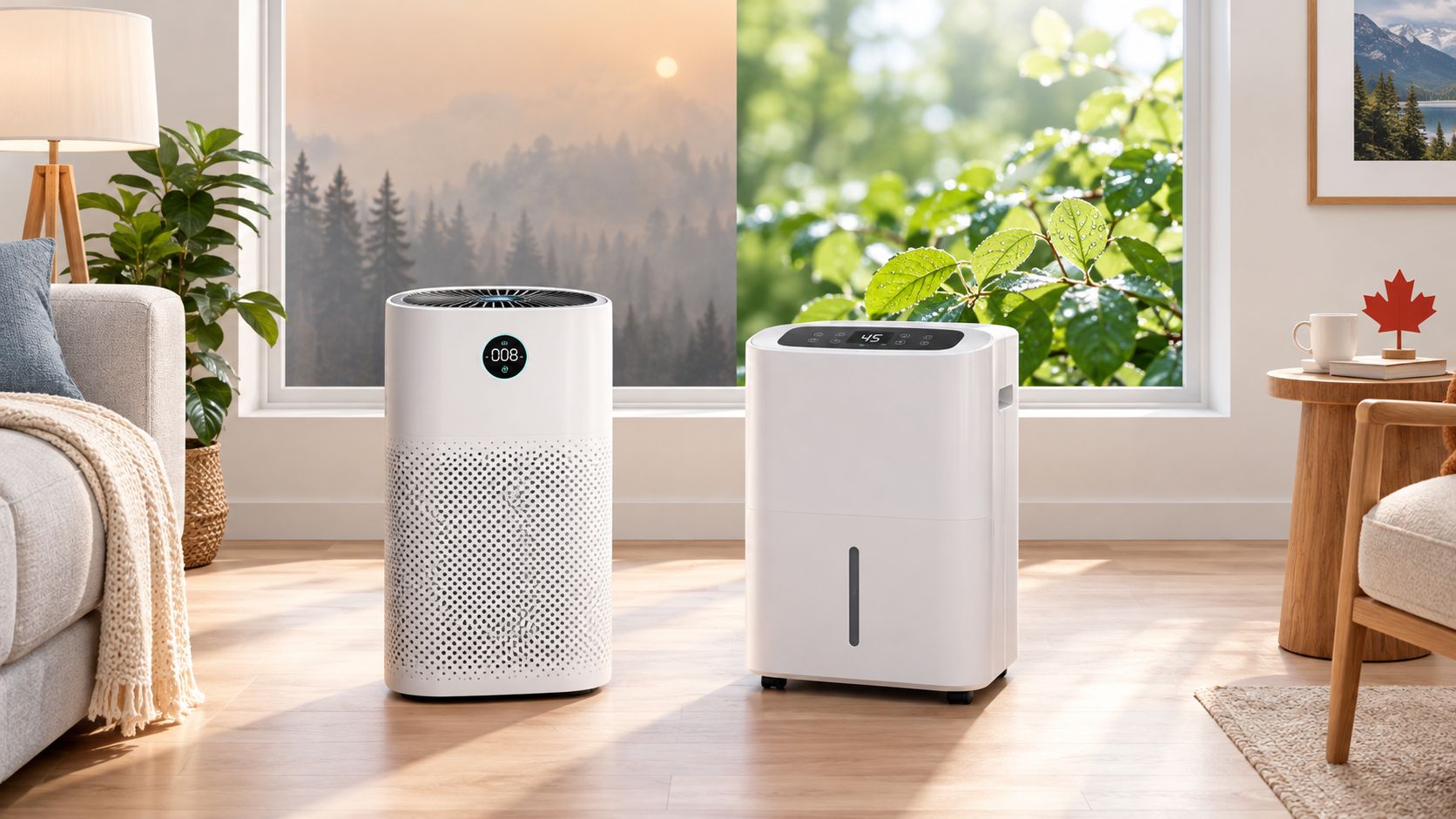
You're sitting in your Canadian living room with the windows closed because wildfire smoke has turned the outdoor air unhealthy. A few months later, the same home has a musty basement, condensation on the windows, and a hygrometer reading above 50% relative humidity. The obvious question is whether one appliance can solve both problems.
It can't. An air purifier removes airborne particles. A dehumidifier removes water vapour. Buying the wrong one means spending money while the original problem continues. The right choice depends on the measurable trigger in your home: PM2.5 and smoke call for filtration, while sustained relative humidity above 50% or visible condensation calls for moisture control.
| Criterion | Air Purifier | Dehumidifier |
|---|---|---|
| Main job | Captures suspended particles | Removes excess water vapour |
| Best trigger | Smoke, PM2.5, pollen, dust or airborne allergens | RH above 50%, condensation or damp conditions |
| Main specification | Tobacco-smoke CADR | Moisture extraction and humidity control |
| What it won't fix | High humidity or leaks | Fine smoke particles or dry-air problems |
| Best Canadian use | Wildfire season and allergy periods | Damp basements, bathrooms and condensation-prone rooms |
Table of Contents
- Two Devices, Two Different Problems in Canadian Homes
- What Each Device Actually Does
- Air Purifier vs Dehumidifier Compared Side by Side
- When Canadian Homes Actually Need Each Device
- Choosing the Right Size and Spec for Your Room
- Energy Cost, Heat Output, and the Case Against Running Both
- Which One Should You Buy First
Two Devices, Two Different Problems in Canadian Homes
A Vancouver-area household can face both appliances' use cases in the same year. During wildfire season, smoke enters through gaps, ventilation systems and open windows. The family closes the windows, watches the Air Quality Health Index and needs to reduce fine particles in the rooms where people sleep and work.
By autumn, the basement may tell a different story. The air feels stale, the windows collect moisture and cardboard boxes become soft at the edges. That's a humidity problem, not a filtration problem. A purifier can circulate cleaner air through the room, but it won't lower the water content of that air.
Canada's wildfire record shows why smoke deserves a separate response. Environment and Climate Change Canada's air-quality indicators report that the national average PM2.5 concentration reached 9.5 µg/m³ in 2023, the highest point in its 15-year record from 2009 to 2023. The national peak reached 45.1 µg/m³, while more than 14 million hectares burned during the country's unprecedented wildfire season. These conditions make an air purifier the relevant tool when indoor particles are the concern.
A dehumidifier becomes relevant when the home's humidity stays high or moisture condenses on cold surfaces. Health Canada's moisture and mould guidance uses 30% to 50% RH as the general indoor range and identifies humidity above 50% or condensation as reasons to use a dehumidifier.
Use the symptom, not the appliance label
Smoke odour, visible haze, high PM2.5 or allergy-triggering dust points to an air purifier. A musty smell, damp walls, wet windows or a hygrometer reading that remains above 50% points to a dehumidifier.
Neither machine repairs a leak, removes established mould or replaces source control. If a basement wall is wet, fix the water entry. If outdoor smoke is severe, close windows and reduce infiltration before relying on a purifier.
What Each Device Actually Does
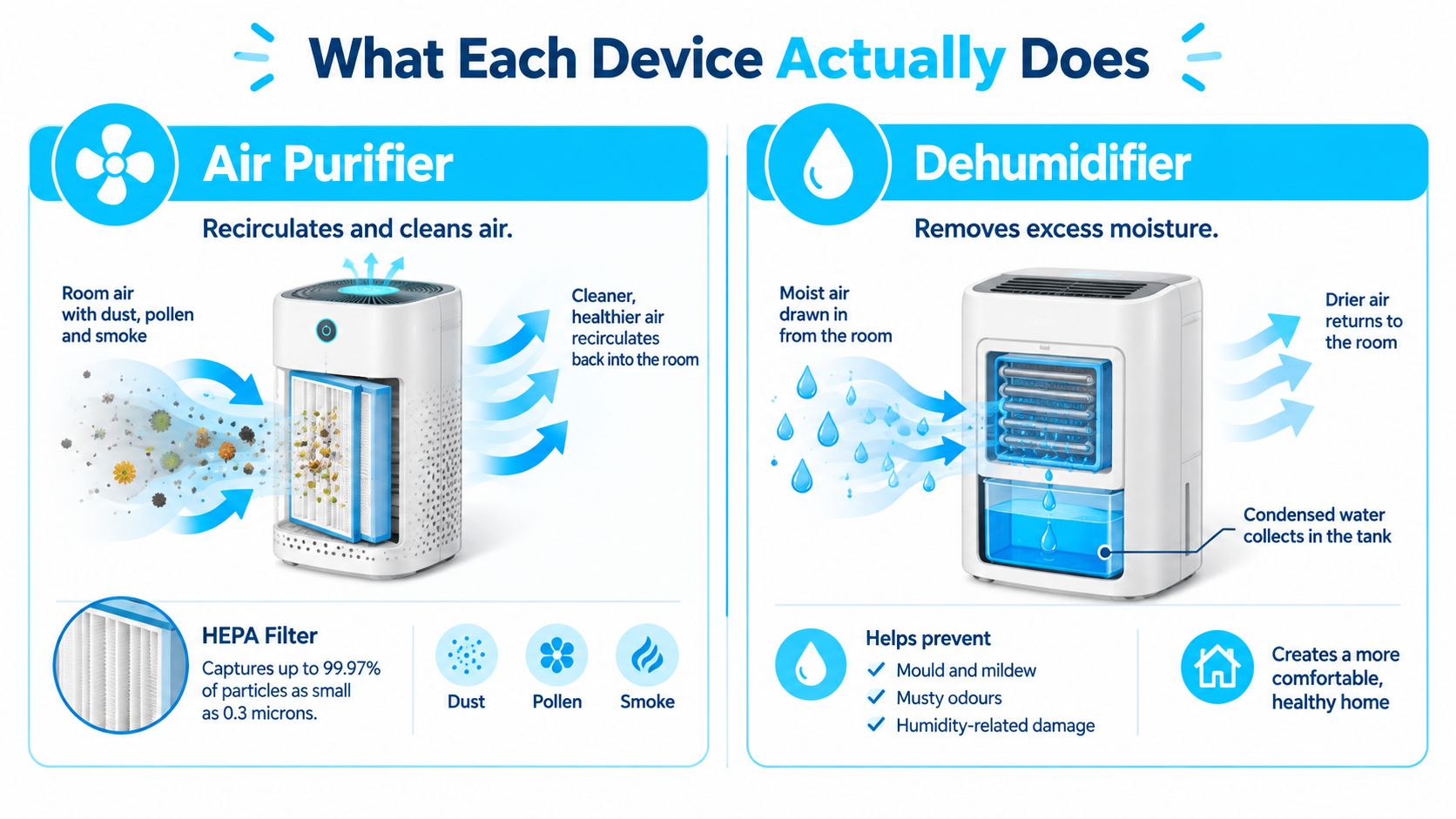
An air purifier is a fan and filter system. It draws room air through a pre-filter and particle filter, then sends treated air back into the room. A HEPA-based unit can capture suspended particles such as smoke, dust, pollen, mould spores and pet dander, but it leaves relative humidity unchanged.
A dehumidifier uses a refrigeration cycle. It pulls room air across a cold coil, condenses water vapour into liquid, collects that water in a tank or drain line, and returns drier air to the room. It may include a basic dust filter, but that filter isn't a substitute for a properly rated particle-cleaning stage.
Airflow determines purifier performance
A purifier's result depends on two linked factors, filter efficiency and airflow. A highly efficient filter does little if the fan moves too little air through it. That's why Canadian buyers should compare the tobacco-smoke Clean Air Delivery Rate, or CADR, rather than relying only on a “HEPA” label.
Health Canada's portable air-cleaner guidance recommends a tobacco-smoke CADR of at least two-thirds of the room's floor area. A 300 sq. ft. room therefore needs a minimum CADR of approximately 200 cfm. Choose a low-ozone model, and avoid ozone-generating machines.
Moisture removal depends on conditions
A dehumidifier's performance depends on room temperature, humidity, airflow and drainage. In a cold basement, a standard compressor model may extract less water than its marketing conditions suggest. A built-in humidistat helps the machine maintain a target RH instead of running continuously.
The useful mental model is simple: purifiers clean what floats in the air, while dehumidifiers change how much water the air holds. A purifier is the response to PM2.5. A dehumidifier is the response to sustained RH above 50% or visible condensation.
Air Purifier vs Dehumidifier Compared Side by Side
The air purifier vs dehumidifier decision becomes straightforward when each specification is matched to the problem it measures. A purifier is judged by particle delivery, filter quality and room coverage. A dehumidifier is judged by humidity control, extraction, drainage and performance in the room where moisture collects.
Air Purifier vs Dehumidifier at a Glance
| Criterion | Air Purifier | Dehumidifier |
|---|---|---|
| Particle removal | Designed to reduce airborne smoke, dust, pollen and other particles | Not designed for fine-particle removal |
| Humidity control | Doesn't lower RH | Lowers RH by condensing water vapour |
| Room sizing | Match tobacco-smoke CADR to floor area | Match extraction capacity and operating conditions to the room |
| Core maintenance | Replace or clean filters | Empty the tank, clean the filter and maintain the drain |
| Noise | Fan noise varies by speed | Compressor and fan noise can be noticeable |
| Heat output | Primarily recirculates air | Returns warmer air while operating |
| Main limitation | Doesn't correct dampness or condensation | Doesn't replace HEPA filtration during smoke events |
The sharpest distinction: a purifier with a tobacco-smoke CADR of 200 cfm is suited to roughly a 300 sq. ft. room, while a dehumidifier is assessed by water extraction and humidity control. Those figures describe different jobs, not competing versions of the same job. Health Canada's purifier guidance explains the CADR relationship.
Noise and placement matter in small Canadian homes. Put the purifier in the bedroom or main living area where people spend time, with its intake and outlet unobstructed. Place the dehumidifier in the wettest room, usually a basement, bathroom or laundry area, and allow room around it for airflow.
Operating cost also differs. A purifier uses electricity and eventually needs filter replacement. A dehumidifier uses more power while running because it operates a compressor and fan, and it may need frequent tank emptying unless you connect a drain hose.
For a wider home-monitoring setup, a Canadian air-quality monitor guide can help you compare devices that track indoor conditions. Still, don't let a monitor replace direct diagnosis. Use PM2.5 readings for filtration decisions and RH readings for dehumidification decisions.
When Canadian Homes Actually Need Each Device
Canadian homes don't have one universal indoor-air problem. Wildfire smoke, spring pollen, summer basement dampness and winter condensation arrive at different times and affect different rooms. The appliance should follow the condition you can measure.
During wildfire smoke events, use a portable air purifier in the occupied room. Environment and Climate Change Canada reports that Canada had twice as many days with poor air quality during the 2023 wildfire season as in 2021, and 11 times as many as in 2020. That makes a low-ozone purifier with sufficient CADR particularly relevant for households in British Columbia, Alberta, Ontario, Quebec and northern communities affected by smoke.
Match the season to the trigger
Smoke can affect Canadian homes from roughly April through late October, but the device trigger remains PM2.5 or an active smoke event, not the calendar. Close windows, limit outdoor-air entry and run the purifier where the household spends the most time. Don't use smoke odour as your only test, because odour doesn't quantify particle concentration.
A damp basement requires a different response. Use a hygrometer and watch for RH above 50%, condensation or recurring dampness. A dehumidifier can lower the moisture load, but leaks, flooding and water infiltration still need repair.
Spring thaw can expose basement moisture problems, while cold winter windows can collect condensation when warm indoor air meets cold glass. If RH is already low and the home feels dry, don't run a dehumidifier. Winter irritation and static can indicate that the air is too dry, not too humid.
Use this rule: PM2.5 or smoke means purifier. Sustained RH above 50% or condensation means dehumidifier. If neither condition is present, don't buy either appliance on the basis of smell alone.
Spring pollen shifts the recommendation back to filtration. A purifier in a bedroom can reduce airborne pollen and dust, while window management and cleaning reduce the amount entering the room. For dehumidifier models and placement options, compare a Canadian dehumidifier buying guide alongside the humidity reading from your home.
A purifier won't make a damp basement dry. A dehumidifier won't reliably capture wildfire smoke. If a home has both conditions, use each device in the room and season where its measurable trigger exists.
Choosing the Right Size and Spec for Your Room
Start with measurement, not a product category. Measure the room's floor area, place a hygrometer away from windows and vents, and check the Air Quality Health Index before deciding whether the immediate problem is particulate pollution or moisture.
For an air purifier, calculate the tobacco-smoke CADR target from the room area. Health Canada recommends at least two-thirds of the floor area, so a 300 sq. ft. room needs approximately 200 cfm of tobacco-smoke CADR. Pick a model that meets or exceeds that figure, rather than accepting a room-size claim without checking the underlying CADR.
Purifier buying checklist
- Room coverage: Measure the bedroom, office or living area where the unit will operate.
- CADR: Use the tobacco-smoke rating as the primary comparison figure.
- Filtration: Choose a properly rated HEPA-based system for particles.
- Ozone: Avoid ozone-generating models, since ozone can harm health.
- Controls: A particle sensor and automatic mode can help, but manual operation remains useful during smoke events.
- Replacement filters: Confirm that filters are available in Canada before buying.
You can use a Canadian air-purifier buying guide to compare models sold for local rooms and conditions. Don't pay extra for a combination device merely because it includes a small, unverified moisture or fragrance feature.
Dehumidifier sizing follows the wet room
Choose a dehumidifier for the space where RH stays high. A small bedroom or condo may need a smaller unit than a large, damp finished basement, but the label alone doesn't tell the whole story. Cold rooms reduce extraction performance, so a basement model must suit the room's temperature and offer a suitable operating mode.
A continuous drain connection is valuable in a basement because it avoids repeated tank emptying. A humidistat lets you set a target instead of running the appliance without feedback. Aim for approximately 40% to 50% RH, then verify that condensation declines.
The practical tools are inexpensive compared with a major appliance: a hygrometer for humidity, and the free Air Quality Health Index for outdoor particle conditions. Measure first, then spend in CAD on the appliance that addresses the reading.
Energy Cost, Heat Output, and the Case Against Running Both
Running both appliances year-round isn't automatically safer or more efficient. A dehumidifier removes moisture through a compressor system and returns warmer air to the room. That can suit a cool basement, but it can make a small bedroom less comfortable during summer.
A purifier primarily recirculates air. Its main ongoing expense is electricity plus replacement filtration. A dehumidifier's power use rises with runtime, especially in a persistently damp basement. The exact bill depends on the unit, room conditions and electricity rate, so compare wattage and use patterns rather than trusting a universal CAD operating-cost estimate.
Don't chase maximum dryness
Health Canada's general indoor target is 30% to 50% RH, with colder-weather guidance sometimes calling for approximately 30% to limit condensation. Drying a winter condo below that range can worsen irritation and static instead of improving comfort.
A dehumidifier also isn't mould remediation. It can control moisture after you correct leaks, flooding or water infiltration, but it won't remove established mould or dry hidden water damage by itself. If materials remain wet, investigate the source rather than turning the machine to a more aggressive setting.
The economical setup is usually the smallest one that responds to the measured problem. Use the purifier during smoke or high-particle events, and use the dehumidifier only while RH or condensation shows a moisture issue.
If both problems coexist, separate placement is usually more sensible than expecting one combination appliance to perform both jobs well. Put the purifier in the occupied living space and the dehumidifier in the damp basement. If RH is normal and PM2.5 is low, leave both off.
Which One Should You Buy First
Buy an air purifier first if smoke, PM2.5, pollen, fine dust or airborne allergy triggers are the recurring complaint. Choose a HEPA-based model with a tobacco-smoke CADR matched to the room where you sleep or spend the most time. Check the Air Quality Health Index during wildfire events, and don't buy a dehumidifier unless a hygrometer shows sustained RH above 50% or condensation appears.
Buy a dehumidifier first if the home has damp basement air, wet windows, condensation or a hygrometer reading above 50%. Choose a model suited to the wettest room, target approximately 40% to 50% RH, and correct leaks or water entry instead of treating the appliance as a complete mould solution.
The one-device decision
- Smoke or PM2.5: Buy the purifier.
- RH above 50% or condensation: Buy the dehumidifier.
- Both conditions at once: Put the purifier in the occupied living space and the dehumidifier in the damp room.
- Neither condition: Don't buy either device yet. Monitor the room and identify the source first.
If you're deciding between models, check three details before price: tobacco-smoke CADR, room size and low-ozone operation for a purifier, or humidity control, cold-room suitability and drainage for a dehumidifier. Canadian seasonal timing helps you plan, but the measurement should make the final decision.
Celmin offers Canadian buying guides and appliance comparisons that help you evaluate air purifiers, dehumidifiers, room sizing and seasonal home-air needs in CAD. Visit Celmin to compare practical home-tech guidance before choosing the device that matches your PM2.5 or RH reading.
Sign up or sign in to join the conversation.