
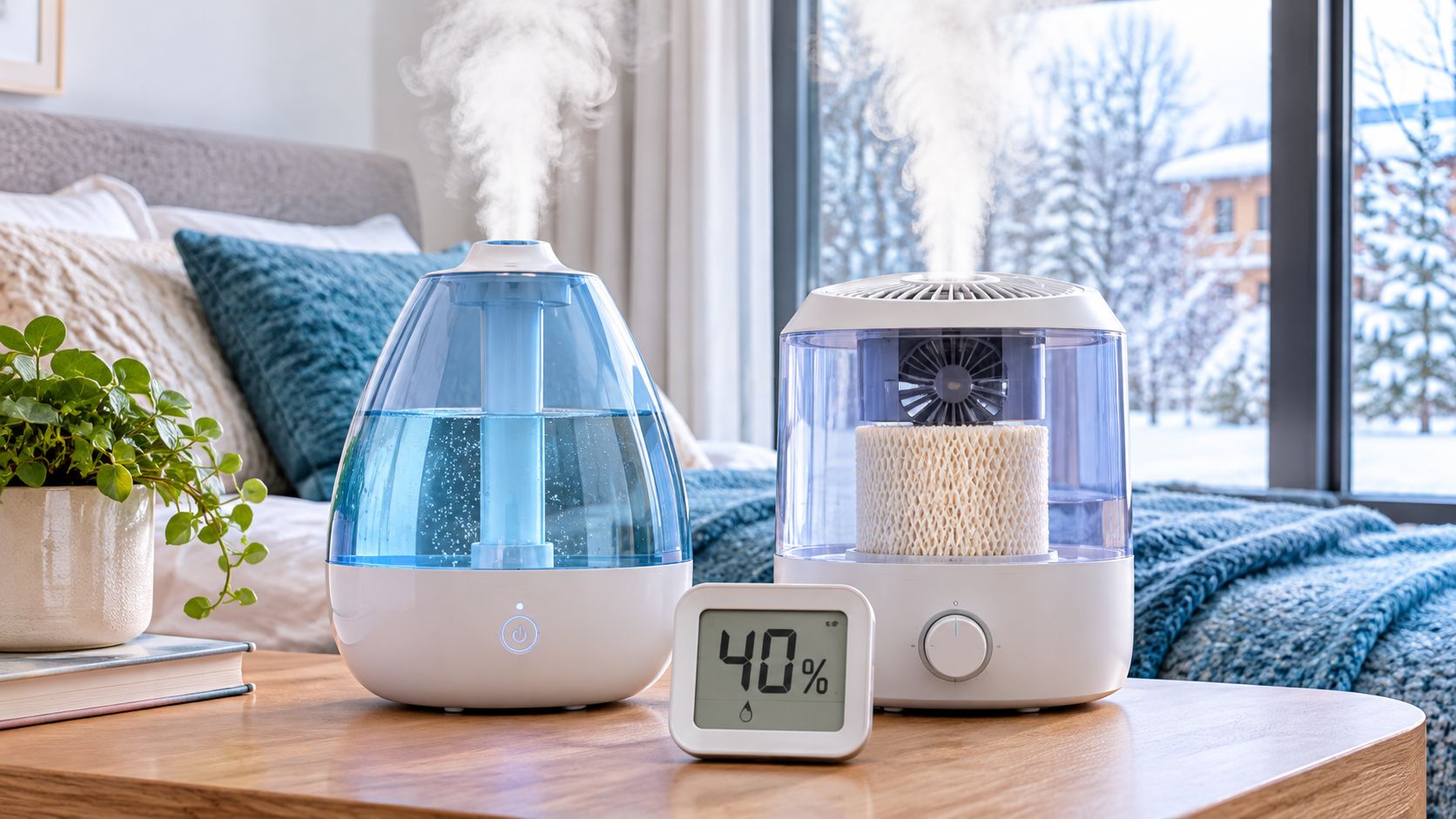
You wake up in January with a dry throat, your skin itches, and you get a static shock from the bedroom door handle. The furnace has run all night, the windows are shut, and the air feels thin. A cold mist humidifier looks like the obvious fix. Don't buy on mist output alone. Your first decision is a number, your room's measured humidity, because the right type, tank size and setting all follow from that reading.
Table of Contents
- Measure Humidity Before You Run One
- Ultrasonic or Evaporative Cold Mist Humidifiers Compared
- Matching Tank Size and Output to Your Room
- How to Clean a Humidifier and Stop White Dust
- Noise and Running Costs You Should Expect
- CAD Prices and Where to Buy in Canada
- Choose Your Cold Mist Humidifier This Winter
Measure Humidity Before You Run One
A cold mist humidifier adds moisture without heating water. Health Canada's guidance on cool-mist humidifiers describes cool-mist models as devices where a motor forces water droplets into the air as mist, and it recommends keeping indoor humidity at approximately 30% in winter and around 50% in summer. The colder the weather, the lower your winter target should sit. Windows that fog or drip are the first sign you've gone too far.
That target matters because cold outdoor air holds little water vapour, and once your furnace heats it, the relative humidity inside drops sharply. Add too much moisture back and the reverse problem starts: water condenses on cold glass and exterior walls, which encourages mould and can damage window frames and drywall.
Practical rule: Control the humidity, not the mist output.
How to read the number
A hygrometer gives you the reading, and a humidifier with a built-in humidistat reads it continuously for you. Set the sensor at about head height, away from the mist outlet, so it measures the room rather than the plume. Our guide to the ThermoPro TP50 digital hygrometer and indoor thermometer explains what the display tells you and where placement goes wrong.

Then act on the reading, not the calendar:
- Below about 30% in winter: Run the unit, starting on low.
- Around 30%: Hold the setting. You're in the comfortable zone for most heated homes.
- Clearly above your winter target: Lower the output and keep an eye on the glass.
- Any window condensation: Switch off. The room doesn't need more moisture.
One reading can mislead.
Check morning, evening and overnight over a full day, since furnace cycles swing the result. If your bedroom already sits near the winter target, a humidifier adds condensation risk rather than comfort. If readings stay low for hours, you've confirmed a real need, and you now know the feature that matters most: a unit that holds a set level and then pauses beats one that produces the biggest cloud.
Ultrasonic or Evaporative Cold Mist Humidifiers Compared
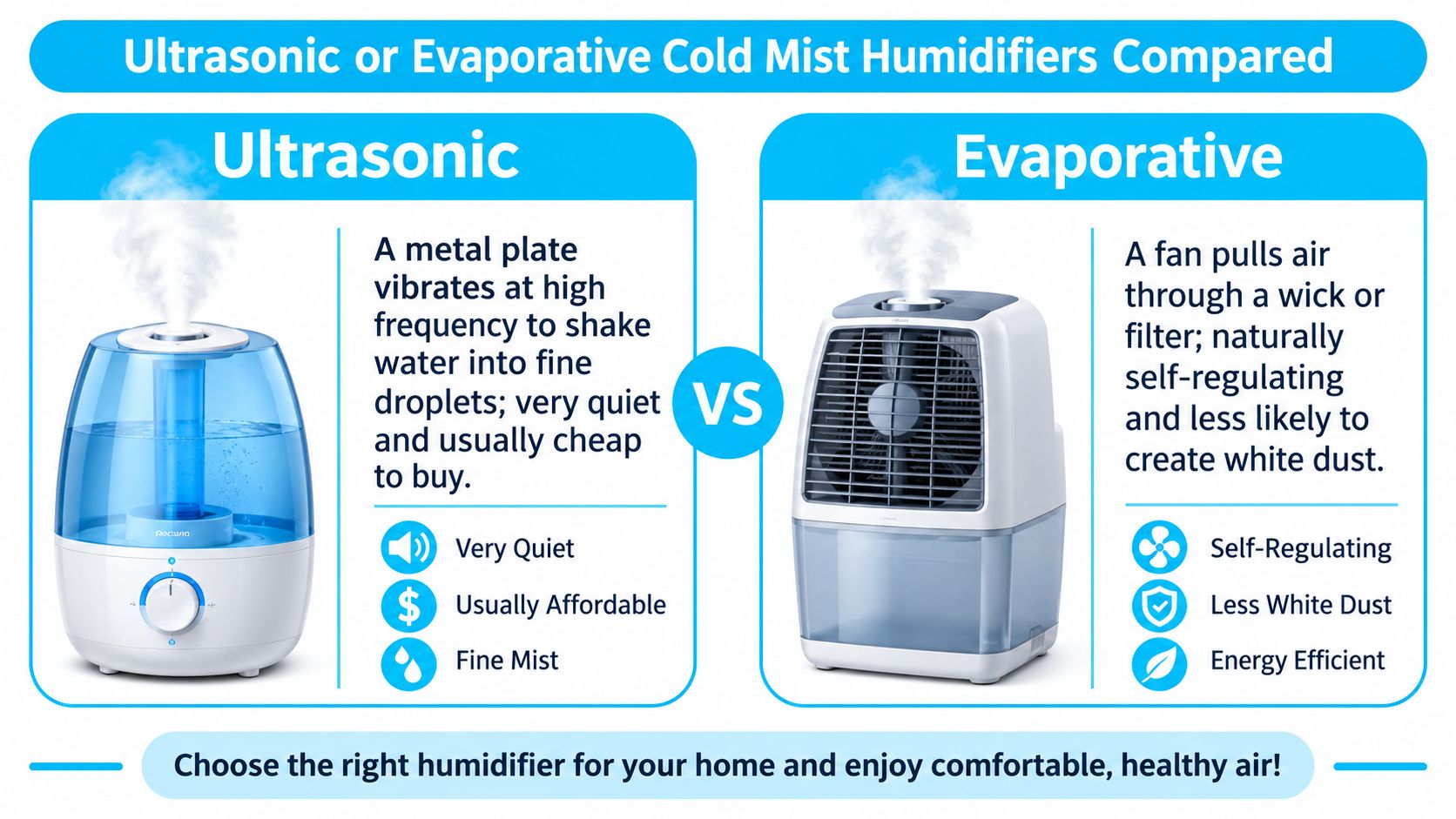
Start with the short version. Choose ultrasonic for a quiet bedroom where using distilled water is practical. Choose evaporative if your tap water is hard or white dust on furniture would be a problem. Everything else is detail behind that trade-off.
The comparison below shows the two designs side by side before we break down why they behave differently.
How each type makes mist
An ultrasonic model uses a metal plate vibrating at high frequency to shake water into fine droplets. There's no fan pushing a lot of air, so it's very quiet and usually cheap to run. The catch is minerals. Anything dissolved in hard tap water rides out with the droplets and can settle as white mineral dust.
An evaporative model works differently. A fan pulls room air through a wet wick, and water evaporates into that airflow. The wick traps minerals instead of releasing them, so you don't get white dust. You do get a steady fan hum, and you'll replace the wick on the schedule in the manual.
| Type | How it makes mist | Noise | Upkeep | Main drawback |
|---|---|---|---|---|
| Ultrasonic | Metal plate vibrates water into fine droplets | Very quiet | Clean tank every few days; use distilled water | White mineral dust with hard water |
| Evaporative | Fan pulls air through a wet wick | Steady fan hum | Replace wick on the manual's schedule | Ongoing filter cost and fan noise |
Both are cool-mist designs with no heating element. That matters in a child's room because there's no hot water or exposed hot surface. It doesn't remove the need for sensible placement, stable surfaces and cords kept out of reach.
This short video shows the visible mist behaviour so you can picture placement and output before you shop.
Before you choose, find out how hard your tap water is. Read your municipal water quality report or use a cheap test strip on the tap. If the result shows hard water and you don't want to buy distilled water regularly, evaporative is usually the lower hassle choice, even with the fan noise and wick cost.
Matching Tank Size and Output to Your Room
Measure the room before you look at tanks. Multiply length by width to get square metres, and note whether the door stays closed at night. A closed bedroom is a smaller, easier space to humidify than an open doorway that leaks moist air into a hall.
Tank size and output do different jobs. Tank size sets how long the unit runs before you refill it. Output sets how fast humidity rises. A big tank on high can still overshoot a small room, while a modest tank on low can hold a bedroom steady all night.
| Room size | Tank size (approx.) | Starting output | Note |
|---|---|---|---|
| Under 15 m² (under 160 sq ft), condo bedroom | 2 to 3 L | Low | Runs overnight without refilling |
| 15 to 25 m² (160 to 270 sq ft), bedroom | 3 to 4.5 L | Medium | Suits a full night on a medium setting |
| 25 to 40 m² (270 to 430 sq ft), open-concept living area | 4.5 to 6 L | Variable | Needs variable output to avoid overshooting |
| Above 40 m² or whole floor | Two units or a central system | Not applicable | One portable unit rarely covers the space |
Walking through the table
For a small condo bedroom under 15 m², a 2 to 3 L tank on low is enough. You're not trying to fill the condo, only the room where you sleep. Low output also reduces the chance of waking to a fogged window.
A 15 to 25 m² bedroom suits 3 to 4.5 L on medium for a full night. The extra capacity matters because refilling at 3 a.m. defeats the purpose. If you're assessing a model in this band, our overview of the Dreo Smart Humidifier 4L top-fill design is a useful example of how tank access and controls affect nightly use.
An open-concept living area of 25 to 40 m² needs 4.5 to 6 L and variable output. Open spaces lose moisture to adjoining areas, but output still needs restraint near cold windows. Above 40 m² or for a whole floor, one portable unit rarely covers the space evenly. Two units in separate zones or a central system are the practical options.
Size for the room you'll close the door on, not the largest room in the home.
Say your condo bedroom is 12 m² with the door closed. For example, a 2.5 L unit on low could run overnight without refilling and hold the level steady. A 5 L unit on high in that same room could push humidity up too fast and fog the window. The bigger tank isn't better there; it is mismatched.
Write down your room's square metres before shopping. Bring that number, plus whether the door stays closed, to every product comparison. It'll filter out oversized units quickly and keep you focused on runtime at the setting you'll use.
How to Clean a Humidifier and Stop White Dust
Cleaning decides whether a cold mist humidifier stays helpful. Standing water, damp internals and mineral scale build up fast in daily winter use. With ultrasonic models, hard water can also leave a white film on nearby furniture because minerals leave with the droplets.
The visual summary below condenses the routine, then the numbered steps give you the sink-side version.

The cleaning procedure
- Unplug and empty: Unplug the unit and pour out remaining water. Don't clean around a live base, and don't top up old water day after day.
- Wipe loose scale away: Wipe the base and tank with a damp cloth to remove loose scale and slime. This stops you from soaking debris back into every corner.
- Soak with vinegar solution: Fill the tank with a 1:1 mix of white vinegar and water, or the cleaning solution named in the manual, and let it stand for 20 to 30 minutes. The soak softens mineral deposits so you don't need force.
- Scrub gently: Scrub the ultrasonic plate or wick housing with a soft brush or cotton swab. Never use an abrasive pad or steel wool, since scratches give scale more surface to grip and it builds faster.
- Rinse three times: Empty and rinse the tank three times with clean water until no vinegar smell remains. Skipping this step can leave a sour smell in the mist.
- Air-dry every part: Let all parts dry fully before refilling. Damp internals encourage mould, especially in seams and under caps.
- Refill with distilled water: Refill with distilled water where the manual allows it. Fewer minerals in means less white dust and less scale for ultrasonic models.
Schedule and signs to watch
Clean an ultrasonic tank every few days of use, not only when it looks dirty. By the time you see a film, scale is already interfering with output. For evaporative models, replace the wick on the interval in the manual, even if it still looks intact. A worn wick holds odour and reduces evaporation.
Don't mix cleaning products unless the manual says you can. Vinegar handles mineral scale for routine care, but some parts and coatings have specific limits. If the manual names a product, use that product for those parts.
A healthy unit gives clear signs. There's no white film building inside the tank, no sour or musty smell when you open it, and the mist stays steady at the chosen setting. If output weakens, smells appear or dust returns quickly after cleaning, check your water source first, then repeat the soak and inspect the plate or wick housing for missed scale.
Noise and Running Costs You Should Expect
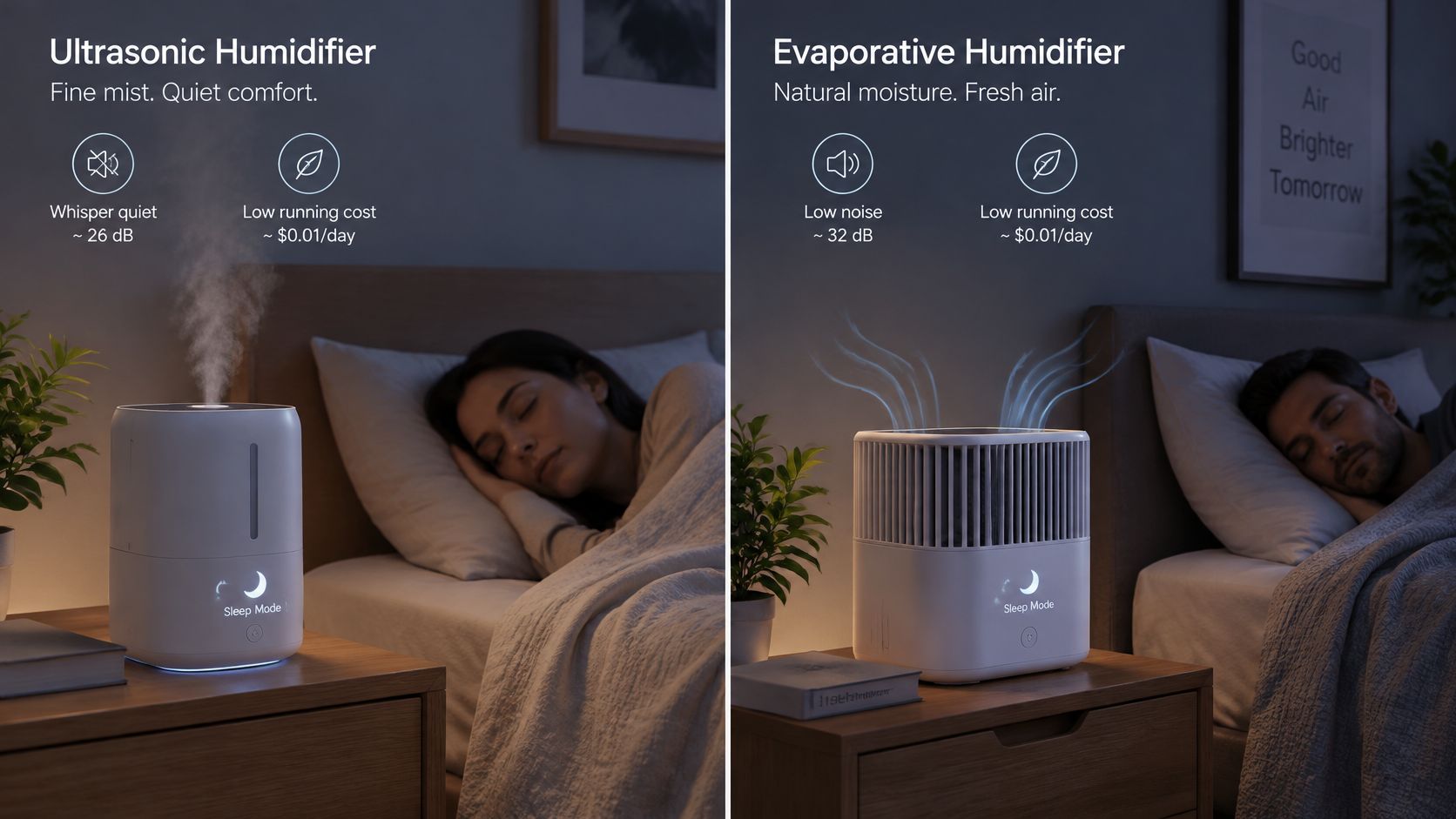
Noise matters most at 2 a.m. Ultrasonic units are typically the quietest, often little more than a faint hum, because they don't rely on a fan to move air. Evaporative units produce a steadier fan sound. Some people sleep well with that constant hum, others find it distracting in a small bedroom.
Look for a sleep or night mode if the unit will run beside a bed. On evaporative models, that mode usually lowers fan speed. On many models it also dims display lights, which helps in a dark room. The image below sets up the bedroom comparison most shoppers care about, a quiet unit you forget versus one you keep adjusting.
What the electricity actually costs
Cool-mist humidifiers use little electricity because they don't boil water. Your cost still depends on wattage, hours of use and your electricity rate. Rates differ by province, so check your own bill rather than copying someone else's estimate.
For example, say a 30 W unit runs 8 hours a night for a 150-day heating season. That's about 36 kWh over the season. At an illustrative rate of CAD $0.15 per kWh, the example works out to about CAD $5.40 for the season. Your result will shift with your rate and runtime, but electricity is rarely the main cost.
The hidden costs add up faster. Budget for replacement wicks or filters on evaporative models, vinegar for cleaning, distilled water if you choose ultrasonic with hard tap water, and a hygrometer if the unit doesn't measure humidity well. A cheap unit with pricey wicks can cost more to own than a slightly dearer model with simpler upkeep.
- Read the decibel rating: Check the spec sheet, not only marketing words like whisper quiet.
- Confirm sleep mode: Make sure it lowers noise and dims lights.
- Check the wattage: Use it with your provincial rate to estimate seasonal cost.
- Price replacement parts: Note wick, filter and cartridge costs before you buy.
CAD Prices and Where to Buy in Canada
Your humidity reading still matters at the checkout stage. Health Canada warns that too much indoor moisture can lead to condensation and mould, so control matters more than maximum mist output. Once you know your room size and preferred type, compare prices.
The table below lists two cool-mist ultrasonic models listed at Best Buy Canada in 2026. Treat it as a snapshot, then open the live listing on the day you buy because sales and stock move prices quickly.
| Model | Type | CAD price | Listed at |
|---|---|---|---|
| HQ 130 Pure | Ultrasonic | CAD $39.99 | Best Buy Canada, 2026 |
| Honeywell Ultra Cool Mist | Ultrasonic | CAD $59.98 | Best Buy Canada, 2026 |
Best Buy Canada's digital humidifier listings listed the HQ 130 Pure cool-mist ultrasonic humidifier at CAD $39.99 in 2026. Best Buy Canada's humidifiers for colds listings listed the Honeywell Ultra Cool Mist ultrasonic humidifier at CAD $59.98 in 2026.
What the price gap might buy
The gap between the two priced ultrasonic units is roughly CAD $20. That difference could pay for a larger tank, a humidistat, quieter operation or easier filling. It could also pay for lights and styling.
Read the spec sheet line by line before paying the higher amount. Compare each feature against the needs you already measured: tank band, sleep-time noise and humidity control. If the dearer model does nothing to hold a steadier level in your room, the lower price is doing the useful work.
Price sets the budget. Your sizing, noise and running-cost checks decide which model fits.
Compare the same model across Canadian retailers such as Best Buy Canada and Amazon.ca. Keep the comparison Canadian: the CAD shelf price, the return route and how warranty service is handled in Canada. Be cautious with cross-border listings priced in US dollars until shipping, duties, returns and warranty handling are added, because a lower headline price can disappear once those costs land.
As a budget guide, basic ultrasonic units sit in the lower price range. Models with a humidistat, larger tanks or stronger output controls cost more. Paying for capacity your measured room does not need creates a different problem: an oversized unit can push a small bedroom past a comfortable level and leave you switching it off by hand. A modest unit that holds a steady level on low is often better value than a larger unit you have to manage constantly.
The shelf price is the entry point. Keep the upkeep items you priced earlier in the same comparison, then choose the model that fits your room rather than the one with the most impressive mist photo.
Choose Your Cold Mist Humidifier This Winter
You can finish this decision this week with one sequence. Don't start by browsing colours or mist photos. Start with your room, your water and your sleep tolerance.
- Take the reading: Measure humidity for a full day, including overnight.
- Stop if it's already high: If readings sit above 55% or you see window condensation, you don't need a humidifier.
- Pick the tank band: Use your room's square metres to select the tank range.
- Choose the type: Pick ultrasonic for a noise-sensitive room where distilled water is practical, or evaporative if your tap water is hard.
- Shortlist two models: Apply the noise, wattage and replacement-part checks to two models in that band.
Verdicts by situation
A condo renter with hard tap water usually gets on better with an evaporative unit, despite the wick cost. A light sleeper with a bedroom under 15 m² should look at a quiet ultrasonic model on low. A family humidifying a large living area should prioritise higher output with a humidistat, so the unit pauses instead of pushing moisture into cold glass.
If you're still deciding whether the season calls for added moisture at all, our guide to using a humidifier for winter or summer helps you place that choice in context. We name the trade-offs of products we cover, such as noisy robot vacuums, smart plugs that need a patient router, and air fryers that take up counter space, and humidifiers deserve the same candour about cleaning and noise. Compare your two shortlisted models on CAD price, warranty terms and replacement part prices, check our product directory for curated listings, descriptions, specifications and reviews, then buy from the listing you checked that day.
Before you order, compare your two finalists in Celmin's product directory, where curated listings bring together descriptions, specifications and reviews for Canadian shoppers. Use those details to confirm tank size, noise, humidistat control and replacement part costs against your measured room, not against marketing claims. Visit Celmin to check the models side by side and choose the cold mist humidifier that fits your winter routine.
Sign up or sign in to join the conversation.