
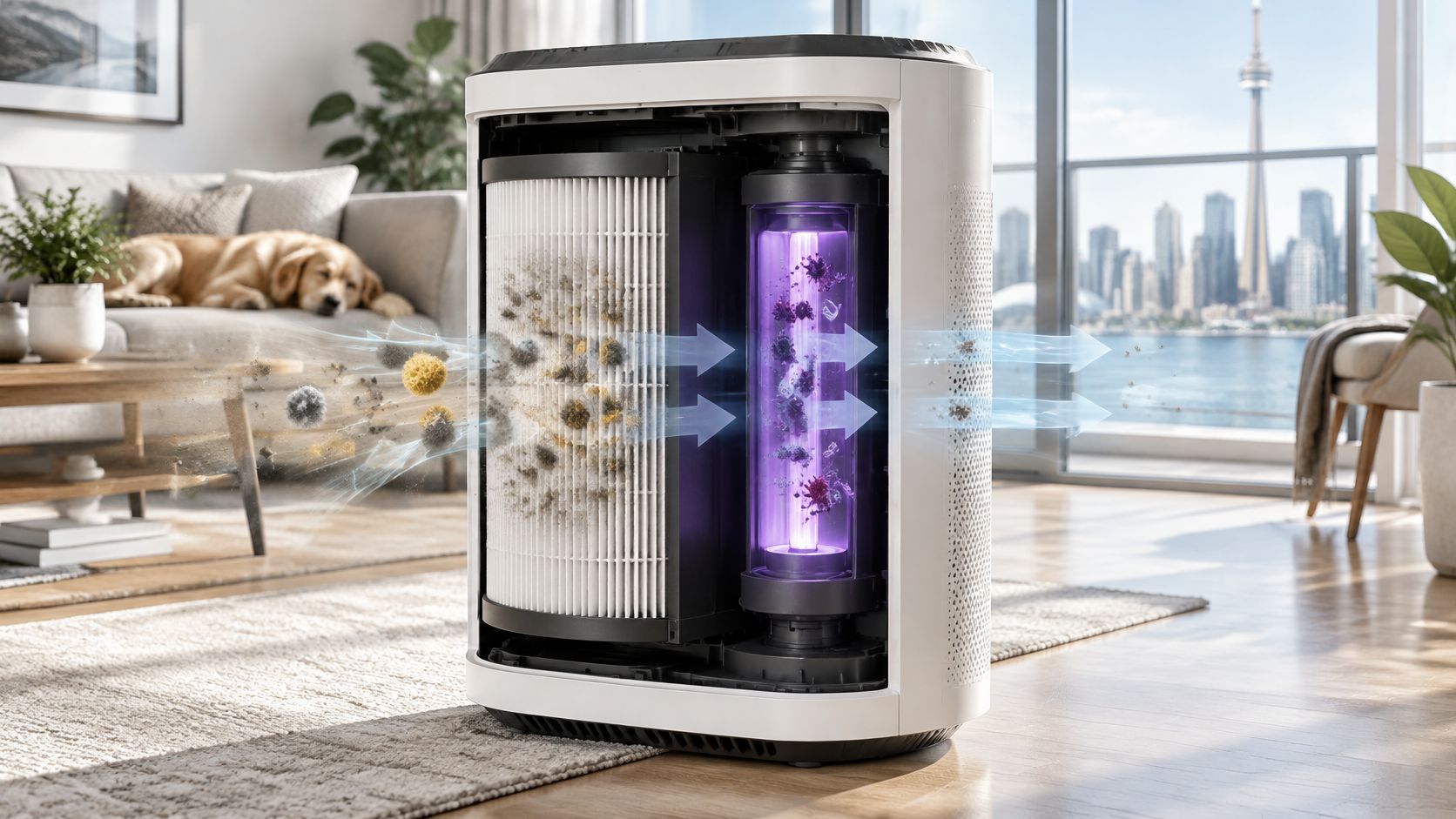
A UV-C lamp inactivates microbes that pass through it, but it does not capture dust, smoke or pollen. Those particles are what a HEPA filter removes.
The advice you'll hear most often is simpler than that. Buy an air purifier UV unit and the air is "sterilized." That line treats a UV-C label as if it were a finished whole-room result. It isn't. A lamp only acts on air that reaches it, for as long as that air stays in the light, and only on living microbes. Hallway dust, wildfire smoke under a condo door, and spring pollen stay airborne unless something physical catches them.
Canadian listings lean on "UV-C sterilization" because the phrase sounds complete. The sharper question is which pollutant the page claims to handle, under which test, and what the box leaves behind. Every claim below is judged by those test conditions and by specifications a seller can put in writing.
Table of Contents
- What Each Filter Actually Removes
- How UV-C Works and What the Evidence Shows
- Ozone and Safety Checks to Run Before You Buy
- Lamp Life, Filter Upkeep and Running Costs
- When UV Earns Its Place in a Canadian Home
- Specs to Confirm and Your Buying Decision
What Each Filter Actually Removes
Health Canada's guide to choosing a portable air cleaner draws a line that product pages often blur: these units improve indoor air quality primarily by removing small particles. A UV-C lamp damages microbial DNA or RNA on microbes that pass through the light. A HEPA filter mechanically traps particles and does not inactivate what it catches. Neither function substitutes for the other, so a "UV-C sterilization" badge says little about dust, wildfire smoke or pollen.
That gap is concrete for renters and condo residents. A unit that seals up for winter and then faces summer smoke needs particle capture sized to the room. UV can reduce viable microbes in air that reaches the lamp. It cannot remove the particles that carry smoke odour or trigger seasonal allergies.
| Technology | What it targets | How it works | Evidence for home use | Main limit |
|---|---|---|---|---|
| Enclosed UV-C lamp (254 nm) | Airborne microbes that pass the lamp | Damages microbial DNA or RNA | Mixed; upper-room installations dominate the research | Does not capture dust, smoke or pollen |
| HEPA filter (H13) | Particles 0.3 µm and larger | Mechanical capture | Strong; well-established testing | Does not inactivate microbes |
| MERV 13 filter | Fine particles, including smoke and pollen | Mechanical capture | Strong; widely used in building ventilation | Does not remove gases or odours |
| Activated carbon | Odours and volatile organic compounds | Adsorption onto a porous surface | Good for gases; capacity is limited | Does not inactivate microbes or reliably capture fine particles |
If smoke or pollen is the complaint, start with a HEPA air purifier sized for the room, then decide whether a lamp adds anything.
Run this three-part test on any listing before you compare prices.
- Name the pollutant. The page should say microbes, particles, gases, or a named mix, not "clean air."
- Show a specification. Look for a lamp wavelength and intensity, or a filter class such as H13 or MERV 13, plus airflow. A UV-C label without those numbers is not a comparable specification.
- Say what it leaves behind. An honest listing states that UV does not capture dust, smoke or pollen, and that carbon does not catch fine particles.
Verdict: UV supplements filtration. It does not replace it. A UV-C label alone does not settle the particle question, and the next checks are dose, safety and documented lamp performance.
How UV-C Works and What the Evidence Shows
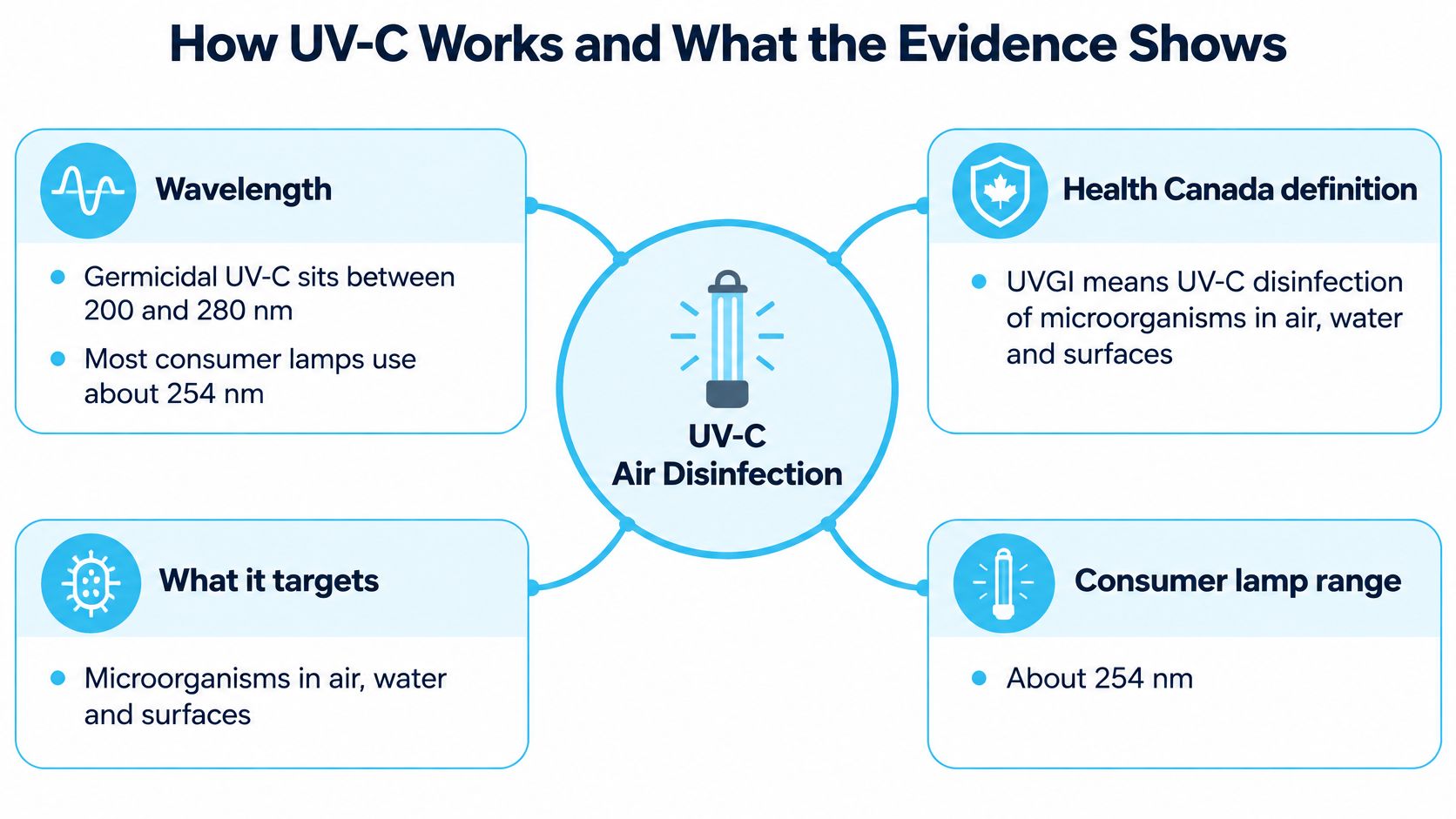
Germicidal effect is a dose problem, not a logo problem. Four design facts decide whether a lamp in a box changes the air in a Canadian living room.
Wavelength and what the term means
Health Canada defines ultraviolet germicidal irradiation (UVGI) as a disinfection method that uses ultraviolet-C radiation, generally between 200 and 280 nanometres, to inactivate microorganisms in air, water and on surfaces. Most consumer lamps sit near 254 nm, inside that band. The definition is about inactivation, not about trapping anything.
Dose is intensity times time
Think of a sunburn. A brief, weak exposure does little. A longer or stronger one does more. UV dose works the same way. It is lamp intensity multiplied by how long a microbe stays in the beam. A bright lamp with almost no dwell time can deliver a weak dose. A modest lamp with a slow, well-mixed pass can deliver a stronger one. Marketing that quotes a wavelength and skips both intensity and contact time has not described a dose at all.
Airflow sets the contact time
A fan pulls room air past the lamp in a fraction of a second. A unit that moves more air per hour gives each microbe less time under the light, unless the lamp zone is longer or the output is higher. Inactivation is not removal. If the dose was too small, the organism is still viable, and the particle it rode on is still in the room either way. Dust and smoke do not disappear because they passed a purple tube.
Design changes the result
Health Canada stresses that effectiveness depends on exposure dose, airflow, room configuration and system design. A claim that a product "uses UV-C" does not, by itself, establish a level of whole-room air cleaning. The same lamp in a short chamber, a leaky sleeve, or a room with dead corners will not match a lab slide held under a lamp for minutes.
What the 2022 review actually counted
In its 2022 evidence review, Health Canada reported that UV-C had demonstrated the ability to inactivate SARS-CoV-2 by up to 99.9% under the studied conditions. That figure belongs to those conditions, not to every box on a Canadian retail site. The review examined nine studies on occupied-room air. The split matters more than the headline percentage.
| Study group | Number of studies | Relevance to a home purifier |
|---|---|---|
| Upper-room UVGI | 7 | Low; professionally designed systems |
| Far-UV-C | 1 | Early-stage; not a consumer benchmark |
| Portable UV air cleaner | 1 | Closest match to a home unit |
| Total reviewed | 9 | Mostly professional, not consumer, evidence |
Seven of nine studies evaluated upper-room UVGI, the kind mounted high in a room and engineered so occupants are not in the beam. One assessed far-UV-C. One studied a portable UV air cleaner. The evidence supports UVGI as a potentially useful supplemental control, especially with ventilation and filtration, not as a universal replacement for those measures.
An Alberta doctoral thesis published in 2025 adds a harder comparison. Tested UV-photocatalytic-oxidation systems required substantially improved UV intensity to achieve sufficient infectious-aerosol inactivation, and they imposed higher energy burdens than MERV 13 filters. Photocatalytic oxidation is not the same hardware as a plain enclosed 254 nm lamp, so don't treat that thesis as a verdict on every UV tube. It does show that adding UV chemistry to airflow can raise energy use and still miss a health-safety bar unless intensity is much higher.
Match every percentage to the room, the hardware and the exposure that produced it. A 99.9% result from a studied setup is not a promise printed on a carton.
Ask the seller for a test of the complete purifier, not a chamber test of a bare lamp, and for the intensity and contact time used. If those figures are missing, the evidence for that model is thinner than the label suggests. UV evidence is real. For small consumer boxes, it is still thin.
Ozone and Safety Checks to Run Before You Buy
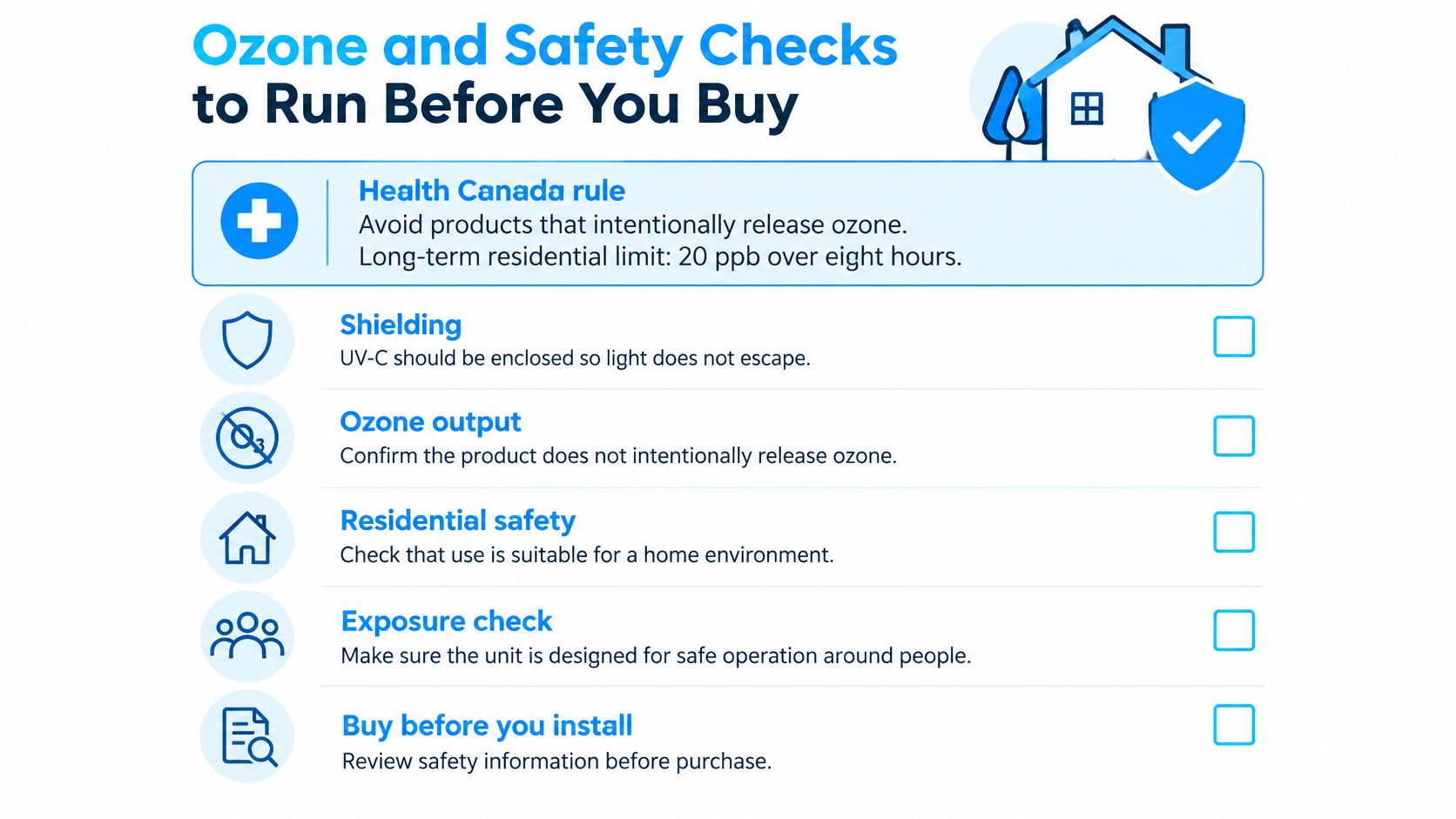
Health Canada advises against products that intentionally release ozone and sets a long-term residential ozone exposure limit of 20 ppb over eight hours. That is the rule to apply before you look at microbial claims. Prolonged UV-C exposure can damage skin and eyes. Health Canada's evidence summary reports that exposure above 230 nm can do that damage, and it recommends proper system design and professional maintenance. Lamps belong inside a housing that keeps the beam off people.
Regulatory status is separate from a safety sticker. UV devices marketed to control human pathogens in air may require authorization or registration under the Pest Control Products Act. Devices that generate ozone or other substances must meet additional requirements. A UV-C button is not that paperwork.
Identified studies in that evidence summary did not measure or discuss ozone or volatile-organic-compound by-products. That gap matters most in a bedroom, a nursery, or a small condo where the unit runs all night beside the bed.
Five checks before you pay
- Confirm the lamp is fully enclosed. Reject open-room UV products that lack exposure controls. If you can see the bare tube while the unit runs in an occupied room, the design has not kept the beam off skin and eyes.
- Look for Canadian authorization or registration when the ad claims pathogen control. A germ claim can move the product into pesticide rules. Ask for the registration number in writing, not a slogan.
- Reject marketing that promotes ozone on purpose. Request independent ozone-emissions data and compare it with the eight-hour residential limit, rather than trusting "ozone free" as a badge with no test behind it.
- Ask whether VOC by-products were measured. Most of the identified studies did not measure them. A seller who cannot say either way has not closed that question for continuous home use.
- Separate the technologies on the label. An enclosed 254 nm lamp, a far-UVC system, an ionizer, photocatalytic oxidation and an ozone generator are not interchangeable. Treating every "UV-C" word as the same product is how unsafe hardware gets a pass.
UV is not automatically unsafe. Safety depends on wavelength, shielding, by-products, installation and maintenance, not on a button that says UV-C.
Lamp Life, Filter Upkeep and Running Costs
UV-C output falls with age and with dust on the glass. Health Canada's indoor air guidance, citing the National Collaborating Centre for Environmental Health, reports that UV-C lamp output can decline with age and dust accumulation. The same guidance puts typical lamp lifespan at about 9,000 operating hours, roughly one year of continuous operation. That figure is an operating-life estimate, not a guarantee that germicidal output stays at its original level through hour 9,000. Replacement intervals still follow the manufacturer's instructions and how the unit is kept. The guidance also places UV germicidal irradiation alongside ventilation and filtration when "equivalent clean air" is calculated. The lamp is a supplement whose output has to be maintained, not a substitute for outdoor air.
The owner's manual overrides any general schedule below. Use the table to plan maintenance, then price the consumables separately.
| Maintenance task | Typical interval | Why it matters |
|---|---|---|
| Vacuum or wash the pre-filter | Monthly, or when dust is visible | Keeps airflow up so the UV dose holds |
| Clean the quartz sleeve or lamp housing | Monthly | Dust on the lamp cuts output |
| Replace the HEPA or carbon filter | Every 6 to 12 months | Filters load over time and reduce airflow |
| Replace the UV-C lamp | About 9,000 operating hours, roughly one year of continuous running | Lamp output declines with age and dust |
Why each task changes performance
A clogged pre-filter cuts airflow. Slower air can lengthen the time a particle spends near the lamp, but it also means less room air is treated each hour, and a loaded filter is no longer doing its capture job. A dusty quartz sleeve cuts the light that leaves the lamp, so the intensity half of the dose drops while the unit still looks "on." Filters load whether or not a lamp is present. Once airflow falls, both capture and any UV pass get worse together. Plan replacement filters as a scheduled cost, not a surprise.
What to price before you buy
Check the rated power draw in watts if the manufacturer publishes it, then estimate a year of electricity in CAD from your utility rate and the hours you expect to run it. Continuous bedroom use is a different bill from a few evening hours. A lamp that requires a proprietary cartridge can also change the math, because the consumable cost is tied to the assembly rather than to a standard tube.
Ask for four figures in writing.
- Replacement lamp price in CAD, not a bundled "care kit" with no lamp line.
- Whether the lamp is sold on its own, so you are not replacing the whole chassis.
- Whether HEPA and carbon filters are stocked in Canada.
- Whether a replacement schedule is published, with hours or months, not "as needed" alone.
Add one yearly budget line that sums the lamp, the filters and the electricity. That total is the cost of keeping the stated performance, and it is the number to set beside the purchase price. If the seller cannot provide the lamp price, the filter price and a replacement interval, the running-cost comparison is incomplete.
When UV Earns Its Place in a Canadian Home
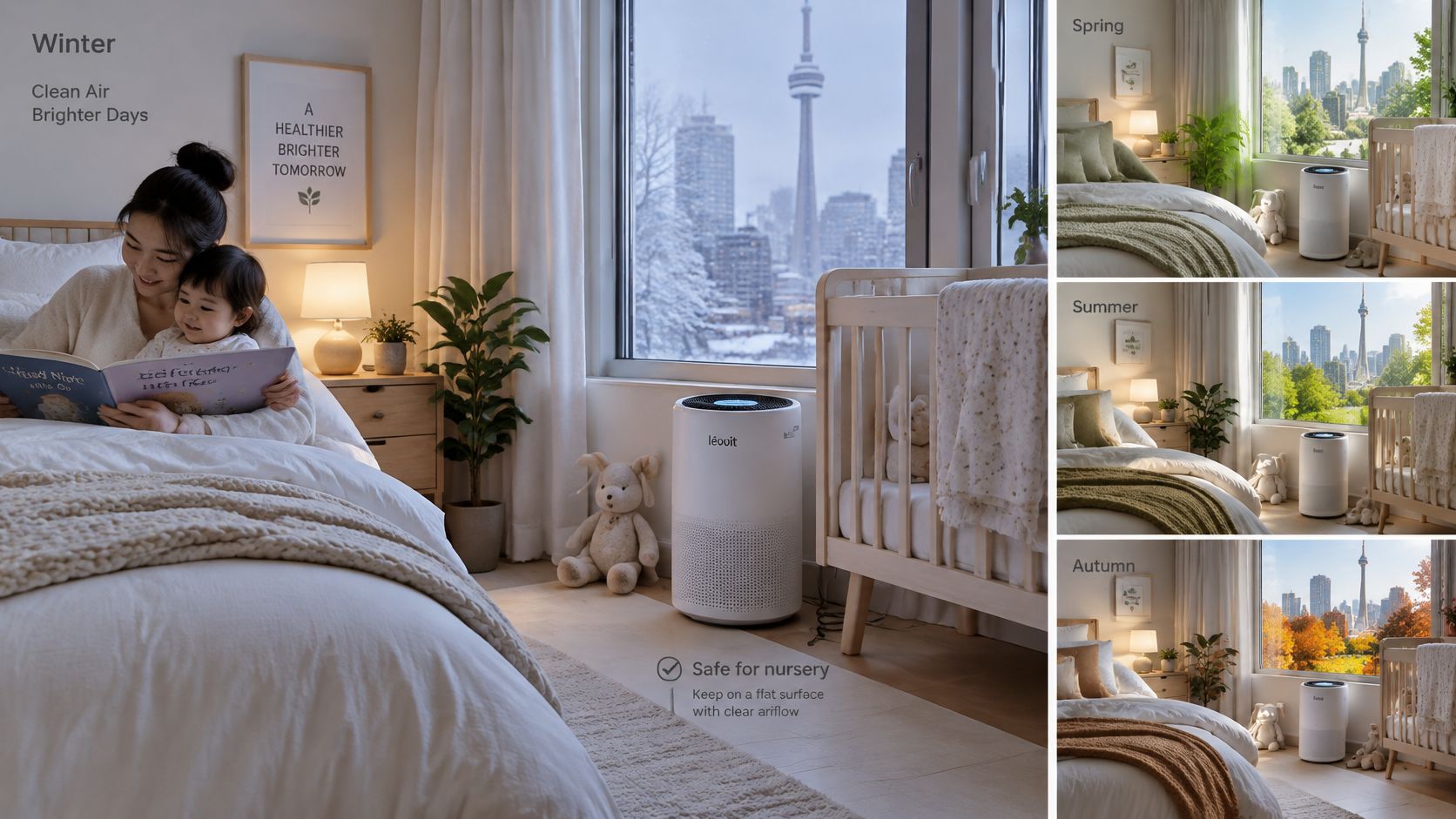
Three households show when a lamp earns floor space and when it doesn't. The hardware can be the same. The pollutant and the room are not.
A condo bedroom or nursery that runs all night. The unit sits near sleepers for hours. Enclosure and ozone checks come first, and the unit should pass them before anyone relies on it overnight. A bare lamp, an ionizer sold as "UV," or a missing emissions test fails this room even if the filter class looks fine. Infants and people asleep cannot step away from a bad by-product.
A winter home with the windows sealed. Dry indoor air and limited fresh air make particles linger. Mechanical filtration and whatever ventilation the building allows do more for dust than a lamp does. UV can sit behind a filter you already trust if shared indoor air and microbes are a real concern. It is not the main control for a stuffy January apartment.
A summer week of wildfire smoke. Fine smoke is a particle problem. A lamp does not catch it. A properly sized HEPA filter, or MERV 13 where the furnace or HRV can take that rating, is the priority. Spending the budget on a UV badge while the carbon and HEPA stages are undersized leaves the smoke in the room.
Renters often have a short counter, a strict strata noise rule, and nowhere to store spare lamps. Weigh the lamp's added value against footprint and sound. We name those trade-offs on the products we cover, including noisy robot vacuums, smart plugs that need a patient router, and air fryers that take up counter space. A UV stage is the same kind of compromise. It takes room, it hums with the fan, and it adds a yearly part.
For a wider look at cost against what you breathe, see whether an air purifier is worth it in a given season.
UV adds value when the specification is documented, the lamp is enclosed and not an ozone product, and you want a supplement to filtration for microbes in shared indoor air.
Skip the lamp and choose a HEPA-first unit when smoke or dust is the main problem, when no intensity or contact-time figure is published, or when the device would run near sleeping infants without verified exposure controls.
Specs to Confirm and Your Buying Decision
Buy a UV unit only when its specifications are documented and it complements a filter you already trust. Otherwise choose a HEPA-first purifier and treat UV as an optional extra you can skip.
We publish expert reviews and guides for smart home devices, tech gadgets and home appliances, and the same standard applies here. A headline germ claim is not a spec sheet. Before you pay, ask the seller for a written answer on each of these, in the same email or chat thread so you can keep it.
- Lamp wavelength. Germicidal consumer lamps should be identified near 254 nm, not described only as "UV light."
- Lamp intensity. This is the output that sets the dose. A wattage of the whole appliance is not the same number.
- Air-contact time through the lamp zone, in seconds or a stated range, not "instant."
- Rated airflow. That figure tells you how much air is moved and, with contact time, whether the dose is plausible.
- Where the test was run. Performance should be for the complete purifier, not a laboratory chamber with a bare lamp and still air.
Then confirm the safety items that belong with any continuous home unit. The lamp housing should be enclosed, ozone-emissions data should be independent rather than a slogan, and any Canadian authorization or registration should be named if the ad claims control of human pathogens.
Put two or three models on one sheet. Columns that matter are the CAD price, whether the unit and its lamp are available from a Canadian seller, and the replacement lamp cost. Leave a column for wavelength, intensity and contact time, and leave it blank if the seller will not answer. Do not rank rows by who prints "UV-C" larger.
A written refusal is useful. If the seller cannot supply intensity, contact time, or a full-unit test, you don't have documented performance. You have a label. In that case the rational buy is the purifier whose filter class, room size and replacement parts you can already verify, with no UV stage required.
Celmin publishes practical buying guides for air quality gear and other home tech, written for Canadian rooms, CAD prices and local parts availability. If you are weighing a HEPA-first purifier against a unit that adds UV, start with the air quality guides on Celmin and match the hardware to the pollutant you need to cut.
Sign up or sign in to join the conversation.