
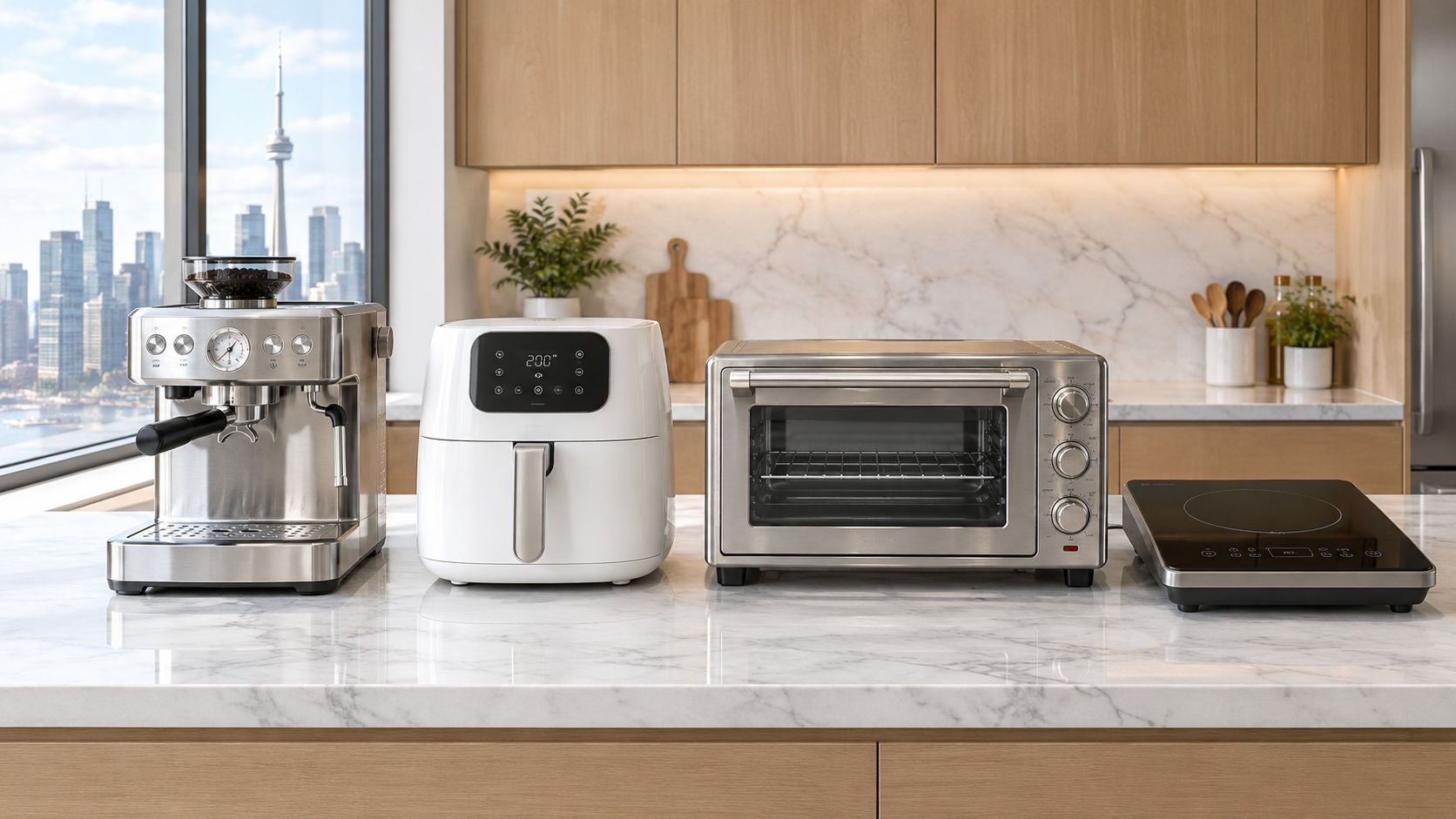
You're probably staring at a kitchen that already feels full. The kettle lives beside the sink because there's nowhere else to put it. The toaster gets hauled out of a cabinet every morning. Someone in your home wants an air fryer, someone else wants an espresso machine, and your actual prep space is about the size of a cutting board.
That's the buying problem. Not feature count. Not app control. Not whether a retailer slapped “smart” on the box.
The best kitchen appliances for Canadian homes are the ones that earn space every day. In a condo, that standard gets brutal fast. If an appliance doesn't save time, replace another tool, or improve cooking often enough to justify its footprint, it doesn't belong on the counter. It belongs in a cabinet, or it belongs in someone else's shopping cart.
Table of Contents
- Why Your Kitchen Space Should Drive the Decision
- What Canadian Shoppers Are Actually Buying Right Now
- The Quick Answer Table Worth Bookmarking
- Category Verdicts From an Espresso Maker to a Dishwasher
- Smart Features Versus Real Value in a Canadian Kitchen
- Matching Appliances to Real Canadian Living Situations
- Timing Your Purchase Around CAD Pricing and Seasonal Deals
- Practical Questions Canadian Buyers Always Ask
Why Your Kitchen Space Should Drive the Decision
A lot of appliance guides are written like everyone has a giant suburban kitchen with endless outlets and deep counters. That's nonsense for a huge chunk of Canadian buyers. In a Toronto condo or Vancouver rental, space is the first filter. Everything else comes second.
If two people share a small kitchen, every appliance creates friction. One bulky machine can block prep space, crowd the drying rack, and turn weeknight cooking into a shuffle. That's why I judge the best kitchen appliances by one simple question: would I give this appliance permanent square inches in a condo kitchen?
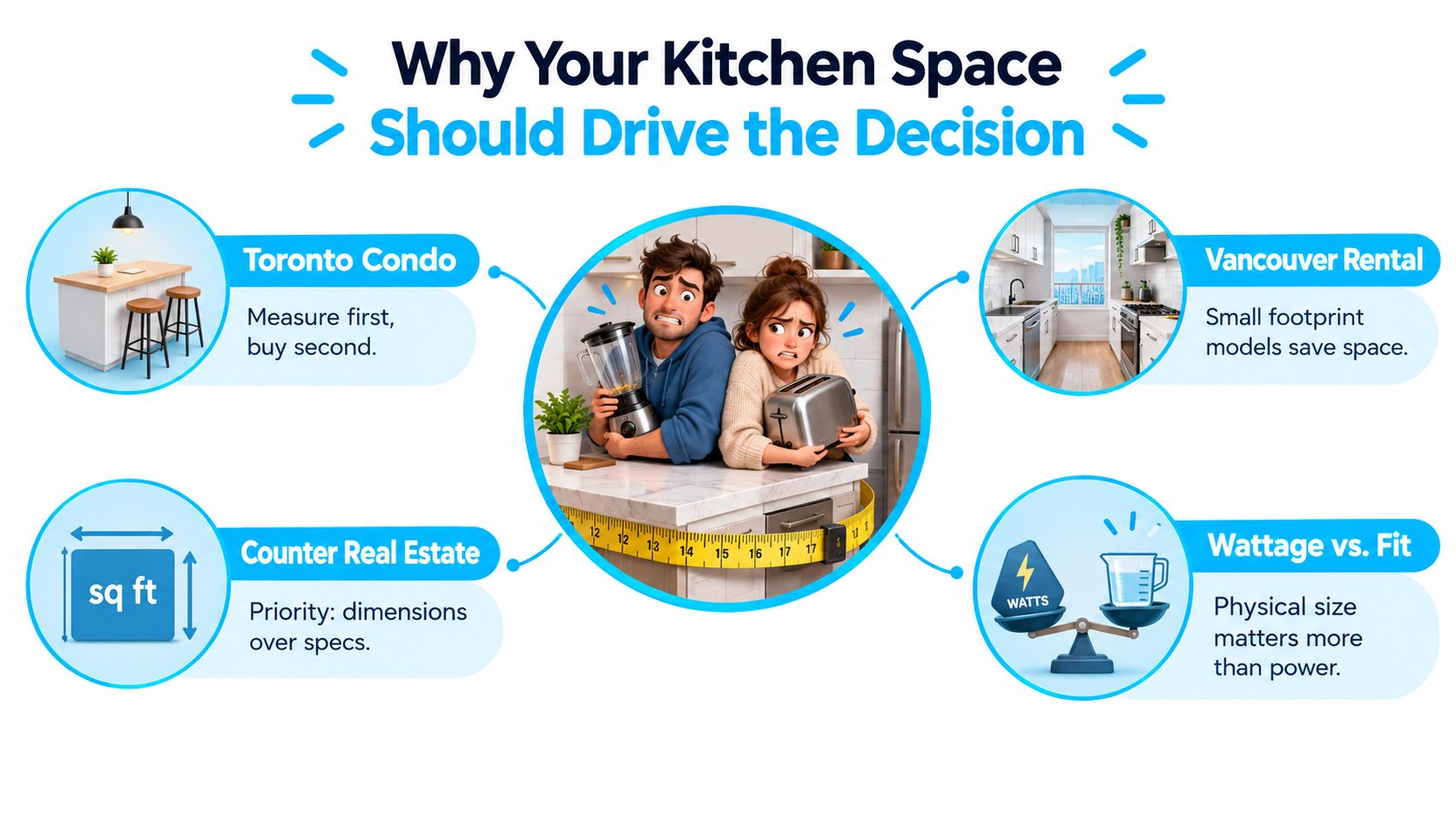
Measure first and get honest second
Before you compare brands, do three things:
- Measure your live counter space. Not total counter space. Live space. The part you can use once the kettle, knife block, dish rack, and coffee setup are in place.
- List what you cook every week. Toast, rice, smoothies, espresso, sheet-pan dinners, frozen food, soups. This matters more than a spec sheet.
- Ask what the new appliance replaces. If it doesn't replace something, it needs to add daily value.
That's the difference between a smart buy and clutter with a power cord.
For readers dealing with tiny layouts, Celmin's guide to kitchen appliances for small spaces is useful because it treats footprint as the main buying constraint, which is exactly how you should shop.
Practical rule: If an appliance can't justify staying plugged in, it probably shouldn't be bought at all.
Feature bloat usually means bulk
The worst offenders are appliances with too many modes and too little purpose. A fancy toaster with a screen doesn't beat a good toaster oven if you already heat leftovers and roast vegetables. A giant stand mixer doesn't make sense if you bake five times a year. A premium coffee setup can make sense fast, but only if you use it every morning.
This space-first lens also matches where the Canadian market is headed. Canada's household appliance market was valued at USD 4.92 billion in 2024 and is projected to reach USD 6.96 billion by 2033, with cooking appliances holding 41.6% of the market in 2024 and smart appliances projected to grow at 5.8% CAGR from 2025 to 2033, according to Grand View Research's Canada household kitchen appliances market report. That tells me buyers still care most about core cooking gear, with connected features only mattering when they improve a real kitchen task.
What Canadian Shoppers Are Actually Buying Right Now
Aren't shopping for novelty. They're shopping for appliances that solve the same three problems over and over: limited space, daily cooking, and wanting one machine to do the job of two.
Canadian market analysis points that way. One industry estimate puts Canada's kitchen-appliance market at USD 7.45 billion in 2026 and projects USD 9.23 billion by 2031, while also noting that demand is being pulled by compact living and smart-tech integration, according to Mordor Intelligence's Canada kitchen appliances market analysis. That matters because it explains why compact, multifunction appliances keep getting shelf space while single-task gadgets collect dust.
Demand follows daily use
Cooking gear dominates because it earns repeat use. That aligns with the broader Canadian appliance market, where cooking appliances held the largest share, as noted earlier. It also lines up with how people live in smaller homes and condos. A machine that bakes, reheats, crisps, or brews every day is easier to justify than something that only comes out for brunch.
Another useful signal is pricing. Statistics Canada reported that in 2025, prices for cooking appliances were up 0.2%, small household appliances such as toasters and kettles were up 0.4%, and refrigerators and freezers were up 0.1%, according to Statistics Canada's note on home outfitting prices holding steady. When prices are that steady, shoppers should stop obsessing over tiny sale differences and focus harder on fit, maintenance, and long-term use.
Top Kitchen Appliance Categories by Canadian Demand
| Category | Demand Signal | Why It's Selling |
|---|---|---|
| Cooking appliances | Largest share of the Canadian household appliance market | People replace and upgrade tools they use daily |
| Smart appliances | Fastest projected growth within the market | Buyers want connected features when they improve convenience |
| Compact and multifunction units | Demand tied to compact living | Small kitchens need appliances that consolidate tasks |
| Small household appliances | Prices largely steady in 2025 | Stable pricing makes practical fit more important than waiting for tiny price moves |
| Core kitchen categories | Strong buyer interest over novelty purchases | Shoppers favour durable, everyday-use equipment |
Buyers don't need more features. They need fewer regrets after the box is opened.
That's why the rest of this guide leans hard into espresso machines, toaster ovens, dishwashers, blenders, and other workhorse categories. Those are the purchases most likely to earn their keep.
The Quick Answer Table Worth Bookmarking
If you want the short version, this is it. These are the appliance categories debated, scored by footprint, real-world use, value in CAD terms, and how easy they are to buy and support in Canada.
Quick Answer Which Kitchen Appliances Are Worth the Space
| Appliance Category | Footprint | Function | CAD Value | Canadian Availability | Verdict |
|---|---|---|---|---|---|
| Espresso machine | Medium | High for daily coffee drinkers | Strong if used every day | Good at major retailers | Buy mid-tier if you skip café runs |
| Air fryer | Medium | Moderate to high | Good, but overlaps with toaster ovens | Widely available | Buy only if you won't buy a combi oven |
| Compact dishwasher | Built-in, space-sensitive | High | Strong in small households that cook often | Good but selection is narrower | Buy if your layout allows it |
| Stand mixer | Large and heavy | Low to high depending on baking habits | Poor for occasional bakers, strong for weekly bakers | Easy to find | Skip unless you bake weekly |
| Instant Pot or multi-cooker | Large cabinet item | High for soups, rice, braises | Strong | Very good | Buy if it replaces rice cooker and slow cooker |
| Smart kettle | Small | High | Fair to good | Good | Buy only if the temperature presets matter |
| Toaster oven | Medium to large | Very high | Excellent if it replaces toaster and air fryer | Very good | One of the safest buys |
| Full-size refrigerator | Major built-in footprint | Essential | Depends on reliability and layout fit | Very good | Buy for service support, not bells and whistles |
My blunt take
The safest categories for most Canadian homes are toaster ovens, sensible espresso machines, blenders, and dishwashers that fit the layout. The easiest mistakes are giant stand mixers, redundant air fryers, and “smart” countertop gear that duplicates what your oven already does.
If you're trying to build a list of the best kitchen appliances, don't ask which category looks impressive. Ask which one saves you from doing something annoying every day.
Category Verdicts From an Espresso Maker to a Dishwasher
People usually get lost. They compare ten models, forget their own kitchen, and end up buying whatever had the flashiest promo badge. Don't do that.
Category Verdicts at a Glance
| Category | Top Pick (CAD) | Verdict | Why |
|---|---|---|---|
| Drip coffee maker | Technivorm Moccamaster (mid to upper tier) | Buy if two people drink coffee daily | Fast, simple, worth the counter space for households that brew every morning |
| Espresso machine | Breville Bambino Plus or Breville Barista Express | Buy for daily espresso drinkers | Strong utility, reasonable footprint, good fit for condo coffee setups |
| Air fryer | Ninja or Philips basket model | Cabinet or skip | Good results, but often redundant if you own a good toaster oven |
| Toaster oven | Breville Joule Oven or Cuisinart Air Fryer Toaster Oven | Buy | Replaces multiple appliances and handles weeknight meals well |
| Stand mixer | KitchenAid Artisan | Skip unless you bake weekly | Heavy, awkward to store, only worth it for frequent bakers |
| Blender | Vitamix Explorian or Breville Fresh & Furious | Buy if you use it several times a week | Smoothies, soups, sauces. Repeat use justifies the space |
| Food processor | Cuisinart or Breville mid-size model | Cabinet | Useful, but not worthy of permanent counter space for most homes |
| Dishwasher | Bosch 300 Series or Bosch 18-inch option | Buy if it fits | Reliable choice for condo kitchens and compact layouts |
| Range hood | Broan, Faber, or built-in insert | Don't cheap out on function | Ventilation matters more than style |
Coffee first because people use it daily
A basic drip machine still makes sense. If your home drinks coffee by the pot, a Moccamaster-style brewer earns its place because it's used constantly and doesn't demand much fiddling. If coffee is just a solo habit, a large brewer can feel like dead weight.
Espresso is different. A Breville Bambino Plus makes sense for most condo kitchens because it stays compact and gets you solid milk drinks without dominating the counter. A Breville Barista Express earns space if you care about grinding and pulling shots in one machine. A bigger bean-to-cup machine like a De'Longhi Magnifica makes more sense in a larger kitchen, office, or second setup where convenience matters more than footprint.
The air fryer problem
Most Canadian condo buyers don't need both an air fryer and a toaster oven. They need one machine that handles frozen food, toast, reheating, roasting, and the occasional batch of wings.
That's why I'd take a Breville Joule Oven or Cuisinart Air Fryer Toaster Oven over a standalone basket air fryer in a small kitchen. A basket fryer still makes sense for people who cook quick crispy food constantly, but for everyone else it's a duplicate.
A combi toaster oven is often the better condo move because it replaces more tools, not because it wins any social media argument.
The heavy stuff that often gets overbought
A KitchenAid Artisan is great. It's also large, heavy, and often wasted on occasional bakers. If you make bread, cookies, or cakes most weeks, buy it. If you bake during the holidays and one rainy weekend in February, save the money and the shelf space.
Blenders are easier to defend. If smoothies, sauces, or soup are regular meals, a good blender earns either permanent or near-permanent space. Celmin's guide to the best blender for smoothies is useful if that's your main use case, especially if you're choosing between compact and full-power models sold in Canada.
Food processors are useful but rarely deserve a permanent spot. Keep one in a cabinet if you prep a lot of vegetables, pastry dough, or slaws. Otherwise, skip it.
Built-in appliances that are worth caring about
Dishwashers matter more than people think. In condos, a Bosch 300 Series is a safe default because it balances footprint, decent support, and a reputation for getting on with the job. If you're working with a tighter galley layout, an 18-inch Bosch dishwasher can be the smarter fit.
Range hoods don't get enough attention. People obsess over fridge doors and ignore ventilation. That's backwards. If you cook with oil, sear often, or live in a closed condo layout, a competent hood improves daily life more than a touchscreen fridge ever will. Function first. Looks second.
Smart Features Versus Real Value in a Canadian Kitchen
A lot of smart appliance features are expensive ways to do nothing important. That's the truth.
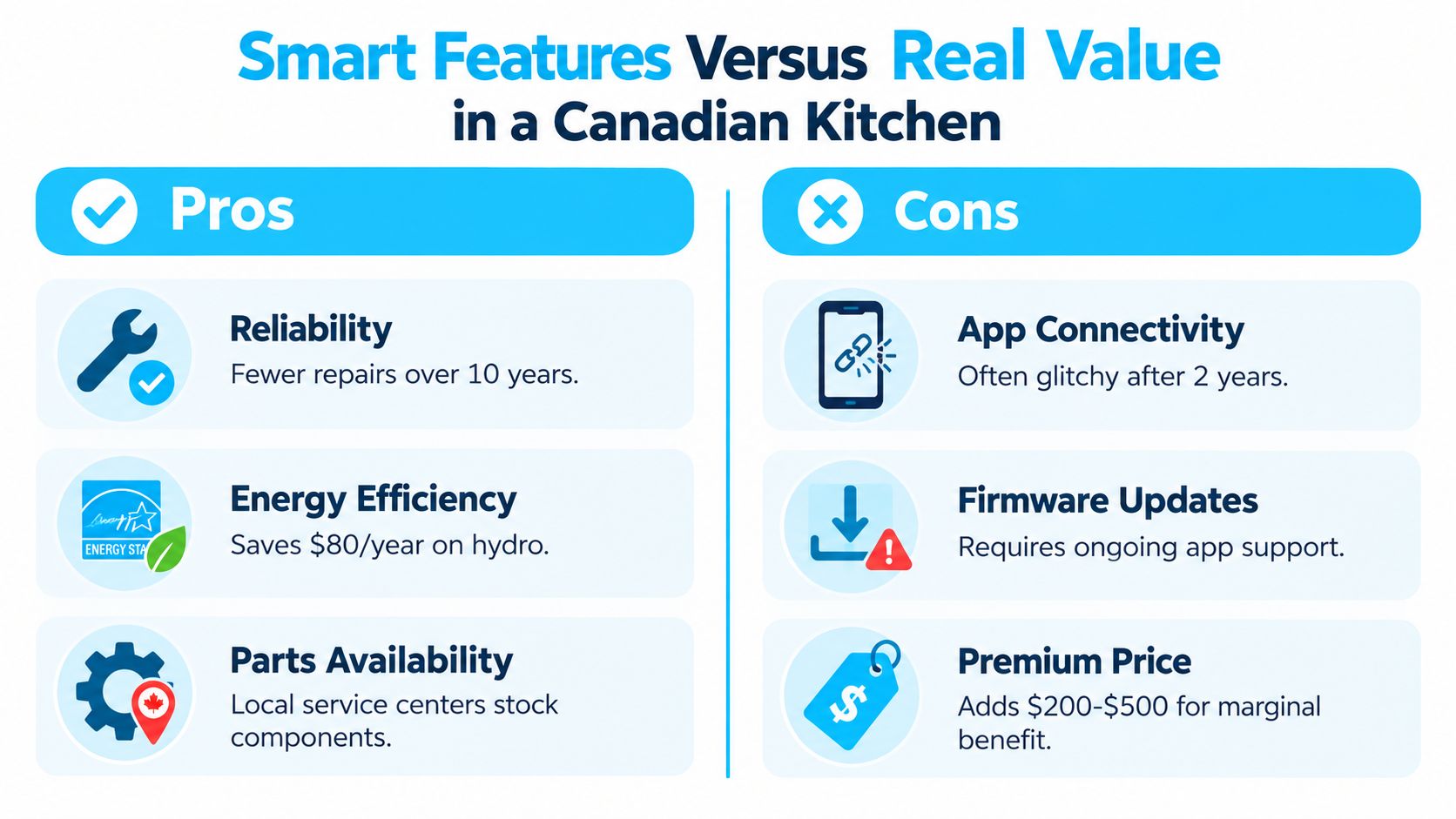
Because 2025 appliance pricing in Canada has been broadly steady in core categories, the better question isn't “Should I wait for a deal?” It's “Should I spend the extra money on features I'll barely touch?” Most of the time, the answer is no.
Smart features that actually matter
Some upgrades are useful because they change daily cooking or ownership pain.
- Induction cooking: Faster response, easier cleanup, and a better fit for many modern kitchens.
- Dual-evaporator fridge design: Better if you care about more stable cooling and odour separation.
- Precise temperature control on kettles: Worth it if you drink pour-over coffee or tea and use the presets.
- Delay start and cycle info on dishwashers: Helpful because people use them often.
Canadian appliance efficiency has also improved sharply over time. Natural Resources Canada data cited in a federal industry profile shows the average set of major appliances shipped in Canada used about 2,299 kWh per year in 2020, almost half the consumption of a comparable set in 2000, with ENERGY STAR coverage reaching 67% for refrigerators, 92% for dishwashers, 73% for clothes washers, and 61% for electric clothes dryers in 2020, as summarized in this federal Canadian appliance industry profile. That's why I'd prioritise efficient, proven hardware over flashy connectivity.
Smart features that are mostly hype
App-controlled ovens sound cool until you realise you still need to load the food, set the rack, and clean the mess. Camera fridges are even worse. You do not need a screen on your refrigerator to remember whether you need milk.
Touch panels are another common trap. They look premium in a showroom. Long term, they often add complexity to a job that used to require one knob and common sense.
For a more detailed Canada-first look at that trade-off, Celmin's article on whether smart kitchen appliances are worth it covers the practical side of ownership.
Here's the video version of that debate if you want a quick visual breakdown before you buy.
What to prioritise instead
Buyers in Canada should care more about these points:
- Service network. If you live outside a major city, this matters a lot.
- Parts availability. Fancy electronics are useless if repairs are painful.
- Clear controls. The best appliance is often the one everyone in the home can operate without a tutorial.
- Energy labels and warranty terms. More useful than Wi-Fi in most cases.
Reliability beats novelty. Especially when the appliance is supposed to last longer than your phone.
Matching Appliances to Real Canadian Living Situations
The right appliance setup depends on how you live, not on what looked good in a showroom. Four households can spend the same money and get wildly different value.
Downtown condo cook
You cook often, host occasionally, and your kitchen is compact enough that every purchase needs a justification memo.
Buy a Breville Bambino Plus, a Bosch dishwasher in the size your layout allows, and a good combi toaster oven instead of separate toaster and air fryer units. Add a portable induction burner only if your existing cooktop is weak or you need overflow cooking.
Skip the giant stand mixer, the oversized superautomatic espresso machine, and the novelty gadgets. This setup keeps the kitchen flexible and avoids turning your counter into storage.
Suburban family kitchen
Larger appliances can finally make sense. A KitchenAid stand mixer is worth it if someone in the house bakes often. A full-size French-door fridge can be justified because storage pressure is real. A standard 30-inch range in gas or induction usually fits the cutout and the household rhythm.
What should still be skipped? App-heavy fridges, overcomplicated coffee systems for people who only drink drip coffee, and duplicate countertop ovens. Bigger kitchen doesn't mean buy everything.
Snowbird pair or part-time condo setup
Low maintenance matters more than bragging rights. A programmable drip coffee maker, a countertop convection or toaster oven, and a simple blender are better choices than machines that need constant cleaning, descaling, or software babysitting.
The goal is obvious: walk in, plug in, cook, leave. You don't want a temperamental appliance waiting for you after months away.
The best setup for a part-time home is the one that still makes sense when you haven't touched it in weeks.
One or two people in a small condo
People overbuy the most in this category. If you live alone or as a pair, you probably don't need a separate air fryer. You probably don't need a full espresso bar setup either unless coffee is your thing.
A strong small-space kit usually looks like this:
- Combi toaster oven: Handles toast, reheating, roasting, and crisping.
- Compact espresso machine or drip brewer: Pick one based on actual use.
- Mid-size blender: Enough for smoothies, soup, and sauces.
- 18-inch dishwasher: Worth it if the kitchen layout supports it.
- Electric kettle: Small footprint, high use.
Skip any appliance you need to “find room for later.” Later usually means never.
Timing Your Purchase Around CAD Pricing and Seasonal Deals
A good appliance bought at the wrong time is still a good appliance. But timing can save you hassle, improve model choice, and make delivery easier.
The useful Canadian timing rule is simple. Major appliances and small electrics don't follow the same buying rhythm. Treating them the same is how people miss the better deal window.

When to buy what
For major appliances, I'd watch November and January most closely. Retailers clear inventory, floor models move, and discontinued finishes get marked down more aggressively than current colour lines. If you want a very specific finish or handle style, expect less flexibility.
For small electrics, spring promos and midsummer sale events are often better hunting ground. Espresso machines, kettles, and blenders get promoted differently than fridges and dishwashers, and they're easier for retailers to discount without delivery drama.
The Canadian catch
Shipping matters more than most review sites admit. Large appliances can get expensive or awkward to deliver outside major urban centres. White-glove delivery, stair fees, haul-away policies, and regional freight restrictions can wipe out the appeal of a modest discount.
Currency also matters. If you're eyeing a brand that's more exposed to cross-border pricing, Canadian listings can move faster than shoppers expect. That's one more reason to compare final checkout cost, not just the sale tag.
My timing checklist
- Buy major appliances in late November or January if model-year turnover is helping the price.
- Buy small electrics during spring promos or midsummer events if stock is healthy.
- Check floor models if you care more about value than perfect packaging.
- Read delivery terms before paying. Especially for condos and regional addresses.
- Compare total landed cost. A lower sticker price can still lose once shipping and setup are added.
Practical Questions Canadian Buyers Always Ask
A few questions come up every time, and they matter more than another round of feature comparisons.
What warranty should you expect
For many appliances in Canada, the standard starting point is a basic manufacturer warranty, with longer coverage sometimes limited to specific components. Don't assume “premium” means dramatically better support. Read the service terms, find out who performs the repair, and check whether your postal code is inside the service area.
Do Energy Star and EnerGuide labels matter
Yes. They're more useful than most smart features because they tell you something practical about efficiency and operating expectations. If two models are close in price and fit, I'd lean toward the clearer efficiency story and the simpler controls.
Can you buy a US-listed model instead
Be careful. If a model appears on a US website but not the Canadian one, verify Canadian approval and support before ordering. You don't want voltage surprises, service refusal, or a warranty headache because you imported the wrong variant.
What about returns and service
Small appliances are usually easier to return than major built-ins. Once a big appliance is delivered, installed, or unboxed, the options often tighten fast. That's why service coverage matters so much. In smaller provinces and secondary markets, third-party repair support can be more important than the logo on the door.
Register your appliances after purchase so you receive recall and safety notices from both the manufacturer and Canadian authorities. It takes a few minutes and saves a lot of trouble later.
Celmin publishes Canada-first appliance and home tech guides that focus on the stuff buyers need to know, including CAD pricing context, local availability, and whether a product makes sense in small kitchens. If you're narrowing down the best kitchen appliances for your space, visit Celmin for practical reviews and buying guides written for Canadian homes, not generic US showrooms.
Discussion
Sign up or sign in to join the conversation.