
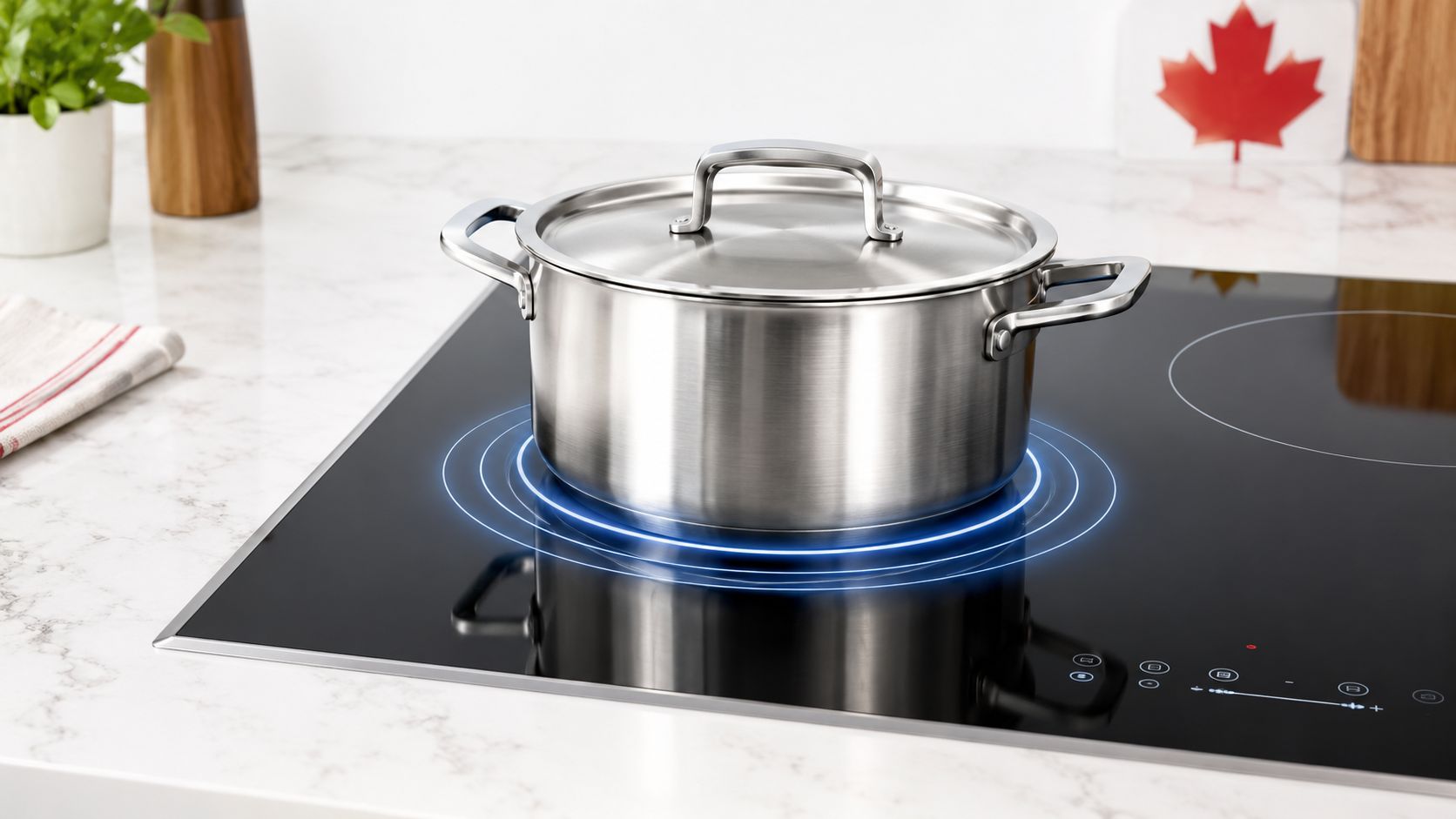
Most Canadian buying guides tell you to compare an induction stove top with gas or electric by appliance price alone. That advice is incomplete. The appliance is only one part of the conversion, and condo owners or people in older homes can discover that the electrical work, cookware replacement, and rebate paperwork determine the actual cost.
Induction still deserves serious consideration. It transfers energy directly into the pan, offers fast response and precise control, and avoids combustion inside the kitchen. But it isn't automatically the cheapest upgrade. Treat it as a small kitchen project, not a simple appliance swap, and your decision will be much more reliable.
Table of Contents
- The Full Cost of Switching to Induction
- How Magnetic Heating Actually Works
- Comparing Induction Against Gas and Electric
- Electrical Requirements for Canadian Homes
- Solving the Cookware Compatibility Puzzle
- Navigating Rebates and Installation Budgets
- Making the Final Decision for Your Kitchen
The Full Cost of Switching to Induction
The appliance price is only the opening cost. Federal appliance data compiled by Natural Resources Canada places entry-level induction cooktops near $1,000 and induction ranges below $1,500. Comparable gas cooktops were about $600, while gas ranges were about $900, so induction can require a noticeable upfront premium.
That premium does not decide whether the upgrade is good value. Your project budget may also include an electrician's assessment, a dedicated circuit, panel modifications, installation, and cookware with a magnetic base. Renters may lack permission to change wiring. Condo owners may need building approval, coordinate elevator or access restrictions, or discover that the electrical panel has little spare capacity.
Count the costs before you order
Check these three items before choosing a model:
- Electrical capacity: Can the existing kitchen circuit support the unit, or must a licensed electrician install or upgrade the wiring?
- Cookware: How many pots and pans already work with induction, and how many would need replacement?
- Incentive eligibility: Does your province offer a rebate, and does the programme specify an appliance type, application process, or proof of purchase?
Cookware replacement is easy to underestimate. A magnetic test can identify compatible pieces, but a kitchen built around non-magnetic aluminium, copper, or glass cookware may need a broader replacement budget.
Electrical work can also change the project from an appliance purchase into a renovation. Older homes and compact condos are the most likely to expose capacity limits, access problems, or approval requirements.
Budget rule: Add the appliance, installation, circuit work, cookware, and rebate timing before you order. Comparing range prices alone leaves out the costs most likely to disrupt your budget.
Induction makes the strongest financial case when you are already renovating, replacing an obsolete range, or correcting the electrical system for another reason. If the panel and cookware are ready, the premium is easier to justify. If both need replacement, calculate the complete conversion first, then decide whether faster heating and precise controls justify the added work.
How Magnetic Heating Actually Works
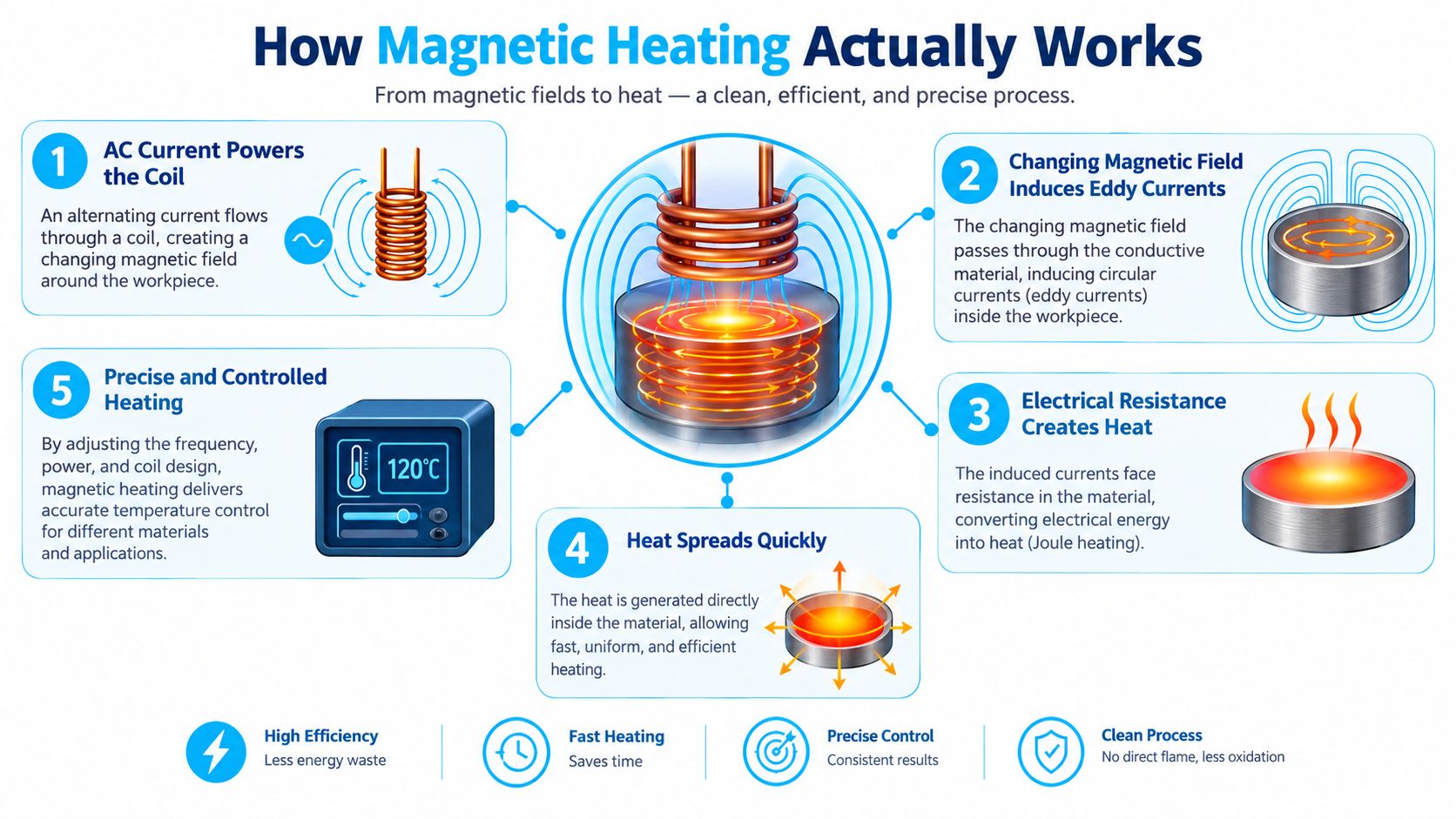
An induction stove top doesn't heat in the same sequence as a radiant electric burner. A conventional element becomes hot first, transfers heat through the cooktop, and then warms the pan. Induction creates a magnetic field beneath the glass and uses compatible cookware as the active heating component.
The process in plain language
Think of the copper coil under the glass as an invisible electrical engine.
- Current reaches the coil. The cooktop sends a high-frequency electrical current through copper wiring beneath the cooking zone.
- The coil creates a field. That current produces an electromagnetic field above the coil.
- The pan completes the system. When you place magnetic cookware over the zone, the field induces electrical currents in the pan's base.
- Resistance creates heat. The pan's metal resists those currents, and that resistance produces heat inside the cookware.
- Food receives the energy. The hot pan transfers energy to water, oil, vegetables, or whatever you're cooking.
The glass isn't the primary heat source. It can still become warm because the pan transfers some heat back to the surface, but the cooktop doesn't need to glow red before the pan begins heating. Remove the compatible pan and the unit can stop delivering energy to that zone, subject to the appliance's controls and safety logic.
Why the difference matters
Direct heating explains induction's practical strengths. A temperature adjustment reaches the pan quickly because you're not waiting for a large element to cool or for heat to travel through the glass. The surface also avoids the broad radiant heat of a conventional burner, which helps reduce burnt spills and makes wiping the area easier after it cools.
The technology only works with suitable cookware, though. The magnetic field needs a responsive metal base, so a beautiful copper pan or a lightweight aluminium pot may remain cold unless it includes a magnetic layer. Induction isn't mysterious once you understand that the pan itself is part of the electrical heating system.
Comparing Induction Against Gas and Electric
The appliance price is only part of the decision. For Canadian buyers, induction usually delivers the strongest cooking performance, but its total cost can include electrical work and replacement cookware. Gas preserves a visible flame and familiar manual control. Traditional electric remains the least disruptive option when your existing circuit, cookware, and kitchen layout already fit.
Efficiency is the clearest technical difference. BC Hydro reports that induction can transfer up to 90% of consumed energy to food, compared with about 70% to 75% for traditional electric cooktops and as low as 40% for gas cooktops BC Hydro's comparison of gas and induction cooking. CBC cites about 85% efficiency for induction versus about 32% for gas. A University of British Columbia study estimated 73.3% for induction and 39.9% for gas in its testing context a UBC cooking-efficiency study (PDF).
| Feature | Induction | Gas | Traditional Electric |
|---|---|---|---|
| Heat transfer | Directly heats compatible cookware, with high transfer efficiency | Flame heats the pan and surrounding air | Radiant element heats the surface and then the pan |
| Temperature response | Fast changes and precise adjustment | Immediate visual flame response | Slower response after an adjustment |
| Boiling and high heat | Strong performance, especially with boost settings | Powerful, but loses heat around the pan | Reliable, though generally less responsive |
| Simmering | Precise low-power control on a good model | Excellent visual control, but depends on burner design | Steady once established, slower to change |
| Indoor air quality | No combustion from the cooktop | Combustion occurs indoors and requires ventilation | No combustion from the cooktop |
| Surface cleaning | Flat glass surface with fewer grooves | Grates, burners, and spill areas need more work | Flat smooth tops are easy to wipe, but spills can bake onto hot elements |
| Cookware | Requires a magnetic base | Works with most cookware | Works with most cookware |
| Installation concern | Electrical capacity and dedicated circuit | Gas connection, ventilation, and local installation requirements | Existing electrical circuit may or may not suit the replacement |
The indoor-air question
Gas offers a cooking feel many home cooks prefer, but it also introduces combustion into the room. In tightly sealed Canadian homes during colder weather, closed windows make effective kitchen ventilation more important. BC Hydro connects the move away from combustion appliances with climate and indoor-air-quality considerations in the same comparison.
Traditional electric suits a low-disruption replacement. It works with almost any cookware and may appeal to cooks who prefer gradual heating. Its weakness is lag. Lowering the control does not remove heat immediately, because the element and glass remain hot while the temperature change works through the system.
Induction is my recommendation when speed, control, easier cleaning, and reduced indoor combustion justify the conversion work. Check cookware and electrical capacity before ordering, then investigate provincial rebates that may reduce the upgrade cost. Choose traditional electric when compatibility and minimal installation matter more. Keep gas only if flame control is important enough to accept ventilation, cleaning, and combustion trade-offs.
Electrical Requirements for Canadian Homes
The panel, not the cooktop, often determines whether an induction upgrade stays affordable. A Canadian induction cooktop or range may require 208 to 240 volts, 60 hertz, and 30 amps, with whole-unit input near 7.2 kilowatts on a 30-inch-class model, according to the Bosch NIT8060UC specification sheet (PDF). Treat those figures as model-specific requirements, not proof that your existing wiring is suitable.
The same sheet lists normal zone output around 1.4 to 2.6 kilowatts, with boost output reaching roughly 2.2 to 3.7 kilowatts. Several zones operating together can put a heavy load on the circuit, even when the appliance electronically manages its total power draw. That is why the appliance's exact electrical data must guide the installation.
What the electrician needs to verify
Have a qualified electrician inspect the following before you order:
- The existing circuit: Confirm the voltage, conductor size, breaker rating, and whether the circuit is dedicated to cooking equipment.
- The panel capacity: Check whether the main panel and service can accept the new load.
- The building rules: Condo boards, property managers, and local authorities may require approval or specific procedures.
- The appliance data plate: Match the exact model's requirements with the circuit design.
- The connection point: Confirm that the receptacle or hardwired connection follows the manufacturer's instructions and local code.
Do not choose a breaker from a forum post. A 30-amp appliance specification does not automatically make a 30-amp circuit suitable. Some full-size induction ranges call for a larger dedicated circuit, often protected by a 40-amp or 50-amp breaker, as outlined in Home Depot Canada's induction range guidance. The installation manual and electrician's assessment decide the correct setup.
Condos and older homes need extra scrutiny
Condo owners should confirm the unit's available electrical capacity before ordering. The kitchen connection may look suitable while the panel lacks space, or the building may restrict work affecting shared infrastructure. Older houses can have dated wiring, limited service capacity, or incomplete circuit records from previous renovations.
High boost is not free performance. An undersized circuit can limit cooking zones or trip protection. An improper shortcut can create a fire and shock hazard. Never use an extension cord, install an oversized breaker, or perform DIY wiring to force compatibility.
To understand broader household electricity use before planning an upgrade, review Celmin's smart home energy monitor guide. Monitoring will not replace an electrician's inspection, but it can show how cooking demand fits into your home's overall electrical use.
Solving the Cookware Compatibility Puzzle
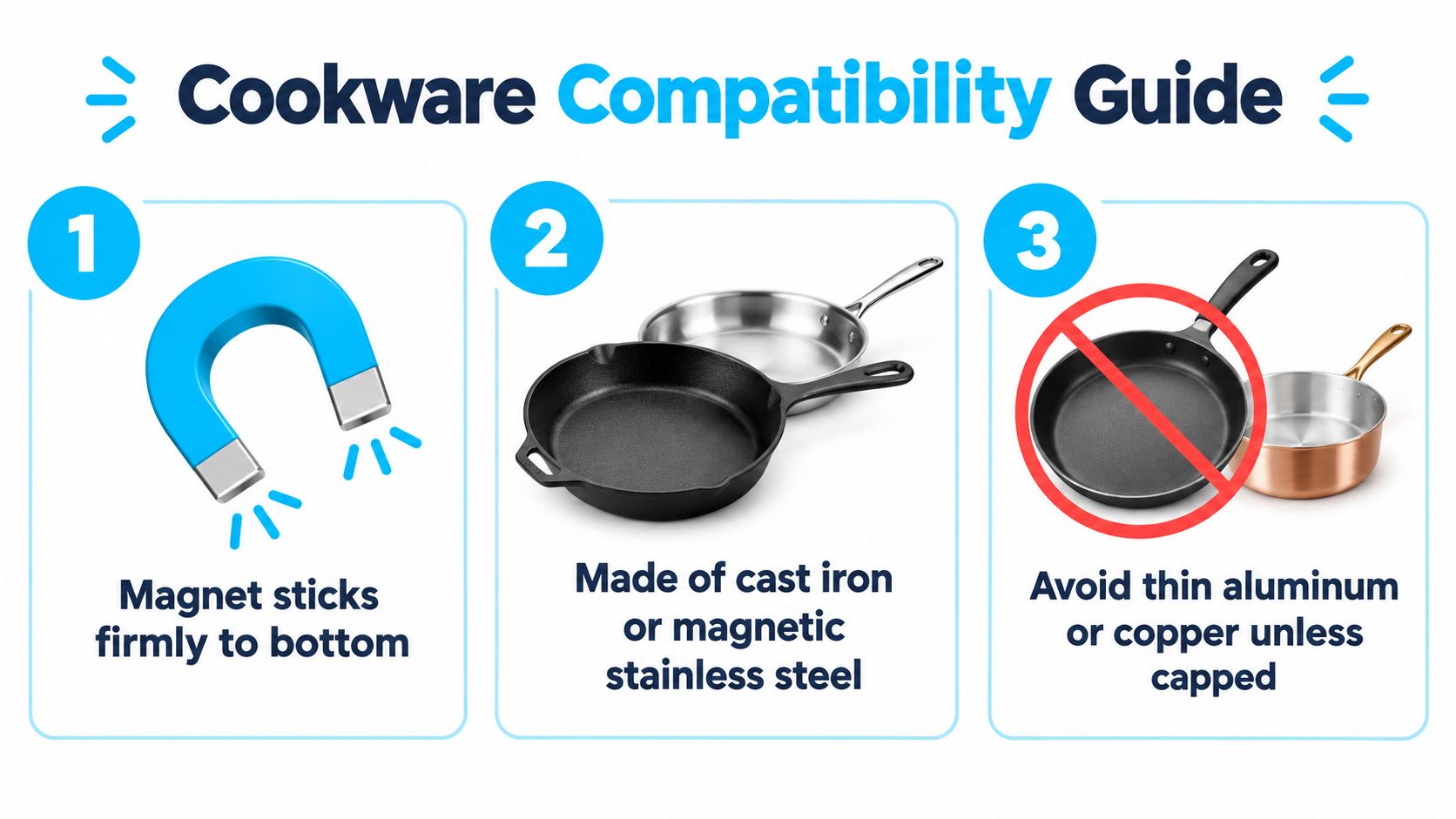
Your cookware is part of the induction system, so audit it before you buy. Start with a household magnet. Place it against the underside of each pot or pan, not the cooking surface. If it sticks firmly, the base is likely magnetic enough to work, although the final test remains the appliance manufacturer's compatibility guidance.
A practical kitchen audit
Work through the cupboard in this order:
- Test the base. A strong magnetic connection is a good sign. A weak attraction or no attraction means the pan shouldn't be part of your induction budget.
- Check the shape. The base should sit flat and make good contact with the cooking zone. A warped bottom can heat unevenly and may scratch the glass if dragged.
- Identify the construction. Cast iron, carbon steel, and magnetic stainless steel are dependable starting points. Stainless steel isn't automatically compatible, because some grades aren't magnetic.
- Look for a labelled base. Packaging or the manufacturer's specification should identify induction compatibility. Use that information when the magnet test is ambiguous.
- Set aside problem materials. Pure copper, aluminium, and glass generally won't work unless the manufacturer has added a magnetic base.
Cast iron is compatible, but it deserves careful handling. Its rough or heavy underside can damage a glass surface if you slide it, and its thermal mass can make rapid heat changes unforgiving. Lift it instead of dragging it, and preheat gradually.
For replacements, multi-ply stainless steel with a magnetic exterior base offers versatility without forcing you into a single cooking style. Enameled cast iron can suit braising and slow cooking, while induction-compatible non-stick pans are useful for delicate food. Don't buy a large set blindly. Replace the pieces you use most, then fill gaps with pans that match your actual recipes.
The cheapest cookware is the cookware you already own and can verify. Test first, replace selectively, and avoid budgeting for a complete new set unless your existing collection is mostly incompatible.
Cookware care still matters after the switch. Keep pan bottoms clean, avoid sliding heavy cast iron, and follow the care instructions for non-stick coatings and enamel. A flat, clean base transfers energy more consistently and protects your investment in the cooktop.
Navigating Rebates and Installation Budgets
A rebate rarely changes the main decision. The hidden cost is the conversion work around the cooktop, especially in an older condo with limited panel capacity or cookware that fails the magnet test. Treat the incentive as a deduction from a complete project budget, not as proof that induction is inexpensive.
Ontario lists a $150 rebate for eligible induction cooktops and ranges, while Quebec lists up to $250 for an eligible induction range. Check the current requirements through Ontario's appliance rebate programme and the applicable Quebec programme before purchasing. Eligibility, deadlines, appliance requirements, and application procedures can change.
The application may require a post-purchase submission. Keep the invoice, model number, installation records, and any other requested documents. Check the rules before delivery, and confirm whether the offer comes from a government or utility programme rather than a retailer promotion.
Build an all-in conversion budget
Use separate lines instead of relying on the appliance sticker price:
- Appliance price: Record the exact model and its Canadian warranty terms.
- Electrical assessment: Get a written opinion from a qualified electrician before committing.
- Circuit or panel work: Include a dedicated circuit, conductor changes, panel-capacity work, and condo approval where applicable.
- Installation: Confirm whether the retailer's service includes the connection your home requires.
- Cookware: Price only the pans that fail your audit. Prioritise replacements for the meals you cook most often.
- Rebate deduction: Subtract the incentive only after confirming eligibility, timing, and required proof.
Paperwork habit: Photograph the appliance label and save the receipt before installation. Claims are easier when the model and purchase record are organised.
A provincial incentive may still leave you paying for a substantial electrical project. Quebec's listed allowance can improve the calculation for an eligible range, while Ontario's amount may cover only part of the added cost. Buyers elsewhere should check their provincial or utility programme directly. A missing offer on a retailer page does not establish that no local programme exists.
For wider appliance comparisons, Celmin's kitchen appliance guidance provides context for assessing the cooktop alongside the rest of the kitchen. Your electrician's written quote, cookware audit, and verified programme rules should determine the final budget.
Making the Final Decision for Your Kitchen
The sticker price rarely decides whether induction is affordable. The key question is whether your home can support the installation without turning a straightforward appliance purchase into an electrical project. Induction earns my recommendation when the panel, cookware, rebate, and installation plan all hold up.
A renovation is the easiest time to make the switch. Electrical work and counter changes can be scheduled together, while the flat surface is easier to wipe than gas grates. Removing combustion from the cooktop also matters in a closed Canadian kitchen. You get fast, controlled cooking without an active flame.
Condos require a harder look. A panel with limited capacity, building approval requirements, or restrictions on electrical work can change the calculation quickly. A portable induction burner is a sensible trial if you want to test magnetic cookware, heat response, and your cooking habits before committing to a permanent conversion. Renters should obtain the landlord's approval and remember that a portable unit still needs a suitable circuit.
Match the technology to the household
Choose a full induction range or cooktop when:
- You're renovating: The electrical assessment can be coordinated with the rest of the kitchen work.
- You cook frequently: Faster response and precise control provide value every day.
- You have children at home: Removing the active flame reduces one kitchen hazard, although hot pans and residual surface heat still require supervision.
- You own compatible pans: More of the budget can go toward the appliance and installation.
- You want easier cleaning: A smooth surface avoids burner caps and removable grates.
Wait or choose another route when:
- The panel is already constrained: Electrical work may become the largest project cost.
- Most cookware is non-magnetic: Replacing several useful pans can erase the apparent appliance savings.
- You rent: Permanent electrical work may require approval and may not be recoverable.
- You rely on oversized or irregular pans: Zone shape and base contact can limit performance.
- You prefer visible flame control: Induction changes the tactile experience, even with more precise temperature adjustment.
Induction remains a strong long-term electrification choice. Natural Resources Canada identifies direct heating of cookware, safety, speed, temperature control, and easier cleaning among its main advantages in its cooking-product information. The same UBC modelling estimated about 206.4 kWh per year in one scenario. Your result will vary with cooking habits and appliance use.
Before ordering, use Celmin's induction cooker reviews for Canadian homes to check practical buying details, including width, electrical support, cookware compatibility, rebate eligibility, and documentation for incentive claims.
My recommendation is firm: buy induction when the electrical path is clear, not just because the technology is fashionable. Have the panel assessed, test every pan, confirm the provincial rebate, and price the complete conversion. If those checks work, induction is the better everyday cooking platform for many Canadian households. If they do not, wait for a renovation or choose a lower-disruption option rather than forcing an expensive installation.
Celmin publishes Canadian-focused appliance reviews and buying guides covering induction models, electrical requirements, cookware compatibility, and local purchasing considerations. Visit Celmin before ordering, and use its practical guidance to cost the kitchen decision accurately.
Sign up or sign in to join the conversation.