
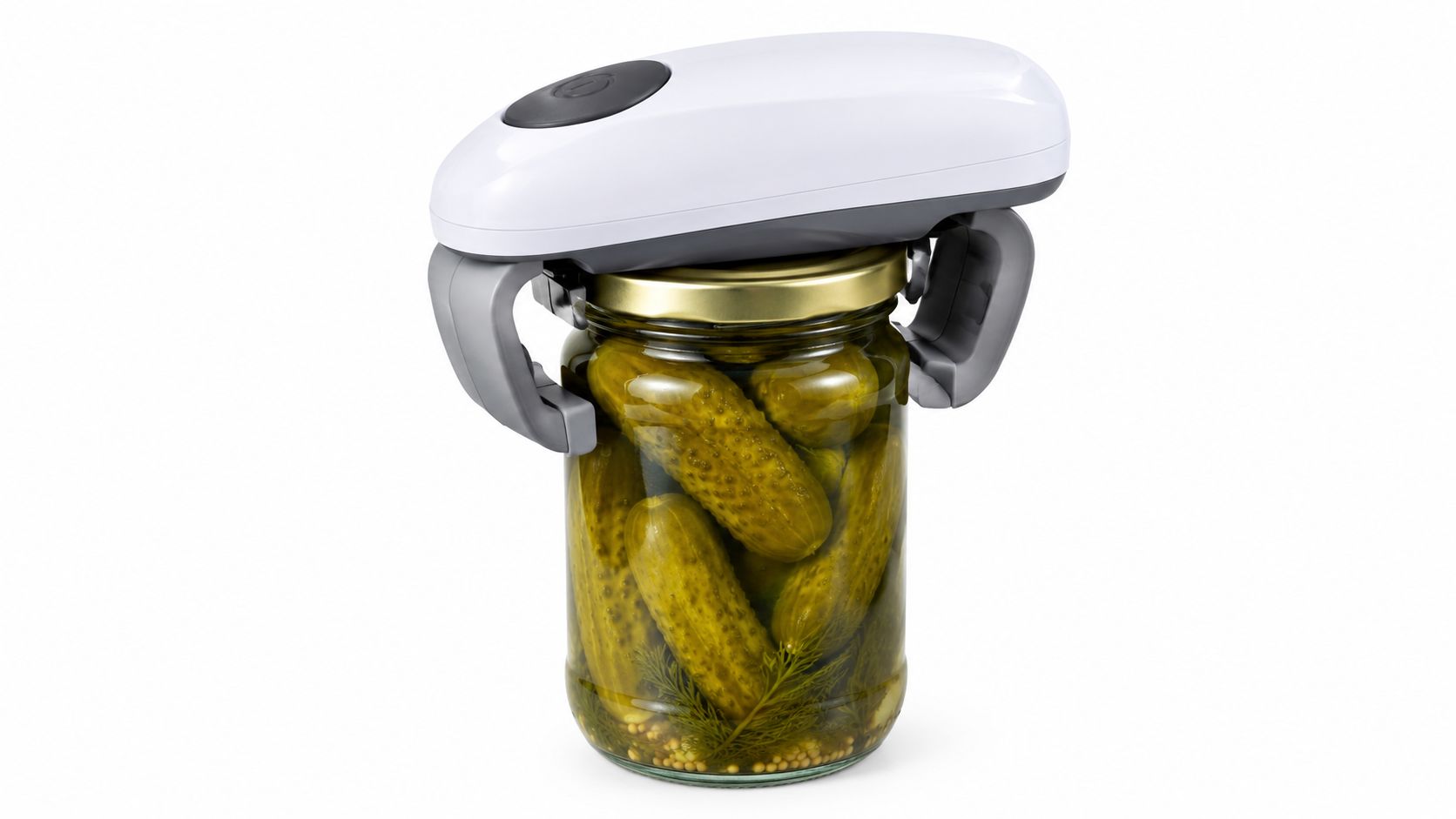
Most electric jar openers sold in Canada grip lids between roughly 30 and 88 mm, so measure a jar at home before you buy. A model outside that range may run perfectly and still fail on your favourite pickle jar.
The lid is sitting on a folded kitchen towel, the rubber grip pad is ready, and the tap has already had its chance. You twist until your knuckles complain, but the jar doesn't move. That familiar sealed pickle or pasta-sauce jar can turn a simple lunch into a small test of hand strength.
This matters most for people with arthritis, rheumatoid conditions, recovering hands, carpal tunnel symptoms, or one-handed use. It also matters in ordinary kitchens, because a gadget that fits only some of your pantry is not a solution. Lid diameter, clamp stability, and jar shape decide whether an electric opener works.
Table of Contents
- Why Factory-Sealed Lids Resist Hand Strength
- How Electric Jar Openers Actually Work
- Mounting Styles and What They Mean in a Real Kitchen
- Features That Matter and the Ones You Can Skip
- Matching the Opener to the Jars You Own
- Where Canadians Can Actually Buy One
- A Quick Decision Checklist Before You Buy
Why Factory-Sealed Lids Resist Hand Strength
The pickle jar is on the counter, your towel is slipping, and the lid still refuses to move. A sealed lid presses tightly against the jar rim, while its smooth metal band gives your fingers little purchase. Large jars, wet surfaces, and lids tightened during factory filling can demand more twisting force than your hands can comfortably produce.
A dish towel may worsen the problem because it compresses under pressure. A rubber pad improves friction, but you still have to create and maintain the twist. That puts unnecessary strain on hands affected by age, arthritis, surgery, or injury.
Practical rule: If opening a jar causes wrist pain, stop treating the task as a strength challenge. Change the mechanism instead.
Electric jar openers replace much of that wrist effort with a powered clamp-and-rotate action. The device grips the lid, braces against the jar or its shoulder, and turns the lid until the seal releases. The trade-off is fit. A model can work well on one pantry staple and fail on another if the lid falls outside its jaw range or the jar has a steep curve and irregular shoulder.
That problem is easy to miss when Canadian availability is limited and product pages rely on broad “fits most jars” language. One Canadian listing specifies a 30 to 88 mm lid range and a 40 to 100 mm jar range, plus automatic jaw reset after removal, as shown in this Canadian electric opener listing. Treat those measurements as a buying filter, not a footnote. Check the lids in your own pantry first, then choose a model that grips those shapes securely. The right opener is the one that handles your pickle, pasta-sauce, and other regular jars, not the one with the most convincing product photograph.
How Electric Jar Openers Actually Work
A pickle jar can sit on the counter while the motor makes noise and the lid stays fixed. That failure usually comes from the grip, not a weak battery. An electric opener needs a firm contact with both the lid and the jar before its motor can do useful work.
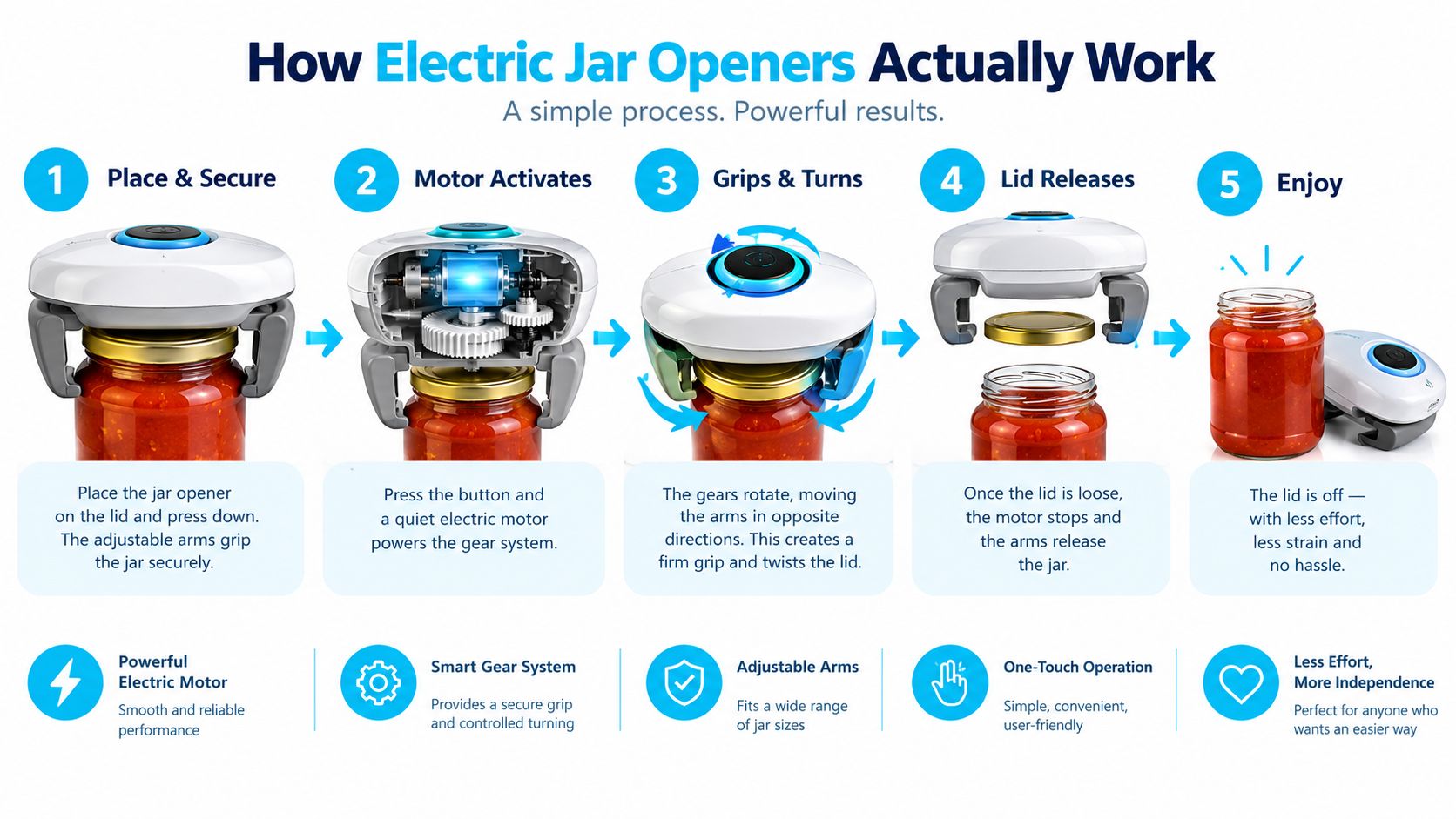
Most compact models combine a battery-powered motor with moving jaws. You place the unit over the lid and press the control. The jaws close around the lid edge, while part of the mechanism braces against the jar or its shoulder. Once those surfaces hold, the motor rotates the lid and breaks the seal without requiring your wrist to supply the force.
The product specifications for a Canadian electric jar opener illustrate why the fit details deserve attention. Use the listed measurements as a filter, then compare them with the jars in your pantry. A model that handles a pasta-sauce lid may still struggle with a wide pickle jar, a low-profile preserve lid, or a container with a sharply sloped shoulder.
The grip comes before the motor
Rubber or silicone contact surfaces help the jaws hold smooth metal. Some openers clamp from opposite sides. Others engage the lid and jar together with a wider mechanism. The design matters less than the contact area. If the jaws catch only a narrow curve, the motor wastes its force on slipping.
Set the jar on a dry, stable surface and keep the lid free of oil or condensation. A wet jar can rotate with the opener, especially with a handheld model. That is a mechanism limitation, not a user error.
Slow rotation helps maintain pressure while the vacuum seal releases. Automatic stopping matters too. Once the lid turns free, the motor should stop instead of continuing against an empty grip, spilling the contents or straining the gears.
Why the printed range matters
Treat the stated lid range as a boundary, not a general promise. A small lid may sit below the jaws, while a large one may stop them from closing. Jar shoulders add another constraint, particularly on containers that taper sharply near the top.
Electric assistance makes a suitable jar easier to open. It does not make an incompatible shape suitable. Measure the lids you use most, then choose an opener whose clamp can reach them securely.
Mounting Styles and What They Mean in a Real Kitchen
The best mounting style depends on who will use the opener and where the jar normally gets opened. A handheld unit travels easily and stores in a drawer, but the user still needs to position it accurately and keep the jar stable. A countertop model provides a more fixed working position, while an under-cabinet design can leave both hands available for placing the jar.
A practical comparison
| Style | Power Source | Typical Price (CAD) | Bench Space | Best For |
|---|---|---|---|---|
| Handheld | Batteries | Varies by model | Drawer storage | Renters, occasional use, portable kitchens |
| Countertop | Batteries or outlet | Varies by model | Permanent or semi-permanent space | Households that open jars often |
| Under-cabinet | Batteries or outlet | Varies by model | Frees the work surface | One-handed use and limited grip strength |
Handheld models are the easiest choice when you don't want installation. They're also the easiest to misuse. If the jar is wet, the lid is unusually smooth, or the user can't hold the container firmly, the opener may rotate without making progress. A small kitchen gains storage flexibility, but the user pays for it with more setup work.
Countertop units offer a reasonable middle ground when a dedicated appliance can stay on the counter. They don't require drilling, and their base can help keep the jar in position. The drawback is permanent visual and physical clutter, which is a poor trade in a compact condo if the appliance is used only occasionally. For broader small-kitchen decisions, Celmin's guide to kitchen appliances for small spaces is a useful companion.
Stability beats portability for accessibility
Under-cabinet models are the strongest fit for someone with limited grip or one-handed use because the opener stays fixed. The user lifts or positions the jar, activates the mechanism, and avoids wrestling with a moving gadget. Installation still needs care. Cabinet clearance, jar height, and the position of the opening area all matter.
Tall containers can collide with the cabinet or ceiling of the appliance before the lid releases. That makes under-cabinet designs excellent for the jars they fit and frustrating for containers that are too tall or oddly shaped. Choose the mounting style around the user's actual routine, not just the appliance's advertised convenience.
Features That Matter and the Ones You Can Skip
Start with the lid range. Everything else comes after it. A powerful motor cannot rescue an opener whose jaws can't reach the lid correctly, and a soft grip surface can't compensate for a clamp that loses contact as soon as the lid begins to turn.
Prioritise contact and control
Look for a clearly stated lid diameter range, not just “universal” language. The range should cover the smallest and largest lids you regularly open, with enough room for the opener to sit squarely rather than at an angle.
A textured rubberised or silicone grip is preferable to smooth plastic where the lid is metal and glossy. The contact surface should also be easy to wipe, because pickle brine, jam, oil, and pasta sauce eventually find their way onto kitchen gadgets.
Automatic stopping is another worthwhile feature. Once the seal breaks, the motor shouldn't continue forcing the lid around. A stop function makes the operation more predictable and helps avoid unnecessary wear.
| Feature | Why It Matters | Skip If... |
|---|---|---|
| Stated lid range | Confirms the jaws can make proper contact | The listing only says “fits most jars” |
| Textured grip pads | Reduces slipping on smooth lids | The contact surfaces are plain, hard plastic |
| Automatic stop | Limits movement after the seal releases | The motor runs only while you hold a button |
| Easy-clean parts | Helps with sticky food residue | The lid-contact area is difficult to access |
| Battery or outlet power | Matches portability with regular placement | The power arrangement conflicts with your kitchen |
| Overload protection | Helps protect the motor and gears | The listing focuses only on speed |
| Built-in light | Adds visibility in a dark cupboard | It increases the price without improving grip |
Ignore impressive-sounding extras
“Universal fit,” “whisper-quiet,” and a built-in light don't tell you whether the opener will hold a wet pickle lid. Advertised speed is also less useful than stable contact. A fast motor that slips is worse than a slower one that stays engaged.
Be suspicious of specifications that omit the lid range or show only one idealised jar in use. Canadian accessibility guidance also stresses that fit, clamping stability, and jar shape limit performance, particularly for people buying an opener for arthritis or low-grip cooking. The adaptive kitchen tool guidance for one-handed and low-grip cooking makes the important point clear: powered assistance helps only when the mechanism can lock onto a stable surface.
Matching the Opener to the Jars You Own
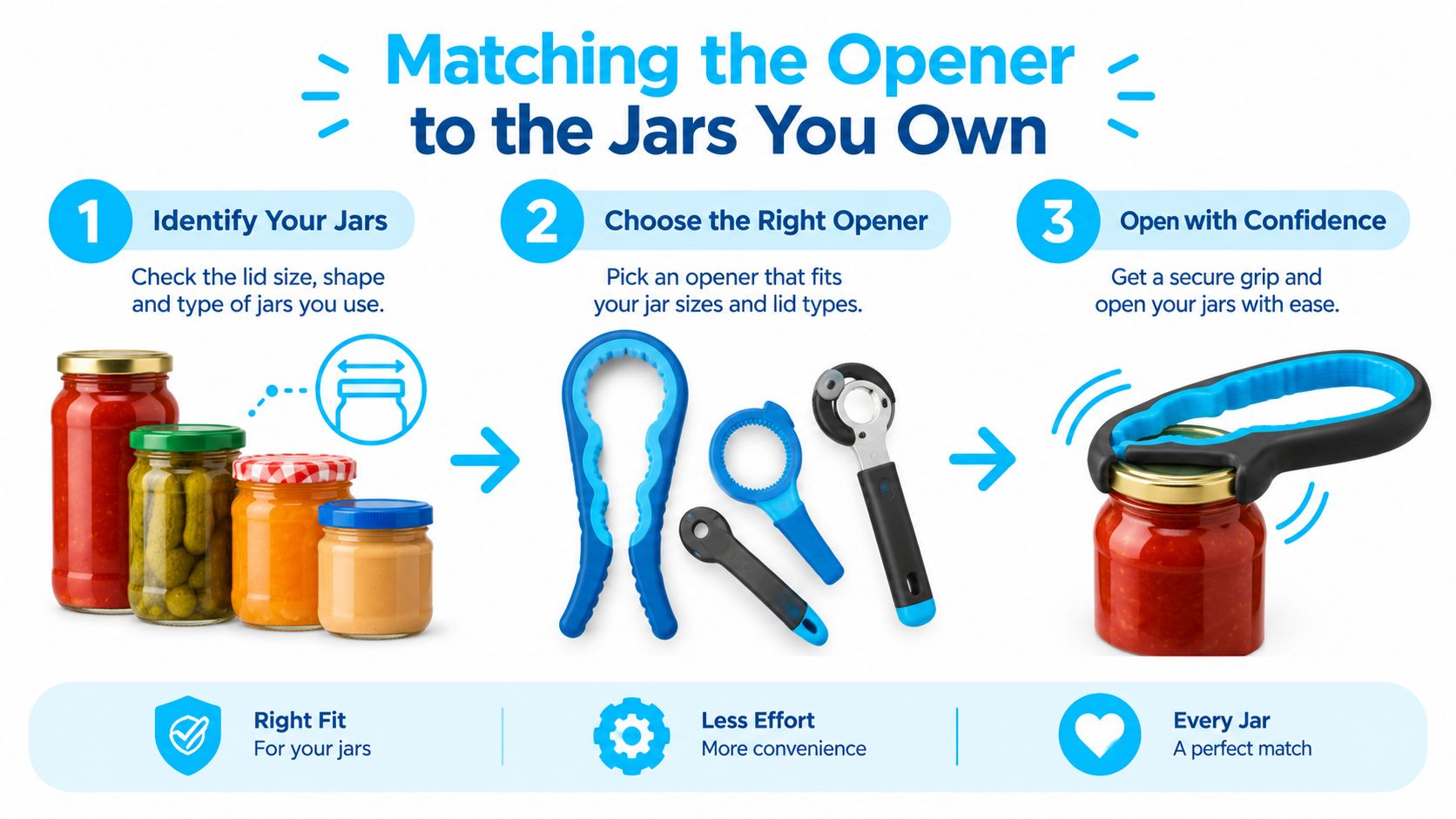
Shopping should start in the pantry, not on a product page. Pick several jars you open often, including the most frustrating one, and measure each lid across its diameter with a ruler. Don't measure around the lid. Manufacturers describe opener compatibility by the distance from one side of the lid to the other.
Write the measurements down, then identify the awkward containers. A small jam lid, a broad pickle lid, a smooth pasta-sauce lid, and a plastic storage jar can place very different demands on the same opener. The largest lid is the important one, but the smallest can fail too if the jaws can't close around it securely.
Use this pantry check
Measure the lid face. Measure straight across the lid, not the jar body or the circumference.
Mark the extremes. Record the smallest and largest lids you use regularly. Your chosen model's stated range needs to cover both.
Inspect the edge. Note whether each lid is smooth, recessed, ridged, plastic, or partly covered by a curved jar shoulder.
Check the jar shape. A straight-sided jar is easier for a clamp to hold than a container that narrows sharply below the lid.
Test the working position. Leave room for the opener to sit level and for the jar to remain stable while the motor runs.
Match the design to the user
A person with arthritis or one-handed use should prioritise a fixed, automatic design that minimises wrist movement and jar stabilisation. A renter who opens jars occasionally may prefer a handheld unit that can disappear into a drawer. A small kitchen shouldn't surrender valuable counter space to an appliance that doesn't solve a frequent problem.
Slippery surfaces deserve special attention. A wet jar rim can cause a rubber-grip handheld opener to spin uselessly, while a fixed unit with a more secure toothed or textured contact may hold better. Plastic jars and lids with recessed edges also need careful checking. The guide to the Unerver M12 smart electric Mason jar vacuum sealer is relevant for readers comparing jar-related devices, but a vacuum sealer isn't automatically a substitute for a lid opener.
Where Canadians Can Actually Buy One
Canadian shoppers face a frustrating availability problem. The question isn't only which electric jar opener looks capable. It's which model is available in Canada, from a seller that will ship to your province and support a return if the jaws don't fit your pantry.
Major Canadian grocers don't provide a dependable source for this category, and the Canadian market has a narrow, uneven selection. The Amazon.ca can opener category illustrates the broader issue. Shoppers often have to search across channels instead of comparing a consistent local range in one place.
Treat marketplace listings as a starting point
Amazon.ca usually gives shoppers the broadest chance of finding an electric model, but listings can change, sellers can vary, and product descriptions may leave compatibility details unclear. Read the full specification panel, not only the headline. Look for lid range, power source, return terms, and whether the seller ships from within Canada.
Canadian department stores and hardware retailers may carry a small number of countertop or handheld options, but selection is inconsistent. Seasonal stock can appear and disappear, and an in-store search may not reveal under-cabinet designs intended for accessibility.
Specialty accessibility retailers and medical-supply stores are worth checking when the opener is for arthritis, post-surgical recovery, or permanent one-handed use. Their selection may be more focused on stability and ease of operation, though shoppers should still confirm the exact lid range before paying more.
Don't confuse can openers with jar openers
Search results often mix electric can openers with electric jar openers. A can opener cuts through a metal can. A jar opener must grip and rotate a sealed lid while keeping the jar stable. They aren't interchangeable, even when both products use a one-touch button.
This distinction matters in a small kitchen, where a compact appliance earns its place only if it solves the task you have. For wider Canadian buying guidance on appliances and local availability, see Celmin's best kitchen appliances guide. Then return to the product listing and confirm the lid measurement before ordering.
A Quick Decision Checklist Before You Buy
Run this checklist before you click purchase. It takes less time than returning an opener that spins on the first wet pickle jar.
- Measure your pantry: Check the smallest and largest lids you use regularly.
- Confirm the range: Make sure the product's stated lid range covers both measurements.
- Inspect the lid surfaces: Look for smooth metal, recessed edges, plastic, or unusual shapes.
- Choose the mounting style: Pick handheld for portability, countertop for a dedicated station, or under-cabinet for maximum stability.
- Check the power arrangement: Confirm that batteries or an outlet suit the place where you'll use it.
- Look for automatic stopping: The motor should stop when the seal releases.
- Verify the seller: Check Canadian shipping, the return process, and the warranty route before buying.
- Test the actual clearance: For a mounted model, make sure your tallest regular jar fits beneath it.

A cheap handheld model can be sensible if it fits every lid you use and you can hold the jar steady. It can also be a false economy if the main user has limited grip, the jars are routinely wet, or the device will be used on a crowded counter. Under-cabinet mounting costs more effort to install, but stability is often worth more than portability for accessibility.
Cross-border listings deserve extra caution. A product may look like the right answer until shipping, returns, voltage, or warranty support becomes the actual problem. Canadian availability is part of the product, not an administrative detail.
The single check that prevents most disappointment is simple: confirm that the opener's stated lid range covers every jar currently in your pantry. If it doesn't, keep shopping. A motor cannot fix a dimensional mismatch.
Celmin publishes Canadian buying guides and practical reviews that focus on local availability, household fit, and the trade-offs behind appliance specifications. Visit Celmin to compare kitchen technology and find advice suited to Canadian homes before you buy.
Sign up or sign in to join the conversation.