
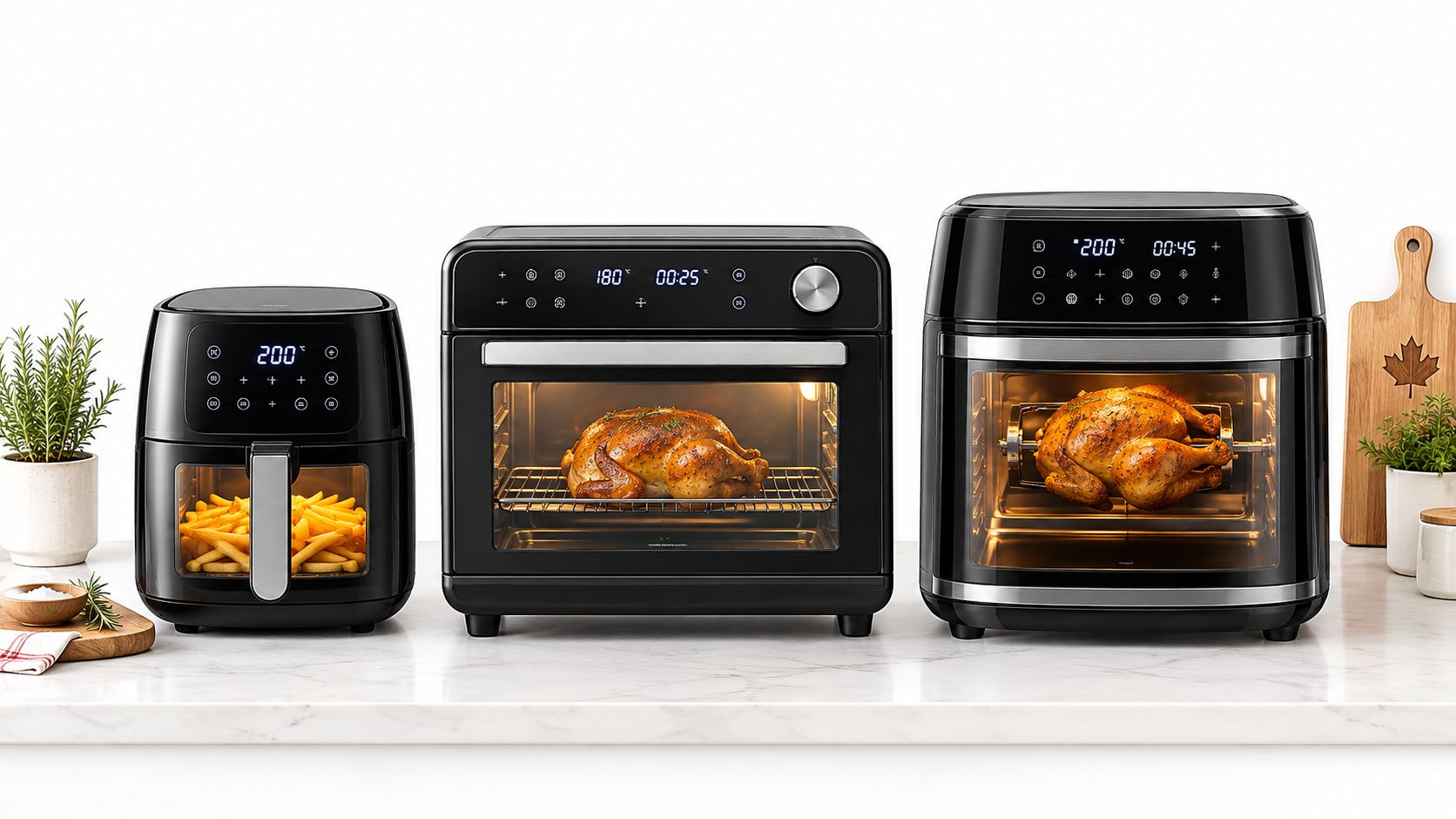
You're standing in a condo kitchen with chicken in the fridge, frozen fries in the freezer, and one strip of counter left beside the kettle. The full-size oven feels excessive for dinner for two, but a small basket fryer may not handle the meal you want. That's the Canadian air-fryer-oven problem: the best air fryer oven isn't the one with the most presets. It's the one that earns its counter space, cooks the portions you eat, and can be verified as safe for use in Canada.
This guide judges each choice through three practical questions: How much counter footprint does it consume? What should you measure before calculating CAD cost per meal? Does the exact model have a traceable Canadian recall record? Wattage, fan design, usable cavity, noise, windows, probes, racks, and rotisserie functions matter only when they improve those outcomes.
Table of Contents
- What an Air Fryer Oven Does in a Canadian Kitchen
- Basket Air Fryer vs Oven Style Air Fryer
- Air Fryer Oven Models Worth Considering in Canada
- Cooking Performance and Food Safety in Real Use
- Energy Use and Real CAD Cost per Meal
- Canadian Safety, Certification, and Recall Checks
- Picking the Right Air Fryer Oven for Your Situation
- Final Checklist Before You Click Buy in Canada
What an Air Fryer Oven Does in a Canadian Kitchen
In a condo kitchen, the right air fryer oven earns its counter space by cooking the portions you eat without turning dinner into a two-batch project. It is a compact convection appliance: a heating element warms the cavity, while a fan circulates hot air to brown and crisp food. Basket models use a removable drawer. Oven-style models use trays or racks and may add toast, bake, broil, roast, proof, or dehydrate settings.
The format changes what your counter can do. A basket fryer gives quick access to fries, wings, vegetables, and other foods that improve when tossed during cooking. An oven-style unit takes more horizontal space, but handles flatter foods, small baking jobs, and multiple levels. Neither format replaces a full-size oven for a large meal.
Start with the electrical label
For Canadian use, look for 120 V AC and 60 Hz compatibility, a North American plug, and a recognised certification mark such as CSA, cUL, UL, or ETL. Countertop units commonly draw approximately 1,300 to 1,800 W, according to the Canada-focused appliance guidance from NBANZ.
A 15 A circuit can support a high-wattage countertop appliance when it is the only major load. Do not run it alongside another high-draw appliance on the same circuit. The same source notes that a 1,750 W appliance draws about 14.6 A at 120 V, leaving little capacity for another demanding appliance.
Measure behind and above the appliance, not only the shelf width. The door needs clearance, hot air needs an escape path, and a unit pressed against a wall or upper cabinet quickly becomes awkward to use. That wasted space affects the appliance's real value just as much as its purchase price.
Use the cavity, not the marketing capacity
“Six quart” and “large capacity” do not show whether your usual tray or meal will fit. Check the basket floor, rack spacing, door swing, and ventilation clearance. A rotisserie attachment can consume useful cavity space while adding washing and storage work, so skip it unless you will use it regularly.
| Metric | Why it matters for a Canadian kitchen | Target range |
|---|---|---|
| Electrical supply | Prevents a cross-border mismatch | 120 V AC, 60 Hz |
| Power draw | Determines circuit load | Approximately 1,300 to 1,800 W |
| Basket or cavity | Decides whether you cook one batch or several | Match the footprint to your usual portions |
| Temperature range | Separates crisping from low-temperature jobs | A model such as the Cosori TurboBlaze spans 90 to 450°F |
| Visibility | Reduces unnecessary door or basket opening | Window, light, or dependable timer |
| Certification | Provides a Canadian safety screening point | CSA, cUL, UL, or ETL mark |
| Counter footprint | Determines whether the appliance stays accessible | Measure width, depth, height, and ventilation space |
Québec's household guidance places appliances and electronics at up to 20% of home energy consumption and identifies stoves among the more energy-intensive appliances. For equivalent cooking time, it reports that a toaster oven uses approximately two times less energy than a conventional stove oven. It is a stove-oven benchmark, not an air-fryer lab result, but it is the closest Canadian figure shoppers can use when comparing a compact convection appliance with a full-size oven. See the Québec government's household appliance energy guidance.
Practical rule: Choose the smallest usable cavity that cooks your normal meal in one batch. A tiny appliance that forces two rounds gives back less counter space than its compact shell promises.
Basket Air Fryer vs Oven Style Air Fryer
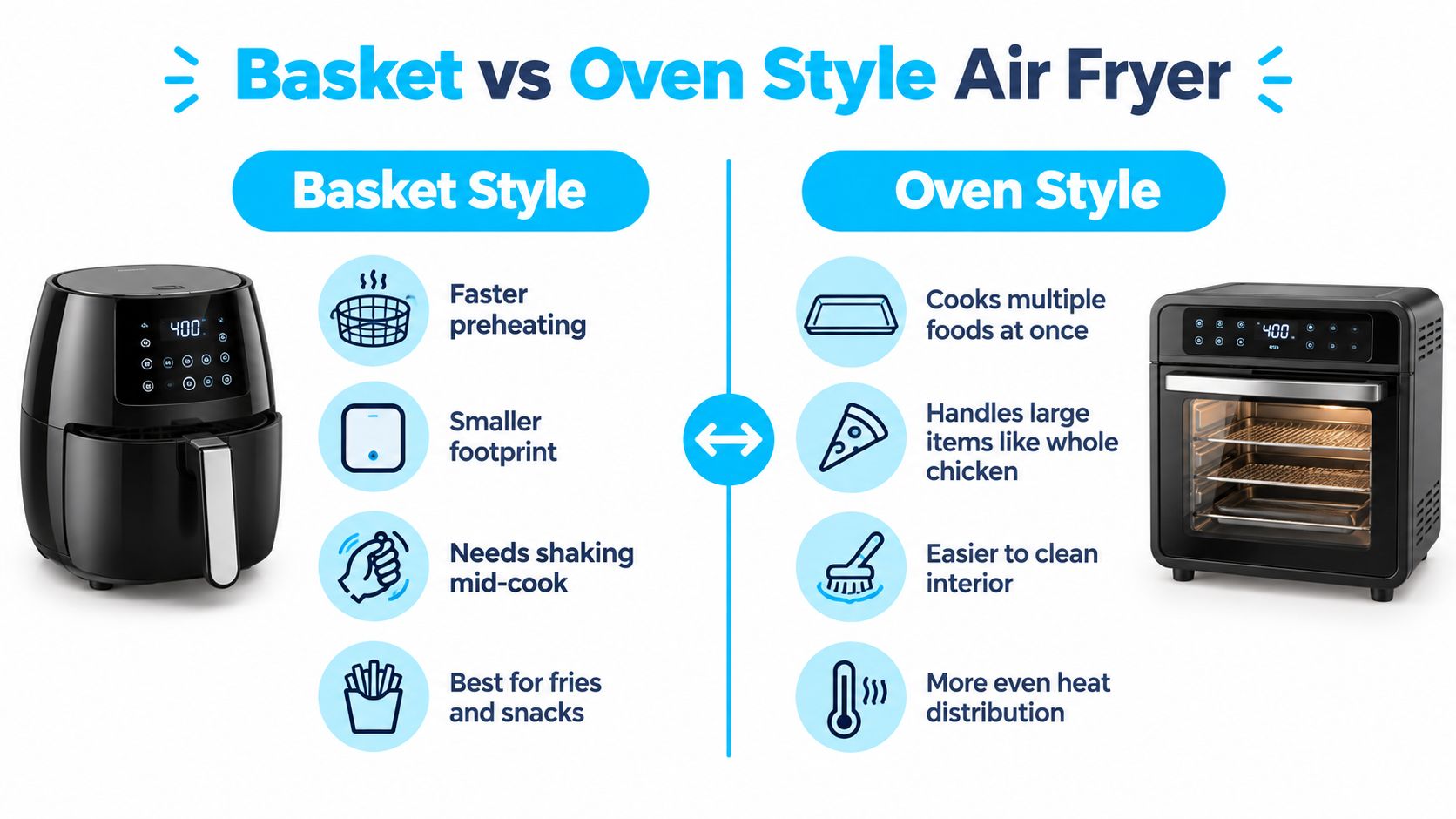
Your usual meal should decide the shape. A basket-style air fryer suits quick, crisp food in a small condo footprint. An oven-style air fryer earns its wider counter space when you also want toast, flat trays, baking, roast-sized portions, or one appliance for several jobs.
The Cosori TurboBlaze gives basket shoppers a practical reference point: 1,725 W and a 6-quart capacity, according to Chef Picks Canada. That combination suits one or two people who want strong airflow without giving up the counter area required by a broader oven-style chassis. Wattage affects heating demand, while capacity matters only if the basket floor fits the food you normally cook.
What the basket does better
A drawer basket keeps food close to the fan and heating element. Pull it out, shake fries or Brussels sprouts, and return it quickly. That layout works especially well for frozen fries, tots, wings, and chopped vegetables that benefit from movement.
Basket models also use vertical counter space efficiently. Their advertised volume can hide a smaller usable cooking surface, however, and the drawer does not accept a loaf pan easily. You must open it to inspect browning, which releases heat. A window or interior light improves visibility, but it does not turn the appliance into a full baking oven.
For a condo buyer, the question is whether the narrower footprint offsets the extra batch. A compact basket that cooks your normal portion once can reclaim counter space. One that forces two rounds may cost more time and electricity per meal than its smaller shell suggests.
Where oven style wins
Oven-style units use racks, trays, and a door. They suit salmon fillets, vegetables spread in one layer, toast, pizza-style meals, and small roasts. The cavity can handle different foods together, provided the racks have room and airflow remains clear.
The wider format can replace another countertop appliance. If you regularly toast bread, bake small dishes, roast vegetables, and reheat leftovers, an oven-style model may take over toaster-oven duties while reducing full-size oven use. If your main job is crisping fries after work, its extra width and accessories become counter clutter.
For shoppers comparing compact countertop appliances, this mini toaster oven guide helps frame the same footprint decision. Measure the surface you will lose, including space for the door and ventilation, before paying for functions you will not use.
| Decision | Basket style | Oven style |
|---|---|---|
| Best daily job | Fries, wings, snacks, quick proteins | Baking, toast, trays, small roasts |
| Counter shape | Taller and often narrower | Wider and more oven-like |
| Mid-cook handling | Easy to shake | Better for flat, undisturbed food |
| Capacity logic | Basket floor and batch size | Rack spacing and cavity dimensions |
| Cleaning | Fewer parts, but a deep basket | More trays, racks, crumb areas, and door surfaces |
| Extra functions | Often focused on air frying | Usually broader, including bake and toast |
Choose the basket when vertical storage and fast single-batch cooking matter most. Choose the oven style when flat cooking space and appliance replacement justify the wider footprint. Check the Canadian certification mark and recall record for either format before you buy.
Air Fryer Oven Models Worth Considering in Canada
A good shortlist starts with the meal you cook and the counter space you can spare. For a compact condo kitchen, the Cosori TurboBlaze is a useful basket-style benchmark. Its 6-quart capacity suits one or two people, while the 90 to 450°F range covers everyday crisping and lower-temperature dehydration. The basket keeps the footprint smaller than an oven-style unit, but it limits you to basket cooking and modest batches. That makes it a practical choice when each saved section of counter matters more than extra racks. The specifications are listed by Chef Picks Canada.
For the one- or two-person condo
Start with a basket-style model in the six-quart class, then measure its depth, handle clearance, and basket floor. The Cosori TurboBlaze fits households cooking fries, chicken portions, vegetables, reheated leftovers, and occasional dehydrated foods. Its low temperature matters for dehydration, while the basket size caps practical cooking at roughly two servings for many meals. A preset-heavy control panel is less useful than a temperature range you can set confidently.
A clear-window basket model can help if you repeatedly open the drawer to check browning. It will not improve airflow or guarantee even cooking, but it may reduce heat loss caused by constant checking.
For a small family
Choose a mid-size oven-style model with a proper tray and enough rack height for the dishes you already cook. Cuisinart Air Fryer Toaster Oven, Ninja Foodi oven-style models, and similar Canadian-listed countertop convection ovens belong on the comparison list. The exact Canadian electrical label, cavity dimensions, plug, and warranty matter more than the brand name.
This tier earns its footprint by reducing second batches of vegetables or chicken. It also leaves more flat cooking space than a basket, which helps with salmon, toast, and small baking dishes. Measure your preferred tray before ordering, then check how much counter space remains around the door and vents.
For daily replacement of a larger oven
Premium oven-style appliances such as the Breville Smart Oven Air Fryer Pro suit shoppers who will use toast, bake, roast, broil, pizza, proof, dehydrate, and air-fry functions in one appliance. A larger cavity can reclaim full-size-oven use for smaller meals, but it occupies permanent counter space and may draw a substantial electrical load.
Buy this class only if you will use those oven functions several times a week. For one serving, the purchase and footprint make less sense than a compact basket.
For rotisserie households
Rotisserie earns its place only when whole poultry or rotating grill-style cooking is part of your routine. The spit, forks, drip tray, and motor add washing and storage work, so do not pay for them as decoration.
Before buying any model, confirm the exact Canadian model number, power rating, plug, warranty terms, certification mark, and recall record. A retailer's generic “air fryer oven” label does not prove Canadian support or safe electrical compatibility.
Cooking Performance and Food Safety in Real Use
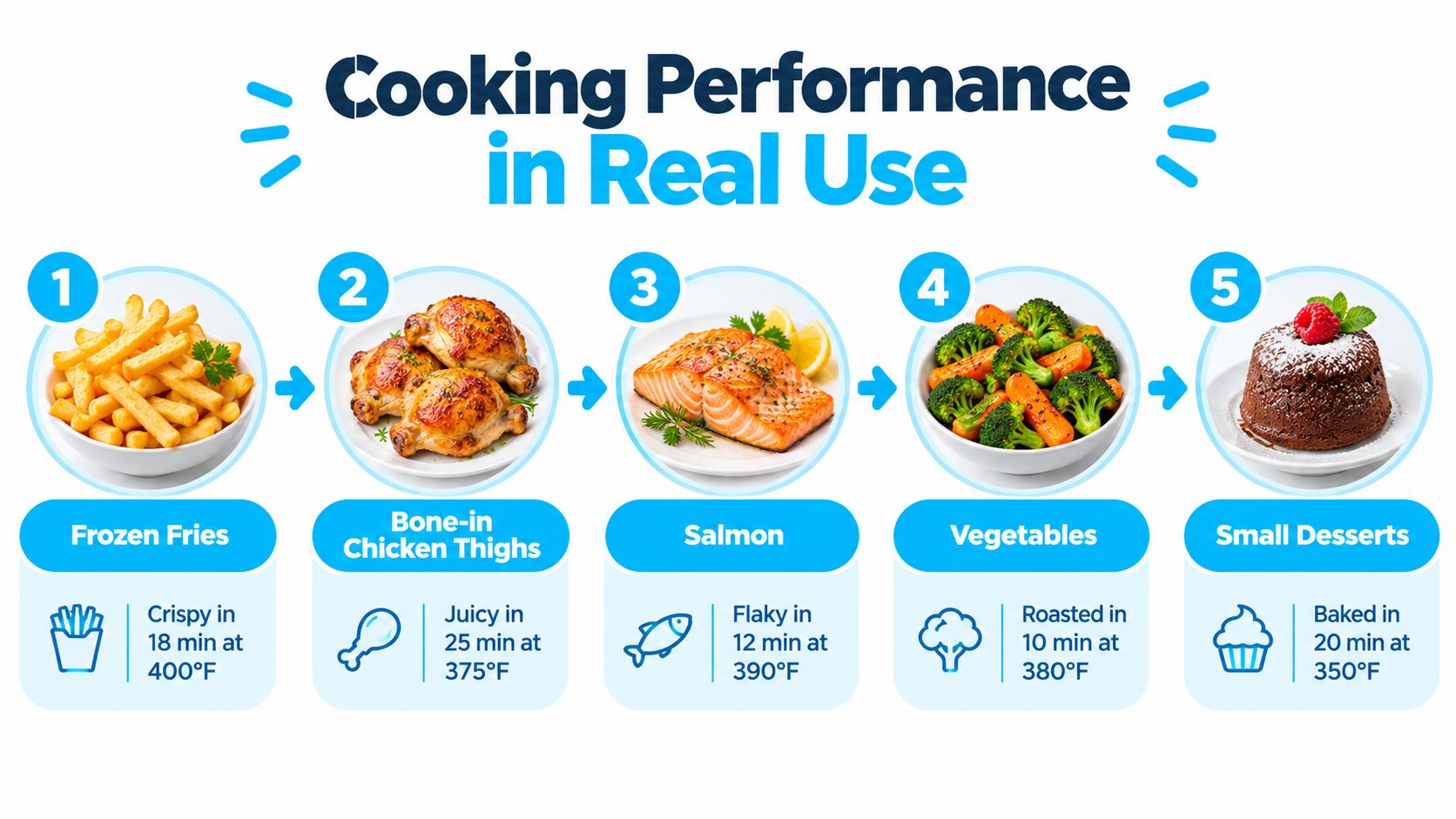
Air-fryer performance shows up on the plate, not on the front panel. Frozen fries should brown without leaving a soggy centre. Chicken should cook evenly through the thickest section. Vegetables need enough airflow to roast rather than steam. Salmon benefits from a flat tray and controlled heat, while a small roast exposes weak airflow and cramped rack spacing.
A basket model normally has an advantage with food that benefits from shaking. An oven-style model is more natural for salmon fillets, vegetables spread across a tray, and foods that need to stay level. Both formats struggle when you overload the cooking surface. Crowding traps moisture and prevents the moving air from doing its job.
Browning isn't a safety test
Health Canada advises cooking food completely and checking the thickest portion with a clean digital thermometer because food can cook unevenly. Its chart specifies 74°C (165°F) for poultry pieces, ground poultry, and frozen raw breaded chicken products, while a whole bird requires 82°C (180°F). The full guidance is available in Health Canada's food safety advice.
That guidance should change how you evaluate a model. A window, interior light, probe access, or a basket that makes thermometer placement easy is more valuable than a spectacular maximum temperature. Crispy skin tells you what happened on the surface. It doesn't tell you what happened at the centre.
Canadian government-supported research reported different bacterial reductions under the tested conditions: deep frying produced a median 7-log reduction, conventional oven cooking a median 6-log reduction, and air frying a median 4-log reduction. The tested chicken-strip procedure needed approximately 8.5 ± 1.0 minutes to reach 74°C internally. These findings don't make air frying unusable, but they do make thermometer checks and clear spacing essential.
Foods that suit the format
- Frozen fries and snacks: Strong candidates, especially in a basket that lets you shake the food.
- Chicken portions: Good candidates when pieces aren't crowded and you verify the centre.
- Salmon and vegetables: Excellent oven-style jobs when the food can sit in a single layer.
- Small roasts: Possible when the cavity leaves space around the food and you can monitor internal temperature.
- Soupy foods and large pizzas: Poor fits for most compact units because liquids need stable cookware and large items need usable cavity width.
The best air fryer oven is the one that makes safe thermometer checks easy, not the one that displays the highest number on its temperature dial.
Energy Use and Real CAD Cost per Meal
A 1,725 W air fryer oven running for 0.5 hours uses 0.8625 kWh. At an example Ontario rate of about $0.12 per kWh, that works out to roughly $0.10 for one cooking session. Your bill may differ, so use the rate on your utility statement and include preheating, cooking time, and every batch.
Use this calculation:
kilowatts × hours used = kilowatt-hours
Then multiply the result by your provincial electricity rate. Meal size matters more than the wattage printed on the box. A larger oven-style unit can cost less per serving when it cooks the whole meal at once. A compact basket can cost less for one portion because it heats a smaller space and avoids a second appliance.
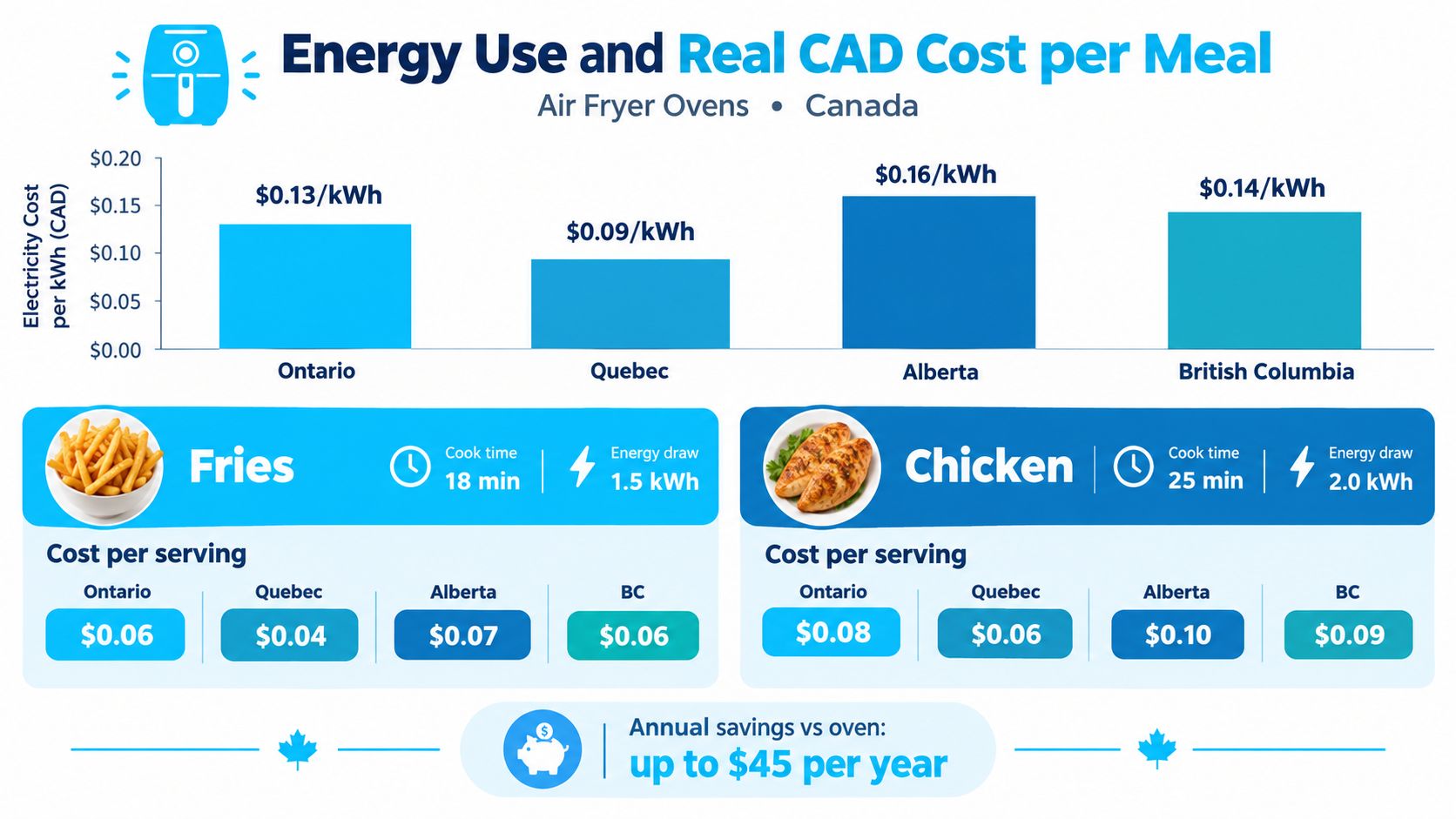
Count meals, not appliance watts
Canadian households spent an average of $2,376 on residential energy in 2023, and 5.6% spent at least 10% of disposable income on energy, according to the federal Energy Fact Book 2025-2026. That makes operating cost worth measuring, but it does not show whether a particular air fryer will recover its purchase price.
Track a few typical meals:
- Record the appliance wattage from the label.
- Time preheating and cooking separately.
- Note whether the meal needs a second batch.
- Measure consumption with a suitable plug-in monitor.
- Apply your utility's current rate.
- Compare the same meal with your full-size oven.
A one- or two-person household may use less energy by skipping the large oven, while a family may get better value from a wider cavity that avoids repeated batches. Counter space belongs in the calculation too. A unit that replaces another countertop oven can reclaim that footprint, while an oversized model used for one serving is paying for capacity you do not use.
For practical measurement, a smart plug with energy monitoring can record actual use, provided it is rated for the air fryer's load and used according to its instructions.
Canadian Safety, Certification, and Recall Checks
A familiar brand name doesn't replace a safety check. Cross-border marketplaces can mix Canadian and non-Canadian inventory, and an attractive listing may show a product image without showing the label you'll receive.
Four checks belong on every purchase
First, inspect certification. Look for a CSA, cUL, UL, or ETL mark on the appliance label, not only in the retailer's description. If the mark is missing or the listing uses vague language such as “tested to North American standards,” stop and verify the product before buying.
Second, confirm electrical compatibility. The unit should specify 120 V, 60 Hz and have a suitable North American plug. A high-wattage appliance can leave little circuit capacity for another demanding device, so plan where you'll use it rather than relying on a crowded kitchen outlet.
Third, search the exact model and date code. Health Canada's recall system is a searchable dataset updated daily. Its available result contained 19,778 active records and 14,445 archived records, which shows why a brand-level search isn't enough. Search the exact model, not just the manufacturer, in the Health Canada recalls and safety alerts database.
Fourth, retain the label information. Photograph the model number, serial or date code, rating plate, and receipt. If you buy used or open-box, ask for those details before paying.
Insignia digital and analogue air fryers and air-fryer ovens appear in Canadian recall records for potential fire hazards, with recalls listed in 2022 and 2024. That example is a reminder that a recognised retail brand can still have affected models.
Use the same discipline when evaluating materials and coatings. A PFAS-free Canadian kitchen guide may help you frame material questions, but it shouldn't distract from electrical certification, heat clearance, cord condition, and recall traceability.
“No current recall found” means only that your search didn't identify a current listing. It isn't proof that an appliance is safe, certified, undamaged, or correctly supported in Canada.
Picking the Right Air Fryer Oven for Your Situation
A Toronto condo dweller cooking for one or two people should choose a compact basket model first. Measure counter depth, leave room for ventilation, and check that the basket fits your usual portions. A visible timer or window helps during busy evenings. Skip app control, rotisserie accessories, and long preset menus unless you will use them every week. The smaller footprint also keeps more counter space available for meal preparation.
For a Calgary family cooking daily, batch size matters more than a sleek control panel. Choose an oven-style cavity or a generously sized basket so vegetables and chicken do not require separate rounds. Check the outlet, circuit load, and ventilation space before installation. Spend on usable rack area, even airflow, and parts that clean easily. Those features reduce cooking time and the CAD cost per meal more reliably than voice control.
A Vancouver weekend host gets more value from an oven-style model. Rack flexibility, a broad tray, stable temperature control, and a rotisserie option support larger meals and varied cooking. Measure the door swing and storage space before buying, because a wide cavity can reclaim less usable counter space than expected. Skip a complicated app when guests and food already need your attention.
For a Northern hobbyist who dehydrates fruit or proofs dough, choose a model with a low minimum temperature and controlled fan behaviour. The Instant Omni Plus is another low-temperature-capable option to compare against the 90°F minimum benchmark cited for suitable models. A low displayed temperature does not create more drying capacity. A small basket still limits each batch, which raises the CAD cost per meal when several rounds are required.
Match the spending to the job
- Small basket tier: Best for limited counter space and quick single-batch meals.
- Mid-size oven tier: Best for trays, toast, roasting, and broader everyday use.
- Premium oven tier: Best when the appliance replaces meaningful full-size oven use.
- Specialty tier: Best only when rotisserie, probe cooking, dehydration, or another specific function is a weekly habit.
Use the first table as your filter. Choose the form factor, confirm the electrical label, measure the usable cavity, and check the exact Canadian model. Then compare features against counter space, meals per batch, and recall status, rather than paying for presets you will rarely use.
Final Checklist Before You Click Buy in Canada
Before checkout, confirm the following:
- Form factor: Basket for fast crisping and compact storage, oven style for trays and broader cooking.
- Counter footprint: Measure width, depth, height, door swing, and ventilation clearance.
- Meal cost: Record wattage, cooking time, preheat time, and batch count before estimating CAD cost.
- Safety label: Confirm 120 V, 60 Hz and a CSA, cUL, UL, or ETL mark.
- Recall status: Search the exact model and date code in Health Canada's database.
- Weekly feature: Pay for the function you'll use every week, not the three presets you'll forget.
- Support: Keep the receipt, model code, warranty details, and product label photograph.
Prices, retailer stock, model lines, noise measurements, and electricity rates can change after a refresh or seasonal sale. Recheck those details before ordering, especially for cross-border listings.
Celmin publishes Canadian buying guides and product comparisons that translate appliance specifications into practical decisions for small kitchens, CAD budgets, and local availability. Visit Celmin to compare the air-fryer options and related countertop appliances before you commit your counter space.
Sign up or sign in to join the conversation.