
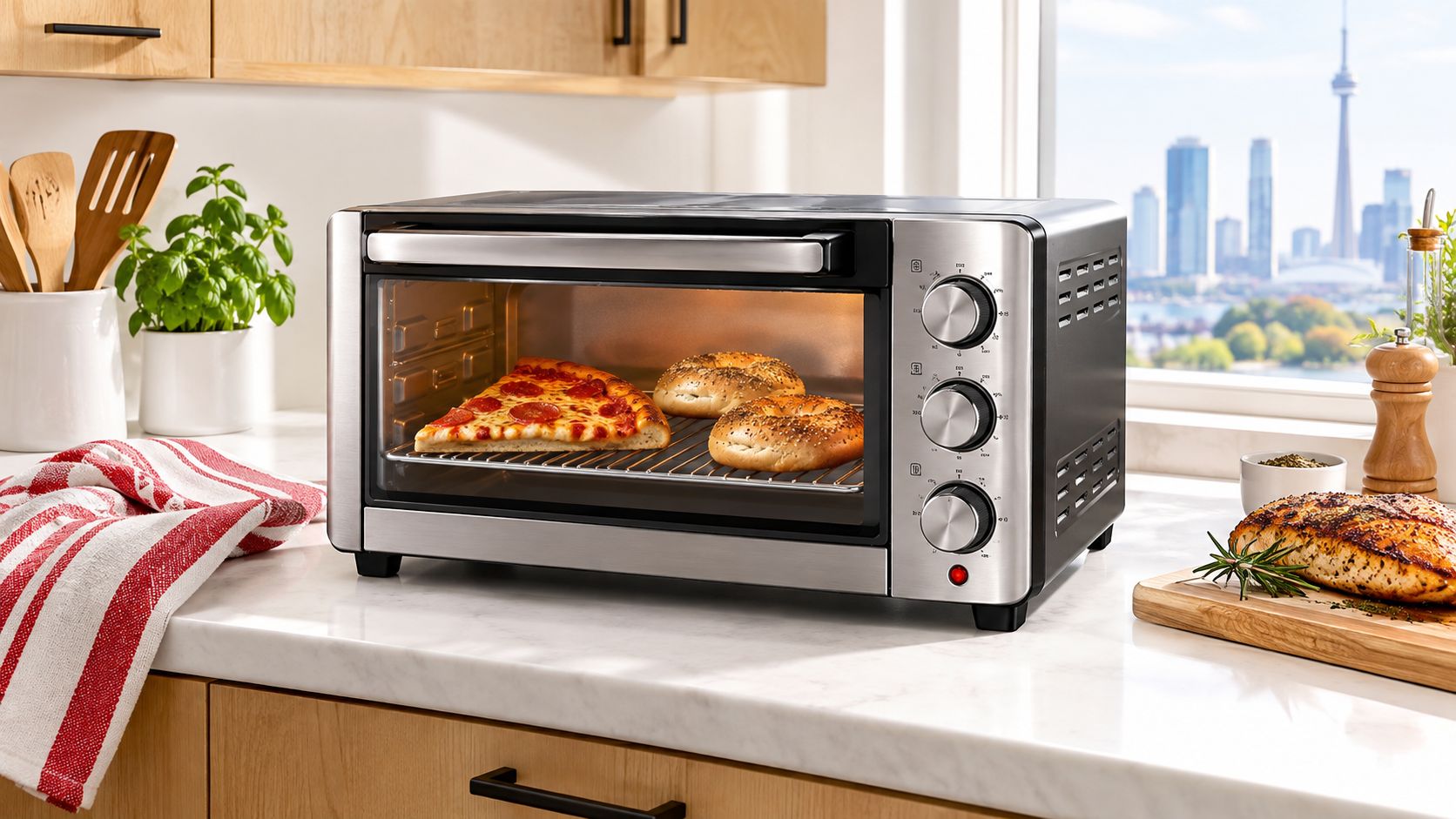
A small Canadian kitchen can make a full-size oven feel absurd. You want to toast two bagels, reheat last night's stew, or cook one chicken breast, but the large oven heats the room, occupies your attention, and feels excessive for a small meal. A mini toaster oven promises a better fit, but only if you choose usable cooking space over a deceptively tiny exterior.
The right question isn't whether the appliance fits your counter. It's whether the interior fits the food you cook, whether its wattage suits your outlet, and whether the energy savings come from its smaller cavity rather than from a marketing label. For condo kitchens, basement suites, older rentals, dorms, and cottages, those trade-offs matter more than a long preset menu.
Table of Contents
- What a Mini Toaster Oven Actually Is
- Sizing and Capacity for Small Canadian Kitchens
- Key Features Worth Paying For
- Pros and Cons in Real Canadian Homes
- Energy Use and Operating Cost in Canada
- Price Ranges and Where to Buy in Canada
- Maintenance, Safety, and Placement
- Decision Checklist and Common Buyer Questions
What a Mini Toaster Oven Actually Is
A mini toaster oven is a compact countertop electric oven for toast, quick reheating, small portions, and limited baking. It fills the gap between a basic toaster and a larger countertop oven, but its small footprint comes with a direct capacity trade-off. The Dash Mini Toaster Oven listing describes a model rated at 550 watts and measuring about 7.2 inches high, 6.3 inches wide, and 7.7 inches deep.
That format suits one person making toast, warming a snack, or reheating a small serving. It does not suit someone who regularly prepares food for several people. A one-slice unit is a separate category of appliance, not a shrunken family oven. Check the rated wattage against the outlet you plan to use, especially in an older rental or a kitchen where several appliances share one circuit.
Start with the food, not the appliance
Choose the oven around the meals you repeat:
- Do you mainly toast bread, bagels, or English muffins?
- Do you reheat leftovers that turn soggy in a microwave?
- Do you bake small portions or roast individual pieces of food?
- Do you need room for a pizza, casserole, or several portions?
A basic compact unit handles toast and straightforward reheating. Choose a larger cavity when you want reliable browning, roasting, or small-batch baking. The extra counter space from an ultra-small oven has little value if its interior forces awkward portions or repeated cooking cycles.
A mini toaster oven can't replace a full-size range oven for every task. Large turkeys, multiple sheet pans, and large casseroles require more interior room and batch capacity. A long feature list does not change that physical limit.
Practical rule: Buy the smallest oven that handles your most common meal, not the smallest oven that technically fits your counter.
Canadian shoppers should also account for import-dependent supply. Canadian countertop toaster ovens have over 90–95% of units sourced from abroad, mainly China and Vietnam, according to Canadian countertop toaster oven market analysis. Exchange rates, freight costs, and overseas production changes can affect availability and retail pricing. Treat the wattage, interior cooking space, and outlet setup as one buying checklist, rather than judging the appliance by exterior size alone.
Sizing and Capacity for Small Canadian Kitchens
The defining compromise is footprint versus usable capacity. A very small appliance may leave plenty of counter space but force you to cut food into awkward portions, cook in repeated batches, or abandon the recipes you expected to make.
Don't judge capacity from the exterior alone. Open the product diagram and check the interior width, rack position, tray dimensions, and door clearance. A manufacturer's slice-count claim can also flatter the product. Thick sourdough, wide bagels, and food on a tray need more room than thin sandwich bread arranged flat.
Compare the space you gain with the cooking you lose
Canadian listings illustrate the spread. The Dash mini is described as having one-slice capacity, while other compact models sold in Canada can fit four slices or pizzas measuring 11 to 13.5 inches, as documented in this Canadian mini toaster oven listing. Those are very different appliances, even if retailers place them under the same mini category.
| Size class | Interior volume | Slices of toast | Max pizza or pan | Approximate footprint |
|---|---|---|---|---|
| Ultra-mini | Very limited | One slice on some models | Small single portion | Smallest counter footprint |
| Small mini | Compact | Up to four slices on some Canadian listings | Small pizza or tray | Compact |
| Larger compact | More flexible | Depends on rack and bread size | Some listings accept 11- to 13.5-inch pizzas | Requires more counter depth |
The practical test is simple. Put a plate, baking dish, or pizza box on your counter and mark the area the oven will occupy. Then measure the clearance around it. A model can fit within the counter boundary and still interfere with cabinet doors, a kettle, or the space where you prepare food.
Choose capacity by routine
For one person who mainly makes toast and reheats small leftovers, an ultra-mini unit can be sensible. For a couple, a small mini with a real tray is a safer choice. Anyone cooking several portions should move toward a larger compact oven rather than pretending a smaller cavity will keep up.
Use this guide to kitchen appliances for small spaces as a second check on placement, not as a substitute for measuring the appliance and your counter. The best compact appliance is the one you can leave safely accessible without turning your only work surface into an obstacle course.
Key Features Worth Paying For
A mini toaster oven earns its counter space through heat control, usable interior space, and simple operation. Put cooking performance first. Pay for convenience only when it matches the food you prepare.
Convection earns its space
Choose convection if you roast, bake, or cook frozen foods regularly. A fan circulates hot air through the cavity, improving browning and consistency when food fills much of the tray. It does not increase the oven's capacity, but it helps you get more even results from the space you have.
For a routine built around toast and reheating, skip convection. Reliable upper and lower heating can serve you better than extra controls you will rarely use. In a condo kitchen, fewer controls also mean fewer parts to clean and troubleshoot.
Air-fry labels need scrutiny
Air-fry mode deserves your money only when the oven combines strong airflow, a suitable basket or tray, and effective upper heat. A label alone does not produce crisp food. For wings, fries, and vegetables, look for room around the food and airflow beneath it, rather than a shallow tray pressed close to a heating element.
If baking and toast make up most of your routine, do not pay extra for air fry. If crisping food is the main reason you are buying, prioritise fan performance, basket design, and cleaning access over a long preset list.
Wattage affects speed and circuits
Power ratings vary sharply between compact ovens. The Dash example is rated at 550 watts, as shown in this Canadian product information. Larger smart ovens draw substantially more power and may use four quartz elements.
Higher wattage generally supports faster temperature recovery and stronger browning. It also places a greater load on a shared outlet. Read the appliance label before buying, and avoid operating a high-wattage oven at the same time as a kettle, air fryer, microwave, or other heating appliance on the same circuit. Outlet capacity matters as much as cooking speed in older apartments and condo kitchens.
Controls and visibility
Dial controls are quick and easy to understand. Digital controls can provide useful presets, but they add complexity and can slow down a simple toast-and-reheat routine. An interior light deserves priority because it lets you check food without opening the door and releasing heat.
Use this buying order:
- Interior dimensions and tray fit
- Wattage suitable for your outlet
- Convection for baking and roasting
- Air fry for crisp-food routines
- An interior light
- The simplest controls you will use
Pros and Cons in Real Canadian Homes
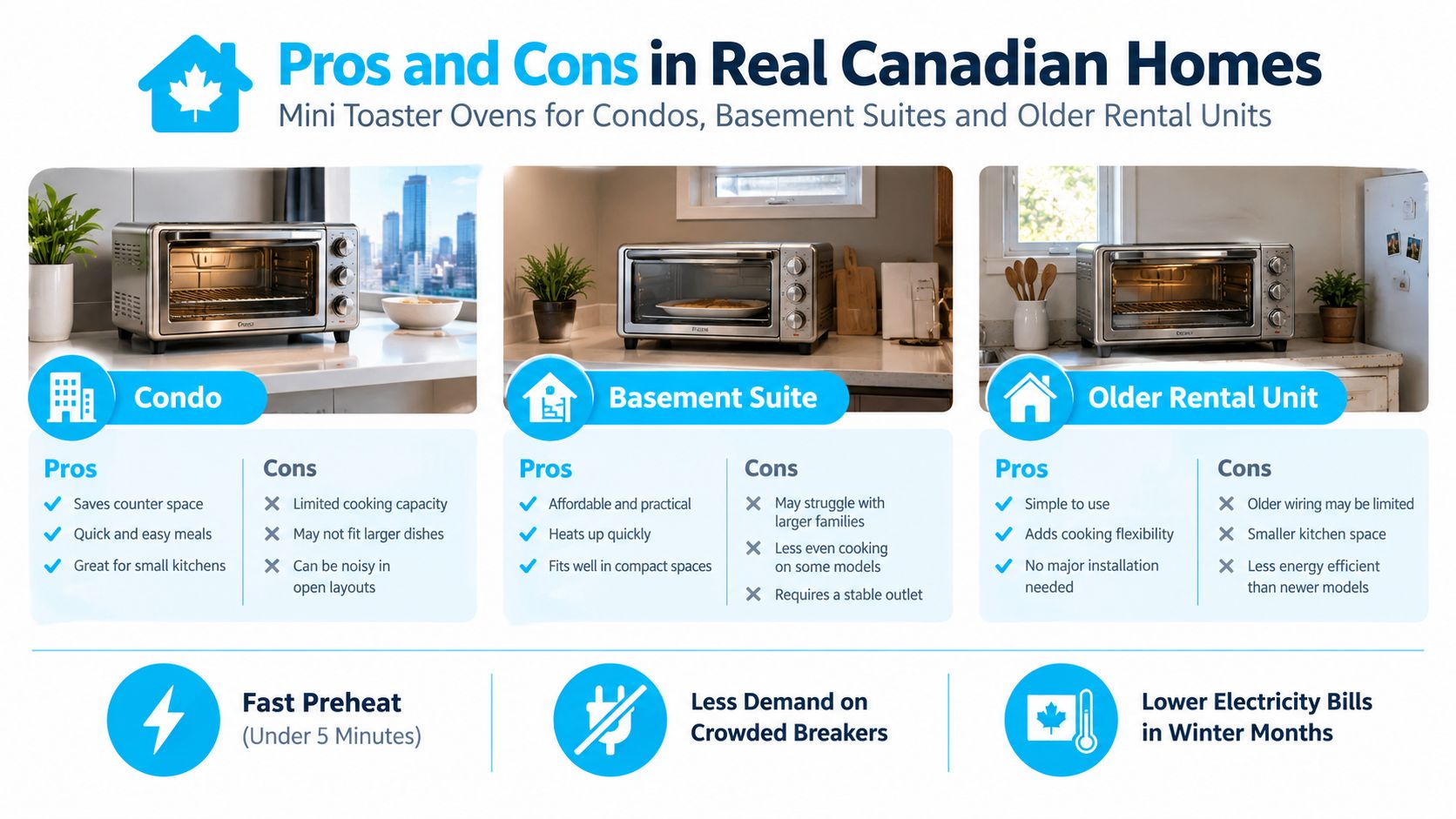
In a condo kitchen, a mini toaster oven earns its counter space when you regularly cook one or two portions. It heats a smaller cavity than a full-size oven, handles toast and reheating without warming the entire kitchen, and can limit unwanted heat during warm weather. Those advantages matter most when the oven's footprint matches your routine.
For the same cooking time, a toaster oven uses about half the energy of a stove oven, according to Quebec's household appliance guidance. The saving comes from heating less space. Use that advantage for toast, leftovers, small bakes, and single portions, not as a reason to force a family-size meal into a cramped cavity.
The drawbacks are concentrated in small homes
Noise becomes noticeable in an open-concept condo. A fan can be distracting beside a dining table or near a sleeping area, so check where the oven will run before treating compact size as an automatic benefit.
Radiant heat also matters in a tight kitchen. Leave clearance around the appliance, and keep it away from heat-sensitive cabinets and wall finishes that could discolour. A small footprint does not remove the need for safe placement.
Check the kitchen circuit before choosing a powerful model. A high-wattage mini oven can share a circuit with a kettle, microwave, or induction appliance and trip the breaker. If that happens, stop resetting it repeatedly. Move one appliance to another circuit, reduce simultaneous loads, and arrange an electrician's inspection if the problem continues.
A household cooking for four every night will probably outgrow a mini oven. A solo renter, couple, or occasional baker may find it ideal. Choose by usable capacity first, then confirm that the appliance fits your counter, clearance, and outlet. The right match makes the compact oven useful. The wrong match turns its small footprint into a daily limitation.
Energy Use and Operating Cost in Canada
A mini toaster oven can reduce energy use because it heats a smaller cavity. It does not make electricity cheaper. A lower-wattage model may draw less power at a given moment, yet a longer cooking time can narrow the gap with a faster, higher-wattage oven.
BC Hydro figures cited in Canadian coverage indicate that a 1200-watt toaster oven running for 50 minutes at 450°F can use about 0.9 kWh. A typical 2500- to 5000-watt electric oven used for 60 minutes can use about 2 kWh, as summarised in Canadian toaster oven energy guidance.
Use your tariff, not a made-up rate
Electricity prices vary by province, utility, tariff, and billing period. The table below provides a calculation framework. Check your current utility rate, then multiply it by the oven's measured kWh use.
| Province or utility | Rate in CAD per kWh | Cost per 45-minute session | Annual cost at five sessions per week |
|---|---|---|---|
| British Columbia | Check current BC Hydro tariff | Multiply oven kWh by your tariff | Multiply weekly sessions by your local session cost |
| Quebec | Check current Hydro-Québec tariff | Multiply oven kWh by your tariff | Multiply weekly sessions by your local session cost |
| Alberta | Check current local utility tariff | Multiply oven kWh by your tariff | Multiply weekly sessions by your local session cost |
Wattage on the box shows potential draw, not the energy used throughout a complete cooking cycle. A plug-in monitor gives you a better comparison between toast, reheating, and baking. The smart home energy monitor guide explains how to measure appliance consumption at the outlet.
Match capacity to the batch
Use the mini oven for toast, pizza slices, leftovers, and small bakes. Group similar foods into one planned session instead of switching the oven on repeatedly for tiny portions. That approach makes the limited cavity more useful and reduces wasted preheating.
For a large roast or several portions, use the full-size oven. Repeating small batches in a mini model can erase its energy advantage and add preparation time. Capacity matters as much as wattage.
Convection may shorten cooking time for suitable recipes, but the setting does not guarantee a fixed saving. Compare actual cooking time and measured energy use for meals you prepare regularly, then choose the oven that fits both your counter and your cooking pattern.
Price Ranges and Where to Buy in Canada
A mini toaster oven earns its counter space only when its usable tray area matches your cooking pattern. In Canadian retail, basic models often cost below CAD 80, while convection and air-fryer combinations commonly fall between CAD 120 and CAD 250, with retailer and seasonal variation.
| Price band | Typical features | Common brands | Where to buy in Canada |
|---|---|---|---|
| Below CAD 80 | Toasting, reheating, basic heating | Varies by current listing | Major Canadian retailers and discount channels |
| CAD 80 to CAD 150 | More useful capacity and possible convection | Varies by current listing | Canadian appliance and electronics retailers |
| CAD 120 to CAD 250 | Convection, air-fry combinations, or expanded controls | Varies by current listing | Canadian retailers and brand-authorised sellers |
Spend according to your cooking pattern
Choose the lower band for toast, bagels, leftovers, and reheating. A low-priced model makes sense when those tasks fit its smaller cavity. It is a poor choice if you expect one to roast or crisp food like a larger convection appliance.
The middle range is the strongest starting point for many condo kitchens. Look for a wider tray, useful rack positions, and predictable heating controls. Compare the oven's external footprint with its actual cooking area. A slightly larger body can be the better buy if it prevents repeated batches, while a compact unit may suit a solo user who values every centimetre of counter space.
Pay the higher price for air-fry, convection, or a more substantial cavity only when you will use those features regularly. Extra modes do not justify occupying valuable counter space for someone who mainly makes toast.
Before ordering, confirm that the plug and voltage suit Canadian use, then check warranty coverage, the return address, and replacement-part availability. An unauthorised cross-border or grey-market listing can make returns, documentation, and service more difficult even when the price looks attractive.
Compare the model's dimensions, tray size, controls, and warranty in this Canadian kitchen appliance guide before choosing extra cooking modes. The right price is the lowest one that delivers enough usable capacity without creating a counter or service problem.
Maintenance, Safety, and Placement
Compact appliances need disciplined placement because their heat is concentrated in a small area. Put the oven on a stable, heat-resistant surface with open space around the sides, back, and top. Follow the manufacturer's clearance instructions rather than pushing the unit beneath a cabinet because the footprint looks convenient.
A heat-resistant mat can protect laminate and other vulnerable surfaces, but it isn't permission to operate the oven inside a cramped shelf. Keep the crumb tray accessible, and don't drape towels, packaging, or cords across the top or sides.
Use a simple cleaning routine
Remove crumbs after each use once the oven has cooled. Wipe grease from the tray and interior surfaces with a suitable cleaner, and avoid abrasive products that can damage non-stick coatings or finishes. Don't scrub heating elements aggressively. Instead, follow the manual and remove spills before they bake onto the surface.
Keep the door, seals, racks, and tray clean enough that food doesn't smoke during the next cycle. Smoke can trigger alarms, especially during broiling or when grease reaches a hot element.
Treat the outlet as part of the purchase
A high-wattage mini oven can overload a shared kitchen circuit when used with a kettle, microwave, or another heating appliance. Plug it directly into a suitable wall outlet rather than relying on a lightweight extension cord or power bar unless the manufacturer specifically permits that setup.
If the breaker trips during normal use, unplug the oven and identify what else is running on the circuit. Repeated trips indicate a load or wiring problem that deserves professional attention, particularly in older rental buildings.
Warranty terms vary by brand and seller. Keep the receipt, register the product when offered, and confirm how Canadian service is handled before buying. A longer warranty has value only if the company provides parts, repairs, or replacement support where you live.
Decision Checklist and Common Buyer Questions
The correct mini toaster oven profile depends on household size, food shape, and outlet conditions. Use this table as a starting point, then verify the product's interior dimensions.
| Household profile | Capacity | Wattage | Key features |
|---|---|---|---|
| Solo urban dweller | Smallest cavity that fits regular toast and a personal meal | Lower draw if the circuit is limited | Basic controls and easy cleaning |
| Couple or small household | Compact cavity with a usable tray | Moderate to higher draw if the outlet supports it | Convection and interior light |
| Crisp-food enthusiast | Larger compact cavity | Higher draw, checked against circuit use | Genuine airflow, basket, strong upper heat |
| Cottage or RV owner | Small cavity matched to available power | Lower wattage priority | Simple controls, low operating demand, reliable service |
Questions buyers often skip
Can a mini toaster oven replace a full-size wall oven in a one-bedroom condo?
It can replace many small cooking tasks, including toast, reheating, pizza slices, and small portions. It won't replace the full oven for large batches, oversized dishes, or meals that need substantial rack space.
Does it trigger smoke alarms more than a stove?
Broiling can produce smoke when grease or food residue reaches the upper element. Keep the interior clean, watch high-heat cooking, and don't treat the small cavity as smoke-proof.
Will the fan be too loud for an open-concept apartment?
That depends on the model, surface, and room layout. A fan-driven convection or air-fry unit will usually be more noticeable than a basic heating toaster oven. If you work or sleep near the kitchen, prioritise simple operation and check owner feedback for noise before purchase.
What should I do if it trips the breaker during dinner?
Turn off other high-draw appliances on the circuit, unplug the oven, and let the breaker reset once. Don't keep resetting it while the same load is connected. If the problem returns, stop using the appliance until the outlet and circuit have been checked.
Is the smallest model automatically the cheapest to run?
No. Smaller wattage can mean lower draw, but restricted capacity may force repeated cooking. Compare the food you make, the total cooking time, and the appliance's measured consumption.
Should I choose wattage or capacity first?
Choose capacity first if you regularly cook food that barely fits. Choose wattage first if you're in a cottage, RV, older rental, or shared kitchen with limited electrical capacity. A perfectly sized oven that trips the breaker isn't a practical purchase.
The best choice for most small Canadian kitchens is a compact oven with enough interior space for your regular meals, verified wattage for your circuit, and convection only when you'll use it.
For more Canada-focused appliance comparisons, practical small-space guides, and buying advice, visit Celmin. Use its kitchen appliance coverage to compare the trade-offs before you commit counter space and outlet capacity to a mini toaster oven.
Sign up or sign in to join the conversation.