
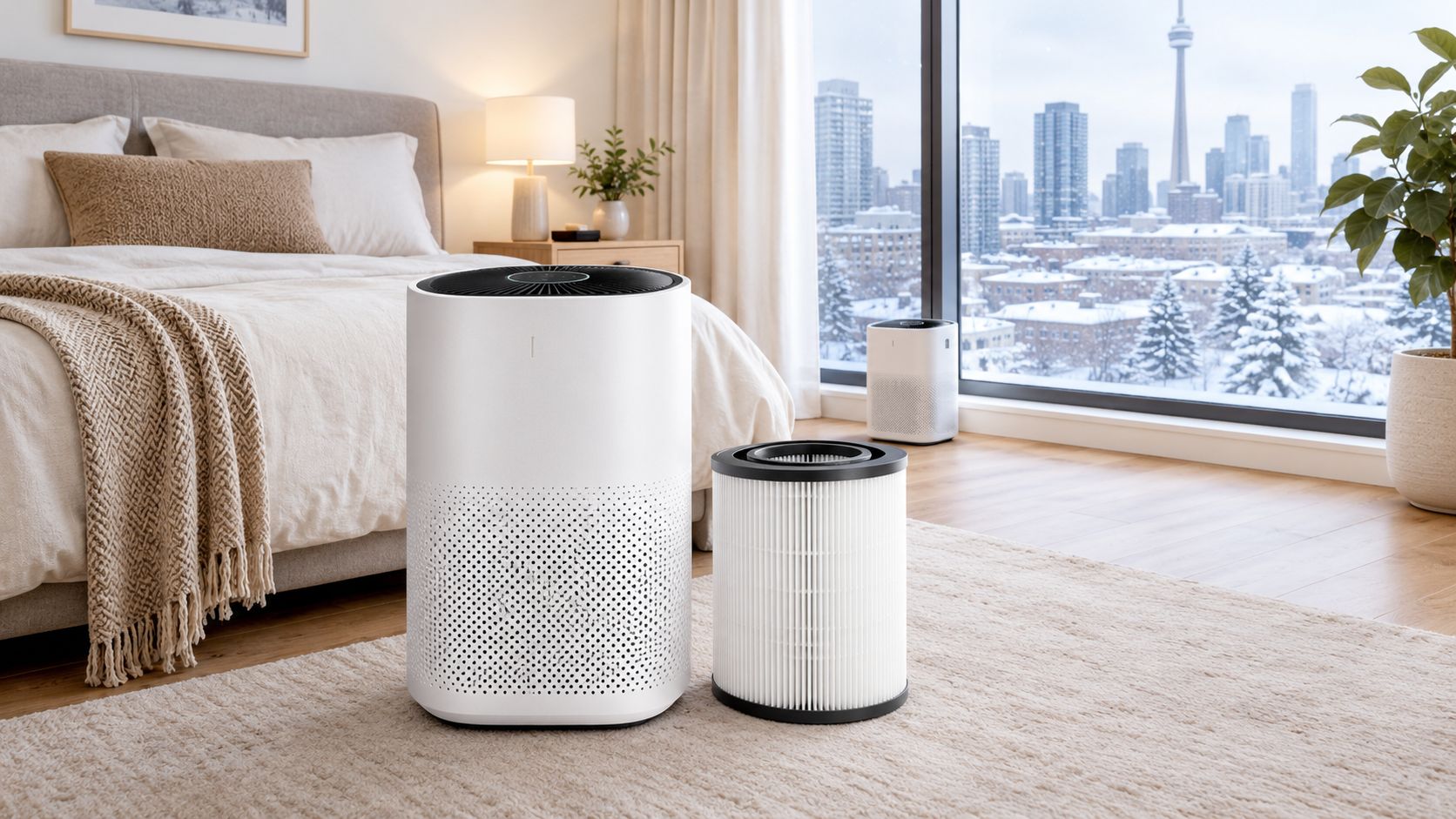
A smoky afternoon in a Canadian summer can turn a bedroom into a room you'd rather keep sealed. In winter, the windows stay shut for a different reason, while the furnace runs and the air feels dry. In either season, an air purifier can earn its floor space, but only if it can move enough filtered air for the room where you'll use it.
The number to check before brand, app, or colour is tobacco-smoke CADR. It tells you more about fine-particle cleaning capacity than a vague room-coverage claim, and it gives you a practical way to compare an air purifier with a HEPA filter across brands.
| What you're deciding | What to check | Why it matters |
|---|---|---|
| Whether it's large enough | Independently reported tobacco-smoke CADR | Helps match filtered airflow to your room |
| Whether the filter claim is meaningful | A clearly described mechanical filter, not just “HEPA-type” wording | Labels don't all make the same promise |
| Whether you'll keep using it | Noise at the speed you'll run, placement, and filter availability in Canada | A powerful unit is no help if it ends up switched off |
| Whether it fits your home | Room size, doors, windows, and use during smoke events | Real conditions affect how much air gets cleaned |
Table of Contents
- Why Canadian Homes Need a Different Buying Lens
- True HEPA Versus HEPA-Type and Other Filter Claims
- Sizing the Purifier to Your Room With CADR
- Noise, Power Use, and Winter Bedroom Reality
- Replacement Filters and Long-Term Canadian Availability
- Recommended Models for Canadian Rooms
- Seasonal Use, Humidity, and Year-Round Operation
- Smart Buying Moves and Quick Answers
Why Canadian Homes Need a Different Buying Lens
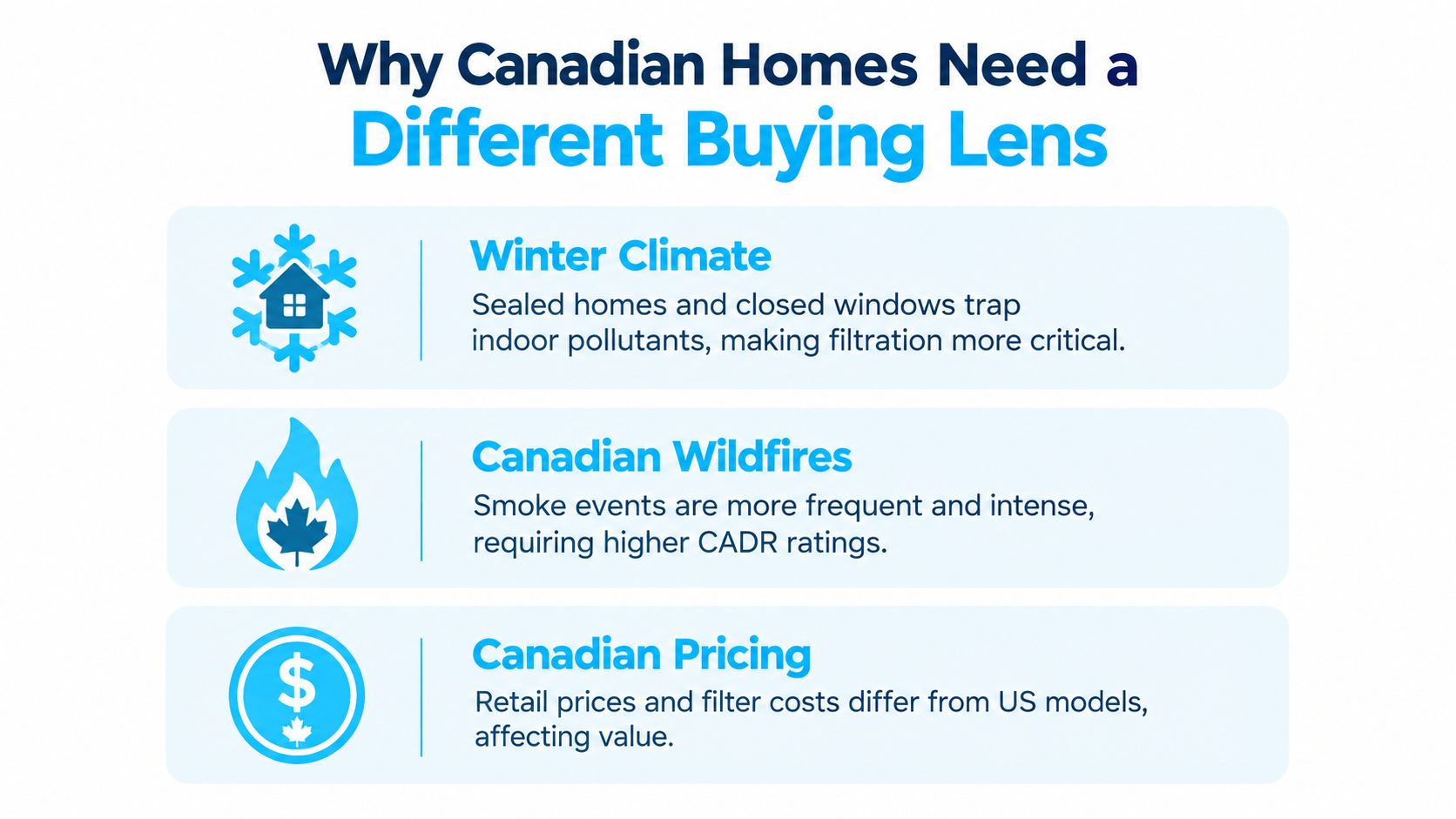
A coverage claim printed on a purifier box tells you almost nothing about what the machine will do in a smoky August bedroom. That figure describes square footage on paper, while what matters is how fast the unit moves filtered air at a fan speed you can tolerate in your bedroom. Canadian buyers face a tougher version of this problem: wildfire seasons that stretch for weeks, winters when every window stays shut, and condos where a loud fan on high is its own complaint to the neighbours.
The starting point is room-matched smoke CADR. Health Canada recommends a tobacco-smoke CADR of at least two-thirds of the room's floor area in square feet, a minimum sizing rule rather than a promise of a particular indoor particle level. Apply it to a 200-square-foot main-floor living room and the rule calls for a smoke CADR in the mid-130s, which rules out most compact units marketed with generous coverage numbers. Room layout, air leakage, and open doors all shift real-world results, as Health Canada's portable air purifier guidance explains.
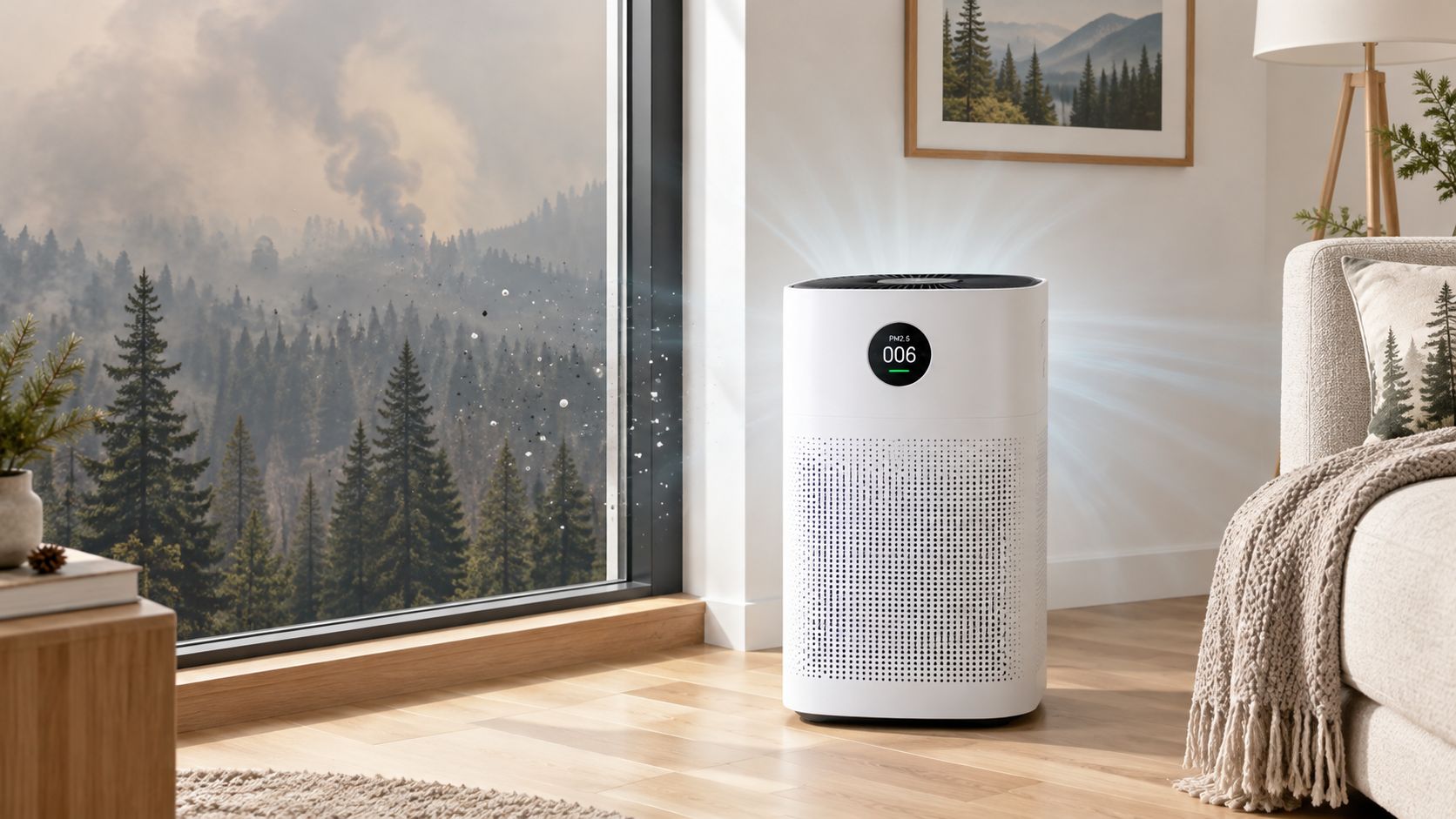
Smoke is the reason this sizing rule matters more here than in most markets. The B.C. Centre for Disease Control's evidence review reports that PM2.5 makes up approximately 90% of the total particulate mass in wildfire smoke, and it documents homes where filtration cut indoor PM2.5 levels. Those measurements came from particular houses, so read them as evidence of what good filtration can do rather than a guarantee. Purifier capacity, closed windows and doors, and filter maintenance all decide the outcome in yours.
Match capacity to the room you use
Skip the retail question "what's the biggest room this covers?" and ask instead: "what's the tobacco-smoke CADR, and can this unit hit it at a noise level I can live with?" For a bedroom, start from its floor area and the two-thirds rule, then check whether you'll realistically run the fan hard enough to reach that figure with the door closed.
Filter upkeep belongs in the same decision. During a long smoke season you may need a replacement by mid-August, so favour a model whose filters you can order from Amazon.ca or Best Buy Canada over a cheaper import with no Canadian filter supply. If you want to see whether the machine is earning its floor space, pair it with a dedicated air-quality monitor that reports indoor PM2.5 directly.
True HEPA Versus HEPA-Type and Other Filter Claims
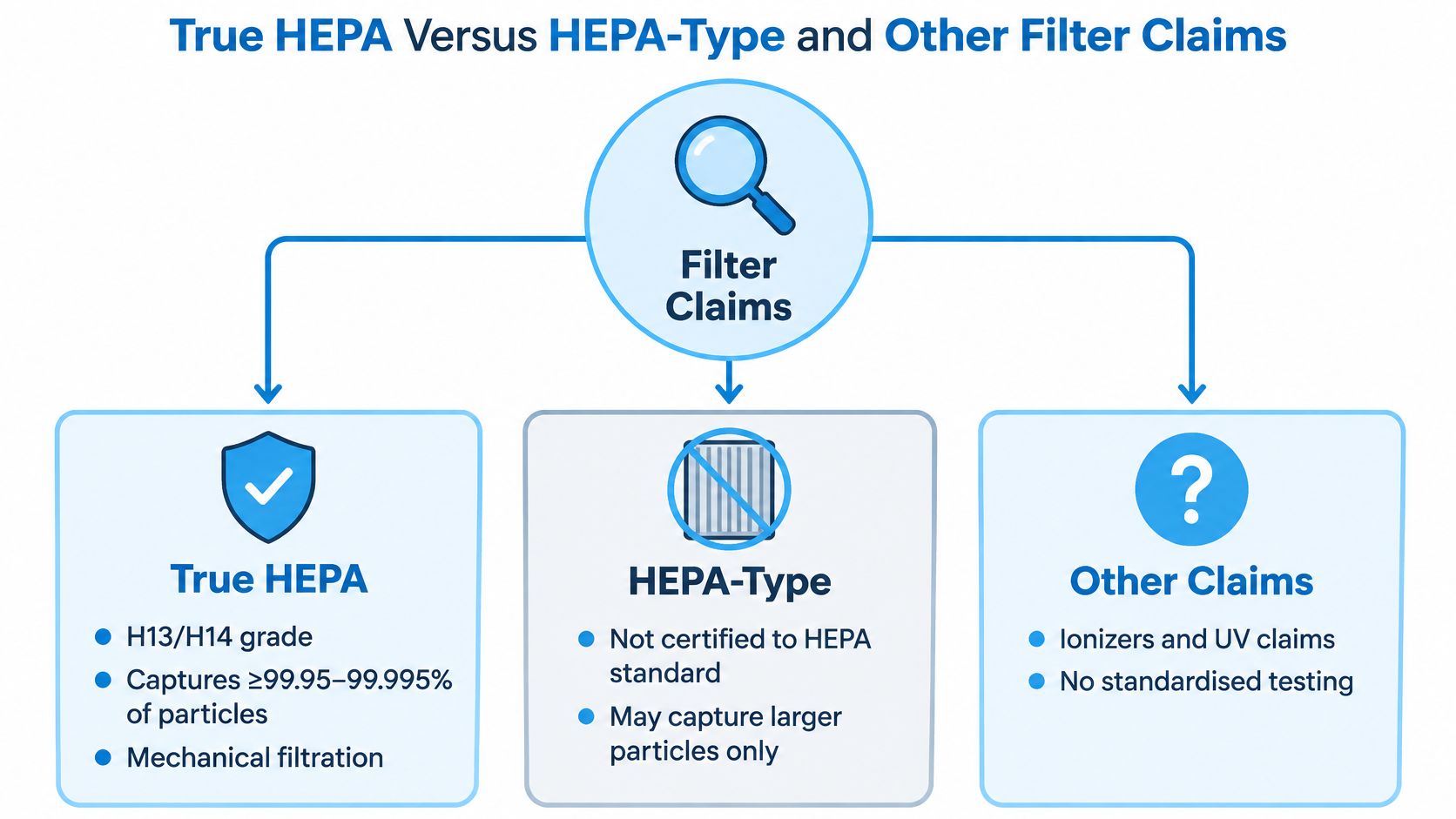
The word “HEPA” on a box isn't enough to settle whether a purifier is a good buy. Look for clear information about the filter and the product's independently reported performance. If the manufacturer relies on phrases such as “HEPA-like” or “HEPA-type” without explaining what standard the filter meets, don't assume it's equivalent to a filter described as true HEPA.
True HEPA describes a mechanical particle filter. Air passes through a dense filter medium that captures particles as the purifier draws air through it. A pre-filter can catch larger material, while an activated-carbon stage may help with some odours and gases. That carbon layer is separate from particle filtration: HEPA alone doesn't remove every airborne gas or household smell.
Read the whole filtration claim
When comparing products, check the specification page and manual, not only the front of the carton. Look for the manufacturer's exact description of the filter, whether the claim is tied to a recognised test method, and whether the unit reports a tobacco-smoke CADR. A verified CADR can help you compare particle-cleaning performance across models, whereas a broad statement about removing particles may not tell you how much filtered air the purifier delivers.
Be cautious with products that lean heavily on ionizers, UV lights, or claims about “sterilising” the air. Those features don't replace the need to verify particle filtration and room-matched airflow. For wildfire smoke, the central indoor concern is fine particles; Health Canada identifies PM2.5 as the dominant particulate component of smoke, so a purifier's particle performance deserves priority over a long list of secondary features.
Practical rule: Treat “HEPA-type” as a marketing description unless the manufacturer backs it with a clear, verifiable filtration standard.
Before buying, check how the filter fits and seals inside the unit, how the manufacturer says to maintain it, and whether genuine replacements are sold through Canadian retailers. A strong filter claim is only useful if air passes through the filter as intended and you can keep the unit maintained.
Sizing the Purifier to Your Room With CADR
The two-thirds rule from the previous section becomes concrete once you measure your room. A 250-square-foot condo living room needs roughly 167 smoke CADR. A small 120-square-foot bedroom clears the bar at 80. Go below those numbers and you bought a filter with no muscle.
CADR combines airflow and particle-removal performance. That single number tells you more than the HEPA label alone. Compare tobacco-smoke CADR across listings on Amazon.ca and Best Buy Canada, and reject any portable unit that hides it. No published smoke CADR means no sale.
Check room volume for smoke events
Floor area gets you in the range. Smoke season demands a stricter check. Health Canada advises roughly two to three room-volume changes per hour during wildfire smoke, which works out to about 38 to 58 cubic feet per minute of effective filtered airflow for a 12-by-12-foot room with an eight-foot ceiling (Health Canada's wildfire-smoke guidance).
Volume is 1,152 cubic feet in that example. Run the math for your own bedroom before you buy.
Open-concept condos punish undersized units. If your living room bleeds into a kitchen or hallway, add that connected square footage. One compact purifier will not cover two zones. Buy the smallest unit that meets the calculated CADR and still runs at a speed you tolerate. During smoke events, keep windows and doors closed where practical and follow the manufacturer maintenance schedule.
| Smoke CADR | Room size | Best Canadian use case | Typical CAD price |
|---|---|---|---|
| At least 80 | 120 sq. ft. | Small bedroom, minimum sizing calculation | Varies by model and retailer |
| Around 167 | 250 sq. ft. | Condo living room, calculated example | Check current Canadian listings |
| Use smoke CADR where available | Open or connected spaces | Compare effective airflow and consider room layout | Check current Canadian listings |
Noise, Power Use, and Winter Bedroom Reality
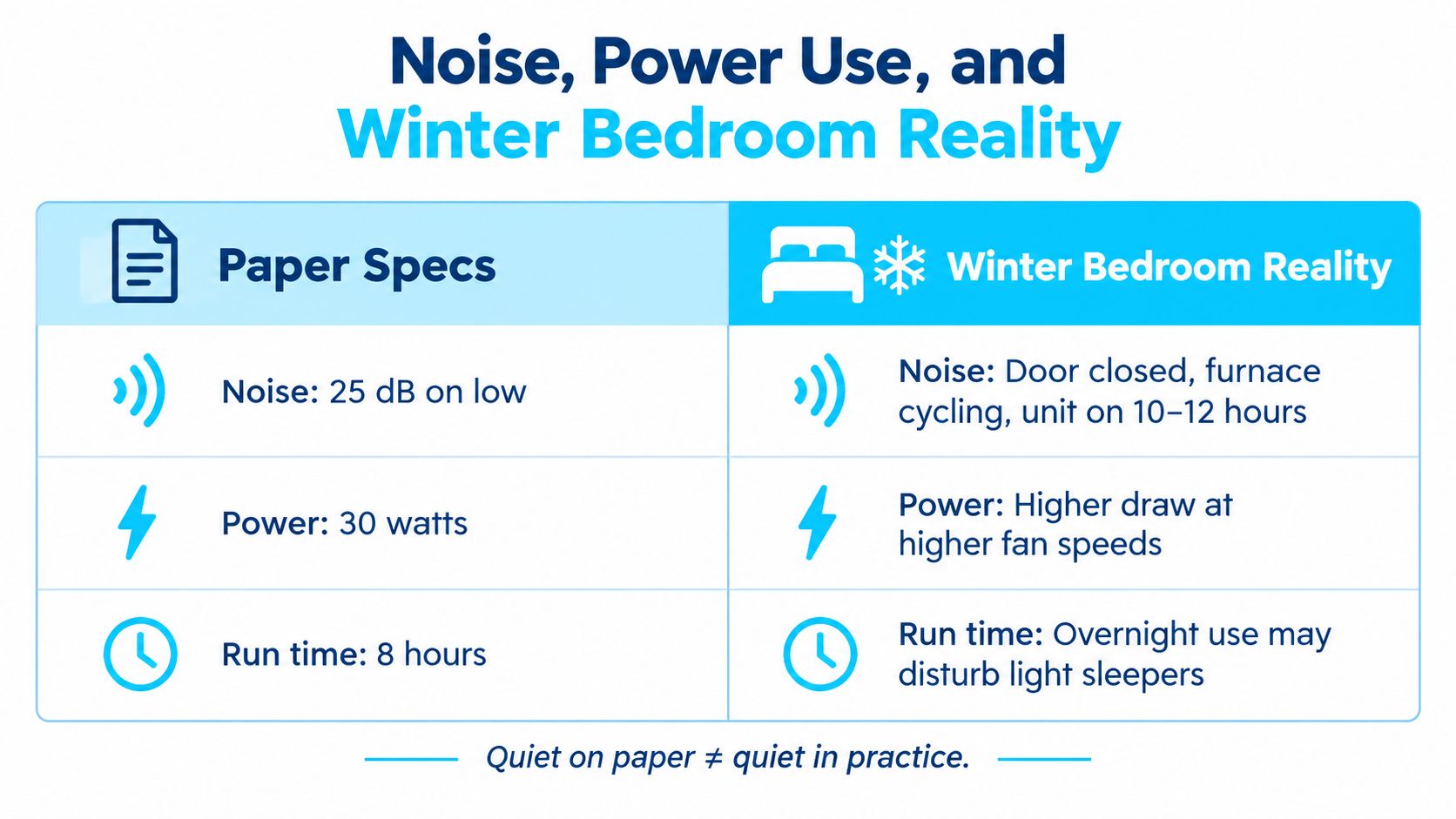
A purifier's strongest fan setting can make an impressive spec sheet, but it may not be the setting you use beside your bed. Judge bedroom models by the speed you can tolerate overnight, not only by their maximum advertised performance. If the unit is too intrusive, you'll turn it down or switch it off, which undermines the reason you bought it.
Noise descriptions are hard to compare unless manufacturers report them at clearly identified fan speeds. “Quiet” is a sales word, not a complete test result. Check the manual or product listing for measured sound levels on low and medium, and listen in person if you can. A fan's pitch and vibration can bother a light sleeper even when a headline decibel figure looks modest.
Test the setting you'll actually use
Sleep mode often reduces fan speed, which can also reduce filtered airflow. Don't assume that a unit's top-line CADR applies when the purifier is in its quietest mode. Check whether the manufacturer provides CADR by fan speed; if it doesn't, treat the sleep setting as a comfort feature, not evidence that the purifier will deliver its highest cleaning performance overnight.
Winter changes how you experience the machine. A closed bedroom door, furnace cycling, and hours of continuous operation can make fan noise more noticeable. Look for a display you can dim or switch off, and check whether indicator lights or wireless controls can be disabled. A bright status light can be a bigger bedroom nuisance than the motor.
Power use deserves the same practical check. Compare the unit's stated consumption at the settings you'll use, then check your own electricity bill or utility's current rate before estimating ongoing cost. Don't rely on a generic annual-cost figure: actual use depends on fan speed, operating hours, and your local electricity price. Choose a purifier you can leave running at a sustainable setting, not one that only meets the room's needs when it's roaring on maximum.
Replacement Filters and Long-Term Canadian Availability
A low sticker price can hide an irritating ownership problem: the replacement filter is hard to find, costly to ship, or available only from an unfamiliar seller. Before you buy, search for the exact replacement-filter model number at Canadian retailers. Check whether the listing is sold and shipped within Canada, and whether the product is the correct filter for the exact purifier version you're considering.
That check matters in wildfire season, when airborne debris can load a pre-filter more quickly. Follow the manufacturer's cleaning and replacement instructions, inspect the filter when the unit indicates it needs attention, and pay attention to changes in airflow. Don't assume that a filter lasts a fixed period under every household's conditions.
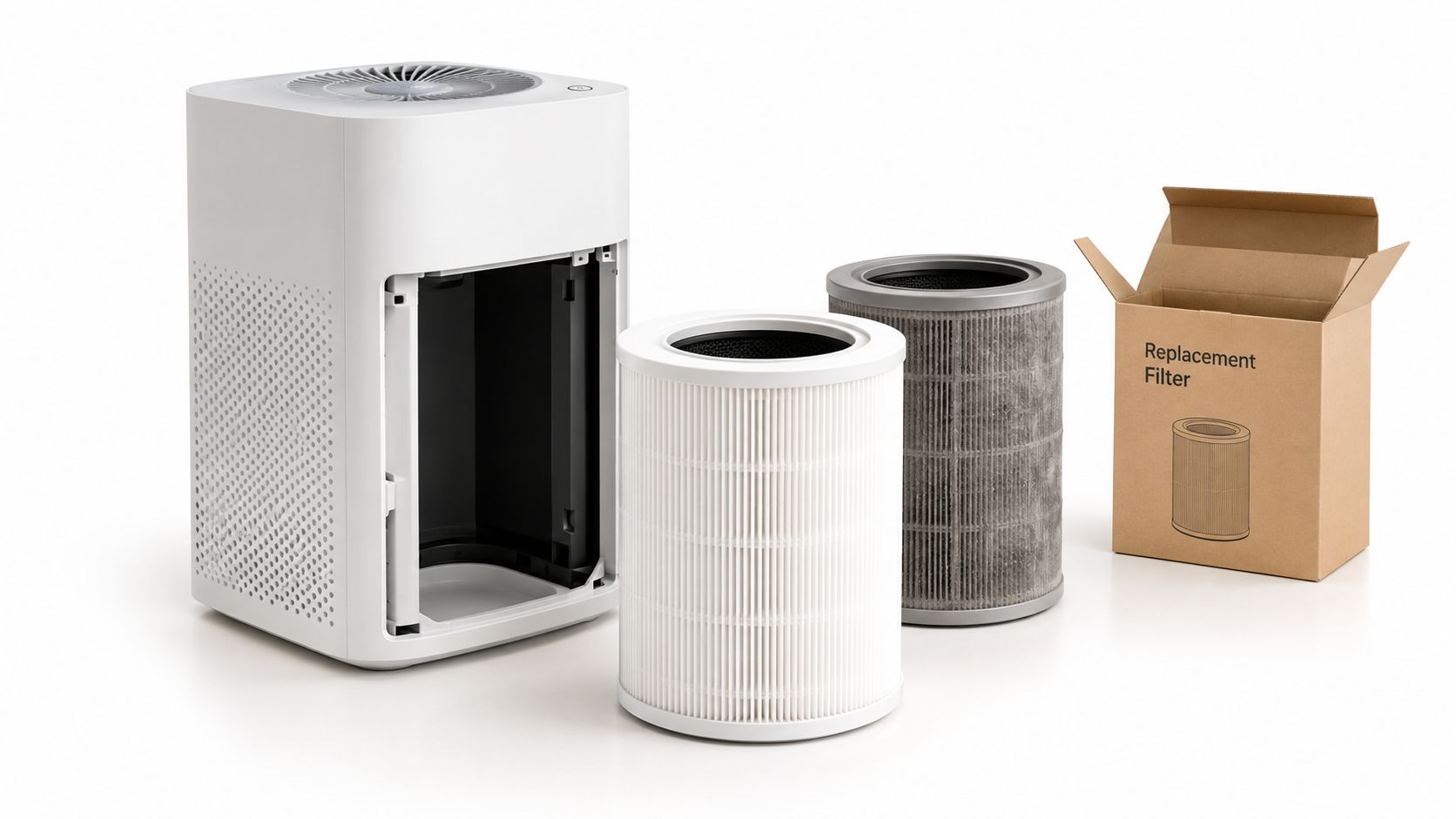
Check stock before you commit
Search Amazon.ca, Best Buy Canada, and other Canadian retailers for the replacement filter before placing your purifier order. Confirm the filter name and model number against the manufacturer's instructions. A product page that says “compatible” doesn't, by itself, prove that a third-party filter fits properly or performs like the intended replacement.
Be especially wary of washable or “permanent HEPA” claims that don't explain how performance is maintained after cleaning. Washing or vacuuming a filter contrary to the manufacturer's instructions can damage it or affect its fit. If a brand calls a filter permanent, look for specific maintenance directions and a clear explanation of what the claim means.
When you compare models, add filter availability to the decision alongside CADR and noise. A purifier that takes a readily available replacement can be a more dependable choice than a model whose filter requires uncertain cross-border shipping. For practical guidance on identifying the right part and planning maintenance, use Celmin's guide to air purifier replacement filters.
Recommended Models for Canadian Rooms
I wouldn't recommend a specific model just because it's popular or has a polished app. The useful recommendation depends on the room, the independently reported smoke CADR, the fan speed you'll tolerate, and whether replacement filters are available in Canada. Without current, verified model listings and measurements, quoting a price or declaring one purifier the winner would be guesswork.
Start with the room rather than the brand. For a bedroom, use the floor-area rule from earlier, then check the unit's noise at the speed you'd use overnight. For a larger condo living room or basement rec room, look for a higher smoke CADR and consider whether an open doorway means the purifier is serving more space than the room's measured floor area.
Compare candidates on the same terms
Coway Airmega, Levoit Core, Blueair Blue, and Dyson Purifier lines are names you may encounter while shopping in Canada. Don't treat a brand name as a performance rating. Models within a product line can differ in airflow, filter design, controls, and replacement-filter costs.
Build a short list using these checks:
- Small bedroom: Verify the tobacco-smoke CADR against the room's floor area, then compare low-speed noise and display controls.
- Condo living area: Look for enough smoke CADR for the space you want to clean, not just the manufacturer's headline room-coverage claim.
- Basement room: Consider whether odours or dampness are also concerns. A particle filter won't correct a moisture problem, and a purifier isn't a substitute for addressing the source.
- Any room: Check replacement-filter stock at Canadian retailers and read the warranty terms before checkout.
Amazon.ca, Best Buy Canada, Costco Canada, and Canadian Tire can all be useful places to compare listings, but stock and prices change. Confirm the precise model number, whether the seller is based in Canada, and the return policy. A retailer's listing should also show the CADR and filtration details clearly enough to verify them against the manufacturer's own documentation.
A well-sized mid-range purifier is a smarter buy than a premium unit that can't keep up with your room.
If a product doesn't disclose smoke CADR or make replacement filters easy to identify, keep looking. The spec you can verify is more valuable than a feature list you can't compare.
Seasonal Use, Humidity, and Year-Round Operation
A HEPA purifier filters particles; it doesn't humidify or dehumidify the room. In a dry-feeling Canadian winter, adding a more expensive filter won't put moisture back into the air. If low humidity is making the room uncomfortable, consider whether a humidifier is the more direct answer, while maintaining the purifier for airborne particles.
Summer calls for a different routine. During wildfire smoke, keep windows and doors closed where practical and run a portable cleaner in the room where you spend time. In milder conditions, ventilation may be appropriate, but opening a window while outdoor smoke is present can bring more particles inside. Use local air-quality information and your own comfort to decide when to ventilate.
A practical seasonal routine
- Winter: Keep the purifier in the bedroom or living space where you spend the most time. Follow the filter instructions, and consider a humidifier if the indoor air feels uncomfortably dry.
- Spring: Check the pre-filter and clean or replace it as the manufacturer directs. If pollen bothers you, keep the purifier running in the room you use most.
- Summer smoke episodes: Close windows and doors where practical, run the purifier at a speed you can sustain, and check the filter more often.
- Humid or damp conditions: A purifier won't remove excess moisture. Address leaks, ventilation, or dampness directly, and consider a dehumidifier if the room needs moisture control.
A neglected filter can collect debris, so don't let seasonal habits turn into year-round neglect. At the same time, don't replace parts on an arbitrary schedule if the manufacturer provides specific instructions and the filter remains in suitable condition. Pay attention to the unit's alerts and airflow, and follow its manual.
If you're choosing between devices for dry-air comfort and particle filtration, keep their jobs separate. Celmin's comparison of an air purifier versus a humidifier can help you decide which problem you're trying to solve.
Smart Buying Moves and Quick Answers
The most expensive purifier doesn't automatically clean your room better. A premium app, polished casing, or extra modes won't make up for inadequate smoke CADR, an intolerable fan, or replacement filters you can't source. Buy for the room and routine you have, not for the longest feature list.
Before checkout, answer these questions:
- Does the smoke CADR fit the room? Measure the floor area and use the Health Canada rule as your baseline.
- Can you live with the noise? Check the fan speed you'll use in a bedroom, not just the quietest or strongest marketing claim.
- Can you buy replacement filters in Canada? Search the exact part number at familiar Canadian retailers.
- What will ownership cost? Compare replacement-filter prices and the unit's stated power use, then apply your local electricity rate and expected routine.
- Who handles warranty service? Read the warranty terms and confirm whether service is available through a Canadian seller or distributor.
Buy for performance you can sustain
A purifier that meets the room-size rule on its highest setting may not be the right bedroom choice if you can't sleep with it running there. Conversely, a quiet mode may not provide the airflow you need during a smoky spell. Check the available specifications, decide which trade-off you can accept, and choose the model you'll use.
If a retailer can't provide a clear smoke CADR, filter details, or replacement-filter information, don't let a discount pressure you into buying. Compare another unit. The smart purchase is a purifier that suits the room, works at a tolerable setting, and remains maintainable after the box is gone.
Celmin publishes Canadian-focused reviews and practical buying guides for home technology, including air-quality products and advice on comparing filtration, room coverage, and replacement filters. Visit Celmin to explore its Canadian home-tech coverage and find guidance for your next air-quality purchase.

Sign up or sign in to join the conversation.