
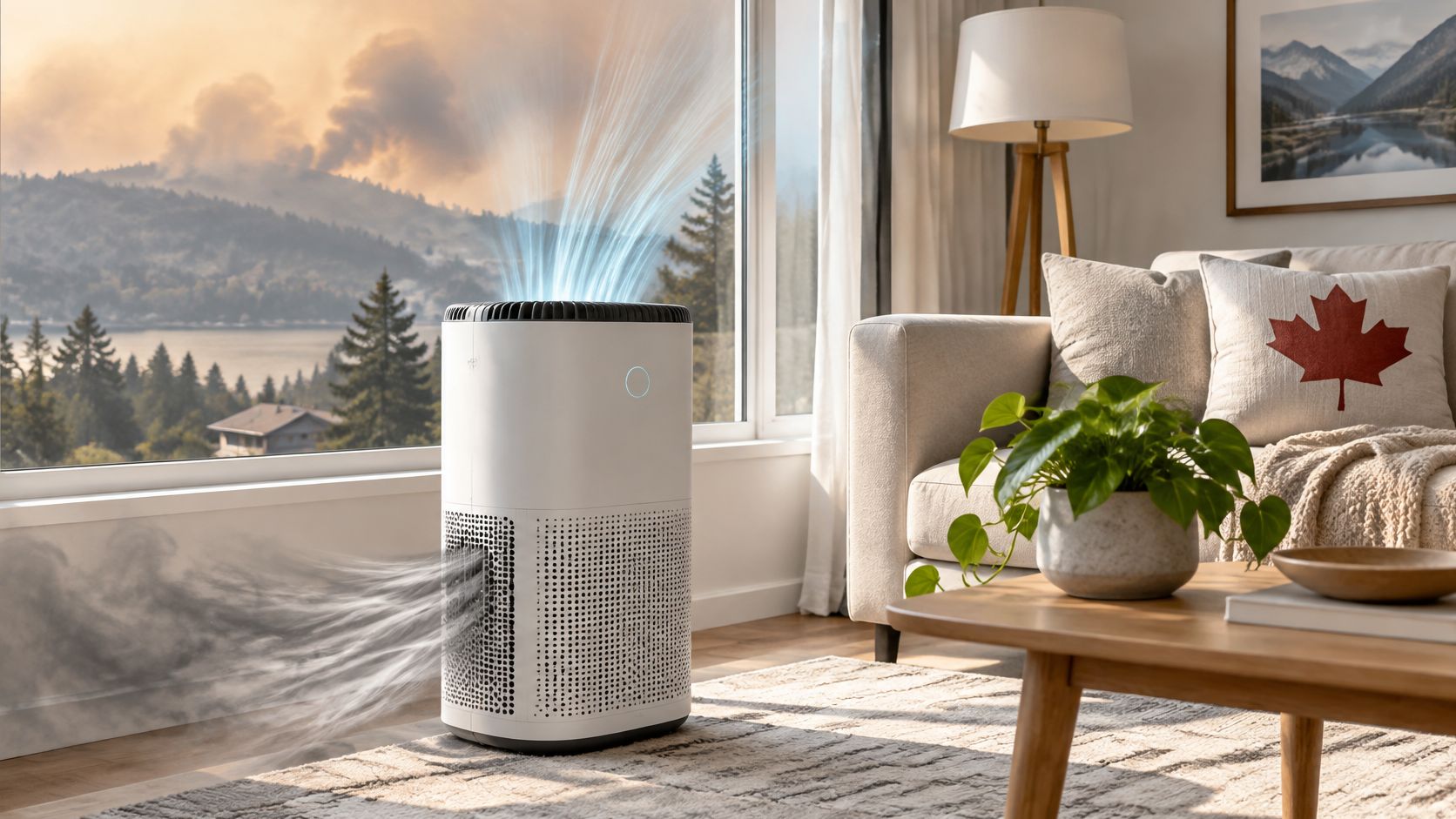
An air purifier is worth it when your home has a recurring fine-particle source or someone with asthma, allergies, or heart or lung disease, with wildfire studies finding an average indoor PM2.5 reduction of 57%. It's usually not worth buying when indoor air is already clean, because there's less pollution for it to remove.
The counterintuitive part is that a purifier can be a sensible seasonal purchase without being a necessary year-round appliance. For Canadian households, the strongest case isn't a vague promise of healthier air. It's a specific job: reducing smoke or other airborne particles in an occupied room, with enough capacity, tolerable noise and an affordable supply of replacement filters.
Table of Contents
- When an Air Purifier Is Worth It at Home
- How Purifiers Remove Particles and What They Miss
- Matching Purifier Size to Your Room in Canada
- What the Canadian Evidence Shows About Health
- Running a Purifier Through Wildfire Smoke and Heat
- Operating Costs and CAD Price Ranges
- Cheaper Fixes That Often Beat a Purifier
- Confirm the Decision Before You Buy
When an Air Purifier Is Worth It at Home
Buy for an identifiable exposure, not just because a room feels stale. Wildfire smoke, wood burning and frequent cooking create a clearer reason to consider filtration than the absence of an air-quality appliance. A sensitive household member strengthens the case, but doesn't make every purifier suitable.
Measurements in several Canadian cities found average indoor PM2.5 concentrations below 15 µg/m³ in homes without smokers and below 35 µg/m³ in homes with smokers, according to Health Canada's residential fine-particulate guidance. Those are measured averages, not a guarantee that every nonsmoking home has low exposure.
Verdict by household situation
| Household situation | Worth it? | Why | Expected payoff |
|---|---|---|---|
| Wildfire smoke nearby, windows must stay shut | Yes, strongly | A suitably sized HEPA unit targets smoke particles entering the room | Greater benefit during smoke episodes than on clean-air days |
| Smoker, wood stove or frequent indoor particle source | Yes, alongside source control | Filtration can reduce particles that remain airborne | Lower particle exposure, not elimination of smoke hazards |
| Asthma, allergies, or heart or lung disease | Often yes | Relevant when airborne particles contribute to exposure | Individual benefit isn't guaranteed; discuss the approach with a clinician |
| Pets that shed | Sometimes | Can capture airborne dander and hair that reach the filter | Targeted particle reduction, not removal of allergens from furnishings |
| Cooking-heavy kitchen or gas appliances | Partly | Captures particles but doesn't replace exhaust ventilation | Supplementary control while the range hood handles emissions at the source |
| Nonsmoking home with clean outdoor air | Usually no | There may be little particulate pollution to remove | Limited day-to-day gain |
| Extreme heat with no air conditioning | Cool the home first | Filtration doesn't solve dangerous indoor heat | Secondary protection within a safe cooling plan |
The distinction between removing a source and filtering its emissions matters. A purifier shouldn't become permission to smoke indoors or ignore a poorly operating wood-burning appliance. It treats some pollution after release, rather than preventing the release.
For allergies, identify what you're trying to control. Airborne material can reach a filter; material embedded in bedding, carpets or upholstery still requires cleaning and source management.
Before shopping, answer these questions:
- Source: What particle-producing activity or outdoor event affects the home?
- Sensitivity: Does someone need extra protection from those particles?
- Room: Can the purchase clean the space where that person spends time?
How Purifiers Remove Particles and What They Miss
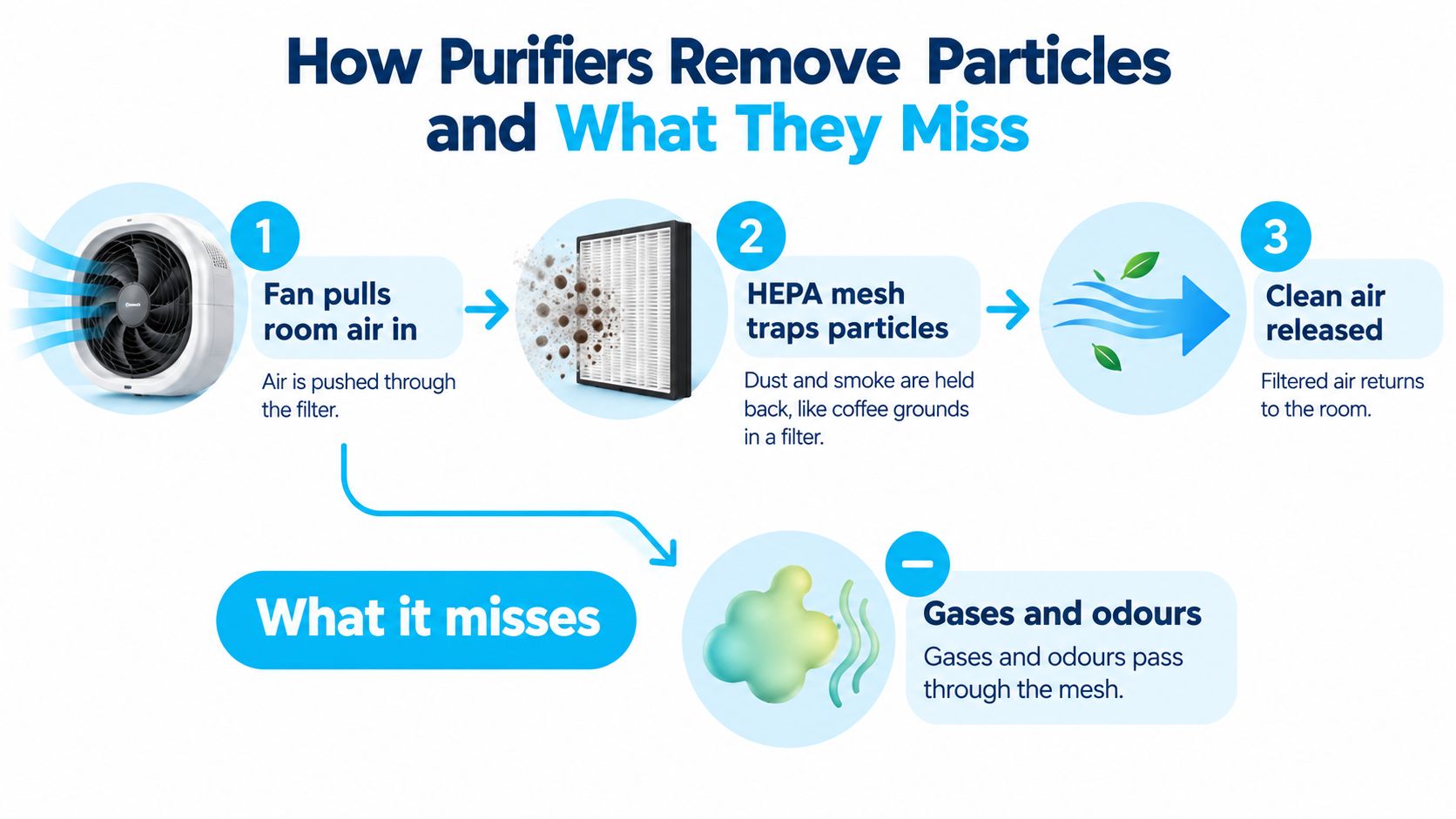
A portable purifier is a fan and a filter working together. Air passes through the device, particles collect on filter material, and filtered air returns to the room.
A coffee filter offers a useful analogy: it holds back grounds while letting the coffee and its aroma through. HEPA filtration is more complicated than a simple sieve, but the practical distinction holds. Capturing particles isn't the same as removing gases.
This diagram separates the airflow path from the pollutants that can pass through.
Airflow matters as much as filter material
Clean-air delivery rate, or CADR, estimates the volume of filtered, particle-free air delivered per unit of time; Health Canada's portable-purifier guidance explains why product performance and maintenance affect effectiveness. A highly efficient filter can't clean much room air if too little air moves through it.
HEPA targets airborne particles, including smoke aerosols. It doesn't reliably remove odours or gaseous pollutants, and it doesn't address high carbon dioxide levels. An appropriately sized activated-carbon stage can handle some gases and odours, but it shouldn't be relied on as general-purpose gas protection. The distinction matters most when evaluating air purifiers for VOCs.
Practical rule: Choose filtration for the pollutant you have, not for the longest feature list on the box.
Maintenance is part of performance
As filters collect material, resistance can increase and airflow can decline. The fan may still sound normal while the device delivers less clean air.
Check the following before choosing a model:
- Independent CADR: Prefer a reported clean-air delivery figure over an unexplained coverage claim.
- Pre-filter access: A cleanable pre-filter makes hair and lint easier to manage. Wash it only if the instructions permit.
- Clear airflow: Leave intake and exhaust openings unobstructed, rather than placing the unit behind furniture.
- Technology choice: Prefer straightforward mechanical filtration over a device whose main selling point is ozone generation.
The useful question isn't whether the machine makes air smell different. It's whether it removes the pollutant you need controlled.
Matching Purifier Size to Your Room in Canada
Measure the room before comparing machines. Record its floor area, ceiling height and any permanently open connection to adjoining spaces. A bedroom with a closed door is a different filtration job from a living room connected to a kitchen, hallway and stairwell.
There isn't a universal minimum smoke CADR established by the evidence reviewed here. Giving a floor-area shortcut without its ceiling-height and air-cleaning assumptions would imply more precision than that evidence supports.
A National Collaborating Centre for Environmental Health evidence review identifies CADR, room volume, placement, operating time, filter condition and outdoor smoke infiltration as factors affecting performance. That's why the appropriate target is the occupied room under realistic operating conditions, not the largest coverage number on the packaging.
Minimum smoke CADR by room size
These are example room areas for planning, not validated CADR thresholds. Confirm the smoke CADR against the manufacturer's documented room-sizing method and ceiling-height assumptions.
| Room size (m²) | Typical fit |
|---|---|
| 10 | Small bedroom or den; check the smoke CADR for an enclosed room |
| 15 | Standard bedroom or condo bedroom; compare performance at a sleep-tolerable speed |
| 20 | Small open-plan living area; include connected space in sizing |
| 30 | Large living room or studio; check the full room volume |
| 40 | Open-concept main floor; assess whether a larger unit or separate room units will provide useful coverage |
A room's label doesn't establish its filtration needs. A tall-ceilinged bedroom contains more air than a lower-ceilinged bedroom with the same floor area. An open doorway also changes what the purifier is effectively being asked to clean.
Read the rating at the speed you'll use
Compare smoke CADR figures in matching units. If one listing uses cubic feet per minute and another uses cubic metres per hour, convert them before deciding which machine delivers more clean air.
Then check which fan setting produced the advertised result. A maximum-speed rating won't describe overnight performance if you can only tolerate the lowest setting.
A room-sized purifier that stays running is a more credible purchase than a whole-home promise you can't verify.
For renters and condo owners, start with an enclosed bedroom or another regularly occupied room. Place the unit where air can circulate freely, observe its clearance instructions, and avoid assuming it will pull polluted air effectively through several doorways.
The buying decision becomes simpler once the boundary is clear: choose the room first, then the machine.
What the Canadian Evidence Shows About Health
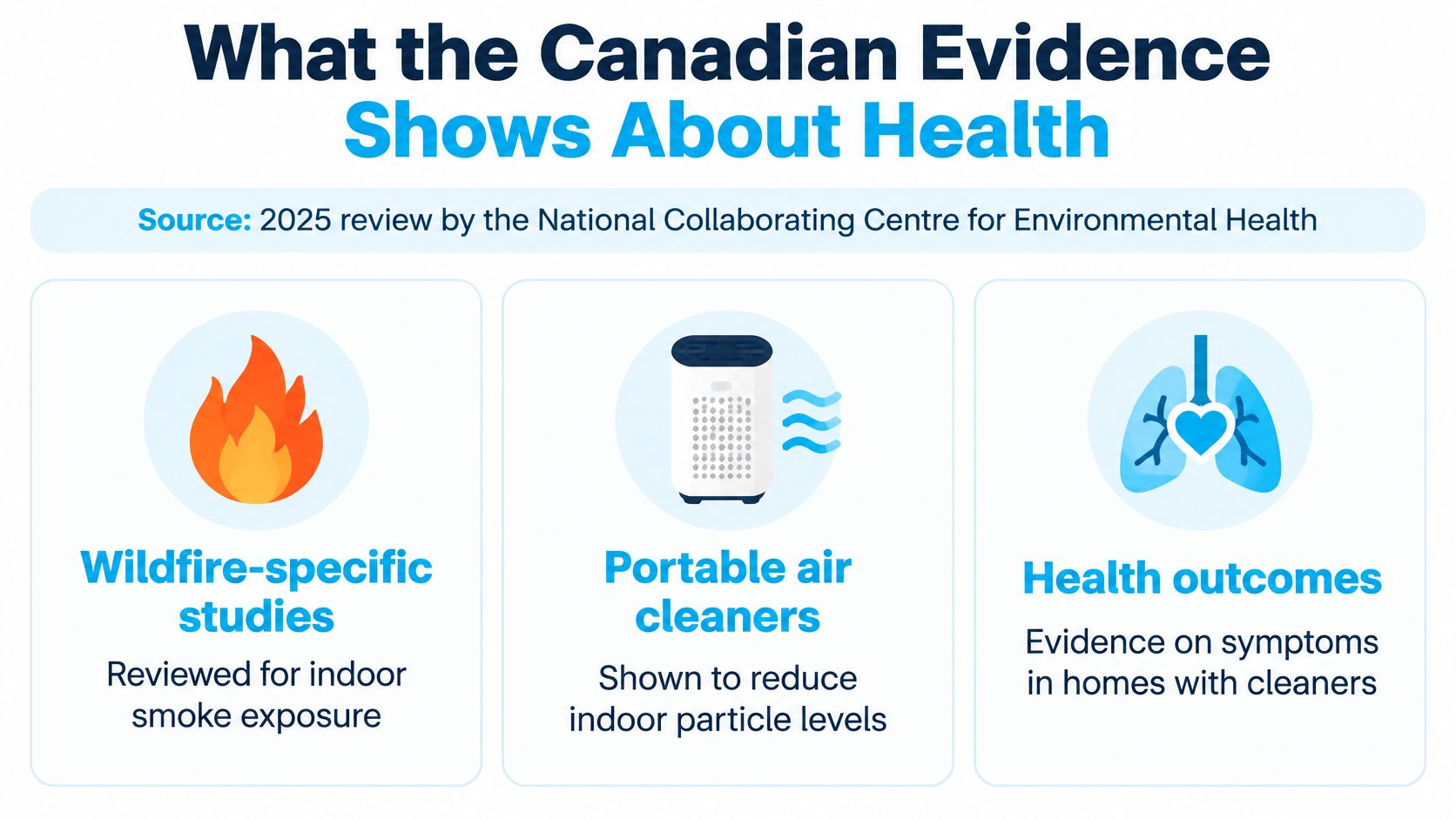
A Canadian evidence review from the National Collaborating Centre for Environmental Health and the National Collaborating Centre for Methods and Tools found that portable air cleaners reduced indoor PM2.5 by an average of 57% across 10 wildfire-specific studies, with results ranging from 5.3% to 99%. The average absolute reduction was 17 µg/m³ across eight studies.
That's meaningful evidence of lower particle exposure. It isn't equivalent to demonstrating a matching reduction in symptoms, hospital visits or long-term disease.
The evidence is best read by separating the measured exposure change from the health outcome a buyer hopes to achieve.
Measured purifier results by setting
The averages below describe groups of studies, not promised results for an individual home. The certainty assessment concerns the estimated benefit, not a certification of any particular appliance.
| Setting | Average result | Range across studies | Certainty rating |
|---|---|---|---|
| Wildfire-specific studies | Substantial average reduction in indoor particles | From small to very large reductions | Low certainty about the exact effect size |
| Combustion episodes | Lower indoor particle concentrations with filtration | Wide differences between settings | Low certainty about the exact effect size |
| Wood-smoke homes, Canadian studies | Lower particle concentrations after filtration | Uneven performance between homes | A separate rating isn't established here |
Exposure reduction isn't a health guarantee
The cautious conclusion is still useful: a correctly selected purifier can reduce the amount of fine particulate pollution in the room. The stronger claim that it will prevent illness, eliminate allergy symptoms or save healthcare costs isn't established by those particle measurements.
The wide spread in results also explains why a review average shouldn't become a product guarantee. A capable machine in an enclosed room faces a different task from an undersized machine in a leaky, open-plan home with ongoing pollution.
Low certainty doesn't mean the appliance has no effect. It means readers should be cautious about the precision of the expected benefit and about transferring a study average directly to their own home.
A person with asthma or heart or lung disease may reasonably place greater value on reducing exposure. That decision should complement their treatment and public-health advice, rather than replace either.
The most defensible interpretation is therefore narrower than many advertisements suggest: purifiers are risk-reduction tools, particularly during smoke events. They aren't proof that a room is safe, and the absence of visible haze or smell doesn't establish that all pollutants have been removed.
Running a Purifier Through Wildfire Smoke and Heat
A purifier isn't an alternative to cooling. During a smoke event, the practical goal is a room that remains both cooler and lower in particles, not a tightly sealed space that becomes dangerously hot.
A workable setup also needs enough clearance for the device to move room air.
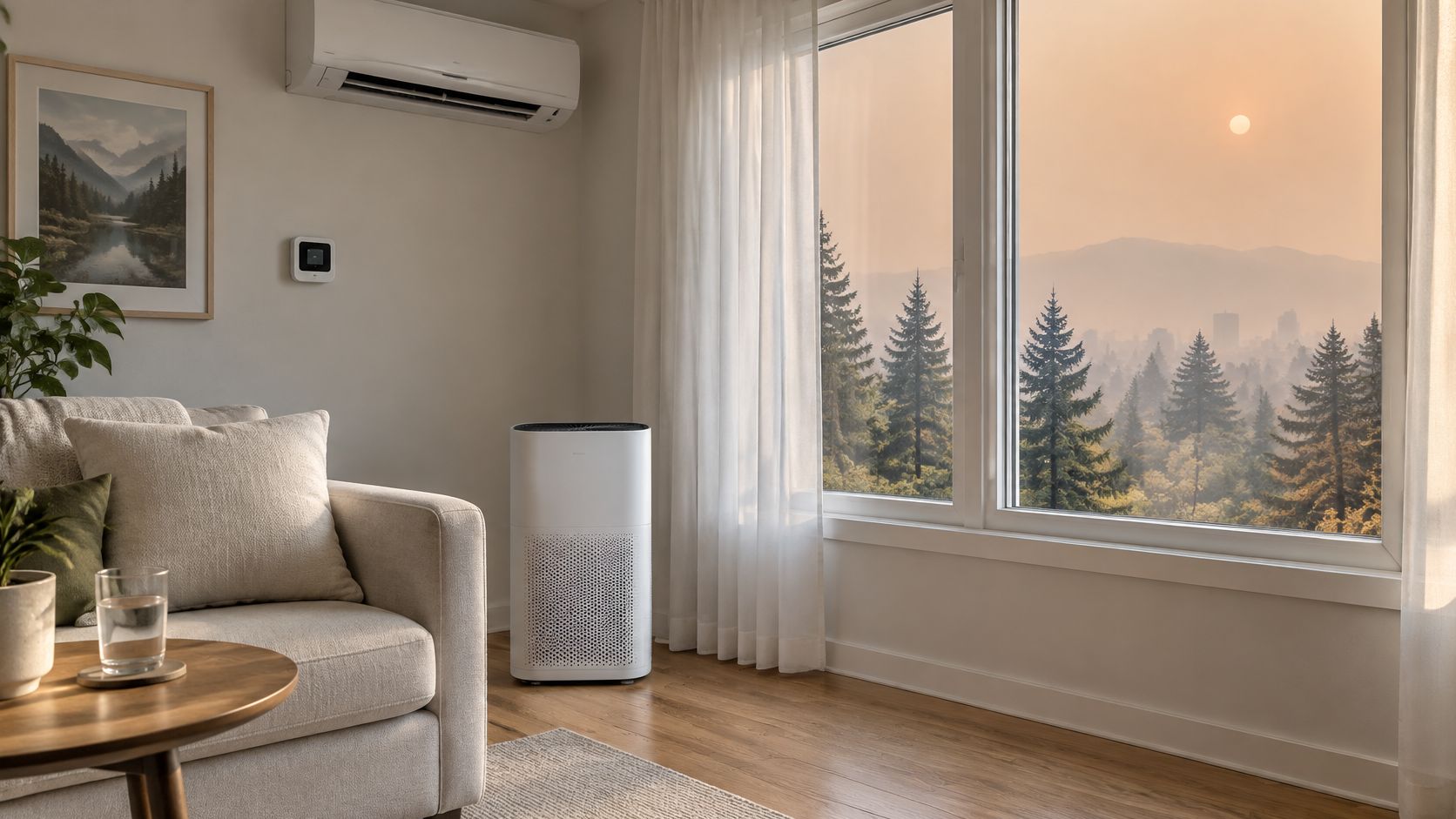
Health Canada's cleaner-air-space guidance recommends reducing smoke entry, using the highest-quality HVAC filter the system can accommodate and using a suitable portable cleaner, while prioritising cooling during extreme heat. That heat exception should determine the household plan before anyone closes the windows.
A smoke-day routine
- Check local conditions. Consult the Air Quality Health Index, smoke forecasts and local public-health notices before choosing outdoor ventilation.
- Limit smoke entry. Close windows and doors when outdoor smoke is affecting the home. Adjust outdoor-air intake only where the equipment and building instructions allow it.
- Check central filtration. Use the highest-quality filter your furnace or heat pump can accommodate. Don't assume a denser filter is compatible with every system.
- Prepare an occupied clean-air room. Choose a space that can remain comfortable, with a door you can close and a properly matched purifier.
- Run at a useful, tolerable speed. Keep the machine operating during exposure rather than waiting for the room to smell smoky.
- Act on heat. If the home can't stay safely cool, follow local advice about a cooled cleaner-air location rather than relying on filtration alone.
- Maintain the equipment. Check filters and airflow, and replace filters according to the device's instructions and actual condition.
Plan for the season, not just the appliance
Winter wood burning can make particle control relevant even without a wildfire. Spring airborne allergens create a different task, while summer can combine smoke with an urgent need for cooling.
In autumn, check the furnace filter and the purifier's replacement-filter supply before either becomes urgent. A purifier won't correct winter dryness, just as it won't cool a summer bedroom.
This video offers an additional visual reference for thinking about household air filtration.
Renters should ask the landlord or building manager before changing shared ventilation settings or modifying HVAC equipment. In a condo, controls inside the suite may not govern the building's outdoor-air supply.
Operating Costs and CAD Price Ranges
The purchase price is only the opening expense. Compare the machine, replacement filters and electricity together, using Canadian-dollar quotes and the operating speed you expect to use. Checkout prices vary between retailers and electricity rates vary by province, so the honest budget is the one built from your shortlist and your own bill.
Calculate electricity from your own inputs
Use this formula:
Annual electricity cost = power draw in kilowatts × operating hours per year × electricity rate in CAD per kilowatt-hour.
If the specification lists watts, convert them to kilowatts first. Use the energy rate on your bill, and distinguish consumption charges from fixed account charges you'd pay regardless.
The power figure needs context. A maximum rated draw may not represent the fan setting you'll run overnight, while a lowest-speed figure may describe less cleaning capacity than the room needs.
Estimated annual running cost by purifier tier
Electricity is often the smaller line. Take a purifier drawing 50 W at its working speed, run 8 hours a day at an illustrative rate of $0.15 per kWh: 0.05 kW × roughly 2,920 hours × $0.15 works out to about $22 per year. Substitute the wattage at your intended speed and the rate on your bill to get your own figure.
| Tier (typical room and CADR) | Power draw | Electricity per year | Filter cost per year |
|---|---|---|---|
| Small bedroom, room-matched smoke CADR | Worked example: 50 W (0.05 kW) at the intended speed | 0.05 kW × 8 h/day × $0.15/kWh ≈ $22 | Price of the full replacement set × expected replacements that year |
| Medium living area, higher room-matched smoke CADR | Take the wattage at the speed the larger room requires | Same formula, substituting that unit's draw and hours | Price particle and carbon filters separately where they are replaced separately |
A unit that runs only through a multi-week smoke season logs far fewer hours than the example assumes, which shifts the budget question toward filter price and replacement timing. For a larger open-plan space, compare a larger machine against separate units serving enclosed occupied rooms. Include every unit's filters and electricity rather than comparing only the combined purchase price.
Compare ownership costs on equal terms
A useful comparison covers the same ownership period and operating schedule for each candidate. Add purchase price, expected electricity and the replacement filters needed during that period.
Check the following before accepting an apparently inexpensive unit:
- Canadian filter availability: Search the exact filter model, not merely the purifier's brand.
- Complete replacement set: Establish whether the quoted price includes every replaceable filtration stage.
- Shipping and tax: Compare checkout totals rather than headline prices.
- Maintenance assumptions: Check whether replacement timing is based on elapsed time, operating hours or a condition indicator.
Don't assume filters always cost more than electricity, or that a higher purchase price buys lower ownership costs. Either can be true for a particular model, but it requires the actual figures.
Budget check: If replacement filters would be an unwelcome expense, price them before buying the appliance that requires them.
A cheaper machine that you can maintain may be a better purchase than a premium one whose filters you postpone replacing.
Cheaper Fixes That Often Beat a Purifier
Stop preventable emissions before paying to filter them. Moving smoking outdoors, reducing candles and incense, and using an outdoor-exhausting range hood during cooking address pollution closer to its source.
For a wood-burning home, correct appliance operation and maintenance deserve attention before treating the purifier as the main defence. Where central filtration is available, check system compatibility before buying a more restrictive filter.
Make the alternative match the problem
- Outdoor smoke: Manage window opening around outdoor conditions rather than ventilating indiscriminately.
- Settled dust and pet material: Clean floors, upholstery and bedding instead of expecting airborne filtration to reach them.
- Existing central filtration: Establish what the system already provides before buying duplicate equipment.
A broader indoor-air-quality improvement plan can help separate a particle problem from a ventilation or moisture problem. Buying the wrong category of device won't resolve the latter.
At Celmin, we name product compromises, whether that's a noisy robot vacuum or an air fryer occupying valuable counter space. Apply the same scrutiny here: a purifier needs floor space, makes fan noise and commits you to maintenance.
If the household has no recurring particle concern, start with those source-control and cleaning measures. Keep the purifier budget available for a clearly defined need.
Confirm the Decision Before You Buy
Make the final decision against a specific room and pollutant. A general desire for fresher air isn't enough to identify the right machine.
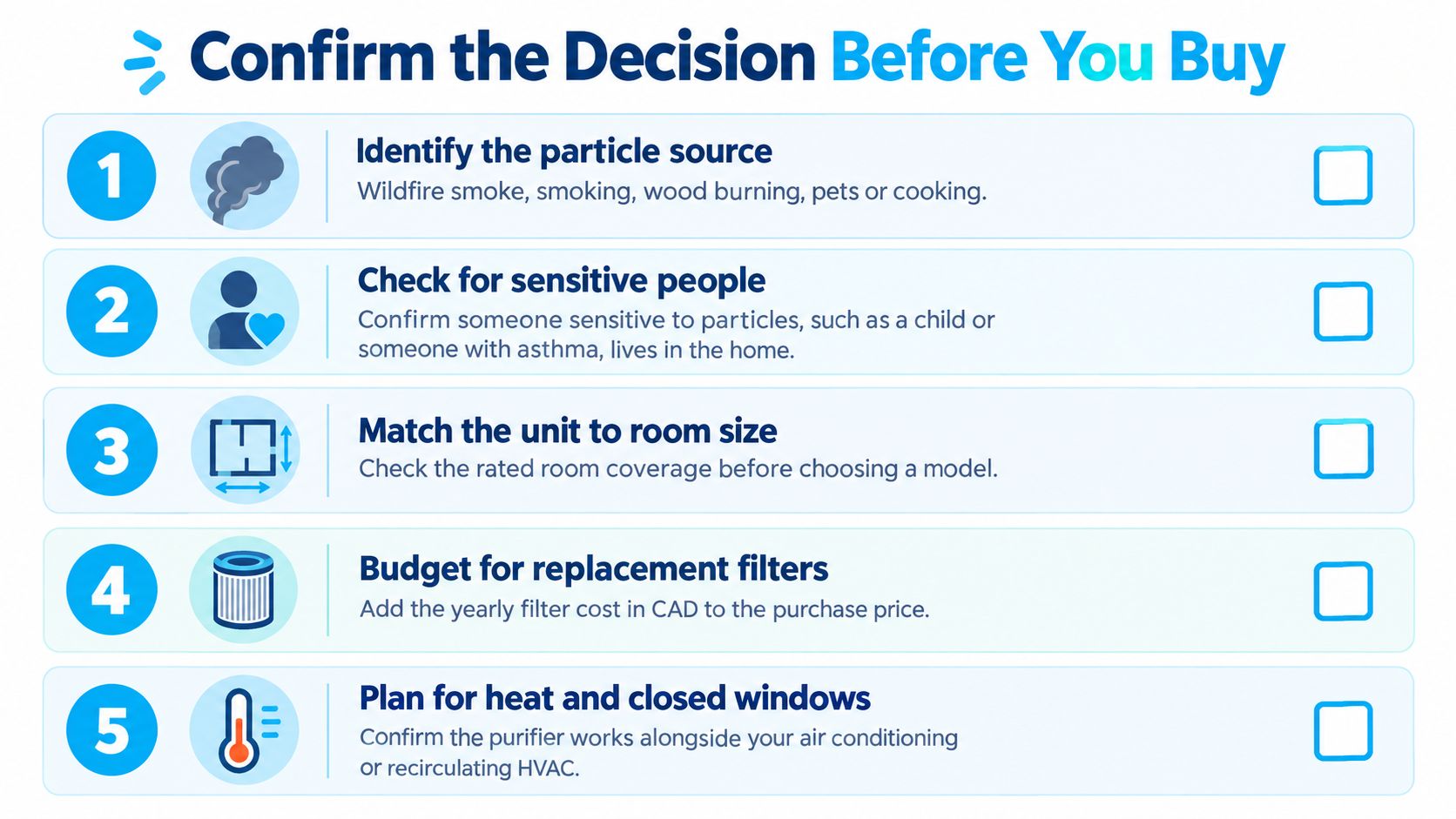
Use this checklist to turn that concern into a purchase decision.
Check the fit before checkout
- Identify the pollutant: Name the recurring source and whether it produces particles, gases or both.
- Consider the person: Establish who needs protection and discuss condition-specific concerns with a clinician.
- Measure the space: Record area, ceiling height and connected rooms.
- Verify useful performance: Check independently reported smoke CADR and noise at the intended operating speed.
- Price ownership: Confirm Canadian replacement-filter availability, electricity inputs, warranty and return conditions.
A home air-quality monitor may help clarify patterns, provided its sensor measures the pollutant you're investigating. Don't treat a general air-quality score as a diagnosis or a guarantee of safety.
If the need is clear, compare a short list using the same room, fan-speed and ownership-cost assumptions. If it isn't, address the likely source first and reconsider when a real exposure makes the benefit easier to judge.
Celmin publishes expert reviews and practical buying guides for Canadian households, with attention to the compromises that matter after purchase. Visit Celmin to compare air-purifier options by room fit, noise, maintenance and local availability before committing to a machine and its replacement filters.
Sign up or sign in to join the conversation.