
If you're buying a premium countertop blender in Canada in 2026, two very different ideas of "good enough" show up fast: the Vitamix A3500 Ascent Series Smart Blender and the Oster Pro 1200 Smoothie Blender. One is the prestige-machine answer people talk about like a kitchen heirloom. The...
If you're buying a premium countertop blender in Canada in 2026, two very different ideas of "good enough" show up fast: the Vitamix A3500 Ascent Series Smart Blender and the Oster Pro 1200 Smoothie Blender. One is the prestige-machine answer people talk about like a kitchen heirloom. The other is the much cheaper, widely available blender that covers the jobs most people actually do: smoothies, frozen drinks, salsa, and the occasional soup experiment. For a lot of households, this is not really a blender comparison so much as a value judgement.
This article isn't a hands-on review. It's an editorial comparison of what these two blenders are built to do, where the price difference goes, which features matter in a real kitchen, and whether the Vitamix premium makes any sense if your blender's main duty is a once-a-day smoothie. By the end, you should know whether to spend big, spend modestly, or stop romanticizing high-end blenders entirely.
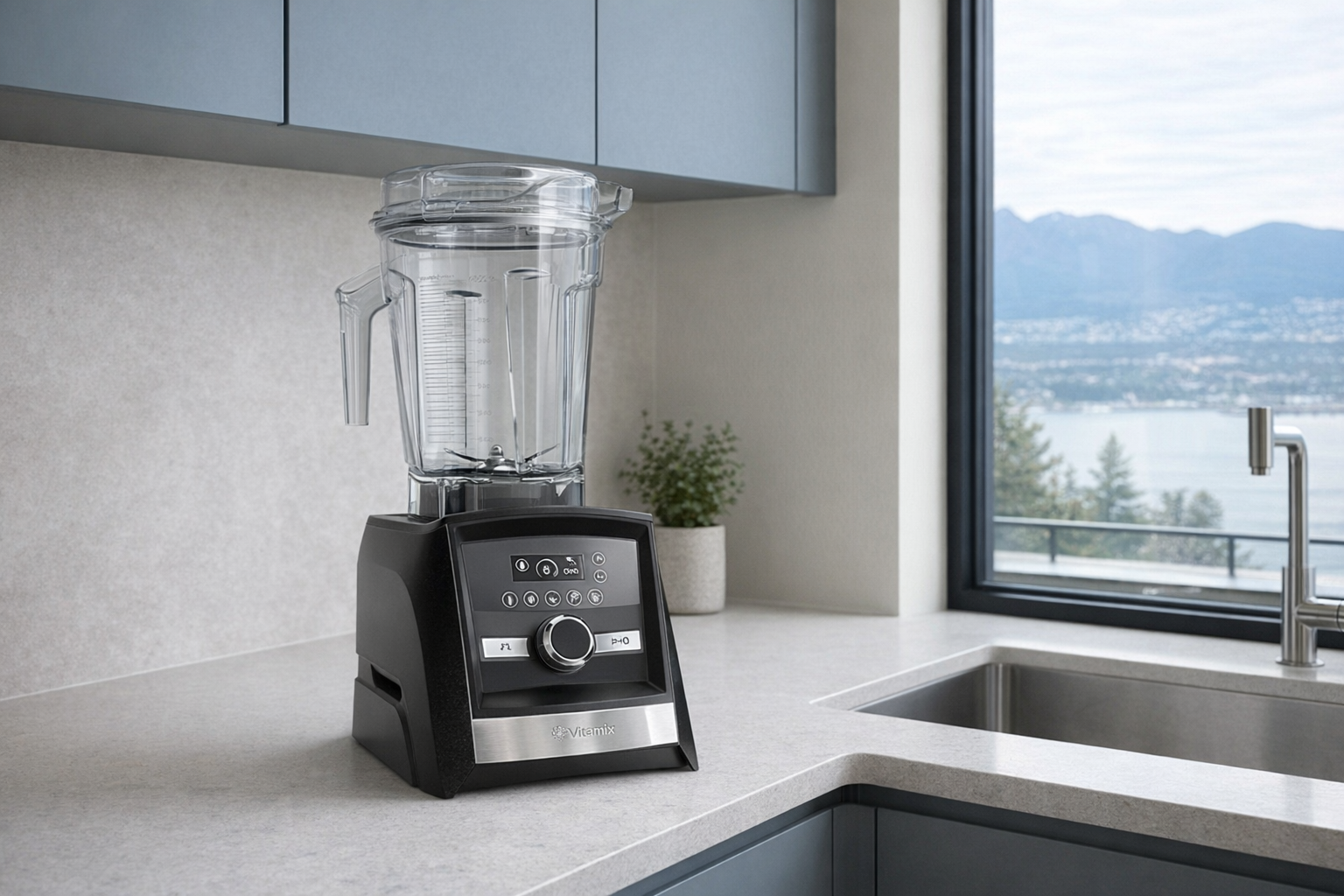
At a glance
| Vitamix A3500 | Oster Pro 1200 | |
|---|---|---|
| Price (CAD) | ~$230 | ~$180 |
| Rating signal | 4.6/5 on source listing | 4.4/5 on source listing |
| Made by | Vitamix | Oster |
| Motor power | 1440W | 1200W |
| Programs | 5 presets | 3 presets |
| Jar / container | Low-profile 64 oz container | 6-cup Boroclass glass jar + 24 oz smoothie cup |
| Smart features | Wireless container sensing, auto-adjusted settings | None beyond preset programs |
| Manual control | Variable speed control + pulse | 7 speeds |
| Cleaning mode | Dedicated self-cleaning program | Dishwasher-safe jar |
| Best for | Buyers who want a more capable all-round blender for soups, thicker blends, and long-term ownership | Budget-conscious buyers mostly making smoothies, milkshakes, salsa, and basic frozen drinks |
| Skip if | You just want quick daily smoothies and don't care about premium fit, smart sensing, or long-term ambition | You want the "buy once, keep for a decade" premium path or plan to push into harder jobs often |
Pro tip: Blender regret usually has less to do with wattage than with what you actually blend. If your realistic use is bananas, berries, protein powder, and milk once each morning, don't buy a high-end machine out of fantasy. If you want nut butter, thicker blends, hot soup-style blending, and frequent frozen work, cheaping out gets old faster than people admit.
What each one actually is
The Vitamix A3500 Ascent Series Smart Blender is Vitamix's touchscreen, preset-heavy, premium-positioned blender with a 1440W motor, five program settings, a 64 oz low-profile container, and built-in wireless connectivity that reads container size and adjusts settings automatically. The pitch is not just "it blends well." It's that this is a more advanced, more polished countertop appliance with both manual control and guided automation. It is plainly trying to justify itself as more than a smoothie machine.
The Oster Pro 1200 Smoothie Blender is a much more affordable 1200W countertop blender with 7 speeds, 3 preset settings, a 6-cup Boroclass glass jar, and a 24 oz smoothie cup included in the box. Its marketing angle is practical rather than aspirational: enough power for smoothies and ice crushing, dual-direction blades for better circulation, and a bundle that makes immediate sense for everyday kitchen use.
The fundamental difference: the Oster is a competent everyday blender package, while the Vitamix is a more ambitious machine that asks whether you want blender ownership to be a long-term appliance decision rather than a cheap convenience purchase.
What each blender actually looks like on paper
Vitamix A3500 — the premium "buy once" machine
The Vitamix A3500 Ascent Series Smart Blender is the one people buy when they are tired of replacing mediocre blenders. According to the listing, it gives you five program settings — Smoothies, Hot Soups, Dips & Spreads, Frozen Desserts, and Self-Cleaning — plus variable speed control, pulse, a programmable timer, and touchscreen controls. It also includes a low-profile 64 oz container, which matters because that is a family-size vessel, not a single-serve cup pretending to be a blender ecosystem.
The most distinctive feature here is the wireless container sensing. The machine reportedly reads container size and adjusts settings automatically. That's a very Vitamix kind of feature: slightly overengineered, slightly indulgent, but also more honest than fake "AI blending" language you see elsewhere. It is at least tied to something concrete — container recognition and program adjustment — rather than empty smart-home buzzwords.
The larger point is that the A3500 is not priced or positioned for occasional milkshakes. It's for buyers who want a machine that can do thin smoothies, thicker blends, spreads, frozen desserts, and soup-style blending without feeling like it's on the edge of its abilities every time. That doesn't mean everyone needs one. It means the machine has a broader job description than most cheaper blenders.
- Full explainer: Vitamix A3500 Ascent Series Smart Blender on Celmin · Directory: product page
Oster Pro 1200 — the sensible everyday value pick
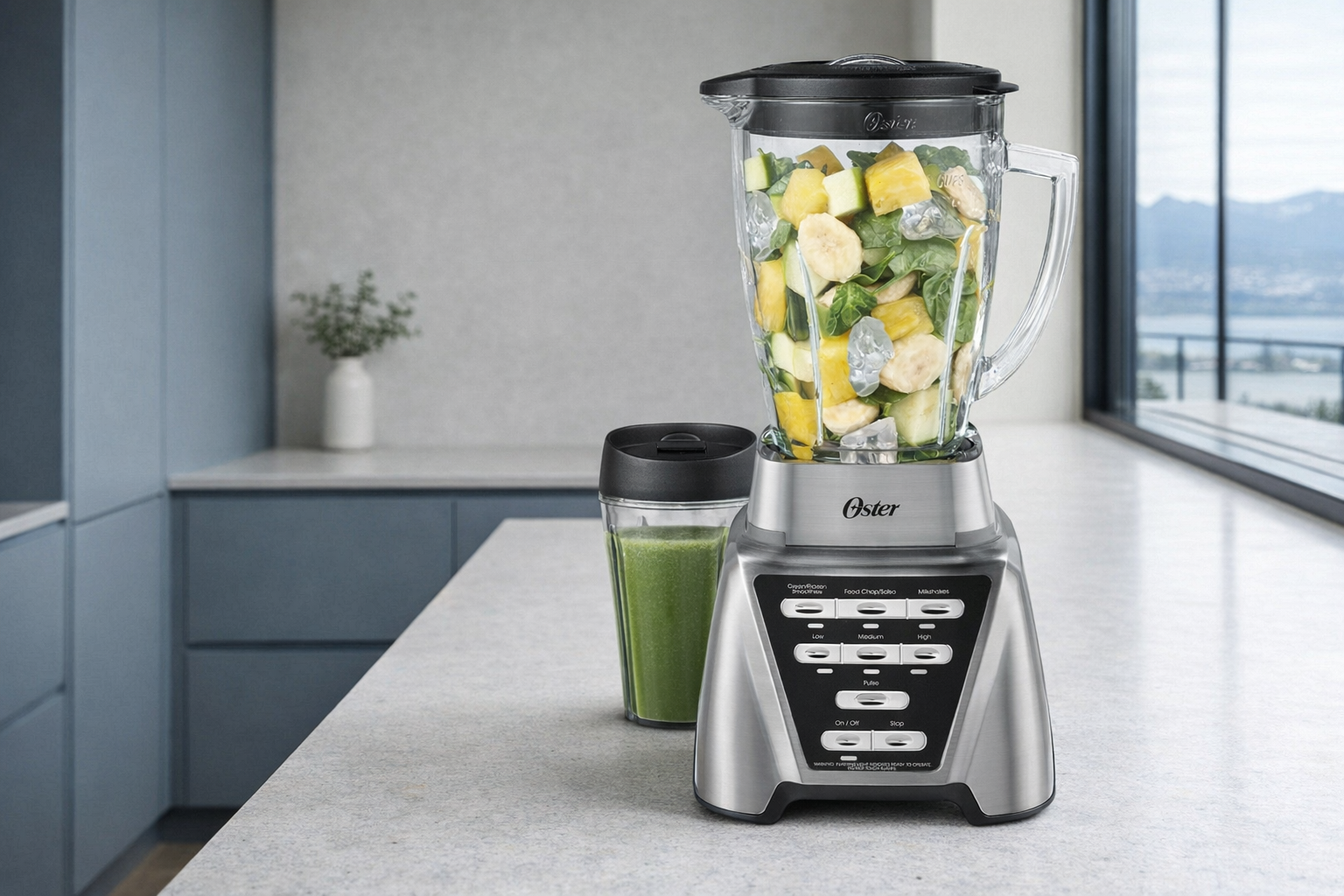
The Oster Pro 1200 Smoothie Blender is what a lot more people should probably buy before convincing themselves they need a prestige blender. It has a 1200W motor, 900W ice crushing power according to the listing, 7 speeds, 3 pre-programmed settings for smoothies, salsas, and milkshakes, and dual direction blade technology that spins forward and reverse for better blending movement. It also includes two useful containers out of the box: a 6-cup dishwasher-safe Boroclass glass jar and a 24 oz smoothie to-go cup.
That package is practical in a way some premium blenders aren't. The included smoothie cup means a single-user breakfast routine makes immediate sense. The glass jar will appeal to people who simply dislike large plastic blender pitchers. And the 10-year Duralast all-metal drive warranty on the drive system is the kind of detail that suggests Oster knows durability concerns come up quickly once you drop below top-tier blender pricing.
The honest read, though, is that this is still a mid-market blender, not a disguised Vitamix killer. Its feature set is strong for the money, and its included accessories are arguably better aligned to everyday use than some expensive machines. But "better value" and "same class" are not the same thing. The Oster is compelling because it knows its lane.
- Full explainer: Oster Pro 1200 Smoothie Blender on Celmin · Directory: product page
The seven battlegrounds
1. Raw power numbers — Vitamix wins, but the label is not the whole story
On paper, this starts with 1440W vs 1200W. That is a real gap, but not a dramatic one if all you do is soft-fruit smoothies. People tend to read motor wattage like TV brightness specs: higher must always mean meaningfully better. In blenders, that's only partly true.
The editorial brief here matters: torque vs RPM is a more useful frame than wattage alone. The Vitamix Ascent motor is described as having better low-RPM torque, and that's the kind of advantage that matters when a blend is thick, sticky, or resistant. A machine with better torque can keep moving ingredients instead of just making noise and creating an air pocket. That's much more relevant to nut butters, dense frozen mixtures, and thick dips than to oat milk and blueberries.
So yes, the Vitamix wins the motor conversation. But if you only make ordinary smoothies, the Oster's 1200W is already enough to clear the bar. The premium only starts earning its keep once your ingredients get harder, denser, or more frequent.
2. Presets and smart features — Vitamix is more advanced, Oster is more honest
The Vitamix A3500 offers five programs: Smoothies, Hot Soups, Dips & Spreads, Frozen Desserts, and Self-Cleaning. The Oster Pro 1200 offers three: smoothies, salsas, and milkshakes.
That's the simple version. The more interesting difference is the wireless container sensing on the Vitamix. According to the listing, it detects container size and adjusts settings automatically. That is a meaningful smart feature, not a sticker on the box. It improves how the machine behaves based on what is attached. For a premium blender, that's the kind of extra that makes sense.
The Oster, by contrast, is not pretending to be smart in any deeper way. It has presets, speeds, and blade-direction changes. That's fine. In some ways it's refreshing. A cheaper blender shouldn't need an identity crisis.
Winner: Vitamix, clearly. But with one caveat: if you never use presets and just slam every blender to high manually, a lot of this value disappears. Plenty of people do exactly that.
3. Jar and container design — this is closer than it looks
The Vitamix includes a 64 oz low-profile container. The Oster includes a 6-cup glass jar and a 24 oz smoothie cup. This is not just a size comparison; it's a usage philosophy comparison.
The Vitamix setup is better if you're blending for multiple people, making larger batches, or treating the blender like a serious prep tool. The low-profile design matters because giant tall containers can be annoying under cabinets and awkward in real kitchens. A 64 oz container says "family batch" and "bigger recipes" without becoming absurd.
The Oster counters with something many buyers genuinely prefer: a Boroclass glass jar and a separate to-go cup. That's a very practical bundle. If you mostly make one smoothie for yourself, the included 24 oz cup is a more useful accessory than a prestige sensor system. And some people simply trust glass more for odour resistance and long-term cleanliness.
This one is basically a split decision. Vitamix has the better premium container system, but Oster has the more everyday-friendly accessory bundle for single-serve habits. The more realistic your kitchen routine, the better the Oster's package looks.
4. Smoothie quality, frozen blends, soup, and nut butter — this is where the price gap starts making sense
If the question is "which one is more likely to produce a smoother result with difficult ingredients," the answer is Vitamix. Not because of one magic spec, but because the whole machine appears designed around broader blending ambition: stronger motor output, better torque behaviour, a large 64 oz container, dedicated programs for Hot Soups, Dips & Spreads, and Frozen Desserts, plus manual speed control and pulse.
The Oster absolutely covers common smoothie use. Its 3.5 inch blade system, dual direction blade technology, and 900W ice crushing power suggest it should handle ice, fruit, and milkshake-style blending reasonably well. For normal households, that's enough most of the time.
But "most of the time" is not the same as "without compromise." Thick nut butter is where many cheaper blenders start feeling like they were not built for your ambition. Soup-style hot blending also belongs more naturally in the Vitamix's design language because it has an explicit Hot Soups program. That does not automatically mean everyone should make soup in a blender. It means the product is openly designed for that use.
So if you want the machine to be a daily kitchen workhorse across multiple jobs, Vitamix wins easily. If you want a smoothie and maybe salsa on weekends, the Oster is probably enough. That's the whole article in miniature.
5. Noise and refinement — nobody should expect quiet, but Vitamix is the more premium machine
Neither of these should be bought by someone chasing silence. A high-speed blender is a loud appliance category. There is no honest way around that.
What can be said, based on positioning and feature set, is that the Vitamix A3500 is more likely to feel like a more refined machine in operation. Premium blenders tend to justify some of their price in control, consistency, and confidence under load rather than in lower decibels. The Oster may still perform well, but cheaper blenders often sound more strained once you push them beyond simple liquid-heavy blends.
That's the important distinction: not quiet vs loud, but composed vs stressed. A blender making a thick frozen mixture or spread should sound like it was designed for the task, not like it's negotiating with it. The Vitamix is the safer bet there.
Winner: Vitamix, cautiously. Just don't turn that into "quiet blender." That category mostly lives in marketing copy.
6. Cleaning and day-to-day convenience — tie, with different strengths
The Vitamix has a dedicated Self-Cleaning program and a touchscreen that is easy to wipe down. That's very clean premium-appliance logic: fewer physical crevices, a built-in program, less fiddling.
The Oster answers with a dishwasher-safe glass jar. For plenty of kitchens, that is actually the more persuasive convenience story. Dishwasher-safe is not glamorous, but it is concrete. The included 24 oz smoothie cup also cuts down on extra dish load if you're making a quick personal drink.
This is a tie, but not in a lazy way. Vitamix offers the more polished cleaning experience, while Oster offers the more straightforward one. If you value appliance refinement, the Vitamix approach is nicer. If you value "can I just toss this in the dishwasher and move on," the Oster has a strong case.
7. Warranty, longevity, and five-year value — Vitamix is the better long-term bet, Oster is the better reality check
The editorial brief calls out Vitamix 10-year vs Oster 3-year warranty, and that is the right lens for this section: the expensive machine is trying to justify itself over time. When a blender starts to approach luxury-appliance pricing, the warranty stops being a footnote and becomes part of the pitch. A long warranty says the company expects prolonged ownership, not disposable enthusiasm.
The Oster listing specifies a 10-year Duralast all-metal drive warranty, which is useful and more reassuring than many budget appliances offer. But that is not the same as a whole-machine long-term ownership proposition. It is a narrower durability promise, and buyers should read it that way.
The blunt version: if you replace a mediocre blender every few years, the Vitamix argument gets stronger. If you buy one blender, use it lightly, and mostly want protein shakes, the Oster remains the better value story. The Vitamix is better positioned for long-term ownership. The Oster is better positioned for not overspending on a kitchen habit that may stay simple forever.
The three questions that actually decide this
- Are you mostly making one daily smoothie, milkshake, or basic frozen drink and trying not to overspend? Yes → Oster Pro 1200 Smoothie Blender.
- Do you want your blender to handle thicker jobs like nut butter, dips, hot soup-style blending, and larger batches with less compromise? Yes → Vitamix A3500 Ascent Series Smart Blender.
- Do you buy appliances as short-term tools or long-term fixtures? Short-term / practical → Oster. Long-term / buy-once mentality → Vitamix.
The verdict, by household
| If this sounds like you... | ...buy this |
|---|---|
| Single person making a morning smoothie, wants the best value | Oster Pro 1200 Smoothie Blender |
| Family kitchen doing larger batches and more varied recipes | Vitamix A3500 Ascent Series Smart Blender |
| You want nut butter, thicker dips, and regular frozen dessert use | Vitamix |
| You mostly want smoothies, salsa, and occasional milkshakes | Oster |
| You prefer a glass jar and like the included to-go cup idea | Oster |
| You want the more premium control system and smart container sensing | Vitamix |
| You are price-sensitive but still want a respectable blender | Oster |
| You are tired of buying "pretty good" appliances twice | Vitamix |
Got Questions About Vitamix A3500 vs Oster Pro 1200? Let's Clear Things Up.
Is this a hands-on review?
No. This is an editorial comparison based on the listed specs, feature sets, product positioning, and realistic use cases implied by those features. It is meant to help you decide which blender fits your kitchen habits, not to simulate side-by-side lab testing.
Is the Vitamix A3500 really worth it over the Oster for most people?
For most people, honestly, probably not. That's the unfashionable answer. If your blender life is one smoothie a day, the Oster's 1200W motor, presets, glass jar, and included 24 oz cup are already enough. The Vitamix starts making sense when your blending gets thicker, more frequent, or more varied. Premium blenders are often justified by edge cases that become regular habits.
Is this actually a $1,000 blender vs a $180 blender comparison?
Not by the supplied pricing here. Based on the dossier, the Vitamix A3500 is listed at roughly $230 CAD and the Oster Pro 1200 at roughly $180 CAD. The title reflects the way this category is often discussed — with Vitamix treated as the ultra-premium benchmark — but buyers should judge the current listing price, not mythology. Always check the live retailer page because blender pricing moves around more than people expect.
Is the Oster Pro 1200 the same class of machine as a Vitamix?
No. It competes on usefulness and value, not on being a one-to-one equivalent. The Oster has a strong everyday package, especially with the glass jar and smoothie cup, but the Vitamix is built and marketed as a broader-capability machine. "Good enough for my kitchen" is a different question from "same class."
Which one is better for smoothies?
If your smoothie is liquid-heavy and ordinary — fruit, yogurt, milk, protein powder — either should do the job. If you care about the smoothest texture possible, use tougher ingredients, or want more consistency with thicker recipes, Vitamix is the safer pick. The key point is that many smoothie drinkers pay for premium capacity they never actually use.
What about soup, nut butter, and frozen desserts?
This is where the Vitamix has the stronger case. It explicitly includes programs for Hot Soups, Dips & Spreads, and Frozen Desserts, plus the manual controls to fine-tune texture. The Oster is not useless here, but it is more naturally aimed at smoothies, salsas, and milkshakes. If you want the blender to be more than a beverage tool, the Vitamix is the better fit.
What does installation or setup cost?
Nothing in the normal sense. These are countertop blenders, so there is no install cost beyond the purchase itself. The real "setup" question is counter space. A 64 oz blender container is a commitment. Make sure you actually want a full-size appliance living on your counter before buying one on reputation alone.
Where should I buy to verify current pricing and availability?
Check the live retailer listings because prices change and bundles can shift:
- Vitamix A3500 Ascent Series Smart Blender retailer listing
- Oster Pro 1200 Smoothie Blender retailer listing
You should also read Celmin's product pages for the latest product context:
- Vitamix A3500 Ascent Series Smart Blender on Celmin · Directory: product page
- Oster Pro 1200 Smoothie Blender on Celmin · Directory: product page
Which would Celmin pick?
For the average household making daily smoothies and trying to stay rational: Oster Pro 1200 Smoothie Blender. It is the more sensible buy for how most people actually use a blender. For the buyer who genuinely wants thicker blends, soup, frozen desserts, and a more premium long-term machine: Vitamix A3500 Ascent Series Smart Blender. The honest catch is that Vitamix's audience is narrower than the mythology suggests, while Oster's audience is wider than budget shoppers sometimes assume.
If you're building a smarter home in Canada and want honest comparisons of gadgets worth considering — plus the ones worth skipping — Celmin covers the full catalog without the marketing theater. More comparisons, reviews, and buyer guides at https://celmin.ca.
Discussion
Sign up or sign in to join the conversation.