
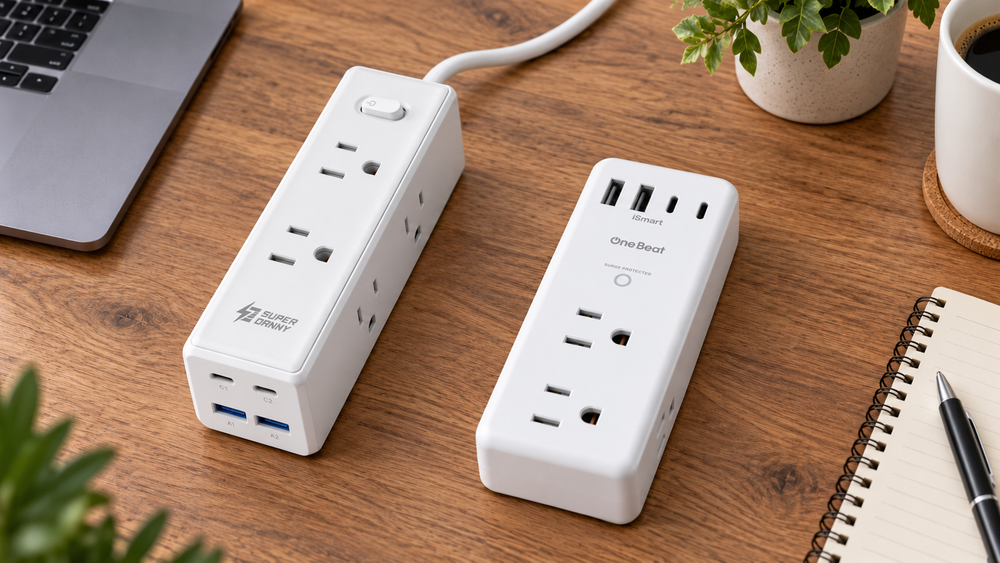
SUPERDANNY moves outlets along a 10-foot cord; One Beat expands the wall socket. Compare placement, load ratings and shared USB output.
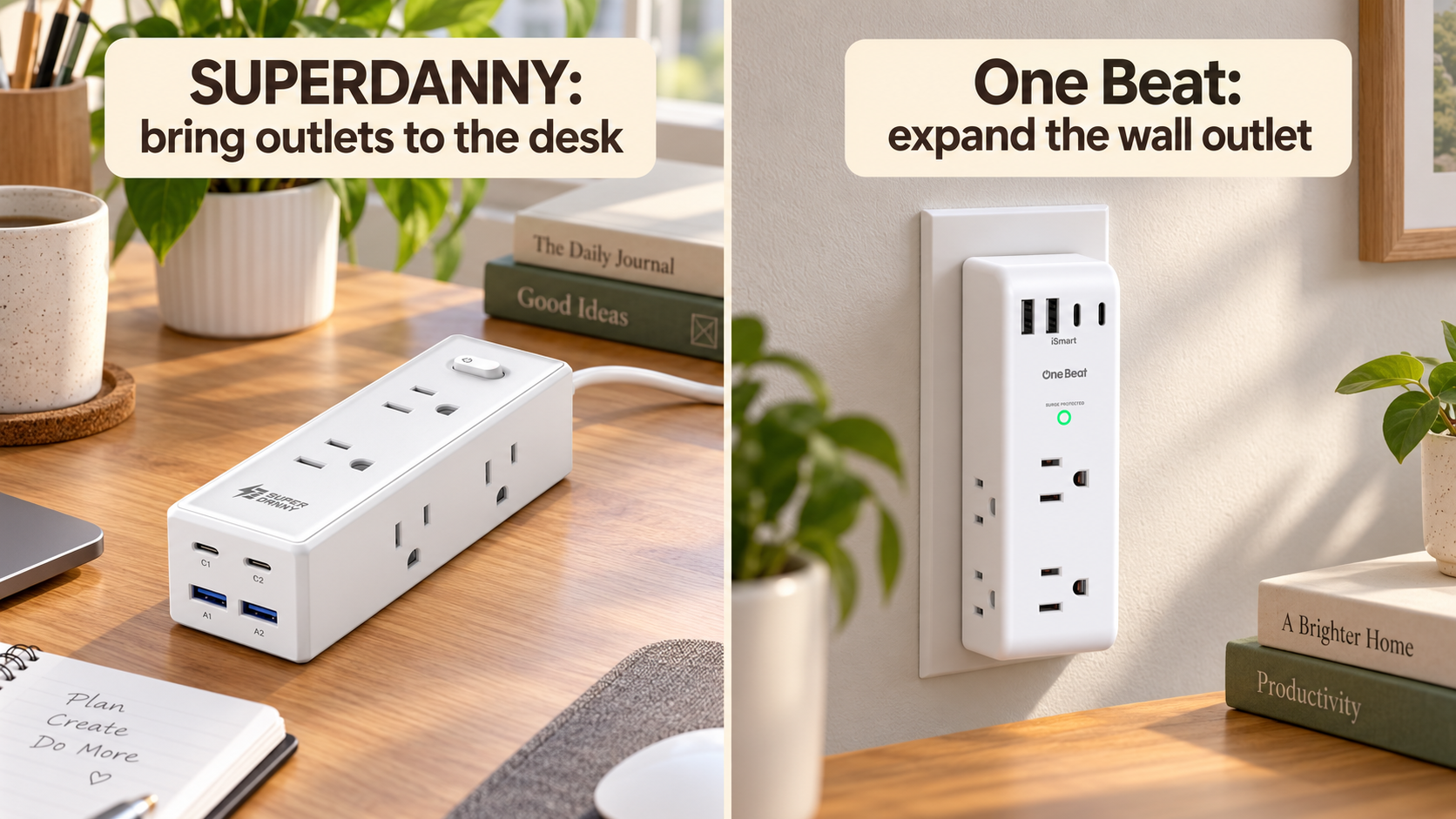
The SUPERDANNY SDCP08 and One Beat OB3W6 solve different placement problems. SUPERDANNY puts a power bar at the end of a 10-foot cord. One Beat plugs directly into the wall and keeps the connections there.
If the wall socket is behind a cabinet, a direct-plug extender may remain awkward to reach. If the socket is already beside the desk, a long cord may simply add clutter. Start with the room layout before comparing the ports.
| Specification | SUPERDANNY | One Beat |
|---|---|---|
| Placement | 10 ft / 3.05 m cord | Direct wall plug with rotation |
| AC outlets | Six | Six across three faces |
| USB ports | Two USB-A, two USB-C | Two USB-A, two USB-C |
| Total AC rating | 10 A / 1,250 W | 15 A / 1,875 W at 125 V |
| Shared USB output | Up to 15 W | 5 V / 3.1 A, about 15.5 W |
| Advertised surge rating | 1,050 J | 1,800 J |
USB-C shape does not promise laptop-class charging
SUPERDANNY SDCP08 power bar
 Shop at Amazon.ca
One Beat OB3W6 outlet extender
Shop at Amazon.caChoose the location of the connections first
Imagine the devices connected, not just the bare product. With SUPERDANNY, the bar can sit near the equipment while its cord reaches the wall. With One Beat, the adapters and cables gather at the wall outlet itself. That difference affects access, appearance and how much cable each device needs.
For a desk some distance from a suitable outlet, the SDCP08's reach is the more relevant feature. For a wall socket already beside the working area, the OB3W6 can add connection positions without a separate power-bar cord. Neither arrangement is inherently tidier in every room.
A direct-plug unit also needs enough room for its attached chargers. A socket behind a cabinet may be accessible with nothing plugged in and awkward once the extender and bulky adapters are in place. Rotation changes orientation; it does not make the whole assembly disappear into the wall.
Three room layouts to think through
A desk away from the wall socket
SUPERDANNY can bring connections toward the desk, but measure the actual cable route around furniture. The straight-line distance across the room is not the route you should plan to walk over. Leave appropriate clearance and keep the bar accessible for routine changes.
With One Beat in this layout, each device still needs a cable long enough to reach the wall. If that means stretching several device leads, the lack of a cord on the extender has not solved the distance problem.
A bedside outlet already within reach
One Beat may be the more relevant format if it fits securely and leaves room for the bed, wall plate and chargers. Consider where the phone cable will run and whether the connected assembly protrudes into a place where it can be knocked.
SUPERDANNY may still be useful if you want the connections in another accessible position, but account for the extra cord. A long lead that must be awkwardly gathered beside the bed is not automatically an advantage.
A height-adjustable workstation
Check the cable arrangement through the desk's whole movement range. Connections fixed at the wall and connections positioned near the desktop create different routing needs. Neither product removes the need to prevent strain, pinching or an unsuitable loose cable path as the desk moves.
Where a cord helps
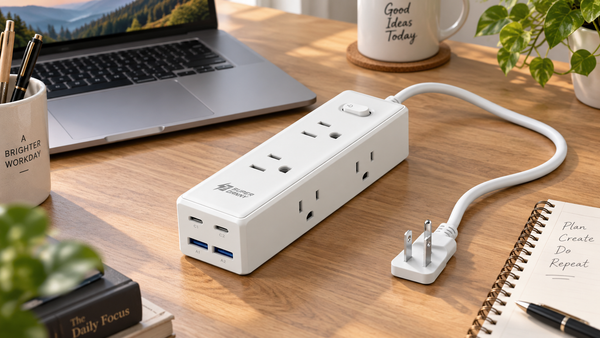
SUPERDANNY can bring the connections closer to your equipment without making every device cable reach the wall. Measure a safe route around furniture and leave the cord unpinched and uncovered.
Its flat plug may help in a tight space, but check the clearance behind the furniture. Mounting the bar can make the switch and outlets easier to reach if you follow the supplied instructions.
One Beat avoids that extra cord. Check the room around the wall plate, though: the body and attached chargers still project from the wall. A rotating plug changes orientation; it does not remove the need for space or make a loose wall socket acceptable.
Count the adapters you can actually fit
Both products have six AC positions, but your usable count depends on plug shapes and clearance. A wide charger can obstruct a neighbouring socket or project into furniture. Multi-sided layouts help distribute connections, yet they do not guarantee that every combination will fit.
Lay out the adapters you plan to use and note the direction in which their leads leave the body. Compare those shapes with the product dimensions and socket arrangement. Include access for unplugging; an arrangement that technically fits may still be frustrating to use.
For One Beat, consider the weight and projection of the complete connected assembly at the wall. Confirm a secure fit in a suitable outlet. A rotating plug is an orientation feature, not a remedy for a worn or loose receptacle.
For SUPERDANNY, consider where the bar itself will rest or mount. Follow its mounting instructions and leave room for cables on each side. Do not treat a compact body measurement as the dimensions of the complete connected setup.
The higher AC rating does not change appliance instructions
One Beat advertises a higher total rating than this SUPERDANNY model. That is relevant when checking a planned load, but it is not permission to connect any appliance to an extender. The appliance's own connection requirements and the delivered product's rating still govern the decision.
Make a list of the devices that will operate together and check their labels. Do not multiply either unit's total rating by its outlet count. The sockets share the model's overall limit.
Nor should overload protection be used to discover a workable load by trial and error. Choose an appropriate arrangement beforehand. If the setup requires connecting extenders together or ignores a device's direct-wall requirement, neither option is an acceptable fix for that plan.
Six outlets do not mean six heavy appliances
The total rating applies to the connected load together. Check the devices’ labels and their own instructions before deciding what belongs on either unit. Do not connect power bars or extenders together to gain more capacity.
Health Canada’s electrical safety guidance specifically says portable heaters should not use a power bar or extension cord. More sockets are a convenience, not permission to disregard an appliance’s connection requirements.
Try arranging your existing adapters on paper or beside a ruler. Large charger bodies can cover neighbouring sockets even when a product advertises generous spacing.
Four charging ports are not four fast chargers
Both products provide two USB-A and two USB-C ports with a modest shared output. That can suit a collection of small devices or a less time-sensitive charging routine. It is a different proposition from replacing several independent high-output chargers.
If you charge a phone and accessories together, the useful question is whether the combined arrangement meets your timing needs. A device connected alone may not behave the same way when other ports are occupied. The small difference between the advertised shared totals is unlikely to outweigh connection placement.
For a laptop, keep the appropriate charger in the plan unless the required charging specification is expressly supported by the integrated ports. USB-C describes a connector, not an assurance of laptop-class power or a particular charging protocol.
These ports should also not be mistaken for a computer data hub. Decide separately how keyboards, drives and other data accessories connect to their host. Having a convenient USB-shaped socket nearby does not establish data connectivity.
What the surge figures can and cannot decide
One Beat's advertised joule rating is larger, but that single number is not a complete protection comparison. Documentation, product condition and the exact protection design matter too. Do not translate the difference into a promise that one will protect every connected device from every event.
Neither stores backup energy for a power outage. If keeping equipment running through an interruption is the requirement, these products do not supply that function. Their role is connection distribution with stated protection features.
Read any indicator descriptions and replacement guidance in the manual. A light showing power is present should not automatically be interpreted as a complete protection-health report. Keep the model and purchase details for a support or warranty question.
The USB outputs are quite similar
Both divide modest USB output among four ports. The USB-C shape does not establish laptop-class charging or USB Power Delivery. If a laptop needs its own higher-output charger, plan an AC outlet for it.
The difference between 15 W and about 15.5 W total is unlikely to be the main reason to choose one of these formats. Your device requirements and the number charging at once matter more.
The practical verdict
SUPERDANNY is the stronger format match when the connections need to move away from the wall and there is a suitable route for its cord. One Beat is the stronger format match when the wall outlet is already convenient and the extender fits securely with your actual adapters attached.
Before buying either, settle four questions: does the connected layout fit, is the planned load appropriate, do the USB outputs meet your devices' needs, and is the delivered product properly certified for Canada? Those answers matter more than choosing the larger number in every row of the comparison table.
If both layouts work, favour the one you can inspect and access easily. A visible, understandable arrangement is more practical than a compact-looking setup that hides connections behind heavy furniture or leaves daily charging cables under strain.
Verify certification before buying either
Check the actual product for an electrical certification mark recognized in Canada. An ETL claim alone does not settle the mark on a particular unit. Use Health Canada’s shopping guidance and inspect the delivered product label before putting either format into service.
Likewise, the joule figures do not establish a complete protection ranking or guarantee protection from every surge. Neither unit supplies backup power.
Choose SUPERDANNY when safe cord routing puts the connections somewhere useful. Choose One Beat when the wall socket is already in the right place and the extender fits securely. The layout is the clearest difference; certification and suitable loading are requirements for both.
SUPERDANNY SDCP08 power bar
Shop at Amazon.caOne Beat OB3W6 outlet extender
Shop at Amazon.caImages are AI-generated illustrations based on product references.


Sign up or sign in to join the conversation.