
If you're buying a home espresso machine in Canada in 2026, two very different ideas are competing for the same counter space: the SPINN Espresso & Coffee Machine and the Casabrews CM5418 Espresso Machine. One is a connected, app-driven, bean-to-cup robot built around 4,500 RPM centri...
If you're buying a home espresso machine in Canada in 2026, two very different ideas are competing for the same counter space: the SPINN Espresso & Coffee Machine and the Casabrews CM5418 Espresso Machine. One is a connected, app-driven, bean-to-cup robot built around 4,500 RPM centrifugal brewing and a promise of coffee or espresso in 60 seconds. The other is the more familiar small semi-automatic path: portafilter, steam wand, manual steps, and the kind of ritual that some people genuinely enjoy and others quietly regret after three weekday mornings.
This article isn't a hands-on review. It's an editorial comparison of what these two machines are actually offering, what kind of ownership each one implies, where the real costs show up, and which workflow makes sense for your kitchen. The point here is not to force one winner. It's to answer the more useful question: do you want espresso as a beverage outcome, or espresso as a hobby-adjacent process?
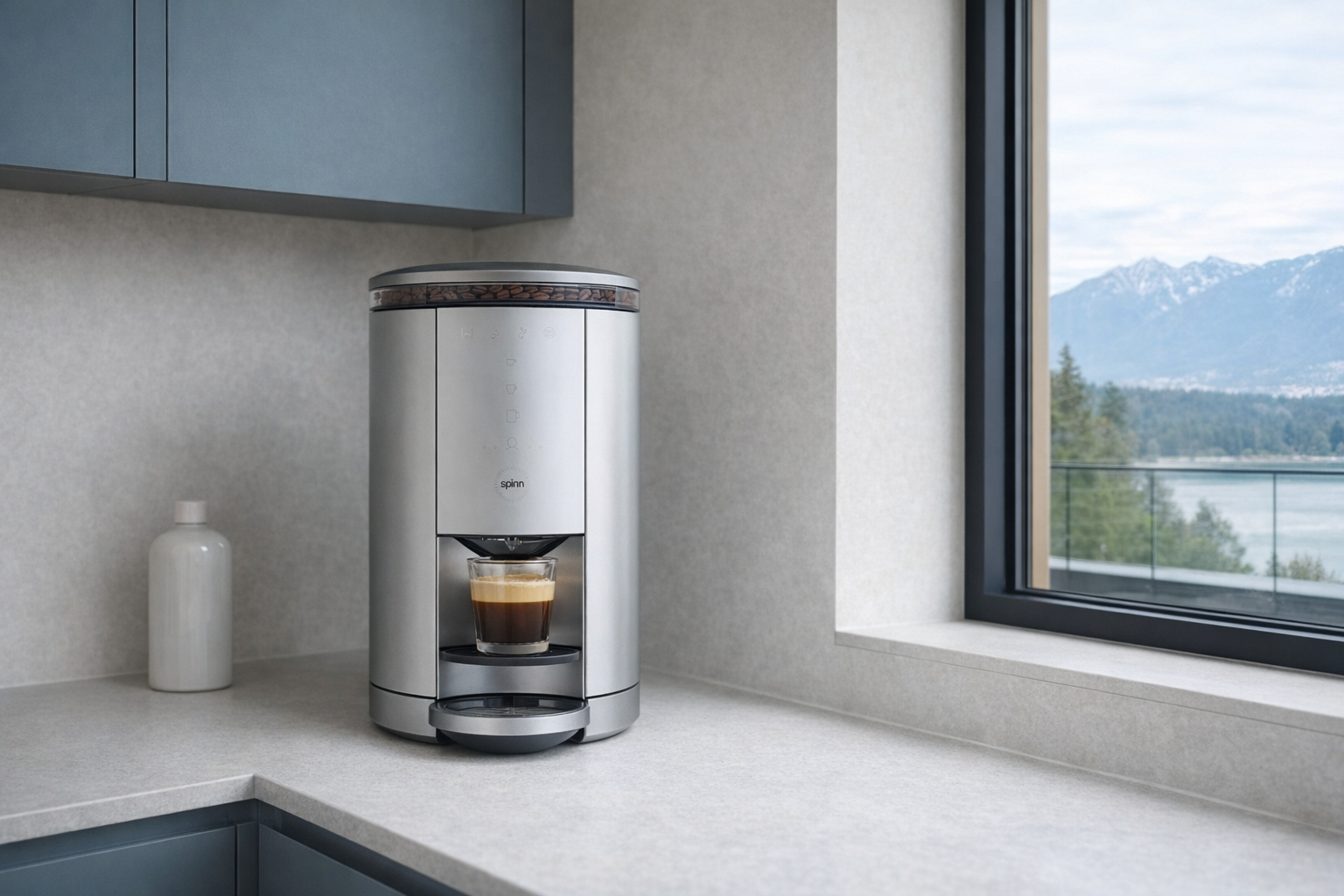
At a glance
| SPINN Espresso & Coffee Machine | Casabrews CM5418 Espresso Machine | |
|---|---|---|
| Price (CAD) | ~$299 | ~$180 |
| Rating signal | 4.7/5 on source listing | No rating supplied |
| Made by | SPINN | Casabrews |
| Brewing approach | Centrifugal brewing at 4,500 RPM | Traditional espresso-machine format |
| Built-in grinder | Yes | Not stated in supplied dossier |
| Drink range | Espresso, drip coffee, cold brew and more | Espresso-focused, with microfoam language in listing |
| Speed claim | Any drink in 60 seconds | No speed claim supplied |
| Connectivity | WiFi + Bluetooth, app control | None supplied |
| Waste model | Whole beans, no pods or disposable filters | Not specified |
| Best for | People who want convenience, variety, and low-friction daily coffee | People who want a more traditional espresso ritual at a lower upfront price |
| Skip if | You dislike app dependence or want a manual espresso craft workflow | You want push-button convenience, drip coffee, cold brew, or all-in-one simplicity |
Pro tip: Don't compare these as "two espresso machines under $300." That's how people buy the wrong one. The real split is whether you want to make coffee with a machine or make coffee through a machine. Those sound similar; they are not.
What each one actually is
The SPINN Espresso & Coffee Machine is a smart, WiFi-enabled bean-to-cup system built around centrifugal brewing technology at 4,500 RPM. According to the listing, it grinds whole beans seconds before brewing, makes espresso, drip coffee, cold brew and more, and can produce any drink in 60 seconds. It also leans hard into app control, adjustable brew parameters, and the "zero waste" pitch: no pods and no disposable filters. This is not trying to be a café-training machine. It's trying to compress the daily coffee routine into something fast, repeatable, and cleaner than pod systems. That's a legitimate pitch.
The Casabrews CM5418 Espresso Machine is a more traditional home espresso machine sold here in the Ivory Bloom Edition, with the listing emphasizing warm-toned design and "trusted CM5418 performance" along with rich extraction and silky microfoam. The supplied dossier does not list pressure, grinder details, or tank size, so it would be irresponsible to invent them. What can be said safely is that this is positioned as a conventional espresso-format machine for people who want the familiar workflow: espresso-focused use, milk-texturing potential, and a more tactile relationship with the process than a connected bean-to-cup system offers.
The fundamental difference is simple: SPINN is selling automation and variety; Casabrews is selling a more traditional espresso ritual at a lower entry price.
The battlegrounds
1. Workflow — automation versus participation
This is the real decision, and it decides almost everything else.
With SPINN, the workflow implied by the feature list is straightforward: whole beans go in, the machine grinds them, brewing is handled internally, and drinks can be adjusted through the app. The headline is convenience. The listing's 60-second claim matters because it tells you what SPINN thinks its customer values most: speed, repeatability, and low effort. For a weekday kitchen, that's appealing in a very unromantic but very real way.
With the Casabrews CM5418, the implied workflow is slower and more involved. Even without a full spec sheet, the product positioning and espresso-machine form point to a more manual routine. That usually means more steps between wanting a drink and having one. Some buyers want exactly that. They don't want a coffee robot; they want the feeling of making the drink. Fair enough. But this path gets romanticized too much online. A manual workflow is satisfying when you enjoy it. It's annoying when you're late.
Winner: neither, because this is the wrong place to force one. If you want speed and consistency, SPINN makes more sense. If you want involvement and ritual, the Casabrews path is the more honest fit.
2. Learning curve — who has to adapt, you or the machine?
The SPINN proposition is that the machine does most of the adaptation for you. It has a built-in grinder, app-based controls, and adjustable brew parameters. That suggests a gentler learning curve for someone who wants better coffee without turning the kitchen into a tiny training lab. The tradeoff is that you are learning a system, not a craft. You are trusting presets, firmware logic, and a connected experience to carry some of the result.
The Casabrews CM5418 likely asks more of the owner, simply because traditional espresso workflows always do. Even if the machine itself is simple, espresso as a category is not forgiving. Small changes in dose, grind, tamping consistency, and milk steaming technique can change the cup. That's not a flaw in the machine; it's the nature of the format. For some households, that challenge is half the fun. For others, it's a good way to end up buying takeout coffee while a nice-looking machine gathers dust.
A blunt opinion: many people say they want to "get into espresso" when what they actually want is a better latte at home with less effort. Those are different goals. If you're in the second camp, SPINN is probably the smarter purchase.
Winner: SPINN for accessibility. Casabrews only wins if you actively want the learning curve.
3. Drink range — espresso-only mindset versus one-machine flexibility
This is a stronger point for SPINN than the price discussion suggests.
According to the listing, SPINN can make espresso, drip coffee, cold brew and more. That matters in mixed households where one person wants espresso, another wants a full mug of coffee, and someone else decides they are a cold-brew person for three months every summer. A machine that can cover all three asks is easier to justify on a crowded counter.
The Casabrews CM5418 is clearly positioned around espresso and milk drinks, with the listing mentioning rich extraction and silky microfoam. That can be exactly right if your household lives on cappuccinos, flat whites, and straight shots. But it is narrower. If what you really drink most days is not espresso, buying an espresso-first machine can be a slightly expensive form of self-deception.
This is where SPINN's concept feels more honest than a lot of entry espresso machines. It admits that many people do not want one sacred drink category. They want options.
Winner: SPINN, comfortably.
4. Ongoing cost — beans, waste, and the quiet economics of ownership
On list price alone, the Casabrews CM5418 is cheaper at ~$180 CAD versus ~$299 CAD for the SPINN. That difference is real. But it's not the whole ownership story.
SPINN uses whole beans and explicitly claims zero waste, no pods or disposable filters. That's meaningful. A bean-based system avoids the recurring cost and garbage load that come with pod ecosystems, while still promising convenience. That is one of SPINN's better arguments, because it positions the machine as the middle ground between a manual setup and a capsule system. Less waste than pods, less effort than traditional espresso. That's a sensible middle lane.
With the Casabrews, the supplied dossier does not mention pods, filters, or grinder inclusion, so the safe editorial reading is this: your ongoing cost depends more on the rest of your setup. If you already own a grinder and understand how you want to source beans, the machine's lower purchase price can be attractive. If you still need supporting gear, the real cost can creep up. That's the trap with cheaper espresso machines generally: the machine may be ~$180, but the workflow around it may not stay cheap.
Winner: slight edge to SPINN for a more self-contained ownership model, even though it costs more upfront.
5. Counter-space logic — what belongs in a normal kitchen?
This section is less glamorous than brew theory, but more useful.
The SPINN consolidates grinder and brewer into one connected machine. That can make it easier to justify in a condo kitchen or smaller household setup. If one machine covers grinding, brewing, and multiple drink styles, it is doing more work per square inch. That's a practical advantage, not a lifestyle slogan.
The Casabrews CM5418 may take less space than a full prosumer espresso setup, but a traditional workflow often brings supporting clutter with it. Even when the machine itself is compact, the routine tends to expand: coffee tools, milk pitcher, tamper area, bean storage, cleanup habits, and so on. None of that is automatically bad. It just means you're not buying a single appliance so much as adopting a small station.
This is where buyers should be honest about their homes. If your kitchen already feels crowded, a machine that asks for less surrounding ceremony is often the better machine.
Winner: SPINN for most everyday kitchens.
6. Satisfaction curve — which one gets better over time?
This is the most important battleground, and the one most listings ignore.
The SPINN satisfaction curve is front-loaded. You likely understand the value quickly: whole beans, app controls, different drink types, and a 60-second promise that fits real mornings. If that convenience matches your lifestyle, you'll be happy almost immediately. The long-term risk is different: some buyers eventually find highly automated coffee machines a little emotionally flat. The drinks are there, the process is easy, but the machine can feel more like an appliance than a craft object. Again, that is not a defect. It just means the pleasure is mostly in the outcome.
The Casabrews CM5418 has the opposite curve. Early ownership can be less satisfying because the workflow is less forgiving and the routine takes more effort. But for people who actually enjoy espresso-making as a skill, the machine can become more satisfying over time because the owner becomes more competent. That kind of satisfaction is slower and more earned. It is also much more fragile. If you stop enjoying the ritual, the whole value proposition collapses.
A plain judgment: manual espresso has a higher ceiling and a lower floor. Automation has a lower ceiling and a much higher floor. That's the comparison.
Winner: tie, depending entirely on personality. SPINN wins for reliable daily satisfaction; Casabrews can win for hobby satisfaction.
7. Design and kitchen presence — décor object or coffee tool?
The supplied dossier for the Casabrews CM5418 spends a lot of its energy on the Ivory Bloom Edition styling: warm porcelain-inspired tones, soft golden florals, botanical details, understated warmth. That tells you something important. Casabrews understands that many buyers in this tier are not just shopping extraction theory; they want a machine that looks pleasant on the counter. There is nothing wrong with that. Kitchens are visible spaces. Appliances live there.
The SPINN pitch is much more functional and systems-oriented: WiFi, Bluetooth, app brewing, parameter control, bean-to-cup efficiency. It sounds like a tech product because it is one. Some people will love that. Others will find it less charming than a traditional espresso machine with a bit of visual personality.
My opinion: the Casabrews styling is probably a bigger selling point than espresso purists would like to admit, and that's fine. But pretty hardware is not the same thing as a better ownership fit. A good-looking machine still has to survive Monday morning.
Winner: Casabrews if aesthetics are a major part of the purchase; otherwise this category should not outweigh workflow.
The three questions that actually decide this
- Do you want coffee with as little friction as possible, including grinding and drink variety? Yes → SPINN Espresso & Coffee Machine.
- Do you specifically want a traditional espresso routine, even if it asks more of you? Yes → Casabrews CM5418 Espresso Machine.
- Will this machine mostly serve one person chasing espresso craft, or a household with mixed drink habits? One person, ritual-first → Casabrews. Mixed household, convenience-first → SPINN.
The verdict, by household
| If this sounds like you... | ...buy this |
|---|---|
| You want espresso, drip coffee, and cold brew from one machine | SPINN Espresso & Coffee Machine |
| You care more about a traditional espresso ritual than automation | Casabrews CM5418 Espresso Machine |
| Busy weekday mornings, little patience, one-button mentality | SPINN |
| You enjoy making coffee as a hands-on ritual | Casabrews |
| Small kitchen, minimal accessory clutter desired | SPINN |
| Design-forward kitchen where the machine is part of the décor | Casabrews |
| You dislike app-connected appliances | Casabrews |
| You want a higher-floor, lower-effort ownership experience | SPINN |
Got Questions About SPINN vs Casabrews CM5418? Let's Clear Things Up.
Is this a hands-on review?
No. This is an editorial comparison based on the supplied listings, product positioning, and what those features realistically imply for ownership. It is meant to help you choose the right type of machine, not to replace side-by-side bench testing.
Is the SPINN the same thing as a pod coffee machine?
No. According to the listing, the SPINN Espresso & Coffee Machine uses whole beans, has a built-in grinder, and is explicitly pitched as zero waste with no pods or disposable filters. That matters because SPINN is really aiming at people who want pod-like convenience without the pod system itself. That's a more credible idea than a lot of "smart coffee" marketing.
Is the Casabrews CM5418 basically the same as a bean-to-cup machine?
No. The categories overlap only in the sense that both can help you get espresso-style drinks at home. The Casabrews CM5418 Espresso Machine is positioned as a traditional espresso-format machine with milk-texturing appeal, not an all-in-one smart robot. If you are expecting push-button bean-to-cup convenience, you're asking it to be a different product.
Which one makes more sense for a typical Canadian kitchen with limited counter space?
Usually SPINN, because it combines grinding and brewing in one machine and covers more drink types. In smaller kitchens, versatility matters more than enthusiasts sometimes admit. If your home has room for a more dedicated espresso station and you actually want that setup, Casabrews can still make sense. But "I have limited space and want espresso" is not automatically a reason to buy a traditional machine.
What about long-term cost in Canada?
Upfront, Casabrews is cheaper at roughly $180 CAD, while SPINN is around $299 CAD. But ownership cost is not just sticker price. SPINN's whole-bean, no-pod, no-disposable-filter approach may make it feel more self-contained over time. With Casabrews, your real long-term cost depends partly on what else your espresso workflow requires. That's why the cheaper machine is not always the cheaper path.
Is the app on SPINN a good thing or an annoying thing?
Potentially either, depending on your tolerance for connected appliances. The upside is obvious: WiFi + Bluetooth, remote brewing, and adjustable brew parameters through the app. The downside is also obvious: some people do not want their coffee machine to feel like another account-based device in the house. Neither reaction is irrational. If app control sounds convenient to you, SPINN's smart features are useful. If that sounds tiresome, Casabrews will likely feel simpler.
What does setup and daily use probably look like for each?
A realistic reading of the listings suggests SPINN is more "fill beans, choose drink, let the machine do the rest." A realistic reading of the Casabrews CM5418 listing suggests more direct involvement in making espresso and milk drinks. That is the practical difference. One machine is about compressing the routine. The other preserves more of it.
Where should I buy and where can I read more?
Verify the latest pricing and listing details directly from the brands: SPINN Espresso & Coffee Machine · Casabrews CM5418 Espresso Machine. For Celmin coverage, see the product sections below.
Which would Celmin pick?
For the average household that wants better coffee with less friction, SPINN Espresso & Coffee Machine is the smarter recommendation. The built-in grinder, broader drink range, app controls, and 60-second pitch line up with how most people actually behave after the novelty wears off. But that is not the same as saying it is "better" for everyone. If what you really want is a traditional espresso routine and a machine that feels more tactile than digital, the Casabrews CM5418 Espresso Machine is the more honest choice. This matchup is less about superiority than self-awareness.
SPINN Espresso & Coffee Machine — the automation-first all-rounder
The SPINN Espresso & Coffee Machine is a smart coffee system for people who want café-adjacent convenience without sliding into pod dependence. According to the listing, it uses centrifugal brewing technology at 4,500 RPM, grinds whole beans just before brewing, and can make espresso, drip coffee, cold brew and more in 60 seconds. It also includes WiFi + Bluetooth connectivity and adjustable brew parameters through the Spinn app.
The strongest argument for SPINN is not that it is smart. Plenty of kitchen products are "smart" in a way that adds nothing. The better argument is that its feature set points toward a lower-friction ownership experience: beans instead of pods, no disposable filters, built-in grinding, and multiple drink categories from one machine. For a busy household, that's a practical design, not just a flashy one.
The main caution is philosophical more than technical. SPINN is for people who want reliable beverage output and convenience. If your idea of a satisfying coffee setup involves technique, process, and tactile control, this machine may feel a little too managed. That's not a criticism of the machine. It's a reminder not to buy an appliance designed to remove the very steps you enjoy.
- Full explainer: SPINN Espresso & Coffee Machine on Celmin · Directory: product page
Casabrews CM5418 Espresso Machine — the traditional path with décor appeal
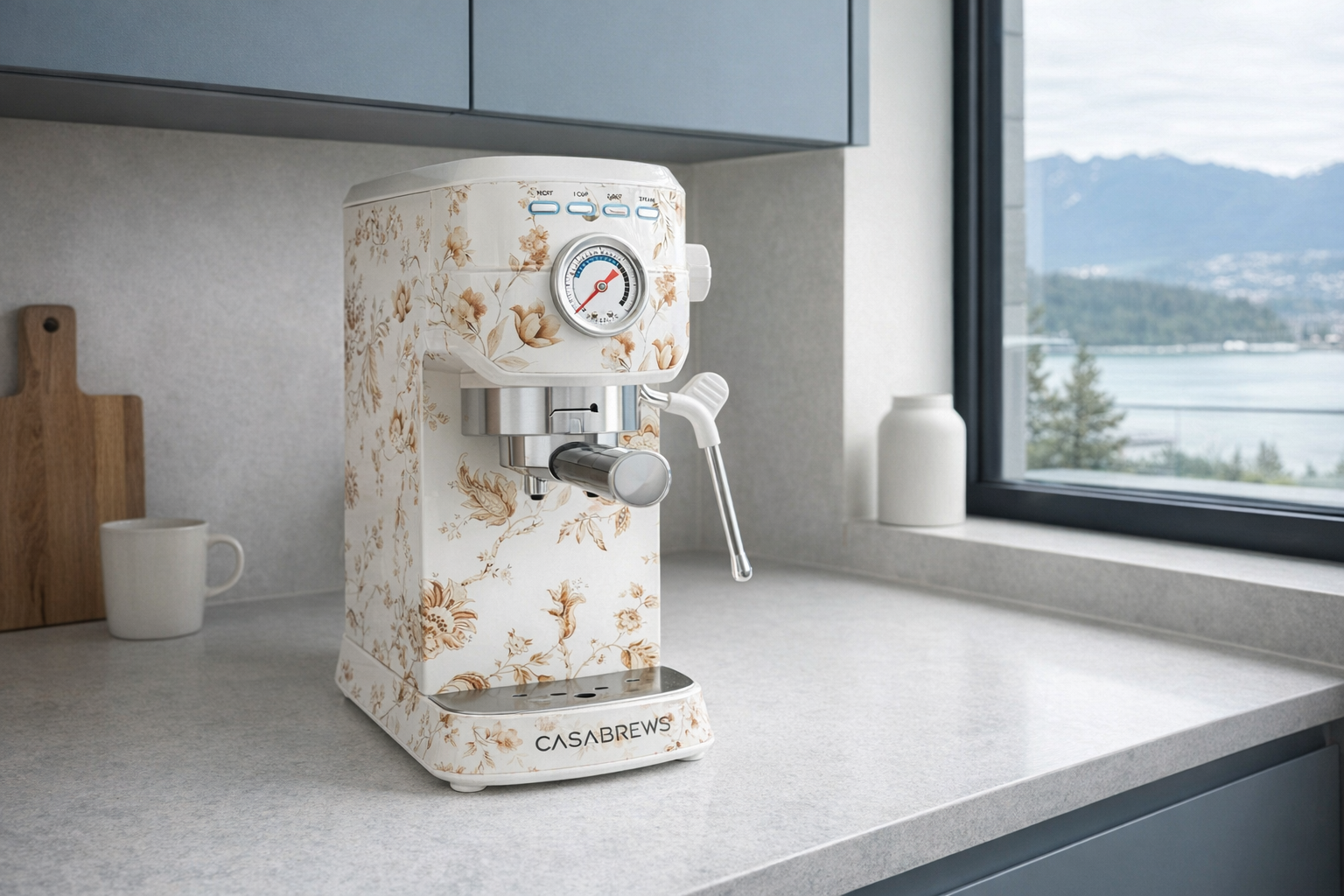
The Casabrews CM5418 Espresso Machine is a more conventional home espresso proposition, here framed through the Ivory Bloom Edition design language. The listing emphasizes soft floral detailing, a warm-toned finish, and "trusted CM5418 performance" paired with rich extraction and silky microfoam. In other words, it is being sold partly as a countertop object and partly as an espresso machine.
That may sound superficial, but it isn't entirely. A lot of people buying an entry or mid-entry espresso machine care how it looks because it sits out every day. Casabrews is being more transparent about that than many brands are. The real question is whether the underlying traditional workflow is something you'll still enjoy after the aesthetic glow fades. For buyers who want the ritual, that answer may be yes. For buyers who mostly want coffee quickly, the pretty exterior will not save the mismatch.
One honest read here: the Casabrews is probably for a narrower audience than "espresso machine under $200" marketing usually implies. It makes more sense for someone who wants to participate in the drink-making process, not bypass it.
- Full explainer: Casabrews CM5418 Espresso Machine on Celmin · Directory: product page
If you're building a smarter home in Canada and want honest comparisons of gadgets worth considering — plus the ones worth skipping — Celmin covers the full catalog without the marketing theater. More comparisons, reviews, and buyer guides at https://celmin.ca.
Discussion
Sign up or sign in to join the conversation.