

You're standing in front of a thermostat that looks simple until you remove the cover. Behind it are several wires, a furnace in the basement, and a rebate page that seems to describe a different house. A video installer says to match the colours, but Canadian HVAC systems don't always follow a tidy colour code. The right smart thermostat depends first on your heating equipment, wiring, home type, and provincial eligibility.
That's the standard I'm applying in this smart thermostat review. App design matters, but it comes after compatibility. A thermostat that can't control your furnace, heat pump, boiler, or baseboards is an expensive wall ornament.
Table of Contents
- Why a Smart Thermostat Review Has to Start With Your Home
- What a Smart Thermostat Actually Does
- Canadian HVAC Compatibility and the Wiring Question
- Energy Savings and Setpoints in Real Canadian Conditions
- Installation, Setup, and Common Troubleshooting
- Rebates and Provincial Programs Worth Knowing
- Top Smart Thermostats Worth Buying in Canada
- Your Smart Thermostat Buying Checklist
Why a Smart Thermostat Review Has to Start With Your Home
A homeowner in an Ontario subdivision built in the 1990s may have a conventional forced-air gas furnace, central air conditioning, and a thermostat cable that doesn't include a usable common wire. Another household in a Montreal century home may have a hydronic boiler, while a Halifax renovation may use an air-source heat pump. A condo owner could have electric baseboard heaters controlled by line voltage, not the low-voltage wiring used by most central HVAC systems.
Those homes can all benefit from better temperature control, but they shouldn't buy the same thermostat. The first question isn't whether Google Nest looks better than ecobee. It's whether the device can operate the equipment already installed in your home.
Practical rule: Buy for the HVAC control board, not for the thermostat display.
Canadian homes also expose the limits of generic reviews. A model that performs neatly on a straightforward single-stage furnace may require extra planning with a condensing boiler, dual-fuel heat pump, humidifier, or HRV. Older houses often have undocumented wiring changes, abandoned conductors, or a thermostat cable that was installed for a much simpler controller.
That's why a useful smart-home upgrade starts with the building. Celmin's guide to building a smart home takes the same practical view, beginning with the household's infrastructure rather than treating individual devices as isolated gadgets.
The house determines the shortlist
Write down the equipment before opening a retailer page:
- Heating source: Gas furnace, boiler, heat pump, electric baseboard, or another system.
- System stages: Single-stage, multi-stage, variable capacity, or dual fuel.
- Thermostat voltage: Low-voltage central HVAC and high-voltage baseboard controls aren't interchangeable.
- Accessory controls: Humidifier, ventilator, HRV, electric auxiliary heat, or zone panel.
- Home arrangement: Detached home, townhouse, condo, apartment, or rental.
A smart thermostat can reduce friction in a compatible system. It can't repair poor insulation, replace a missing zone controller, or make a line-voltage baseboard circuit safe for a low-voltage product. The best review therefore starts with the home's equipment and ends with the app.
What a Smart Thermostat Actually Does
Think of a smart thermostat as the shift supervisor for your heating system. It decides when the furnace, boiler, air conditioner, or heat pump should work, based on a schedule, manual commands, occupancy information, and the limits you set.
Scheduling is the most basic function. You choose different temperatures for periods such as sleeping, leaving for work, returning home, and settling in for the evening. Natural Resources Canada gives practical Canadian setpoints of about 17°C when sleeping or away and 20°C when awake at home, with the exact choice depending on comfort and the building. Its guidance also says a smart thermostat can help save about 8% on yearly home energy costs for heating and cooling. Read the Natural Resources Canada smart thermostat guidance for the full context.
Learning removes some manual programming. The thermostat observes patterns and may adjust its schedule, but I prefer treating learning as a convenience rather than handing over complete control. A household with irregular shifts, pets, or a home office can confuse an aggressive learning mode.
Geofencing uses the location of household phones to react when people leave or return. It's useful when plans change, but it shouldn't be the only protection against freezing conditions or an unreliable phone location.

Features that matter in practice
Wi-Fi gives you remote control and software features, but it doesn't automatically improve heating performance. Occupancy sensing can prevent unnecessary heating in an empty home. Room sensors can help a bedroom or nursery influence the comfort reading, although they won't create genuine HVAC zoning unless the system has separate zones.
Energy reports are useful when they lead to a decision, such as changing a schedule or investigating unusually long runtime. Voice control through HomeKit, Google Home, or Alexa is convenient, but it's a secondary feature.
The core value is automatic, sensible temperature control. In Canadian homes, the strongest opportunity often appears during shoulder seasons, when outdoor conditions change quickly and a fixed schedule can overheat or underheat the house. Remote access is nice. Reliable scheduling, accurate sensing, and correct HVAC staging are what deserve the purchase budget.
Canadian HVAC Compatibility and the Wiring Question
Compatibility failures usually happen because buyers identify the thermostat brand but not the equipment behind it. A low-voltage smart thermostat is designed for the control circuits used by many central furnaces, air conditioners, and heat pumps. It isn't a drop-in replacement for a high-voltage electric baseboard thermostat.
Start with the system type
| HVAC Type | Common in Canada | Works With Most Smart Thermostats? | Watch-Outs |
|---|---|---|---|
| Forced-air gas furnace | Yes | Often, especially for straightforward systems | Check stages, C-wire availability, accessories, and furnace control terminals |
| Boiler | Common in older and urban homes | Sometimes | Confirm relay compatibility and whether the thermostat controls heat only or additional zones |
| Cold-climate air-source heat pump | Growing option | Only with suitable models | Verify O/B configuration, auxiliary heat, emergency heat, staging, and dual-fuel support |
| Electric baseboard | Common in some condos and older electric-heated homes | No, not with low-voltage models | Requires a thermostat designed for line voltage |
| Fireplace insert or specialty heat | Property-dependent | Rarely as a direct replacement | Proprietary controls and safety interlocks may prevent ordinary thermostat installation |
| HRV or ventilator accessory | Often paired with newer HVAC systems | Model-dependent | Confirm accessory terminals and control logic before disconnecting the existing controller |
The C-wire, or common wire, supplies continuous power to many smart thermostats. Older installations may have a spare conductor tucked behind the wall, but a spare wire isn't useful unless it connects to the correct terminal at the furnace or control board. A power extender or adapter can solve some installations, but it isn't a universal fix.
Wiring warning: Never assume a blue wire is a C-wire. Trace the terminal connection at both ends.
Ontario's rebate terms also show why HVAC compatibility is a financial issue. The thermostat must control the home's primary heating or cooling source, and the listed property types include single-family, semi-detached, row or townhomes, and mobile homes on permanent foundations. Review the Ontario smart thermostat post-purchase terms before assuming a device qualifies.
Energy Savings and Setpoints in Real Canadian Conditions
A smart thermostat doesn't create energy savings by being connected to Wi-Fi. It saves when it changes heating behaviour, prevents unnecessary runtime, and makes setbacks easier to follow without sacrificing the ability to recover comfortably.
Natural Resources Canada's practical guidance recommends about 17°C during sleep or absence and 20°C while awake at home, and estimates that a smart thermostat can help save about 8% on annual heating and cooling energy costs. That's a useful national benchmark, not a guarantee for every house. A well-insulated home with disciplined manual scheduling has less avoidable waste than a drafty house where the thermostat stays at one temperature all day.
Ontario retrofit evidence is more persuasive than a glossy app claim. A study of apartment retrofits measured annual space-heating savings of 8.8% to 11.8%, with the strongest effect during the shoulder season. The project attributed 16,200 m³ and 39,500 m³ of natural gas savings over one heating season across two building groups, as reported in the Toronto Atmospheric Fund smart thermostat white paper.
Why payback varies so much
A thermostat's payback depends on the cost of the device, installation, fuel, system response, and how much control the household already exercises. I won't give you a fake Toronto-versus-Calgary calculation based on invented fuel prices. Without your bill, floor area, equipment efficiency, and installation cost, that model would look precise while being meaningless.
The device offers less value when:
- You already use disciplined setbacks: Automation may add convenience without changing behaviour.
- The home has major envelope problems: Air leakage and weak insulation can dominate heating demand.
- The system is proprietary: A thermostat may not control the equipment's full operating logic.
- The home uses high-voltage baseboards: A low-voltage smart thermostat won't work.
- The household rarely changes settings: Remote access alone may not justify the purchase.
The National Research Council study used data from more than 11,000 Canadian homes, with temperature traces recorded at 5-minute intervals over four years, to infer building thermal performance. That finding matters for reviewers because data fidelity has practical value. A thermostat that records useful indoor and outdoor conditions can help identify overheating, heat-loss patterns, and retrofit priorities, not just display a green savings leaf. See the National Research Council study on smart thermostat data for the research context.
Installation, Setup, and Common Troubleshooting
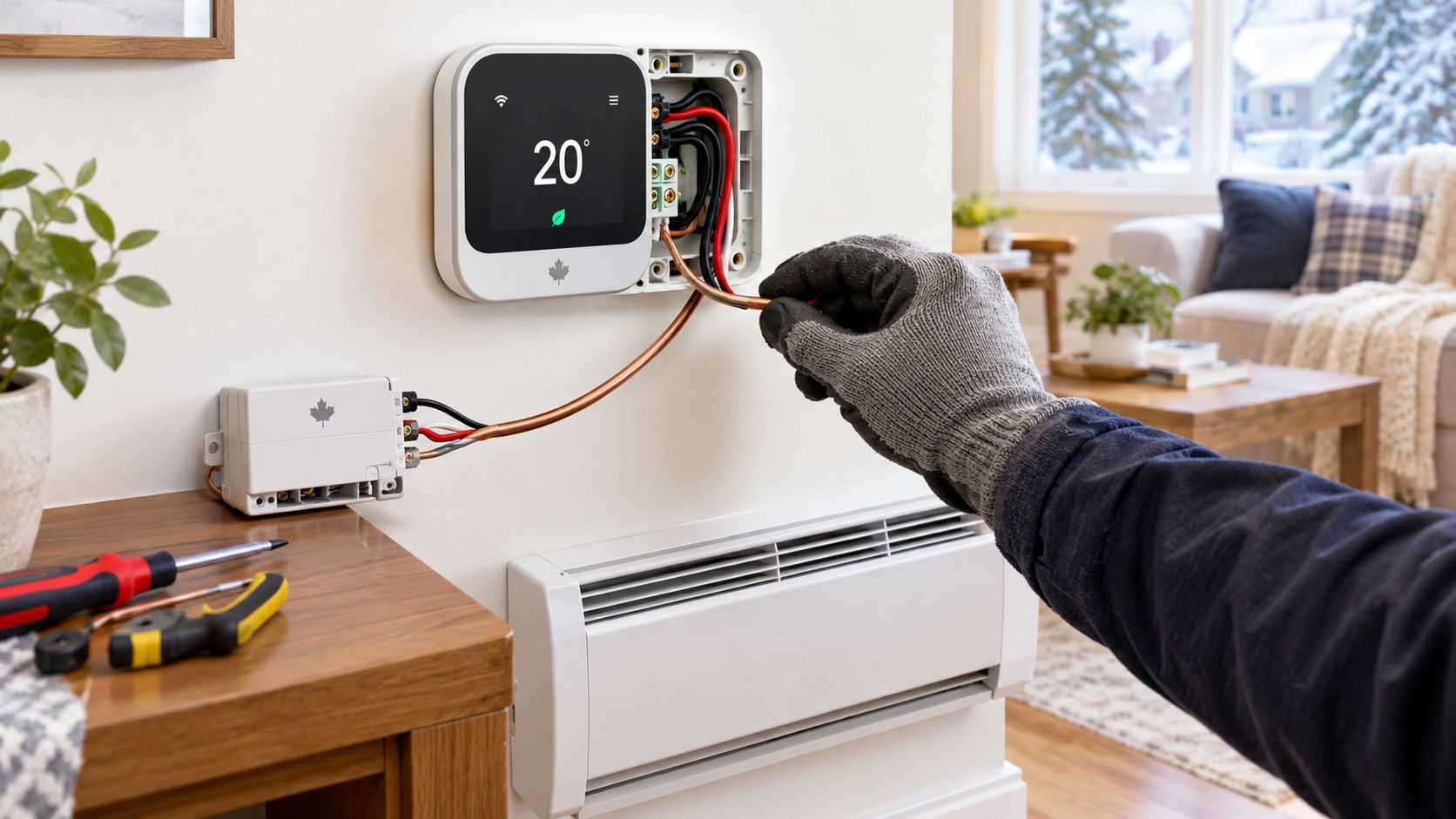
Turn off power to the HVAC equipment at the breaker before touching the thermostat wiring. The furnace service switch may also be present, but I still verify that the thermostat display goes dark and that the equipment can't start unexpectedly.
Take a clear photograph of the existing terminals before removing anything. Then label each conductor by its terminal letter, not by its insulation colour. A red wire may be connected to R, but the label at the terminal is what matters.
A safer installation sequence
- Shut off power: Use the breaker or service switch, then confirm the old thermostat is unpowered.
- Photograph and label: Record the terminal layout and attach labels before loosening wires.
- Check for C: Look for a conductor connected to C at the furnace control board, not merely a loose wire in the wall.
- Mount the new plate: Use a level and cover the old screw holes where practical.
- Connect the conductors: Match terminal functions exactly and keep bare copper from touching adjacent terminals.
- Restore power: Watch for a normal boot sequence and confirm the system responds to a heating or cooling call.
- Configure the app: Connect Wi-Fi, set equipment type, establish a schedule, and test every available mode.

A power-extender kit can help when the thermostat cable lacks a usable C-wire, but installation gets less predictable with heat pumps, dual fuel, multi-stage equipment, boilers, humidifiers, and HRVs. Call an HVAC professional if the old thermostat uses unfamiliar terminals, the system has line-voltage wiring, or the equipment starts short cycling after the replacement.
Troubleshooting that actually helps
A blank display usually points to power, the breaker, the furnace switch, or incorrect wiring. Wi-Fi dropouts are common in basement mechanical rooms, so test signal strength where the thermostat is mounted rather than beside the router. Short cycling after installation can come from an incorrect equipment setting, an overly aggressive schedule, or a wiring error, and it shouldn't be ignored.
Humidifier and ventilator connections deserve separate attention. Don't connect accessories to spare terminals just because they're available. If you need to clear settings or recover from a failed pairing attempt, use this guide on how to reset a smart thermostat.
If the thermostat loses internet service during a January cold snap, the HVAC system should still follow its local schedule in most conventional setups. Check the display, confirm the equipment is running locally, and avoid relying on cloud access as your only means of preventing a cold home.
Rebates and Provincial Programs Worth Knowing
Canadian thermostat rebates are useful, but eligibility is often more important than the headline amount. The province, utility relationship, property type, heating source, approved model list, installation date, and required documents can all decide whether the claim succeeds.
Ontario's program has a clear timeline. Peak Perks introduced a $75 incentive for households that enrolled and permitted brief thermostat adjustments during periods of peak summer demand. The program was later folded into the Home Renovation Savings pathway launched on January 28, 2025. The current Ontario offer lists a $100 smart thermostat rebate, with eligible homes heated by Enbridge Gas or connected to the Ontario electricity grid. Some households may qualify for up to $125 through the Equity Access Program. The original Ontario Peak Perks and energy-efficiency announcement provides the policy background.
British Columbia announced free smart thermostats in 2026 for residents as part of an energy-use reduction effort, but that doesn't mean every home type, utility account, or HVAC arrangement qualifies. The British Columbia program announcement should be checked directly before purchase.
| Province | Program Name | Thermostat Rebate | Eligibility Notes | Status |
|---|---|---|---|---|
| Ontario | Home Renovation Savings | $100, or up to $125 through Equity Access | Enbridge gas or Ontario-grid electricity, eligible home types, primary heating or cooling control | Current program terms should be checked before buying |
| British Columbia | Provincial smart thermostat initiative | Free smart thermostats | Eligibility depends on the program's household and equipment rules | Announced for 2026 |
| Quebec | No verified amount in the supplied data | Not stated | Confirm with the current provincial or utility program | Check current rules |
| Alberta | No verified amount in the supplied data | Not stated | Confirm with the current provincial or utility program | Check current rules |
| Other provinces | No verified amount in the supplied data | Not stated | Utility-specific rules may apply | Check current rules |
The rebate traps
A condo or rental unit may fall outside a program even if the thermostat itself appears on an approved list. Some offers require proof of purchase, model details, serial numbers, installation information, or participation through a specific utility. Program rules can also change, pause, or close without matching a retailer's older promotional copy.
Treat the rebate as a bonus until you confirm eligibility in writing. The safer order is to identify the HVAC system, check the current program terms, save the receipt and model information, and only then choose the thermostat.
Top Smart Thermostats Worth Buying in Canada
The model shortlist is smaller than the marketing suggests. My recommendations below are conditional because each device still has to match the equipment and wiring in your home.
| Model | Best For | HVAC Compatibility | C-wire Needed | CAD Price (approx.) | Verdict |
|---|---|---|---|---|---|
| ecobee Smart Thermostat Premium | Larger homes and complex comfort needs | Strong option for many multi-stage and heat-pump systems, verify equipment | Often preferred, adapter may help | Check current Canadian retail pricing | Best fit for a heat-pump retrofit or multi-room home when professionally matched |
| Google Nest Learning Thermostat, 4th gen | Simple systems and Google households | Good for compatible conventional HVAC, verify staging and heat-pump details | System-dependent | Check current Canadian retail pricing | Good for a straightforward new-build installation |
| Mysa for line-voltage systems | Electric baseboards | Designed for compatible line-voltage heating | Not the same low-voltage question | Check current Canadian retail pricing | The sensible rental or condo choice when baseboards are the actual system |
| Honeywell Home T10 Pro | Contractor-led installations | Broad compatibility, but configuration depends on the HVAC setup | Installation-dependent | Check current Canadian retail pricing | Practical for homeowners who want installer support and room sensing |
| Amazon Smart Thermostat | Budget-first buyers | Best reserved for compatible conventional systems | Verify before purchase | Check current Canadian retail pricing | Consider for a simple apartment or basic furnace where cost leads |
The ecobee Smart Thermostat Premium is my strongest technical pick when the home needs room sensors, more detailed equipment configuration, or a better path through complicated comfort problems. Its weakness is that buyers can overpay for features they won't use, and some reporting or service features may involve an ongoing subscription.
The Google Nest Learning Thermostat is easier to recommend for a clean, conventional installation and a household already committed to Google Home. Don't assume its learning behaviour replaces proper staging support. Confirm the exact equipment configuration before buying, especially in an older system.
Mysa belongs in a separate category because it targets line-voltage electric heating. It's the model to investigate for compatible baseboards, not a substitute for a low-voltage furnace thermostat.
Honeywell Home's T10 Pro makes the most sense when a contractor is already involved, particularly where room sensing and equipment setup need careful commissioning. The Amazon Smart Thermostat is the budget-first option, but only after confirming that the wiring and HVAC type are supported.
For a second opinion focused specifically on Google's platform and Canadian use, consult Celmin's Google Nest smart thermostat guide. The verdict remains simple: choose the least complicated thermostat that fully controls your system.
Your Smart Thermostat Buying Checklist
Use this checklist before placing an order. It's designed to stop the two most expensive mistakes, buying the wrong voltage and assuming a rebate applies.
- Identify the equipment. Photograph the furnace, boiler, heat pump, or baseboard controller. Record the manufacturer and model, then look for the data plate and system type.
- Count the stages. Determine whether the equipment is single-stage, multi-stage, variable capacity, heat pump, auxiliary heat, or dual fuel. If you can't tell, ask the installer before purchasing.
- Document the wiring. Remove the thermostat cover, photograph every terminal, and label each wire by terminal letter. Don't rely on colour.
- Confirm the C-wire. Trace the common connection at the HVAC control board. If it's absent, investigate a compatible power extender or adapter, such as a Venstar option, rather than assuming every thermostat can run without one.
- Check room control needs. A large or multi-level home may benefit from remote temperature or occupancy sensors. Remember that sensors don't create separate HVAC zones by themselves.
- Verify the smart-home platform. Check compatibility with Apple Home, Google Home, Alexa, or Matter before committing to an ecosystem.
- Price the complete installation. Include the thermostat, adapter, professional labour where needed, and any subscription feature you plan to use.
- Check the rebate before checkout. Confirm the current program, eligible home type, utility relationship, approved equipment, purchase window, and required documents. Save the receipt and model details.

Three common buyer paths
A Calgary condo owner with compatible forced-air heating should prioritize wiring, building rules, and whether the thermostat controls the unit's primary system. A Montreal century-home boiler user should confirm relay and zone compatibility before considering app features.
A Halifax heat-pump retrofit should favour professional configuration, especially if auxiliary or emergency heat is involved. A renter with electric baseboards should look at line-voltage products such as Mysa rather than adapting a furnace thermostat.
The best thermostat is the one your HVAC can run reliably, without jumper-wire workarounds or rebate assumptions. Confirm that first, then compare screens, sensors, integrations, and price.
Celmin publishes Canadian smart-home buying guides, product comparisons, and practical setup help that can make device decisions easier in real homes. Visit Celmin to compare smart-home products and find troubleshooting guidance before you buy or install your next thermostat.
Sign up or sign in to join the conversation.