

The DAOTAILI Smart Plant Watering System sits in a practical corner of the smart-home world that gets much less attention than robot vacuums or video doorbells: small automatic irrigation for pots, planters, balcony gardens, and indoor plants. It is the kind of product people usually start se...
The DAOTAILI Smart Plant Watering System sits in a practical corner of the smart-home world that gets much less attention than robot vacuums or video doorbells: small automatic irrigation for pots, planters, balcony gardens, and indoor plants. It is the kind of product people usually start searching for right before a vacation, during a heat wave, or after realizing they are very good at buying plants and not especially good at keeping them alive. The basic pitch is simple: a compact pump-based watering system that can move water from a reservoir to multiple plants on a schedule. The more useful question is not whether that sounds convenient — it does — but what kind of watering mechanism this actually belongs to, and when a scheduled drip system makes more sense than self-watering pots, wicking ropes, or true moisture-sensing irrigation.
This article is not a hands-on review. Nothing here is based on personally testing the device. Instead, the goal is to explain what the DAOTAILI Smart Plant Watering System appears to be from its listing, how systems like this typically work, and where they fit realistically in a home, balcony, or small garden setup. If you are comparing it with the cheap spike-and-bottle gadgets, a DIY aquarium-pump approach, or a more advanced system like the SwitchBot S10 ecosystem's water-management thinking on the smart-home side, this is the calmer breakdown.
Quick snapshot
| Question | What the Smart Plant Watering System actually is |
|---|---|
| Category | Outdoor & Garden |
| Made by | DAOTAILI |
| Typical price | ~$65 CAD (listing at the time of writing — verify current pricing) |
| Rating signal | 4/5 on the source listing |
| Best for | Apartment plant owners, balcony gardeners, frequent travelers, people managing several pots from one water source |
| Skip if | You want soil-moisture feedback, a fully app-based ecosystem, or a hose-connected outdoor irrigation controller |
Pro tip: Treat this kind of product as a scheduled pump, not a plant-care brain. If your plants have very different water needs, group similar ones together or use separate systems instead of expecting one timer to magically understand them all.
What the Smart Plant Watering System actually is
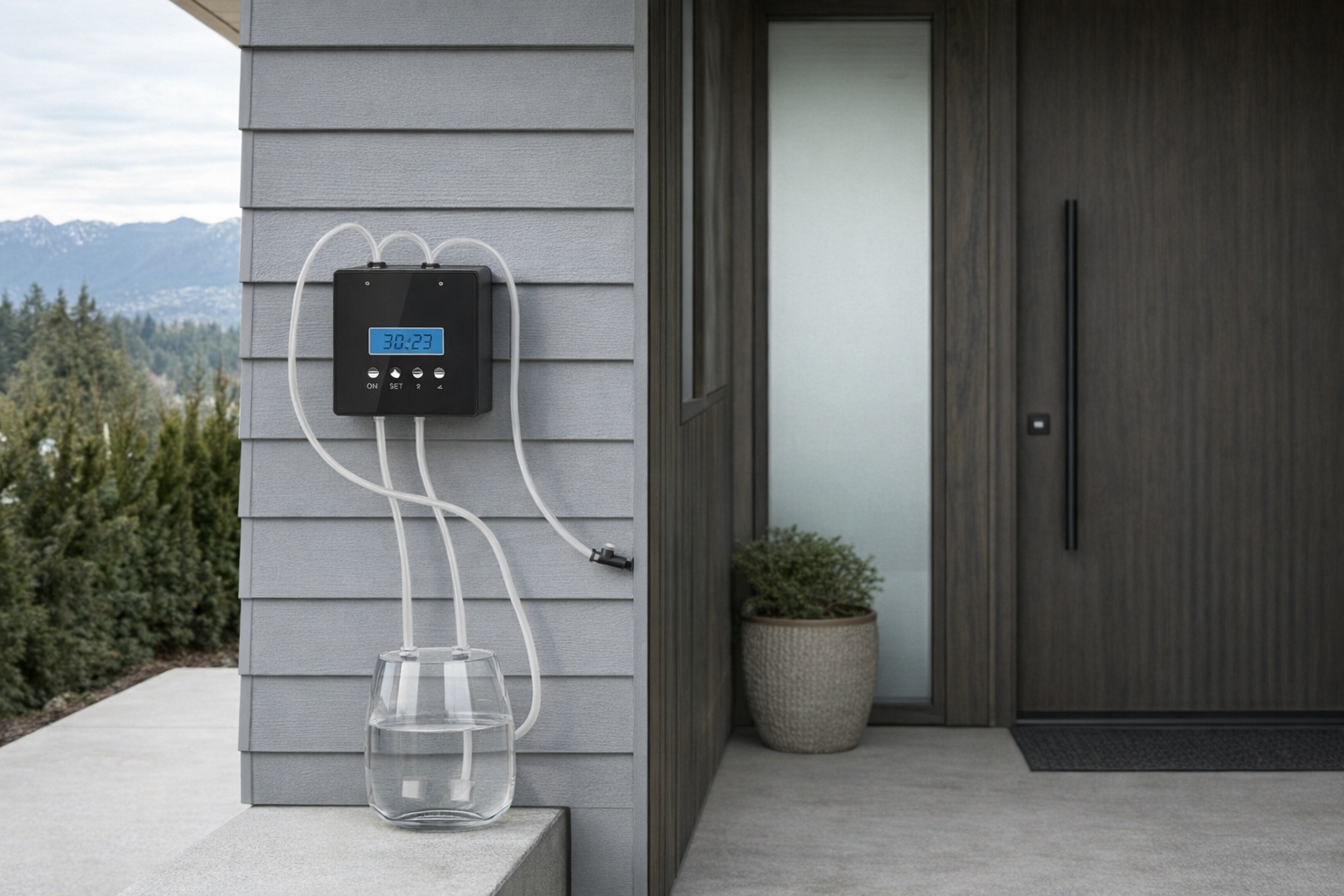
In plain English, the DAOTAILI Smart Plant Watering System appears to be a compact automatic irrigation kit designed to pull water from a separate container and deliver it to plants through small tubes on a programmed schedule. That puts it in the same broad family as vacation watering kits and indoor drip systems, not in the category of faucet-connected sprinkler controllers or sensor-rich greenhouse automation. The important distinction is that this kind of system usually automates timing, not plant diagnosis. It can be very useful, but it is only as smart as the watering schedule you set.
That empty description field is worth noting because it means buyers are leaning heavily on the product title and visible listing cues: "automatic irrigation," "self-priming," and "programmable." Those phrases tell us more than marketing fluff usually does. Self-priming suggests the unit is meant to draw water up from a reservoir rather than requiring a pressurized line, while programmable implies a timer-based controller. That is a more specific, and more modest, kind of smart watering than what people sometimes imagine when they hear "smart plant system."
A useful comparison here is the Moistenland Automatic Drip Irrigation Kit, a well-known competing style of product on Amazon. Like that kind of kit, the DAOTAILI unit is best understood as a small pump-plus-tubing system for potted plants. It is not trying to be a full garden controller with weather data, and it is not the same thing as a sensor-driven self-watering planter. That narrower role is often more honest than many competitors' "AI plant care" language.
Key features at a glance
- Programmable watering schedule rather than manual daily watering
- Self-priming pump design that can draw from a water reservoir
- Drip-style tubing setup for feeding multiple pots from one source
- Useful for vacations and routine maintenance when you cannot water by hand
- Works best with container plants rather than broad lawn or in-ground irrigation
- Likely low-water, controlled delivery compared with pouring from a watering can
How the Smart Plant Watering System actually works
Most products in this class rely on a small electric pump, narrow tubing, and a simple controller. You place the intake tube into a water container — often a bucket, jug, or reservoir — and route output tubes to the plants you want to water. Once the schedule runs, the pump moves water from the container through the lines and out to the pots. The "smart" part is usually the timing logic: how often it runs and for how long.
That matters because scheduled pump systems solve a very particular problem. Hand watering is inconsistent. One day you forget, the next day you overcompensate. A timer can smooth that out. But unlike a true sensor-led irrigation controller, it does not know whether the soil is already damp from cool weather, whether one pot drains poorly, or whether another is sitting in direct sun and drying twice as fast. So the real mechanism here is controlled repetition, not adaptive intelligence.
It also helps to separate three common watering approaches that buyers often lump together:
- Drip pump systems like this one
These use powered pumping and tubing. They are best when you want to feed several pots from one water source, especially indoors, on balconies, or on patios without a hose tap nearby. - Wicking systems
These use rope, felt, or capillary matting to draw water passively from a reservoir into soil. They are simpler and quieter, but usually slower, less controllable, and not ideal for plants with higher or variable demand. - Sensor-based irrigation systems
These add soil-moisture probes or ecosystem logic. They can be more precise, but also more expensive and more fiddly. For many people, especially around the $65 CAD range, that is overkill.
The phrase self-priming is also useful. In practical terms, it usually means the pump is designed to start drawing water without a lot of manual coaxing every time. That is important in a small household irrigation device because air bubbles and dry lines are common headaches. If the listing uses that term accurately, it suggests a setup meant to be more forgiving than a bare-bones DIY pump rig.
A realistic "day in the life" with Smart Plant Watering System
Because this is an informational piece, here is what a typical use pattern might look like based on the listing and the category — not a tested account.
- Morning. A few indoor herbs and two thirsty balcony planters get a short programmed watering cycle from a reservoir you filled earlier in the week. Instead of guessing with a watering can before work, the system delivers the same measured routine each day.
- Midday. On a hot, bright day, the limitation of timer-based watering becomes obvious: sun-exposed containers may dry out faster than shaded ones. If they share the same line schedule, one group may be happy while the other wants more. That is the trade-off for a simpler, lower-cost setup.
- Afternoon. You notice one plant is staying wetter than the rest because its potting mix drains slowly. In this kind of system, the fix is usually physical — adjust the dripper, move the plant to another group, or shorten the run time — rather than tapping an app that automatically figures it out.
- Evening. Before a weekend away, you top up the reservoir and confirm the intake tube is submerged. That is where systems like this are at their best: they reduce anxiety about plants being neglected for 2 or 3 days, or sometimes longer, as long as the water supply is large enough and the schedule is sensible.
Who the Smart Plant Watering System is actually for (and who it isn't)
Great fits
- Apartment dwellers with 6 to 12 potted plants who are tired of daily hand watering and want one reservoir-based system.
- Balcony gardeners who do not have a hose bib but still need more consistency in summer.
- Frequent travelers or cottage-goers who leave home for several days at a time and need basic plant coverage.
- People growing herbs, pothos, spider plants, or similar container plants that respond well to predictable, moderate watering.
- Plant owners managing hard-to-reach shelves or hanging baskets where manual watering is messy and annoying.
Poor fits
- Collectors of fussy plants like some orchids, succulents, or rare aroids that all want very different moisture levels.
- People expecting weather-aware outdoor irrigation for lawns, beds, or large gardens.
- Anyone who wants true feedback from the soil rather than a fixed timer.
- Households that will forget reservoir maintenance and assume "automatic" means no checking required.
- Users wanting tight integration with Apple Home, Alexa routines, or Google Home dashboards; nothing in the supplied data suggests that kind of ecosystem depth.
Practical trade-offs
Install and setup
Small irrigation kits are easy in theory and slightly fiddly in practice. The hard part is not usually powering the controller; it is routing the tubing neatly, placing the reservoir at a workable height, and making sure each plant gets an appropriate amount of flow. With several pots of different sizes, setup becomes a little like tuning a drip coffee machine made of spaghetti. That is manageable, but it is not "plug it in and forget it" on day one.
The self-priming claim helps here if it works as advertised, because manual siphoning and dry-line troubleshooting are common frustrations with cheap pump kits. Still, expect some initial calibration. The first week is usually about observing which pots stay too wet and which dry too quickly.
Maintenance and reliability
A watering system is only reliable if water can actually move through it. Narrow tubes can kink. Reservoirs can run low. Sediment, fertilizer residue, or algae can build up if the source container sits in bright light for too long. If you are using plain water and a reasonably clean reservoir, maintenance should be light, but it is not zero.
This is also why simpler systems can be better than overcomplicated ones. A timer, pump, and tube are easier to understand than a stack of sensors and cloud logic. But you do need to treat the reservoir as part of the appliance. A neglected bucket of water is not a neutral object.
Precision versus plant variety
This is the biggest honest limitation. A single timer can be excellent for a group of plants with similar needs and frustrating for mixed collections. Basil, mint, and thirsty annuals may do well on one routine. Snake plants and succulents absolutely should not be on that same schedule. If your plant collection is eclectic, the system does not become useless — it just becomes a grouping exercise.
That is why this type of product tends to work best in zones. One line for balcony tomatoes. Another system for indoor tropicals. No system at all for drought-tolerant plants. Evaluate it like a bulk watering tool, not a universal plant whisperer.
Where the Smart Plant Watering System fits in a smart home
This product fits best at the edge of a smart home, not at the centre of one. It pairs naturally with a few boring but effective companion pieces:
- A simple indoor water reservoir or lidded bucket to reduce evaporation and dust
- Smart plugs if you are building a belt-and-suspenders setup, though many watering kits already include their own timer logic
- Leak sensors placed nearby if the plants sit on hardwood, condo flooring, or near electronics
- Plant lights for indoor shelves, where watering consistency and light consistency work together
- Balcony weather awareness, meaning your phone's forecast more than some deep ecosystem integration
If you already run an Alexa, Google Home, or Apple Home household, this product is unlikely to become a first-class citizen in that system based on the provided information. Think of it more like a dedicated appliance, similar to a dehumidifier with its own controls. It has one job. That is often fine.
In practical terms, it also suits Canadian use patterns pretty well: condos with dry winter indoor air, balcony planters that bake in July, and vacation stretches when you are away for a long weekend. It is less relevant for a large in-ground garden with hose zones, where a faucet-mounted controller from Orbit or Rachio makes more sense.
The buying decision, in plain terms
Before buying this kind of watering kit, three questions usually tell you whether it is a good fit:
- Do your plants have similar watering needs?
If yes, a scheduled drip system is sensible. If no, you may spend more time compensating for mismatched plants than the automation saves. - Will you actually maintain a reservoir and tubing?
If yes, this can remove a real chore. If you want total hands-off operation, the reality may disappoint. - Do you need timer-based watering or true moisture sensing?
If a repeatable schedule is enough, this is the cheaper and simpler path. If you want the system to react to changing conditions, look higher up the market.
If those answers line up, the DAOTAILI Smart Plant Watering System looks like a sensible, low-cost way to automate container watering without pretending to be smarter than it is.
Got Questions About the Smart Plant Watering System? Let's Clear Things Up.
Is this a hands-on review?
No. This is an informational explainer based on the listing details provided and on how pump-based watering systems in this category generally work. It is meant to help you decide whether this type of product fits your plants and routine.
Is this the same as a self-watering planter?
No. A self-watering planter usually has a built-in reservoir and passive watering mechanism inside the pot itself. The Smart Plant Watering System is better understood as a central watering device that pushes water through tubes to separate pots.
Does it use moisture sensors?
Nothing in the supplied product data confirms moisture sensing. Based on the wording provided, this looks more like a programmable timer-and-pump system than a sensor-led irrigation setup. Check the current retailer page if sensor support is a deciding factor.
Is it good for vacations?
Yes, that is one of the most obvious use cases for products in this class. As long as the reservoir holds enough water and the schedule is dialed in, automatic watering can cover a few days away very well. The catch is that you still need to confirm tube placement and water supply before leaving.
Can it handle outdoor plants?
Potentially, yes for potted outdoor plants, balcony containers, or patio planters. That is different from managing a lawn, raised-bed irrigation network, or in-ground garden zones. For broad outdoor watering, a hose-connected controller is the better tool.
Where can I verify the current listing details or buy it?
The current retailer page for the DAOTAILI Smart Plant Watering System is on Amazon here. That is the best place to verify current price, included accessories, and any updated specs or photos before buying.
What does it cost in Canada?
At the time of writing, the listed price is roughly ~$65 CAD. That places it in the affordable end of automatic plant watering, well below larger smart irrigation controllers. As always with Amazon listings, check the live page because pricing can move around.
Where is the Celmin Directory listing for this product?
For a catalog-style view of the same product — structured specs, pros and cons, similar picks, and FAQ — see Smart Plant Watering System on Celmin Directory.
If you're building a smarter home in Canada and want honest explainers on gadgets worth considering — plus the ones worth skipping — Celmin covers the full catalog without the marketing theater. More reviews, comparisons, and buyer guides at https://celmin.ca.


Discussion
Sign up or sign in to join the conversation.