
You're halfway through a podcast when the upstairs neighbour starts moving furniture. Outside, a delivery truck idles below the window, your condo's heat is running too warmly, and the person beside you is asking whether you can hear them. You want enough volume to follow the conversation, but not enough to disturb the next unit or strain your ears.
That's the everyday Canadian case for closed-back headphones. They won't silence a building, replace certified hearing protection, or solve every comfort problem, but a well-fitting pair can keep sound contained, reduce competing noise, and make music, calls, and podcasts easier to enjoy in shared homes and transit environments.
Table of Contents
- Why Your Home Environment Demands Isolation
- What Makes Closed Back Headphones Different
- Closed Back Versus Open Back Headphones
- The Perfect Fit for Canadian Commuters and Renters
- Choosing Comfort for Long Listening Sessions
- Final Verdict and Buying Advice
Why Your Home Environment Demands Isolation
Canadian homes rarely offer perfect acoustic privacy. A Vancouver condo may pass traffic and hallway noise through thin walls. A Toronto apartment can put a streetcar, construction crew, and neighbour's television into the same listening session. In a suburban house, winter changes the routine: windows stay shut, heating systems run, and family members spend more time indoors.
Open-back headphones make that situation harder. Their earcups allow air and sound to move through the housing, creating a spacious presentation but also leaking your music into the room. They let outside noise in, too. That's a poor arrangement when you're working beside a sleeping partner, sharing a home office, or trying to hear a podcast over a furnace.
A closed design seals the rear of each earcup. The pads create a contact surface around your ears, while the enclosed housing limits leakage and reduces some external sound before it reaches your ears. That combination is useful for more than music. It helps keep speech intelligible during a video call and stops a late-night gaming session from becoming everyone else's soundtrack.
For practical work setups, pair selection matters as much as isolation. A guide to noise-cancelling headphones for work is useful when your main problem is conversation, office equipment, or shared-room distraction. Still, don't assume active noise cancellation is automatically the better choice. A passive closed-back model can be simpler, cooler, and free from battery management.
The Canadian noise problem is real
The need isn't just anecdotal. Statistics Canada found that 53% of Canadians aged 3 to 79 had used earbuds or headphones for music, films, or other audio during the previous 12 months in its 2012–2015 Canadian Health Measures Survey. Among those users, one-third regularly listened at or above three-quarters of their device's maximum volume (Statistics Canada's headphone-use and hearing-loss results).
Those figures don't isolate closed-back models, so they aren't proof that one headphone design is safer than another. They do show why reducing the need to overpower background noise is a sensible buying priority.
A closed-back pair suits the listener who needs privacy in both directions. You hear less of the room, and the room hears less of you. In Canadian condos, rentals, home offices, and commutes, that practical exchange is usually more valuable than the widest possible soundstage.
What Makes Closed Back Headphones Different
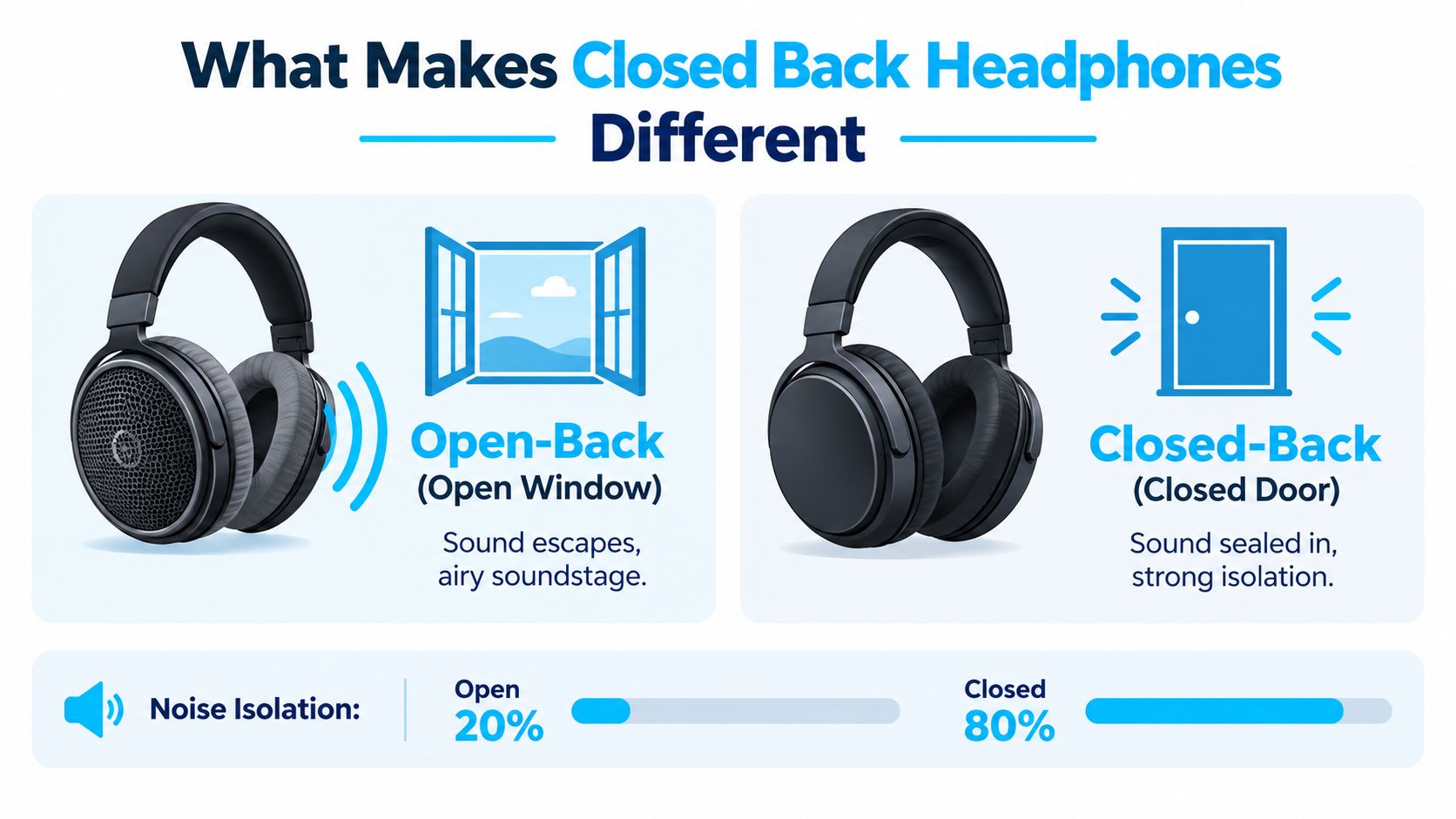
Closed-back headphones use a solid rear housing, sealed ear pads, and a driver tuned within an enclosed chamber. That construction creates a physical barrier between your ears and the room. It will not erase a condo neighbour, furnace, or bus engine, but it reduces the sound reaching you and limits what escapes.
The main parts are straightforward:
- Enclosed earcups: The driver's rear is covered rather than vented, which limits sound leakage into the room.
- Sealing pads: Cushions sit around the ear and reduce gaps where outside noise can enter.
- Passive isolation: The housing and pads reduce some external noise without microphones, processing, or a battery.
- Driver tuning: The enclosed space affects how bass, voices, and treble reach your ears.
Why the seal matters more than the label
A closed housing only works well when the pads sit securely. Glasses arms, hair, uneven clamp, or earcups that are too small can create gaps. The box may be closed, yet the practical isolation can still disappoint.
Pad design deserves as much attention as driver type. Thick memory foam can form a dependable seal. Soft fabric usually feels cooler, but it allows more sound through. Leather and synthetic leather often block noise effectively, although both can retain more heat during warm indoor sessions or summer commutes.
The seal also changes the sound. Many closed models produce firm, concentrated bass because the enclosed chamber reinforces low-frequency energy. Some sound focused and intimate. Others use venting or damping to prevent a congested presentation. Treat “closed” as a description of physical architecture, not a guarantee of sound quality or a particular tuning.
Passive isolation has clear limits
Closed-back headphones are not hearing protectors. They do not cap driver output, and a loud source can still create excessive exposure. Health Canada notes that 85 dBA for 45 minutes per day presents no known risk of hearing loss, while 85 dBA or higher for 8 hours per day can pose a significant risk. Its guidance also warns that headphone or earbud listening at 100 dB can reach a hazardous exposure level in about 15 minutes (Health Canada's hearing-loss and noise guidance).
Use isolation to keep the volume reasonable, not to justify louder playback. If your ears ring, hearing sounds muffled after removal, or normal conversation seems dull, lower the level and shorten the session.
For a visual explanation of the enclosure, seal, and listening trade-offs, this video offers a useful overview:
Closed Back Versus Open Back Headphones
The question is where you will listen most often. Open-back headphones suit a quiet room and create a broad, airy presentation. Closed-back headphones give up some openness for privacy and better control over condo noise, household sounds, and transit rumble.
| Priority | Closed back | Open back |
|---|---|---|
| Isolation | Reduces outside noise and limits leakage | Offers little isolation in either direction |
| Sound presentation | Often focused, weighty, and direct | Often spacious and natural |
| Shared spaces | Works well in bedrooms, offices, and condos | Usually unsuitable around other people |
| Transit | More practical, especially with a secure seal | External noise quickly competes with the music |
| Heat | Can feel warmer over long sessions | Usually allows more airflow |
| Listening privacy | Stronger choice for calls, games, and late-night use | Best when nobody else is nearby |
Open-back models earn their advantage in a quiet listening room. Without a sealed rear chamber, instruments can feel less boxed in, which suits classical music, acoustic recordings, and focused desktop listening. A bus engine, neighbour, furnace, or thin condo wall quickly weakens that benefit. Seasonal temperature swings matter too. An open design may feel more comfortable in a warm room, while a closed model can become noticeably warmer during a long summer session.
Closed designs usually sound more intimate. Bass can feel denser, vocals may sit closer, and busy recordings can seem more concentrated. Tuning still matters. A cheap or poorly damped closed headphone may sound boomy, hollow, or tiring, while a well-designed model can remain detailed and balanced.
Price shouldn't decide the design
A lower price or impressive product page should not push you toward open back. If you listen in a shared home, limited isolation turns its sound-quality advantage into a daily nuisance. You will hear more room noise, disturb people nearby, and have fewer useful listening hours.
The reverse applies in a private room. If you want a natural, spacious presentation, open back is a sensible choice. A closed model may add warmth and pressure that you do not need, especially during extended desktop listening.
For a smaller, less enclosing option, in-ear headphones offer a different balance of portability and isolation. They are not suitable for everyone, particularly listeners who dislike an in-ear fit, but they deserve comparison before you buy a large over-ear headset.
Practical rule: If someone is sleeping, working, studying, or watching television in the same room, choose closed back. If you are alone in a quiet room, choose based on sound preference and comfort.
For Canadian renters and condo residents, closed back is usually the better default. A narrower soundstage is a fair trade for privacy, steadier listening through household noise, and less temptation to raise the volume on a crowded train or during a cold, drafty commute.
The Perfect Fit for Canadian Commuters and Renters
A bus engine, a reverberant subway platform, and a crowded train create different listening problems. Add the shift from a heated vehicle to a cold, exposed station, and your headphones face changing conditions throughout one commute. A dependable earcup seal matters more here than a specification that looks impressive on a product page.
Closed-back headphones reduce competing sound before it reaches your ears. Speech, bass lines, and podcast dialogue become easier to follow without immediately raising playback volume. They do not make loud listening safe, but quieter surroundings remove one common reason to turn the level up.
Federal survey data provides useful context. The Statistics Canada results classify hearing loss as slight or worse in 8% of children and youth aged 6 to 19, and report that 40% of adults aged 20 to 79 had at least slight hearing loss in one or both ears during the measured period (the same Statistics Canada audiometry results). Those findings describe hearing status broadly, not headphone users specifically. Treat volume and listening time seriously instead of using the figures to predict your personal risk.
Why renters benefit twice
Renters deal with noise in both directions. Building sounds come through the walls, while your own headphones can send sound into a shared room or a thin party wall. Closed-back designs handle both privacy problems better than open-back models.
That makes them practical for evening gaming, early-morning work, and shared-room viewing. You can reduce sound reaching a sleeping partner, keep a video call from filling the room, and limit what travels through the wall. Isolation does not replace awareness. Footsteps, plumbing, and smoke alarms can still matter, so keep enough environmental awareness for safety.
A 2025 Canadian poll found that 63% of respondents said their municipality had become noisier over the previous year, while 11% reported acquiring noise-cancelling headphones or earphones to deal with noise (Research Co.’s Canadian noise poll). The poll covers noise-cancelling products generally, not passive closed-back headphones, but it reflects the conditions influencing Canadian buyers.
Use the whole-day exposure picture
Headphone use can span a morning commute, a work block, a video call, and evening entertainment. Canadian federal occupational guidance lists an 87 dBA average over 8 hours as an exposure reference, with allowable duration falling to 4 hours at 90 dBA, 1.3 hours at 95 dBA, and approximately 24 minutes at 100 dBA (Canadian federal occupational hearing guidance).
These are workplace benchmarks, not a consumer headphone rating. They show why modest volume increases matter. Set a phone volume limit or use exposure monitoring where available, take breaks, and lower the level once a good seal lets you hear clearly.
Choosing Comfort for Long Listening Sessions
A long work block in a condo exposes every comfort flaw. Clamp pressure reaches your jaw, glasses can break the seal, and warm earcups become unpleasant before the playlist ends. Closed-back headphones earn their place only if you can wear them through a commute, a video call, or an evening at home.
Start with the earcups. Your ears should sit fully inside the pads, away from the driver grille and inner wall. Shallow cups create pressure quickly, while narrow cups press against the outer ear. The headband should spread its weight across your head instead of creating one painful hot spot.

Check the fit in this order
- Ear clearance: Make sure the entire ear sits inside the cushion. Thick pads do not help if the ear still touches the interior.
- Clamp: The headphones should stay secure when you turn your head, without squeezing your jaw. A loose fit may feel comfortable at home and shift during a crowded commute.
- Glasses compatibility: Thick frames can create gaps at the temples and weaken isolation. Softer cushions or thinner frame arms usually seal more effectively.
- Headband adjustment: Set both cups evenly. Uneven positioning can concentrate pressure on one ear and leave the other side with a weaker seal.
- Movement: Test speech, walking, and head turns. A stable fit matters more than a perfect seal while you sit still.
Material choice should match the season and your room. Leather and synthetic leather usually block more sound and wipe clean easily, but they can trap heat in a warm summer condo. Fabric feels cooler during long work sessions, though it can absorb moisture and provide less isolation. Memory foam can conform around glasses and hair, but comfort depends on its density and how quickly it returns to shape.
Plan for Canadian temperature swings
Winter changes the fit. Thick pads feel welcome in a cold room, yet a hat or toque can alter the clamp and interfere with the seal. If you commute outdoors, adjust the headphones after putting on your headwear. A fit that works over bare hair may feel too tight under winter layers.
Summer calls for ventilation and maintenance. Take short breaks, wipe the pads, and choose replaceable cushions so worn material does not force a full replacement. Removable pads also let you change the feel later as indoor temperatures shift through the year.
For over-ear models with wireless convenience, compare options in this practical wireless over-ear headphones guide. Prioritize pad shape, balanced weight, and controls you can operate without removing the headphones. Wireless freedom cannot fix a painful clamp or a poor seal.
A comfortable seal beats maximum clamp. The pads should meet your head, not squeeze it.
Final Verdict and Buying Advice
For the average Canadian listener, closed-back headphones are the sensible default. They suit condo walls, rented bedrooms, shared home offices, winter indoor routines, and noisy commutes. Open-back headphones can sound more spacious, but that advantage requires a quiet, private room that many people don't have.
Choose the design first, then judge individual models by how they handle your routine. Don't buy on driver jargon alone. A headphone with excellent specifications is still a poor purchase if the pads leak around your glasses or the clamp becomes painful during a work session.
Use this buying checklist
- Prioritise passive isolation: Look for earcups and pads that create a dependable seal without excessive pressure.
- Check comfort materials: Decide whether you need cooler fabric for summer, wipe-clean synthetic leather, or soft foam for glasses compatibility.
- Protect your hearing: Use moderate levels, monitor cumulative listening, and take breaks. Closed back doesn't mean hearing protection.
- Match the source: A phone or laptop may drive some headphones easily, while others may need more power. Don't assume an amplifier improves safety.
- Consider awareness: You still need to hear doorbells, alarms, children, traffic, and important conversations. Isolation becomes a problem when it removes necessary awareness.
- Treat ANC as optional: Active noise cancellation can help with steady low-frequency noise, but a well-sealed passive model is often enough for rooms, commuting, and leakage control.
My recommendation is direct. If you live with other people, share walls, or commute regularly, start with a comfortable closed-back model that seals well and can be worn at a sensible volume. Spend less time chasing an airy soundstage and more time checking pad fit, heat management, glasses compatibility, and how the headphone behaves after a long session.
Celmin publishes Canadian audio buying guides and reviews that compare headphones by isolation, comfort, sound, and everyday use. Visit Celmin to compare practical options for your home, commute, and seasonal listening habits.
Sign up or sign in to join the conversation.