

The Momax OneSense Soul sits in one of the more interesting corners of wearables right now: the smart ring that wants to do more than count steps and sleep. Plenty of rings already promise discreet health tracking. What makes this one stand out on paper is the extra layer of haptic alerts...
The Momax OneSense Soul sits in one of the more interesting corners of wearables right now: the smart ring that wants to do more than count steps and sleep. Plenty of rings already promise discreet health tracking. What makes this one stand out on paper is the extra layer of haptic alerts, touch gesture controls, and AI mood tracking packed into a ring that reportedly weighs just 2.8g. That is a more ambitious pitch than the usual "fitness tracker, but smaller" approach.
This is not a hands-on review. Nothing here is based on personally wearing the ring. The goal is simpler and, for most buyers, more useful: explain what the Momax OneSense Soul actually is, how its listed features are supposed to work together, and who it realistically makes sense for. If you are trying to figure out whether this is a practical wearable or just an attractive spec sheet, this is the calmer version of that conversation.
📺 Watch: Momax OneSense Soul in context
Quick snapshot
| Question | What the Momax OneSense Soul actually is |
|---|---|
| Category | Smart Rings |
| Made by | Momax |
| Typical price | ~$141 CAD (listing at the time of writing — verify current pricing) |
| Rating signal | Check current reviews |
| Best for | People who want discreet health tracking plus silent notifications and simple gesture control |
| Skip if | You want a screen, deep smartwatch apps, or proven medical-grade mood insights |
Pro tip: Treat the Momax OneSense Soul as a lightweight wearable companion, not a replacement for a smartwatch. Its real appeal is subtlety: vibration on your finger, passive tracking, and a ring form factor you can forget you're wearing.
What the Momax OneSense Soul actually is
In plain English, the Momax OneSense Soul is a smart ring that tries to combine three ideas in one device: a health tracker, a silent notification tool, and a small remote control for your phone. Most smart rings focus heavily on sleep, recovery, heart-related signals, and general activity. The Momax ring adds a tactile layer with vibration alerts and touch gestures, which suggests it is meant to feel a bit more interactive in daily use than a passive tracker.
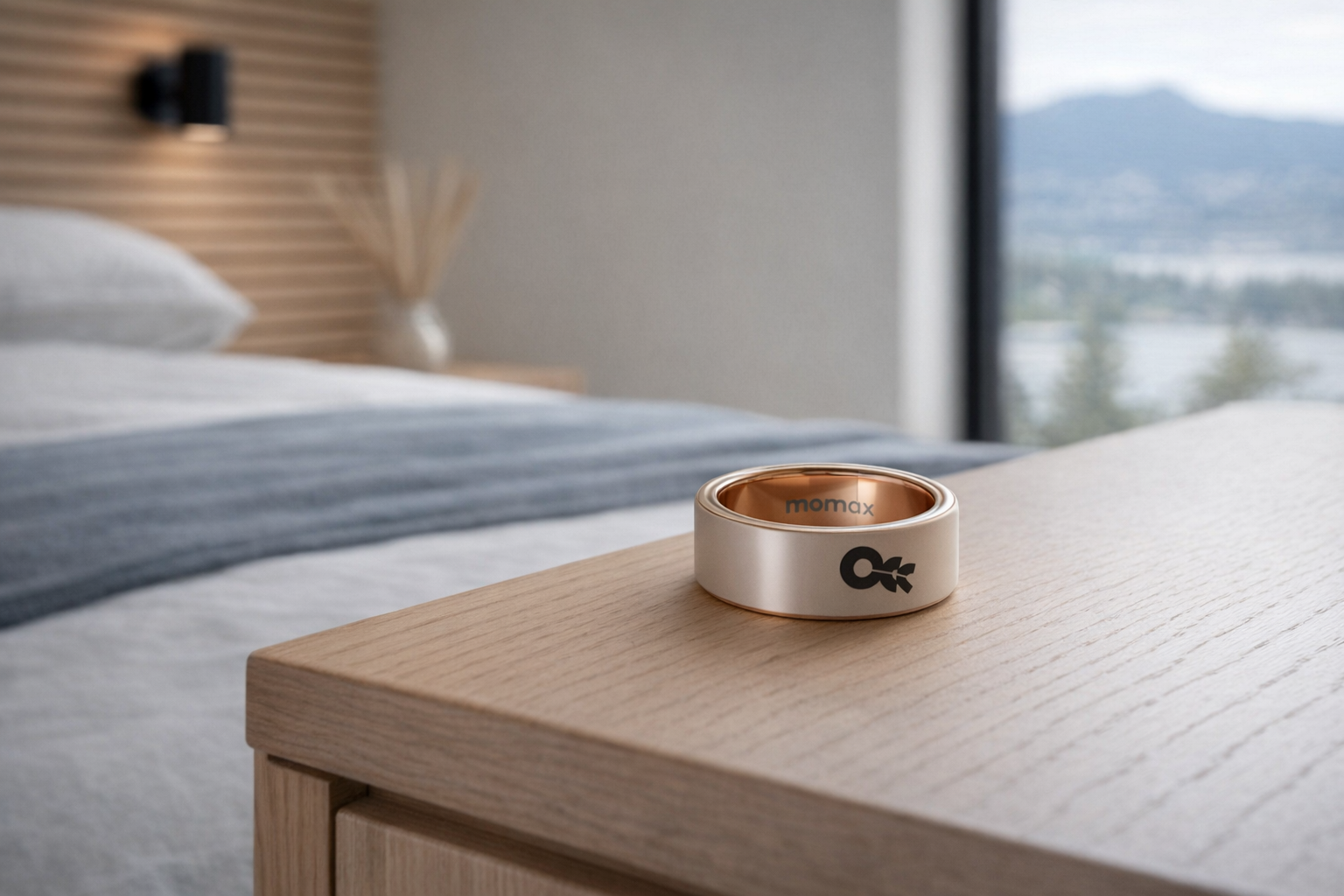
The Momax OneSense Soul is the world's first haptic smart ring with AI mood tracking. Weighing just 2.8g in a latte beige ceramic design, it features haptic vibration alerts, touch gesture controls, AI-based sentiment analysis, and comprehensive health tracking. IP68/5ATM waterproof with up to 6 days battery life and no subscription required for the companion app.
That combination makes it different, at least on paper, from a well-known competitor like the Oura Ring. Oura has built its name around sleep, readiness, and polished app insights, but it does not position itself as a haptic notification ring with touch gesture controls in the same way. Momax is clearly aiming at buyers who want the ring to do a little more in the moment, not just summarize data afterward. Whether that turns out to be genuinely useful is the right question to ask before buying.
Key features at a glance
- Haptic vibration alerts for silent notifications on your finger
- AI mood tracking and sentiment analysis
- Ultra-light 2.8g ceramic design in latte beige
- Touch gesture controls for music, camera, and presentations
- IP68 / 5ATM water resistance for daily wear and swimming
- Up to 6 days of battery life
- No subscription required for the companion app
- Comprehensive health tracking, according to the listing
How the Momax OneSense Soul actually works
A smart ring like this generally works by combining small internal sensors with a phone app. The ring collects data from your finger throughout the day and night, then sends that data to the app over Bluetooth for analysis and presentation. The finger is a useful place for this because blood flow signals can often be captured consistently there, which is why rings can be good at passive, all-day tracking without needing a watch-sized body.
For the Momax OneSense Soul, there appear to be three main layers to understand.
- Health sensing. The ring is advertised with comprehensive health tracking, which implies routine wearable basics such as activity and sleep-style monitoring, likely paired with heart-related or wellness signals processed in the app. The exact sensor list is not supplied here, so the honest move is to check the current spec page before assuming more than the listing claims.
- Haptic and gesture interaction. This is the headline feature set. Vibration alerts mean the ring can discreetly notify you without a buzzing phone in your pocket or a lit-up watch on your wrist. Touch gestures for music, camera, and presentations suggest the outer surface or ring body can register taps or other simple inputs and translate them into commands through the connected phone.
- AI mood tracking. This is the feature that needs the most skepticism. Wearables can estimate patterns related to stress, rest, activity, and physiological variation. Turning that into "mood" or "sentiment analysis" is a bigger leap. That does not mean it is useless; it means it should be treated as a wellness-oriented interpretation, not a psychological diagnosis.
The listed 6-day battery life is also important because it tells you how Momax expects the ring to be used: worn continuously, charged occasionally, and not fussed over every night. That is one of the practical advantages of rings over smartwatches. A ring that lasts close to a work week is easier to live with than a watch that needs frequent top-ups, though real runtime always depends on notification frequency, sensor sampling, and how aggressively the gesture features are used.
The IP68 / 5ATM rating matters too. In practical terms, that means the ring is built to handle day-to-day water exposure and, according to the listing, swimming. That makes it more believable as an always-on wearable. If you have to remove a ring every time you wash dishes, shower, or deal with slushy winter weather, it stops being convenient very quickly.
A realistic "day in the life" with Momax OneSense Soul
Because this is an informational explainer, the scenario below is based on the listed features and how smart rings typically fit into daily routines — not a tested diary.
- Morning. You wake up and open the app to look at whatever sleep, recovery, or wellness summary the ring provides. If the AI mood feature is active, this is probably where it surfaces a daily emotional or stress-style readout based on overnight and recent physiological data.
- Midday. At work, the haptic vibration alerts become the main draw. Instead of glancing at a smartwatch screen every few minutes, you get a silent buzz on your finger when something important comes in. That is a subtler kind of notification, and for some people, less socially annoying.
- Afternoon. During a meeting or presentation, the touch gesture controls are the interesting part. The ring is advertised to help with presentations, music, and camera controls, which implies simple taps or gestures can trigger phone-based actions without pulling the phone out every time.
- Evening. At the gym, in the pool, or just during normal end-of-day chores, the water resistance and low-profile design should matter more than the AI angle. A 2.8g ring that stays on through hand-washing and swimming is easier to treat as background tech rather than a gadget demanding attention.
Who the Momax OneSense Soul is actually for (and who it isn't)
Great fits
- People who dislike smartwatches but still want passive health tracking on the body.
- Office workers who want silent alerts without wearing a glowing screen on their wrist all day.
- Frequent presenters who like the idea of a discreet wearable trigger for slides or phone-based controls.
- Minimalists who want one wearable that can track wellness, survive swimming, and not require a monthly app fee.
- Buyers curious about smart rings but unwilling to pay flagship-ring prices first.
Poor fits
- Anyone expecting Apple Watch-level apps, screens, and interaction. A ring is a much smaller, simpler device.
- People who want medically validated emotional analysis. "AI mood tracking" should be treated carefully.
- Users who need advanced sports metrics, onboard GPS, or rich workout displays during exercise.
- Shoppers who mainly want the most mature smart ring ecosystem and best-known app polish; that is still where established players like Oura tend to have the advantage.
- Anyone bothered by charging small accessories or managing another device in their Bluetooth list.
Practical trade-offs
Mood tracking versus real emotional insight
This is the first big reality check. The listing highlights AI mood tracking and sentiment analysis, which sounds impressive and also slightly slippery. Wearables are good at spotting patterns in rest, activity, and stress-related signals. They are much less reliable at understanding why you feel the way you feel.
So the right way to read this feature is as a wellness prompt, not an authority. If the app nudges you to notice bad sleep, an off day, or a stressful stretch, that can be useful. If you are hoping the ring will accurately decode your emotional state from sensor data alone, that is asking too much of current consumer wearables.
Gesture controls sound great — but only if they fit your habits
The second trade-off is practical usefulness. Touch controls for music, camera, and presentations are genuinely interesting because they give the ring a purpose beyond passive tracking. But features like this can land in two very different ways: either they become a small daily convenience, or they become something you try twice and forget exists.
That depends on your routines. If you regularly prop up your phone for photos, pause music while commuting, or click through slides during meetings, the idea makes sense. If you mostly leave your phone in your hand anyway, the ring's control gestures may be more novelty than necessity.
Ring sizing, wear comfort, and durability matter more than marketing
A smartwatch can be loosened, tightened, or moved. A ring has to fit properly. That makes sizing and comfort a more serious purchase factor here than with many wearables. The listed 2.8g weight and ceramic build suggest Momax is aiming for a light, premium-feeling experience, but the truth of ring wear is simple: if the fit is wrong, the product is wrong.
Ceramic can also feel elegant while raising practical questions about long-term knocks and scratches in everyday life. The IP68 / 5ATM protection helps with water exposure, but it does not make the ring indestructible. Evaluate it like a piece of daily-wear electronics, not like a plain metal band you never think about.
Where the Momax OneSense Soul fits in a smart home
The Momax OneSense Soul is not really a smart-home control centre, and that is fine. Its best role is as a personal wearable input layer sitting beside a more conventional setup.
A realistic stack might look like this:
- Apple Health, Google Fit, or the brand's own app for collecting and viewing health data
- A smartphone as the bridge for notifications, camera control, and music playback
- Smart speakers like an Amazon Echo or Google Nest speaker for home control and voice routines
- A smartwatch or fitness watch only if you still need a display for workouts or navigation
In that setup, the Momax ring handles quiet, body-worn awareness: subtle buzzes, passive tracking, quick gestures. Your phone still does the heavy lifting, and your home assistant still runs lights, routines, and thermostats. That is the healthiest expectation to set. This ring is a personal accessory, not infrastructure.
It may also make sense for specific routines. For example, if you use your phone to run music in the kitchen, trigger a camera shutter for family photos, or control slides in a home office, the gesture features could slot into daily life more naturally than they would for someone who just wants wellness graphs.
The buying decision, in plain terms
Before buying the Momax OneSense Soul, three questions usually sort this out quickly:
- Do you actually want a ring, or do you just want wearable tracking? If you want a screen, workout prompts, maps, and app interactions, buy a watch instead. If you want something small and quiet that mostly disappears on your hand, the ring form makes sense.
- Will you genuinely use haptics and gesture controls? These are the product's most distinctive features. If silent vibration alerts and tap-based controls sound useful in your routine, the ring becomes much more compelling.
- Are you comfortable treating AI mood insights as light guidance, not hard truth? If yes, the wellness angle may be interesting. If no, then this part of the pitch should not be a deciding factor.
If those answers lean yes, the Momax OneSense Soul looks like a sensible, lower-cost way into smart rings; if not, a basic fitness band or a more established ring may be the cleaner choice.
Got Questions About the Momax OneSense Soul? Let's Clear Things Up.
Is this a hands-on review?
No. This is an informational explainer based on the listed product details and broader smart-ring category patterns. It is meant to help you understand what the Momax OneSense Soul appears to offer before you decide whether to research further.
Does the Momax OneSense Soul need a subscription?
According to the listing, no subscription is required for the companion app. That is a meaningful advantage in a category where some wearables increasingly tie better insights or long-term data features to monthly fees.
Is the Momax OneSense Soul waterproof enough for swimming?
The ring is listed as IP68 / 5ATM waterproof, and the feature summary specifically mentions swimming. That suggests it is intended for regular water exposure rather than just splash resistance, though it is still wise to check the current care guidance on the official product page for any limits around hot water, diving, or long exposure.
How long does the battery last?
Momax lists up to 6 days of battery life. As always with wearables, "up to" is the key phrase: actual runtime will depend on how often notifications fire, how aggressively sensors sample, and how much you use interactive features like haptic alerts and gesture controls.
Can it control music, a phone camera, and presentations?
According to the listing, yes. The Momax OneSense Soul is advertised with touch gesture controls for music, camera, and presentations, which implies it acts as a Bluetooth-connected input device through the companion app or phone integration. Check current compatibility details if you use a specific phone platform or presentation app.
Where can you verify the latest specs or buy it?
The best place to verify current details is the official retailer page: Momax OneSense Soul product page. That is where you should confirm sizing, battery claims, supported features, and current pricing before ordering.
What does it cost in Canada?
At the time of writing, the listed price is ~$141 CAD. That is low enough to make it feel more like an experimental premium accessory than a major wearable investment, but prices can shift, so verify the current amount on the retailer page before buying.
Where is the Celmin Directory listing for this product?
For a catalog-style view of the same product — structured specs, pros and cons, similar picks, and FAQ — see Momax OneSense Soul on Celmin Directory.
If you're building a smarter home in Canada and want honest explainers on gadgets worth considering — plus the ones worth skipping — Celmin covers the full catalog without the marketing theater. More reviews, comparisons, and buyer guides at https://celmin.ca.


Discussion
Sign up or sign in to join the conversation.