
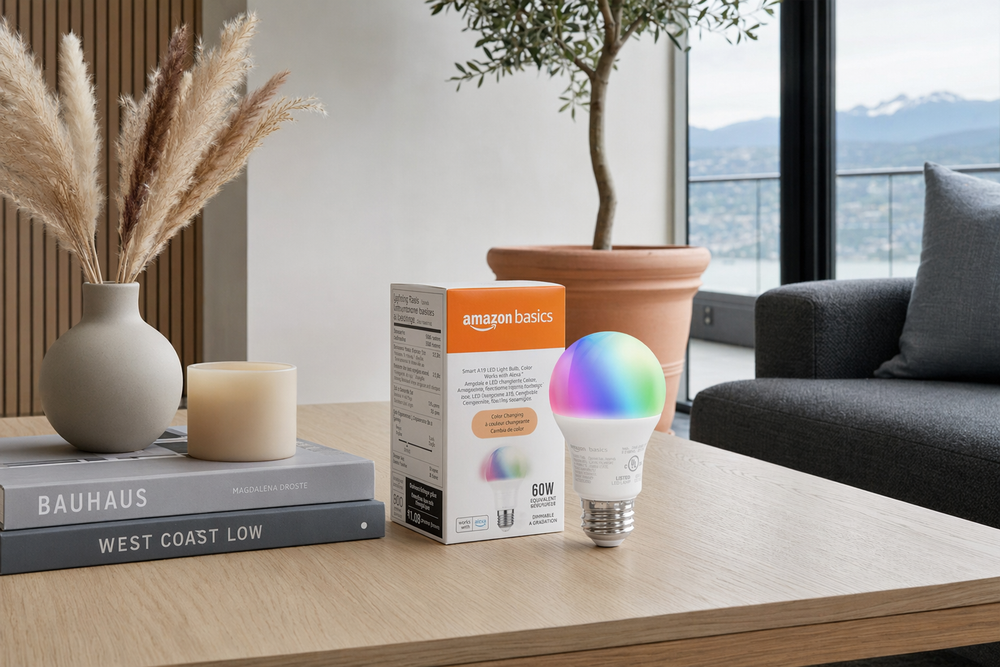
The Amazon Basics Smart Light Bulbs sit at the very low-friction end of the smart-home market: not a flashy gadget, not a statement piece, and not the kind of product people brag about owning. They are simply connected light bulbs meant to replace the plain bulbs already in lamps, ceiling fix...
The Amazon Basics Smart Light Bulbs sit at the very low-friction end of the smart-home market: not a flashy gadget, not a statement piece, and not the kind of product people brag about owning. They are simply connected light bulbs meant to replace the plain bulbs already in lamps, ceiling fixtures, or bedside lights — with app control, voice control, and automation layered on top. That sounds modest, and it is. But in a real home, smart bulbs are often one of the fastest ways to make routines feel genuinely smarter.
This article is not a hands-on review. Nothing here is based on personally using the bulbs. Instead, the goal is to explain what the Amazon Basics Smart Light Bulbs actually are, what their low price likely means in practical terms, and who they make sense for based on the listing details and the broader smart-lighting category. If you are trying to decide whether a ~$12 CAD bulb is a smart bargain or just cheap for a reason, this is the calmer version of that conversation.
Quick snapshot
| Question | What the Amazon Basics Smart Light Bulbs actually are |
|---|---|
| Category | Smart Home |
| Made by | Amazon Basics |
| Typical price | ~$12 CAD (listing at the time of writing — verify current pricing) |
| Rating signal | 4.4/5 on the source listing |
| Best for | Alexa households, renters, first-time smart-home buyers, cheap lamp upgrades |
| Skip if | You want premium colour quality, broad ecosystem flexibility, or whole-home lighting design |
Pro tip: Use Amazon Basics Smart Light Bulbs in secondary lighting first — table lamps, hallway lamps, kids' rooms, or a porch fixture — not the one living-room light you care about most. Budget smart bulbs make more sense when convenience matters more than perfect light quality.
What the Amazon Basics Smart Light Bulbs actually is
In plain English, these are entry-level smart bulbs sold under Amazon's house brand. Their job is simple: screw into a compatible fixture, connect them through Amazon's ecosystem, and let you turn lights on and off, dim them, or in some versions change colour, without touching the switch every time. If you already use Alexa devices, that is the real pitch. The bulb itself is the hardware; the value comes from routines, schedules, and voice control.
The missing description on the listing data is a bit telling in its own way. Amazon Basics products are usually sold on a straightforward promise rather than on a lot of storytelling. That can be good. A light bulb does not need a personality. What matters more is whether it handles the basics reliably: turns on when scheduled, reconnects after power cuts, dims without fuss, and does not make you install a complicated bridge for a lamp by the couch.
The clearest comparison here is to Philips Hue White and Color Ambiance bulbs. Hue remains the more mature, premium system, with better ecosystem support, stronger app depth, and a longer reputation in smart lighting. But Hue bulbs often cost many times more than ~$12 CAD. Amazon Basics Smart Light Bulbs are clearly aimed at people who want the core convenience of smart lighting without paying premium-system prices. That is a more honest proposition than pretending a budget bulb is the same thing as a flagship one.
Key features at a glance
- Smart lighting control through Amazon's ecosystem
- Voice-control potential with Alexa in compatible setups
- App-based scheduling and routines typical of connected bulbs in this category
- Budget-friendly pricing at roughly $12 CAD per listing
- Simple bulb-swap installation compared with rewiring a switch
- Possible dimming and colour options depending on the exact bulb version on the listing page
How the Amazon Basics Smart Light Bulbs actually works
A smart bulb like this combines a normal LED light with a small wireless radio and onboard controller. Instead of behaving like a plain bulb that only responds to wall power, it also responds to commands from an app, a smart assistant, or an automation routine. That means the bulb needs two things to stay useful: constant power at the fixture, and a stable connection to the ecosystem it is designed for.
In practical terms, the setup pattern is usually straightforward. You screw the bulb into a standard socket, turn the light on at the wall, then pair it through the relevant app or Alexa flow. Once paired, the bulb can appear as a controllable device in routines like “turn on at sunset,” “dim to 20% at bedtime,” or “switch off when everyone says goodnight.” The physical wall switch still matters, though. If someone turns the lamp fully off at the switch, the smart features disappear until power is restored. That is not a flaw unique to Amazon Basics — it is one of the core trade-offs of smart bulbs generally.
There is also an important distinction between smart bulbs and smart switches. A bulb is the easier retrofit. You do not need an electrician, and renters can usually take it with them when they move. But bulbs work best when people in the home understand that the switch should usually stay on. A smart switch, by contrast, often feels more natural for shared spaces because the wall control remains the main control. For a bedroom lamp or a reading nook, bulbs are often ideal. For a heavily used kitchen ceiling fixture, they can be the wrong tool.
What the low price implies is equally important. A $12.42 CAD smart bulb is unlikely to be competing on premium colour rendering, ultra-refined app features, or top-tier materials. It is probably competing on “good enough to automate a lamp.” For many households, that is perfectly fine.
A realistic "day in the life" with Amazon Basics Smart Light Bulbs
Because this is an informational piece, here is what a typical day might look like based on the listing context and how smart bulbs usually fit into a home — not a tested account.
- Morning. A bedside lamp using an Amazon Basics Smart Light Bulb turns on at a scheduled time instead of leaving you to wake up in a dark room. If paired with Alexa routines, it could come on gradually or at least reliably enough to act as a simple visual cue that the day has started.
- Midday. A home-office lamp is switched on by voice rather than by reaching behind a desk. That sounds small, but it is exactly the kind of tiny friction smart bulbs remove. The best-case use for budget smart lighting is not drama; it is convenience you stop noticing after a week.
- Afternoon. A porch or hallway bulb turns on automatically around sunset. In winter, when darkness arrives early, that kind of schedule matters more than colour scenes or novelty effects. This is where cheap connected bulbs can punch above their price.
- Evening. A living-room lamp dims as part of a bedtime routine, or a kid's room light switches off on a timer after reading time. Again, these are not headline-grabbing features. They are just practical household automations, and smart bulbs are often the easiest way to get them.
Who the Amazon Basics Smart Light Bulbs is actually for (and who it isn't)
Great fits
- Alexa-first households already using Echo speakers or displays and wanting the easiest next device to add.
- Renters who cannot replace wall switches but can swap bulbs in lamps and standard fixtures.
- Students or first-apartment buyers trying to build a basic smart-home setup cheaply.
- Parents who want simple timed lighting in a child's room, hallway, or nursery lamp.
- People automating secondary lights like side tables, entry lamps, or seasonal fixtures.
- Anyone bulb-curious who wants to try smart lighting without spending Philips Hue money.
Poor fits
- Design-conscious buyers who care deeply about colour accuracy, tone consistency, or premium scene control.
- Homes using Apple HomeKit or broader cross-platform setups that need maximum interoperability beyond Amazon's orbit.
- People sharing switch-heavy rooms where family members will keep cutting power at the wall and breaking the “smart” part.
- Anyone expecting one cheap bulb to transform a whole home into a polished lighting system.
- Users who dislike app setup and want traditional lighting to stay completely dumb and predictable.
- Large homes planning dozens of bulbs where long-term ecosystem consistency matters more than entry price.
Practical trade-offs
Ecosystem lock-in
The biggest thing to understand before buying is that budget smart bulbs are rarely about universal freedom. They are usually about fitting neatly into one ecosystem. In this case, the Amazon Basics branding strongly suggests the bulbs make the most sense in an Alexa-centered home. If you already have Echo devices, that is convenient. If you are trying to stay platform-agnostic, it may feel limiting.
That matters because lighting tends to spread. People buy one bulb for a lamp, then another for the bedroom, then two for the hallway, and suddenly they are committed to a system. Evaluate these bulbs like an ecosystem starting point, not just a one-off bargain.
Light quality and expectations
At this price, it is wise to keep expectations realistic. Smart bulbs can vary a lot in brightness, colour smoothness, dimming performance, and how warm or pleasant the white light looks. A bulb can be technically “smart” while still producing light that feels flat or less refined than a better LED. That does not mean Amazon Basics bulbs are bad — only that low-cost lighting is often best judged as functional lighting, not aspirational lighting.
If you are putting a bulb in a utility room, guest room, basement lamp, or hallway fixture, that trade-off is usually easy to accept. If you are trying to create a carefully lit living room with layered ambience, premium bulbs may justify their price more clearly.
Reliability over time
Smart bulbs live or die on routine reliability. The actual automation is simple; the trust is the hard part. A bulb that occasionally drops offline, fails to reconnect after a router reset, or ignores a schedule even once in a while stops feeling helpful very quickly. That is why cheap smart-home gear can be a bargain or a nuisance depending on the household's patience.
Amazon Basics has one advantage here: it is not trying to sell a huge fantasy. The product is fundamentally a connected bulb from a mass-market brand. That simplicity can be a strength. Still, the safer assumption is to use budget bulbs where occasional imperfections are tolerable — not in the one fixture your morning routine depends on.
Where the Amazon Basics Smart Light Bulbs fits in a smart home
These bulbs fit best in an Alexa-led smart home with a mix of practical devices, not as the centrepiece of a lighting masterpiece. A typical setup might look like this:
- Echo Dot or Echo Show handles voice control and routines
- Amazon Basics Smart Light Bulbs handle lamps, side tables, and secondary room lighting
- Smart plugs handle fans, coffee makers, or holiday lights
- A video doorbell or camera handles entry notifications
- A thermostat from Ecobee or Nest handles climate
That kind of division makes sense. Lighting bulbs do one thing well enough: make ordinary lights schedulable and voice-controllable. They are not security devices, not home hubs, and not replacements for good fixtures. They are the low-cost automation layer around the edges of daily life.
They also fit particularly well in homes where rewiring is off the table. If you cannot install Lutron Caséta switches, and you do not want to pay Hue prices, a cheap smart bulb in a lamp is often the easiest available answer. For many people, that is not glamorous. It is just sensible.
The buying decision, in plain terms
Before buying Amazon Basics Smart Light Bulbs, three questions usually get you to the right answer fast:
- Do you already use Alexa, or are you willing to? If yes, the bulbs make more sense. If no, a more platform-flexible bulb may be the safer buy.
- Is this for convenience lighting or premium lighting? If you want a lamp to turn on at sunset or dim at bedtime, this is the right category. If you want beautiful colour scenes and polished whole-home lighting, budget bulbs may disappoint.
- Are you okay with occasional smart-home quirks in exchange for a low price? At roughly $12 CAD, this is an easy experiment. But it should be evaluated like a cheap, useful upgrade — not like a professional lighting system.
If those answers lean yes, these bulbs are a sensible, low-risk starting point for smart lighting.
Got Questions About the Amazon Basics Smart Light Bulbs? Let's Clear Things Up.
Is this a hands-on review?
No. This is an informational explainer based on the product listing details and the broader smart-bulb category. The goal is to clarify what the product likely offers and where it fits, not to replace real-world testing.
Do the Amazon Basics Smart Light Bulbs need a hub?
The listing data provided here does not specify that in detail, so it is best to check the current Amazon product page before buying. Many Amazon smart-home accessories are designed to work smoothly with Alexa setups, but exact requirements can vary by model generation and connection type.
Are these better than Philips Hue bulbs?
“Better” depends on what you care about. Philips Hue White and Color Ambiance bulbs are generally the more premium option, with stronger ecosystem maturity and more polished lighting control. Amazon Basics Smart Light Bulbs are better understood as the cheaper, simpler option for basic automation.
Can you use these in any lamp?
They should be treated like any smart bulb: check the bulb shape, base type, and fixture compatibility on the current listing. Also remember that smart features only work properly if the fixture keeps power flowing, so they are a better fit for lamps or fixtures where the switch can remain on.
Are smart bulbs or smart switches the better buy?
For renters and for table lamps, smart bulbs are usually the easier choice. For shared ceiling fixtures in busy rooms, smart switches often make more sense because people can still use the wall control normally. A bulb is the easier retrofit; a switch is often the cleaner long-term solution.
Where can I verify the current specs or buy them?
The safest place to verify compatibility, current pricing, and any setup requirements is the live Amazon listing. You can check it here: Amazon Basics Smart Light Bulbs on Amazon.
What does it cost in Canada?
At the time of writing, the listed price is roughly ~$12 CAD. Because Amazon pricing changes often, especially for house-brand accessories, it is worth checking the live listing before buying more than one.
Where is the Celmin Directory listing for this product?
For a catalog-style view of the same product — structured specs, pros and cons, similar picks, and FAQ — see Amazon Basics Smart Light Bulbs on Celmin Directory.
If you're building a smarter home in Canada and want honest explainers on gadgets worth considering — plus the ones worth skipping — Celmin covers the full catalog without the marketing theater. More reviews, comparisons, and buyer guides at https://celmin.ca.

Discussion
Sign up or sign in to join the conversation.